Multidimensional Dialogue Management
Simon Keizer and Harry Bunt
Department of Language and Information Science
Faculty of Arts, Tilburg University
P.O. Box 90153, 5000 LE Tilburg, The Netherlands
{s.keizer,harry.bunt}@uvt.nl
Abstract
In this paper we present an approach to dialogue management that supports the generation of multifunctional utterances. It is based on the multidimensional dia-logue act taxonomy and associated con-text model as developed in Dynamic Inter-pretation Theory (DIT). The multidimen-sional organisation of the taxonomy re-flects that there are various aspects that di-alogue participants have to deal with si-multaneously during a dialogue. Besides performing some underlying task, a par-ticipant also has to pay attention to vari-ous aspects of the communication process itself, including social conventions.
Therefore, a multi-agent approach is pro-posed, in which for each of the dimensions in the taxonomy a specialised dialogue act agent is designed, dedicated to the gener-ation of dialogue acts from that particular dimension. These dialogue act agents op-erate in parallel on the information state of the system. For a simplified version of the taxonomy, a dialogue manager has been implemented and integrated into an inter-active QA system.
1 Introduction
During (task-oriented) dialogues, the participants have to deal with many different aspects of com-munication simultaneously. Besides some under-lying task that may be performed through the dia-logue, there are also various aspects of managing the communicative process itself, including deal-ing with social obligations. Therefore, speakers often use utterances that are multifunctional.
We will present an approach to dialogue man-agement that accounts for the generation of multi-functional utterances. The approach is based on a dialogue theory involving a multidimensional dia-logue act taxonomy and associated context model. In this theory, called Dynamic Interpretation The-ory (DIT) (Bunt, 1996; Bunt, 2000a), a dialogue is modelled as a sequence of (sets of)dialogue acts operating on theInformation State of each of the participants. The dialogue acts are organised in a taxonomy that is multidimensional, i.e., each ut-terance may involve dialogue acts of at most one type from each dimension. The taxonomy has di-mensions for aspects like feedback, interaction-management, social obligations management and managing the underlying task.
In a dialogue system developed according to the principles of DIT, the information state is rep-resented through a context model, containing all information considered relevant for interpreting user utterances an generating system utterances in terms of dialogue acts. Hence, given the multidi-mensionality of the taxonomy, the input interpre-tation components of the system result in several dialogue acts for each utterance, at most one from each of the dimensions. Using these recognised user dialogue acts, the context model is updated.
On the other hand, the ultimate task for a di-alogue manager component of a didi-alogue system is deciding which dialogue acts to generate. So, again with the multidimensional organisation of the taxonomy in mind, we argue for a multi-agent approach, in which the dialogue act generation task is divided over several agents that operate in parallel on the context model, each agent being dedicated to the generation of dialogue acts from one particular dimension in the taxonomy. This leads to the design of a number of so-called
alogue Act Agents, including e.g. a task-oriented agent, two feedback agents and an agent dealing with social obligations management.
The multi-agent approach to dialogue manage-ment itself is not new: JASPIS (Turunen and Hakulinen, 2000; Salonen et al., 2004) is a multi-agent framework for dialogue systems which al-lows for implementations of several agents for the same tasks, varying from input interpretation and output presentation to dialogue management. De-pending on the situation, the agent that is most appropriate for a given task is selected in a pro-cess involving several so-called ’evaluators’. In JASPIS the multi-agent approach is aimed at flex-ibility and adaptiveness, while our approach fo-cuses more on supporting multidimensionality in communication.
In a very general sense, our dialogue manage-ment approach follows an information state update approach similar to the dialogue managers that are developed within the TRINDI framework (Lars-son and Traum, 2000). For example, Mathe(Lars-son et al. (2000) describe the implementation of a di-alogue management system focusing in the con-cepts of grounding and discourse obligations.
An approach to dialogue management which identifies several simultaneous processes in the generation of system utterances, is described in (Stent, 2002). In this approach, which is imple-mented in the TRIPS dialogue system, dialogue contributions are generated through three core components operating independently and concur-rently, using a system of conversation acts or-ganised in several levels (Traum and Hinkelman, 1992).
Although there are apparent similarities be-tween our approach and that of the TRINDI based dialogue managers and the TRIPS system, there are clear differences as well, which for an impor-tant part stem from the system of dialogue acts used and the way the information state is organ-ised. More particularly, the way in which mech-anisms for generating dialogue acts along multi-ple dimensions are modelled and immulti-plemented by means of multiple agents, differs from existing ap-proaches.
This paper is organised as follows. First we ex-plain the closely connected DIT notions of dia-logue act and information state, and the multi-dimensional dialogue act taxonomy and context model (Sections 2 and 3). We then introduce
the multi-agent approach to dialogue management (Section 4) and illustrate it by a description of the current implementation (Section 4.1). This implementation is carried out in the PARADIME
project (PARallel Agent-based DIalogue Manage-ment Engine), which is part of the multiproject IMIX (Interactive Multimodal Information Ex-traction). The PARADIME dialogue manager is integrated into an interactive question-answering system that is developed in a collaboration be-tween several projects participating in IMIX. The paper ends with conclusions and directions for fu-ture research (Section 5).
2 The DIT dialogue act taxonomy
Based on studies of a variety of dialogues from several dialogue corpora, a dialogue act taxonomy was developed consisting of a number of dimen-sions, reflecting the idea that during a dialogue, several aspects of the communication need to be attended to by the dialogue participants (Bunt, 2006). Even within single utterances, several as-pects are dealt with at the same time, i.e., in gen-eral, utterances aremultifunctional. The multidi-mensional organisation of the taxonomy supports this multifunctionality in that it allows several di-alogue acts to be performed in each utterance, at most one from each dimension. The 11 dimen-sions of the taxonomy are listed below, with brief descriptions and/or specific dialogue act types in that dimension. For convenience, the dimensions are further grouped into so-calledlayers. At the top level are two layers: one for dialogue con-trol acts and one coinciding with the task-domain dimension. Dialogue control is further divided into 3 layers: Feedback (2 dimensions), Interac-tion Management (7 dimensions), and a layer co-inciding with the Social Obligations Management dimension.
• Dialogue Control
– Feedback
1. Auto-Feedback: acts dealing with the speaker’s processing of the addressee’s utterances; contains positive and nega-tive feedback acts on the levels of per-ception, interpretation, evaluation, and execution;
speaker); contains positive and negative feedback-giving acts and feedback elic-itation acts, both on the levels of per-ception, interpretation, evaluation, and execution;
– Interaction management
3. Turn Management: turn accepting, giving, grabbing, keeping;
4. Time Management: stalling, pausing; 5. Dialogue Structuring: opening,
preclosing, closing, dialogue act an-nouncement;
6. Partner Processing Management: completion, correct-misspeaking; 7. Own Processing Management: error
signalling, retraction, self-correction; 8. Contact Management: contact check,
contact indication;
9. Topic Management: topic introduction, closing, shift, shift announcement; 10. Social Obligations Management:
saluta-tion, self-introducsaluta-tion, gratitude, apology, valediction;
11. Task/domain: acts that concern the specific underlying task and/or domain.
Formally, a dialogue act in DIT consists of a Semantic Contentand aCommunicative Function, the latter specifying how the information state of the addressee is to be updated with the for-mer. A dialogue act in a particular dimension may have either a dimension-specific communica-tive function, or a General-Purpose communica-tive function with acontent type(type of semantic content) in that dimension. The general-purpose communicative functions are hierarchically or-ganised into the branches of Information Trans-fer and Action Discussion functions, Information Transfer consisting of information-seeking (e.g., WH-QUESTION, YN-QUESTION, CHECK) and information-providing functions (e.g., INFORM, WH-ANSWER, YN-ANSWER, CONFIRM), and
Action Discussion consisting of commissives (e.g., OFFER, PROMISE, ACCEPT-REQUEST) and directives (e.g., INSTRUCT, REQUEST, DECLINE
-OFFER).
The taxonomy is currently being evaluated in annotation experiments, involving several anno-tators and several dialogue corpora. Measuring inter-annotator agreement will give an indication of the usability of the taxonomy and annotation
scheme. A first analysis has resulted in promising scores (Geertzen and Bunt, 2006).
3 The DIT context model
The Information State according to DIT is repre-sented by a Context Model, containing all infor-mation considered relevant for interpreting user utterances (in terms of dialogue acts) and gener-ating system dialogue acts (leading to system ut-terances). The contents of the context model are therefore very closely related to the dialogue act taxonomy; in (Bunt and Keizer, 2005) it is ar-gued that the context model serves as a formal se-mantics for dialogue annotation, such an annota-tion being a kind of underspecified semantic rep-resentation. In combination with additional gen-eral conceptual considerations, the context model has evolved into a five component structure:
1. Linguistic Context: linguistic information about the utterances produced in the dialogue so far (a kind of ’extended dialogue history’); information about planned system dialogue acts (a ’dialogue future’);
2. Semantic Context: contains current infor-mation about the task/domain, including as-sumptions about the dialogue partner’s infor-mation;
3. Cognitive Context: the current processing states of both participants (on the levels of perception, interpretation, evaluation, and task execution), as viewed by the speaker;
4. Physical and Perceptual Context: the percep-tible aspects of the communication process and the task/domain;
5. Social Context: current communicative pres-sures.
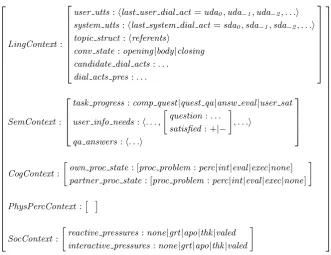
topic struct:hreferentsi
conv state:opening|body|closing candidate dial acts:. . .
task progress:comp quest|quest qa|answ eval|user sat user info needs:h. . . ,
PhysPercContext:
SocContext :
reactive pressures:none|grt|apo|thk|valed interactive pressures:none|grt|apo|thk|valed
Figure 1: Feature structure representation of the PARADIMEcontext model.
are related to the actual generation of system di-alogue acts: candidate dial acts stores the dia-logue acts generated by the diadia-logue act agents, anddial acts pres stores combined dialogue acts for presentation as system output; in Section 4, this will be discussed in more detail.
The specification of the Semantic Context is determined by the character of the task-domain. In Section 4.1, the task-domain of interactive question-answering on encyclopedic medical in-formation will be discussed and from that, the specification of the Semantic Context for this pur-pose.
The Cognitive Context is specified by means of two features, representing the processing states of the system (own proc state) and the user ( part-ner proc state). Both features indicate whether or not a processing problem was encountered, and if so, on which level of processing this happened.
The Physical and Perceptual Context is consid-ered not to be relevant for the current system func-tionality.
The Social Context is specified in terms of re-active and interre-active pressures; the correspond-ing features indicate whether or not a pressure ex-ists and if so, for which social obligations manage-ment act it is a pressure (e.g.,reactive pressures: grtindicates a pressure for the system to respond to a greeting).
4 Dialogue Act Agents
Having discussed the dialogue act taxonomy and context model in DIT, we can now move on to the dialogue management approach that is also closely connected to these concepts. Having 11 dimen-sions of dialogue acts that each attend to a dif-ferent aspect of communication, the generation of (system) dialogue acts should also happen along those 11 dimensions. As a dialogue act in a di-mension can be selected independent of the other dimensions, we propose to divide the generation process over 11Dialogue Act Agentsoperating in parallel on the information state of the system, each agent dedicated to generating dialogue acts from one particular dimension.
prob-lem (e.g., “Could you repeat that please?” or “Did you say ’five’?”). The Auto-Feedback Agent may also be triggered if it has reason to believe that the user is not certain that the system has understood a previous utterance, or simply if it has not given any explicit positive feedback for some time. In these cases of triggering, the agent tries to gener-ate a positive auto-feedback act.
Hence the dialogue management process in-volves 11 dialogue act agents that operate in par-allel on the context model. The dialogue acts gen-erated by these agents are kept in the linguistic context as candidates. The selection of dialogue acts from different dimensions may happen inde-pendently, but for their order of performance and their combination, the relative importance of the dimensions at the given point in the dialogue has to be taken into account.
An additional Evaluation Agent monitors the list of candidates and decides which of them can be combined into a multifunctional system utter-ance for generation, and when. Some of the dia-logue act candidates may have higher priority and should be generated at once, some may be stored for possible generation in later system turns, and some will already be implicitly performed through the performance of other candidate acts.
4.1 A dialogue manager for interactive QA The current implementation of the PARADIME
dialogue manager is integrated in an interactive question-answering (QA) system, as developed the IMIX multiproject. The task-domain at hand concerns encyclopedic information in the medical domain, in particular RSI (Repetitive Strain In-jury). The system consists of several input anal-ysis modules (ASR, syntactic analanal-ysis in terms of dependency trees, and shallow semantic tag-ging), three different QA modules that take self-contained domain questions and return answers retrieved from several electronic documents with text data in the medical domain, and a presentation module that takes the output from the dialogue manager, possibly combining any QA-answers to be presented, into a multimodal system utterance. The dialogue management module provides support for more interactive, coherent dialogues, in which problems can be solved about both com-munication and question-answering processes. In interaction with the user, the system should play the role of an Information Search Assistant (ISA).
This HCI metaphor posits that the dialogue system is not an expert on the domain, but merely assists the user in formulating questions about the domain that will lead to QA answers from the QA mod-ules satisfying the user’s information need (Akker et al., 2005).
In the context model for this dialogue manager, as represented by the feature structure in Figure 1, the Semantic Context has been further specified according to this underlying task. It contains a state variable for keeping track of the question-answering process (the featuretask progresswith values to distinguish between the states of com-posing a self-contained question to send to the QA modules, waiting for the QA results in case a QA-question has been sent, evaluating the QA results, and discussing the results with the user). Also, the Semantic Context keeps a record of user’s infor-mation need, by means of a list user info needs of ’information need’ specifications in terms of semantic descriptions of domain questions and whether or not these info-needs have been satis-fied.
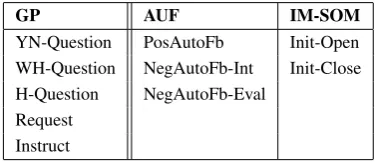
For the first version of the dialogue manager we have defined a limited system functionality, and following from that a simplified version of the dialogue act taxonomy. This simplification means for example that Social Obligations Man-agement (SOM) and the various dimensions in the Interaction Management (IM) layer have been merged into one dimension, following the obser-vation that utterances with a SOM function very often also have a function in the IM layer, es-pecially in human-computer dialogue; see (Bunt, 2000b). Also several general-purpose commu-nicative functions have been clustered into single types. Table 1 lists the dialogue acts that the dia-logue act recogniser is able to identify from user utterances.
GP AUF IM-SOM
YN-Question PosAutoFb Init-Open WH-Question NegAutoFb-Int Init-Close H-Question NegAutoFb-Eval
Request Instruct
Table 1: Dialogue act types for interpreting user utterances.
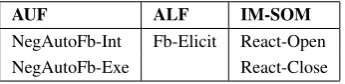
do-main, consist of a general-purpose function (either a WH-ANSWER or UNC-WH-ANSWER; the latter reflecting that the speaker is uncertain about the in-formation provided) with a semantic content con-taining the answers obtained from QA.
AUF ALF IM-SOM
NegAutoFb-Int Fb-Elicit React-Open NegAutoFb-Exe React-Close
Table 2: Dialogue act types for generating system responses.
The above considerations have resulted in a di-alogue manager containing 4 didi-alogue act agents that operate on a slightly simplified version of the context model as specified in Figure 1: a Task-Oriented (TO) Agent, an Auto-Feedback (AUF) Agent, an Allo-Feedback (AUF) Agent, and an Interaction Management and Social Obligations Management (IMSOM) Agent. In addition, a (cur-rently very simple) Evaluation Agent takes care of merging candidate dialogue acts for output presen-tation.
In Appendices A.1 and A.2, two example di-alogues with the IMIX demonstrator system are given, showing system responses based on can-didate dialogue acts from several dialogue act agents. The ISA metaphor is reflected in the sys-tem behaviour especially in the way in which QA results are presented to the user. In system utter-ances S2 and S3 in Appendix A.1, for example, the answer derived from the retrieved QA results is isolated from the first part of the system utterance, showing that the system has a neutral attitude con-cerning that answer.
4.1.1 The Task-Oriented Agent
The TO-Agent is dedicated to the generation of task-specific dialogue acts, which in practice in-volves ANSWER dialogue acts intended to satisfy
the user’s information need about the (medical) domain as indicated through his/her domain ques-tions. The agent is triggered if a new information need is recorded in the Semantic Context. Once it has been triggered, the agent sends a request to the QA modules to come up with answers to a ques-tion asked, and evaluates the returned results. This evaluation is based on the number of answers re-ceived and the confidence scores of the answers; the confidence scores are also part of the output of the QA modules. If the QA did not find any an-swers or if the anan-swers produced had confidence
scores that were all below somelower threshold, the TO-Agent will not generate a dialogue act, but write an execution problem in the Own Process-ing State of the Cognitive Context (which causes the Auto-Feedback Agent to be triggered, see Sec-tion 4.1.2; an example can be found in the dia-logue in Appendix A.2). Otherwise, the TO-Agent tries to make a selection from the QA answers to be presented to the user. If this selection will end up containing extremely many answers, again, an execution problem is written in the Cognitive Context (the question might have been too gen-eral to be answerable). Otherwise, the selection will be included in an answer dialogue act, either a WHANSWER, or UNCWHANSWER (uncertain wh-answer) in case the confidence scores are be-low someupper threshold. System utterances S1 and S2 in the example dialogue in Appendix A.1 illustrate this variation. The selection is narrowed down further if there is a subselection of answers with confidences that are significantly higher than those of the other answers in the selection.
4.1.2 The Auto-Feedback-Agent
The AUF-Agent is dedicated to the generation of auto-feedback dialogue acts. It currently pro-duces negative auto-feedback acts on the levels of interpretation (“I didn’t understand what you said”), evaluation (“I do not know what to do with this”) and execution (“I could not find any answers to your question”). It may also decide to occa-sionally give positive feedback to the user. In the future, we would also like this agent to be able to generate articulate feedback acts, for example with the purpose of resolving reference resolution problems, as in:
U: what is RSI?
S: RSI (repetitive strain injury) is a pain or discomfort caused by small repetitive move-ments or tensions.
U: how can it be prevented?
S: do you mean ’RSI’ or ’pain’?
4.1.3 The Allo-Feedback Agent
4.1.4 Interaction Management and Social Obligations Management Agent
The IM-SOM Agent is dedicated to the gener-ation of social obliggener-ations management acts, pos-sibly also functioning as dialogue structuring acts (opening resp. closing a dialogue through a greet-ing resp. valediction act). It gets triggered if communicative pressures are recorded in the So-cial Context. Currently it only responds to re-active pressures as caused by initiative greetings and goodbyes. The example dialogues in Appen-dices A.1 and A.2 illustrate this type of social be-haviour.
4.1.5 Multi-agent Architecture of the Dialogue Manager
In Figure 2, a schematic overview of the multi-agent dialogue manager is given. It shows the context model with four components (for now, the Physical and Perceptual Context is considered to be of minor importance and is therefore ignored), a set of dialogue act agents, and an Evaluation Agent. The dialogue act agents each monitor the context model and may be triggered if certain con-ditions are satisfied. The TO-agent may also write to the Cognitive Context (particularly in case of execution problems). All agents may construct a dialogue act and write it in the candidates list in the Linguistic Context. The Evaluation Agent monitors this candidates list and selects one or more dialogue acts from it for presentation as sys-tem output. In this way, a control module may decide to take this combination of dialogue act for presentation anytimeand send it to the presenta-tion module to produce a system utterance.
With this initial design of a multi-agent dia-logue manager, the system is able to support mul-tifunctional output. The beginning of the example dialogue in Appendix A.1 illustrates multifunc-tionality, both in input interpretation and output generation. The system has recognised two dia-logue acts in processing U1 (a conventional open-ing and a domain question), and S1 is generated on the basis of two candidate dialogue acts gen-erated by different dialogue act agents: the IM-SOM-Agent (generated the react-greeting act) and the TO-Agent (generated the answer act).
5 Conclusions and future work
We have presented a dialogue management ap-proach supporting the generation of
multifunc-candidate dialogue acts
IM−SOM−Agent TO−Agent AUF−Agent
ALF−Agent
Semantic Context Cognitive Context
Social Context
Linguistic Context
candidate dialogue acts
Eval−Agent
dialogue acts for presentation
DIALOGUE ACT AGENTS
CONTEXT MODEL
Figure 2: Architecture of the PARADIMEdialogue manager.
tional utterances. The approach builds on a di-alogue theory involving a multidimensional dia-logue act taxonomy and an information state on which the dialogue acts operate. Several dialogue acts from different dimensions are generated by dialogue act agents associated with these dimen-sions, and can thus be combined into multifunc-tional system utterances.
A first implementation of a dialogue manager following this multi-agent approach has been in-tegrated into an interactive QA system and sup-ports a limited range of dialogue acts from the DIT taxonomy, both for interpreting user utter-ances and generating system utterutter-ances. The sys-tem is able to attend to different aspects of the communication simultaneously, involving reactive social behaviour, answering domain questions and giving feedback about utterance interpretation and the question-answering process.
Future development will involve extending the range of dialogue acts to be covered by the dia-logue manager, for a part following from the def-inition of an extended system functionality, and consequently, extending the set of dialogue act agents. This also has consequences for the Eval-uation Agent: the process of combination and se-lection will be more complex if more dialogue act types can be expected and if the dialogue acts have a semantic content that is more than just a collec-tion of QA-answers.
sup-port for generatingarticulate feedback, i.e., feed-back acts that are not merely signalling processing success or failure, but (in case of negative feed-back) also contain a further specification of the processing problem at hand. For example, the sys-tem may have encountered problems in processing certain parts of a user utterance, or in resolving an anaphor; then it should be able to ask the user a specific question in order to obtain the informa-tion required to solve the processing problem (see the example in Section 4.1.2). The articulate feed-back acts may also involve dealing with problems in the question answering process, where the sys-tem should be able to give specific instructions to the user to reformulate his question or give addi-tional information about his information need.
In addition to supporting generation of articu-late feedback acts, we also aim at dialogues be-tween user and system that are more coherent and natural, i.e., the system should be more aware of the conversational structure, and display more re-fined social behaviour. Not only should it gener-ate simple reactions to greetings, apologies, and goodbyes; it should also be able to generate initia-tive social acts, for example, apologies after sev-eral cases of negative auto-feedback.
The extended set of dialogue acts will also lead to an extended context model. Related to the context model and updating mechanism is on-going work on belief dynamics and grounding in DIT (Morante and Bunt, 2005). The defined mechanisms for the creation, strengthening, adop-tion, and cancelling of beliefs and goals in the context model are currently being implemented in a demonstrator tool and will also be integrated in the information state update mechanism of the PARADIMEdialogue manager.
Acknowledgement
This work is part of PARADIME (Parallel Agent-based Dialogue Management Engine), which is a subproject of IMIX (Interactive Multimodal Infor-mation eXtraction), a multiproject on Dutch lan-guage and speech technology, funded by the Dutch national science foundation (NWO).
We would like to thank the reviewers for their valuable comments, which really helped us to im-prove our paper.
References
R. op den Akker, H. Bunt, S. Keizer, and B. van Schooten. 2005. From question answering to spo-ken dialogue: Towards an information search assis-tant for interactive multimodal information extrac-tion. In Proceedings of the 9th European Confer-ence on Speech Communication and Technology, In-terspeech 2005, pages 2793–2796.
H. Bunt and S. Keizer. 2005. Dialogue semantics links annotation to context representation. InJoint TALK/AMI Workshop on Standards for Multimodal Dialogue Context. http://homepages.inf.
ed.ac.uk/olemon/standcon-SOI.html.
H. Bunt. 1996. Dynamic interpretation and dia-logue theory. In M.M. Taylor, F. N´eel, and D.G. Bouwhuis, editors,The Structure of Multimodal Di-alogue, Volume 2, pages 139–166. John Benjamins.
H. Bunt. 2000a. Dialogue pragmatics and context specification. In H. Bunt and W. Black, editors,
Abduction, Belief and Context in Dialogue, Studies in Computational Pragmatics, pages 81–150. John Benjamins.
H. Bunt. 2000b. Non-problems and social obliga-tions in human-computer conversation. In Proceed-ings of the 3rd International Workshop on Human-Computer Conversation, pages 36–41.
H. Bunt. 2006. Dimensions in dialogue act anno-tation. In Proceedings Fifth International Confer-ence on Language Resources and Evaluation (LREC 2006).
J. Geertzen and H. Bunt. 2006. Measuring annotator agreement in a complex hierarchical dialogue act an-notation scheme. In7th SIGdial Workshop on Dis-course and Dialogue.
S. Larsson and D. Traum. 2000. Information state and dialogue management in the TRINDI dialogue move engine toolkit. Natural Language Engineer-ing: Special Issue on Best Practice in Spoken Lan-guage Dialogue Systems, 6(3–4):323–340.
C. Matheson, M. Poesio, and D. Traum. 2000. Mod-eling grounding and discourse obligations using up-date rules. InProceedings of the First Annual Meet-ing of the North American Chapter of the ACL.
R. Morante and H. Bunt. 2005. Micro-analysis of the belief transfer in information dialogues. In C. Gar-dent and B. Gaiffe, editors, DIALOR’05 Proceed-ings of the Ninth Workshop on the Semantics and Pragmatics of Dialogue, pages 135–138.
E.P. Salonen, M. Hartikainen, M. Turunen, J. Hakuli-nen, and J.A. Funk. 2004. Flexible dialogue man-agement using distributed and dynamic dialogue control. InProceedings of ICSLP 2004.
Speech and Language, Special Issue on Spoken Lan-guage Generation, 16(3–4):313–352.
D.R. Traum and E.R. Hinkelman. 1992. Conversa-tion acts in task-oriented spoken dialogue. Compu-tational Intelligence, 3(8):575–599.
M. Turunen and J. Hakulinen. 2000. Jaspis – a frame-work for multilingual adaptive speech applications. In Sixth International Conference on Spoken Lan-guage Processing (ICSLP 2000), volume 2, pages 719–722.
A Example dialogues
A.1 Example 1: greetings, answers and unc-answers
U1: hallo, ik wilde graag weten wat rsi is
(hello, I wanted to know what is rsi)
[INIT-OPEN; INDWHQ,task-domain]
S1: Hallo. Ik heb de volgende informatie gevonden:
(repetitive strain injury) Algemene benaming voor (blijvende) beschadigingen aan het lichaam ten gevolge van langdurige, eentonige werkzaamheden.
(Hello. I found the following information: ...)
[REACT-OPEN; ANSWER,task-domain]
U2: wat moet ik doen als ik denk rsi te hebben
(what should I do if I think I have RSI)
[WHQUESTION,task-domain]
S2: De volgende informatie levert mogelijk een antwoord op uw vraag:
Ontspanning betekent minder stress, minder aange-spannen spieren en dus minder kans op RSI.
(The following information might answer your ques-tion: ...)
[UNCANSWER,task-domain]
U3: helpt ontspanning ook als ik eenmaal rsi heb
(does relaxing help as well, once I have RSI)
[YNQUESTION,task-domain]
S3: Ik heb de volgende informatie gevonden:
Behandelmethoden bij RSI Er zijn vele wegen die naar Rome leiden. Verbetering van de doorbloeding ...
(I found the following information: ...)
[ANSWER,task-domain]
U4: oke, bedankt
(okay, thanks)
[INIT-CLOSE]
S4: tot ziens. U kunt de buttons gebruiken om te stoppen of om een nieuwe dialoog te beginnen.
(Goodbye. You may use the buttons to stop or to start a new dialogue.)
[REACT-CLOSE]
A.2 Example 2: negative execution-feedback
U1: hallo!
(hello!)
[INIT-OPEN]
S1: Hallo. Stel uw vraag.
(Hello. Ask your question.)
[REACT-OPEN]
U2: wat kan ik als beelschermwerker tegen rugpijn doen
(what can I, a person working behind a computer screen all the time, do against pain in the back)
[WHQUESTION,task-domain]
S2: Ik heb helaas geen antwoorden kunnen vinden; probeer de vraag te herformuleren.
(Unfortunately, I could not find any answers; please try to reformulate the question)
[NEGAUTOFB-EXEC]
U3: wat kan men tegen rugpijn doen
(what can be done against pain in the back)
[WHQUESTION,task-domain]
S3: ik heb de volgende informatie gevonden:
Deze is afhankelijk van de oorzaak. Rugpijn die door instabiliteit of door tekortschietende spieren en ban-den ontstaat, kan behandeld worban-den met houdingscor-rigerende oefentherapie.
(I found the following information: ...)
[ANSWER,task-domain]
U4: bedankt!
(thanks!)
[INIT-CLOSE]
S4: Tot ziens. U kunt de buttons gebruiken om te stoppen of om een nieuwe dialoog te beginnen.
(Goodbye. U may use the buttons to stop or to start a new dialogue.)