Syntax-Based Alignment: Supervised or Unsupervised?
Hao Zhang and Daniel Gildea Computer Science Department
University of Rochester Rochester, NY 14627
Abstract
Tree-based approaches to alignment model translation as a sequence of probabilistic op-erations transforming the syntactic parse tree of a sentence in one language into that of the other. The trees may be learned directly from parallel corpora (Wu, 1997), or provided by a parser trained on hand-annotated treebanks (Ya-mada and Knight, 2001). In this paper, we compare these approaches on Chinese-English and French-English datasets, and find that au-tomatically derived trees result in better agree-ment with human-annotated word-level align-ments for unseen test data.
1 Introduction
Statistical approaches to machine translation, pio-neered by Brown et al. (1990), estimate parame-ters for a probabilistic model of word-to-word cor-respondences and word re-orderings directly from large corpora of parallel bilingual text. In re-cent years, a number of syntactically motivated ap-proaches to statistical machine translation have been proposed. These approaches assign a parallel tree structure to the two sides of each sentence pair, and model the translation process with reordering oper-ations defined on the tree structure. The tree-based approach allows us to represent the fact that syn-tactic constituents tend to move as unit, as well as systematic differences in word order in the gram-mars of the two languages. Furthermore, the tree structure allows us to make probabilistic indepen-dence assumptions that result in polynomial time algorithms for estimating a translation model from parallel training data, and for finding the highest probability translation given a new sentence.
Wu (1997) modeled the reordering process with binary branching trees, where each production could be either in the same or in reverse order going from source to target language. The trees of Wu’s Inversion Transduction Grammar were derived by synchronously parsing a parallel corpus, using a grammar with lexical translation probabilities at the leaves and a simple grammar with a single
nonter-minal providing the tree structure. While this gram-mar did not represent traditional syntactic categories such as verb phrases and noun phrases, it served to restrict the word-level alignments considered by the system to those allowable by reordering opera-tions on binary trees. This restriction corresponds to intuitions about the alignments that could be pro-duced by systematic differences between the two language’s grammars, and allows for a polynomial time algorithm for finding the highest-probability alignment, and for re-estimation of the lexical trans-lation and grammar probabilities using the Expecta-tion MaximizaExpecta-tion algorithm.
Yamada and Knight (2001) present an algorithm for estimating probabilistic parameters for a simi-lar model which represents translation as a sequence of re-ordering operations over children of nodes in a syntactic tree, using automatic parser output for the initial tree structures. This gives the translation model more information about the structure of the source language, and further constrains the reorder-ings to match not just a possible bracketing as in Wu (1997), but the specific bracketing of the parse tree provided.
In this paper, we make a direct comparison of a syntactically unsupervised alignment model, based on Wu (1997), with a syntactically
super-vised model, based on Yamada and Knight (2001).
further discussion in Section 5.
2 The Inversion Transduction Grammar The Inversion Transduction Grammar of Wu (1997) can be thought as a a generative process which si-multaneously produces strings in both languages through a series of synchronous context-free gram-mar productions. The gramgram-mar is restricted to bi-nary rules, which can have the symbols in the right hand side appear in the same order in both lan-guages, represented with square brackets:
X →[Y Z]
or the symbols may appear in reverse order in the two languages, indicated by angle brackets:
X→ hY Zi
Individual lexical translations between English wordseand French wordsftake place at the leaves of the tree, generated by grammar rules with a single right hand side symbol in each language:
X→e/f
Given a bilingual sentence pair, a synchronous parse can be built using a two-dimensional exten-sion of chart parsing, where chart items are indexed by their nonterminal Y and beginning and ending positionsl, min the source language string, and be-ginning and ending positionsi, j in the target lan-guage string. For Expectation Maximization train-ing, we compute inside probabilitiesβ(Y, l, m, i, j)
from the bottom up as outlined below:
for alll, m, nsuch that1≤l < m < n < Nsdo for alli, j, ksuch that1< i < j < k < Ntdo
for all rulesX→Y Z ∈Gdo
β(X, l, n, i, k)+=
P([Y Z]|X)β(Y, l, m, i, j)β(Z, m, n, j, k)
β(X, l, n, i, k)+=
P(hY Zi|X)β(Y, m, n, i, j)β(Z, l, m, j, k)
end for end for end for
A similar recursion is used to compute outside probabilities for each chart item, and the inside and outside probabilities are combined to derive ex-pected counts for occurrence of each grammar rule, including the rules corresponding to individual lex-ical translations. In our experiments we use a gram-mar with a start symbolS, a single preterminalC, and two nonterminalsAandB used to ensure that only one parse can generate any given word-level alignment (ignoring insertions and deletions) (Wu, 1997; Zens and Ney, 2003). The individual lexical
translations produced by the grammar may include a NULL word on either side, in order to represent insertions and deletions.
3 The Tree-To-String Model
The model of Yamada and Knight (2001) can be thought of as a generative process taking a tree in one language as input and producing a string in the other through a sequence of probabilistic oper-ations. If we follow the process of an English tence’s transformation into French, the English sen-tence is first given a syntactic tree representation by a statistical parser (Collins, 1999). As the first step in the translation process, the children of each node in the tree can be re-ordered. For any node with m children, m! re-orderings are possible, each of which is assigned a probabilityPorder conditioned
on the syntactic categories of the parent node and its children. As the second step, French words can be inserted at each node of the parse tree. Insertions are modeled in two steps, the first predicting whether an insertion to the left, an insertion to the right, or no insertion takes place with probability Pins,
condi-tioned on the syntactic category of the node and that of its parent. The second step is the choice of the in-serted wordPt(f|NULL), which is predicted
with-out any conditioning information. The final step, a French translation of each original English word, at the leaves of the tree, is chosen according to a distributionPt(f|e). The French word is predicted
conditioned only on the English word, and each En-glish word can generate at most one French word, or can generate a NULL symbol, representing dele-tion. Given the original tree, the re-ordering, inser-tion, and translation probabilities at each node are independent of the choices at any other node. These independence relations are analogous to those of a stochastic context-free grammar, and allow for effi-cient parameter estimation by an inside-outside Ex-pectation Maximization algorithm. The computa-tion of inside probabilities β, outlined below, con-siders possible reorderings of nodes in the original tree in a bottom-up manner:
for all nodesεiin input treeTdo for allk, lsuch that1< k < l < Ndo
for all orderingsρof the childrenε1...εm ofεi
do
for all partitions of span k, l into k1, l1...km, lmdo
β(εi, k, l)+= Porder(ρ|εi)Qmj
=1β(εj, kj, lj)
As with Inversion Transduction Grammar, many alignments between source and target sentences are not allowed. As a minimal example, take the tree:
A
B
X Y
Z
Of the six possible re-orderings of the three ter-minals, the two which would involve crossing the bracketing of the original tree (XZY and YZX) are not allowed. While this constraint gives us a way of using syntactic information in translation, it may in many cases be too rigid. In part to deal with this problem, Yamada and Knight (2001) flat-ten the trees in a pre-processing step by collapsing nodes with the same lexical head-word. This allows, for example, an English subject-verb-object (SVO) structure, which is analyzed as having a VP node spanning the verb and object, to be re-ordered as VSO in a language such as Arabic. Larger syntactic divergences between the two trees may require fur-ther relaxation of this constraint, and in practice we expect such divergences to be frequent. For exam-ple, a nominal modifier in one language may show up as an adverbial in the other, or, due to choices such as which information is represented by a main verb, the syntactic correspondence between the two sentences may break down completely. While hav-ing flatter trees can make more reorderhav-ings possible than with the binary Inversion Transduction Gram-mar trees, fixing the tree in one language generally has a much stronger opposite effect, dramatically re-stricting the number of permissible alignments.
3.1 Tree-to-String With Cloning
In order to provide more flexibility in alignments, a cloning operation was introduced for tree-to-string alignment by Gildea (2003). The model is modified to allow for a copy of a (translated) subtree from the English sentences to occur, with some cost, at any point in the resulting French sentence. For example, in the case of the input tree
A
B
X Y
Z
a clone operation making a copy of node 3 as a new child of B would produce the tree:
A
B
X Z Y
Z
This operation, combined with the deletion of the original node Z, produces the alignment (XZY) that was disallowed by the original tree reordering model.
The probability of adding a clone of original node εi as a child of nodeεj is calculated in two steps:
first, the choice of whether to insert a clone under εj, with probabilityPins(clone|εj), and the choice
of which original node to copy, with probability
Pclone(εi|clone= 1) =
Pmakeclone(εi)
P
kPmakeclone(εk)
where Pmakeclone is the probability of an original
node producing a copy. In our implementation, Pins(clone) is estimated by the Expectation
Max-imization algorithm conditioned on the label of the parent nodeεj, andPmakecloneis a constant,
mean-ing that the node to be copied is chosen from all the nodes in the original tree with uniform probability.
4 Experiments
We trained our translation models on a parallel corpus of Chinese-English newswire text. We re-stricted ourselves to sentences of no more than 25 words in either language, resulting in a training cor-pus of 18,773 sentence pairs with a total of 276,113 Chinese words and 315,415 English words. The Chinese data were automatically segmented into to-kens, and English capitalization was retained. We replace words occurring only once with an unknown word token, resulting in a Chinese vocabulary of 23,783 words and an English vocabulary of 27,075 words. Our hand-aligned data consisted of 48 sen-tence pairs also with less than 25 words in either language, for a total of 788 English words and 580 Chinese words. A separate development set of 49 sentence pairs was used to control overfitting. These sets were the data used by Hwa et al. (2002). The hand aligned test data consisted of 745 individual aligned word pairs. Words could be aligned one-to-many in either direction. This limits the perfor-mance achievable by our models; the IBM models allow one-to-many alignments in one direction only, while the tree-based models allow only one-to-one alignment unless the cloning operation is used.
Ulrich German. We used as training data 20,000 sentence pairs of no more than 25 words in ei-ther language. Our test data consisted of 447 sen-tence pairs of no more than 30 words, hand aligned by Och and Ney (2000). A separate development set of 37 sentences was used to control overfitting. We used of vocabulary of words occurring at least 10 times in the entire Hansard corpus, resulting in 19,304 English words and 22,906 French words. Our test set is that used in the alignment evalua-tion organized by Mihalcea and Pederson (2003), though we retained sentence-initial capitalization, used a closed vocabulary, and restricted ourselves to a smaller training corpus. We parsed the English side of the data with the Collins parser. As an ar-tifact of the parser’s probability model, it outputs sentence-final punctuation attached at the lowest level of the tree. We raised sentence-final punctu-ation to be a daughter of the tree’s root before train-ing our parse-based model. As our Chinese-English test data did not include sentence-final punctuation, we also removed it from our French-English test set. We evaluate our translation models in terms of agreement with human-annotated word-level align-ments between the sentence pairs. For scoring the viterbi alignments of each system against gold-standard annotated alignments, we use the align-ment error rate (AER) of Och and Ney (2000), which measures agreement at the level of pairs of words:
AER= 1−|A∩GP|+|A∩GS| |A|+|GS|
where A is the set of word pairs aligned by the automatic system, GS is the set marked in the
gold standard as “sure”, andGP is the set marked
as “possible” (including the “sure” pairs). In our Chinese-English data, only one type of alignment was marked, meaning thatGP = GS. For a better
understanding of how the models differ, we break this figure down into precision:
P = |A∩GP| |A|
and recall:
R= |A∩GS| |GS|
Since none of the systems presented in this com-parison make use of hand-aligned data, they may differ in the overall proportion of words that are aligned, rather than inserted or deleted. This affects the precision/recall tradeoff; better results with re-spect to human alignments may be possible by
ad-justing an overall insertion probability in order to optimize AER.
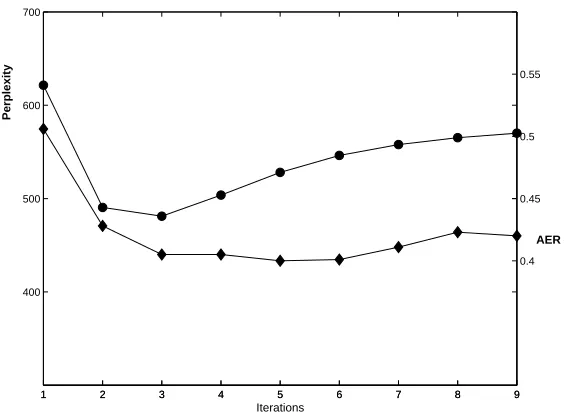
Table 1 provides a comparison of results using the tree-based models with the word-level IBM models. IBM Models 1 and 4 refer to Brown et al. (1993). We used the GIZA++ package, including the HMM model of Och and Ney (2000). We ran Model 1 for three iterations, then the HMM model for three iter-ations, and finally Model 4 for two iteriter-ations, train-ing each model until AER began to increase on our held-out cross validation data. “Inversion Transduc-tion Grammar” (ITG) is the model of Wu (1997), “Tree-to-String” is the model of Yamada and Knight (2001), and “Tree-to-String, Clone” allows the node cloning operation described above. Our tree-based models were initialized from uniform distributions for both the lexical translation probabilities and the tree reordering operations, and were trained until AER began to rise on our held-out cross-validation data, which turned out to be four iterations for the tree-to-string models and three for the Inversion Transduction Grammar. French-English results are shown in Table 2. Here, IBM Model 1 was trained for 12 iterations, then the HMM model for 5 iter-ations and Model 4 for 5 iteriter-ations. The ITG and tree-to-string models were both trained for 5 itera-tions. A learning curve for the Inversion Transduc-tion Grammar, is shown in Figure 1, showing both perplexity on held-out data and alignment error rate. In general we found that while all models would in-crease in AER if trained for too many iterations, the increases were of only a few percent.
5 Discussion
The Inversion Transduction Grammar significantly outperforms the syntactically supervised tree-to-string model of Yamada and Knight (2001). The tree-to-string and IBM models are roughly equiva-lent. Adding the cloning operation improves tree-to-string results by 2% precision and recall. It is particularly significant that the ITG gets higher re-call than the other models, when it is the only model entirely limited to one-to-one alignments, bounding the maximum recall it can achieve.
Our French-English experiments show only small differences between the various systems. Overall, performance on French-English is much better than for Chinese-English. French-English has less re-ordering overall, as shown by the percentage of pro-ductions in the viterbi ITG parses that are inverted: 14% for French-English in comparison to 23% for Chinese-English.
“syntacti-Alignment Precision Recall Error Rate
IBM Model 1 .56 .42 .52
IBM Model 4 .67 .43 .47
[image:5.612.154.461.70.159.2]Inversion Transduction Grammar .68 .52 .40 Tree-to-String w/ Clone .65 .43 .48 Tree-to-String w/o Clone .63 .41 .50
Table 1: Alignment results on Chinese-English corpus. Higher precision and recall correspond to lower alignment error rate.
Alignment Precision Recall Error Rate
IBM Model 1 .63 .71 .34
IBM Model 4 .83 .83 .17
Inversion Transduction Grammar .82 .87 .16 Tree-to-String w/ Clone .84 .85 .15
Table 2: French-English results.
cally supervised”, in fact this supervision comes in the form of the annotation of the Wall Street Journal treebank on which the parser is trained, rather than parses for our parallel training corpus. In particular, the text we are parsing has a different vocabulary and style of prose from the WSJ treebank, and often the fluency of the English translations leaves some-thing to be desired. While both corpora consist of newswire text, a typical WSJ sentence
Pierre Vinken, 61 years old, will join the board as a nonexecutive director Nov. 29.
contrasts dramatically with
In the past when education on opposing Communists and on resisting Russia was stressed, retaking the mainland and uni-fying China became a slogan for the au-thoritarian system, which made the uni-fication under the martial law a tool for oppressing the Taiwan people.
a typical sentence from our corpus.
While we did not have human-annotated gold-standard parses for our training data, we did have human annotated parses for the Chinese side of our test data, which was taken from the Penn Chinese Treebank (Xue et al., 2002). We trained a second tree-to-string model in the opposite direction, us-ing Chinese trees and English strus-ings. The Chi-nese training data was parsed with the Bikel (2002) parser, and used the Chinese Treebank parses for our test data. Results are shown in Table 3. Because the ITG is a symmetric, generative model, the ITG results in Table 3 are identical to those in Table 1. While the experiment does not show a significant
improvement, it is possible that better parses for the training data might be equally important.
Even when the automatic parser output is correct, the tree structure of the two languages may not cor-respond. Dorr (1994) categorizes sources of syntac-tic divergence between languages, and Fox (2002) analyzed a parallel French-English corpus, quanti-fying how often parse dependencies cross when pro-jecting an English tree onto a French string. Even in this closely related language pair with gener-ally similar word order, crossed dependencies were caused by such common occurrences as adverb modification of a verb, or the correspondence of “not” to “ne pas”. Galley et al. (2004) extract trans-lation rules from a large parsed parallel corpus that extend in scope to tree fragments beyond a single node; we believe that adding such larger-scale op-erations to the translation model is likely to signifi-cantly improve the performance of syntactically su-pervised alignment.
The syntactically supervised model has been found to outperform the IBM word-level alignment models of Brown et al. (1993) for translation by Yamada and Knight (2002). An evaluation for the alignment task, measuring agreement with human judges, also found the syntax-based model to out-perform the IBM models. However, a relatively small corpus was used to train both models (2121 Japanese-English sentence pairs), and the evalua-tions were performed on the same data for training, meaning that one or both models might be signifi-cantly overfitting.
[image:5.612.157.461.208.277.2]1 2 3 4 5 6 7 8 9 400
500 600 700
Perplexity
1 2 3 4 5 6 7 8 9
0.4 0.45 0.5 0.55
Iterations
[image:6.612.165.447.71.281.2]AER
Figure 1: Training curve for ITG model, showing perplexity on cross-validation data, and alignment error rate on a separate hand-aligned dataset.
Alignment Precision Recall Error Rate
Inversion Transduction Grammar .68 .52 .40 Tree-to-String, automatic parses .61 .48 .46 Tree-to-String, gold parses .61 .52 .44
Table 3: Chinese Tree to English String
(1997) as well as Brown et al. (1993). Decoding, meaning exact computation of the highest probabil-ity translation given a foreign sentence, is not pos-sible in polynomial time for the IBM models, and in practice decoders search through the space of hy-pothesis translations using a set of additional, hard alignment constraints. Zens and Ney (2003) com-pute the viterbi alignments for German-English and French-English sentences pairs using IBM Model 5, and then measure how many of the resulting alignments fall within the hard constraints of both Wu (1997) and Berger et al. (1996). They find higher coverage for an extended version of ITG than for the IBM decoding constraint for both language pairs, with the unmodified ITG implementation cov-ering about the same amount of German-English data as IBM, and significantly less French-English data. These results show promise for ITG as a ba-sis for efficient decoding, but do not address which model best aligns the original training data, as IBM-derived alignments were taken as the gold standard, rather than human alignments. We believe that our results show that syntactically-motivated models are a promising general approach to training translation models as well to searching through the resulting
probability space.
Computational complexity is an issue for the tree-based models presented here. While training the IBM models with the GIZA++ software takes min-utes, the tree-based EM takes hours. With our C im-plementation, one iteration of the syntactically su-pervised model takes 50 CPU hours, which can be parallelized across machines. Our tree-based mod-els are estimated with complete EM, while the train-ing procedure for the IBM models samples from a number of likely alignments when accumulating ex-pected counts. Because not every alignment is legal with the tree-based models, the technique of sam-pling by choosing likely alignments according to a simpler model is not straightforward. Nonetheless, we feel that training times can be improved with the right pruning and sampling techniques, as will be necessary to train on the much larger amounts data now available, and on longer sentences.
6 Conclusion
[image:6.612.148.460.340.401.2]align-ment task, but a data-derived tree structure gives better results than projecting automatic English parser output onto the Chinese string. The French-English task is easier overall, and exhibits smaller differences between the systems.
Acknowledgments We are very grateful to Re-becca Hwa for assistance with the Chinese-English data, and to everyone who helped make the re-sources we used available to the research commu-nity. This work was partially supported by NSF ITR IIS-09325646.
References
Adam Berger, Peter Brown, Stephen Della Pietra, Vincent Della Pietra, J. R. Fillett, Andrew Kehler, and Robert Mercer. 1996. Language transla-tion apparatus and method of using context-based tanslation models. United States patent 5,510,981.
Daniel M. Bikel. 2002. Design of a multi-lingual, parallel-processing statistical parsing engine. In
Proceedings ARPA Workshop on Human Lan-guage Technology.
Peter F. Brown, John Cocke, Stephen A. Della Pietra, Vincent J. Della Pietra, Frederick Je-linek, John D. Lafferty, Robert L. Mercer, and Paul S. Roossin. 1990. A statistical approach to machine translation. Computational Linguistics, 16(2):79–85, June.
Peter F. Brown, Stephen A. Della Pietra, Vincent J. Della Pietra, and Robert L. Mercer. 1993. The mathematics of statistical machine translation: Parameter estimation. Computational
Linguis-tics, 19(2):263–311.
Michael John Collins. 1999. Head-driven
Statisti-cal Models for Natural Language Parsing. Ph.D.
thesis, University of Pennsylvania, Philadelphia. Bonnie J. Dorr. 1994. Machine translation
diver-gences: A formal description and proposed solu-tion. Computational Linguistics, 20(4):597–633. Heidi J. Fox. 2002. Phrasal cohesion and statisti-cal machine translation. In In Proceedings of the
2002 Conference on Empirical Methods in Natu-ral Language Processing (EMNLP 2002), pages
304–311.
Michel Galley, Mark Hopkins, Kevin Knight, and Daniel Marcu. 2004. What’s in a translation rule? In Proceedings of the Human Language
Technology Conference/North American Chapter of the Association for Computational Linguistics (HLT/NAACL).
Daniel Gildea. 2003. Loosely tree-based alignment for machine translation. In Proceedings of the
41th Annual Conference of the Association for
Computational Linguistics (ACL-03), pages 80–
87, Sapporo, Japan.
Rebecca Hwa, Philip Resnik, Amy Weinberg, and Okan Kolak. 2002. Evaluating translational cor-respondence using annotation projection. In
Pro-ceedings of the 40th Annual Conference of the Association for Computational Linguistics (ACL-02).
Rada Mihalcea and Ted Pederson. 2003. An eval-uation exercise for word alignment. In
HLT-NAACL 2003 Workshop on Building and Using Parallel Texts: Data Driven Machine Translation and Beyond, pages 1–10, Edmonton, Alberta.
Franz Josef Och and Hermann Ney. 2000. Im-proved statistical alignment models. In
Proceed-ings of the 38th Annual Conference of the Asso-ciation for Computational Linguistics (ACL-00),
pages 440–447, Hong Kong, October.
Dekai Wu. 1997. Stochastic inversion transduction grammars and bilingual parsing of parallel cor-pora. Computational Linguistics, 23(3):377–403. Nianwen Xue, Fu-Dong Chiou, and Martha Palmer. 2002. Building a large-scale annotated chinese corpus. In Proceedings of the 19th. International
Conference on Computational Linguistics (COL-ING 2002), Taipei, Taiwan.
Kenji Yamada and Kevin Knight. 2001. A syntax-based statistical translation model. In
Proceed-ings of the 39th Annual Conference of the Asso-ciation for Computational Linguistics (ACL-01),
Toulouse, France.
Kenji Yamada and Kevin Knight. 2002. A de-coder for syntax-based statistical MT. In
Pro-ceedings of the 40th Annual Conference of the Association for Computational Linguistics (ACL-02), Philadelphia, PA.
Richard Zens and Hermann Ney. 2003. A compar-ative study on reordering constraints in statistical machine translation. In Proceedings of the 40th