Climbing the path to grammar: a maximum entropy model of
subject/object learning
Felice Dell’Orletta Alessandro Lenci Simonetta Montemagni Vito Pirrelli
Dept. of Computer Science Dept. of Linguistics ILC-CNR ILC-CNR
University of Pisa University of Pis a Area della Ricerca Area della Ricerca Largo Pontecorvo 3
56100 Pisa (Italy)
Via Santa Maria 36 56100 Pisa (Italy)
Via Moruzzi 1 56100 Pisa (Italy)
Via Moruzzi 1 56100 Pisa (Italy)
{felice.dellorletta, alessandro.lenci, simonetta.montemagni, vito.pirrelli}@ilc.cnr.it
Abstract
In this paper, we discuss an applic ation of Maximum Entropy to modeling the acqui-sition of subject and object processing in Italian. The model is able to learn from corpus data a set of experimentally and theoretically well-motivated linguistic constraints, as well as their relative sali-ence in Italian grammar development and processing. The model is also shown to acquire robust syntactic generalizations by relying on the evidence provided by a small number of high token frequency verbs only. These results are consistent with current research focusing on the role of high frequency verbs in allowing chil-dren to converge on the most salient con-straints in the grammar.
1 Introduction
Current research in language learning supports the view that developing grammatical competence in-volve mastering and integrating multiple, parallel, probabilistic constraints defined over different types of linguistic (and non linguistic) information (Seidenberg and MacDonald 1999, MacWhinney 2004). This is particularly clear when we focus on the core of grammatical deve lopment, namely the ability to properly identify syntactic relations. Psy-cholinguistic evidence shows that children learn to
identify sentence subjects and direct objects by combining various types of probabilistic cues, such as word order, noun animacy, definiteness, agree-ment, etc. The relative prominence of each of these cues during the development of a child’s syntactic competence can considerably vary cross-linguistically, mirroring their relative salience in the adult grammar system (cf. Bates et al. 1984).
If grammatical constraints are inherently prob-abilistic (Manning 2003), the path through which the child acquires adult grammar competence can be viewed as the process of building a stochastic model out of the linguistic input. Consistently with “usage-based” approaches to language acquisition (cf. Tomasello, 2000) grammatical constraints would thus emerge from language use thanks to the child’s ability to keep track of statistical regulari-ties in linguistic cues. In turn, this raises the issue of how children are able to exploit the statistical distribution of cues in the linguistic input. Various types of cross-linguistic evidence converge on the hypothesis that children are actually able to take great advantage of the highly skewed distribution of naturalistic language data. Goldberg et al.
(2004), Matthews et al. (2003), Ninio (1999) among the others argue that verbs with high token frequency in the input have a facilitatory effect in allowing children to derive robust syntactic gener-alizations even from surprisingly minimal input. According to this model, syntactic learning is driven by a small pool of verbs occurring with the highest token frequency: they approximately corre-spond to so-called “light verbs” such as English
“cata-lysts” in allow ing children to converge on the most salient grammar constraints of the language they are acquiring.
In computational linguistics, Maximum Entropy
models have proven to be robust statistical learning algorithms that perform well in a number of proc-essing tasks (cf. Ratnaparkhi 1998). In this paper, we discuss successful application of a Maximum Entropy (ME) model to the processing of Italian syntactic relations. We believe that this discussion is of general interest for two basic reasons. First, the model is able to learn, from corpus data, a set of experimentally and theoretically well-motivated linguistic constraints, as well as their relative sali-ence in the processing of Italian. This suggests that it is possible for a child to bootstrap and use this type of knowledge on the basis of a specific distri-bution of real language data, a conclusion that bears on the question of the role and type of innate inductive biases. Secondly, the model is also shown to acquire robust syntactic generalizations by relying on the evidence provided by a small number of high token frequency verbs only. With some qualifications, this evidence sheds light on the interaction between highly skewed language data distributions and language maturation. Robust grammar generalizations emerge on the basis of exposure to early, statist ically stable and lexically underspecified evidence, thus providing a reliable backbone to children’s syntactic development and later lexical organization.
In the following section we first broach the general problem of parsing subjects and objects in Italian. Section 3 describes an ME model of the problem. Section 4 and 5 are devoted to a detailed empirical analysis of the interaction of different feature configurations and of the interplay between verb token frequency and relevant generalizations. Conclusions are drawn in the final discussion.
2 Subjects and Objects in Italian
Children that learn how to process subjects and objects in Italian are confronted with a twofold challenge: i) the relatively free order of Italian sen-tence constituents and ii) the possible absence of an overt subject. The existence of a preferred Sub-ject Verb ObSub-ject (SVO) order in Italian main clauses does not rule out all other possible permu-tations of these units: in fact, they are all attested, albeit with considerable differences in distribution
and degree of markedness (Bartolini et al. 2004).1 Moreover, because of pro-drop, an Italian Verb Noun (VN) sequence can either be interpreted as a
VO construction with subject omission (e.g. ha dichiarato guerra ‘(he) declared war’) or as an instance of postverbal subject (VS, e.g. ha di-chiarato Giovanni ‘John declared’). Symmetri-cally, an NV sequence is potentially ambiguous between SV and OV: compare il bambino ha man-giato ‘the child ate’ with il gelato ha mangiato ‘the ice-cream, (he) ate’.
These grammatical facts are in keeping with what we know about Italian children’s parsing strategies. Bates et al. (1984) show that while, in English, word order is by and large the most effec-tive cue for subject-object identification (hence-forth SOI) both in syntactic processing and during the child’s syntactic development, the same cue plays second fiddle in Italian. Bates and colleagues bring empirical evidence supporting the hypothesis that Italian children show extreme reliance on NV
agreement and, secondly, on noun animacy, rather than word order. They conclude that the follo w ing syntactic constraints dominance hierarchy is opera-tive in Italian: agreement > animacy > word order. The fact that animacy can reliably be resorted to in Italian SOI receives indirect confirmation from corpus data. We looked at the distribution of animate subjects and objects in the Italian Syntac-tic SemanSyntac-tic Treebank (ISST, Montemagni et al., 2003), a 300,000 tokens syntactically annotated corpus, including articles from contemporary Ita l-ian newspapers and periodicals covering a broad variety of topics. Subjects and objects in ISST were automatically annotated for animacy using the SIMPLE Italian computational lexicon (Lenci
et al. 2000) as a background semantic resource. The annotation was then checked manually. Cor-pus analysis highlights a strong asymmetry in the distribution of animate nouns in subject and object roles: over 56.6% of ISST subjects are animate (out of a total number of 12,646), while only the 11.1% of objects are animate (out of a total number of 5,559). Such an overwhelming preference for inanimate ob jects in adult language data makes animacy play a very important role in SOI, both as a key developmental factor in the bootstrapping of the syntax-semantics mapping and as a reliable
1
processing cue, consistently with psycholinguistic data.
On the other ha nd, the distribution of word or-der configurations in the same corpus shows an-other interesting asymmetry. NV sequences receive an SV interpretation in 95.6% of the cases, and an object interpretation in the remaining 4.4% (most of which are clitic and relative pronouns, whose preverbal pos ition is grammatically constrained). The situation is quite different when we turn to VN
sequences, where verb-object pairs represent 73.4% of the cases, with verb-subject pairs repre-senting the remaining 26.6%. We infer that – at least in standard written Italian – VS is a much more consistently used construction than OV, and that the role of word order in Italian parsing is not a marginal one across the board, but rather relative
to VN contexts only. In NV constructions there is a strong preference for a subject interpretation, and this suggests a more dynamic dominance hierarchy of Italian syntactic constraints than the one pro-vided above.
As for agreement, it represents conclusive evi-dence for SOI only when a nominal constit uent and a verb do not agree in number and/or person (as in
leggono il libro ‘(they) read the book’). On the contrary, when noun and verb share the same per-son and number the impact of agreement on SOI is neutralised, as in il bambino legge il libro ‘the child reads the book’ or in ha dichiarato il presi-dente ‘the president declared’. Although this ambi-guity arises in specific contexts (i.e. when the verb is used in the third person singular or plural and the subject/object candidate agrees with it), it is inter-esting to note that in ISST: third person verb forms cover 95.6% of all finite verb forms; and, more interestingly for our present concerns, 87.9% of all
VN and NV pairs involving a third person verb form contains an agreeing noun. From this we con-clude that the contribution of agreement to our problem is fairly limited, as lack of agreement shows up only in a limited number of contexts.
All in all, corpus data lend support to the idea that in Italian SOI is governed by a complex inter-play of proba bilistic constraints of a different na-ture (morpho-syntactic, semantic, word order etc.). Moreover, distributional asymmetries in la nguage data seem to provide a fairly reliable statistical ba-sis upon which relevant probabilistic constraints can be bootstrapped and combined consistently. In the following section we shall present a ME model
of how constraints and their interaction can be bootstrapped from la nguage data.
3 A Maximum Entropy model of SOI
The Maximum Entropy (ME) framework offers a mathematically sound way to build a probabilistic model for SOI, which combines different linguistic cues. Given a linguistic context c and an outcome
a∈A that depends on c, in the ME framework the conditional probability distribution p(a|c) is esti-mated on the basis of the assumption that no a pri-ori constraints must be met other than those related to a set of features fj(a,c) of c, whose distribution is
derived from the training data. It can be proven that the probability distribution p satisfying the above assumption is the one with the highest en-tropy, is unique and has the following expone ntial form (Berger et al. 1996):
(1)
∏
=
= k
j
c a j f j
c Z c a p
1
) , (
) ( 1 ) |
( α
where Z(c) is a normalization factor, fj(a,c) are the
values of k features of the pair (a,c) and correspond to the linguistic cues of c that are relevant to pre-dict the outcome a. Features are extracted from the training data and define the constraints that the probabilistic model p must satisfy. The parameters of the distribution a1, …, ak correspond to weights
associated with the features, and determine the relevance of each feature in the overall model. In the experiments reported below feature weights have been estimated with the Generative Iterative Scaling (GIS) algorithm implemented in the AMIS software (Miyao and Tsujii 2002).
We model SOI as the task of predicting the cor-rect syntactic function f ∈ {subject, object} of a noun occurring in a given syntactic context s. This is equivalent to build the conditional probability distribution p(f|s) of having a syntactic function f
in a syntactic context s. Adopting the ME ap-proach, the distribution p can be rewritten in the parametric form of (1), with features correspond-ing to the lcorrespond-inguistic contextual cues relevant to
SOI. The context s is a pair <vs, ns>, where vs is
the verbal head and ns its nominal dependent in s.
local task of establishing the grammatical function of a noun n observed in a verb-noun pair. This simplifying assumption is consistent with the claim in MacWhinney et al. (1984) that SVO word order is actually derivative from SV and VO local pat-terns and downplays the role of the transitive com-plex construction in sentence processing. Evidence in favour of this hypothesis also comes from cor-pus data: in ISST, there are 4,072 comp lete sub-ject-verb-object-configurations, a small number if compared to the 11,584 verb tokens appearing with either a subject or an object only. Due to the com-parative sparseness of canonical SVO constructions in Italian, it seems more reasonable to assume that children should pay a great deal of attention to both SV and VO units as cues in sentence percep-tion (Matthews et al. 2004). Reconstruction of the whole lexical SVO pattern can accordingly be seen as the end point of an acquisition process whereby smaller units are re-analyzed as being part of more comprehensive constructions. This hypothesis is more in line with a distributed view of canonical constructions as derivative of more basic local po-sitional patterns, working together to yield more complex and abstract constructions. Last but not least, assuming verb-noun pairs as the relevant context for SOI allows us to simultaneously model the interaction of word order variation with pro-drop in Italian.
4 Feature selection
The most important part of any ME model is the selection of the context features whose weights are to be estimated from data distributions. Our feature selection strategy is grounded on the main assump-tion that features should correspond to linguisti-cally and psycholinguistilinguisti-cally well-motivated contextual cues. This allows us to evaluate the probabilistic model also with respect to its ability to replicate psycholinguistic experimental results and to be consistent with linguistic generalizations. Features are binary functions fki,f (f,s), which
test whether a certain cueki for the function f
oc-curs in the context s. For our ME model of SOI, we have selected the following types of features:
Word order tests the position of the noun wrt the verb, for instance:
(2)
=
=
otherwise
post pos noun if subj
fpostsubj
0
. 1
) , ( ,
σ σ
Animacy tests whether the noun in s is animate or
inanimate (cf. §.2). The centrality of this cue in Italian is widely supported by psycholinguistic evidence. Another source of converging evidence comes from functional and typological linguistic research. For instance, Aissen (2003) argues for the universal value of the following hierarchy rep-resenting the relative markedness of the associa-tions between grammatical funcassocia-tions and animacy degrees (with each item in these scale been less marked than the elements to its right):
Animacy Markedness Hierarchy
Subj/Human > Subj/Animate > Subj/Inanimate Obj/Inanimate > Obj/Animate > Obj/Human
Markedness hierarchies have also been interpreted as probabilistic constraints estimated form corpus data (Bresnan et al. 2001, Øvrelid 2004). In our ME model we have used a reduced version of the animacy markedness hierarchy in which human and animate nouns have been both subsumed under the general class animate.
Definiteness tests the degree of “referentiality” of the noun in a context pair s. Like for animacy, definiteness has been claimed to be associated with grammatical functions, giving rise to the following universal markedness hierarchy Aissen (2003):
Definiteness Markedness Hierarchy Subj/Pro > Subj/Name > Subj/Def > Subj/Indef Obj/Indef > Obj/Def > Obj/Name > Obj/Pro
According to this hierarchy, subjects with a low degree of definiteness are more marked than sub-jects with a high degree of definiteness (for obsub-jects the reverse pattern holds). Given the importance assigned to the definiteness markedness hierarchy in current linguistic research, we have included the definiteness cue in the ME model. It is worth re-marking that, unlike animacy, in psycholinguistic experiments definiteness has not been assigned any effective role in SOI. This makes testing this cue in a computational model even more interesting, as a way to evaluate its effective contribution to Italian
pair i) is a name or a pronoun ii) has a definite arti-cle iii), has an indefinite artiarti-cle or iv) is a “bare” noun (i.e. with no article). It is worth saying that “bare” nouns are usually placed at the bottom end of the definiteness scale.
The three types of features above only refer to nominal cues in the context pairs. Nevertheless, specific lexical properties of the verb can also be resorted to in SOI. The probability for ns to be
sub-ject or obsub-ject may also depend on the specific lexi-cal preferences of vs. To take this lexical factor
into account, we add a set of lexical cues to the three general feature types above. Lexical cues test animacy with respect to a specific verb vk:
(3)
= ∧ = =
otherwise
anim n
v v if subj
fanimvksubj k
0 1 ) , (
, ,
σ σ σ
Lexical features provide evidence of the prope nsity of a given verb to have an animate (inanimate) subject or object. In fact, the verb argument struc-ture and thematic properties may well influence the possible distribution of animate (inanimate) sub-jects and obsub-jects, thus overriding more general tendencies. By including lexical cues, we are thus able to test the interplay of lexical constraints with general grammatical ones.
Note that in our ME model we have not in-cluded agreement as a feature, in spite of its prominent role in Italian. The fact that agreement is often inconclusive for SOI (§.2) suggests that children must also acquire the ability to deal with the interplay of various concurrent constraints, none of which is singularly sufficient for the task completion this type of competence. It is exactly this area of syntactic competence that we wanted to explore with the experiments reported below (cf. MacWhinney et al. 1984, who similarly abstract from the dominant role of case in Ge rman SOI).
5 Testing feature configurations for SOI
The ME model for Italian SOI has been trained on 18,205 verb-subject/object pairs extracted from ISST. The training set was obtained by extracting all verb-subject and verb-object dependencies headed by an active verb occurring in a finite ver-bal construction and by excluding all cases where the position of the nominal constituent was
gram-matically constrained (e.g. clitic objects, relative clauses). Two different feature configurations have been used for training:
− non-lexical feature configuration (NLC), in-cluding only general features acting as global constraints: namely word order, noun animacy and noun definiteness;
− lexical fe ature configuration (LC), including word order, noun animacy and definiteness, and information about the verb head.
The test corpus consists of 645 verb-noun pairs extracted from contexts where agreement happens to be neutralized. Of them, 446 contained a subject (either pre- or post-verbal) and 199 contained an object (either pre- or post-verbal). The two feature configurations were evaluated by calculating the percentage of correctly assigned relations over the total number of test pairs (accuracy). As our model always assigns one syntactic relation to each test pair, accuracy equals both standard precision and recall. Finally, we have assumed a baseline score of 69%, corresponding to the result yielded by a dumb model assigning to each test pair the most frequent relation in the training corpus, i.e. subject.
5.1 Non-lexical feature configuration
Our first experiment was carried out with NLC. The accuracy on the test corpus is 91.5%; most errors (i.e. 96.4%) relate to the postverbal position, with 44 mistaken subjects (42 inanimate) and 9 mistaken objects (all animate). The score was con-firmed by a 10-fold cross-validation on the whole training set (89.3% accuracy).
A further way to evaluate the goodness of the model is by inspecting the weights associated with feature values (Table 1).
Subj Obj
Preverbal 1,34E+00 2,10E-02 Postverbal 5,21E-01 1,47E+00 Anim 1,28E+00 3,34E-01 Inanim 8,60E-01 1,21E+00 PronName 1,22E+00 5,75E-01 DefArt 1,05E+00 1,00E+00 IndefArt 8,33E-01 1,16E+00 NoArticle 9,46E-01 1,07E+00 Table 1 – Feature value weights in NLC
are preferred over animate objects, etc. Interest-ingly, if we rank the Anim and Inanim values for subjects and objects, we can observe tha t they dis-tribute consistently with the Animacy Markedness Hierarchy reported in §.4: Subj/Anim >
Subj/Inanim and Obj/Inanim > Obj/Anim. Sim i-larly, by ranking the values of the definiteness fea-tures in the Subj column by decreasing weight values we obtain the following ordering: Pron-Name > DefArt > IndefArt > NoArt, which nicely fits in with the Definiteness Markedness Hierarchy
in §.4. The so-called “markedness reversal” is ob-served if we focus on the values for the same fea-tures in the Obj column: the PronName feature represents the most marked option, followed by
DefArt. The only exception is represented by the relative ordering of IndefArt and NoArt which however show very close values.
Evaluating feature salience
In order to evaluate the most reliable cues in Italian
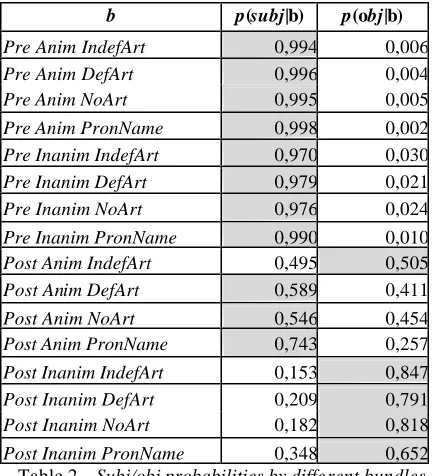
SOI, we have analysed the model predictions for different bundles of feature values. For each of the 16 different bundles (b) attested in the data, we have estimated p(subj|b) and p(obj|b):
b p(subj|b) p(obj|b)
Pre Anim IndefArt 0,994 0,006
Pre Anim DefArt 0,996 0,004
Pre Anim NoArt 0,995 0,005
Pre Anim PronName 0,998 0,002
Pre Inanim IndefArt 0,970 0,030
Pre Inanim DefArt 0,979 0,021
Pre Inanim NoArt 0,976 0,024
Pre Inanim PronName 0,990 0,010
Post Anim IndefArt 0,495 0,505
Post Anim DefArt 0,589 0,411
Post Anim NoArt 0,546 0,454
Post Anim PronName 0,743 0,257
Post Inanim IndefArt 0,153 0,847
Post Inanim DefArt 0,209 0,791
Post Inanim NoArt 0,182 0,818
Post Inanim PronName 0,348 0,652
Table 2 – Subj/obj probabilities by different bundles
The model shows a neat preference for subject when the noun is preverbal. Instead, when the noun is postverbal, function assignment is de facto de-cided by the noun animacy. Conversely, definite-ness features have a much more secondary role:
they can re-enforce (or weaken) the preference ex-pressed by animacy, but they do not have the strength to determine SOI.
The relative salience of the different constraints acting on SOI can also be inferred by comparing the weights associated with individual feature val-ues. For instance, Goldwater and Johnson (2003) show that ME can be successfully applied to learn constraint rankings in Optimality Theory, by as-suming the parameter weights a1, …, ak as the
ranking values of the constraints. The following table lists the 16 general constraints of the model by increasing weight values:
Feature Weight
Preverbal_Obj 2,10E-02
Anim_Obj 3,34E-01
Postverbal_Subj 5,21E-01
ProName_Obj 5,75E-01
IndefArt_Subj 8,33E-01
Inanim_Subj 8,60E-01
NoArticle_Subj 9,46E-01
ArtDef_Obj 1,00E+00
DefArt_Subj 1,05E+00
NoArticle_Obj 1,07E+00
IndefArt_Obj 1,16E+00
Inanim_Obj 1,21E+00
PronName_Subj 1,22E+00
Anim_Subj 1,28E+00
Preverbal_Subj 1,34E+00
Postverbal_Obj 1,47E+00
Table 3 – Constraint weights ranking
The rankings in Table 3 can be used to derive the relative salience of each constraint. Lower ranked constraints correspond to more marked syntactic config urations that are then disfavoured in SOI. Notice that the two animacy constraints Anim_Obj
the constraints involving noun definiteness occupy a more intermediate position in the general rank-ing, with very close values. This is again consistent with the less decisive role of this feature type in
SOI, as shown above.
5.2 Lexical feature configuration
In this experiment the general features reported in Table 1 have been integrated with 4,316 verb-specific features as the ones exemplified below for the verb dire ‘say’:
dire_animSog 1.228213e+00 dire_noanimSog 7.028484e-01 dire_animOgg 3.645964e-01 dire_noanimOgg 1.321887e+00
whose associated weights show the strong prefer-ence of this verb to take animate subjects as op-posed to inanimate ones as well as a preference for inanimate objects with respect to animate ones. The results achieved with LC on the test corpus show a significant improvement with respect to those obtained with NLC: the accuracy is now 95.5%, with a 4% improvement, confirmed by a 10-fold cross-validation (94.9%). Also in this case, most of the errors relate to the pos tverbal position (i.e. 27 out of 29), partitioned into 26 mistaken subjects and 1 mistaken object. Lexical features have been resorted to to solve most of the NLC
errors (i.e. 34 out of 55). It is interesting to note however that lexical features can also be mislead-ing. The LC results include 8 new errors, suggest-ing that lexical features do not always provide conclusive evidence: in fact, in 185 cases out of 645 test VN pairs (i.e. 28.7% of the cases) general features are preferred over lexical ones. It is also worth mentioning that the ranking of general ani-macy and definiteness features in LC actually fits in with the respective markedness hierarchies even with a better approximation than the one produced by NLC. Finally, the relative prominence of the different global features confirms the trend in Ta-ble 2, with word order being predominant in pre-verbal pos ition and animacy playing a major role with postverbal nouns.
Both feature configurations of the ME model thus appear to comply with linguistic and psycho-linguistic gene ralizations on SOI. On the linguistic side, the constraints learnt by the model are consis-tent with universal markedness hierarchies for
grammatical relations. Secondly, the prominence of the various constraints in the model fits in well with psycholinguistic data. Consistently with the results in Bates et al. (1984), the model confirms the great impact of noun animacy in Italian, al-though in this case its key role seems to be more directly limited to the postverbal position. Con-versely, the preverbal position is by itself a very strong cue for subject interpretation.
6 High frequency verbs and SOI
Frequency is known to play a major influence in language learning. In morphology, for example, highly frequent lexical items tend to be shorter forms, more readily accessible in the mental lexi-con, independently stored as whole items (Stem-berger and MacWhinney 1986) and fairly resistant to morphological overgeneralization through time, thus establishing a correlation between irregular inflected forms and frequency. Frequency has also been assigned a key role in the acquisition of syn-tactic constructions. In fact, Goldberg (1998) and Ninio (1999) have independently argued for the existence of a causal relation between early expo-sure to highly frequent light verbs and acquisition of abstract syntax-semantics mappings (construc-tions). Light verbs such as want, put and go tend to be very frequent, because they are applicable in a wider range of contexts and are learned and used at an early la nguage maturation stage The main idea is that children’s early use of these high frequency verbs is conducive to the acquisition of abstract constructional properties generalizing over partic u-lar instances.
and construction prototypicality and extension is tenuous. In fact, it is difficult to argue that frequent light verbs such as see, want or do exhibit a high degree of both semantic and constructional trans i-tivity (Goldberg et al. 2004). This is reminiscent of the morphological behaviour of very frequent word forms in infle ctional languages, as most of these forms are highly fused and show a general ten-dency towards irregular inflection and low mor-phological prototypicality. Furthermore, it is difficult to reconcile the “pathbreaking” view with the observation that frequently observed linguistic units are memorized in full, as unanalyzed wholes.
6.1 Testing the role of frequency
To address these open issues and put the alleged “pathbreaking” role of light verbs to the challeng-ing test of a probabilistic model, we carried out a second battery of experiments to learn the general, non-lexical constraints from two training corpora of roughly equivalent size where overall type and token verb frequencies were controlled for. Both corpora are a subset of the original training set: 1. skewed frequency corpus (SF) – it includes 5,261 context pairs, obtained by selecting 15 verbs occurring more than 100 times in ISST (figures in parentheses give their token frequency): essere
‘be’ (2406), avere ‘have’ (708), fare ‘do, make’ (527), dire ‘say, tell’ (275), dare ‘give’ (173), ve-dere ‘see’ (134), andare ‘go’ (126), sembrare
‘seem’ (124), cercare ‘try’ (122), mettere ‘put’ (122), portare ‘take’ (121), trovare ‘find’ (112),
volere ‘want’ (105), lasciare ‘leave’ (105), riu scire
‘manage’ (101). It is worth noticing that this set includes typical “pathbreaking” verbs;
2. balanced frequency corpus (BF) – this corpus includes 5,373 context pairs selected in such a way to ensure that every verb type in the original train-ing set is attested in BF and occurs at most 6 times. For verbs occurring with a higher frequency, the pairs to be included in BF have been randomly se-lected.
Thus SF and BF represent two opposite training situations: SF contains few types with very high token frequencies, while BF contains a high num-ber of verb types (i.e. 1457), with very low and uniform token frequency. These training sets re-semble the structure of linguistic input used by Goldberg et al. (2004) for their experiments. In that case, one group of subjects was exposed to linguistic inputs in which some verbs occurred
with a much higher frequency than the others; a second group of subjects was instead exposed to linguistic stimuli in which every verb occurred with roughly equal frequency. Therefore, by train-ing our ME model on SF and BF we are able to evaluate the effective role of high token frequency verbs in driving syntactic learning.
The ME model with the general features only (i.e. NLC) was first trained on SF, and then tested on the 645-pair corpus in §.5, showing a 90% ac-curacy. The same ME model was then trained on BF, and then tested on the 645-pair corpus, scoring a 87% accuracy. The ME model trained on the skewed frequency data thus outperforms the model trained on BF in a statistically significant way (?2 =
4.97; a=0.05; p-value = 0.025).
By using a training set formed only by the verbs with the highest token frequency, the model has thus been able to acquire robust syntactic con-straints for SOI. Once these constraints have been applied to unseen events, the model has achieved a performance comparable to the one of the general models in §.5. This is somehow even more signif i-cant if we consider that the training set was now formed by less than one-third of the pairs on which the models in §.5 were trained. Data quantity aside, the most relevant fact is that it is the way verb fre-quencies are distributed to determine the learning path, with a significant positive effect produced by high token frequency verbs. In the model trained on SF, feature ranking is also governed by mark-edness relations, and the relative prominence of the various constraints is utterly similar to the one dis-cussed in §.5. In other terms, the results of this ex-periment prove that frequent verbs are actually able to act as “catalysts” of the syntactic acquis i-tion process. It is possible for children to converge on the correct generalizations governing SOI in Italian, just by relying on the linguistic evidence provided by the most frequent verbs.
are processed, for lack of more specific overriding information, in the light of these constraints. Since processing is the result of a “conspiracy” of dis-tributed constraints, “pathbreaking” prototypes need not be real construction exemplars but highly schematic patterns. We proved that highly frequent local positional patterns offer the right sort of con-straint conspiracy.
7 General discussion
It appears that the distributional evidence of high frequency light verbs may well provide a solid cognitive anchor for sweeping perceptual generali-zations on the syntax-semantics mapping. These generalizations are local, in that they involve pos i-tional NV and VN pairs only, and are perceptual as they address the issue of identifying appropriate syntactic relations by relying on perceptual fea-tures of linguistic contexts, such as position, ani-macy, etc. On the basis of these findings, one can reasonably argue that complex lexical construc-tions (in the sense of Goldberg 1998) are built upon these local patterns, by combining them in those contexts where the presence of a particular verb licenses such a combination.
The two feature configurations discussed in §.5 (i.e. NLC and LC) can thus be viewed as two suc-cessive steps along the path that leads towards the emergence of complex, lexically-driven construc-tions. This can actually be modeled as the incre-mental process of adding more and more lexical constraints to early lexicon-free generalizations (based on word order, animacy, definiteness etc.). As a result of such additional constraints, the pres-ence of an intransitive verb may completely rule out the object interpretation of a VN pattern, flying in the face of a general bias towards viewing VN as a transitive pattern. This picture is compatible with the well-known observation that constructions are used rather conservatively by children at early stages of language maturation (Tomasello 2000). In fact, if early generalizations are mainly percep-tual and local, we do not expect them to be used in production, at least until the child reaches a stage where they are combined into bigger lexically-driven constructions.
ME has proven to be a sound computational learning framework to simulate the interplay of complex probabilistic constraints in language. Our experiments confirm linguistic generalizations and
psycholinguistic data for subjects and objects in Italian, while raising new interesting issues at the same time. This is the case of the role of definite-ness in SOI. In fact, the model features neatly re-produce the definiteness markedness hierarchy, but definiteness does not appear to be really influential for subject and object processing. Various hy-potheses are compatible with such results, inclu d-ing that definiteness is not a cue on which speakers rely for SOI in Italian. Another more interesting possibility is that definiteness constraints may in-deed play a decisive role when the learner is asked to assign subject and object relations in the context of a more complex construction than a simple NV
pair. Suppose that both nouns of a noun-noun-verb triple are amenable to a subject interpretation, but that one of them is a more likely subject than the other due to its being part of a definite noun phrase. Then, it is reasonable to expect that the model would select the definite noun phrase as the subject in the triple and opt for an object interpre-tation of the other candidate noun phrase.
As part of our future work, we plan to train the ME model on a more realistic corpus of parental input to Italian children, available in the CHILDES database (MacWhinney, 2000: http://childes.psy. cmu.edu/data/Romance/Italian). In fact, there is converging evidence that the use of particular con-structions in parental speech is largely dominated by the use of each construction with one specific, highly frequent verb (e.g. go for the intransitive construction). The same trends noted in mother’s speech to children are mirrored in children’s early speech (Goldberg et al., 2004). Quochi (in prepara-tion) reports a similar distributional pattern for the caused motion and intransitive motion verbs in two Italian CHILDES corpora (named “Italian-Antelmi” and “Italian-Calambrone”). If these find-ings are confirmed, the high accuracy of our ME model trained on the skewed frequency corpus (SF) allows us to expect an equally high accuracy when training the model on evidence from Italian parental speech.
Iden-tification of the contextually-relevant subject is, for lack of explicit morphosyntactic clues such as agreement and diathesis, simply a matter of guess-ing the more likely agent of the action expressed by the verb on the basis of semantic and pragmatic features such as animacy, definiteness and noun position to the verb. Mutatis mutandis, the same holds for object identification. It is then highly likely that salient evidence for the correct sub-ject/object classific ation comes to the child from direct observation of the situation described by a sentence. It is such systematic coupling of linguis-tic evidence from the sentence with perceptual evi-dence of the situation described by the sentence that can assist the child in developing interface notions such as subject, object and the like.
References
Aissen J., 2003. Differential object marking: iconicity vs. economy. Natural Language and Linguistic The-ory, 21: 435-483.
Bartolini R., Lenci A., Montemagni S., Pirrelli V., 2004. Hybrid constraints for robust parsing: First experi-ments and evaluation. LREC2004: 859-862.
Bates E., MacWhinney B., Caselli C., Devescovi A., Natale F., Venza V., 1984. A crosslinguistic study of the development of sentence interpretation strategies. Child Development, 55: 341-354.
Berger A., Della Pietra S., Della Pietra V., 1996. A maximum entropy approach to natural language processing. Computational Linguistics 22(1): 39-71
Bresnan J., Dingare D., Manning C. D., 2001. Soft con-straints mirror hard concon-straints: voice and person in English and Lummi. Proceedings of the LFG01 Con-ference, Hong Kong: 13-32.
Goldberg A. E., 1998. The emergence of the semantics of argument structure constructions. In B. MacWhin-ney (e d.), The Emergence of Language. Lawrence Erlbaum Associates, Hillsdale, N. J.: 197-212.
Goldberg A. E., Casenhiser D., Sethuraman N., 2004. Learning argument structure generalizations, Cogni-tive Linguistics.
Goldwater S., Johnson M. 2003. Learning OT Con-straint Rankings Using a Maximum Entropy Model. In Spenader J., Eriksson A., Dahl Ö. (eds.), Proceed-ings of the Stockholm Workshop on Variation within Optimality Theory. April 26-27, 2003, Stockholm University: 111-120.
Lenci A. et al., 2000. SIMPLE: A Ge neral Framework for the Development of Multilingual Lexicons. Inter-national Journal of Lexicography, 13 (4): 249-263.
Manning C. D., 2003. Probabilistic syntax. In R. Bod, J. Hay, S. Jannedy (eds), Probabilistic Linguistics, MIT Press, Cambridge MA: 289-341.
MacWhinney, B., 2000. The CHILDES project: Tools for analyzing talk. Third Edition. Mahwah, NJ: La w-rence Erlbaum Associates
MacWhinney B., Bates E., Kliegl R., 1984. Cue validity and sentence interpretation in English, German, and Italian. Journal of Verbal Learning and Verbal Be-havior, 23: 127-150.
MacWhinney B., 2004. A unified model of language acquisition. In J. Kroll & A. De Groot (eds.), Hand-book of bilingualism: Psycholinguistic approaches, Oxford University Press, Oxford.
Matthews D., Lieven E., Theakston A., Tomasello M., in press, The role of frequency in the acquisition of English word order, Cognitive Development.
Miyao Y., Tsujii J., 2002. Maximum entropy estimation for feature forests. Proc. HLT2002.
Montemagni S. et al. 2003.Building the Italian syntac-tic-semantic treebank. In Abeillé A. (ed.) Treebanks. Building and Using Parsed Corpora, Kluwer, Dordrecht: 189-210.
Ninio, A. 1999. Pathbreaking verbs in syntactic devel-opment and the question of prototypical transitivity. Journal of Child Language, 26: 619- 653.
Øvrelid L., 2004. Disambiguation of syntactic functions in Norwegian: modeling variation in word order in-terpretations conditioned by animacy and definite-ness. Proceedings of the 20th Scandinavian Conference of Linguistics, Helsinki.
Quochi, V., (in preparation). A constructional analysis of parental speech: The role of frequency and predic-tion in language acquisipredic-tion, evidence from Italian.
Ratnaparkhi A., 1998. Maximum Entropy Models for Natural Language Ambiguity Resolution. Ph.D. Dis-sertation, University of Pennsylvania.
Seidenberg M. S., MacDonald M. C. 1999. A probabil-istic constraints approach to language acquisition and processing. Cognitive Science 23(4): 569-588.
Stemberger, J., MacWhinney, B. 1986. Frequency and the lexical storage of regularly inflected forms. Memory and Cognition, 14:17-26.