Paraphrastic Grammars
Claire Gardent
CNRS-LORIA, Nancy France
Marilisa Amoia
Computational Linguistics University of Saarbruecken
Germany
Evelyne Jacquey
CNRS-ATILF, Nancy France
Abstract
Arguably, grammars which associate natural lan-guage expressions not only with a syntactic but also with a semantic representation, should do so in a way that capture paraphrasing relations between sentences whose core semantics are equivalent. Yet existing semantic grammars fail to do so. In this pa-per, we describe an ongoing project whose aim is the production of a “paraphrastic grammar” that is, a grammar which associates paraphrases with iden-tical semantic representations. We begin by propos-ing a typology of paraphrases. We then show how this typology can be used to simultaneously guide the development of a grammar and of a testsuite de-signed to support the evaluation of this grammar.
1 Introduction
A salient feature of natural language is that it allows paraphrases that is, it allows different verbalisations of the same content. Thus although the various ver-balisations in (1) may have different pragmatic or communicative values (with respect for instance to topicalisation, presuppositions or focus/ground par-titioning), they all share a core semantic content, the content approximated by a traditional montagovian compositional semantics.
(1) a. La croisi`ere coˆute cher. Lit. the cruse is expensive
b. Le coˆut de la croisi`ere est ´elev´e. Lit. the cost of the cruse is high c. La croisi`ere a un coˆut ´elev´e Lit. the cruse has a high cost
Linguists have long noticed the pervasiveness of paraphrases in natural language and attempted to caracterise it. Thus for instance Chomsky’s “trans-formations” capture the relation between one core meaning (a deep structure in Chomsky’s terms) and several surface realisations (for instance, between the passive and the active form of the same sen-tence) while (Mel’ˇcuk, 1988) presents sixty
para-phrastic rules designed to account for parapara-phrastic relations between sentences.
More recently, work in information extraction (IE) and question answering (QA) has triggered a renewed research interest in paraphrases as IE and QA systems typically need to be able to recognise various verbalisations of the content. Because of the large, open domain corpora these systems deal with, coverage and robustness are key issues and much on the work on paraphrases in that domain is based on automatic learning techniques. For instance, (Lin and Pantel, 2001) acquire two-argument templates (inference rules) from corpora using an extended version of the distributional analysis in which paths in dependency trees that have similar arguments are taken to be close in meaning. Similarly, (Barzi-lay and Lee, 2003) and (Shinyanma et al., 2002) learn sentence level paraphrase templates from a corpus of news articles stemming from different news source. And (Glickman and Dagan, 2003) use clustering and similarity measures to identify sim-ilar contexts in a single corpus and extract verbal paraphrases from these contexts.
Such machine learning approaches have known pros and cons. On the one hand, they produce large scale resources at little man labour cost. On the other hand, the degree of descriptive abstraction of-fered by the list of inference or paraphrase rules they output is low.
We chose to investigate an alternative research di-rection by aiming to develop a “paraphrastic gram-mar” that is, a grammar which captures the para-phrastic relations between linguistic structures1. Based on a computational grammar that associates natural language expressions with both a syntactic and a semantic representation, a paraphrastic
gram-1
mar is a grammar that moreover associates para-phrases with the same semantic representation. That is, contrary to machine learning based approaches which relate paraphrases via sentence patterns, the paraphrastic grammar approach relates paraphrases via a common semantic representation. In this way, the paraphrastic approach provides an interesting al-ternative basis for generation from conceptual rep-resentations and for the inference-based, deep se-mantic processing of the kind that is ultimately needed for high quality question answering.
Specifically, we aim at developing a paraphras-tic grammar for French, based on the Tree Adjoin-ing Grammar (TAG) developed for this language by Anne Abeill´e (Abeill´e, 2002).
The paper is structured as follows. We start by proposing a typology of the paraphrastic means made available by natural language. We then show how this typology can be used to develop a testsuite for developing and evaluating a paraphrastic gram-mar. Finally, we highlight some of the issues arising when developing a paraphrastic grammar.
2 Classifying paraphrases
A paraphrastic grammar should capture the vari-ous means made available by natural language to support paraphrasing. But what are those means? We distinguish here between three main classes namely, parallel, shuffling and definitional para-phrastic means.
Parallel paraphrastic means. A parallel para-phrase can hold either between two non predica-tive lexical units (words or multi word expressions) modulo negation or between two predicative units of identical arity. If it holds between predicative units, the mapping linking grammatical functions (subject, objects, etc.) and thematic roles (agent, theme, etc.) must be the same. Depending on whether or not negation is involved, semantic equiv-alence will futhermore obtain either through syn-onymy or through antsyn-onymy.
As illustrated in Figure 1, synonymy can be fur-ther divided in a number of cases depending on var-ious morphological and syntactic criteria. The clas-sification criteria used involve :
• Syntactic category: Do the synonyms have the same syntactic category?
• Morphological relatedness: Do the synonyms contain words that are morphologically re-lated?
• Form: Are the synonyms simple lexical units or multi word expressions?
As for antonymy, we distinguish between trans and intracategorial antonymy:
(2) Jean est lent/Jean n’est pas rapide.
Jean is slow/Jean is not fast.
lent/rapide, intracategorial Jean a cesser de fumer/Jean ne fume plus.
Jean has stopped smoking/Jean smokes no more.
cesse de/ne. . .plus, transcategorial
Shuffling paraphrastic means. When a seman-tic equivalence holds between predicative units with distinct grammatical functions/thematic role link-ing, we speak of shuffling paraphrases. Such para-phrases can be realised either by means of argument preserving alternations (in the sense of Beth Levin, cf. (4)) or using a converse construction (cf. 3)2.
(3) a Jean donne un livre `a Marie.
Jean gives a book to Marie.
Marie rec¸oit un livre de Jean
Jean receives a book from Marie.
b Jean est le parent de Marie.
Jean is the parent of Marie.
Marie est l’enfant de Jean.
Marie is the child of Jean.
(4) a. Cette cl´e ouvre le coffre fort
This key opens the safe.
Le coffre fort s’ouvre avec cette cl´e
The safe opens with this key.
b. Jean mange une pomme
Jean eats an apple.
une pomme est mang´ee par Jean
An apple is eaten by Jean.
Il a ´et´e mang´e une pomme par Jean.
There has been an apple eaten by Jean.
c. L’eau remplit la cruche
The water fills the jug .
La cruche se remplit d’eau
The jug fills with water.
On remplit la cruche d’eau
One fills the jug with water.
d. Le laboratoire fusionne avec l’entreprise
The laboratory merges with the firm.
le laboratoire et l’entreprise fusionnent
The laboratory and the firm merge.
e. Jean frappe le mur avec un baton
Jean hit the wall with a stick.
2
Same synt. Same morph. Form Example categories family
yes no word/word policier, flic
yes yes word/mwe conseiller, donner conseil
yes no word/mwe s’exprimer sur, donner son avis sur
yes no mwe/mwe donner carte blanche `a, laisser tout pouvoir no yes word/word construire, construction
no no word/word candidature `a, briguer
Figure 1: Synonymy
Jean frappe le baton sur le mur.
Jean hit the stick on the wall.
f. Je fournis des livres `a Jean
I provide books to Jean.
Je fournis Jean en livre
I provide Jean with books.
Definitional paraphrastic means. Third, we call “definitional paraphrases” semantic equivalences that hold between a lexical unit and a phrase con-sisting of more than one lexical unit. The phrase in this case, defines the meaning of the lexical unit. Since definitions are notoriously difficult to decide upon, we restrict ourselves here to such definitions as can be given by derivational morphology that is, definitions based on a word that is morphologically linked to the definiendum (cf. 5).
(5) a. Le conducteur de la BMW est chauve
The driver of the BMW is bald.
La personne qui conduit la BMW est chauve
The person who drives the BMW is bald.
b. Cet outil est param´etrable
This tool is parameterisable.
Cet outil peut ˆetre param´etr´e
This tool can be parameterised.
3 Developing a paraphrase testsuite
Based on the above typology, we can systematically construct a testsuite for developing and evaluating a paraphrastic grammar. Indeed, when developing a grammar, it is necessary to have some means of assessing both the coverage of the grammar (does it generate all the sentences of the described lan-guage?) and its degree of overgeneration (does it generate only the sentences of the described lan-guage?) While corpus driven efforts along the PAR
-SEVAL lines (Black et al., 1991) are good at giving some measure of a grammar coverage, they are not suitable for finer grained analysis and in particular, for progress evaluation, regression testing and com-parative report generation. Another known method consists in developing and using a test suite that is,
a set of negative and positive items against which the grammar can be systematically tested. For en-glish, there is for instance the 15 year old Hewlett-Packard test suite, a simple text file listing test sen-tences and grouping them according to linguistics phenomena (Flickinger et al., 1987); and more re-cently, the much more sophisticated TSNLP (Test Suite for Natural Language Processing) which in-cludes some 9500 test items for English, French and German, each of them being annotated with syntac-tic and application related information (Oepen and Flickinger, 1998).
Yet because they do not take into account the se-mantic dimension, none of these tools are adequate for evaluating the paraphrastic power of a gram-mar. To remedy this, we propose to develop a para-phrase test suite based on the parapara-phrase typology described in the previous section. In such a testsuite, test items pair a semantic representation with a set of paraphrases verbalising this semantics. The con-struction and annotation of the paraphrases reflects the paraphrase typology. In a first phase, we concen-trate on simple, non-recursive predicate/argument structure. Given such a structure, the construction and annotation of a test item proceeds as follows.
First, a “canonical verbalisation” is produced in which the predicate is realised by the “canonical verb” for the given concept3 and the arguments by the canonical nouns.
Next variants are produced by systematically try-ing to create parallel, shuffltry-ing and definitional para-phrases. Each of the variant is furthermore anno-tated with labels caracterising the type of paraphras-ing involved. Here is an example. Suppose the input semantics is:
apply(e), agent(e,jean), theme(e,job), failure(e)
for which the canonical verbalisation is:
(6) Jean a candidat´e sans succ`es sur le poste
Jean has applied in vain for the job.
3
The parallel synonyms4 that can be used are the following:5
candidater candidature +pred-N poser sa +pred-vsupV candidature
briguer +pred-V sans succ`es ´echouer +mod-V
ˆetre sans succ`es +mod-beAdv ne pas ˆetre retenu +mod-Vanton
For shuffling synonymy, two alternations are available: the active/passive alternation for “poser” and the active/locative one for “´echouer”. There is no converse construction. Neither is there any defi-nition given by derivational morphology for any of the terms occurring in the canonical verbalisation. Based on these facts, the following variants and an-notations can be constructed.
(7) a. Jean a brigu´e le poste sans succ`es
Jean has asked for the job in vain.
+pred-Vsyn
b. Jean a pos´e sa candidature sur le poste sans succ`es
Jean has submitted his application for the job in vain.
+pred-vsupN
c. La candidature pos´ee par Jean sur le poste a ´et´e sans succ`es
The application submitted by Jean for the job was in vain.
+pred-partAdj, +mod-beAdv
d. La candidature pos´ee par Jean sur le poste a ´echou´e
The application submitted by Jean for the job failed.
+pred-partAdj, +mod-V
e. La candidature de Jean sur le poste a ´et´e sans succ`es
Jean’s application for the job was in vain.
+pred-N, +mod-beAdv
f. La candidature de Jean sur le poste n’a pas ´et´e retenue
4
As has been abundantly argued by linguists, real synonyms are extremely rare. By synonyms, we in fact refer here to the notion of quasi-synonyms used for instance in WordNet that is, words that are interchangeable in a restricted set of contexts.
5The labels are the ones used for annotation. They
carac-terise variations with respect to the canonical realisation. For instance, +pref-N indicates that the main predicate (realised by a verb in the canonical verbalisation) is realised as a noun.
Jean’s application for the job was not suc-cessful.
+pred-N, +mod-Vanton
g. La candidature de Jean sur le poste a ´echou´e
Jean’s application for the job failed.
+pred-N, +mod-V
h. Jean a ´echou´e dans sa candidature sur le poste.
Jean failed in his application for the job.
+pred-N, +mod-V-altLoc
Thus the typology of paraphrastic means help guide the construction of the various paraphrases contained in a single item. There remains the ques-tion of how to choose the particular items of the testsuite. In other words: which semantic repre-sentations should we use to populate the test suite and on the basis of which criteria? The basic aim here is to cover the various types of possible seman-tic combinations and the constraints they are sub-ject to at the syntactic (realisation) level. If, as Beth Levin argues, syntax is a reflex of semantic proper-ties, then different semantic contents should be sub-ject to varying syntactic constraints and the test suite ought to cover these various types of interactions. Accordingly test items are constructed whose main predicate vary along the following dimensions :
(1) WordNet Verb Family; (2) Aspect; (3) Arit´e
That is, items are constructed for each word-Net family (the french Wordword-Net counts roughly 170 such families). Within a given family, we attempt to find examples with distinct aspectual categories (state, accomplishment and process). Finally, given a WN family and an aspectual category, items will vary with respect to the arity of the main predicate and the types of their arguments e.g., predicates of arity one (run, cost, sleep), of arity two with non propositional arguments (eat, hit, dug), of arity two with a propositional argument (say, promise etc.), etc.
4 A paraphrastic grammar
Lexical Functional grammar (LFG) with a glue se-mantics.
These grammars are both efficient and large scale in that they cover an important fragment of the nat-ural language they describe and can be processed by parsers and generators in almost real time. For in-stance, the LFG grammar parses sentences from the Wall Street Journal and the ERG HPSG grammar will produce semantic representations for about 83 per cent of the utterances in a corpus of some 10 000 utterances varying in length between one and thirty words. Parsing times vary between a few ms for short sentences and several tens of seconds for longer ones.
Nonetheless, from a semantics viewpoint, these grammars fail to yield a clear account of the para-phrastic relation. Here is a simple example illustrat-ing this shortcomillustrat-ing. Suppose we parse the follow-ing paraphrases where a lexical definition (driver≡ person who drives) is involved:
(8) a. The person who drives the car is mad. b. The driver of the car is mad.
When given these sentences, the LKB system based on the ERG HPSG grammar returns semantic representations which can be sketched as follows6:
(9) a. the(x, person(x) ∧ the(y, car(y) ∧ drive(e,x,y)∧mad(x)))
a. the(y, car(y)∧the(x, driver(x,y) ∧of(x,y)) ∧mad(x))
In other words, the grammar associates with these paraphrases semantic representations which are very different. It could be argued of course that although these representations are syntactically distinct, they can be inferred, given the appropri-ate knowledge, to be semantically equivalent. But a solution that avoids placing such extra burden on the inferencing component is obviously better. In short, one important shortcoming of existing large scale semantic grammars is that they do not assign semantically equivalent sentences, the same seman-tic representation.
By contrast, we propose to develop a grammar which whereever possible assigns identical seman-tic representations to paraphrases and whose
devel-6These semantic representations have been simplified for
better readibility. The real representations output by the LKB are the following:
prpstn(def(x,person(x)∧prpstn(def(y,car(y), drive(e1,v1,x,y,v2),v3)), mad(e2,x,v4),v5) prpstn(def(x,person(x)∧prpstn(def(y,car(y), drive(e1,v1,x,y,v2),v3)), mad(e2,x,v4),v5)
prpstn(def(y,car(y)∧prpstn(def(x, driver(x,y) ∧ of(e1,x,y,v1), mad(e2,x,v2,v3)))))
opment is based both on semantic and syntactic con-siderations.
4.1 Linguistic framework
Our grammar is couched within the Feature-Based Tree Adjoining grammar (FTAG) formalism. An FTAG consists of a set of (auxiliary or initial) ele-mentary trees and two tree composition operations: substitution and adjunction. Substitution is the stan-dard tree operation used in phrase structure gram-mars while adjunction is an operation which inserts an auxiliary tree into a derived tree. To account for the effect of these insertions, two feature structures (called top and bottom) are associated with each tree node in FTAG. The top feature structure en-codes information that needs to be percolated up the tree should an adjunction take place. In contrast, the bottom feature structure encodes information that remains local to the node at which adjunction takes place.
The language chosen for semantic representa-tion is a flat semantics along the line of (Bos, 1995; Copestake et al., 1999; Copestake et al., 2001). However because we are here focusing on paraphrases rather than fine grained semantic dis-tinctions, the underspecification and the descrip-tion of the scope reladescrip-tions permitted by these mantics will here be largely ignored and flat se-mantics will be principally used as a convenient way of describing predicate/arguments and modi-fiers/modified relationships. Thus the semantic rep-resentations we assume are simply set of literals of the form Pn(x1, . . . , xn) where P
n
is a predicate of arity n and xi is either a constant or a
unifica-tion variable whose value will be instantiated during processing.
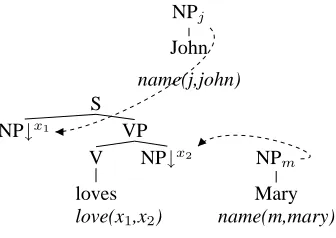
Semantic construction proceeds from the derived tree (Gardent and Kallmeyer, 2003) rather than – as is more common in TAG – from the derivation tree. This is done by associating each elementary tree with a semantic representation and by deco-rating relevant tree nodes with unification variables and constants occuring in associated semantic rep-resentation. The association between tree nodes and unification variables encodes the syntax/semantics interface – it specifies which node in the tree pro-vides the value for which variable in the final se-mantic representation.
NPj
John
name(j,john)
S NP↓x1 VP
V NP↓x2 NP m
loves Mary
[image:6.595.90.258.79.198.2]love(x1,x2) name(m,mary)
Figure 2: “John loves Mary”
Suppose the elementary trees for “John”, “loves” and “Mary” are as given in Fig. 2 where a downar-row (↓) indicates a substitution node and Cx/Cx
ab-breviate a node with category C and a top/bottom feature structure including the feature-value pair { index :x}. On substitution, the root node of the tree being substituted in is unified with the node at which substitution takes place. Further, when derivation ends, the top and bottom feature structures of each node in the derived tree are unified. Thus in this case,x1is unified withjandx2withm. Hence, the resulting semantics is:
love(j, m), name(j, john), name(m, mary)
4.2 The signature of the semantic representation language
Let us now come back to the paraphrases given in example 1. To produce an identical semantic rep-resentation of these three sentences, we first need to ensure that synonyms be assigned the same concept. That is, we need to fix a concept inventory and to use this inventory in a consistent way in particular, by assigning synonyms the same concept.
For non predicative units, we use WordNet synset numbers or when working within a restricted do-main with a well defined thesaurus, the descriptors of that thesaurus.
To represent the semantics of predicative units, we use FrameNet inventory of frames and frame el-ements (C.Johnson et al., 2002). FrameNet is an on-line lexical resource for English based on the prin-ciples of Frame Semantics. In this approach, a word evokes a frame i.e., a simple or a complex event, and each frame is associated with a number of frame
el-ements that is, a number of participants fulfilling a
given role in the frame. Finally each frame is as-sociated with a set of target words, the words that evoke that frame.
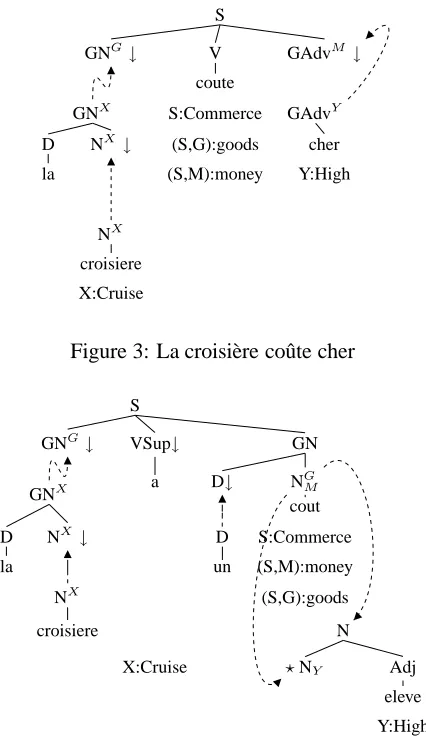
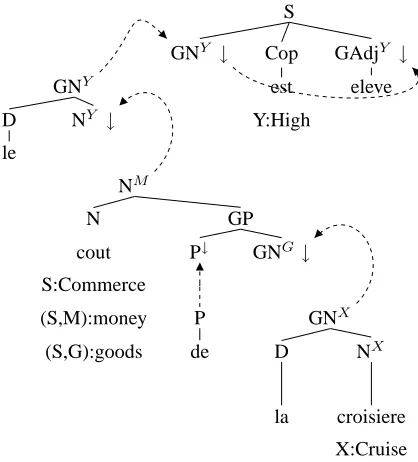
Thus FrameNet associates synonyms with an identical concept namely, the frame evoked by those synonyms. We make use of this feature and instead of choosing our own semantic predicates and re-lations, draw on FrameNet frames and frame ele-ments. For instance, the paraphrases in example 1 are taken to evoke the FrameNet COMMERCEframe
and to instantiate two of its frame elements namely, GOODS and MONEY. The semantic representation they will be assigned will therefore be the follow-ing:
commerce(e,g,m), cruise(g), goods(e,g), high(m), money(e,m)
4.3 Capturing paraphrastic relations
Given the basic signature provided by FrameNet (and any extension of it that will prove necessary to account for the data), the grammar must then specify a compositional semantics which will de-rive identical representations for the types of para-phrases captured by our typology. In essence, this implies assigning the same semantic representations to synonyms, converses and alternations. Con-cretely, this involves two different subtasks : first, a modeling of the synonymic relation between syn-tactically divergent constructs (e.g., between a pred-icative noun, a support verb construction and a verb) and second, the identification of the synonymic sets (which are the words and multi word expressions that stand in a parallel, shuffling or definitional para-phrastic relation?).
Modeling intercategorial synonymic links. A first investigation of Anne Abeill´e’s TAG for French suggests that modeling the synonymic relations across syntactic constructs is reasonably straightfor-ward. For instance, as Figures 3, 4 and 5 show, the FTAG trees assigned on syntactic grounds by Anne Abeill´e FTAG to predicative nouns, support verb constructions and transitive verbs can be equiped with a flat semantics in such a way as to assign the three sentences in 1 a unique semantic rep-resentation namely the one given above. Gener-ally, the problem is not so much to state the cor-respondances between synonymic but syntactically different constructs as to do this in a general way while not overgeneralising. To address this prob-lem, we are currently working on developing a metagrammar in the sense of (Candito, 1999). This metagrammar allows us to factorise both syntac-tic and semansyntac-tic information. Syntacsyntac-tic informa-tion is factorised in the usual way. For instance, there will be a classNOVN1 which groups together
two nominal arguments can occur. But addition-nally there will be semantic classes such as, “bi-nary predicate of semantic type X” which will be associated with the relevant syntactic classes for in-stance, NOVN1 (the class of transitive verbs with nominal arguments), BINARY NPRED (the class of
binary predicative nouns), NOVSUPNN1 , the class
of support verb constructions taking two nominal arguments. By further associating semantic units (e.g., “cost”) with the appropriate semantic classes (e.g., “binary predicate of semantic type X”), we can in this way capture both intra and intercategorial paraphrasing links in a general way.
Constructing paraphrastic sets. Depending on the type of paraphrastic means involved, construct-ing a paraphrastic set (the set of all lexical items re-lated by a paraphrastic link be it parallel, shuffling or definitional) is more or less easy as resources for that specific means may or may not be readily avail-able.
Cases of intracategorial synonymy are relatively straigthtforward as several electronic synonym dic-tionnaries for french are available (Ploux, 1997). Multi word expressions however remain a problem as they are often not or only partially included in such dictionnaries. For these or for a specific do-main, basic synonymic dictionaries can be comple-mented using learning methods based on distribu-tional similarity (Pereira et al., 1993; Lin, 1998). techniques.
For intercategorial synonymy involving a deriva-tional morphology link, some resources are avail-able which however are only partial in that they only store morphological families that is, sets of items that are morphologically related. Lexical semantics information still need to be included.
Intercategorial synonymy not involving a deriva-tional morphology link has been little studied and resources are lacking. However as for other types of synonymy, distributional analysis and clustering techniques can be used to develop such resources.
For shuffling paraphrases, french alternations are partially described in (Saint-Dizier, 1999) and a re-source is available which describes alternation and the mapping verbs/alternations for roughly 1 700 verbs. For complementing this database and for converse constructions, the LADL tables (Gross, 1975) can furthermore be resorted to, which list detailed syntactico-semantic descriptions for 5 000 verbs and 25 000 verbal expressions. In particu-lar, (Gross, 1989) lists the converses of some 3 500 predicative nouns.
S
GNG ↓ V GAdvM ↓
coute
GNX S:Commerce GAdvY
D NX↓ (S,G):goods cher
la (S,M):money Y:High
NX
croisiere
[image:7.595.321.534.69.445.2]X:Cruise
Figure 3: La croisi`ere coˆute cher
S
GNG↓ VSup↓ GN
a D↓ NGM
GNX
cout
D NX ↓ D S:Commerce
la un (S,M):money
NX (S,G):goods
croisiere N
X:Cruise ?NY Adj
eleve
Y:High
Figure 4: La croisi`ere a un coˆut ´elev´e
5 Conclusion
Besides the development and evaluation of a core paraphrastic testsuite and grammar for French, we plan to investigate two main issues. First, how pre-cisely should a metagrammar be structured to best describe a paraphrastic grammar? And second: is it possible to extract from the kind of inference rules automatically derived in machine learning ap-proach, information that can be used to specify this metagrammar?
6 Acknowledgments.
S
GNY ↓ Cop GAdjY ↓
GNY est eleve
D NY ↓ Y:High
le
NM
N GP
cout P↓ GNG↓
S:Commerce
(S,M):money P GNX
(S,G):goods de D NX
la croisiere
[image:8.595.77.286.71.302.2]X:Cruise
Figure 5: Le coˆut de la croisi`ere est ´elev´e
References
A. Abeill´e. 2002. Une Grammaire Electronique du
Franais. CNRS Editions.
R. Barzilay and L. Lee. 2003. Learning to paraphrase: an unsupervised approahc using mutliple-sequence alignment. In Proceedings of
NAACL-HLT.
A. Black, S. Abney, D. Flickinger, C. Gdaniec, R. Grishman, P. Harrison, D. Hindel, R. INgria, F. Jelinek, F. Klaavans, M. Liberman, M. Mar-cus, S. Roukos, B. Santorini, and T. Strzalkowski. 1991. A procedure for quantitatively comparing the syntactic coverage of english grammars. In
Proceedings of teh 4th DARPA Speech and Natu-ral Language Workshop.
J. Bos. 1995. Predicate logic unplugged. In Paul Dekker and Martin Stokhof, editors, Proceedings
of the 10th Amsterdam Colloquium, pages 133–
142.
M.H Candito. 1999. Un outil multilingue de gener-ation de ltag : applicgener-ation au francais et a l’italien.
TAL, 40(1).
C.Johnson, C. Fillmore, M. Petruckand C. Baker, M. Ellsworth, and J. Ruppenhofer. 2002. Framenet: Theory and practice. Technical report, Berkeley.
Ann Copestake and Dan Flickinger. 2000. An open source grammar development environment and broad-coverage English grammar using HPSG. In Proceedings of the 2nd International
Con-ference on Language Resources and Evaluation,
Athens, Greece.
A. Copestake, D. Flickinger, I. Sag, and C. Pollard. 1999. Minimal Recursion Semantics. An Intro-duction. Manuscript, Stanford University. A. Copestake, A. Lascarides, and D. Flickinger.
2001. An algebra for semantic construction in constraint-based grammars. In Proceedings of
the 39th Annual Meeting of the Association for Computational Linguistics, Toulouse, France.
M. Dalrymple. 1999. Semantics and syntax in
lexi-cal functional grammar. MIT Press.
D. Flickinger, J. Nerbonne, I. Sag, and T. Wasow. 1987. Towards evaluation of nlp systems. Tech-nical report, Hewlett-Packard Laboratories. C. Gardent and L. Kallmeyer. 2003. Semantic
con-struction in ftag. In Proceedings of EACL, Bu-dapest, Hungary.
O. Glickman and I. Dagan. 2003. Identifying lexi-cal paraphrases from a single corpus: a case study for verbs. In Proceedings of Recent Advances in
Natural Language Processing.
M. Gross. 1975. M´ethodes en syntase. Masson, Paris.
G. Gross. 1989. Les constructions converses du
francais. CNRS Editions.
Dekang Lin and Patrick Pantel. 2001. Discovery of inference rules for question answering. Natural
Language Engineering.
D. Lin. 1998. Automatic retrieval and clustering of similar words. In Proceedings of ACL/COLING, pages 768–774.
I. Mel’ˇcuk. 1988. Paraphrase et lexique dans la thorie linguistique sens-texte. Lexique, 6:13–54. S. Oepen and D. Flickinger. 1998. Towards
sys-tematic grammar profiling. test suite technology 10 years after. Computer Speech and Language, 12:411–435.
F. Pereira, N. Tishby, and L. Lee. 1993. Distribu-tional clustering of english words. In
Proceed-ings of the ACL, pages 183–190.
S. Ploux. 1997. Modlisation et traitement infor-matique de la synonymi. Linguisticae
Investiga-tiones, XXI(1).
P. Saint-Dizier, 1999. Alternations and Verb
Se-mantic Classes for French: analysis and class formation, chapter 5. Kluwer.