A brief introduction to the GeM annotation schema for complex
document layout
John Bateman University of Bremen
Bremen, Germany [email protected]
Renate Henschel University of Stirling
Stirling, Scotland [email protected]
Judy Delin University of Stirling and
Enterprise IDU Newport Pagnell, England [email protected]
Abstract
In this paper we sketch the design, motivation and use of the GeM annotation scheme: an XML-based annotation framework for prepar-ing corpora involvprepar-ing documents with complex layout of text, graphics, diagrams, layout and other navigational elements.We set out the basic organizational layers, contrast the techni-cal approach with some other schemes for com-plex markup in the XML tradition, and indicate some of the applications we are pursuing. 1 Introduction
In the GeM project (“Genre and Multimodal-ity”: http://www.purl.org/net/gem)1 we are
investigating the relationship between different document genres and their potential realiza-tional forms in combinations of text, layout, graphics, pictures and diagrams.The central fo-cus of the project is to develop a theory of visual and textual page layout in electronic and paper documents that includes adequate attention to local and expert knowledge in information de-sign.By analysing resources across visual and verbal modes, we aim to reveal the purpose of each in contributing to the message and struc-ture of the communicative artefact as a whole. We see it as crucial, however, that research of this nature be placed on as solid an empirical basis as has become common in other areas of linguistic inquiry.The data basis for many of the claims made in this area hitherto has been far too narrow: the provision of suitable corpus materials is therefore fundamental.
For such an enterprise to succeed, it is es-sential to obtain or construct a structured set
1The GeM project is funded by the British Economic and Social Research Council, whose support we grate-fully acknowledge. We also thank the anonymous review-ers for this workshop for some very useful comments.
of data on which to base the analysis; that is, in the words of Gunther Kress, a leading researcher in the area of multimodal meaning (cf., e.g., Kress and Van Leeuwen (2001)): we need “to turn stuff into data”.In our case, the “stuff” consists of raw paged-based infor-mation presentations, such as illustrated books, newspapers (print and online versions), instruc-tional texts, manuals, and so on; the “data” is then highly structured re-representations of these documents that bring out parallel but in-terrelated dimensions of organization crucial for the total effect, or meaning, of the ‘page’.
Although it is (a) widely accepted that data for designing and improving natural language processing can best be made available in the form of structured, standardized annotated cor-pora and (b) increasingly accepted that such data should stretch to include more than the traditional concerns of linguistics–i.e., speech and plain text data–and take in more visu-ally challenging presentations, movements in this direction have to date been very limited. The GeM annotation scheme is being devel-oped in order to support analyses of the broader range of layout-text-graphical interactions that is commonplace in professionally designed doc-uments.We are currently annotating an ex-ploratory corpus in order to bring out the com-plex interrelationships that can be observed within page-based information delivery.
2 Annotation content
introduced by Bateman et al.(2001).This organization reflects both artefact-internal considerations such as the layout, text and graphics, as well as artefact-external consid-erations such as design decisions, production constraints (e.g., cost), and artefact constraints (i.e., the limited size of a piece of paper contrasted with the theoretically unbounded scrollable window on a computer screen).These external considerations are often connected. The ‘ideal’ layout of information on a page might as a consequence never occur: it must be ‘folded in’ to the structures afforded by the artefact, and labelled and arranged according to the structures required for access.
In order to pick apart and explicitly repre-sent the strands of meaning that we believe play a crucial role in multimodal page-based docu-ment design, we require several orthogonal lay-ers of annotation.We claim that these levels are the minimum necessary for revealing accounts of the operation of the kinds of visual artifacts being gathered in our corpus–we expect further layers to be added.Indeed, we consider it a crucial design feature that the annotation lay-ers adopted be additive and open rather than excluding and closed.The layers at the focus of attention within the current phase of the GeM enterprise are:
• Rhetorical structure: the rhetorical rela-tionships between content elements; how the content is ‘argued’;
• Layout structure: the nature, appearance and position of communicative elements on the page;
• Navigation structure: the ways in which the intended mode(s) of consumption of the document is/are supported.
We then need in addition to these layers, ex-plicit representation of constraints that range freely over the layers and which relate design decisions to document types, or genres.Further constraints that are known to determine docu-ment design include: canvas constraints, arising out of the physical nature of the object being produced (e.g., page or screen, fold-geometry in leaflets, and so on),production constraints, aris-ing out of the production technology, and con-sumption constraints, arising out of the time,
place, and manner of acquiring and consuming the document.Further details and background for our approach to document design and de-scription are given in Delin et al.(2002).
Our corpus needs to contain information about each of these contributing sources of con-straint in a way that supports empirical in-vestigation.Our hypothesis, following Waller (1987), is that not only is it possible to find systematic correspondences between these lay-ers, but also that those correspondences them-selves will depend on specifiable aspects of their context of use.But to verify (or otherwise) this hypothesis, the data gathering and annotation must come first.And this leads directly to some important technical issues, since the structures induced by these layers of constraint can be highly divergent and need to be mapped onto one another with extreme flexibility.The well-known corpus annotation problem of intersect-ing hierarchies therefore arises here with consid-erable force.
3 Technical approach
el-ement is marked as a base unit and receives a unique base unit identifier.
The more abstract annotation levels may then group base units as required; these group-ings must again be very flexible–for exam-ple, it is quite possible that non-consecutive basic units need to be grouped (and that differing non-consecutive basic units will be grouped within differing annotation layers). Each of the more abstract layers is repre-sented formally as a further structured XML specification whose precise informational con-tent and form is in turn defined by an ap-propriate Document Type Definition (DTD).2
Each layer defines a particular structural view of the original document.The markup for a single document then consists mini-mally of the following four inter-related layers:
Name content
GeM base base units
RST base rhetorical structure
Layout base layout properties and
structure
Navigation base navigation elements
and structure
All information apart from that of the base level is expressed in terms of pointers to the rel-evant units of the base level.This stand-off ap-proach to annotation readily supports the nec-essary range of intersecting, overlapping hierar-chical structures commonly found in even the simplest documents.
The relationships of the differing annotation levels to the base level units is depicted graph-ically in Figure 1.This shows that base units (the central column) provide the basic vocabu-lary for all other kinds of units and can, further, be cross-classified.
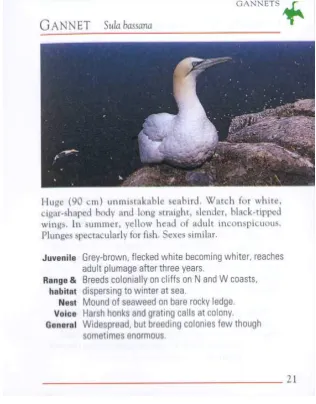
Space precludes a detailed account of the or-ganization of all the levels of the annotation scheme.Instead we select some examples of an annotated document at each layer of annotation to give an indication of the annotation scheme in action.For further technical details and spec-ifications of the annotation scheme, the inter-ested reader is referred to the technical manual (Henschel, 2002).For ease of exposition, we will draw most of our examples from the annotation of the page shown in Figure 2.This page has
2For the DTDs themselves, as well as further infor-mation and examples, see the GeM corpus webpages.
base units
Layout SemanticContent
RST segments
[image:3.595.330.527.75.188.2]navigational elements layout units
Figure 1: The distribution of base elements to layout, rhetorical and navigational elements
Figure 2: Example page: Flegg, J.(1999)
Collins Gem Birds. Italy: Harper Collins.p21. Used by kind permission of the publisher.
the advantage that it is relatively straightfor-ward; more complex examples can be found on the corpus webpages.
The base unit annotation (GemBase) for an extract from the centre of the page is as follows:
<unit id="u-21.5">---</unit> <unit id="u-21.6"
src="gannet.jpg" alt="gannet-photo"/> <unit id="u-21.7">
Huge (90cm) unmistakable seabird. </unit>
<unit id="u-21.8">
Watch for white, cigar-shaped body and long straight, slender, black-tipped wings. </unit>
<unit id="u-21.9">
[image:3.595.348.506.235.437.2]<unit id="u-21.10">
Plunges spectacularly for fish.</unit> <unit id="u-21.11">Sexes similar.</unit>
Although the base annotation generally has a flat structure, in certain cases, we diverge from this and allow nested markup, i.e., base units inside base units.This is used in the following situations: emphasized text portions in a sen-tence/heading, icons or similar pictorial signs in a sentence, text pieces in a diagram or picture, arrows and other graphical signs in a diagram or picture, and document deictic expressions oc-curring in a sentence.
The layout base then consists of three main parts: (a) layout segmentation–identification of the minimal layout units, (b) realization infor-mation – typographical and other layout prop-erties of the basic layout units, and (c) the lay-out structure information–the grouping of the layout units into more complex layout entities. Whereas in typography, the minimal layout el-ement (in text) is the glyph, here we are con-cerned with groupings of base units that have a visual coherence and unity with respect to the organisation of the page: these groupings are termed layout units and, unlike the base units, are organized into a non-trivial hierarchi-cal structure as required to describe the page. Again, each layout-unit has an id attribute, which carries an identifying symbol; in addition, however, the stand-off annotation is achieved via an attribute xref which points to the base units which belong to that layout unit.It is possible, but not necessary, to store the corre-sponding text portions of the original text file between the start and end tag of a layout-unit for mnemonic purposes; this text information is not used in any further processing.The follow-ing extract shows the layout unit correspondfollow-ing to the main block of text underneath the gannet photo.
<layout-unit id="lay-flegg-text" xref="u-21.7 u-21.8 u-21.9
u-21.10u-21.11">
Huge (90cm) unmistakable seabird. Watch for white, cigar-shaped body and long straight, slender,
black-tipped wings. In summer, yellow head of adult inconspicuous. Plunges spectacularly for fish. Sexes similar. </layout-unit>
The second part of the layout base is the re-alization.Each layout unit specified in the lay-out segmentation has a visual realization.The most apparent difference is which mode has been used – the verbal or the visual mode.Fol-lowing this distinction, the layout base differen-tiates between two kinds of elements: textual elements and graphical elements marked with the tags<text>and<graphics>respectively. These two elements have a differing sets of at-tributes describing their layout properties.The attributes are generally consistent with the lay-out attributes defined for XSL formatting ob-ject and CSS layout models.The id of each layout unit of the segmentation part of the lay-out base has to occur exactly once under xref
in the realization part: either in a <text> or a <graphics> element.In the following cod-ing example, we have five layout units which share typographical characteristics.These cor-respond to the five table cells in the first column of the table on the page shown in Figure 2. <text xref="lay-21.12 lay-21.14 lay-21.16
lay-21.18 lay-21.20" font-family="sans-serif"
font-size="10" font-style="normal" font-weight="bold"
case="mixed" justification="right" color="black"/>
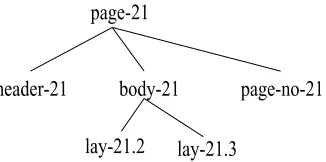
The third part of the layout base then serves to represent the hierarchical layout structure. Generally we assume that the layout structure of a document is tree-like with the entire docu-ment being the root; this will certainly be prob-lematic for some document types but also has sufficient applicability to enable us to make con-siderable headway.Each layout chunk is a node in the tree, and the basic layout units, which have been identified in the segmentation part of the layout base, are the terminal nodes of that tree.In our annotation, we use several different tags for the nodes in the layout tree.The three most common are: <layout-root>, the ele-ment describing the entire docuele-ment,
<layout-chunk>, all non-terminal nodes in the layout
page-21
header-21 body-21 page-no-21
[image:5.595.105.268.74.155.2]lay-21.2 lay-21.3
Figure 3: Example page layout structure shown graphically
<layout-root id="page-21">
<layout-leaf xref="header-21"/> <layout-chunk id="body-21">
<layout-leaf xref="lay-21.2"/> <layout-leaf xref="lay-21.3"/> </layout-chunk>
<layout-leaf xref="page-no-21"/> </layout-root>
Whereas the annotations so far specify the hierarchical structuring of a page into visually distinguishable and groupable layout units, we need also to record specific information about how layout units are placed on their pages: the page or page segment layout is not fully deter-mined by grouping layout units into a tree struc-ture since further information is required about the actual position of each unit in the docu-ment (on or within its page).For this, we in-troduce anarea model, which serves to deter-mine the position of each layout-chunk/layout-leaf in an abstract, but fully explicit, way.The area model is a generalization of common no-tions of ‘page models’.Each page usually par-titions its space into sub-areas and these can be used for positioning or aligning layout units or subtrees of the layout structure.For instance, a page is often designed in three rows – the area for the running head (row-1), the area for the page body (row-2), and the area for the page number (row-3) – which are arranged ver-tically.The page body space can itself consist of two columns arranged horizontally.These rows/columns need not to be of equal size.For the present, we restrict ourselves to rectangular areas and sub-areas, and allow recursive area subdivision.The partitioning of the space of the entire document is defined in thearea-root, which structures the document (page) into rect-angular sub-areas in a table-like fashion.
The tag to represent the area root is
<area-root>.The tag to represent the division of
a sub-area into smaller rectangles is
<sub-area>, this shares the attributes of the root
but adds alocation attribute so that subareas are positioned relative to their parent.Loca-tions are indicated with respect to a logical grid defining rows and columns.The area model for our example page therefore contains a single col-umn with 5 rows (the header, the photograph, the text block, the table, and the footer), in which the fourth row, the table, is itself made up of a subarea corresponding to the rows and columns of a virtual table.This is captured by the following annotation:
<area-root id="page-frame" cols="1" rows="5"
hspacing="100" vspacing="5 40 15 45 5" height="16cm" width="14cm">
<sub-area id="table-frame" location="row-4"
cols="2" rows="5" hspacing="1090" vspacing="100"/>
</area-root>
The attribute vspacing=‘‘5 4015 45 5’’
means that the area for the running head takes 5% of the entire page height, the area for the next row 40%, etc.The area model then pro-vides logical names for the precise positioning of the layout units identified in the hierarchi-cal layout structure.This makes it straightfor-ward to indicate, for example, that collections of siblings in the layout structure share (or fail to share) some particular alignment properties within the page.
this annotation layer again represents a hierar-chical decomposition in which the leaves of the tree can correspond to both textual and graph-ical base units.
Finally, the navigation base captures those parts of the document/page which tell the reader where the current text, or ‘document thread’, is continued or which point to an al-ternative continuation or continuations.These make up the navigation layer of annotation. The addresses used by such pointers are either names of RST spans or names of layout chunks. For long-distance navigation, typical nodes in the RST structure and in the layout structure have been established for use in pointers; in particular, chapter/section headings are names for RST spans and page numbers are names for page-sized layout-chunks.This structure imposed by the navigational elements is thus quite different from the preceding layers and can freely cross-cut the hierarchicies expressed there.Again, for further details, the reader is refered to the documentation manual.
4 Comparison with other XML-based approaches
It is useful to consider other approaches to representing ‘overlapping hierarchies’ that have been proposed in the XML literature; since these are early days in the construction of such annotation schemes, it is likely that the expe-rience gained with differing schemes will prove highly beneficial for further development.
The first examples of extensive overlapping hierarchies within markup for NLP are proba-bly to be found in speech corpora.It is clear that intonational phenomena, for example, may or may not respect grammatical or other kinds of structure and so need to be maintained sep-arately.Speech-oriented corpora generally use the time line as a basic reference method since speech events are necessarily strictly ordered in time.This is quite different in the GeM case where we have found the non-linearity and the non-consecutive nature of the units grouped within our annotation scheme as presenting a major problem for annotation models that have been developed in the speech processing tradi-tion where contiguity of units is the expected case.Whereas the speech signal can be encoded by means of time-stamps, in the GeM model we
need to use the layout structure (or even the area model within the layout structure) instead for placing elements within the physical docu-ment.
One of the most detailed general considera-tions of the range of XML-based soluconsidera-tions to the multiple, overlapping hierarchies problem, as well as an extensive listing of further litera-ture, is given by Durusau and O’Donnell (sub-mitted).After reviewing several requirements and approaches to the problem, Durusau and O’Donnell propose a Bottom-Up Virtual Hier-archy approach which (i) creates multiple in-stances of the source document, each with its own consistent XML-defined hierarchy and (ii) creates one further document instance called the ‘base file’, in which each basic element of the document is linked via XPath expressions to its position in each of the separately defined hier-archy documents.The position in each separate hierarchy is captured as the value of a distinct attribute to a base element tag.This means that the base file becomes extremely complex, although Durusau and O’Donnell envisage that this file could in future be automatically con-structed and maintained.
of stratification of linguistic information across the linguistic system.
Single structured text views can, of course, be created out of the GeM markup by following the indirection links present in any individual GeM annotation layer.This requires that that layer be interpreted with respect to the corre-sponding base level document and is not then ‘locally’ complete.This (formally slight) com-plexity is, we feel, more than balanced by the fact that we need neither any additional com-plexity in our base level markup nor the double coding of the position of nodes in hierarchies and base elements.It is also straightforward to introduce intermediate levels of structural analysis–as, for example, already done in our se-lection of base units as units relevant to layout rather than ‘words’ or other more straightfor-ward formal units.Indeed, when the more tra-ditional linguistic levels of annotation (syntax, semantics) are added into the complete scheme, many of the GeM annotation layers will con-tinue not to access the leaves of these structures at all, and will continue to work with the base units illustrated here; this variable granularity may prove to be a general requirement for lin-guistically complex analyses.And, finally, we also need not recompile our base level document whenever an additional layer of annotation is added to the scheme, thereby simplifying main-tenance.Further comparison of the approaches will, however, require more detailed evaluation in use.
Finally, we can consider the GeM approach as contrasted with directions within the XML community itself since there, too, there are pro-posals for capturing distinctions of content, lay-out (e.g., in terms of formatting objects: XSL-FO) and navigational elements (e.g., in terms of Xlink).Whereas we are attempting to make the GeM description as compatible with these con-structs as possible–for example, as noted above with respect to the realizational possibilities for the layout units–it is important to understand the very different aims involved.The purpose of the GeM project is to analyse the multimodal decisions made in a wide range of document types and it is not yet clear which theoretical levels and which theoretical constructs within those levels will prove appropriate.The format-ting object description is only suited to a certain
class of layout types (which excludes, for exam-ple, newspapers) and so is in many respects too specific for our more exploratory purposes.We are also searching for effective levels of abstrac-tion at which to characterize our data: effective here meaning that these will be the constructs over which canvas constraints, production con-straints and consumption concon-straints are most appropriately expressed.Perhaps, to offer an NLP analogy: whereas the XML modelling cisions correspond to a fine-scaled phonetic de-scription of a language event, we are in the GeM project searching for the higher levels of abstraction corresponding to the grammar, se-mantics and pragmatics of the language events. We expect this to give us a substantially better theoretical grasp of the meaning-making poten-tial of layout decisions and their control by ex-ternal constraints.
5 Applications of the annotated corpus
A number of uses are currently being made of the annotated GeM corpus.While our empiri-cal study will need considerably more data to be encoded before we can make reliable statements concerning the patterning of various constraints with document decisions, we have already been struck by the rather wide variation that exists within single documents between selected lay-out structures on the one hand and rhetorical organization on the other.In surprisingly many cases, this variation goes beyond what might be considered ‘good’ design: in fact, we would argue that most such designs are flawed and would be improved by a more explicit attention to the rhetorical force communicated by partic-ular layout decisions.This represents the use of the corpus for document critique and improve-ment (cf.Delin and Bateman (2002)).
in Henschel et al.(to appear) which describes a prototype implemented as a set of XSLT trans-formations that convert a content representa-tion into an XSL-FO document.The transfor-mations are conditionalized so as to respond to various features of the content, the modes of the available material, and the rhetorical structure; so far pages generated include further examples of the kind used as an example in this paper as well as pages from instructional texts such as telephone user guides.
Conditionalization is expressed in terms of XPath specifications that check the presence or absence of particular configurations within any of the GeM annotation layers as required.Such specifications are, however, somewhat cumber-some for more complex queries.Whether fur-ther developments such as XQL or XQuery will bring benefits is not yet clear.Somewhat dis-appointing was the unsuitability of the previous generation of linguistic-oriented corpus tools, which, despite considerable investment, seem to have been outstripped by the very rapid devel-opments seen in the mainstream XML commu-nity.Most of our current work is done directly with XMLSpy and XLST tools such as Xalan.
The final goal of our corpus collection work and the prototype document generation systems is to place the commonly quoted aim of using XML markup for document ‘repurposing’ on a solid theoretical foundation.Thus, for example, the ability automatically to generate very dif-ferent presentational forms for the instructional texts or bird pages mentioned above is an in-herent feature of the GeM model.More impor-tant for us is to uncover as precisely as possi-ble the conditions which make certain presen-tational selections more appropriate than oth-ers.In general, we relate the need for present-ing information in different forms to the kinds of constraints we introduced above: very differ-ent canvas constraints are imposed, for exam-ple, depending on whether the delivery medium is across the telephone, on a palmtop, or as a display on a big screen.However, it is not sim-ply a matter of the differing affordances of the display device.The selection of particular infor-mation and inforinfor-mation display modes is also a matter of established document types.These document types change over time, due both to changing production constraints and to the
es-tablishment of new genres.It is not possible to deploy inappropriate realizations for established genres; a newspaper that changed its presenta-tion style to that of birdbooks would quickly be out of business–and vice versa.Mapping out these possibilities and showing what larger pat-terns hold is then our eventual goal.And for this, extensive and detailed empirical studies of the kind we hope the GeM corpus and annota-tion scheme will support are crucial.
References
John A.Bateman, Thomas Kamps, J¨org Kleinz, and Klaus Reichenberger.2001.Constructive text, di-agram and layout generation for information pre-sentation: the DArtbio system. Computational
Linguistics, 27(3):409–449.
Lynne Cahill, Roger Evans, Chris Mellis, Daniel Paiva, Mike Reape, and Donia Scott.2001.Intro-duction to the RAGS architecture .Available at
http://www.itri.brighton.ac.uk/projects/rags.
Corpus Encoding Standard.2000.Corpus En-coding Standard.Version 1.5. Available at: http://www.cs.vassar.edu/CES.
Judy L.Delin and John A.Bateman. 2002. Describ-ing and critiquDescrib-ing multimodal documents. Docu-ment Design, 3(2).Amsterdam: John Benjamins. Judy Delin, John Bateman, and Patrick Allen.2002. A model of genre in document layout. Informa-tion Design Journal.
Patrick Durusau and Matthew Brook O’Donnell. submitted.Implementing concurrent markup in XML. Markup Languages: Theory and Practice. Renate Henschel, John Bateman, and Judy Delin.
to appear.Automatic genre-driven layout gener-ation.InProceedings of the 6. Konferenz zur Ver-arbeitung nat¨urlicher Sprache (KONVENS 2002), University of the Saarland, Saarbr¨ucken.
Renate Henschel.2002.GeM annotation manual. Gem project report, University of Bremen and University of Stirling, Bremen and Stirling.Avail-able at http://purl.org/net/gem.
Gunther Kress and Theo Van Leeuwen.2001. Mul-timodal discourse: the modes and media of con-temporary communication.Arnold, London. William C.Mann and Sandra A.Thompson. 1988.
Rhetorical structure theory: Toward a functional theory of text organization. Text, 8(3):243–281. Henry S.Thompson and