Knowledge-Based Multilingual Document Analysis
R. Basili and R. Catizone and L. Padro and M.T. PazienzaG. Rigau and A. Setzer and N. Webb F. Zanzotto
Dept. of Computer Science, Systems and Production University of Rome, Tor Vergata
Via di Tor Vergata 00133 Roma, Italy
basili, pazienza, [email protected]
Department of Computer Science University of Sheffield Regent Court, 211 Portobello Street
Sheffield S1 4DP, UK
R.Catizone, A.Setzer, [email protected]
Departament de Llenguatges i Sistemes Informatics Universitat Politecnica de Catalunya
Centre de Recerca TALP Jordi Girona Salgado 1-3 08034 Barcelona, Spain
l.padro, [email protected]
Abstract
The growing availability of multilingual resources, like EuroWordnet, has recently inspired the develop-ment of large scale linguistic technologies, e.g. mul-tilingual IE and Q&A, that were considered infeasi-ble until a few years ago. In this paper a system for categorisation and automatic authoring of news streams in different languages is presented. In our system, a knowledge-based approach to Information Extraction is adopted as a support for hyperlinking. Authoring across documents in different languages is triggered by Named Entities and event recogni-tion. The matching of events in texts is carried out by discourse processing driven by a large scale world model. This kind of multilingual analysis relies on a lexical knowledge base of nouns(i.e. the EuroWord-net Base Concepts) shared among English, Spanish and Italian lexicons. The impact of the design choices on the language independence and the possibilities it opens for automatic learning of the event hierarchy will be discussed.
1 Introduction
Modern information technologies are faced with the problem of selecting, filtering, linking and manag-ing growmanag-ing amounts of multilmanag-ingual information to which access is usually critical. Our work is
2 The Application
In the 5th Framework NAMIC Project (News Agen-cies Multilingual Information Categorisation), the de-fined task of the system was to support the automatic authoring of multilingual news agencies texts where the chosen languages were English, Italian and Span-ish. The goal was the Hypertextual linking of related articles in one language as well as related articles in the other project languages. One of the intermediate goals of NAMICwas to categorise incoming news
ar-ticles, in one of the three target languages and use Natural Language Technology to derive an ‘objec-tive representation’ of the events and agents contained within the news. This representation which is ini-tially created once using representative news corpora is stored in a repository and accessed in the authoring process.
2.1 Automatic Authoring
Automatic Authoring is the task of automatically de-riving a hypertextual structure from a set of available news articles (in three different languages English, Spanish and Italian in our case). This relies on the ac-tivity of event matching. Event matching is the pro-cess of selecting the relevant facts in a news article in terms of their general type (e.g. selling or buying companies, winning a football match), their partici-pants and their related roles (e.g. the company sold or the winning football team) Authoring is the activity of generating links between news articles according to relationships established among facts detected in the previous phase.
For instance, a company acquisition can be referred to in one (or more) news items as:
Intel, the world’s largest chipmaker, bought a unit of Danish cable maker NKT that designs high-speed computer chips used in products that direct traffic across the internet and corporate networks.
The giant chip maker Intel said it acquired the closely held ICP Vortex Computersysteme, a German maker of systems for storing data on computer networks, to enhance its array of data-storage products.
Intel ha acquistato Xircom inc. per 748 milioni di dollari.
Le dichiarazioni della Microsoft, infatti, sono state precedute da un certo fermento, dovuto all’interesse verso Linux di grandi ditte quali Corel, Compaq e non ultima Intel (che ha ac-quistato quote della Red Hat) ...
The hypothesis underlying Authoring is that all the above news items deal with facts in the same area of interest to a potential class of readers. They should be thus linked and links should suggest to the user that the underlying motivation is that they all refer to Intel
acquisitions.
3 The NAMIC Architecture
The NAMIC system uses a modularised IE architec-ture whose principal components, used to create the IE repository, are morpho-syntactic analysis, cate-gorisation and semantic analysis. During Morpho-Syntactic analysis, a modular and lexicalised shal-low morpho-syntactic parser (Basili et al., 2000b), provides the extraction of dependency graphs from source sentences. Ambiguity is controlled by part-of-speech tagging and domain verb-subcategorisation frames that guide the dependency recognition phase. It is within the semantic analysis, which relies on the output of this parser, that objects in the text, and their relationships to key events are captured. This process is explained in more detail in 4. In the next two sec-tions, we will elaborate on the IE engine. For a full description of the NAMICArchitecture see (Basili et
al., 2001).
3.1 LaSIE
In NAMIC, we have integrated a key part of the Infor-mation Extraction system called LaSIE (Large-scale Information Extraction system, (Humphreys et al., 1998)). Specifically, we have taken the Named Entity Matcher and the Discourse Processor from the over-all architecture of LaSIE. The roles of each of these modules is outlined below.
3.1.1 Named Entity Matcher
The Named Entity (NE) Matcher finds named enti-ties (persons, organisations, locations, and dates, in our case) through a secondary phase of parsing which uses a NE grammar and a set of gazetteer lists. It takes as input parsed text from the first phase of parsing and the NE grammar which contains rules for finding a predefined set of named entities and a set of gazetteer lists containing proper nouns. The NE Matcher re-turns the text with the Named Entities marked. The NE grammar contains rules for coreferring abbrevia-tions as well as different ways of expressing the same named entity such as Dr. Smith, John Smith and Mr. Smith occurring in the same article.
3.1.2 Discourse Processor
and their attributes, in the XI knowledge representa-tion language (Gaizauskas and Humphreys, 1996).
XI allows a straightforward definition of cross-classification hierarchies, the association of arbitrary attributes with classes or instances, and a simple mechanism to inherit attributes from classes or in-stances higher in the hierarchy.
The semantic representation produced by the parser for a single sentence is processed by adding its instances, together with their attributes, to the dis-course model which has been constructed for a text.
Following the addition of the instances mentioned in the current sentence, together with any presuppo-sitions that they inherit, the coreference algorithm is applied to attempt to resolve, or in fact merge, each of the newly added instances with instances currently in the discourse model.
The merging of instances involves the removal of the least specific instance (i.e. the highest in the on-tology) and the addition of all its attributes to the other instance. This results in a single instance with more than one realisation attribute, which corresponds to a single entity mentioned more than once in the text, i.e. a coreference.
The mechanism described here is an extremely powerful tool for accomplishing the IE task, however, in common with all knowledge-based approaches, and as highlighted in the introduction to this paper, the significant overhead in terms of development and deployment is in the creation of the world model rep-resentation.
4 Large-Scale World Model Acquisition
The traditional limitations of a knowledge-based in-formation extraction system such as LaSIE have been the need to hand-code information for the world model - specifically relating to the event structure of the domain. This is also valid for NAMIC. To aid the development of the world model, a semi-automatic boot-strapping process has been developed, which creates the event type component of the world model. To us, event descriptions can be categorised as a set of regularly occurring verbs within our domain, com-plete with their subcategorisation information.
4.1 Event Hierarchy
The domain verbs can be selected according to sta-tistical techniques and are, for the moment, subjected to hand pruning. Once a list of verbs has been ex-tracted, subcategorisation patterns can be generated automatically using a combination of weakly super-vised example-driven machine learning algorithms. There are mainly three induction steps. First,
syn-tactic properties are derived for each verb, express-ing the major subcategorisation information under-lying those verbal senses which are more important in the domain. Then, in a second phase, verb usage examples are used to induce the semantic properties of nouns in argumental positions. This information relates to selectional constraints, independently as-signed to each verb subcategorisation pattern. Thus, different verb senses are derived, able to describe the main properties of the domain events (e.g.
Compa-nies acquire compaCompa-nies). In a third and final phase
event types are derived by grouping verbs accord-ing to their syntactic-semantic similarities. Here, shared properties are used to generalise from the lex-ical level, and generate verbal groups expressing spe-cific semantic (and thus conceptual) aspects. These types are then fed into the event hierarchy as required for their straightforward application within the target IE scenario.
4.1.1 Acquisition of Subcategorisation Patterns
Each verb is separately processed. First, each local
context (extracted from sentences in the source cor-pus) is mapped into a feature vector describing:
the verb of each vector (i.e. the lexical head of
the source clause);
the different grammatical relationships (e.g.
SubjandObjfor grammatical subject and ob-jects respectively) as observed in the clause;
the lexical items, usually nouns, occurring in specific grammatical positions, e.g. the subject Named Entity, in the clause.
Then, vectors are clustered according to the set of shared grammatical (not lexical) properties: Only the clauses showing the same relationships (e.g. all the
Subj- -Objtriples) enter in the same subset .
Each cluster thus expresses a specific grammatical be-haviour shared by several contexts (i.e. clauses) in the corpus. The shared properties in characterise the
cluster, as they are necessary and sufficient member-ship conditions for the grouped contexts.
As one context can enter in more than one cluster (as it can share all (or part) of its relations with the others), the inclusion property establishes a natural partial order among clusters. A cluster is included
in another cluster if its set of properties is larger
(i.e. ) but it is shown only by a subset of the
contexts of the latter . The larger the set of
express for each cluster candidate subcategorisation patterns for the target verb .
Finally, the lattice is traversed top-down and the search stops at the more important clusters (i.e. those showing a large set of members and characterised by linguistically appealing properties): they are re-tained and a lexicon of subcategorisation structures (i.e. grammatical patterns describing different us-ages of the same verb) is compiled for the target verb
. For example,(buy, [Subj:X, Obj:Y])can
be used to describe the transitive usage of the verb . More details can be found in (Basili et al., 1997).
4.1.2 Corpus-driven Induction of Verb Selectional Restrictions
The lattice can be further refined to express seman-tic constraints over the syntacseman-tic patterns specified at the previous stage. A technique proposed in (Basili et al., 2000a) is adopted by deriving semantic con-straints via synsets (i.e. synonymy sets) in the Word-Net 1.6 base concepts (part of EuroWordWord-Net). When a given lattice node expresses a set of syntactic prop-erties, then this suggests:
a set of grammatical relations necessary to ex-press a given verb meaning, "! ; and
references to source corpus contexts# where the
grammatical relations are realised in texts.
This information is used to generalise verb argu-ments. For each node/pattern, the nouns appearing in the same argumental position $ (in at least one
of the referred examples in the corpus) are grouped together to form a noun set%: a learning algorithm
based on EuroWordNet derives the most informa-tive EuroWordNet synset(s) for each argument, activated by the % members. Most informative
synsets are those capable of (1) generalising as many nouns as possible in % , while (2) preserving their
specific semantic properties. A metric based on conceptual density (Agirre and Rigau, 1995) is here employed to detect the promising, most specific generalisations &')(+*,%-/. of %0. Then the derived
sets for each argument 1 "! are used to
gen-erate the minimal set of semantic patterns &12&'!
capable of “covering” all the examples in # , with &3546&')(+*,%78.:9;$. The sequences express the most
promising generalisations of examples # for the
subcategorisation "! . As an example,(buy,
[Agent:Company,Object:Company])
expresses the knowledge required for matching sentences like ”Intel buys Vortex”. Full details on the above process can be found in (Basili et al., 2000a). Notice how Company is a base concept
in EuroWordNet and it is shared among the three languages. It can thus be activated via the Inter-Lingual-Index from lexical items of any language. If included in the world model (as a concept in the object hierarchy), these base concepts play the role of a multilingual abstraction for the event constraints.
4.1.3 Induction of Domain event Types via Conceptual Clustering of Verb semantic Patterns
The final phase in the development of a large scale world model aims to link the event matching rules valid for one verb to the suitable event hierarchy nodes. The following semi-automatic process can be applied:
First, a limited set of high level event types can be defined by studying the corpus and via knowl-edge engineering techniques (e.g. interactions with experts of the domain);
then, semantic descriptions of verbs can be grouped automatically, according to the similar-ity among their corresponding patterns;
finally, the obtained verb groups can be mapped to the high-level types, thus resulting in a flat hierarchy.
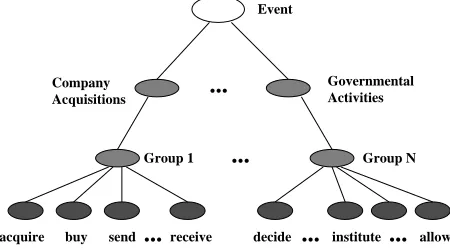
An example of the target event hierarchy is given in figure 1.
Governmental Activities Company
Acquisitions
Event
Group 1 Group N
acquire buy send receive decide institute allow
...
...
[image:4.612.324.549.403.528.2]...
...
...
Figure 1: Top levels in theeventhierarchy vs. verb clusters
Currently, a set of event types (< main groupings
in a financial domain ranging from ”Company
Ac-quisitions” and ”Company Assets” to ”Regulation”)
dif-ferent verbs (i.e. pattern & 2&'! derived in the
pre-vious phase). All verbs are considered1 and the ob-tained clusters represent semantic abstractions valid for more than one verb. The following is an example of the grouping of the verbs acquire to win.
cluster(141,[acquire,buy,catch, contribute,earn,gain,hire, issue,obtain,offer,order, pay,reach,receive,refer, secure,sell, serve,trade, win]).
patt(141, [ arg(’Obj’,
(’measure quantity amount quantum’ ,0),
’abstraction ’), arg(’Subj’,
(’social_group’,0), ’entity something ’) ]).
The above cluster expresses a conceptual property able to suggest a specific event subtype. Thus, manual mapping to the correct high-level concept (”Company
acquisition” event type) is made possible and more
intuitive. As semantic constraints in event types are given by base concepts, translations into Italian and Spanish rules (for example: (acquistare,
[Agent:Company,Object:Company])) are
possible. They inherit the same topological position in the event ontology. Accordingly, the world model has a structure (i.e. the main object and
event hierarchies) which is essentially language independent. Only the lowest levels are represen-tative of each language. Here, a language specific lexicalisation is required. The advantage is that most of the groups derived for English can be retained for other languages, and a simple translation suffices for most of the patterns. Lexicalisations are thus associated with the language independent abstrac-tions (i.e. matching rules over parsed texts) which control the behaviour of instances of these events in the discourse processing.
The integrated adoption of EuroWordNet and the automatic acquisition/translation of verb rules is thus the key idea leading to a successful and quick devel-opment of the large scale IE component required for automatic authoring.
1Initial partitions according to the Levin classification (Levin,
1993) are adopted. A partition of the verbs is built for each of the Levin classes and conceptual clustering is applied internally to each group.
4.2 Object Hierarchy
In typical Information Extraction processing environ-ments, the range of objects in the text is expected to be as limited and constrained as the event types. For example, when processing ’management succession’ events (MUC-6, 1995), the object types are the ob-vious person, location, organisation, time and date. Intuitively however, if the need was to process the en-tire output of a news gathering organisation, it seems clear that we must be able to capture a much wider range of possible objects which interact with cen-tral events. Rather than attempt to acquire all of this object information from the corpus data, we instead chose to use an existing multilingual lexical resource, EuroWordNet.
4.2.1 EuroWordNet
EuroWordNet (Vossen, 1998) is a multilingual lexi-cal knowledge (KB) base comprised of hierarchilexi-cal representations of lexical items for several European languages (Dutch, Italian, Spanish, German, French, Czech and Estonian). The wordnets are structured in the same way as the English WordNet developed at Princeton (Miller, 1990) in terms of synsets (sets of synonymous words) with basic semantic relations be-tween them.
In addition, the wordnets are linked to an Inter-Lingual-Index (ILI), based on the Princeton Word-Net 1.5. (WordWord-Net 1.6 is also connected to the ILI as another English WordNet (Daude et al., 2000)). Via this index, the languages are interconnected so that it is possible to go from concepts in one lan-guage to concepts in any other lanlan-guage having sim-ilar meaning. Such an index also gives access to a shared top-ontology and a subset of 1024 Base Con-cepts (BC). The Base ConCon-cepts provide a common semantic framework for all the languages, while lan-guage specific properties are maintained in the indi-vidual wordnets. The KB can be used, among oth-ers, for monolingual and cross-lingual information re-trieval, which was demonstrated by (Gonzalo et al., 1998).
4.2.2 EuroWordNet as the Object Ontology
The example rules shown in the previous section re-late to Agents which conveniently belong to a class of Named Entities as would be easily recognised under the MUC competition rules (person, company and
lo-cation for example). However, a majority of the rules
extracted automatically from the corpus data involved other kinds of semantic classes of information which play key roles in the subcategorisation patterns of the verbs.
it was necessary to extend the number of seman-tic classes beyond the usual number of predefined classes, across a variety of languages.
Representing the entirety of EWN in our object hi-erarchy would be time consuming, and lead to inef-ficient processing times. Instead we took advantage of the Base Concepts (Rodriquez et al., 1998) within EWN, a set of approximately 1000 nodes, with hier-archical structure, that can be used to generalise the rest of the EWN hierarchy.
These Base Concepts represent a core set of com-mon concepts to be covered for every language that has been defined in EWN. A concept is determined as important (and is therefore a base concept) if it is widely used, either directly or as a reference for other widely used concepts. Importance is reflected in the ability of a concept to function as an anchor to attach other concepts.
The hierarchical representation of the base con-cepts is added to the object hierarchy of the NAMIC world model. Additionally, a concept lookup function is added to the namematcher module of the NAMIC architecture. This lookup takes all common nouns in the input, and translates them into their respective EWN Base Concept codes.
This process was reversed in the event rule acquisi-tion stage, so that each occurrence of a object in a rule was translated into a Base Concept code. This has two effects. Firstly, the rules become more generic, creating a more compact rule base. Secondly, given the nature of the inter-lingual index which connects EWN lexicons, the rules became language indepen-dent at the object level. Links between the lexicali-sations of events are still required, and at present are hand-coded, but future development of the verb rep-resentations of WN might eliminate this.
In summary, this new, expanded WM covers both the domain specific events and a wide range of agents, and can be acquired largely automatically from cor-pus data, and used to process large amounts of text on a spectrum of domains by leveraging existing multi-lingual lexical resources.
5 Discussion and Future Work
The NAMIC system was created to provide an envi-ronment for automatic hypertextual authoring of mul-tilingual news articles. In order to address that task, we created language processors in three languages (English, Italian and Spanish) which allows us to cre-ate a database of conceptually analysed text. The abil-ity to analyse text in this way is vital for the authoring process, but is also applicable to a wide range of tech-nologies, including Information Retrieval in general,
and Question-Answering in particular.
Information Retrieval (Spark Jones and Willett, 1997; Rijsbergen, 1979), or document retrieval as it is in practice, is a well used, robust technology which allows users to access some subset of documents by means of a set of keywords. However, the retrieval of answers to questions by keywords, whilst easy to im-plement, suffers by their restrictive nature. For exam-ple, a keyword based retrieval mechanism would be unable to distinguish between the queries who killed
Lee Harvey Oswald? and who did Lee Harvey Os-wald kill?, operating as they do by reducing these
queries to a bag of stemmed words. By accessing the kind of knowledge base that we created in the Namic project where events and their relations are explic-itly represented, an IR system would be able to dis-tinguish between the above two queries or any other queries that require this kind of data mining.
to these questions may prompt a series of subsidiary questions.
The depth of interpretation which an experienced and educated journalist can bring to events cannot hope to be imitated by a computer, at least for some considerable time. However, what does seem pos-sible is that a computerised assistant, a sort of elec-tronic cub reporter, could assist the human journal-ist by finding and collating relevant archival mate-rials in an intelligent fashion - i.e. without precise, low-level instruction from the journalist. This multi-lingual question-answering task would be aided by the development the proposed system.
In conclusion, we believe that the creation of a sophisticated knowledge base resource can benefit many Information Technology applications - IR and Question Answering to name two. We were able to create such a resource in the NAMIC project by im-plementing a scalable IE system containing a robust world model based on EuroWordnet. We feel that this kind of automatic resource building will play a signif-icant part of future IT applications.
6 Acknowledgements
This research is funded by the European Union, grant number IST-1999-12392. We would also like to thank all of the partners in the NAMIC consortium espe-cially Yorick Wilks.
References
E. Agirre and G. Rigau. 1995. A Proposal for Word Sense Disambiguation using Conceptual Distance. In International Conference ”Recent Advances in
Natural Language Processing” RANLP’95, Tzigov
Chark, Bulgaria.
R. Basili, M.T. Pazienza, and M. Vindigni. 1997. Corpus-driven unsupervised learning of verb sub-categorization frames. In M. Lenzerini, editor,
AI*IA 97: Advances in Artificial Intelligence, Lecture Notes in Artificial Intelligence n., 1321.
Springer Verlag, Berlin.
R. Basili, M.T. Pazienza, and M. Vindigni. 2000a. Corpus-driven learning of Event Recognition Rules. In Proceedings of Machine Learning for
In-formation Extraction workshop, held jointly with the ECAI2000, Berlin, Germany.
R. Basili, M.T. Pazienza, and F.M. Zanzotto. 2000b. Customizable Modular Lexicalized Parsing. In
Proceedings of the 6th International Workshop on Parsing Technology, IWPT2000, Trento, Italy.
R. Basili, R. Catizone, L. Padro, M.T. Pazienza, R. Rigau, A. Setzer, N. Webb, Y. Wilks, and F.M. Zanzotto. 2001. Multilingual Authoring: the
NAMIC Approach. In Proceedings of the
Work-shop on Human Language Technology and Knowl-edge Management (at ACL-EACL 2001), Toulouse,
France.
J. Daude, L. Padro, and R. Rigau. 2000. Mapping WordNets using Structural Information. In
Pro-ceedings of the 38th Annual Meeting of the Associ-ation for ComputAssoci-ational Linguistics ACL’00, Hong
Kong, China.
R. Gaizauskas and K. Humphreys. 1996. XI: A Simple Prolog-based Language for Cross-Classification and Inheritance. In Proceedings of
the 6th International Conference on Artificial In-telligence: Methodologies, Systems, Applications (AIMSA96), pages 86–95.
J. Gonzalo, F. Verdejo, I. Chugur, and J. Cigarran. 1998. Indexing with WordNet Synsets can im-prove Text Retrieval. In Proceedings of the
COL-ING/ACL’98 Workshop on Usage of WordNet for NLP, Montreal, Canada.
K. Humphreys, R. Gaizauskas, S. Azzam, C. Huyck, B. Mitchell, H. Cunningham, and Y. Wilks. 1998. University of Sheffield: Description of the LaSIE-II system as used for MUC-7. In Proceedings
of the Seventh Message Understanding Confer-ences (MUC-7). Morgan Kaufman. Available at
http://www.saic.com.
B. Levin. 1993. English Verb Classes and
Alterna-tions. Chicago, Il.
G. Miller. 1990. Five Papers on WordNet.
Interna-tional Journal of Lexicography, 4(3).
MUC-6. 1995. Proceedings of the Sixth Mes-sage Understanding Conference (MUC-6). Mor-gan Kaufman. Available at http://www.saic.com. C.J. Rijsbergen. 1979. Information Retrieval.
But-terworths, London.
H. Rodriquez, S. Climent, P. Vossen, L. Bloksma, A. Roventini, F. Bertagna, A. Alonge, and W. Pe-ters. 1998. The Top-Down Strategy for Building EuroWordNet: Vocabulary Coverage, Base Con-cepts and Top Ontology. Special Issue on
Eu-roWordNet. Computers and the Humanities,
32(2-3):117–152.
K. Spark Jones and P. Willett, editors. 1997.
Read-ings in Information Retrieval. Morgan Kaufmann,
San Francisco, CA.
P. Vossen. 1998. EuroWordNet: A Multilin-gual Database with Lexical Semantic Networks.