Translation with Source Constituency and Dependency Trees
Fandong Meng†§ Jun Xie† Linfeng Song†§ Yajuan L ¨u† Qun Liu‡†
†Key Laboratory of Intelligent Information Processing Institute of Computing Technology, Chinese Academy of Sciences
§University of Chinese Academy of Sciences
{mengfandong,xiejun,songlinfeng,lvyajuan}@ict.ac.cn ‡Centre for Next Generation Localisation
Faculty of Engineering and Computing, Dublin City University [email protected]
Abstract
We present a novel translation model, which simultaneously exploits the constituency and dependency trees on the source side, to com-bine the advantages of two types of trees. We take head-dependents relations of dependency trees as backbone and incorporate phrasal n-odes of constituency trees as the source side of our translation rules, and the target side as strings. Our rules hold the property of long distance reorderings and the compatibility with phrases. Large-scale experimental result-s result-show that our model achieveresult-s result-significantly improvements over the constituency-to-string (+2.45 BLEU on average) and dependency-to-string (+0.91 BLEU on average) model-s, which only employ single type of treemodel-s, and significantly outperforms the state-of-the-art hierarchical phrase-based model (+1.12 BLEU on average), on three Chinese-English NIST test sets.
1 Introduction
In recent years, syntax-based models have become a hot topic in statistical machine translation. Accord-ing to the lAccord-inguistic structures, these models can be broadly divided into two categories: constituency-based models (Yamada and Knight, 2001; Graehl and Knight, 2004; Liu et al., 2006; Huang et al., 2006), and dependency-based models (Lin, 2004; Ding and Palmer, 2005; Quirk et al., 2005; Xiong et al., 2007; Shen et al., 2008; Xie et al., 2011). These two kinds of models have their own advan-tages, as they capture different linguistic phenome-na. Constituency trees describe how words and
se-quences of words combine to form constituents, and constituency-based models show better compatibil-ity with phrases. However, dependency trees de-scribe the grammatical relation between words of the sentence, and represent long distance dependen-cies in a concise manner. Dependency-based mod-els, such as dependency-to-string model (Xie et al., 2011), exhibit better capability of long distance re-orderings.
In this paper, we propose to combine the advan-tages of source side constituency and dependency trees. Since the dependency tree is structurally sim-pler and directly represents long distance depen-dencies, we take dependency trees as the backbone and incorporate constituents to them. Our mod-el employs rules that represent the source side as head-dependents relations which are incorporated with constituency phrasal nodes, and the target side as strings. A head-dependents relation (Xie et al., 2011) is composed of a head and all its dependents in dependency trees, and it encodes phrase pattern and sentence pattern (typically long distance reordering relations). With the advantages of head-dependents relations, the translation rules of our model hold the property of long distance reorderings and the com-patibility with phrases.
Our new model (Section 2) extracts rules from word-aligned pairs of source trees (constituency and dependency) and target strings (Section 3), and translate source trees into target strings by employ-ing a bottom-up chart-based algorithm (Section 4). Compared with the constituency-to-string (Liu et al., 2006) and dependency-to-string (Xie et al., 2011) models that only employ a single type of trees, our
᧘ࠪ/VV
㤡⢩ቄ/NR ሶ/AD ㅄ䇠ᵜ/NN
ӊ⍢/NR Ⅾ/M 䎵㓗/JJ
ㅜа/OD
NP1
VP2
VP3
᧘ࠪ
㤡⢩ቄ ሶ ӊ⍢ ㅜа Ⅾ 䎵㓗 ㅄ䇠ᵜ
NR AD VV NR OD M JJ NN
NP1
CLP QP
NP
NP
VP2
ADVP
VP3
NP
IP
(a)
(c)
Intel will launch Asia first super laptop
Chinese: 㤡⢩ቄ ሶ ᧘ࠪ ӊ⍢ ㅜа Ⅾ 䎵㓗 ㅄ䇠ᵜ
English: Intel will launch the first Ultrabook in Asia
ADVP NP
[image:2.612.87.524.66.284.2](b)
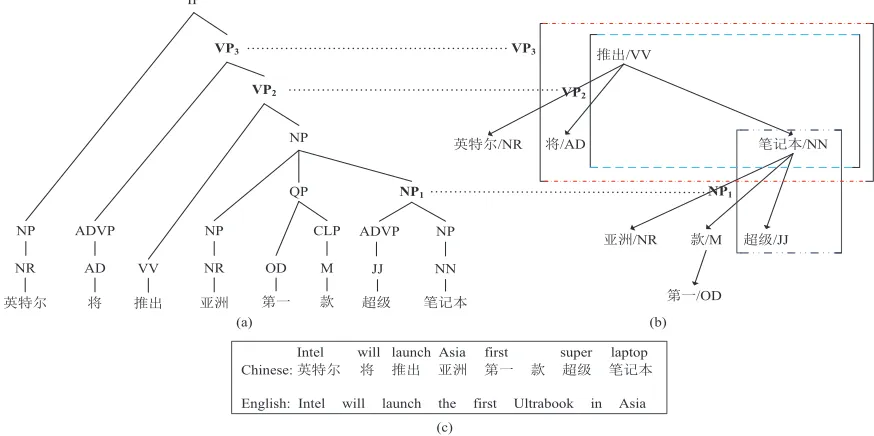
Figure 1: Illustration of phrases that can not be captured by a dependency tree (b) while captured by a constituency tree (a), where the bold phrasal nodes NP1,VP2,VP3indicate the phrases which can not be captured by dependency
syn-tactic phrases. (c) is the corresponding bilingual sentences. The subscripts of phrasal nodes are used for distinguishing the nodes with same phrasal categories.
approach yields encouraging results by exploiting t-wo types of trees. Large-scale experiments (Sec-tion 5) on Chinese-English transla(Sec-tion show that our model significantly outperforms the state-of-the-art single constituency-to-string model by av-eraged +2.45 BLEU points, dependency-to-string model by averaged +0.91 BLEU points, and hierar-chical phrase-based model (Chiang, 2005) by aver-aged +1.12 BLEU points, on three Chinese-English NIST test sets.
2 Grammar
We take head-dependents relations of dependency trees as backbone and incorporate phrasal nodes of constituency trees as the source side of our transla-tion rules, and the target side as strings. A head-dependents relation consists of a head and all its de-pendents in dependency trees, and it can represent long distance dependencies. Incorporating phrasal nodes of constituency trees into head-dependents relations further enhances the compatibility with phrases of our rules. Figure 1 shows an example of phrases which can not be captured by a dependen-cy tree while captured by a constituendependen-cy tree, such as the bold phrasal nodes NP1,VP2 and VP3. The
phrasal node NP1 in the constituency tree indicates
that “? )P” is a noun phrase and it should
be translated as a basic unit, while in the depen-dency tree it is a non-syntactic phrase. The head-dependents relation in the top level of the dependen-cy tree presents long distance dependencies of the words “=A”, “ò”, “íÑ”, and “)P” in a
concise manner, which is useful for long distance re-ordering. We adopt this kind of rule representation to hold the property of long distance reorderings and the compatibility with phrases.
Figure 2 shows two examples of our translation rules corresponding to the top level of Figure 1-(b). We can see thatr1 captures a head-dependents
rela-tion, whiler2extendsr1by incorporating a phrasal
node VP2 to replace the two nodes “íÑ/VV” and
“)P/NN”. As shown in Figure 1-(b), VP2
con-sists of two parts, a head node “íÑ/VV” and a
subtree rooted at the dependent node “)P/NN”.
Therefore, we use VP2 and the POS tags of the
t-wo nodes VV and NN to denote the part covered by VP2 in r2, to indicate that the source sequence
covered by VP2 can be translated by a bilingual
phrase. Since VP2 covers a head node “íÑ/VV”,
1 ᧘ࠪ
㤡⢩ቄ ሶ 1
1
2 1 2
[image:3.612.316.532.61.499.2]㤡⢩ቄ ሶ 1
Figure 2: Two examples of our translation rules corre-sponding to the top level of Figure 1-(b). r1captures a
head-dependents relation, andr2extendsr1 by
incorpo-rating a phrasal node VP2. “x1:NN” indicates a
substitu-tion site which can be replaced by a subtree whose root has POS tag “NN”. “x1:VP2|||VV NN” indicates a
sub-stitution site which can be replaced by a source phrase covered by a phrasal node VP (the phrasal node consist-s of two dependency nodeconsist-s with POS tag VV and NN, respectively). The underline denotes a leaf node.
VP2|||VV NN. For simplicity, we use a shorten
for-m CHDR to represent the head-dependents relations with/without constituency phrasal nodes.
Formally, our grammarGis defined as a 5-tuple
G =hΣ, Nc, Nd,∆, Ri, whereΣis a set of source language terminals, Nc is a set of constituency phrasal categories, Nd is a set of categories (POS
tags) for the terminals inΣ,∆is a set of target lan-guage terminals, and Ris a set of translation rules that include bilingual phrases for translating source language terminals and CHDR rules for translation and reordering. A CHDR rule is represented as a tripleht, s,∼i, where:
• t is CHDR with each node labeled by a ter-minal from Σ or a variable from a set X =
{x1, x2,· · · }constrained by a terminal fromΣ
or a category fromNdor a joint category (con-structed by the categories fromNcandNd);
• s∈(X ∪∆)denotes the target side string;
• ∼denotes one-to-one links between nontermi-nals intand variables ins.
We use the lexicon dependency grammar (Hellwig, 2006) which adopts a bracket representation to ex-press the head-dependents relation and CHDR. For example, the left-hand sides ofr1 andr2in Figure 2
can be respectively represented as follows: (=A) (ò)íÑ(x1:NN)
(=A) (ò) x1:VP2|||VV NN
᧘ࠪ/VV
㤡⢩ቄ/NR ሶ/AD ㅄ䇠ᵜ/NN
ӊ⍢/NRⅮ/M 䎵㓗/JJ
ㅜа/OD
NP1
VP2
VP3
㤡⢩ቄ ሶ ᧘ࠪ ӊ⍢ ㅜа Ⅾ 䎵㓗 ㅄ䇠ᵜ
Parseing Labelling
㤡⢩ቄ/NR ሶ/AD launch
Intel will launch 䎵㓗 ㅄ䇠ᵜ in Asia
Intel will launch in Asia
(a)
(b)
(c)
(d)
(e)
NP1
Ⅾ/M
ㅜа/OD
Intel will launch the first in Asia
(f)
Ultrabook
Ultrabook
ㅄ䇠ᵜ/NN
ӊ⍢/NRⅮ/M 䎵㓗/JJ
ㅜа/OD
NP1 r3
r4 r5
r6
r7
Ⅾ/M
ㅜа/OD
r8
(x1:NR) (x2:AD) ᧘ࠪ(x3:ㅄ䇠ᵜ) x1x2launch x3 Intel
㤡⢩ቄ
ሶ will
(ӊ⍢)(x1:M)x2:NP1|||JJ_NN x1x2 in Aisa
䎵㓗 ㅄ䇠ᵜ Ultrabook
ㅜа(Ⅾ) the first
Translation Rules r3
r4 r5 r6 r7 r8 (g)
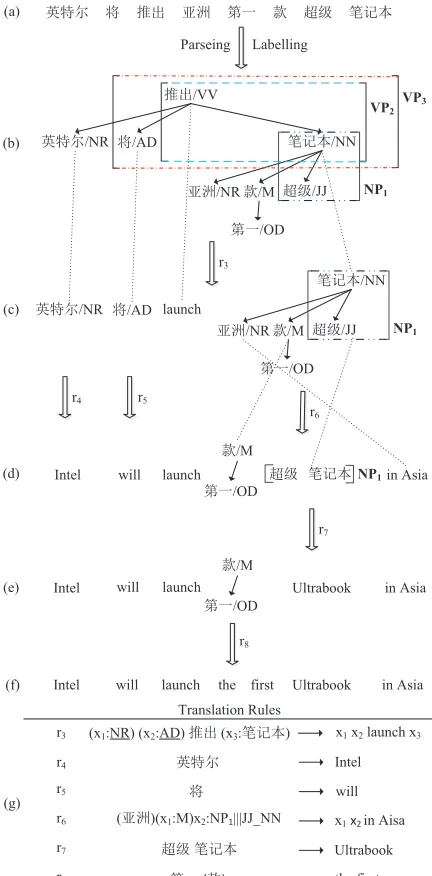
Figure 3: An example derivation of translation. (g) lists all the translation rules. r3,r6andr8 are CHDR rules,
whiler4,r5andr7are bilingual phrases, which are used
for translating source terminals. The dash lines indicate the reordering when employing a translation rule.
The formalized presentation of r2 in Figure 2-(b):
t= (=A) (ò)x1:VP2|||VV NN s=Intel will x1
∼=x1:VP2|||VV NN↔x1
where the underline indicates a leaf node.
[image:3.612.90.283.63.142.2]listed in (g). r3, r6 and r8 are CHDR rules, while
r4, r5 andr7 are bilingual phrases, which are used
for translating source language terminals. Given a sentence to translate in (a), we first parse it into a constituency tree and a dependency tree, then label the phrasal nodes from the constituency tree to the dependency tree, and yield (b). Then, we translate it into a target string by the following steps. At the root node, we apply ruler3to translate the top level
head-dependents relation and results in four unfin-ished substructures and target strings in (c). From (c) to (d), there are three steps (one rule for one step). We use r4 to translate “=A” to “Intel”, r5 to
translate “ò” to “will”, andr6to translate the
right-most unfinished part. Then, we applyr7to translate
the phrase “?)P” to “Ultrabook”, and yield
(e). Finally, we apply r8 to translate the last
frag-ment to “the first”, and get the final result (f).
3 Rule Extraction
In this section, we describe how to extract rules from a set of 4-tuples hC, T, S, Ai, whereC is a source constituency tree,T is a source dependency tree,S
is a target side sentence, andAis an word alignmen-t relaalignmen-tion bealignmen-tween T/C and S. We extract CHDR rules from each 4-tuplehC, T, S, Aibased on GHK-M algorithm (Galley et al., 2004) with three steps:
1. Label the dependency tree with phrasal nodes from the constituency tree, and annotate align-ment information to the phrasal nodes labeled dependency tree (Section 3.1).
2. Identify acceptable CHDR fragments from the annotated dependency tree for rule induction (Section 3.2).
3. Induce a set of lexicalized and generalized CHDR rules from the acceptable fragments (Section 3.3).
3.1 Annotation
Given a 4-tuple hC, T, S, Ai, we first label phrasal nodes from the constituency tree C to the depen-dency treeT, which can be easily accomplished by phrases mapping according to the common covered source sequences. As dependency trees can capture some phrasal information by dependency syntactic
᧘ࠪ/VV {3-3}{1-8}
㤡⢩ቄ/NR {1-1}{1-1}
ሶ/AD {2-2}{2-2}
ㅄ䇠ᵜ/NN {6-6}{4-8}
ӊ⍢/NR {7-8}{7-8}
Ⅾ/M {null}{4-5}
䎵㓗/JJ {6-6}{6-6}
ㅜа/OD {4-5}{4-5}
NP1 <6-6>
VP2 <3-8>
[image:4.612.315.535.57.231.2]VP3 <2-8>
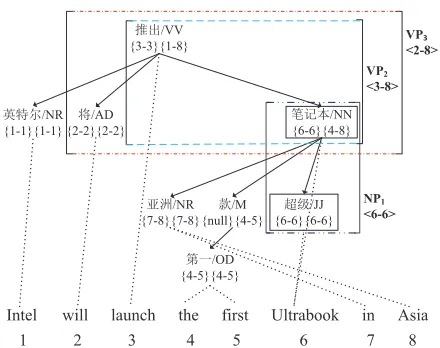
Figure 4: An annotated dependency tree. Each node is annotated with two spans, the former is node span and the latter subtree span. The fragments covered by phrasal nodes are annotated with phrasal spans. The nodes de-noted by the solid line box are notnspconsistent.
phrases, in order to complement the information that dependency trees can not capture, we only label the phrasal nodes that cover dependency non-syntactic phrases.
Then, we annotate alignment information to the phrasal nodes labeled dependency treeT, as shown in Figure 4. For description convenience, we make use of the notion of spans (Fox, 2002; Lin, 2004). Given a nodenin the source phrasal nodes labeled
T with word alignment information, the spans ofn
induced by the word alignment are consecutive se-quences of words in the target sentence. As shown in Figure 4, we annotate each nodenof phrasal n-odes labeledT with two attributes: node span and
subtree span; besides, we annotate phrasal span to
the parts covered by phrasal nodes in each subtree rooted atn. The three types of spans are defined as follows:
Definition 1 Given a noden, its node spannsp(n)
is the consecutive target word sequence aligned with the noden.
Take the node “æ³/NR” in Figure 4 for example, nsp(æ³/NR)={7-8}, which corresponds to the
tar-get words “in” and “Asia”.
Definition 2 Given a subtree T′ rooted at n, the
all nodes inT′ to the upper bound of the same set of spans.
For instance,tsp()P/NN)={4-8}, which
corre-sponds to the target words “the first Ultrabook in A-sia”, whose indexes are from 4 to 8.
Definition 3 Given a fragment f covered by a
phrasal node, the phrasal span psp(f) of f is the consecutive target word sequence aligned with source string covered byf.
For example, psp(VP2)=h3-8i, which corresponds
to the target word sequence “launch the first Ultra-book in Asia”.
We saynsp,tspandpspare consistent according to the notion in the phrase-based model (Koehn et al., 2003). For example, nsp(æ³/NR), tsp()P
/NN) and psp(NP1) are consistent whilensp( ?/JJ) andnsp()P/NN) are not consistent.
The annotation can be achieved by a single pos-torder transversal of the phrasal nodes labeled de-pendency tree. For simplicity, we call the annotat-ed phrasal nodes labelannotat-ed dependency tree annotatannotat-ed
dependency tree. The extraction of bilingual phrases
(including the translation of head node, dependen-cy syntactic phrases and the fragment covered by a phrasal node) can be readily achieved by the algo-rithm described in Koehn et al., (2003). In the fol-lowing, we focus on CHDR rules extraction.
3.2 Acceptable Fragments Identification
Before present the method of acceptable fragments identification, we give a brief description of CHDR fragments. A CHDR fragment is an annotated frag-ment that consists of a source head-dependents rela-tion with/without constituency phrasal nodes, a tar-get string and the word alignment information be-tween the source and target side. We identify the ac-ceptable CHDR fragments that are suitable for rule induction from the annotated dependency tree. We divide the acceptable CHDR fragments into two cat-egories depending on whether the fragments con-tain phrasal nodes. If an acceptable CHDR frag-ment does not contain phrasal nodes, we call it
CHDR-normal fragment, otherwise CHDR-phrasal fragment. Given a CHDR fragmentF rooted atn, we sayF is acceptable if it satisfies any one of the following properties:
CHDR-phrasal Rules
r9: (㤡⢩ቄ)(ሶ)x1:VP2|||VV_NN Intel will x1
r10: (x1:NR)(x2:AD)x3:VP2|||VV_NN x1x2x3
r11: (㤡⢩ቄ)x1:VP3|||AD_VV_NN Intel x1
r12: (x1:NR)x2:VP3|||AD_VV_NN x1x2 CHDR-normal Rules
r4: (x1:NR) (x2:AD) ᧘ࠪ(x3:NN) x1x2launch x3 Intel will launch x1 r3: (㤡⢩ቄ) (ሶ)᧘ࠪ(x1:NN)
r2: (x1:NR) (x2:AD) ᧘ࠪ(x3:ㅄ䇠ᵜ) x1x2launch x3 r1: (㤡⢩ቄ) (ሶ)᧘ࠪ(x1:ㅄ䇠ᵜ) Intel will launch x1
r5: (㤡⢩ቄ) (ሶ)x1:VV (x2:ㅄ䇠ᵜ) Intel will x1x2
r8: (x1:NR) (x2:AD) x3:VV (x4:NN) x1x2x3 x4 r6: (x1:NR) (x2:AD) x3:VV (x4:ㅄ䇠ᵜ) x1x2x3 x4
Intel will x1x2 r7: (㤡⢩ቄ) (ሶ)x1:VV (x2:NN)
(d)
᧘ࠪ/VV
㤡⢩ቄ/NR ሶ/AD ㅄ䇠ᵜ/NN
Intel 1
will 2
launch 3
the first Ultrabook in Asia 4-8
(a)
Intel 1
will 2
launch the first Ultrabook in Asia 3-8
VP2 ᧘ࠪ/VV
㤡⢩ቄ/NR ሶ/AD ㅄ䇠ᵜ/NN (b)
(c)
Intel 1
will launch the first Ultrabook in Asia 2-8
VP3 ᧘ࠪ/VV
㤡⢩ቄ/NR ሶ/AD ㅄ䇠ᵜ/NN
VP2|||VV_NN
[image:5.612.315.537.62.488.2]VP3|||AD_VV_NN
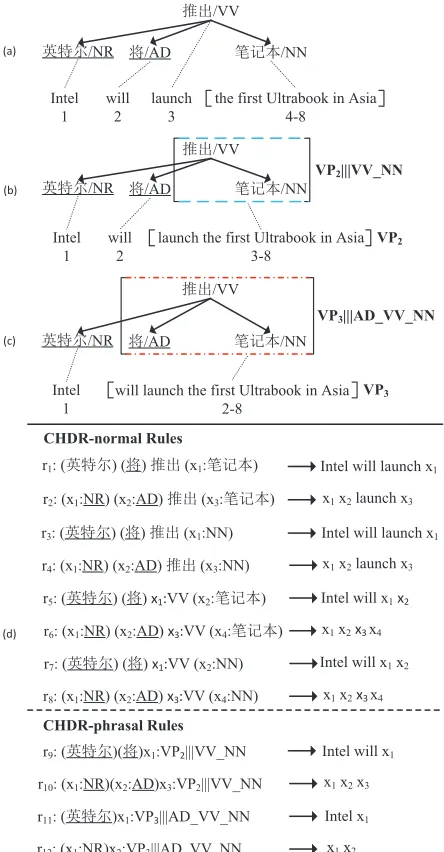
Figure 5: Examples of a CHDR-normal fragment (a), two CHDR-phrasal fragments (b) and (c) that are identified from the top level of the annotated dependency tree in Figure 4, and the corresponding CHDR rules (d) induced from (a), (b) and (c). The underline denotes a leaf node.
1. Without phrasal nodes, the node span of the root n is consistent and the subtree spans of
n’s all dependents are consistent. For example, Figure 5-(a) shows a CHDR-normal fragmen-t fragmen-thafragmen-t idenfragmen-tified from fragmen-the fragmen-top level of fragmen-the an-notated dependency tree in Figure 4, since the
nsp(íÑ/VV),tsp(=A/NR),tsp(ò/AD)
2. With phrasal nodes, the phrasal spans of phrasal nodes are consistent; and for the other nodes, the node span of head (if it is not cov-ered by any phrasal node) is consistent, and the subtree spans of dependents are consistent. For instance, Figure 5-(b) and (c) show two CHDR-phrasal fragments identified from the top level of Figure 4. In Figure 5-(b),psp(VP2),tsp(=
A/NR) and tsp(ò/AD) are consistent. In
Figure 5-(c), psp(VP3) and tsp(=A/NR)
are consistent.
The identification of acceptable fragments can be achieved by a single postorder transversal of the an-notated dependency tree. Typically, each acceptable fragment contains at most three types of nodes: head node, head of the related CHDR; internal nodes, in-ternal nodes of the related CHDR except head node; leaf nodes, leaf nodes of the related CHDR.
3.3 Rule Induction
From each acceptable CHDR fragment, we induce a set of lexicalized and generalized CHDR rules. We induce CHDR-normal rules and CHDR-phrasal rules from normal fragments and CHDR-phrasal fragments, respectively.
We first induce a lexicalized form of CHDR rule from an acceptable CHDR fragment:
1. For a CHDR-normal fragment, we first mark the internal nodes as substitution sites. This forms the input of a CHDR-normal rule. Then we generate the target string according to the node span of the head and the subtree spans of the dependents, and turn the word sequences covered by the internal nodes into variables. This forms the output of a lexicalized CHDR-normal rule.
2. For a CHDR-phrasal fragment, we first mark the internal nodes and the phrasal nodes as sub-stitution sites. This forms the input of a CHDR-phrasal rule. Then we construct the output of the CHDR-phrasal rule in almost the same way with constructing CHDR-normal rules, except that we replace the target sequences covered by the internal nodes and the phrasal nodes with variables.
For example, ruler1 in Figure 5-(d) is a lexicalized
CHDR-normal rule induced from the CHDR-normal fragment in Figure 5-(a). r9 and r11 are
CHDR-phrasal rules induced from the CHDR-CHDR-phrasal frag-ment in Figure 5-(b) and Figure 5-(c) respectively. As we can see, these CHDR-phrasal rules are par-tially unlexicalized.
To alleviate the sparseness problem, we gener-alize the lexicgener-alized CHDR-normal rules and par-tially unlexicalized CHDR-phrasal rules with un-lexicalized nodes by the method proposed in Xie et al., (2011). As the modification relations be-tween head and dependents are determined by the edges, we can replace the lexical word of each n-ode with its category (POS tag) and obtain new head-dependents relations with unlexicalized nodes keeping the same modification relations. We gen-eralize the rule by simultaneously turn the nodes of the same type (head, internal, leaf) into their cate-gories. For example, CHDR-normal rulesr2 ∼ r7
are generalized fromr1in Figure 5-(d). Besides,r10
and r12 are the corresponding generalized
CHDR-phrasal rules. Actually, our CHDR rules are the su-perset of head-dependents relation rules in Xie et al., (2011). CHDR-normal rules are equivalent with the head-dependents relation rules and the CHDR-phrasal rules are the extension of these rules. For convenience of description, we use the subscript to distinguish the phrasal nodes with the same catego-ry, such as VP2and VP3. In actual operation, we use
VP instead of VP2and VP3.
We handle the unaligned words of the target side by extending the node spans of the lexicalized head and leaf nodes, and the subtree spans of the lexical-ized dependents, on both left and right directions. This procedure is similar with the method of Och and Ney, (2004). During this process, we might ob-tain m(m ≥ 1) CHDR rules from an acceptable fragment. Each of these rules is assigned with a frac-tional count1/m. We take the extracted rule set as observed data and make use of relative frequency es-timator to obtain the translation probabilitiesP(t|s) andP(s|t).
4 Decoding and the Model
source phrasal nodes labeled dependency tree into a target stringe. The probability ofdis defined as:
P(d)∝Y i
φi(d)λi
(1)
whereφi are features defined on derivations and λi
are feature weights. In our experiments of this paper, the features are used as follows:
• CHDR rules translation probabilities P(t|s) andP(s|t), and CHDR rules lexical translation probabilitiesPlex(t|s)andPlex(s|t);
• bilingual phrases translation probabilities
Pbp(t|s) and Pbp(s|t), and bilingual phrases
lexical translation probabilitiesPbplex(t|s)and
Pbplex(s|t);
• rule penaltyexp(−1);
• pseudo translation rule penaltyexp(−1);
• target word penaltyexp(|e|); • language modelPlm(e).
We have twelve features in our model. The values of the first four features are accumulated on the CHDR rules and the next four features are accumulated on the bilingual phrases. We also use a pseudo transla-tion rule (constructed according to the word order of head-dependents relation) as a feature to guarantee the complete translation when no matched rules can be found during decoding.
Our decoder is based on bottom-up chart-based algorithm. It finds the best derivation that convert the input phrasal nodes labeled dependency tree into a target string among all possible derivations. Giv-en the source constituGiv-ency tree and depGiv-endGiv-ency tree, we first generate phrasal nodes labeled dependency treeT as described in Section 3.1, then the decoder transverses each node in T by postorder. For each noden, it enumerates all instances of CHDR rooted atn, and checks the rule set for matched translation rules. A larger translation is generated by substitut-ing the variables in the target side of a translation rule with the translations of the corresponding de-pendents. Cube pruning (Chiang, 2007; Huang and Chiang, 2007) is used to find the k-best items with integrated language model for each node.
To balance the performance and speed of the de-coder, we limit the search space by reducing the
number of translation rules used for each node. There are two ways to limit the rule table size: by a fixed limit (rule-limit) of how many rules are re-trieved for each input node, and by a threshold (rule-threshold) to specify that the rule with a score low-er thanβtimes of the best score should be discard-ed. On the other hand, instead of keeping the full list of candidates for a given node, we keep a top-scoring subset of the candidates. This can also be done by a fixed limit (stack-limit) and a threshold (stack-threshold).
5 Experiments
We evaluated the performance of our model by com-paring with hierarchical phrase-based model (Chi-ang, 2007), constituency-to-string model (Liu et al., 2006) and dependency-to-string model (Xie et al., 2011) on Chinese-English translation. First, we de-scribe data preparation (Section 5.1) and systems (Section 5.2). Then, we validate that our model sig-nificantly outperforms all the other baseline models (Section 5.3). Finally, we give detail analysis (Sec-tion 5.4).
5.1 Data Preparation
Our training data consists of 1.25M sentence pairs extracted from LDC1 data. We choose NIST MT Evaluation test set 2002 as our development set, NIST MT Evaluation test sets 2003 (MT03), 2004 (MT04) and 2005 (MT05) as our test sets. The qual-ity of translations is evaluated by the case insensitive NIST BLEU-4 metric2.
We parse the source sentences to constituency trees (without binarization) and projective depen-dency trees with Stanford Parser (Klein and Man-ning, 2002). The word alignments are obtained by running GIZA++ (Och and Ney, 2003) on the corpus in both directions and using the “grow-diag-final-and” balance strategy (Koehn et al., 2003). We get bilingual phrases from word-aligned data with algo-rithm described in Koehn et al. (2003) by running Moses Toolkit3. We apply SRI Language Modeling
Toolkit (Stolcke and others, 2002) to train a 4-gram
1
Including LDC2002E18, LDC2003E07, LDC2003E14, Hansards portion of LDC2004T07, LDC2004T08 and LD-C2005T06.
2
ftp://jaguar.ncsl.nist.gov/mt/resources/mteval-v11b.pl
3
System Rule # MT03 MT04 MT05 Average Moses-chart 116.4M 34.65 36.47 34.39 35.17 cons2str 25.4M+32.5M 33.14 35.12 33.27 33.84 dep2str 19.6M+32.5M 34.85 36.57 34.72 35.38 consdep2str 23.3M+32.5M 35.57* 37.68* 35.62* 36.29
Table 1: Statistics of the extracted rules on training data and the BLEU scores (%) on the test sets of different systems. The “+” denotes that the rules are composed of syntactic translation rules and bilingual phrases (32.5M). The “*” denotes that the results are significantly better than all the other systems (p<0.01).
language model with modified Kneser-Ney smooth-ing on the Xinhua portion of the English Gigaword corpus. We make use of the standard MERT (Och, 2003) to tune the feature weights in order to maxi-mize the system’s BLEU score on the development set. The statistical significance test is performed by
sign-test (Collins et al., 2005).
5.2 Systems
We take the open source hierarchical phrase-based system Moses-chart (with default configuration), our in-house constituency-to-string system cons2str and dependency-to-string system dep2str as our baseline systems.
For cons2str, we follow Liu et al., (Liu et al., 2006) to strict that the height of a rule tree is no greater than 3 and phrase length is no greater than 7. To keep consistent with our proposed model, we implement the dependency-to-string model (X-ie et al., 2011) with GHKM (Galley et al., 2004) rule extraction algorithm and utilize bilingual phras-es to translate source head node and dependency syntactic phrases. Our dep2str shows comparable performance with Xie et al., (2011), which can be seen by comparing with the results of hierarchical phrase-based model in our experiments. For dep2str and our proposed model consdep2str, we set rule-threshold and stack-rule-threshold to 10−3
, rule-limit to 100, stack-limit to 300, and phrase length limit to 7.
5.3 Experimental Results
Table 1 illustrates the translation results of our ex-periments. As we can see, our consdep2str sys-tem has gained the best results on all test sets, with +1.12 BLEU points higher than Moses-chart, +2.45 BLEU points higher than cons2str, and +0.91 BLEU points higher than dep2str, averagely on MT03, MT04 and MT05. Our model significantly
outper-forms all the other baseline models, with p<0.01 on statistical significance test sign-test (Collins et al., 2005). By exploiting two types of trees on source side, our model gains significant improve-ments over constituency-to-string and dependency-to-string models, which employ single type of trees. Table 1 also lists the statistical results of rules ex-tracted from training data by different systems. Ac-cording to our statistics, the number of rules extract-ed by our consdep2str system is about 18.88% larger than dep2str, without regard to the 32.5M bilingual phrases. The extra rules are CHDR-phrasal rules, which can bring in BLEU improvements by enhanc-ing the compatibility with phrases. We will conduct a deep analysis in the next sub-section.
5.4 Analysis
In this section, we first illustrate the influence of CHDR-phrasal rules in our consdep2str model. We calculate the proportion of 1-best translations in test sets that employ CHDR-phrasal rules, and we cal-l this proportion “CHDR-phrasacal-l Sent.”. Besides, the proportion of CHDR-phrasal rules in all CHDR rules is calculated in these translations, and we cal-l this proportion “CHDR-phrasacal-l Rucal-le”. Tabcal-le 2 lists the using of CHDR-phrasal rules on test sets, showing that CHDR-phrasal Sent. on all test sets are higher than 50%, and CHDR-phrasal Rule on al-l three test sets are higher than 10%. These resual-lts indicate that CHDR-phrasal rules do play a role in decoding.
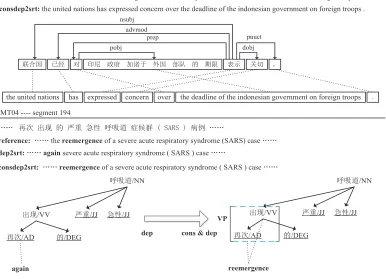
Furthermore, we compare some actual transla-tions of our test sets generated by cons2str,
de-p2str and consdede-p2str systems, as shown in
Fig-ure 6. In the first example, the Chinese input hold-s long dihold-stance dependenciehold-s “éÜI ®² é
... \u ... L« '”, which correspond
System MT03 MT04 MT05 CHDR-phrasal Sent. 50.71 61.80 56.19 CHDR-phrasal Rule 10.53 13.55 10.83
Table 2: The proportion (%) of 1-best translations that employs CHDR-phrasal rules (CHDR-phrasal Sent.) and the proportion (%) of CHDR-phrasal rules in all CHDR rules in these translations (CHDR-phrasal Rule).
phrase+verb+noun”. Cons2str gives a bad result
with wrong global reordering, while our consdep2str system gains an almost correct result since we cap-ture this pattern by CHDR-normal rules. In the sec-ond example, we can see that the Chinese phrase “2gÑy” is a non-syntactic phrase in the
depen-dency tree, and this phrase can not be captured by head-dependents relation rules in Xie et al., (2011), thus can not be translated as one unit. Since we en-code constituency phrasal nodes to the dependency tree, “2gÑy” is labeled by a phrasal node “VP”
(means verb phrase), which can be captured by our CHDR-phrasal rules and translated into the correct result “reemergence” with bilingual phrases.
By combining the merits of constituency and dependency trees, our consdep2str model learns CHDR-normal rules to acquire the property of long distance reorderings and CHDR-phrasal rules to ob-tain good compatibility with phrases.
6 Related Work
In recent years, syntax-based models have witnessed promising improvements. Some researchers make efforts on constituency-based models (Graehl and Knight, 2004; Liu et al., 2006; Huang et al., 2006; Zhang et al., 2007; Mi et al., 2008; Liu et al., 2009; Liu et al., 2011; Zhai et al., 2012). Some works pay attention to dependency-based models (Lin, 2004; Ding and Palmer, 2005; Quirk et al., 2005; Xiong et al., 2007; Shen et al., 2008; Xie et al., 2011). These models are based on single type of trees.
There are also some approaches combining mer-its of different structures. Marton and Resnik (2008) took the source constituency tree into account and added soft constraints to the hierarchical phrase-based model (Chiang, 2005). Cherry (2008) u-tilized dependency tree to add syntactic cohesion to the phrased-based model. Mi and Liu, (2010)
proposed a constituency-to-dependency translation model, which utilizes constituency forests on the source side to direct the translation, and depen-dency trees on the target side to ensure grammati-cality. Feng et al. (2012) presented a hierarchical chunk-to-string translation model, which is a com-promise between the hierarchical phrase-based mod-el and the constituency-to-string modmod-el. Most work-s make effort to introduce linguiwork-stic knowledge in-to the based model and hierarchical phrase-based model with constituency trees. Only the work proposed by Mi and Liu, (2010) utilized constituen-cy and dependenconstituen-cy trees, while their work applied two types of trees on two sides.
Instead, our model simultaneously utilizes con-stituency and dependency trees on the source side to direct the translation, which is concerned with com-bining the advantages of two types of trees in trans-lation rules to advance the state-of-the-art machine translation.
7 Conclusion
In this paper, we present a novel model that si-multaneously utilizes constituency and dependency trees on the source side to direct the translation. To combine the merits of constituency and dependen-cy trees, our model employs head-dependents rela-tions incorporating with constituency phrasal nodes. Experimental results show that our model exhibits good performance and significantly outperforms the state-of-the-art constituency-to-string, dependency-to-string and hierarchical phrase-based models. For the first time, source side constituency and depen-dency trees are simultaneously utilized to direct the translation, and the model surpasses the state-of-the-art translation models.
Since constituency tree binarization can lead to more constituency-to-string rules and syntactic phrases in rule extraction and decoding, which im-prove the performance of constituency-to-string sys-tems, for future work, we would like to do research on encoding binarized constituency trees to depen-dency trees to improve translation performance.
Acknowledgments
MT05 ---- segment 448
㚄ਸഭ ᐢ㓿 ሩ ঠቬ ᭯ᓌ ࣐䈨Ҿ ཆഭ 䜘䱏 Ⲵ ᵏ䲀 㺘⽪ ޣ࠷DŽ
cons2srt:united nations with the indonesian government have expressed concern over the time limit for foreign troops .
consdep2srt: the united nations has expressed concern over the deadline of the indonesian government on foreign troops .
reference:The United Nations has expressed concern over the deadline the Indonesian government imposed on foreign troops.
㚄ਸഭ ᐢ㓿 ሩ ঠቬ ᭯ᓌ ࣐䈨Ҿ ཆഭ 䜘䱏 Ⲵ ᵏ䲀 㺘⽪ ޣ࠷ DŽ dobj pobj
prep advmod nsubj
pnuct
the united nations has expressed concern over the deadline of the indonesian government on foreign troops .
ĂĂ ⅑ ࠪ⧠ Ⲵ ѕ䟽 ᙕᙗ બ੨䚃 ⯷ى㗔 6$56⯵ֻ ĂĂ
dep2srt: ĂĂagainsevere acute respiratory syndrome ( SARS ) case ĂĂ
consdep2srt: ĂĂreemergenceof a severe acute respiratory syndrome ( SARS ) caseĂĂ
reference:ĂĂthereemergenceof a severe acute respiratory syndrome (SARS) case ĂĂ MT04 ---- segment 194
dep cons & dep
ࠪ⧠/VV
⅑/AD Ⲵ/DEG
VP
reemergence
બ੨䚃/NN
ѕ䟽/JJ ᙕᙗ/JJ ࠪ⧠/VV
⅑/AD Ⲵ/DEG
again
બ੨䚃/NN
[image:10.612.114.500.108.387.2]ѕ䟽/JJ ᙕᙗ/JJ
Figure 6: Actual examples translated by the cons2str, dep2str and consdep2str systems.
863 State Key Project (No. 2011AA01A207), and National Key Technology R&D Program (No. 2012BAH39B03), Key Project of Knowledge Inno-vation Program of Chinese Academy of Sciences (No. KGZD-EW-501). Qun Liu.s work was
partially supported by Science Foundation Ireland (Grant No. 07/CE/I1142) as part of the CNGL at Dublin City University. Sincere thanks to the anonymous reviewers for their thorough reviewing and valuable suggestions. We appreciate Haitao Mi, Zhaopeng Tu and Anbang Zhao for insightful ad-vices in writing.
References
Colin Cherry. 2008. Cohesive phrase-based decoding for statistical machine translation. In ACL, pages 72–80.
David Chiang. 2005. A hierarchical phrase-based model for statistical machine translation. In Proceedings of the 43rd Annual Meeting on Association for Computa-tional Linguistics, pages 263–270.
David Chiang. 2007. Hierarchical phrase-based transla-tion. Computational Linguistics, 33(2):201–228. Michael Collins, Philipp Koehn, and Ivona Kuˇcerov´a.
2005. Clause restructuring for statistical machine translation. In Proceedings of the 43rd Annual Meet-ing on Association for Computational LMeet-inguistics, pages 531–540.
Yuan Ding and Martha Palmer. 2005. Machine trans-lation using probabilistic synchronous dependency in-sertion grammars. In Proceedings of the 43rd Annual Meeting on Association for Computational Linguistic-s, pages 541–548.
Yang Feng, Dongdong Zhang, Mu Li, Ming Zhou, and Qun Liu. 2012. Hierarchical chunk-to-string transla-tion. In Proceedings of the 50th Annual Meeting of the Association for Computational Linguistics: Long Papers-Volume 1, pages 950–958.
Heidi J Fox. 2002. Phrasal cohesion and statistical machine translation. In Proceedings of the ACL-02 conference on Empirical methods in natural language processing-Volume 10, pages 304–3111.
Pro-ceedings of HLT/NAACL, volume 4, pages 273–280. Boston.
Jonathan Graehl and Kevin Knight. 2004. Training tree transducers. In Proc. HLT-NAACL, pages 105–112. Peter Hellwig. 2006. Parsing with dependency
gram-mars. An International Handbook of Contemporary Research, 2:1081–1109.
Liang Huang and David Chiang. 2007. Forest rescoring: Faster decoding with integrated language models. In Annual Meeting-Association For Computational Lin-guistics, volume 45, pages 144–151.
Liang Huang, Kevin Knight, and Aravind Joshi. 2006. S-tatistical syntax-directed translation with extended do-main of locality. In Proceedings of AMTA, pages 66– 73.
Dan Klein and Christopher D Manning. 2002. Fast exact inference with a factored model for natural language parsing. In Advances in neural information processing systems, volume 15, pages 3–10.
Philipp Koehn, Franz Josef Och, and Daniel Marcu. 2003. Statistical phrase-based translation. In Proceed-ings of the 2003 Conference of the North American Chapter of the Association for Computational Linguis-tics on Human Language Technology-Volume 1, pages 48–54.
Dekang Lin. 2004. A path-based transfer model for ma-chine translation. In Proceedings of the 20th interna-tional conference on Computainterna-tional Linguistics, pages 625–630.
Yang Liu, Qun Liu, and Shouxun Lin. 2006. Tree-to-string alignment template for statistical machine trans-lation. In Proceedings of the 21st International Con-ference on Computational Linguistics and the 44th annual meeting of the Association for Computational Linguistics, pages 609–616.
Yang Liu, Yajuan L¨u, and Qun Liu. 2009. Improving tree-to-tree translation with packed forests. In Pro-ceedings of the Joint Conference of the 47th Annual Meeting of the ACL and the 4th International Join-t Conference on NaJoin-tural Language Processing of Join-the AFNLP: Volume 2-Volume 2, pages 558–566.
Yang Liu, Qun Liu, and Yajuan L¨u. 2011. Adjoining tree-to-string translation. In Proceedings of the 49th Annual Meeting of the Association for Computational Linguistics: Human Language Technologies-Volume 1, pages 1278–1287.
Yuval Marton and Philip Resnik. 2008. Soft syntactic constraints for hierarchical phrased-based translation. In Proceedings of ACL-08: HLT, pages 1003–1011. Haitao Mi and Qun Liu. 2010. Constituency to
depen-dency translation with forests. In Proceedings of the 48th Annual Meeting of the Association for Computa-tional Linguistics, pages 1433–1442.
Haitao Mi, Liang Huang, and Qun Liu. 2008. Forest-based translation. In Proceedings of ACL-08: HLT, pages 192–199.
Franz Josef Och and Hermann Ney. 2002. Discrimi-native training and maximum entropy models for s-tatistical machine translation. In Proceedings of the 40th Annual Meeting on Association for Computation-al Linguistics, pages 295–302.
Franz Josef Och and Hermann Ney. 2003. A systemat-ic comparison of various statistsystemat-ical alignment models. Computational linguistics, 29(1):19–51.
Franz Josef Och and Hermann Ney. 2004. The alignmen-t alignmen-templaalignmen-te approach alignmen-to salignmen-taalignmen-tisalignmen-tical machine alignmen-translaalignmen-tion. Computational linguistics, 30(4):417–449.
Franz Josef Och. 2003. Minimum error rate training in statistical machine translation. In Proceedings of the 41st Annual Meeting on Association for Computation-al Linguistics-Volume 1, pages 160–167.
Chris Quirk, Arul Menezes, and Colin Cherry. 2005. De-pendency treelet translation: Syntactically informed phrasal smt. In Proceedings of the 43rd Annual Meeting on Association for Computational Linguistic-s, pages 271–279.
Libin Shen, Jinxi Xu, and Ralph Weischedel. 2008. A new string-to-dependency machine translation algo-rithm with a target dependency language model. In Proceedings of ACL-08: HLT, pages 577–585. Andreas Stolcke et al. 2002. Srilm-an extensible
lan-guage modeling toolkit. In Proceedings of the inter-national conference on spoken language processing, volume 2, pages 901–904.
Jun Xie, Haitao Mi, and Qun Liu. 2011. A nov-el dependency-to-string modnov-el for statistical machine translation. In Proceedings of the Conference on Empirical Methods in Natural Language Processing, pages 216–226.
Deyi Xiong, Qun Liu, and Shouxun Lin. 2007. A de-pendency treelet string correspondence model for s-tatistical machine translation. In Proceedings of the Second Workshop on Statistical Machine Translation, pages 40–47.
Kenji Yamada and Kevin Knight. 2001. A syntax-based statistical translation model. In Proceedings of the 39th Annual Meeting on Association for Computation-al Linguistics, pages 523–530.
Feifei Zhai, Jiajun Zhang, Yu Zhou, and Chengqing Zong. 2012. Tree-based translation without using parse trees. In Proceedings of COLING 2012, pages 3037–3054.