Cross-language Projection of Dependency Trees with
Constrained Partial Parsing for Tree-to-Tree Machine Translation
Yu Shen1, Chenhui Chu2∗, Fabien Cromieres2 and Sadao Kurohashi1 1Graduate School of Informatics, Kyoto University
2Japan Science and Technology Agency
{shen-yu,kuro}@nlp.ist.i.kyoto-u.ac.jp {chu,fabien}@pa.jst.jp
Abstract
Tree-to-tree machine translation (MT) that utilizes syntactic parse trees on both source and target sides suffers from the non-isomorphism of the parse trees due to parsing errors and the difference of an-notation criterion between the two lan-guages. In this paper, we present a method that projects dependency parse trees from the language side that has a high quality parser, to the side that has a low qual-ity parser, to improve the isomorphism of the parse trees. We first project a part of the dependencies with high confidence to make a partial parse tree, and then com-plement the remaining dependencies with partial parsing constrained by the already projected dependencies. MT experiments verify the effectiveness of our proposed method.
1 Introduction
According to how syntactic parse trees are used in machine translation (MT), there are 4 types of MT approaches: string-to-string that does not use parse trees (Chiang, 2005; Koehn et al., 2007), string-to-tree that uses parse trees on the target side (Galley et al., 2006; Shen et al., 2008), tree-to-string that uses parse trees on the source side (Quirk et al., 2005; Liu et al., 2006; Mi and Huang, 2008), and tree-to-tree that uses parse trees on both sides (Zhang et al., 2008; Richardson et al., 2015). Intuitively, the tree-to-tree approach seems to be the most appropriate. The reason is that it could preserve the structure information on both sides, which leads to fluent and accurate translations.
In practice, however, good quality parsers on both the source and target sides are difficult to
ac-∗Corresponding author.
quire. In many cases, the parsing quality of one side is much higher than that of the other side, because the higher quality side has a well anno-tated treebank or is linguistically easier to parse. For example, in the case of Japanese-Chinese MT that we study in this paper, the head-final charac-teristic of Japanese (Isozaki et al., 2010) makes the dependency parsing for Japanese much eas-ier than that of Chinese. Currently, the depen-dency parsing accuracy of Japanese is over 90% (Kawahara and Kurohashi, 2006), while the Chi-nese parsing accuracy is less than 80% (Shen et al., 2012). Another problem is the annotation cri-terion difference of the treebanks in different lan-guages, which are used for training the parsers. For example, the dependency annotations of noun phrases and coordination could be different among different languages. For example, in Japanese, noun phrases and coordination are annotated as modifier-head dependencies (Kawahara and Kuro-hashi, 2006), while in Chinese they are annotated as sibling dependencies (Shen et al., 2012). These two problems lead to the parse difference between the source and target parse trees, which affects the translation rule extraction in tree-to-tree MT that requires the isomorphism of the parse trees. This extremely limits the translation quality of tree-to-tree MT.
In this paper, we present an approach that projects dependency trees from a high quality (HQ) parser to a low quality (LQ) parser using alignment information. The projection could re-duce the parsing errors on the LQ side, and ad-dress the annotation criterion difference problem. This can make the LQ trees isomorphic to the HQ trees, which can benefit the translation rule extrac-tion in tree-to-tree MT, and thus improve the MT performance. The idea of cross-language projec-tion of parse trees has been proposed previously, e.g., (Ganchev et al., 2009; Jiang et al., 2010; Goto
!"# $%# &'# ()#
*# +,#
!"#$%&'
!"$%&'() *+,!
!"#$%&#'($)*+#,-&.)/#0#1#%.!
($%#$%&'
"#$%&'()) *+,-./,01234!
!"# ()#
*# -.##
/!0#
56789!
'(! )!
:;! &!
1!
234! $%!
'(! )!
*+,-./,0! &!
1! 234!
"#!
()# +,#
*+,-./,0! 1!
<=4!
12# &'#
>?! $%!
$%# 34#
"#! @A!
BBBCCCCCCCCCCCCCCCCCDDDDDDBBB!
Fig. 1: An example of the KyotoEBMT system on Chinese-to-Japanese translation.
et al., 2015). However, few studies have been con-ducted in the context of dependency based tree-to-tree MT, which is the setting of this paper.
In addition, we propose a novel constrained par-tial parsing method to address the word alignment problems such as unaligned words and alignment errors in projection. In detail, we first apply a par-tial projection step to project a part of the depen-dencies with high confidence judged by the align-ment information and a projectivity criterion. We thus obtain a projected “partial tree.” We then find the missing dependencies from this partial tree by applying a “partial parsing” method: we apply a parser to find the missing dependencies subject to respecting the projected dependencies, so that we obtain a full dependency tree. Initially, the LQ parser is used for the partial parsing process. Once the entire projection process has been finished, we select a part of the projected trees based on the de-pendency projection ratio of the partial projection step, and re-train a parser for the LQ side. This re-trained parser tends to be more isomorphic to the HQ parser, and thus we again apply it for the partial parsing process.
We conduct experiments with an open source dependency based tree-to-tree MT system
Ky-otoEBMT1 (Richardson et al., 2015) on the
Japanese-Chinese language pair. Because of the improvement of the isomorphism of the source and target parse trees by our proposed method, we achieve significant MT performance improve-ments on both Japanese-to-Chinese and Chinese-to-Japanese translation directions.
2 The Difficulties of Tree-to-Tree MT
2.1 Overview of the KyotoEBMT System This study is conducted on the KyotoEBMT sys-tem (Richardson et al., 2015), which is a
represen-1http://nlp.ist.i.kyoto-u.ac.jp/EN/index.php?KyotoEBMT
[image:2.595.75.290.67.201.2]tative dependency based tree-to-tree MT system. Figure 1 shows an overview of the KyotoEBMT system on Chinese-to-Japanese translation. The translation example database is automatically con-structed from a parallel training corpus by means of a discriminative alignment model (Riesa et al., 2011). It contains “examples” that form the hy-potheses to be combined during decoding. Note that both source and target sides of all the exam-ples are stored in dependency trees. An input sen-tence is also parsed and transformed into a depen-dency tree. For all the subtrees in the input de-pendency tree, matching hypotheses are searched in the example database. This step is the most time consuming part, and a fast subtree retrieval method (Cromieres and Kurohashi, 2011) is used. There are many available hypotheses for one sub-tree, and also, there are many possible hypothesis combinations. The best combination is detected by a lattice-based decoder, which optimizes a log-linear model (Cromieres and Kurohashi, 2014). In the example in Figure 1, four hypotheses are used. They are combined and produce an output depen-dency tree, which is the final translation. For more details of the system, please refer to (Richardson et al., 2015).
2.2 The Translation Example Extraction Problem
One advantage of the KyotoEBMT system is that it can handle examples that are discontinuous as a word sequence but continuous structurally, be-cause of the usage of both source and target parse trees. In Figure 2, for example, the translation
ex-ample of “26-31:類似することを示唆する/4:表明
14:类似(show the similarity)” and “0-2:このこと
は30-35:示唆するものと思われる/0-4:认为这一
现象表明 (I think that this phenomenon shows)”
can be extracted by the KyotoEBMT system, be-cause they are continuous in the parse trees. How-ever, in phrase based MT (Koehn et al., 2007), both of these two translation examples could not
be extracted. The reason for this is that “4:表明
(show)” and “14:类似(similarity)” are
discontin-uous in the Chinese sentence; similarly, “0-2:この
ことは(this phenomenon)” and “30-35:示唆する
ものと思われる(I think that shows)” are
discon-tinuous in the Japanese sentence.
!"#$%&'%()'**+*! (,#-! .,'%+&'%+%! (,#%/ ! (,#-! .,' %+ & ' %+ % ! -, + 0 ! -1.! 2-! 2-! 13-+*.4+%! 5',16#+*! !"#$#"%&'(! +%"7! #%8"93'! -(1%31*3! -1&."'! "#:9#3! 13-+*.4+%! 5',16#+*! -#&#"1*! -,+0! (,#%/! -1. !
2-! !2- 13-+
*.4+ % ! 5' ,16 #+ * ! #) *" #+ #' ( ! -#&#"1* ! 1%3 ! + % "7 ! #% 8"9 3 ' !
2-! -(1%31*3
! -1&."' ! "#: 9 #3 ! 2-! 13-+ *.4+ % ! 5' ,16 #+ * ! 2-! ;! <! ;! <! ;
! !< !; !<
[image:3.595.137.468.65.390.2]=1.1%'-'! >, #% ' -' ! ?1*-#%$)'**+*! (,#%$!
Fig. 2: A motivated example that shows a word aligned Japanese-Chinese parse tree pair, where the solid black boxes show the word alignments.
of the extracted examples. This could be a prob-lem because of two reasons. The main reason is parsing error. In Figure 2, for example, because of the parsing errors in the Chinese parse tree, the
translation examples of “3-8:樹液中のK+の
/6-10:树液中K+的 (sap’s K+),” and “13-17:K+
のみを含む/16-19:只含K+ (only include K+)”
could not be extracted. The other reason is the an-notation criterion difference. In Figure 2, for
ex-ample, the translation example of “18:標準19:試
料/21:标准22:试样(standard sample)” could not
be extracted, though both of the parses are correct. In Japanese this kind of noun phrase structure is annotated as the modifier-head, while in Chinese it is annotated as siblings depending on the last word.
One possible solution to address the above problem is to loosen the constraint for translation example extraction. For example, to extract the
“18:標準19:試料/21:标准22:试样(standard
sam-ple)” example caused by the annotation criterion difference, we might allow the extraction of exam-ples that are modifier-head and sibling subtrees on the source and target sides, respectively. However,
!"#$%#& '#"()()*& +"'"! !"#,"-& .#/0%1,/)! !"#,"-& ."#$()*! 23&'#%%&45"6! 73&'#%%&4896! !#/0%1'%+&& '#%%! !"#,"--:&& .#/0%1'%+&'#%%! ;! <!
=! >!
[image:3.595.310.525.435.522.2];! =! <! >! ;! =! <! >! ;! =! <! >!
Fig. 3: An overview of our constrained partial parsing based projection method.
firstly, even the loosening in this degree could also lead to other noisy translation examples; secondly, what kind of loosening is required for the parse error case is unclear, because the types of parse er-rors are diverse. Therefore, instead of loosening the constraint, we choose the cross-lingual projec-tion approach to address the problem.
3 Projection of Dependency Trees with Constrained Partial Parsing
dependencies from the HQ tree using the HQ tree, word alignment information and a projectivity cri-terion. Note that the word alignment information is omitted in Figure 3 for simplification. In Fig-ure 3, the circled part in the HQ tree is projected. Next, we apply partial parsing to complement the other dependencies in the partially projected tree using the LQ parser. In Figure 3, as the LQ parser could parse the circled part in the original LQ tree correctly, it also complements the dependencies for the partially projected tree correctly. Once we obtained the projected trees, we select a part of the highly confident projected trees as training data to train the LQ parser. Finally, we apply the re-trained LQ parser for the partial parsing process, which further improves the quality of projection.
In the remaining of this section, we describe the details of partial projection, partial parsing, and re-training of the LQ parser in Section 3.1, 3.2, and 3.3 respectively.
3.1 Partial Projection
3.1.1 Direct Mapping for Dependency Tree Projection
We first present a direct mapping method for de-pendency tree projection using word alignment, which can be formalized as below.
Given a parallel sentence pair (S, T), where
S = s1...si...sn, and T = t1...tj...tm are
sen-tences of the HQ and LQ sides, respectively; si
and tj denote the word index (which also
de-notes the node index in the dependency tree) in the corresponding sentences. We have a depen-dency tree forSdenoted asT reeS ={(si, sk)...} that is composed of a set of dependencies, where
(si, sk) means that the word si is dependent on
the wordsk. We also have an alignment setA =
{a(si, tj)...}fromS toT, where a(si, tj) means
that the HQ wordsi is aligned to the LQ wordtj.
The new LQ parse treeT reenewT is projected from
T reeS. We first perform the following preprocess-ing for the unaligned HQ words.
• unaligned words (HQ side): If si is an un-aligned word, link the dependencies around si. More specifically, if si is unaligned, and (sh, si) ∈ T reeS, (si, sk) ∈ T reeS, we add (sh, sk) to T reeS, and discard (sh, si) and (si, sk) from T reeS. This preprocess can make two distinct words separated by unaligned words be a modifier-head pair.
For example, in Figure 2, because “32:もの
(thing)” is an unaligned word, we add (30:示
唆(show), 33:と(and)) toT reeS.
We then process each source nodesi inT reeS
in a top-down manner (from the root node to the leaf node) by applying the following rules divided by the alignment types.
• one to one alignment: Ifsi aligns to a unique tj, sk aligns to a unique tl, and (si, sk) ∈ T reeS, add(tj, tl)toT reenewT . For example,
in Figure 2, the Japanese dependency (0:この
(this), 1:こと(phenomenon)) is projected to
the Chinese side as (1:这2:一 (this)) by
ap-plying this rule.
• many to one alignment: If(si, sk, ...)aligns to tj, we take the head sr (e.g., sk) from (si, sk, ...) as the representative, and then perform the same process as in the one to one alignment case. For example, in
Fig-ure 2, a(33:と34:思わ35:れる(think), 0:认
为(think)) is a many to one alignment, and
we select the head “34:思わ” as the
represen-tative.
• one to many alignment: If si aligns to sev-eral words(tj, tl, ...), similar to the many to
one alignment case, we take the headtr(e.g.,
tj) from(tj, tl, ...)based on the original LQ tree as the representative, and then perform the same process as in the one to one align-ment case forsiandtr.
• many to many alignment: Reduce this to one-to-many and many-to-one cases, i.e., select the representatives for both sides, and then perform the same process as in the one to one alignment case.
3.1.2 Partial Projection with Direct Mapping There are several cases that the direct mapping method could not deal with:
1. the other nodes in the one to many alignment case: For the nodes (e.g., tl) (in (tj, tl, ...)
that align to one wordsi) other than the
rep-resentativetr, there are no clues to determine
their dependencies during the projection.
2. unaligned words (LQ side): If tj is an un-aligned word, there are also no clues for the projection. For example, in Figure 2, because
“15:与(and)” and “20:的(’s)” are unaligned
words, we cannot determine their dependen-cies by projection.
3. alignment errors: Because the direct map-ping method highly depends on word align-ments, erroneous word alignments would lead to wrong projected dependency results. For example, in Figure 2, the Japanese
word “12:むしろ(preferably)” is incorrectly
aligned to the Chinese word “13:及其
(ex-tremely)”; this erroneous alignment would
project the Japanese dependency (12:むしろ
(preferably), 14:+) to the Chinese side,
lead-ing to a projected dependency of (13:及其
(extremely), 19:+), which is obviously in-correct. Alignment errors could happen due to many factors, one of which is translation shift. The erroneous alignment in Figure 2 is caused by this.
Because of the existence of the above cases, we only apply the direct mapping method for partial projection. For the (1) and (2) cases, we leave the dependencies for these words as null. For the (3) case, we propose a projectivity criterion to detect the alignment error, and again leave the dependen-cies as null. Note that all of these three cases are processed during the top-down projection process. 3.1.3 Adding a Projectivity Criterion to the
Projection Process
Projectivity is a property of dependency pars-ing, which informally means that there should not be crossing arcs in a dependency tree (Kubler
et al., 2009). For example, T reenewT =
{(0,2)(1,3)(2,3)(3,−1)}(-1 denotes the root) is not projective, because the arc of modifier-head pair (0,2) and that of modifier-head pair (1,3) is crossed. We use the projectivity property to de-tect alignment errors during the top-down projec-tion process. Suppose that by processing the HQ tree from the root, we already have a partially pro-jected LQ subtree. Next, we want to project a new dependency in the HQ tree to the LQ side. If adding this newly projected dependency to the
par-tially projected subtree leads to non-projectivity,2
we give up this projection and leave the depen-dency as null.
Many alignment errors can be detected by the property of projectivity. For example, in Figure
2Note that not all non-projectivites are caused by
align-ment errors; a few of them are also due to translation shift.
2, if we use the erroneous alignment a(12:むし
ろ (preferably), 13:及其 (extremely)) to project
the Japanese dependency (12:むしろ(preferably),
14:+) to the Chinese side, we obtain the
depen-dency of (13:及其(extremely), 19:+). Before the
projection for the node “12:むしろ(preferably)”,
because the node “24: 挙動(behavior)” is an
an-cestor of this node in the Japanese tree, it has been
projected. The dependency (24: 挙動(behavior),
26:類似(similar)) has been projected to the
Chi-nese side, leading the dependency of (27:作用
(be-havior), 14:类似(similar)). (13:及其(extremely),
19:+) and (27:作用(behavior), 14:类似(similar))
lead to non-projectivity. Therefore, we leave the
dependency for “13:及其(extremely)” as null.
3.2 Partial Parsing
After the partial projection step, we obtain partial projected trees, with null dependencies discussed in Section 3.1.2. We then perform partial parsing to complement these null dependencies. Before the description of the partial parsing method, we first review the formalism of dependency parsing used in many previous studies such as (Kubler et al., 2009; Shen et al., 2012):
Y∗ =argmaxY∈Φ(X)score(Y, X) (1)
whereX = x1...xi...xn is the input sentence,Y
is a candidate tree, Φ(X) is a set of all possible
dependency trees over X. Y can be denoted as
Y ={(m, h) : 0 ≤m ≤ n,0 ≤h ≤n}, where
(m, h) is a dependency from the modifier xm to
the headxh. The problem of dependency parsing
is to search the best tree from Φ(X) that
maxi-mizes the score functionscore(Y, X). The score
function can be factorized as the summation of the scores of its factors (subtrees):
score(Y, X) = ∑ F∈Y
score(F, X) (2)
The score function for each factor is denoted as the inner product of a feature and a weight vector:
score(F, X) =w·f(F, X) (3)
The weight vector can be learnt by e.g., the av-eraged structured perceptron algorithm (Collins, 2002) on an annotated treebank. During parsing, the parser would utilize the learnt weight vector to determine the best parse tree.
complement the null dependencies to construct a projective tree. To realize this, we set extremely high scores to the projected dependencies to
max-imize the score(F, X) for these dependencies,
while for the null dependencies we set relatively small scores. Doing so, the parser would search the best tree that respects the partial projected dependencies. In our experiments, we used the projective second order graph based dependency parser (Shen et al., 2012). We set the initial de-pendency scores for the projected dependencies to 1e12, and0to the null dependencies.
3.3 Re-train a New Low Quality Side Parser Re-training a new LQ parser on the projected trees is necessary for two reasons. Initially, we use the original LQ parser for the partial parsing process, because we do not have a better choice; due to the low accuracy and the annotation criterion differ-ence problem of the LQ parser, we have the risk that it will produce unsatisfying parsing results, especially for the trees with a low ratio of depen-dencies being projected. Secondly, if we perform the LQ-to-HQ direction MT, we should make the parsed trees of the input sentences isomorphic to the projected trees. Re-training a new LQ parser on the projected trees could address both of these two problems. As the re-trained parser tend to be more isomorphic to the HQ parser, it could be more effective for the partial parsing process, and could be applied for parsing the input sentences for the LQ-to-HQ direction MT task.
Therefore, after the entire projection process, we select a part of the projected trees, and re-train a parser for the LQ side. How to select the pro-jected trees for training the new LQ parser is an open question. The main question is how to take the balance of the quality and quantity of the pro-jected trees. Currently, the selection criterion is empirical based on the ratio of dependencies pro-jected by the partial projection process in a tree, defined by
ratio= #projected dependencies #all dependencies (4)
The motivation behind this is that the more de-pendencies projected by the partial projection in a tree, the more isomorphic would the projected tree be as the HQ tree, and the less affect would be introduced by the original LQ parser during the partial parsing process. We set a threshold, and
use the trees with the ratio higher than the old for training the parser. We tried several thresh-olds in our preliminary experiments, and selected the best threshold of 0.78 (170k trees) based on the
MT performance.3
4 Experiments
We conducted Japanese-Chinese MT experiments to verify the effectiveness of our constrained par-tial parsing based projection method.
4.1 Settings
We conducted experiments on the scientific do-main MT task on the Japanese-Chinese paper
ex-cerpt corpus (ASPEC-JC),4 which is one
sub-task of the workshop on Asian translation (WAT)5
(Nakazawa et al., 2015). The ASPEC-JC task uses 672,315, 2,090, and 2,107 sentences for train-ing, development, and testtrain-ing, respectively. We
used the tree-to-tree MT system KyotoEBMT6
(Richardson et al., 2015) for all of our MT exper-iments. For Chinese, we used the Chinese
ana-lyzing tool KyotoMorph7proposed by Shen et al.
(2014) for segmentation and part-of-speech (POS)
tagging, and the SKP parser8 (Shen et al., 2012)
for parsing. As the baseline Chinese parser, we trained SKP with the Penn Chinese treebank
ver-sion 5 (CTB5)9 containing 18k sentences in news
domain, and an in-house scientific domain tree-bank of 10k sentences. For Japanese, we used
JU-MAN10 (Kurohashi et al., 1994) for
morpholog-ical analyzing, and the KNP parser for parsing11
(Kawahara and Kurohashi, 2006). We trained two 5-gram language models for Chinese and Japanese, respectively, on the training data of the
ASPEC corpus using the KenLM toolkit12 with
interpolated Kneser-Ney discounting, and used them for all the experiments. In all of our ex-periments, we used the discriminative alignment
model Nile13 (Riesa et al., 2011) for word
align-ment; tuning was performed by the k-best batch
3The average partial projection ratio was 0.70. 4http://lotus.kuee.kyoto-u.ac.jp/ASPEC/ 5http://orchid.kuee.kyoto-u.ac.jp/WAT/
6http://nlp.ist.i.kyoto-u.ac.jp/EN/index.php?KyotoEBMT) 7https://bitbucket.org/msmoshen/kyotomorph-beta 8https://bitbucket.org/msmoshen/skp-beta 9https://catalog.ldc.upenn.edu/LDC2005T01 10http://nlp.ist.i.kyoto-u.ac.jp/EN/index.php?JUMAN 11http://nlp.ist.i.kyoto-u.ac.jp/EN/index.php?KNP 12https://github.com/kpu/kenlm/
MIRA (Cherry and Foster, 2012) with 10 itera-tions, and it was re-run for every experiment.
Note that, in our task, Japanese is the HQ parser side, and Chinese is the LQ parser side, because of the parsing accuracy difference (90% v.s. 80%). Therefore, in our experiments, we projected the Japanese parse trees to Chinese. We compared the MT performance of our proposed projection method with the baseline Chinese parser. For Japanese-to-Chinese MT experiments, we com-pared the MT results of the Chinese training data parsed by the baseline parsed, to those of the pro-jected trees. For Chinese-to-Japanese MT, we also re-parsed the development and test Chinese sen-tences using the SKP model trained on the pro-jected Chinese trees, for the comparison.
[image:7.595.306.527.62.163.2]4.2 MT Results
Table 1 shows the results, where KyotoEBMT is the baseline system that used the Chinese parser trained on CTB5; Baseline partial parsing de-notes the projection systems that used the Chi-nese parser trained on CTB5 for the partial pars-ing process; Re-trained partial parspars-ing denotes the systems that used the Chinese parser re-trained on the projected trees for the partial parsing pro-cess. For reference, we also show the MT per-formance of the phrase based, string-to-tree, and tree-to-string systems, which are based on the open-source GIZA++/Moses pipeline (Koehn et al., 2007). Note that in all of the Moses, string-to-tree, and tree-to-string settings, Japanese is always in the string format, and Chinese is parsed by the
Berkeley parser14(Petrov and Klein, 2007).15 The
significance tests were performed using the boot-strap resampling method (Koehn, 2004).
We can see that, the Baseline KyotoEBMT sys-tem outperforms the Moses, string-to-tree, and tree-to-string systems, which verifies the effective-ness of the tree-to-tree approach. The performance difference of KyotoEBMT against the other three MT approaches on the Ja-to-Zh direction is much larger than those of the Zh-to-Ja direction. The reason for this is that KyotoEBMT is much more sensitive to the parsing accuracy on the source side, because the source tree is utilized in the or-dering of the final translation. Therefore using Chinese as the source side limits the effectiveness
14https://github.com/slavpetrov/berkeleyparser
15We show the MT performance of Moses that only parsed
the Chinese data, because these were the baseline systems of WAT.
System Ja-to-Zh Zh-to-Ja
Moses phrase based 27.25 33.94
Moses string-to-tree 26.20 N/A
Moses tree-to-string N/A 33.49
Baseline KyotoEBMT 29.33 34.73
Baseline partial parsing 30.12† 35.84†
Re-trained partial parsing 30.28† 36.18†‡
Tab. 1: BLEU scores for ASPEC Ja-to-Zh and
Zh-to-Ja (“†,” and “‡” indicate that the re-sult is significantly better than “Baseline KyotoEBMT” and “Baseline partial pars-ing” atp <0.01, respectively).
System Ja-to-Zh Zh-to-Ja
Baseline KyotoEBMT 13.13M 8.43M
Baseline partial parsing 15.69M 9.88M
Re-trained partial parsing 15.69M 9.90M
Tab. 2: Number of hypotheses for the test sen-tences.
of the KyotoEBMT system. Baseline partial pars-ing performs significantly better than the Baseline KyotoEBMT, and Re-trained partial parsing fur-ther improves the performance significantly. We also observe slightly more improvement on the Zh-to-Ja direction than the Ja-to-Zh direction. The reason is similar to the one above that in Zh-to-Ja task, we not only improve the translation example extraction, but also the quality of the input trees.
To further understand the reason for the MT improvement, we investigated the number of potheses for the test sentences. The number of hy-potheses for a test sentence is the number all the matching hypotheses in the example database for all the subtrees in the input dependency structure of the test sentence (refer to Section 2.1). The en-tire number of hypotheses for all the test sentences of different systems are shown in table 2. We can see that the number of hypotheses for the partial parsing systems is greatly larger than the baseline KyotoEBMT system. The reason for this is that our projection method significantly increased the isomorphism of the source and target trees in the training corpus, making more translation exam-ples being extractable. More hypotheses are po-tentially to improve the final MT performance.
!"#$%&'$()*+,+-!./! 0$1,2"&'$3(4"25"%(4"2#&'6((
[image:8.595.119.480.67.257.2]7'48,! 98,48,! 7'48,! 98,48,!
Fig. 4: An improved example of Zh-to-Ja translation (The subtrees in corresponding IDs/colors in the input and output dependency trees show the translation examples being used during translation).
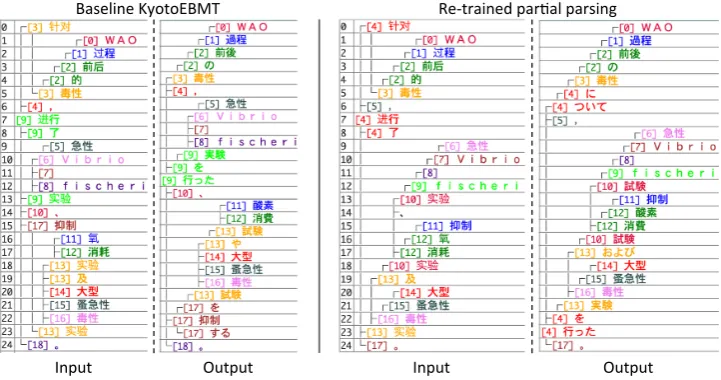
three reasons that lead to the improvement. We explain these reasons through an improved exam-ple of Zh-to-Ja translation shown in Figure 4. The first reason is the improvement of the input parse tree. There is a crucial parsing error in the input tree of the Baseline KyotoEBMT system. The Ky-otoMorph incorrectly assigned a wrong POS tag
“VV (verb)” for the word “15:抑制(inhibition)”,
which should be “NN (noun)” in fact. This leads to this word be the head of the whole following noun phrase. Using this erroneous input parse tree, this word is also translated into the head of the entire noun phrase. Our Re-trained partial parsing
cor-rectly parsed the word “15:抑制 (inhibition)” as
a part of the noun phrase “15-18:抑制氧消耗实
验(inhibition of oxygen consumption test)”,
lead-ing to the correct translation. Although the Re-trained partial parsing could not correct the wrong POS tag of the word, because we also used this kind of data to train the parser, it successfully parsed this sentence. The second reason is the in-crease of translation hypotheses. The number of hypotheses for the Baseline KyotoEBMT system is 2,447, while the number of hypotheses of the Re-trained partial parsing system is 3,311. The
number of hypotheses for “0:针 对...7:进行8:了
(about...performed)” increased from 52 to 176 by the Re-trained partial parsing system, which im-proved the translation. The third reason is the iso-morphism of the input and output target depen-dency trees. Note that the noun phrases “15-18:
抑制氧消耗实验(inhibition of oxygen
consump-tion test)” and “20-23:大型蚤急性毒性实验
(large-scale flea acute toxicity test)” are parsed as sib-lings in the Baseline KyotoEBMT system, while in our Re-trained partial parsing model they are parsed as modifier-head dependencies, which are isomorphic to the Japanese parse tree. One
unsat-isfying point is that “21:蚤急性(flea acute)” is an
unknown word, which is a difficult technical term that could not be translated by both of the two sys-tems.
5 Related Work
There are many previous studies that propose many methods to address the difficulties in pro-jecting the parse trees from a resource rich lan-guage (e.g., English) to a low resource lanlan-guage, to improve the parsing accuracy of the low re-source language. The difficulties in projection can be mainly divided into two categories: word alignment errors and annotation criterion differ-ence (Ganchev et al., 2009).
“dense” projected trees. The “dense” projected trees might only contain a part of dependencies over a threshold. Our proposed method differs from the previous studies in several aspects: we propose the use of the projectivity criterion for partial projection; we utilize the original target parser and propose a constrained partial parsing algorithm; we re-train a target parser on the full trees generated by the partial parsing.
To address the annotation criterion difference problem in projection, Hwa et al. (2005) firstly projected the dependency parse trees, and then applied post projection transformations based on manually created rules. Jiang et al. (2011) pre-sented a method that tolerates the syntactic non-isomorphism between languages. This allows the projected parse trees do not have to follow the an-notation criterion of the source parse trees. Our proposed method does not adjust the annotation criterion difference between the source and the projected trees, because in our tree-to-tree MT task, we prefer isomorphic trees.
Only a few studies have been conducted to improve MT performance via projection. For string-to-string MT (Koehn et al., 2007), Goto et al. (2015) proposed a pre-ordering method that projects target side constituency trees to the source side, and then generates pre-ordering rules based on the projected trees. For tree-to-string MT, Jiang et al. (2010) combined projection and su-pervised constituency parsing by guiding the pars-ing procedure of the supervised parser with the projected parser. They showed that the guided parser achieved comparable MT results on a tree-to-string system (Liu et al., 2006), compared to a normal supervised parser trained on thousands of CTB trees. For tree-to-tree MT (Richardson et al., 2015), Shen et al. (2015) proposed a naive projection method. They complemented the re-maining dependencies for a partially projected tree with a backtracking method. Namely, they reused the dependencies in the original target tree for the complement without considering the partially pro-jected dependencies. In contrast, in this paper we propose partial parsing for the complement, in which we search for the best parse tree by taking account of the partially projected dependencies.
6 Conclusion
In this paper, we proposed a constrained partial parsing method for projection to address the
non-isomorphic parse tree problem in a dependency based tree-to-tree MT system. Experiments ver-ified the effectiveness of our proposed method. As future work, firstly, we plan to design a better way for selecting the projected trees for re-training the LQ parser. Secondly, we plan to perform the par-tial parsing in several iterations. Finally, we plan to conduct experiments on more language pairs to show the language-dependence of our proposed method.
Acknowledgments
We especially thank to Dr. Mo Shen for the in-sightful discussion of the constrained partial pars-ing method with us.
References
Colin Cherry and George Foster. 2012. Batch tuning strategies for statistical machine translation. In Pro-ceedings of the 2012 Conference of the North Amer-ican Chapter of the Association for Computational Linguistics: Human Language Technologies, pages 427–436, Montr´eal, Canada, June. Association for Computational Linguistics.
David Chiang. 2005. A hierarchical phrase-based model for statistical machine translation. In Pro-ceedings of the 43rd Annual Meeting of the Associa-tion for ComputaAssocia-tional Linguistics (ACL’05), pages 263–270, Ann Arbor, Michigan, June. Association for Computational Linguistics.
Michael Collins. 2002. Discriminative training meth-ods for hidden markov models: Theory and experi-ments with perceptron algorithms. InProceedings of the 2002 Conference on Empirical Methods in Natural Language Processing, pages 1–8. Associ-ation for ComputAssoci-ational Linguistics, July.
Fabien Cromieres and Sadao Kurohashi. 2011. Ef-ficient retrieval of tree translation examples for syntax-based machine translation. In Proceedings of the 2011 Conference on Empirical Methods in Natural Language Processing, pages 508–518, Ed-inburgh, Scotland, UK., July. Association for Com-putational Linguistics.
Fabien Cromieres and Sadao Kurohashi. 2014. Trans-lation rules with right-hand side lattices. In Pro-ceedings of the 2014 Conference on Empirical Meth-ods in Natural Language Processing (EMNLP), pages 577–588, Doha, Qatar, October. Association for Computational Linguistics.
Computational Linguistics and 44th Annual Meet-ing of the Association for Computational LMeet-inguis- Linguis-tics, pages 961–968, Sydney, Australia, July. Asso-ciation for Computational Linguistics.
Kuzman Ganchev, Jennifer Gillenwater, and Ben Taskar. 2009. Dependency grammar induction via bitext projection constraints. InProceedings of the Joint Conference of the 47th Annual Meeting of the ACL and the 4th International Joint Conference on Natural Language Processing of the AFNLP, pages 369–377, Suntec, Singapore, August. Association for Computational Linguistics.
Isao Goto, Masao Utiyama, Eiichiro Sumita, and Sadao Kurohashi. 2015. Preordering using a target-language parser via cross-target-language syntactic projec-tion for statistical machine translaprojec-tion. ACM Trans. Asian Low-Resour. Lang. Inf. Process., 14(3):13:1– 13:23, June.
Rebecca Hwa, Philip Resnik, Amy Weinberg, Clara Cabezas, and Okan Kolak. 2005. Bootstrapping parsers via syntactic projection across parallel texts.
Natural language engineering, 11(03):311–325. Hideki Isozaki, Katsuhito Sudoh, Hajime Tsukada, and
Kevin Duh. 2010. Head finalization: A simple reordering rule for sov languages. InProceedings of the Joint Fifth Workshop on Statistical Machine Translation and MetricsMATR, pages 244–251, Up-psala, Sweden, July. Association for Computational Linguistics.
Wenbin Jiang, Yajuan Lv, Yang Liu, and Qun Liu. 2010. Effective constituent projection across lan-guages. In Coling 2010: Posters, pages 516–524, Beijing, China, August. Coling 2010 Organizing Committee.
Wenbin Jiang, Qun Liu, and Yajuan Lv. 2011. Re-laxed cross-lingual projection of constituent syntax. In Proceedings of the 2011 Conference on Empiri-cal Methods in Natural Language Processing, pages 1192–1201, Edinburgh, Scotland, UK., July. Asso-ciation for Computational Linguistics.
Daisuke Kawahara and Sadao Kurohashi. 2006. A fully-lexicalized probabilistic model for japanese syntactic and case structure analysis. InProceedings of the Human Language Technology Conference of the NAACL, Main Conference, pages 176–183, New York City, USA, June. Association for Computa-tional Linguistics.
Philipp Koehn, Hieu Hoang, Alexandra Birch, Chris Callison-Burch, Marcello Federico, Nicola Bertoldi, Brooke Cowan, Wade Shen, Christine Moran, Richard Zens, Chris Dyer, Ondrej Bojar, Alexan-dra Constantin, and Evan Herbst. 2007. Moses: Open source toolkit for statistical machine transla-tion. InProceedings of the 45th Annual Meeting of the Association for Computational Linguistics Com-panion Volume Proceedings of the Demo and Poster Sessions, pages 177–180, Prague, Czech Republic, June. Association for Computational Linguistics.
Philipp Koehn. 2004. Statistical significance tests for machine translation evaluation. In Dekang Lin and Dekai Wu, editors, Proceedings of EMNLP 2004, pages 388–395, Barcelona, Spain, July. Association for Computational Linguistics.
Sandra Kubler, Ryan McDonald, Joakim Nivre, and Graeme Hirst. 2009. Dependency Parsing. Mor-gan and Claypool Publishers.
Sadao Kurohashi, Toshihisa Nakamura, Yuji Mat-sumoto, and Makoto Nagao. 1994. Improve-ments of Japanese morphological analyzer JUMAN. In Proceedings of the International Workshop on Sharable Natural Language, pages 22–28.
Yang (1) Liu, Qun Liu, and Shouxun Lin. 2006. Tree-to-string alignment template for statistical machine translation. In Proceedings of the 21st Interna-tional Conference on ComputaInterna-tional Linguistics and 44th Annual Meeting of the Association for Compu-tational Linguistics, pages 609–616, Sydney, Aus-tralia, July. Association for Computational Linguis-tics.
Haitao Mi and Liang Huang. 2008. Forest-based translation rule extraction. In Proceedings of the 2008 Conference on Empirical Methods in Nat-ural Language Processing, pages 206–214, Hon-olulu, Hawaii, October. Association for Computa-tional Linguistics.
Toshiaki Nakazawa, Hideya Mino, Isao Goto, Gra-ham Neubig, Sadao Kurohashi, and Eiichiro Sumita. 2015. Overview of the 2nd Workshop on Asian Translation. InProceedings of the 2nd Workshop on Asian Translation (WAT2015), pages 1–28, Kyoto, Japan, October.
Slav Petrov and Dan Klein. 2007. Improved infer-ence for unlexicalized parsing. InHuman Language Technologies 2007: The Conference of the North American Chapter of the Association for Computa-tional Linguistics; Proceedings of the Main Confer-ence, pages 404–411, Rochester, New York, April. Association for Computational Linguistics.
Chris Quirk, Arul Menezes, and Colin Cherry. 2005. Dependency treelet translation: Syntactically in-formed phrasal SMT. In Proceedings of the 43rd Annual Meeting of the Association for Computa-tional Linguistics (ACL’05), pages 271–279, Ann Arbor, Michigan, June. Association for Computa-tional Linguistics.
Mohammad Sadegh Rasooli and Michael Collins. 2015. Density-driven cross-lingual transfer of de-pendency parsers. In Proceedings of the 2015 Conference on Empirical Methods in Natural Lan-guage Processing, pages 328–338, Lisbon, Portugal, September. Association for Computational Linguis-tics.
the 2nd Workshop on Asian Translation. In Pro-ceedings of the 2nd Workshop on Asian Translation (WAT2015), pages 54–60, Kyoto, Japan, October.
Jason Riesa, Ann Irvine, and Daniel Marcu. 2011. Feature-rich language-independent syntax-based alignment for statistical machine translation. In
Proceedings of the 2011 Conference on Empir-ical Methods in Natural Language Processing, pages 497–507, Edinburgh, Scotland, UK., July. Association for Computational Linguistics.
Libin Shen, Jinxi Xu, and Ralph Weischedel. 2008. A new string-to-dependency machine translation al-gorithm with a target dependency language model. In Proceedings of ACL-08: HLT, pages 577–585, Columbus, Ohio, June. Association for Computa-tional Linguistics.
Mo Shen, Daisuke Kawahara, and Sadao Kurohashi. 2012. A reranking approach for dependency pars-ing with variable-sized subtree features. In Proceed-ings of the 26th Pacific Asia Conference on Lan-guage, Information, and Computation, pages 308– 317, Bali,Indonesia, November. Faculty of Com-puter Science, Universitas Indonesia.
Mo Shen, Hongxiao Liu, Daisuke Kawahara, and Sadao Kurohashi. 2014. Chinese morphological analysis with character-level pos tagging. In Pro-ceedings of ACL, pages 253–258.
Yu Shen, Chenhui Chu, Fabien Cromieres, and Sadao Kurohashi. 2015. Cross-language projection of dependency trees for tree-to-tree machine transla-tion. InProceedings of the 29th Pacific Asia Con-ference on Language, Information and Computing (PACLIC2015), pages 80–88, Shanghai, China, 10.
Kathrin Spreyer and Jonas Kuhn. 2009. Data-driven dependency parsing of new languages using incom-plete and noisy training data. In Proceedings of the Thirteenth Conference on Computational Nat-ural Language Learning (CoNLL-2009), pages 12– 20, Boulder, Colorado, June. Association for Com-putational Linguistics.