
Volume 2008, Article ID 643081,14pages doi:10.1155/2008/643081
Review Article
Bit and Power Allocation in Constrained
Multicarrier Systems: The Single-User Case
Nikolaos Papandreou and Theodore Antonakopoulos
Department of Electrical and Computer Engineering, University of Patras, Rio, 26500 Patras, Greece
Correspondence should be addressed to Theodore Antonakopoulos, [email protected]
Received 17 January 2007; Accepted 10 July 2007
Recommended by Kostas Berberidis
Multicarrier modulation is a powerful transmission technique that provides improved performance in various communication fields. A fundamental topic of multicarrier communication systems is the bit and power loading, which is addressed in this article as a constrained multivariable nonlinear optimization problem. In particular, we present the main classes of loading problems, namely, rate maximization and margin maximization, and we discuss their optimal solutions for the single-user case. Initially, the classical water-filling solution subject to a total power constraint is presented using the Lagrange multipliers optimization approach. Next, the peak-power constraint is included and the concept of cup-limited waterfilling is introduced. The loading problem is also addressed subject to the integer-bit restriction and the optimal discrete solution is examined using combinatorial optimization methods. Furthermore, we investigate the duality conditions of the rate maximization and margin maximization problems and we highlight various ideas for low-complexity loading algorithms. This article surveys and reviews existing results on resource allocation in constrained multicarrier systems and presents new trends in this area.
Copyright © 2008 N. Papandreou and T. Antonakopoulos. This is an open access article distributed under the Creative Commons Attribution License, which permits unrestricted use, distribution, and reproduction in any medium, provided the original work is properly cited.
1. INTRODUCTION
Multicarrier modulation (MCM) [1, 2] is well recognized as an efficient and powerful transmission technique that has been adopted by various standard committees for both wireless [3–6] and wireline [7–9] systems. MCM provides important benefits including, among others, efficient band-width optimization, enhanced spectrum utilization, low equalization complexity, and multi-user potentiality. More-over, MCM is widely used in new application fields, such as powerline communications (PLC) [10,11], and wireless lo-cal area networks (WLANs) [12–14] due to its recognized value to confront various channel impairments, including frequency selectivity, intersymbol interference (ISI), and im-pulse noise.
The principle of MCM is the spectrum decomposition into a set of orthogonal narrowband subchannels by uti-lizing complex exponentials as information-bearing carri-ers. Two important MCM techniques have widespread use: orthogonal frequency-division multiplexing (OFDM) [14] mainly employed in wireless applications and discrete multi-tone (DMT) [15] used in wireline systems. Both OFDM and
DMT employ the fast Fourier transform (FFT) for spectrum decomposition, hence data transmission is performed in blocks. In order to avoid ISI and to preserve orthogonal-ity, a cyclic prefix is introduced at the expense of a data rate loss [16]. Using the cyclic prefix, the system carriers can be viewed as separate independent channels, on which different information rates can be transferred by utilizing constellations of different sizes.
constraints imposed either by recommendation rules and specifications [18], or by practical limitations and imple-mentation issues [9]. Such constraints include total available power budget, power spectral density (PSD) mask, integer number of bits per subcarrier, and so forth.
Adaptive loading is possible only when channel state information (CSI) is known both at the transmitter and the receiver. In wireless applications, the channel is time-varying and therefore OFDM systems usually employ the same constellation in all carriers. On the other hand, the wireline channel is treated either as almost constant or as slow time-varying, and therefore CSI can be sent to the trans-mitter by a feedback link. Thus, in DMT applications, the uti-lization of different signal constellations per subchannel by adaptive bit and power loading is of great importance, and as the number of subchannels required in commercial applica-tions [9,17] increases, the development of efficient loading algorithms is a challenging task.
The literature contains several loading algorithms proposed for DMT-based systems. These algorithms con-sider either the RM or the MM problem, and two general classes can be distinguished. The first class of loading algo-rithms treats the allocation problem using numerical meth-ods that employ Lagrange optimization, which in general re-sults in real numbers for optimum bit allocation [19–22]. However, for practical applications, the number of bits per subchannel is restricted to integer values, and thus, the above algorithms include a final suboptimum bit-rounding step. The integer-bit constraint imposes a combinatorial struc-ture in the loading optimization problem. The second class of loading algorithms employs discrete greedy-type methods in order to obtain the optimum integer-bit allocation results [23–27].
This article aims at providing a tutorial survey on the bit and power loading in constrained multicarrier systems and at reviewing the most popular results on the loading algorithms for the RM and MM problems. We examine the single-user communications scenario, that is, a point-to-point link between a DMT-based transmitter and a receiver. We start out with a short introductory overview of the multicarrier basics. Then, the loading problem is considered only subject to a total power constraint and the classical water-filling solu-tion is discussed using the Lagrange multipliers optimizasolu-tion approach. Next, the peak-power constraint is included and the concept of cup-limited water-filling is introduced. The loading problem is also addressed subject to the integer-bit restriction and the optimal discrete solution is examined us-ing combinatorial optimization methods. Moreover, we in-vestigate the duality conditions of the RM and MM loading problems and we highlight some ideas for low-complexity loading algorithms. This article aims to provide the basic knowledge for more complex and challenging problems of bit and power allocation in constrained multicarrier systems under the multi-user context.
2. MULTICARRIER LOADING
MCM decomposes the channel spectrum into a set of N
orthogonal narrowband subchannels of equal bandwidths
[1]. For each subchanneli, where 1≤i≤N, a rate function R(Pi) is defined, which gives the number of bitsbithat can
be transmitted using powerPi. The rate function depends on
the maximum probability of error that can be tolerated and the applied modulation and coding schemes, which we as-sume to be shared among all the subchannels. In addition, we assume the existence of the inverse functionR−1(b
i), namely,
power function, which gives the powerPi required for the
transmission ofbi bits. We consider practical QAM-coded
MCM, where the rate function is given by the following log-arithmic expression in bits per two-dimensional symbol:
bi=log2
1 +Pi·gi
Γ
, (1)
wheregi= |Hi|2/Niis the gain-to-noise ratio of subchannel i,Hiis the channel frequency response,Niis the noise power,
andΓis the SNR gap expressing the loss, in terms of SNR, between the actual rate bi conveyed by the used
transmis-sion scheme and the theoretical capacity achieved forΓ=1 (0 dB).
The SNR gap is calculated according to the “gap-approximation” analysis [15,28], based on the target error probabilityPe, the applied coding gainγc, and the system
performance marginγm. Some useful comments on the
va-lidity limits of the “gap-approximation” can be found also in [21]. When QAM transmission is employed, we can write
Γ=1
3·
Q−1
P
e
4
2
·γm γc
, (2)
where Q−1 is the inverse of the well-known Q-function
defined as
Q(x)=√1
2π
∞
x e −y2/2
d y. (3)
Note that the marginγmin (2) expresses the SNR
degra-dation immunity, which the system designer tries to achieve, so that the MCM performance is maintained for the desired probability of error. The higher the system margin is, the more power is required for a given probability of error. On the other hand, as the coding gainγcincreases, the
transmis-sion rate approaches the system capacity.
Since OFDM and DMT systems usually require the same error rate for all subchannels [15], in the rest of this article we will consider thatΓis embedded in thegis, that is,gi ≡ |Hi|2/(N
i·Γ) for 1≤ i ≤ N. From (1), it is clear that the
power function is defined by the exponential expression
Pi=2 bi−1
gi
(4)
while the total power and the total data rate of the multicar-rier system are, respectively,
P= N
i=1
Pi, B= N
i=1
The loading problem aims at determining the optimal distribution of the available power in all subchannels. Using the rate and power functions, (1) and (4), respectively, the optimal distribution of the available power is transformed into an optimal distribution of the achievable data rate over the subchannels, and vice versa. The loading problem is formulated as a multivariable constraint optimization prob-lem. The optimization objective is the maximization of the rate function (RM case), or the minimization of the power function (MM case), subject to a set of constraint func-tions that reflect system limitafunc-tions and restricfunc-tions. In the following sections, we formulate the loading problem, ini-tially only subject to the total power budget constraint, and afterwards when the peak-power restriction per subchannel is also included.
3. TOTAL POWER-CONSTRAINED LOADING
LetPbudgetdenote the total power budget andBtarget denote the desired data rate. The RM and MM loading problems are formulated as follows.
RM loading problem:
max
N
i=1
log21 +Pi·gi ,
subject to
N
i=1
Pi≤Pbudget,
Pi≥0, ∀i: 1≤i≤N.
(6)
MM loading problem:
min
N
i=1
2bi−1
gi
,
subject to
N
i=1
bi=Btarget,
bi≥0, ∀i: 1≤i≤N.
(7)
We observe that the logarithmic expression in (6) is a strictly increasing and concave function of Pi, while the
exponential expression in (7) is a strictly increasing and con-vex function ofbi [29]. As a result, we recognize that both
RM and MM belong to the class of convex optimization problems with convex constraint sets, and therefore a unique global solution exists. Moreover, we observe that both prob-lems are nonlinear. The optimal solution is calculated by forming the corresponding Lagrangian function and apply-ing the Kuhn-Tucker conditions [30].
From the MM problem formulation in (7), it is clear that margin maximization is equivalent to power minimiza-tion. In fact, given a target data rate, the MM objective is to determine (from all possible bit allocations that corre-spond to a data rate equal to the target one) the optimum bit allocation, which requires the least total power. The ad-ditional power, that is, the difference between the available power budget and the total power of the optimum bit alloca-tion, is used in order to increase the system marginγmin (2).
g−1 i
Kr
Pi=Kr−gi−1
g−1 i
i
Not used Not used
1
Subchannels
N
Figure 1: Water-filling rate maximization. The shaded area represents the total available power.
Note that for the MM problem, we assume that the available power budget is sufficient to support the desired target rate, otherwise the problem in (7) has no solution. Based on this assumption, a total power budget constraint is not included in (7).
3.1. Rate maximization water-filling
The optimal solution to the RM problem is given by the following relation, which is known as thewater-filling for-mula:
Pi=
Kr−gi−1 for all used subchannels,
0 otherwise, (8)
whereKr is a constant value depending on the total power
budget.
The solution in (8) can be best described usingFigure 1. The spectrum can be considered as a vessel and the shape of the bottom of this vessel is determined by the inverse of gi values. We can say that the available power ispoured
over the spectrum vessel, so that the subchannels covered by thewater-levelKr are assigned power, while the
remain-ing subchannels are not used at all (water-fillremain-ing is also re-ferred to aswater-pouring). Assuming that the subchannels are sorted,1the water-levelK
ris
Kr= Pbudget
Mr
+ 1
Mr Mr
i=1 g−1
i , (9)
1The subchannels are said to be sorted (in descending order) wheng 1 ≥
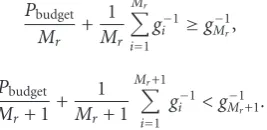
where Mr is the total number of the used subchannels
determined according to the following criteria:
Pbudget Mr + 1 Mr Mr
i=1 g−1
i ≥gM−1r,
Pbudget Mr+ 1+
1
Mr+ 1 Mr+1
i=1
gi−1< gM−1r+1.
(10)
An iterative algorithm that determines the water-filling RM solution by using an initial sorting of the subchannels’ gain-to-noise ratio values is described in [20]. When the subchannels are sorted, the objective of the loading algo-rithm is to determine thecut-off subchannelMrand the
con-stantKr. Sorting is not a trivial task when the number of
sub-channels is large. In general, this task dominates the com-putational complexity of all practical algorithms for water-filling, so the complexity isO(Nlog2N).
The optimum bit allocation is derived by (1) and (8), which results in the following compact formula:
bi=
log2(Krgi) ∀i: 1≤i≤Mr,
0 otherwise (11)
while the total data rate is
B= N
i=1
bi=Mrlog2
Kr − Mr
i=1
log2g−1
i . (12)
Remark 1. By combining (8) and (9), we derive that the op-timal solution uses all the available power budget, that is, the total power constraint in (6) is met with equality. More-over, we observe that as more power budget is available, the water-level in (9) becomes higher and as a consequence, more subchannels may be turned on, as long as (10) im-plies a higher value forMr. Therefore, a higher power budget
corresponds to a higher water-level, which generally results in the utilization of more subchannels and thus in a higher data rate.
Remark 2. From (8) and (9), we can write the optimum power allocation using the following expression:
Pi= Pbudget
Mr +
1
Mr Mr
m=1 g−1
m −gi−1
, ∀i: 1≤i≤Mr.
(13)
The first term is a constant power portion, while the second term is the distance between the mean of the in-verse gain-to-noise ratios of all used subchannels and thegi−1
of each subchannel.Figure 2illustrates this remark, where the subchannels are sorted. Observe that for subchannel i
the distance ofgi−1 to the mean value is positive, while for
subchannelj, the distance is negative.
Remark 3. Figure 2 also illustrates a characteristic feature of the water-filling allocation strategy: water-filling allocates more power to the strongest subchannels.
Pbudget Mr
Subchannels
1 i j Mr+ 1 N
g−1 i
Kr M1r
Mr
m=1 g−1
m −gi−1
M1r
Mr
m=1 g−1
m −g−j1
Pi
g−1
i
Pj
g−1
j
Figure2: Graphical representation of (13).
3.2. Margin maximization water-filling
Using the Lagrange multipliers method and applying the Kuhn-Tucker conditions, we can derive the optimal solution to the MM problem in (7) as follows:
bi=
Km−log2
g−1
i for all used subchannels,
0 otherwise, (14)
whereKmis constant and depends on the target data rate.
Assuming that the subchannels are sorted in a descending order,Kmis given by
Km= Btarget Mm + 1 Mm Mm
i=1
log2g−1
i , (15)
where Mm is the total number of used subchannels
determined according to the following criteria:
Btarget Mm + 1 Mm Mm
i=1
log2g−1 i ≥log2
g−1 Mm ,
Btarget Mm+ 1
+ 1
Mm+ 1 Mm+1
i=1
log2gi−1 <log2
gM−1m+1 .
(16)
The analogy between (9) and (10) of the RM problem with (15) and (16) will be evident, as soon as we calculate the power of each subchannel allocated withbibits according to
(14). Using (4), we get
Pi=
2Km−g−1
i ∀i: 1≤i≤Mm,
0 otherwise. (17)
In (17), we observe that the optimum bit solution to the MM problem results in a power distribution that fol-lows a water-filling power allocation as in the RM problem. Therefore, a power distribution, similar to the one shown in Figure 1, holds also for the MM problem. In this case, the constant water-level is equal to
2Km=2Btarget/Mm
Mm
i=1
g−1 i
1/Mm
while the total power is given by
P= N
i=1
Pi=Mm2Km− Mm
i=1 g−1
i . (19)
Remark 4. We observe in (18), that the higher the target rate, the higher the water-level and consequently more subchan-nels may be used, as long as (16) implies a higher value for
Mm. As a result, a higher target rate requires a higher total
power consumption.
3.3. Duality conditions between RM and MM problems
The RM and MM problems admit a unique water-filling solution. The following proposition holds.
Proposition 1. Let(bwi,Piw), for1≤i≤N, be a water-filling bit and power allocation, whereNi=1bwi =Bwand
N
i=1Pwi = Pw. Then,
Bw=max Pw
N
i=1
bi, Pw=min Bw
N
i=1
Pi. (20)
Proof. We have shown in Section 3.1, that a water-filling power allocation provides the unique solution that maximizes the data rate subject to a total power constraint. In fact, the whole power budget is consumed (seeRemark 1). Therefore, any other allocation (bi,Pi) with
N
i=1Pi=Pw
re-sults in a total rate ofNi=1bi < Bw. Therefore, the first part
of (20) is true.
Moreover, we have shown inSection 3.2, that a water-filling bit allocation provides the unique solution that minimizes the total power subject to a target rate constraint. Therefore, any other allocation (bi,Pi) with
N
i=1bi = Bw
results in a total power ofNi=1Pi > Pw. Consequently, the
second part of (20) is also true.
From the analytical expressions derived for the RM and MM problems, there exists a duality between the RM and MM problems under specific conditions. We are now in the position to define these conditions in the form of the following theorem.
Theorem 1. Let(br
i,Pri), for1≤i≤N, be the solution to the RM problem, whereNi=1br
i = Br. Then,(bri,Pri)is also the solution to the MM problem withBtarget=Br. Equivalently, let
(bm
i ,Pim), for1 ≤i ≤N, be the solution to the MM problem, whereNi=1Pmi =Pm. Then,(bim,Pmi )is also the solution to the RM problem withPbudget=Pm.
Proof. UsingProposition 1, for the RM solution (br
i,Pir), we
can write
Pr= N
i=1 Pr
i =min Br
N
i=1
Pi (21)
which implies that (bri,Pir) is also the solution to the MM
problem, whenBtarget=Br.
Similarly, for the MM solution (bmi ,Pim), we can write
Bm= N
i=1 bm
i =max Pm
N
i=1
bi (22)
which implies that (bmi ,Pim) is also the solution to the RM
problem, whenPbudget=Pm.
4. TOTAL POWER AND PEAK-POWER CONSTRAINED LOADING
When introducing the peak-power constraint, the optimiza-tion problem becomes more complicated. LetPi, for 1≤i≤ N, denote the maximum allowable power per subchannel. In multicarrier systems, a power spectral density (PSD) mask constraint is usually imposed by regulatory rules in order to control the level of interference into other communication systems operating in the neighborhood, for example, [18]. The RM and MM problems are formulated as follows.
RM loading problem:
max
N
i=1
log21 +Pi·gi ,
subject to
N
i=1
Pi≤Pbudget,
0≤Pi≤Pi, ∀i: 1≤i≤N.
(23)
MM loading problem:
min
N
i=1
2bi−1
gi ,
subject to
N
i=1
bi=Btarget,
0≤bi≤bi, ∀i: 1≤i≤N.
(24)
In the RM problem, we observe that the peak-power con-straint upper bounds the possible power allocation in each subchannel. In the MM problem, the peak-power constraint is transformed into a maximum bit allocation constraint, denoted asbifor 1≤i≤N, which upper bounds the possible
bit allocation in each subchannel and is defined by
bi=log2
1 +Pi·gi . (25)
Max-filled Max-filled Bottom
Cover
P
Not used Not used
1
Subchannels
N g−1
i
Kr
Figure3: The concept of “cap-limited” water-filling.
(1)sort gis in descending order
(2)set j=1
(3)apply WATER-FILLING(8)–(10),
over subchannels j,. . .,N
(4)if Pj> Pj then (5) set Pj=Pj
(6) reduce the available power
Pbudget=Pbudget−Pj
(7) update j=j+ 1
(8) go to step (3)
(9)end if
Algorithm1: Cap-limited water-filling.
4.1. Rate maximization water-filling
By using the Lagrange multipliers approach and applying the Kuhn-Tucker conditions, we can derive the optimal solution to the RM problem in (23) as follows2:
Pi=
⎧ ⎨ ⎩
Pi if
N
i=1Pi≤Pbudget,
[Kr−gi−1] Pi
0 if
N
i=1Pi> Pbudget,
(26)
whereKr is a constant and is determined by the solution to
the following nonlinear equation:
N
i=1
Kr−gi−1
Pi
0 =Pbudget. (27)
The RM solution in (26) is again water-filling, however in this case, the spectrum vessel has a limited depth ofPiand
2The following notation is used, wherex,a, andcare real numbers with
a > c: [x]a
c=
⎧ ⎪ ⎪ ⎨ ⎪ ⎪ ⎩
a, x≥a,
x, c < x < a,
c, x≤c.
g−1 1
P1 Pi
g−1 i
Kw
g−1 i
1 i
Subchannels
M+ 1 N
Figure4: The optimal water-filling.
is covered by a cap. WhenPi = Pfor all subchannels, then
the shape of the cap is identical to the vessel’s bottom, that is, the inverse of the gis. The concept of the “cap-limited”
water-filling is illustrated in Figure 3subject to a common PSD mask for all subchannels.
In order to obtain the solution in (26), we need to determine the constant Kr. In Section 3.1, an iterative
al-gorithm for the calculation of the water-level of the total power constrained RM was presented. When the peak-power constraint is introduced, the RM problem in (23) can be treated using an iterative water-filling process [21], which is described using the pseudocode ofAlgorithm 1.
Algorithm 1is optimal, however its direct implementa-tion is not efficient and presentsO(N2) complexity. In
or-der to overcome such a high computational load, an iterative algorithm of reduced complexity can be constructed by ex-ploiting the fact that in every new iteration ofAlgorithm 1, the participating subchannels are allocated more power with respect to the previous iteration.
First, consider the optimal water-filling solution in Section 3.1, which is described inFigure 4, where the sub-channels are sorted. Denoting asPN = [P1,P2,. . .,PN] the
optimumN-point water-filling power vector,PNsatisfies the following set of equations:
P1+· · ·+PM=Pbudget, Pi>0, ∀i: 1≤i≤M, Pi+gi−1=Kw, ∀i: 1≤i≤M,
(28)
whereKwis the water-level and subchannels fromM+ 1 toN
are turned off, that is, they are loaded with zero power, and the following proposition holds.
Proposition 2. Given the sorted water-filling power alloca-tion vectorPN, if one removes subchannels1,. . .,Land reduces Pbudget by
L
i=1Pi, then the new optimal water-filling solution is the(N−L)-point power vectorPN−L=PN− {P1,. . .,PL} =
(1)sort gis in descending order (2)set j=1
(3)apply WATER-FILLING (8)–(10),
over subchannels j,. . .,N
(4)set M=j (5)if Pj> Pj then
(6) update M=M+ 1
(7) if PM> PM then
(8) go to step (6)
(9) else
(10) set Pi=Pi, for i=j,. . .,M−1
(11) reduce the available power
Pbudget=Pbudget− M−1
i=j Pi
(12) set j=M
(13) go to step (3)
(14) end if
(15)end if
Algorithm2: Low-complexity cap-limited water-filling.
Proof. We prove forL = 1. LetPN−1 = [P2,. . .,PN] be the
optimum vector. Then,PN−1should satisfy (28):
P2+· · ·+PM=Pbudget ,
Pi>0, ∀i: 2≤i≤M, Pi+gi−1=Kw, ∀i: 2≤i≤M,
(29)
wherePbudget =Pbudget−P1,Kw=(Pbudget +
M
i=2gi−1)/(M−1),
and subchannels fromM+ 1 toNare turned off. ForM=M, the constantKw becomes
Kw =
1
M−1
Pbudget−P1+
M
i=2 g−1
i
= 1 M−1
Pbudget+
M
i=1 gi−1
−
g1−1+P1
= 1 M−1
M·Kw−Kw =Kw.
(30)
From (28) and (30), we derive that the power vector
PN−1 =[P2,. . .,PN] satisfies (29) and thereforePN−1is the
optimal vector. The proof forL >1 is similar.
As suggested by Algorithm 1, if the power allocated to subchanneli(staring from the one with the highestgi)
ex-ceeds Pi, then we set Pi = Pi, reduce Pbudget by Pi,
ex-clude subchannelifrom the optimization problem, and per-form water-filling to the remaining subchannels. SincePbudget
is reduced by an amount of power less than the optimal power assigned by the previous water-filling, then according toProposition 2andRemark 1, the new solution has higher
Kw and additional subchannels may be turned on. As a
re-sult, all subchannels participating in the next water-filling will be assigned additional power. Based on this remark, the new optimal algorithm is described by the pseudocode in Algorithm 2.
Algorithm 2 is explained using Figure 5 subject to common PSD mask for all subchannels. Given the initial
g−1 1
P1
Pi
g−1 i
P
Knew
w
Kw
gi−1
Mnew
1 i M
Subchannels
M+ 1 N
Mnew+ 1
Figure5: Graphical representation of iterative water-filling.
water-filling solution with cut-offsubchannel indexM and water-levelKw, the algorithm determines the first
subchan-nel, denoted as M, where the power assignment does not violateP. Then, it upper bounds all subchannels from 1 to
M−1 withPand reduces the power budget by the total power assigned so far. At the next step, the algorithm proceeds to successive water-filling over the subchannels ranging fromM
toN. The new water-filling solution determines a new higher water-level,Knew
w , corresponding to new subchannel indexes Mnew > MandMnew≥M. This procedure is repeated until
the water-filling allocation does not violatePin any of the subchannels involved in the new iteration.
The complexity improvement of the iterative water-filling scheme described by Algorithm 2 compared with Algorithm 1depends on the total number of iterations that water-filling has executed. IfL≤N is the number of itera-tions, then the computational complexity ofAlgorithm 2is O(N(L+ log2N)). The lower isLcompared toN, the higher is the computational complexity improvement. In [21], a suboptimum algorithm for the RM problem in (23) is de-scribed that uses an iterative search-secant method to deter-mine the root of (27), by noting that (27) admits a root when
N
i=1Pi > Pbudget. The search-secant process is subject to a
tolerance variable that affects the speed of convergence, as well as the accuracy of the final result. Generally, there is a tradeoffbetween the speed of convergence and accuracy. The method presents a computational complexity that grows lin-early withLN, whereLis the number of the search-secant iterations.
Remark 5. Similar to Remark 1, we observe from (26) and (27) that the optimal “cap-limited” water-filling solution consumes the total available power budget.
4.2. Margin maximization water-filling
the RM and MM problems developed in Section 3.3. We have shown inSection 3.2that the optimal bit solution for the MM problem under a total power constraint results in a power allocation, which follows a water-filling distribu-tion. Given a peak-power constraint, this power allocation should also follow the “cap-limited” water-filling concept of Figure 3. The optimal bit solution to (24) is therefore given by
bi=
Km−log2
gi−1 bi
0, ∀i: 1≤i≤N, (31)
whereKmis the solution to the following nonlinear equation:
N
i=1
Km−log2
g−1 i
bi
0 =Btarget. (32)
It can be easily verified thatTheorem 1applies also for the total and peak-power constrained RM and MM prob-lems.
5. INTEGER-BIT CONSTRAINED LOADING
The Lagrangian methods described in the previous sections provide the optimal loading solutions, where generally the bit assignment in each subchannel takes real values. How-ever, due to implementation constraints, only integer bit val-ues are of practical interest, that is, design of realistic con-stellation encoders and decoders. As a consequence, the pro-posed Lagrangian algorithms in the literature include a final suboptimal bit-rounding step with appropriate power scal-ing to preserve the power budget and target error rate con-straints.
The integer-bit constrained loading problem, also re-ferred to as discrete loading, belongs to the class of combi-natorial optimization problems. The RM and MM formula-tions of the previous secformula-tions apply here, along with the ad-ditional integer-bit constraint:bi∈Z+for 1≤i≤N.
Remark 6. The monotonicity and concave nature of the rate function in (1), along with the monotonicity and convex nature of the power function in (4), as well as of the cor-responding discrete incremental (33) and decremental (34) power cost functions defined below, guarantee the existence of a unique optimum solution for each of the RM and MM discrete loading problems based on appropriate greedy algo-rithms. The optimality is addressed in [26,31,32], using the matroid theory.
5.1. Optimum greedy algorithms
The solution to the integer-bit loading problem is provided using a greedy algorithm, which defines an appropriate bit al-location cost function and iteratively assigns one bit at a time to the least cost-expensive subchannel. In general, a greedy algorithm is characterized by the following two properties [33]. First, at each step, the algorithm always moves its op-erating point along the direction that guarantees the largest increment (decrement) to the assigned objective function to be maximized (minimized). Second, a greedy algorithm
proceeds only in a forward way, that is, it never tracks back. Two greedy loading methods are used: the bit-filling [23,31] and the bit-removal [25,32].
Considering that subchannelicarriesbibits, the power
needed to transmit one more bit in this subchannel is given by
ΔP+i
bi =
2bi
gi
, ∀bi: 0≤bi< bi (33)
while the power saved by removing one bit from this subchannel is given by
ΔP−i (bi)=
2(bi−1)
gi
, ∀bi: 0< bi≤bi (34)
and the maximum3number of bits that can be assigned to
each subchannel is
bi=
log21 +Pi·gi . (35)
The incremental power in (33) constitutes the cost func-tion of the bit-filling process, while the decremental power in (34) constitutes the cost function of the bit-removal pro-cess. In particular, the bit-filling algorithm starts from an initial all-zero bit allocation, bi = 0 for 1 ≤ i ≤ N, and
then adds one bit at a time to the subchannel that requires the minimum additional power until the total power bud-get is consumed (RM case) or the tarbud-get rate is achieved (MM case). On the other hand, the bit-removal algorithm starts from an initial maximum bit allocation,bi = bi for
1 ≤ i ≤ N, and then removes one bit at a time from the subchannel that saves the maximum power until the target rate is achieved (MM case). Note that ifNi=1Pi ≤ Pbudget,
the maximum bit allocationbi=biused initially by the
bit-removal algorithm, is the direct solution to the RM case. In Appendix A, the following theorem is proved.
Theorem 2. Given a target rateBtarget, the filling and
bit-removal algorithms result in the same optimum bit and power allocation.
The following remarks are also in order.
Remark 7. For the nondiscrete RM problems formulated in the previous sections, we have noted that the optimal solu-tion results in the consumpsolu-tion of the total available power budget. In the discrete RM problem, however, the optimum integer-bit solution results in total power that is generally less or equal to the power budget.
Remark 8. Although bit-filling and bit-removal provide the same solution, the computational load associated with each
3In practice, a maximum size in the embedded constellation is also im-posed [7]. Letbmaxdenote the maximum number of bits that can be allo-cated in a subchannel. Then, (35) is written asbi=min(bmax,log2(1 +
method mainly depends on the target data rate. The com-plexity of the bit-filling isO(BtargetN), while the complexity of the bit-removal isO((Bmax−Btarget)N), whereBmaxis the data rate corresponding to thebibit-profile. IfBtargetis close
toBmax, then bit-removal converges faster.
Remark 9. If bit-filling is left free to proceed aboveBtarget, by adding one bit at a time to the least power cost-expensive subchannel, then it will terminate at thebiallocation.
Also for the discrete loading RM and MM problems, there exist exact conditions for their equivalence, as in the water-filling case.Theorem 1developed inSection 3.3holds also for the case of discrete loading, where the only diff er-ence is that due to the integer-bit allocation, the MM solution under the duality conditions is also the RM solution with
Pbudget ≥Pm(seeTheorem 1for details). The proof is given
inAppendix B. Another approach is provided in [34].
5.2. Efficient integer-bit allocation profiles
The high computational load of the greedy filling and bit-removal algorithms is an important disadvantage for prac-tical systems with large number of subchannels and high data rate demands. In [27], an efficient discrete bit allocation profile was developed by recognizing that the order of the subchannels, which participate in the single-bit incremental process of bit-filling, is specific and includes a characteristic circular repetition.
The characteristic bit allocation profile is calculated as follows:
bi =
log2kimin + 1, i=imax,
log2kimin −
log2ki otherwise,
(36)
where imax = arg max{gi},imin = arg min{gi}, and ki = gimax/gifor 1≤i≤N.
The allocationbidepends only on the system gi values
and presents an optimum bit allocation profile of a con-tinuous greedy bit-filling process, where any total power or peak-power constraints are at the moment ignored. In other words, if bit-filling is continuously applied, then it will reach the allocationbiafter
N
i=1bisteps, where
N
i=1biis the data
rate that corresponds to thebiprofile. From (36), we observe
thatbi = 0 fori = imin. Depending on the value ofki,bi
may be zero for other subchannels as well. Assuming that the subchannels are sorted, that is,imax = 1 andimin =N, the following remarks are in order.
Remark 10. Given allocation (36) and assuming that bit-filling is applied, then one bit has to be added to all the subchannelsi : 2 ≤i ≤N, before we can further increase the bits in subchanneli=1 by one. The order, in which the subchannels are assigned by one more bit, depends on the power cost function (33) of each subchannel and generally it does not coincide with the descending order of thegivalues.
Remark 11. If bit-removal is applied in (36), then one bit is first removed from subchanneli = 1 and then, one bit has
to be removed from all the subchannels i : 2 ≤ i ≤ N∗, before we can further decrease the bits in subchanneli=1 by one, whereN∗corresponds to the first nonzero bit-loaded subchannel.
The importance of allocation (36) in providing low com-plexity bit loading follows from Remarks10 and11 along with the next theorem.
Theorem 3. The integer bit allocationbi=[bi+z]b0i, for1≤ i≤Nandz∈Z, is efficient [35]:
ΔP+ i
bi ≥ΔP+j
bj−1 , ∀i,j: 1≤i,j≤N. (37)
Proof. This theorem is proved by substitutingbi=[bi+z]b0i
in (33) and showing that (37) is true,∀i,j: 1≤i,j≤N.
Theorem 3states that every up- or downshift of (36) cor-responds to an optimum discrete bit allocation under the power minimization goal, taking also into account the low (all-zeros) and the upper (bi) bounds of the valid bit vectors.
In [27], the following theorem was proven.
Theorem 4. bimax−bimax=max
bi−bi},∀i: 1≤i≤N.
According toTheorem 4, if (36) is shifted byΔb=bimax− bimax, thenbi ≥ bi −Δb,∀i : 1 ≤ i ≤ N, where the sign
ofΔbdetermines the up- or downshift. This is illustrated in Figure 6for the two possible cases, where the subchannels are sorted. InFigure 6(b), thebi profile violates the maximum
allowable allocation bi in some of the subchannels. This is
due to the fact that profile (36) does not include any power or PSD restrictions.
UsingTheorem 4, along with Remarks10and11, we can use the bit-profile bi as an initial optimum allocation and
then perform a multiple-bit addition or removal process, that converges to the optimum bit solution with no more than a single bit difference per subchannel. In the following sec-tion efficient loading algorithms for the discrete RM and MM problems are presented.
6. LOW-COMPLEXITY INTEGER-BIT LOADING
In the previous section, it was made clear that in each allo-cation step, the greedy algorithm updates the bit-profile ac-cording to a power cost function until the system constraints are met, that is, the total power budget is consumed for the RM case or the target data rate is achieved for the MM case. At the end of the greedy process, the respective objective is satisfied, that is, rate maximization or margin maximization. The system constraints define a pair of low and maximum bit allocation limits. The greedy loading process can be de-scribed as a continuous bit-by-bit allocation procedure, since at each step it updates the bit-profile by moving onefficient
Bit-distribution
Δb≤0
−Δb
bi
bi−Δb
bi
N−1
N
Subchannels 1
(a)
Bit-distribution
Δb≥0
−Δb
bi−Δb
bi
bi
N−1
N
N∗
Subchannels 1
(b) Figure6: Examples of thebibit-profile with respect to thebiupper bound.
with the rate maximization solution. In the rest of this sec-tion, we present efficient discrete loading algorithms by ex-ploiting the characteristic bit-profilebidefined in (36). These
algorithms are based on a multiple-bit loading process that moves thebiprofile towards the optimum solution.
6.1. Discrete rate maximization
First, we address the total power constrained problem. In contrast to the case of a PSD mask, where the maximum allowable bit allocation is directly determined by (35), the bit upper limit in the total power constrained problem is not straightforward. However, we know fromTheorem 3that every shift of thebibit-profile corresponds to an efficient
al-location. Thus, if the available power budget is not exceeded, the new bit allocation is valid within the system constraints.
Since there is no explicit bit upper limit defined, we will use notation [x]a
cwitha= ∞, that is, [x]∞0 =max(x, 0). The
data rate and total power of bit allocationbi+α, whereα∈Z,
are, respectively,
B(α)= N
i=1
bi+α
∞
0, P(α)= N
i=1
2
bi+α ∞
0 −1 gi .
(38)
LetP(0)< Pbudget. In order to obtain the maximum pos-sible data rate, we want to upshift profilebibyα≥0, so that
P(α)≤Pbudget< P(α+ 1). (39)
From (38), we can write
P(α)=2α
P(0) +
N
i=1 g−1
i
− N
i=1 g−1
i . (40)
Using (40), we derive the integer solution of (39) as
α=
log2
Pbudget+Ni=1g−1 i P(0) +Ni=1g−1
i
. (41)
The difference between the total power budget and the power corresponding to thebiprofile upshifted by (41) may
allow the allocation of a limited number of additional bits, less thanN. We can use the greedy bit-filling process to allo-cate these bits.
IfP(0) > Pbudget, then we want to downshift profilebi
byα ≤ 0, so that (39) also holds. Note that |α+ 1| < |α|, whenα ≤ 0. It turns out thatαis given by (41). Since the value of|α|may be greater than the smallest nonzero value ofbifor 1≤i≤N, the total power of the downshifted
bit-profile [bi+α]∞0 may be higher than expected and therefore
additional downshifting may be necessary. In this case, the new value ofαis calculated using (41), where the upper limit of the summations is replaced byN∗, which denotes the to-tal number of nonzero bit-loaded subchannels, andP(0) is replaced by the total powerP(α), which corresponds to the downshifted bit profile of the previous step. At the end of the downshift process, we use greedy bit-filling to add any addi-tional bits less thanN∗if there is available power. The pseu-docode inAlgorithm 3describes the low-complexity discrete loading for the total power constrained RM problem.
In the case of a peak-power constraint, the optimum RM solution can be calculated by directly allocatingbibits and
(1)calculate initial bit-profile bi
(2)calculate total power P(0) from (38)
(3)calculate α from (41)
(4)if α=0 then
(5) set bi=max(0,bi+α) for 1≤i≤N
(6) calculate P(α) from (38)
(7) go to step (3)
(8)else if power available then
(9) doGREEDY BIT-FILLING
(10)end if
Algorithm3: Discrete total power constrained rate maximization.
6.2. Discrete margin maximization
In the MM problem, we assume that the total power budget is sufficient in order to support the desired target rate. As in the previous section, we first address the total power-constrained loading. Given the initial bit-profilebi with a total data rate
ofB(0), see (38), we can perform multiple-bits loading by directly calculating the allocationbi=[bi+α]∞0, where
α=
Btarget−B(0)
N∗
. (42)
In (42),N∗ is the total number of nonzero bit-loaded subchannels, as defined in Remark 11, and the sign of α
depends on whether data rate increase (ifBtarget > B(0)) or decrease (if Btarget < B(0)) is required. The new bit allo-cation bi = [bi +α]∞0 is efficient according to Theorem 3
and optimum under the power minimization goal. How-ever, when downshift is performed, the resulting data rate might be greater than expected due to the low (zero) bit-limit. Therefore successive, but limited, number of multiple-bits loading steps may be necessary until αbecomes zero. Then, according to Remarks10and11, the bit-profile allo-cated so far differs from the target rate solution at most in a single bit per subchannel. The remaining bits can be allo-cated to the appropriate subchannels based on the respective cost function (33) or (34). The pseudocode inAlgorithm 4 describes the low-complexity MM loading.
The above results also hold for the peak-power con-strained loading. However, in this case, two important points should be noted. First, an explicit bit upper limit exists and the data-rate expression in (38) becomes
B(α)= N
i=1
bi+α
bi
0. (43)
Second, in (42), the value of α is calculated by the difference between the desired rate and the rate of the boundedbiprofile. Since the difference betweenbiand [bi]b0i
may be large, a result ofa = 0 may not indicate the maxi-mum of one bit difference convergence. In order to overcome such a situation, ifbimaxviolates the upper limitbimax, we apply
Theorem 4and move thebibit-profile within the bit-limits.
(1)calculate initial bit-profile bi
(2)calculate total rate B(0) from (38)
(3)calculate α from (42)
(4)if α=0 then
(5) set bi =max(0,bi+α) for 1≤i≤N
(6) calculate B(α) from (38)
(7) go to step (3)
(8)else if target rate not met then
(9) doGREEDY BIT-FILLING
(10)end if
Algorithm4: Discrete total power-constrained margin maximiza-tion.
6.3. Numerical example
Figure 7shows an example of bit and power allocation us-ing the CSA(6) standard ADSL loop in Table 47 of ANSI T1.413-1995 [36]. The system parameters are:N=256 sub-channels, subcarrier spacing 4.3125 kHz,−140 dBm/Hz ad-ditive white Gaussian noise (AWGN) plus near-end crosstalk (NEXT) generated by 20 high-rate DSL (HDSL) neighbor-ing lines, and a 40-kHz lower band edge. The loadneighbor-ing con-straint values are:−40 dBm/Hz PSD mask, 100 mWatt total power budget, andbmax=15. We also consider 6 dB margin and 3 dB coding gain. Assuming a maximum bit-error rate of 10−7, the corresponding SNR gap equals 12.8 dB.
Figure 7shows the maximum bit allocation,bi, the
ini-tial bit allocation,bi, and the target bit allocation that
cor-responds to 80% of the maximum possible data rate, that is,
Btarget=0.80·N
i=1bi.Figure 7also shows the transmit PSD
that corresponds to the maximum and the target rate alloca-tion. The sawtooth shape of the PSD is common to all dis-crete bit-loading algorithms and is the result of the stepwise power distribution due to the integer bit constraint. Since there is a 40-kHz lower band edge, subchannels 1–9 are not used. Also, note that for the requested target rate, the loading algorithm does not utilize subchannels 28–52. The remaining power, that is, the difference between the total power of the target rate allocation and the power budget, can be used in order to increase the system margin in all subchannels.
In [27], numerical results show that exploiting the effi -cient bit allocation profile described inSection 5.2, a compu-tational complexity improvement of up to 6 times compared with the greedy bit-filling and the bit-removal methods is achieved. Although the results correspond to the case of to-tal and peak-power constraints, the complexity improvement for the total power constraint is only the same or higher. In-deed, in the latter case, the algorithm experiences less diff er-ences between the actual and the expected power or rate (step 6 of Algorithms3and4), thus the optimum bit-allocation is reached with less shifting operations of thebi profile. It has
to be noted that according to Remarks10and11, the shifting of thebi profile converges to the target rate with only one
250 200
150 100
50
Subchannel Maximum
Target Initial 0
5 10 15
Bi
t
al
lo
ca
ti
o
n
(bi
ts
)
(a)
250 200
150 100
50
Subchannel Maximum
Target −60
−55 −50 −45 −40
P
o
w
er
allocation
(dBm/Hz)
(b)
Figure7: Example of bit and power allocation using the CSA(6) standard ADSL loop.
respectively. As a result of Remarks10and11, after each sub-channel selection, there is no need to update the correspond-ing cost function, thus the total complexity of the final greedy process is reduced.
6.4. When perfect CSI is not known
The bit and power loading algorithms described in the previous sections presume that an estimation of the instanta-neous CSI, that is, the subchannel gain-to-noise ratio values, is available. When the channel is constant or slow time vary-ing, this is not a complex task. For “always on” links, such as DSL, CSI is obtained during the modems’ training. For burst transmission, such as in wireless LANs, CSI can be esti-mated using a suitable preamble structure or inbound train-ing information. However, in order to account for the limi-tations imposed by the time-varying behavior of the wireless channels, such as noisy or outdated CSI, alternative adaptive MCM schemes have gained research attention, for example, statistical adaptive MCM and adaptive MCM with partial CSI. References [37–39] can motivate the interested reader on this topic.
7. CONCLUSIONS
In this work, we surveyed the area of bit and power loading in constrained multicarrier communication systems in the single-user context. We discussed the optimal solutions to the main classes of loading problems, namely, rate maximization and margin maximization, under a set of specification and implementation constraints. We presented the water-filling power allocation policy under a total power constraint and
the cap-limited water-filling concept was introduced when the peak-power constraint is included. Moreover, the loading problem was addressed subject to the integer-bit restriction and the optimal discrete solution was examined using combi-natorial optimization methods. We reviewed existing loading algorithms and highlighted some ideas for low-complexity solutions.
APPENDICES
A. PROOF OFTHEOREM 2: EQUIVALENCE OF BIT-FILLING AND BIT-REMOVAL
We denote asb ∈ ZN
+ theN-point bit vector calculated in
each allocation step by the bit-filling method. Then for all components ofb=[b1,. . .,bN], the following relation holds:
ΔP+i
bi >ΔP+j
bj−1 , ∀i,j: 1≤i,j≤N (A.1)
and the bit-distribution vectorb is said to be BF-efficient. The above definition was first used by Campello [35]. On the other hand, ifb∈ZN
+ is theN-point bit vector calculated
in each allocation step by the bit-removal method, then the following relation holds:
ΔPm−
bm <ΔPn−
bn+ 1 , ∀m,n: 1≤m,n≤N. (A.2)
Similarly, we define that bit vectorb∈ZN
+ isBR-efficient
if equation (A.2) holds.
In order to show that the bit-filling and bit-removal methods are equivalent, we have to prove that for a given target rateBtarget=N
i=1bi, there exists only oneBF-efficient
solution and only oneBR-efficientsolution and that anN -pointBF-efficientvector is alsoBR-efficient.
We assume that there exist two differentBF-efficient vec-torsb = [b1,. . .,bN] andr = [r1,. . .,rN], so thatBtarget =
N
i=1bi =
N
i=1ri. Consequently, there exist at least two
points, namedi0and j0, wherebi0 > ri0 andbj0 < rj0,
oth-erwise the above bit-distributions are equal. SincerisBF-efficient, then
ΔP+ i0
ri0 >ΔP+j0
rj0−1 . (A.3)
From the inequalitybj0< rj0, we have
ΔP+ j0
rj0−1 ≥ΔP+j0
bj0 . (A.4)
Combining (A.3) and (A.4), we get
ΔPi0+
ri0 >ΔP+j0
bj0 . (A.5)
From the inequalitybi0> ri0, we have
ΔP+ i0
bi0−1 ≥ΔPi0+
ri0 . (A.6)
Combining (A.5) and (A.6) we get
ΔP+ i0
bi0−1 >ΔP+j0
bj0 , (A.7)
only one bit-profile that isBF-efficientfor a given target rate. A similar proof can be derived for the uniqueness of the BR-efficientbit solution.
Next, we consider a bit distribution vectorb, which is BF-efficient, that is,∀i,j: 1≤i,j≤N:
ΔP+i
bi >ΔP+j
bj−1 =⇒
2bi
gi >
2bj−1
gj
=⇒ 2(bi+1)−1 gi >
2bj−1
gj =⇒ΔPi−
bi+ 1 >ΔP−j
bj ,
(A.8)
thereforebis alsoBR-efficient.
B. PROOF OFTHEOREM 1: DUALITY CONDITIONS FOR THE DISCRETE RM AND MM PROBLEMS
Let (bGi,PiG), for 1≤i≤N, beefficientgreedy bit and power
allocation profiles that satisfy (37) and letNi=1biG=BGand
N
i=1PiG =PG. From the definition of the greedy bit
alloca-tion process inSection 5.1, we have
PG i =min
bG i
Pi, ∀i: 1≤i≤N, (B.1)
PG=min BG
N
i=1
Pi. (B.2)
For a given subchannel gi, the data rate function bi =
log2(1 +Pi·gi) is strictly increasing with respect toPi, while
the integer function bi is increasing with respect to Pi.
Therefore,
PGi =min bG
i
Pi, ∀i=⇒bGi =max PG
i
bi,∀i=⇒BG=max PG
N
i=1 bi.
(B.3)
Let (bRi,PiR), for 1 ≤ i ≤ N, be the optimum greedy
solution of the integer RM problem, whereNi=1biR=BRand
N
i=1PiR=PR. Then according to (B.2), we can write
PR=min BR
N
i=1
Pi (B.4)
which means that (bR
i,PiR) is also the solution to the integer
MM problem subject to a target rate ofBR.
Similarly, let (bM
i ,PiM), for 1≤ i≤ N, be the optimum
greedy solution of the integer MM problem, whereNi=1bRi = BRandN
i=1PiR=PR. Then according to (B.3), we can write
BM=max
PM
N
i=1
bi (B.5)
which means that (bMi ,PiM) is also the solution to the integer
RM problem subject to a total power ofPM.
REFERENCES
[1] J. A. C. Bingham, “Multicarrier modulation for data transmis-sion: an idea whose time has come,”IEEE Communications Magazine, vol. 28, no. 5, pp. 5–14, 1990.
[2] Z. Wang and G. B. Giannakis, “Wireless multicarrier commu-nications,”IEEE Signal Processing Magazine, vol. 17, no. 3, pp. 29–48, 2000.
[3] K. Taura, M. Tsujishita, M. Takeda, H. Kato, M. Ishida, and Y. Ishida, “A digital audio broadcasting (DAB) receiver,”IEEE Transactions on Consumer Electronics, vol. 42, no. 3, pp. 322– 327, 1996.
[4] H. Sari, G. Karam, and I. Jeanclaude, “Transmission tech-niques for digital terrestrial TV broadcasting,”IEEE Commu-nications Magazine, vol. 33, no. 2, pp. 100–109, 1995. [5] M. Russel and G. L. St¨uber, “Terrestrial digital video
broad-casting for mobile reception using OFDM,”Wireless Personal Communications, vol. 2, no. 1-2, pp. 45–66, 1995.
[6] L. Thibault and M. T. Le, “Performance evaluation of COFDM for digital audio broadcasting—part I: parametric study,”IEEE Transactions on Broadcasting, vol. 43, no. 1, pp. 64–75, 1997. [7] “Asymmetrical Digital Subscriber Line (ADSL) Transceivers,”
July 1999, ITU-T Recommendation G.992.1.
[8] “Very-High-Bit-Rate Digital Subscriber Line (VDSL) Metal-lic Interface—part 1: functional requirements and common specification—part 3: technical specification of a multi-carrier modulation transceiver,” ANSI Contribution T1E1.4/2000-013R1, 2000-009R3.
[9] J. A. C. Bingham,ADSL, VDSL, and Multicarrier Modulation, John Wiley & Sons, New York, NY, USA, 2000.
[10] E. Biglieri, “Coding and modulation for a horrible channel,”
IEEE Communications Magazine, vol. 41, no. 5, pp. 92–98, 2003.
[11] S. Baig and N. D. Gohar, “A discrete multitone transceiver at the heart of the PHY layer of an in-home power line commu-nication local area network,”IEEE Communications Magazine, vol. 41, no. 4, pp. 48–53, 2003.
[12] R. van Nee and R. Prasad,OFDM for Wireless Multimedia Communications, Artech House, Boston, Mass, USA, 2000. [13] R. van Nee, G. Awater, M. Morikura, H. Takanashi, M.
Web-ster, and K. W. Halford, “New high-rate wireless LAN stan-dards,”IEEE Communications Magazine, vol. 37, no. 12, pp. 82–88, 1999.
[14] J. Heiskala and J. Terry,OFDM Wireless LANs: A Theoretical and Practical Guide, Sams, Indianapolis, Indiana, 2002. [15] J. M. Cioffi, “A multicarrier primer,” November 1991, ANSI
Contribution T1E1.4/91-157, Clearfield, Fla, USA.
[16] A. Peled and A. Ruiz, “Frequency domain data transmission using reduced computational complexity algorithms,” in Pro-ceedings of IEEE International Conference on Acoustics, Speech, and Signal Processing (ICASSP ’80), vol. 5, pp. 964–967, Den-ver, Colo, USA, April 1980.
[17] T. Starr, J. M. Cioffi, and P. J. Silverman,Understanding Digital Subscriber Line Technology, Prentice-Hall, Upper Saddle River, NJ, USA, 1999.
[18] “Spectrum Management for Loop Transmission Systems,” ANSI Standard T1.417-2001.
[20] A. Leke and J. M. Cioffi, “A Maximum rate loading algorithm for discrete multitone modulation systems,” inProceedings of the IEEE Global Telecommunications Conference (GLOBECOM ’97), vol. 3, pp. 1514–1518, Phoenix, Ariz, USA, November 1997.
[21] E. Baccarelli, A. Fasano, and M. Biagi, “Novel efficient bit-loading algorithms for peak-energy-limited ADSL-type mul-ticarrier systems,” IEEE Transactions on Signal Processing, vol. 50, no. 5, pp. 1237–1247, 2002.
[22] B. S. Krongold, K. Ramchandran, and D. L. Jones, “Computa-tionally efficient optimal power allocation algorithms for mul-ticarrier communication systems,”IEEE Transactions on Com-munications, vol. 48, no. 1, pp. 23–27, 2000.
[23] D. Hughes-Hartogs, “Ensemble modem structure for imper-fect transmission media,” 4 679 227 (July 1987), 4 731 816 (March 1988) and 4 833 796 (May 1989).
[24] J. Campello, “Practical bit loading for DMT,” inProceedings of IEEE International Conference on Communications (ICC ’99), vol. 2, pp. 801–805, Vancouver, BC, Canada, June 1999. [25] R. V. Sonalkar and R. R. Shively, “Efficient bit-loading
algo-rithm for DMT applications,”IEEE Communications Letters, vol. 4, no. 3, pp. 80–82, 2000.
[26] A. Fasano, G. Di Blasio, E. Baccarelli, and M. Biagi, “Optimal discrete bit loading for DMT based constrained multicarrier systems,” inProceedings of IEEE International Symposium on Information Theory (ISIT ’02), p. 243, Lausanne, Switzerland, June-July 2002.
[27] N. Papandreou and T. Antonakopoulos, “A new computation-ally efficient discrete bit-loading algorithm for DMT applica-tions,”IEEE Transactions on Communications, vol. 53, no. 5, pp. 785–789, 2005.
[28] J. M. Cioffi, G. P. Dudevoir, M. V. Eyuboglu, and G. D. Forney, “MMSE decision-feedback equalizers and coding. II. Coding results,”IEEE Transactions on Communications, vol. 43, no. 10, pp. 2595–2604, 1995.
[29] T. M. Cover and J. A. Thomas,Elements of Information Theory, John Wiley & Sons, New York, NY, USA, 1991.
[30] R. K. Sundaram,A First Course in Optimization Theory, Cam-bridge University Press, CamCam-bridge, UK, 1996.
[31] E. Baccarelli and M. Biagi, “Optimal integer bit-loading for multicarrier ADSL systems subject to spectral-compatibility limits,”Signal Processing, vol. 84, no. 4, pp. 729–741, 2004. [32] A. Fasano, “On the optimal discrete bit loading for
multicar-rier systems with constraints,” inProccedings of the 57th IEEE Semiannual Vehicular Technology Conference (VTC ’03), vol. 2, pp. 915–919, Jeju, Korea, April 2003.
[33] G. L. Nemhauser and L. A. Wolsey,Integer and Combinatorial Optimization, John Wiley & Sons, New York, NY, USA, 1988. [34] A. Fasano and G. Di Blasio, “The duality between margin
max-imization and rate maxmax-imization discrete loading problems,” inProceedings of the 5th IEEE Workshop on Signal Processing Advances in Wireless Communications (SPAWC ’04), pp. 621– 625, Lisbon, Portugal, July 2004.
[35] J. Campello, “Optimal discrete bit loading for multicarrier modulation systems,” in Proceedings of IEEE International Symposium on Information Theory (ISIT ’98), p. 193, Cam-bridge, Mass, USA, August 1998.
[36] “Asymmetric Digital Subscriber Line (ADSL) Metallic Inter-face,” ANSI Standard T1.413-1995.
[37] Z. Song, K. Zhang, and Y. L. Guan, “Statistical adaptive modu-lation for QAM-OFDM systems,” inProceedings of IEEE Global Telecommunications Conference (GLOBECOM ’02), vol. 1, pp. 706–710, Taipei, Taiwan, November 2002.
[38] Y. Yao and G. B. Giannakis, “Rate-maximizing power allo-cation in OFDM based on partial channel knowledge,”IEEE Transactions on Wireless Communications, vol. 4, no. 3, pp. 1073–1083, 2005.
![Figure 7 shows an example of bit and power allocation us-ing the CSA(6) standard ADSL loop in Table 47 of ANSIT1.413-1995 [36]](https://thumb-us.123doks.com/thumbv2/123dok_us/1152978.1144825/11.600.68.272.72.193/figure-shows-example-power-allocation-standard-table-ansit.webp)
