Volume 2011, Article ID 927936,12pages doi:10.1155/2011/927936
Research Article
Sum Rate Optimization by Spatial Precoding for
a Multiuser MIMO DFT-Precoded OFDM Uplink
Hanguang Wu,
1Thomas Haustein (EURASIP Member),
2Eduard Axel Jorswieck
(EURASIP Member),
3and Peter Adam Hoeher
41mimoOn GmbH, Bismarckstraße 120, 47057 Duisburg, Germany
2Fraunhofer-Institute for Telecommunications, Heinrich-Hertz-Institute, Einsteinufer 37, 10587 Berlin, Germany 3Communications Laboratory, Dresden University of Technology, 01062 Dresden, Germany
4Faculty of Engineering, University of Kiel, Kaiserstraße 2, 24143 Kiel, Germany
Correspondence should be addressed to Hanguang Wu,[email protected]
Received 15 October 2010; Revised 31 January 2011; Accepted 10 February 2011
Academic Editor: Robert Fischer
Copyright © 2011 Hanguang Wu et al. This is an open access article distributed under the Creative Commons Attribution License, which permits unrestricted use, distribution, and reproduction in any medium, provided the original work is properly cited.
By means of DFT-precoding, the PAPR of OFDM waveforms can be reduced. DFT-precoding has been proposed for uplink transmission in various future wireless communication systems. In this work, we consider DFT-precoding combined with spatial
precoding for the uplink of multiuser MIMO OFDM systems. An efficient algorithm is developed to optimize the spatial precoder
aiming at maximization of the system sum rate subject to individual power constraints of the users and maintenance of the low PAPR property for one user. Potential gains are shown compared to other popular precoding methods in 3GPP-LTE uplink scenarios.
1. Introduction
Over the last years, the demand for high data rates has increased significantly. This has led to the use of wider trans-mission bandwidth and MIMO (Input Multiple-Output) techniques. In a cellular environment and especially at large transmission bandwidth, the channel between the antennas at the transmitter and receiver becomes increas-ingly frequency selective. OFDM (Orthogonal Frequency-Division Multiplex) with its multiple access scheme OFDMA (Orthogonal Frequency-Division Multiple Access) is consid-ered as a strong candidate for wideband transmission due to its robustness against frequency selective fading and low-computational complexity for channel equalization using frequency domain equalization (FDE) [1]. However, a major drawback of OFDM(A) is that its transmit waveform has a high peak-to-average power ratio (PAPR). In order to avoid the transmitted signal going into the nonlinear region of the power amplifier, the mean input power has to be limited or backed offto a certain value roughly corresponding to the PAPR (in decibel) of the transmitted waveform. Therefore,
high PAPR is power inefficient, especially problematic for cell edge users to be able to overcome the large path loss to reach their serving base station (BS) in uplink transmission.
An alternative possibility to produce a single-carrier wave-form is to equidistantly allocate the subcarriers over the entire bandwidth in DFT-precoded OFDMA systems [7]. This subcarrier mapping is also known as interleaved FDMA (IFDMA) [8]. Another variant of DFT-precoded OFDMA using regularly interleaved blocks of subcarriers is denoted as block-IFDMA (B-IFDMA), which provides robustness to frequency offsets at the expense of increased PAPR compared to IFDMA [9] while still having lower PAPR than OFDM(A) waveforms [10]. This structure has been proposed for nonadaptive uplink transmission in the European Union (EU) 4G research project WINNER [11].
Let us consider the uplink of a multiuser MIMO-OFDM system. If channel state information is available at both the transmitter and receiver, it is known that the optimal precoding matrix applied at the transmitter in terms of asymptotically (The only loss is due to the use of cyclic prefix in OFDM systems, however, the effect becomes negligible when the transmit block size is large. In our discussion, this loss is not considered for simplicity.) achieving the multiple access channel (MAC) capacity can be found efficiently by convex optimization [12]. Generally, the resulting optimal precoding matrices applied to different subcarriers are not the same, as different subcarriers do not experience the same MIMO MAC channel. In order to reduce the signalling overhead to inform the user equipments (UEs) about the subcarrier specific precoding matrix, it is beneficial to apply only one linear precoding matrix for a number of adjacent subcarriers and a number of consecutive OFDM symbols, so-called a chunk [13] or resource block. By applying MMSE successive interference cancellation (SIC) for each subcarrier at the receiver, maximization of the weighted sum rate of MIMO-OFDM MAC is studied in [14], where the problem is formulated under the assumption of individual user power constraints and only one linear precoding matrix applied for a chunk.
In this work, we consider DFT-precoding to be applied to uplink multiuser MIMO OFDM systems as a means to reduce the PAPR of the transmit waveform. For practical interest, we assume that a simple linear zero forcing (ZF) MIMO equalizer is performed on each subcarrier at the receiver to separate the data streams from different users. We propose an algorithm to optimize the spatial precoder aiming at maximization of the system sum rate subject to individual power constraints of the users and maintenance of the low PAPR property of the single-carrier transmit waveform for at least one user. The rest of the paper is organized as follows. Section 2describes the system model and problem formulation.Section 3discusses the proposed spatial precoder optimization algorithm and the associated implementation issues. Simulation results are presented in Section 4. Conclusions are drawn in Section 5. Finally
Section 6discusses the open problems and future work.
2. System Model
We consider an SC-FDMA uplink with two UEs, each having two antennas and the BS also equipped with two antennas. The generalization to the case with multiple antennas and
more than two UEs is possible, which will be discussed later. The block diagram of the system setup is shown in
Figure 1. The transmitted data streamsdu,1,. . .,du,N of UE uare transformed to the frequency domain via anN point DFT and the DFT output xu,1,. . .,xu,N is linear precoded byvu,1,. . .,vu,N, respectively. We assume equal power of the transmitted signal, that is,E{du,nd∗u,n} = Ptotal,u/N, where Ptotal,udenotes the power constraint of UEu. Note that DFT precoding is unitary precoding which preserves the signal energy and it will not change the power distribution of the incoming signal, hence
Exu,nx∗u,n
=Ptotal,u
N . (1)
TheN×2 outputs of the linear precoder represent two spatial data streams, each of which is processed at one antenna by aQpoint IDFT and cyclic prefix is inserted (CP-OFDM). We assume that the assignment of each data stream uses localized subcarrier allocation as applied in LTE for both UEs and they share the same frequency resources. In principle, other allocation methods including IFDMA and B-IFDMA can also be applied. The resulting signal is subsequently parallel to serial converted for transmission. The transmitted signals of both UEs undergo multiple path propagation and are received by the receiver at the BS. The receiver converts the incoming data streams from serial to parallel, removes the cyclic prefix, and processes them using aQpoint DFT. Next, the corresponding subcarrier demapping method and ZF-MIMO equalization (EQ) is performed. Subsequently, the equalized signal xu,1,. . .,xu, N is converted back to the time domain via anNpoint IDFT for detection. InFigure 1, the block diagram without DFT precoding at the transmitter and IDFT at the receiver is referred to as the inner MIMO OFDMA system.
d1,1
d1,N
. . . Npoint DFT precoding x1,1
x1,N
. . . . . . . . . . . . Spatial precoder Spatial precoder Spatial precoder Q point IDFT Add cyclic prefix PS converter
V1,N V1,1
UE 1 (weak user)
V1,1=V1,2= · · · =V1,N
Q point IDFT Add cyclic prefix PS converter . . . . . . . . . d2,1
d2,N
. . . Npoint DFT precoding x2,1
x2,N
. . . . . . . . . . . . Spatial precoder Spatial precoder Spatial precoder Q point IDFT Add cyclic prefix PS converter
V2,N V2,1
UE 2 (strong user)
V2,1=V2,2= · · · =V2,N
Q point IDFT Add cyclic prefix PS converter . . . . . . . . . For UE 1 BS For UE 2 . . . N point IDFT x1,1 x1,N
. . . . . . . . . . . . EQ EQ EQ Q point DFT Rem. cyclic prefix PS converter . . . N point IDFT x2,1 x2,N
. . . . . . . . . . . . Q point DFT Rem. cyclic prefix PS converter DFT precoding
Inner OFDMA system
Inner OFDMA system
MIMO channel
Figure1: Block diagram of the SC-FDMA MIMO system with two UEs under consideration.
antennas can be easily integrated into the conventional single-antenna system.
On each allocated subcarrier, the relationship between theNpoint DFT output at the transmitter and theNpoint IDFT input at the receiver can be illustrated as inFigure 2.
Npoint DFT output of UE 1
x1,n
Npoint DFT output of UE 2
x2,n
Spatial precoder
Spatial precoder
MIMO equalizer
Npoint IDFT intput v1,n
v2,n
G1,n
G2,n
BS
x1,n
x2,n
Hn
Figure2: Spatial precoder for MIMO uplink with multiple transmit antennas at each UE and multiple antennas at the BS. The indexn
represents thenth allocated subcarrier in the system.
hu,n = Gu,nvu,n. The multiuser MIMO channel matrix on subcarriernis written as
Hn=
h1,n h2,n
=G1,nv1,n G2,nv2,n
. (2)
Signals transmitted on subcarrier n from all the UEs are collected in a vector and denoted by xn = [x1,n x2,n]T. The received signal on subcarriernat the BS is then given by yn = Hnxn+nn, wherennis the white Gaussian noise with variance E{nnnHn} = σ2I. After the linear ZF-MIMO equalization, the postdetection SNR of UEuon subcarriern in the inner OFDMA system,γu,n, can be calculated as
γu,n=
Exu,n2
σ2 HH nHn
−1 u,u
, (3)
where the operator [·]u,udenotes theuth diagonal element of the matrix [·]. The postdetection SNR for thenth compo-nent at the IDFT outputs for UEuis related withγu,nby [17]
γu,n=N N n=1 1/γu,n
, (4)
which is the harmonic mean ofγu,n and it is the same for all the components. Note that (4) holds regardless of the used subcarrier allocation method. Using Shannon’s formula the achievable spectral efficiency of the sub-channel between each input and output in SC-FDMA system for UEuis then given by log2(1 +γu,n) and the system sum rate of the MIMO SC-FDMA system is the rate sum of all the subcarriers of all the UEs [17], that is,
R=
2
u=1 N
n=1
log2 1 +γu,n
=
2
u=1 N
n=1 log2
1 +N N n=1 1/γu,n
.
(5)
According to (1), (2), (3), and (5), our objective to maximize the system sum rateRcan be formulated as follows:
max
v1,1,...,v2,N 2
u=1 Nlog2
⎛ ⎜
⎝1 + Ptotal,u σ2N
n=1 HHnHn −1
u,u ⎞ ⎟ ⎠
s.t. vu,n22=1, u=1, 2; n=1,. . .,N,
(6)
where optimization is performed over all possible precoding vectors subject to the constraints that the precoder is normalized according to the transmit power constraint. Note that our system model also includes the special case that only one antenna is available at each UE (conventional virtual MIMO), by settingvu,nto [1 0]Tor [0 1]Tforu=1, 2; n= 1,. . .,Ndepending on which antenna is used by the UEs.
3. Spatial Precoder Optimization
A direct optimization of the objective function in (6) seems to be very difficult and therefore we look for an approximative solution. According to (5), a higherγu,n for both UEs on subcarriernin the inner OFDMA system leads to a higherR; therefore, to maximize R, it is beneficial to maximizeγu,n, or equivalently the data rate for both UEs in the inner OFDMA system and at the same time taking the objective function (harmonic mean ofγu,n’s) into account.
3.1. Eigenbeamforming. If only a single UE, for example, UE u is present and other UEs do not transmit in the system according to Figure 2, the optimum spatial precoder on subcarriernat the transmitter and equalizer at the receiver is given by the dominant right and left singular vector ofGu,n or equivalently the dominant eigenvector (DEV) ofGH
u,nGu,n and the dominant eigenvector ofGu,nGHu,n, respectively. This transmission strategy is called dominant eigenbeamforming transmission (DET). Under this condition, the postdetection SNR on subcarrier n before IDFT is maximized and this relation can be expressed as
xu,n=
λu,1xu,n+zu,n, (7)
on subcarriern. Hence the postdetection SNR on subcarrier ncan be calculated as
γDEV u,n =
Ptotal,u σ2
u,nN
λu,1. (8)
In the case that both UEs are present, if both UEs use DET strategy for transmission, maximum power of both UEs is coupled into the channel but the UEs’ signal will generally interfere with each other unless their effective channels happen to be orthogonal to each other, that is,hH1,nh2,n=0. For this special case, a ZF-MIMO equalizer reduces to a matched filter which maximizes the output SNR of both data streams [18] and thus also maximizes the achievable system sum rate of both UEs on subcarriern.
3.2. Orthogonal Precoder (OP). On the other hand, the transmitted signal from both UEs can always be made interference free to each other if one UE, that is, UE 2, applies a precoding vector in a way such that its effective channelh2,nis orthogonal to that of the reference UE, that is, UE 1. In other words, the signal of the reference UE will not be disturbed and the system sum rate will increase due to the accommodation of the data stream from the additional UE. For convenience, this precoder is referred to as an orthogonal precoder in the sequel. Denote the effective channel of the reference UEu on subcarriern ashu,n, the orthogonal precodervu,nfor the UEuwith respect to the reference UE should fulfill
hH
u,n Gu,nvu,n
=0, (9)
where Gu,n is the physical channel of the UE to which an orthogonal precoder should be applied. The solution to (9) can be obtained as
v⊥u,n=
G−1 u,nh⊥u,n
G−1
u,nh⊥u,n2
, (10)
whereh⊥u,nrepresents the vector orthogonal tohu,nand the denominator is used to normalize the power of the precoder. However, due to the limited degrees of freedom of the linear precoder, after precoding the effective channel orthogonal to the reference UE may experience bad channel condition and therefore the UE which has to transmit the signal in this direction will suffer from low data rate.
In this work, our proposal is to find an appropriate trade-off between completely eliminating the interference (irrespective of how much energy is lost for UE 2) and preserving as much energy as possible for both UEs (at the expense of possibly suffering from interference between the data streams).
3.3. Combination of DEV Precoder and Orthogonal Precoder.
The fact that the DEV precoder preserves as much energy as possible for both UEs (at the expense of possibly suffering from high interference between the data streams) and the orthogonal precoder completely eliminates the interference (irrespective of how much energy is lost for one of the UEs)
suggests that we can find an appropriate trade-offbetween them. To this end, we propose for each UE a precoder which is the linear combination of its DEV precoder and the orthogonal precoder (with which the resulting beam is orthogonal to the dominant eigenbeam of the other UE), that is,
vuDEV,,n ⊥=
αu,nvDEVu,n + 1−αu,n
vu⊥,n
αu,nvDEVu,n + 1−αu,n
v⊥u,n2
, (11)
where the coefficients αu,n and (1− αu,n),αu,n ∈ [0, 1], define for UEuthe weighting for the DEV precoder and the orthogonal precoder, respectively. The denominator of (11) is used to normalize the power of the precoder. Note that for the special case ofαu,n = 0 andαu,n = 1, the precoder of UE ucorresponds to its orthogonal precoder and its DEV precoder, respectively. In order to optimize the system sum rate, theαu,n’s should be optimized jointly over all subcarriers for all UEs.
3.4. Selection Procedure. Using (11) as the spatial precoder for each UE, the problem of maximizing the system sum rate in the ZF-equalized MIMO SC-FDMA system with two UEs can be reformulated as finding an optimumαu,nfor the linear combination of its DEV and its orthogonal precoder such that the system sum rate is maximized. Consequently, (6) can be rewritten as
max 2
u=1 Nlog2
⎛ ⎜
⎝1 + Ptotal,u
σ2N
n=1 HHn(αn)Hn(αn) −1
u,u ⎞ ⎟ ⎠
s.t. 0≤α1,n≤1, 0≤α2,n≤1, n=1,. . .,N, (12)
where
αn=
α1,n,α2,n
Hn= ⎡ ⎢ ⎣
G1,n
α1,nv1,DEVn + 1−α1,n
v1,⊥n T
G2,n
α2,nv2,DEVn + 1−α2,n
v2,⊥n T
⎤ ⎥ ⎦ T
(13)
in the number of UEs U. We will address these two issues separately in the following.
To address the PAPR issue, we propose to use a fre-quency-independent spatial precoder for one UE, preferably the weaker UE. As a result, the single carrier structure of the transmit signal and hence the low PAPR property at each antenna for this UE can be maintained. In this work, we use the dominant eigenvector of the average correlation matrix (1/N)Nn=1(GH
nGn) as the precoding vector, where the subscriptionuis dropped here for notational simplicity. In addition, since the same precoder is applied for all subcarriers, the signal processing complexity is reduced and the signalling overhead to inform the UE about the precoder is also reduced considerably. Subsequently, the best coefficient ofαis found numerically for the other UE such that the system sum rate is maximized and its resulting pre-coding vector is referred to as the optimum complementary precoder (OCP) in our context.
In order to reduce the computational complexity of the selection procedure, optimization of (12) can be performed on an arbitrary subcarrier first to obtain the best precoder for that subcarrier and then it is considered fixed for the optimization of the next subcarrier. As a result, the compu-tational complexity is linear in the number of subcarriers. A description of the algorithm with two UEs can be found in
Algorithm 1.
Algorithm 1aims to maximize the rate sum of all UEs. It can also be extended to incorporate different weighting for the rate of different UEs so as to maximize the weighted sum rate of all UEs. By introduction of the weighting factorwu for the rate Ru of theuth UE, the two user weighted sum rate problem isRtotal=2
u=1wuRuand the optimalα2,n,optin Algorithm 1should be modified as
α2,n,opt
=argmax 2
u=1
wuN·log2 ⎛ ⎜
⎝1+ Ptotal,u/σ 2
ku+ HH n α2,n
Hnα2,n
−1 u,u
⎞ ⎟ ⎠.
(14)
This modified version of Algorithm 1 dealing with the weighted sum rate problem is related to the achievable rate region in the system, which will be interesting for resource allocation and QoS optimization. Changing the weights, any point on the boundary of the achievable rate region can be achieved.
3.5. Scheduling. InAlgorithm 1, one UE, for example, UE 1, always utilizes its dominant eigenbeam direction and then UE 2 has to transmit in a direction such that the system sum rate is maximized. The resulting transmission direction of UE 2 generally differs from its own dominant eigenbeam direction. It can be expected that in the case of both UEs having similar channel conditions, on average the postdetec-tion SNRs of UE 1 in the inner OFDMA system are higher than those of UE 2. According to (4), higher postdetection SNRs lead to a higher harmonic mean, corresponding to the postdetection SNRs of the SC-FDMA system. Therefore,
Input: Channel realizationG1,1,. . .,G2,Nand
power constraintPtotal,ufor 1≤u≤2
Initialization: Calculate the dominant eigenvector vDEV
1 of the average correlation matrix
(1/N)Nn=1(G1,HnG1,n). For 1≤n≤N,
perform SVD forG2,n, obtainvDEV2,n , set
h1,n=G1,nv1DEV, calculatev2,⊥n,
constructv2,DEV,n ⊥according to (11), set
h2,n=G2,nv2,DEV,n ⊥andku=0
forn=1 :N do
calculateHnaccording to (2);
α2,n,opt=
argmax2u=1Nlog2 1+
Ptotal,u/σ2
ku+[(HHn(α2,n)Hn(α2,n))−1]u,u
! ;
Hn,opt=
[h1,n G2,n[α2,n,optv2,DEVn + (1−α2,n,opt)v⊥2,n]];
ku=ku+ [(HHn,optHn,opt)−1]u,u, u=1, 2;
end
output: vDEV
1 ,α2,n,optandvDEV,2,n ⊥according to
(11), for 1≤n≤N
Algorithm1: Spatial precoder optimization algorithm.
it follows that on average the rate of UE 1 is higher than that of UE 2 in the MU-MIMO SC-FDMA system. From the UEs’ perspective, this fixed optimization order is biased and it may cause the individual rate of the UEs to differ a lot from each other. Another factor which may affect the individual rate of the UEs is that the UE which uses OCP may produce strong interference to the UE which uses the DEV precoder. This will not cause any problem if both UEs have similar channel conditions. However, if their channel qualities are largely unbalanced (e.g., 10 dB difference), even the weaker UE always transmits in its dominant eigenbeam direction, a small amount of interference from the much stronger UE will have a strong impact on the rate of the weaker UE. In this situation, it is desirable to let the stronger UE transmit in the direction orthogonal to that of the weaker UE. This leads to our following simple scheduling algorithm to mitigate the aforementioned problems and to balance the individual rate of the UEs.
The scheduler works as follows. It keeps track of the average rate Ravg,u of each UE, which will be updated on per subframe basis. In subframet, the scheduling algorithm assigns the DEV precoder to UE u∗ with smaller Ravg,u in the system, which aims to give higher priority to the weaker UE to balance the individual user rate. In addition, in order to avoid interfering the rate of weaker UE if the UEs experience largely unbalanced channel conditions in the system, a weighting factorβis introduced to weight the channel orthogonal to that of the weaker UE by setting
h"u,n= ⎧ ⎪ ⎪ ⎨ ⎪ ⎪ ⎩
βG"u,n v⊥"u,n v⊥
" u,n2
, α=0, β≥1,
Gu",nvuDEV,",n ⊥, α /=0
in the precoder optimization algorithm, where u" denotes the UE with higher average rateRavg,u. In (15), choosing a largerβmeans to virtually boost the quality of the channel orthogonal to the transmission direction of the weaker UE, so that it is treated as a good channel and the selection procedure preferably picks it up for the stronger UE. In other words, a biggerβindicates higher importance that the UE with higher average rate in the past should transmit in a direction which does not cause any interference to the UE with lower average rate in the past and vice versa.
4. Simulation Results
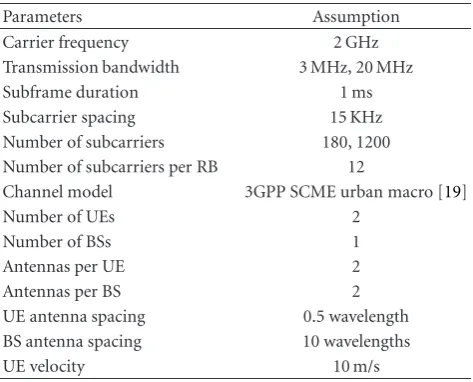
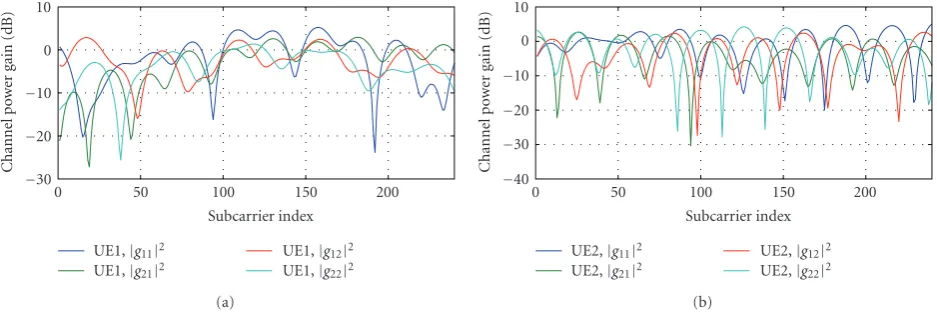
To evaluate the performance of the proposed spatial pre-coders in a 2×2 uplink MIMO system with two UEs as shown in Figure 2, simulations are conducted in the 3GPP LTE uplink with the parameter assumptions given inTable 1. A snapshot of the subcarrier channel power gain between the UEs and the BS is illustrated inFigure 3. For simplicity, it is further assumed that each resource block (RB) experiences the same channel condition and its channel frequency response is represented by the middle, that is, the 6th, subcar-rier of the RB. Under this condition, performance evaluation can be conducted per RB basis and the concept meant for a subcarrier in our previous discussion can be directly applied to an RB to reduce the computational complexity. In the following, first the performance is evaluated using a channel snapshot for illustrative purpose. Then we present results in terms of average spectral efficiency for different bandwidth and SNR conditions.
The upper part ofFigure 4shows the postdetection SNR γu,nof the inner OFDMA system using a channel snapshot of 20 MHz (totally 100 RBs) as depicted inFigure 3. Note that only 20 RBs (240 subcarriers) are shown for better visibility of the details. The dashed lines represent the results for the conventional UEs with each having only a single antenna, that is, settingvu,n =[1 0] for allu’s andn’s in our model. The solid lines stand for the results obtained by the proposed precoding scheme where UE 1 employs the dominant EV of the average channel correlation matrix as precoders for all the subcarriers and UE 2 uses the OCP for each subcarrier. The spectral efficiency of each sub-channel between each input and output component in the SC-FDMA system is plotted in the lower part ofFigure 4. It can be observed that the proposed algorithm significantly improves the spectral efficiency, or in other words the rate of the UEs in the system. Next, the statistics of the postdetection SNR is studied for the conventional virtual MIMO SC-FDMA and the proposed MIMO SC-FDMA with spatial precoding, where a setting of two UEs with the same average SNR = 10 dB over 15 RBs (≈3 MHz) is assumed. Statistics are collected from 50 randomly distributed locations in a cell and 100 subframes are considered assuming that each UE randomly moves from each location. The complementary cumulative distribution function (CCDF) of the postdetection SNR for both schemes is compared in Figure 5, which shows the probability that the postdetection SNR is larger than a certain value. It can be seen that with the proposed spatial precoding scheme the postdetection SNRs of both UEs are significantly increased,
Table1: Parameter assumptions for simulation.
Parameters Assumption
Carrier frequency 2 GHz
Transmission bandwidth 3 MHz, 20 MHz
Subframe duration 1 ms
Subcarrier spacing 15 KHz
Number of subcarriers 180, 1200
Number of subcarriers per RB 12
Channel model 3GPP SCME urban macro [19]
Number of UEs 2
Number of BSs 1
Antennas per UE 2
Antennas per BS 2
UE antenna spacing 0.5 wavelength
BS antenna spacing 10 wavelengths
UE velocity 10 m/s
where the improvement for the UE using dominant EV precoding is much larger than that for the UE using OCP.
For the same setting, Figure 6 shows the cumulative distribution function (CDF) of the system spectral efficiency and the individual user spectral efficiency for the conven-tional virtual MIMO SC-FDMA and the proposed MIMO SC-FDMA with spatial precoding. Spectral efficiency for UE 1 and UE 2 is indicated by dashed and dashdot curves, respectively. The system spectral efficiency is indicated by the solid curve. It can be observed that in comparison with the conventional virtual MIMO SC-FDMA the 50 percentile achievable system spectral efficiency almost dou-bles after applying the proposed scheme for different fixed optimization orders. It can also be clearly seen that with the fixed optimization orders, the UE using the dominant EV precoder always has higher average spectral efficiency than the one using OCP. If the proposed spatial scheduler is used, individual spectral efficiency of the UEs are balanced and the CDF of the achievable system spectral efficiency (green) lies almost on top of those obtained by fixed optimization orders (red and blue). For reference, the case that both UEs use frequency-dependent precoding according to (11) is also shown for both the SC-FDMA system and the OFDMA system. Note that although higher spectral efficiency is possible in this case, the single-carrier structure and hence the low PAPR property cannot be maintained for both UEs any more.
200 150
100 50
0
Subcarrier index −30
−20 −10 0 10
Channel
p
o
w
er
gain
(dB)
UE1,|g11|2 UE1,|g21|2
UE1,|g12|2 UE1,|g22|2 (a)
200 150
100 50
0
Subcarrier index −40
−30 −20 −10 0 10
Channel
p
o
w
er
gain
(dB)
UE2,|g11|2 UE2,|g21|2
UE2,|g12|2 UE2,|g22|2 (b)
Figure3: Channel power gain snapshot between the UEs and the BS according toFigure 2;gi jdenotes the subcarrier frequency response
between thejth transmitter of the UE and theith receiver at the BS.
20 18 16 14 12 10 8 6 4 2 0
Index of RB −10
−5 0 5 10 15 20
SNR
(dB)
Conventional, UE1 Conventional, UE2
Proposed, UE1, EV Proposed, UE2, OCP Postdetection SNR of the inner OFDMA system
(a)
20 18 16 14 12 10 8 6 4 2 0
Symbol index after IDFT 0
2 4 6 8
Sp
ectra
l
e
ffi
cien
cy
(b
its/
s/
H
z)
Conventional, UE1 Conventional, UE2 Conventional, UE1 and UE2
Proposed, UE1, EV Proposed, UE2, OCP Proposed,
UE1 and UE2 Achievable spectral efficiency in the SC-FDMA system
(b)
Figure4: Performance comparison between the conventional virtual MIMO SC-FDMA and the proposed MIMO SC-FDMA with precoding
using the channel snapshot inFigure 3. (Upper: postdetection SNR of the inner OFDMA system; Lower: achievable spectral efficiency in the
SC-FDMA system.)
is higher. As a result, all subframes consist of a similar number of strong/weak subcarriers and a similar number of subcarriers in which both UEs have similar spatial signatures. It follows that the number of low postdetection SNRs in the inner OFDMA system is similar in all subframes. Since the postdetection SNRs of all components in the SC-FDMA system are the harmony mean of the postdetection SNRs of the inner OFDMA system and they are mainly restricted by small values, it turns out that having similar number of low postdetection SNRs for each subframe is less spectrally efficient than having more low postdetection SNRs for some subframes and less for the others [20]. Nevertheless, the proposed scheme still achieves about twice as high system spectral efficiency as the conventional scheme.
Figure 8compares the performance with unequal average received SNR for different UEs, that is, SNRUE1=0 dB and SNRUE2=10 dB in the 3 MHz bandwidth. About twice the system spectral efficiency with respect to the conventional scheme can be expected from the proposed spatial precoding schemes for different fixed optimization orders. It can be
seen that the scheme which always gives higher priority to the weaker UE, that is, DEV and OCP are applied to the weaker UE and the stronger UE, respectively, still results in significant lower rate for weaker UE (red dashed) than for the stronger UE (red dashdot). This is due to the strong amount of interference caused by the stronger UE. Nevertheless, by applying our prosed scheduling algorithm (green) withβ=
10, comparable individual rate of the UEs can be achieved. Figures 9 and 10 illustrate the achievable average rate (bits/s/Hz) obtained by using the modified version of
25 20 15 10 5 0 −5 −10 −15 −20 −25
Postdetection SNR (dB) 0
0.1 0.2 0.3 0.4 0.5 0.6 0.7 0.8 0.9 1
CCDF
of
post
det
ection
S
NR
Conventional, UE1 Conventional, UE2
Proposed, UE1, DEV Proposed, UE2, OCP Postdetection SNR in SC-FDMA, 15 RBs,
SINRUE1=SNRUE2=10 dB
UE2
UE1
Figure 5: Complementary cumulative distribution function
(CCDF) of the postdetection SNR between the conventional MIMO SC-FDMA and the proposed MIMO SC-FDMA with spatial precoding. 15 RBs are available in the system and both UEs have the same average received SNR of 10 dB.
for UE 2 (by optimizing the linear combination of DEV and orthogonal precoder) such that the weighted sum rate of two UEs is maximized. The blue curve is obtained by the opposite optimization order, that is, choosing DEV for UE 2 and OCP for UE 1. If the UEs have the ability to coordinate the timing, the rate pairs on the black dashed curve (but not on the blue and red curves) can be achieved by time-sharing.
The UE rate pairs at the two ends of the black dashed curve correspond to the case where strongly different weight-ing factors are applied to different UEs (w=0.01 for one UE and w = 1.99 for the other). They also correspond to case where the UE with higher weighting using DEV precoder and the UE with lower weighting using the orthogonal precoder (OP). Imposing higher weighting to the UE means giving higher priority to the UE to maximize its own data rate, then the UE with lower weighting has to transmit in the direction without causing strong interference to the UE with higher weighting. The extreme case is that the UE with lower weighting chooses the OP such that it does not cause any interference to the UE with higher weighting.
For comparison, three additional transmit-precoding strategies are also considered and their achievable rate performances are shown in the figures. Each strategy applies a frequency-independent precoder on all subcarriers and the precoder can be different for different subframes. The first strategy is that each UE uses its own DEV of the average channel correlation matrix as the spatial precoder. In other words, each UE roughly couples maximum power into the channel without taking care of how much interference will be caused to each other. The second strategy is that each UE adaptively selects one precoder from the 4 predefined
14 12 10 8 6 4 2 0
Average achievable spectral efficiency (bits/s/Hz) 0
0.1 0.2 0.3 0.4 0.5 0.6 0.7 0.8 0.9 1
CD
F
o
f
av
er
age
ach
iev
able
sp
ect
ral
e
ffi
cien
cy
Conventional, UE1 Conventional, UE2 Conventional, UE1 and UE2 Proposed, UE1, DEV Proposed, UE2, OCP
Proposed, UE1 DEV and UE2 OCP Proposed, UE1, OCP
Proposed, UE2, DEV
Proposed, UE1 OCP and UE2 DEV Proposed scheduler, UE1 Proposed scheduler, UE2 Proposed scheduler, UE1 and UE2 SC-FDMA, UE1, (11)
SC-FDMA, UE2, (11)
SC-FDMA, UE1 (11) and UE2 (11) OFDMA, UE1 (11) and UE2 (11)
SC-FDMA, 15 RBs, SNRUE1=10 dB, SNRUE2=10 dB
Figure6: Cumulative distribution function (CDF) of the
achiev-able spectral efficiency by using conventional virtual MIMO with
a single antenna per UE (black) and by using a spatial precoder
according toFigure 2with fixed optimization order (red and blue)
and a spatial scheduler (green) for an SC-FDMA system (β =1).
For reference, the case that both UEs use frequency-dependent
precoding according to (11) is included for the SC-FDMA system
(cyan) and for the OFDMA system (magenta). 15 RBs are available in the system and both UEs have the same average received SNR of 10 dB.
precoding vectors (They are thev1 = (1/√2)[1 1]T,v2 = (1/√2)[1 −1]T,v3=(1/√2)[1 j]T, andv4=(1/√2)[1 −
j]T, resp.) specified in LTE systems [21] (referred to as the LTE DFT codebook) such that the system sum rate is maximized (16 combinations). The last strategy is that each UE adaptively selects one antenna for transmission (totally 4 possibilities) such that the system sum rate is maximized. It can be observed that all these transmit precoding strategies have inferior rate performance to the proposed scheme. Especially at low and moderate SNR conditions, the gain achieved by the proposed scheme is shown up to 40% over the adaptive LTE DFT codebook strategy and up to 70% over the other considered strategies.
14 12 10 8 6 4 2 0
Average achievable spectral efficiency (bits/s/Hz) 0
0.1 0.2 0.3 0.4 0.5 0.6 0.7 0.8 0.9 1
CD
F
o
f
av
er
age
ach
iev
able
sp
ect
ral
e
ffi
cien
cy
Conventional, UE1 Conventional, UE2 Conventional, UE1 and UE2 Proposed, UE1, DEV Proposed, UE2, OCP
Proposed, UE1 DEV and UE2 OCP Proposed, UE1, OCP
Proposed, UE2, DEV
Proposed, UE1 OCP and UE2 DEV Proposed scheduler, UE1 Proposed scheduler, UE2 Proposed scheduler, UE1 and UE2 SC-FDMA, UE1, (11)
SC-FDMA, UE2, (11)
SC-FDMA, UE1 (11) and UE2 (11) OFDMA, UE1 (11) and UE2 (11)
SC-FDMA, 100 RBs, SNRUE1=10 dB, SNRUE2=10 dB
Figure7: Parameter setting is the same withFigure 6but 100 RBs
are available in the system.
5. Conclusions
We propose to apply DFT precoding combined with spatial precoding to optimize the system sum rate in a MIMO SC-FDMA uplink. Depending on the requirements, at least one of the UEs can optionally apply a frequency nonselective pre-coding to obtain a single-carrier waveform with low PAPR. The required feedback overhead to convey the precoder decision to the UE is significantly reduced. Furthermore, to handle the fairness issues between the UEs, a simple spatial scheduler has been proposed within the framework to eff ec-tively steer and balance the individual user rate exemplarily. Simulation results show that the system spectral efficiency almost doubles for various SNR conditions compared to the case where each UE has only one transmit antenna. Finally, weighted sum rate maximization is also incorporated in the algorithm and its achievable rate region is presented and potential gains are shown compared to other popular precoding schemes for LTE uplink scenarios.
6. Open Problems and Future Work
For the scenario with more than two UEs and more than two antennas in the system, the principle ofAlgorithm 1can be extended by constructing candidate precodersvDEV,⊥
u,n for UE
10 9 8 7 6 5 4 3 2 1 0
Average achievable spectral efficiency (bits/s/Hz) 0
0.1 0.2 0.3 0.4 0.5 0.6 0.7 0.8 0.9 1
CDF
of
av
er
age
ac
h
ie
vable
spect
ra
l
e
ffi
ciency
Conventional, UE1 Conventional, UE2 Conventional, UE1 and UE2 Proposed, UE1, DEV Proposed, UE2, OCP
Proposed, UE1 DEV and UE2 OCP Proposed, UE1, OCP
Proposed, UE2, DEV
Proposed, UE1 OCP and UE2 DEV Proposed scheduler, UE1 Proposed scheduler, UE2 Proposed scheduler, UE1 and UE2 SC-FDMA, UE1, (11)
SC-FDMA, UE2, (11)
SC-FDMA, UE1 (11) and UE2 (11) OFDMA, UE1 (11) and UE2 (11)
SC-FDMA, 15 RBs, SNRUE1=10 dB, SNRUE2=10 dB
Figure 8: Parameter setting is the same with Figure 6but with
unequal average received SNR for the UEs: SNRUE1 = 0 dB and
SNRUE2=10 dB;β=10.
u(2 ≤ u ≤ U) according to (11), wherevDEV
u,n can be cal-culated by performing singular value decomposition (SVD) for the associated channel matrix andvu⊥,n can be obtained by using (10). However, it might happen that the solution to (10) does not exist. Therefore, advanced algorithm design is needed. A partial solution to accommodate multiple UEs is to divide the whole available system bandwidth into small partitions and apply the proposed algorithm for each partition with two UEs.
In the proposed scheduling algorithm, the introduction of a weighting factorβis shown to be able to balance the individual user rates to some extent. A typical value of β is between 1 and 10 depending on the channel quality of different users. However, the optimization ofβfor different channel conditions to achieve comparable rates for all users is an open question and subject to future study.
In
cr
ease
w
eig
hting
for
U
E2
Increase weighting for UE1
UE1 DEV and UE2 OP SNR1=SNR2=−10 dB
SNR1=SNR2=0 dB
SNR1=SNR2=10 dB
UE1 OP and UE2 DEV
101 100
10−1
Achievable average rate of UE1 (bits/s/Hz) 10−1
100 101
A
chie
vable
av
er
age
rat
e
o
f
U
E2
(bits/s/Hz)
UE1 DEV and UE2 OCP UE1 OCP and UE2 DEV DEV/OCP rate region UE1 DEV and UE2 DEV LTE DFT codebook (adaptive) Antenna selection (adaptive)
SC-FDMA, 3 MHz bandwidth (15 RBs),nT,1=nT,2=nR=2
Figure9: Achievable average rate for two UEs for different transmit
precoding strategies in the SCME “urban macro” scenario
accord-ing toTable 1. Both UEs share 3 MHz bandwidth to communicate
with the serving BS using the same time and frequency resources. Both UEs have the same SNR.
low speed in a limited area. In such scenarios, channels of all UEs are quasic-static, which makes it possible for the BS to continuously improve channel estimation with the help of the reference signals [21] sent from the UEs.
References
[1] J. T. E. McDonnell and T. A. Wilkinson, “Comparison of com-putational complexity of adaptive equalization and OFDM
for indoor wireless networks,” inProceedings of the 7th IEEE
International Symposium on Personal, Indoor and Mobile Radio Communications (PIMRC ’96), pp. 1088–1090, October 1996. [2] S. H. Han and J. H. Lee, “An overview of peak-to-average power ratio reduction techniques for multicarrier
transmis-sion,”IEEE Wireless Communications, vol. 12, no. 2, pp. 56–65,
2005.
[3] H. Wu and T. Haustein, “Energy and spectrum efficient
transmission modes for the 3GPP-LTE uplink,” inProceedings
of IEEE International Symposium on Personal, Indoor and Mobile Radio Communications (PIMRC ’07), Athens, Greece, September 2007.
[4] H. G. Myung, J. Lim, and D. J. Goodman, “Peak-to-average power ratio of single carrier FDMA signals with pulse
shaping,” inProceedings of the 17th IEEE International
Sym-posium on Personal, Indoor and Mobile Radio Communications (PIMRC ’06), Helsinki, Finland, September 2006.
In
cr
ease
w
eig
hting
for
U
E2
Increase weighting for UE1
UE1 DEV and UE2 OP UE1 OP and UE2 DEV
101 100
Achievable average rate of UE1 (bits/s/Hz) 101
100
A
chie
vable
av
er
age
rat
e
o
f
U
E2
(bits/s/Hz)
UE1 DEV and UE2 OCP UE1 OCP and UE2 DEV DEV/OCP rate region UE1 DEV and UE2 DEV LTE DFT codebook (adaptive) Antenna selection (adaptive)
SC-FDMA, 3 MHz bandwidth (15 RBs),nT,1=nT,2=nR=2
Figure 10: Achievable average rate for two UEs for different
transmit precoding strategies in the SCME “urban macro” scenario
according toTable 1. Both UEs share 3 MHz bandwidth to
com-municate with the serving BS using the same time and frequency
resources. Unequal SNR with 10 dB difference is assumed for the
UEs (SNRUE1=0 dB, SNRUE2=10 dB).
[5] V. Jungnickel, T. Hindelang, T. Haustein, and W. Zirwas, “SC-FDMA waveform design, performance, power dynamics and
evoluation to MIMO,” in Proceedings of IEEE International
Conference on Portable Information Devices, Orlando,Fla, USA, March 2007.
[6] H. G. Myung, “Introduction to single carrier FDMA,” in Proceedings of the 15th European Signal Processing Conference (EUSIPCO ’07), Poznan, Poland, September 2007.
[7] 3GPP TSG RAN, “Some aspects of single-carrier transmission for EUTRA,” R1-050765, August-September 2005.
[8] U. Sorger, I. De Broeck, and M. Schnell, “Interleaved FDMA—
a new spread-spectrum multiple-access scheme,” in
Proceed-ings of IEEE International Conference on Communications (ICC ’98), vol. 2, pp. 1013–1017, Atlanta, Ga, USA, June 1998. [9] T. Svensson, T. Frank, D. Falconer, M. Sternad, E. Costa, and
A. Klein, “B-IFDMA-a power efficient multiple access scheme
for non-frequencyadaptive transmission,” inIST Mobile and
Wireless Communications Summit, Budapest, Hungary, July 2007.
[10] T. Frank, A. Klein, and T. Haustein, “A survey on the envelope
fluctuations of DFT precoded OFDMA signals,” in
Proceed-ings of IEEE International Conference on Communications (ICC ’08), pp. 3495–3500, Beijing, China, May 2008. [11] WINNER, “Final report on identified RI key technologies,
[12] W. Yu, W. Rhee, S. Boyd, and J. M. Cioffi, “Iterative
water-filling for Gaussian vector multiple-access channels,” IEEE
Transactions on Information Theory, vol. 50, no. 1, pp. 145– 152, 2004.
[13] M. Sternad, T. Svensson, and G. Klang, “The WINNER B3G
system MAC concept,” inProceedings of the 64th IEEEVehicular
Technology Conference (VTC ’06), pp. 3037–3041, September 2006.
[14] E. Jorswieck, A. Sezgin, B. Ottersten, and A. Paulraj, “Feedback reduction in uplink MIMO OFDM systems by chunk
opti-mization,”EURASIP Journal on Advances in Signal Processing,
vol. 2008, Article ID 10.1155/2008/597072, 14 pages, 2008. [15] H. G. Myung, K. J. L. Pan, R. Olesen, and D. Grieco,
“Peak power characteristics of single carrier FDMA MIMO
precoding system,” inProceedings of the 66th IEEE Vehicular
Technology Conference (VTC ’07), pp. 477–481, October 2007. [16] A. Narula, M. D. Trott, and G. W. Wornell, “Performance limits of coded diversity methods for transmitter antenna
arrays,”IEEE Transactions on Information Theory, vol. 45, no.
7, pp. 2418–2433, 1999.
[17] H. Wu and T. Haustein, “Sum rate analysis of SDMA
transmission in single carrier FDMA system,” inProceedings of
the 11th IEEE Singapore International Conference on Commu-nication Systems (ICCS ’08), pp. 846–850, Guangzhou, China, November 2008.
[18] D. Tse and P. Viswanath,Fundamentals of Wireless
Communi-cation, Cambridge University Press, Cambridge, UK, 2005. [19] D. S. Baum, J. Hansen, G. Del Galdo, M. Milojevic, J. Salo,
and P. Ky¨osti, “An interim channel model for beyond-3G systems: Extending the 3GPP spatial channel model (SCM),” inProceedings of the 61st IEEE Vehicular Technology Conference (VTC ’05), pp. 3132–3136, June 2005.
[20] H. Wu, T. Haustein, and P. A. Hoeher, “On the information rate of single-carrier FDMA using linear frequency domain
equalization and its application for 3GPP-LTE uplink,”Eurasip
Journal on Wireless Communications and Networking, vol. 2009, Article ID 957159, 11 pages, 2009.
[21] 3GPP TS 36.211 and Technical Specification Group Radio Access Network, “Requirements for Evolved UTRA (E-UTRA) and Evolved UTRAN (EUTRAN); Physical Channels and Modulation (Release 8),” September 2009.
[22] V. Chandrasekhar, J. G. Andrews, and A. Gatherer, “Femtocell
networks: a survey,”IEEE Communications Magazine, vol. 46,