Improving the Reliability of Warehouse Operations
in the 3PL Industry: An Australian 3PL Case Study
Thi Hien Dieu Ho International College of
Management, Manly NSW 2095, Australia
Jose Arturo Garza-Reyes Centre for Supply Chain Improvement
The University of Derby Derby, U.K. [email protected]
* Corresponding Author
Jay Daniel Derby Business School, The University of Derby,
Derby, U.K. [email protected]
Vikas Kumar Bristol Business School The University of the West of England
Bristol, U.K. [email protected]
Simon Peter Nadeem * Centre for Supply Chain Improvement
The University of Derby Derby, U.K. [email protected]
Abstract— Warehouses play an important value-adding role to provide a competitive edge to any organization, and support business growth and efficiency throughout their supply chains. This paper explores warehouse operations (i.e. receiving, put away, picking, packing and shipping) and a series of challenges faced in managing warehouse operations in general and the 3PL industry in particular. Especially, the paper analyses the warehouse and logistics operations of an Australian 3PL company. By utilizing a mixed method approach both qualitative and quantitative data was gathered through in-depth interviews, direct observations and warehouse operations records. The collected data were then analyzed using thematic analysis. The data was screened and coded to further develop major themes to identify the problematic areas. This analysis helped to identify issues in operations related to the receiving process, missing, picking and locating items as well as human errors. While multiple approaches could be utilized to improve the operations, there yet remained a major challenge to manage operations within the planned budgetary limits. This research, therefore, provides some solutions/recommendations to improve the case company’s warehouse operations through staff empowerment, management process improvement, order dispatch and return process improvement, improvement in record keeping, and recruiting more personnel. These recommendations ensure company’s efficiency while balancing its challenges both in operations and budgetary constraints. This study thus provides an evidence to improve the reliability of warehouse operations through systematic process improvement.
Keywords— Warehouse Operations management, Logistics, 3PL Industry
I. INTRODUCTION
A. Introduction
Warehouses/distribution centers (DCs) play a vital role (1) in matching product demand with supply across different nodes in the supply chain. Without improving Warehouses/ DCs, no supply chain design and logistics is adequate (2) as the warehouses are not only the places to store goods and later distribute them (3) but also serve as centers for added value in logistics and supply chain management. Various DCs/ warehouses have repair, packaging and assembly operations within their premises (4). Therefore more attention is focused on warehouses recently (5). Current research demonstrates that understanding warehouse operations and management underlying principles would play a vital role in improving the efficiency of operations and improving customer service levels (6).
Nowadays, third-party logistics (3PL) is critical for managing companies’ warehouses/DCs (2) as outsourcing of warehouses is on rise (7,8), which let the organizations to focus on their core business to improve performance and reduce costs (8). Armstrong & Associates(9) report a 67% rise in the 3PL market of the Fortune 500 companies. Therefore, for the 3PL industry, it is crucial to identify and resolve any issues in warehouses/DCs to increase their customer satisfaction while concurrently reducing costs and gaining competitive advantage (10). The demand for these improvements by the users of 3PL companies is growing immense. A diverse range of user base makes it even more challenging to improve the warehouse operations as their demands/requirements vary greatly (11,12). Besides
becoming bottlenecks in operations of 3PL service providers, these problems can be damaging in the long run, if not resolved. Therefore, the absence of problem-solving becomes a gap in the capability to continually deliver on prescribed service level agreements and customer expectations. Thus, there is a strong need to identify/recognize key issues in warehouses/DCs and the ways to resolve them to allow for effective and efficient operations of the warehouses/DCs on a continuous basis.
The primary objectives of this research are to explore/ understand the whole warehouse processes in a 3PL industry in Australia; to identify the warehouse issues; to make recommendations to reduce the limitations, and to propose solutions/suggestions to improve warehouse reliability.
The paper is structured as follows: Section II presents the literature review related to this study; Section III explains the research methodology; Section IV provides the results along with and a brief discussion; and Finally, Section V concludes the paper and presents further research directions.
II. LITERATURE REVIEW
Warehouses play an important and very crucial role in the logistics operations (13) and their efficiency is very important for the overall supply chain to be effective (14). Although previously warehouses were perceived negatively due to their high costs (15), however now they are considered strategic element within the overall supply chain (16). The changing role of warehouses from merely storing goods (3) to be the value-adding station (e.g. repair, packaging, assembly, etc.) (4) attracts growing attention (5).
Warehouse have several roles such as raw material storage (17), postponement (18), customization or sub-assembly facilities (19), finished goods storage (20), consolidation (21) and transit warehouses. The focus and subject of this study is the finished goods storage and consolidation in the warehouse.
Warehouse primary purpose is to receive, store, pick and ship the goods and doing so in an efficient, accurate and cost-effective manner (3) which both satisfies the customer and meets business objectives. In order to meet diverse and varying supply and customer’s demand pattern (22), the managers need to manage resources in an efficient manner to allocate areas for stock, a system for tracking and recording customers profile to meet their demands. In order to manage these complex processes, warehouse management system (WMS) is used (22) to control, track, store, manage the stocks in the warehouse. It mainly focuses on physical products in term of receiving, putting-way, storage, picking, packing, shipping, tracking and documentation (23).
A. Definition and type of warehouse
than the physical or tangible object (24) it is accompanied by service. By contrast, service is a set of intangible activities (25) and has a very close relationship between customer, service staffs and facilities. Warehousing operations are a kind of service which is hard to measure as it is intangible for clients (26).
Due to difference of warehouse roles in supply chains, warehouse could be divided into three types, as retail warehouse where the goods are gathered from different supplier and delivered to multiple stores of clients; E-commerce warehouse, from where goods are sent/returned directly to customers on the same or next day (1); and public sector warehouse which supports the public sectors, armed forces and the third sector (27). All 3 types of warehouses can be owned, leased and managed by a third-party, called 3PL warehouse.
B. Warehouse Operations Process and Performance Warehouse operations have four main activities of receiving, storing, picking and shipping (28). Receiving process relate to receipt of products/items into the warehouse. Space constraints and optimization requires the warehouse to be organized in different sections for receiving process to distinguish the stock before and after receiving. Therefore, receiving process needs to be completed as soon as possible to avoid using space and update new stock in the system and be ready to be shipped (29).
Storing is the next process, as product/stock needs to be stockpiled in different areas within the warehouse based on the planned allocation. Storing speed can be determined based on the size of a warehouse, its handling capacity and the size of shipment received. The two main aspects of storage areas are floating location and fixed location. As a warehouse supervisor, it is necessary to manage item storage location ensuring that its safe, visible and easily accessible to locate the item.
Picking process is retrieving items from location to meet the customer's demand. The core activity in this process is to ensure that the right item and right quantity is picked. Thereafter all items in an order will be packed in one or more packages to be ready for shipping (29).
C. Warehouse’s Key Performance Indicators
A warehouse’s performance can only be determined/improved by measuring and evaluating several key performance indicators (KPIs). They are safety, picking, order duration, order picking warehouse statistic, slotting, replenishment, locations, and goods received, equipment, workforce (30).
Safety is always the priority for both the companies as well as employees in any company (31) and warehouse operations are no exception. According to U.S. Bureau of Labor Statistics (2014), warehousing and transport sector have the second highest number of fatalities in the USA. Warehouse operations are highly labor-intensive and involve material handlings (33), with heavy
equipment/vehicles moving around (31) and immense time pressure (34) makes this sector more vulnerable to safety. Therefore, it is extremely important to ensure that all necessary measures and practices are in place to ensure the safety of all.
Picking is one of the most expensive and labor intensive activity and is estimated to be costing around 55% of the total operating expenses (15). Therefore ensuring the process efficiency and effectiveness is crucial to achieving both the customer satisfaction and cost reduction (35). Any wrong movement costs money.
Order duration, as mentioned above any touching of items will cost both time and money. Order duration is calculated from the order being received in a warehouse until the orders are dispatched to customers.
Order picking warehouse statistic is the calculation of items quantity, orders, a number of cartons picked hourly, daily, weekly, monthly, and quarterly depending on the frequency management of the warehouse.
Slotting indicator shoes if the SKUs (stock keeping unit) to be picked together are also slotted closer to each other in the picking area (36).
Replenishment is about the speed of replenishing the inventory, especially in peak seasons.
Location is similar to slotting but it discusses more holistic storage, picking, packing areas in the warehouse. They need to be designed and organized in a way that would make warehouse operations effective and efficient.
Goods received indicator is one of the essential operations of the warehouse and mainly managed based on receiving volume, returned volume.
Equipment is another important indicator as it supports warehouse operation. It is necessary to ensure the functionality of the equipment as well as correct utilization to add value in overall warehouse operations.
Warehouse workforce has a direct impact on performance as they are directly and/or indirectly get in contact with the items either manually or by using the equipment. Any misprocessing by operators can lead to errors rate in picking, packing and dispatching times (37). Despite the fact that there is enormous development to automate the warehouse operations and that state of the art warehouse management systems (WMS) exist, it is undeniable that the human-involvement is integral.
D. Challenges in Warehouse Operations
failure or stoppage can slow down the process resulting in delayed outputs (29).
Inventory management can be a pressure for warehouse management, especially when there are multiple products line with big quantity. Warehouse supervisors need to be flexible to find the alternatives for every type of products at the different time of handling (4)
On the other hand, most of the warehouses always have the return stock, however, depending on whether it is an e-commerce warehouse, the volume of return stock will vary. Warehouse supervisors need to ensure that maximum effort is made to eliminate any processing error to reduce the return stock flow.
Another important challenge is inventory accuracy, depend on the warehouse size and its ability to handle items per day, stock-take is an important measure to see how effective the warehouse operation are. Inadequate management can lead to unexpected shortage/discrepancies and/or excess of products. Any error can raise concerns on warehouse management reliability.
E. Warehouse Management Technologies
Besides using the warehouse management system (WMS), the warehouse manager can consider investing in any of the below-listed technologies to increase warehouse reliability (38).
Machine-to-Machine Technology allows easy equipment control to increase warehouse movements.
Order Fulfilment Optimization Technology can maximize the order picking efficiency and accuracy; minimize the cost of warehouse processes.
Robotic Technology will help to increase the warehouse accuracy and speed by using robots and reduce labor and operational costs.
Voice Tasking Technology is using commands for all the process of the warehouse as receiving, putting away, picking
F. An overview of XYZ 3PL Company
An Italian XYZ global Logistic and Forwarding Company has over 100 years of experience and over 200 hundred offices across the world to provide flexible and trustworthy services to their customer. XYZ offers integrated and customized solutions to their customers with expertise in the sea, airfreight, customs clearance, and door-to-door services.
XYZ has three branches across Australia in Sydney, Melbourne, and Brisbane. However, due to the size of the business and number of customers, XYZ Sydney is dominant to others. Initially, XYZ Sydney provided door-to-door services only but to expand their offerings, since 2016 it has set up a warehouse for inbound customs to facilitate customs clearance and provide storage and distribution service for their customers. Current handling capacity of the warehouse is about three thousand items per day.
III. RESEARCH METHODOLOGY
A mixed method approach by utilizing both qualitative and quantitative method was adopted to collect/analyze both the primary and secondary data. To meet the objectives mentioned earlier, the following research questions were formulated to collect data through interviews:
Q1 How do you measure warehouse operations reliability? Q2 What are the warehouse operations issues in XYZ company? Understanding warehouse operation and identifying issues in XYZ warehouse operations. Q3 What are the solutions and suggestions to improve and
increase warehouse operations and reliability?
A. Data collection
Following the objectives of this research and being able to answer the above questions, the research concentrates on both primary and secondary data. The primary data includes in-depth structured interviews and personally structured observations. This also paved the way for the quantitative data collection from secondary data, which was gathered from warehouse operation records such as a monthly report, stock-take report, etc. Personal observations to collect data regarding warehouse stages, process, records, etc. were very insightful.
1) Qualitative Data
In-depth interviews were conducted with both tactical and operational level personnel within the company to gain a better understanding of operations as a whole from top management as well as at functional level from staff in different sections. Following people were interviewed:
Operations Manager
Supervisors
Staff (6 in receiving section, 3 in putting-away section, 4 in picking, packing, and shipping section)
2) Quantitative Data
Secondary data was collected from warehouse operations (such as warehouse plan in 2016-2017 and monthly, quarterly warehouse reports), warehouse management systems (WMS). This data was mainly about the following aspects of warehouse operations:
Picking time/item
Order duration
Warehouse area/location allocation
Safety condition in the third quarter of 2017
Discrepancies of stock-take in February and July 2017
Percentages of return stocks in the third quarter of 2017
Current handling ability and plans for 2018.
3) Data Analysis
A Thematic Analysis was conducted to look across all the data to identify the common issues that recur, and themes that emerge from the collected data. This is the most common method for descriptive qualitative projects. The key stages in a thematic analysis are to:
Read and annotate transcripts
Develop a coding scheme
Code the data
IV. RESULTS
A. Interview results
The results of interviews with SDB Australia Operation team and 3PL warehouse supervisor are summarized as follows:
Q1. According to the warehouse supervisor, the best method to measure warehouse operation’s reliability is doing the stock-take quarterly instead of biannually. Since it is a time-consuming process and six-month is a long period of time; during which many changes and mistakes can take place. Therefore, quarterly stock-take will minimize the variances and make it easier to find other issues to resolve. Another way that could be used to check warehouse operation reliability is picking and counting randomly the items in the warehouse and compare with its records in systems once a month.
Q2. According to the warehouse supervisor, the discrepancies raised are mostly due to human error and warehouse allocation is the main issue. In addition, return stock is also one of the concern.
Q3. So far, there are many options to improve warehouse reliability, however, in term of cost-efficient and labor-efficient, it is necessary to increase human ability in order to they do their task properly, quickly and efficiently. Apart from this, reallocating the item’s location would be good so it can be easily identifiable and reduce confusion for the staff.
Also, the interview responses with warehouse staff who is working in receiving / putting-away, picking, packing and shipping are summarized below.
Receiving staffs raised concerns regarding over load of work, as at times there are many shipments from overseas to be received within a very short time. Moreover, in peak season (e.g. Christmas) there is a shortage of staff to manage the increased customers’ demand.
They also pointed the problem with barcode labels, as sometimes they are either missing or blurred. This then requires manual entering of the product number and/or finding the code on supplier’s website in the case of a missing label, and it takes more time to perform an otherwise easy and quick task.
Additionally, a system error was identified where it shows a discrepancy between the actual received amount and the amount documented as shipped to the warehouse, despite the fact that items have been carefully scanned through. It then requires to re-do the checks which obviously doubles the time but the error, in fact, exist not at receiving end but from the shipper.
Putting-away staffs raised concerns about item location. Due to lack of warehouse space and absence of
dividers to distinguish allocated space between different items, they easily are mixed up. For example, the items are the same, but due to the insufficiency of location’s space, the items are placed in different locations within a warehouse. Eventually, it is challenging for picking staffs to pick quickly and accurately.
Picking, packing and shipping staffs: Although these steps are separated theoretically, in order to reduce the cost of labor, supervisors rotate and manage the staff between these steps. The picking step is important simply because the items included in the client’s orders have to be picked rightly and fast. However, if an error occurs at this step, it still can be fixed in packing because the items are always scanned to match with the order in the system. The shipping step is processed after scanning orders and the bill of lading will automatically be printed, therefore it minimizes human-error.
The staff in picking, packing and shipping sections pointed to the same problem of multiple locations of same items within the warehouse, therefore to pick items for large orders, it takes more time to pick from multiple locations.
B. Observations
As a personal observation, eighty percent of warehouse staffs have been working in XYZ Australia warehouse for more than six months and they are skillful enough to handle all the steps efficiently and accurately, and they know how to deal with the problems as and when it may arise. Remaining 20% of the staff needs training to effectively and efficiently manage operations while avoiding mistakes.
1) Safety condition in third quarter 2017
Apparently, the safety condition in XYZ warehouse is high. The warehouse is designed with ground floor only and furnished with adjustable temperature system to ensure that the luxury goods are not damaged because of the change of heat and humidity. In term of equipment operation, warehouse staffs are well trained to operate the facilities properly and so far, there is no record of any accidents during the working process.
2) Picking time/item
XYZ warehouse record for the last quarter of 2017 shows the average time to pick one item is from ten to twenty seconds depending on how far is the item located on the shelf from the picker.
3) Order duration
From different customers, destinations, seasons and contents of orders, order duration varies; however, generally, the order duration of XYZ is relatively standard. Although sometimes delays/mistakes do happen in picking due to items being wrongly placed and/or miss picking, however, the percentage is low at roughly two percent in total of handled orders.
4) Warehouse area/ location allocated
goods and fashion industry and have similar suppliers with most suppliers coming from Europe. The space allocated for Gucci is around 1350 square meters (44 percent), Ferragamo is account for 1070 square meters (35 percent) and Saint Laurent is about 650 square meters (21 percent).
5) Discrepancies after stock-take
XYZ warehouse was set up in June 2016 therefore; it only has had two stock-takes so far as in February and August 2017. The first time of stock-take discrepancy was 0.2% and the second time was 0.072%. XYZ has an agreed upon percentage of 0.01% for a margin of error in its contracts with its clients. Because of this agreement and a higher percentage of error in the observed two stock-takes, XYZ had to pay the extra costs.
6) Percentage of return stocks
Most of the goods in the warehouse are delivered directly to stores, not end-user or final clients. The percentage of return stocks is very low comparing with warehouse ability. The average quantity of output is 2000 item/day, of which roughly 12 items were returned per week in the third quarter of 2017, so the percentage of the returned stock was 0.12%. Below is listed percentages of return stock and the causes of return during the third quarter of 2017:
60% orders are changed by customers after orders arrived in store
20% because of faulty items
15% because of wrong items
5% unidentified/unspecified reason
7) Current handling ability and plans for 2018. Input: 3000 items/day
Output: 2000 items/day
Target in 2018
Input: 5000 items/day Output: 3000 items/day
The XYZ does not have the plan to expand the warehouse space in term of a square meter, only need to be more efficient and effective.
C. Challenges face by XYZ 3PL
Based on interviews and personal observation, XYZ is following the standard process as receiving, putting away, picking, packing and shipping and its facilities have been provided with pallet racking, shelving, mobile shelving, multi-tier racking, forklifts and managed by WMS. The current tools and equipment are sufficient to run business given the current capacity.
Biannually
Stock-Take
Variance between actual
stock and system records
Warehouse Allocation
Human Error
Staff Abilities
Managers
20% of staff
needs training
Low (2%) error
in picking
Higher than agreed
margin of error (0.01%)
in StockTake
-resulting in extra costs
Low return stock
-Of which 40% are
due to operations error
Observations
Work
overload
Staff shortage
in peak season
Missing or
blurred barcodes
Shippers error
on quantity shipped
Receiving
Staff
Space
shortage
No dividers
to distinguish
allocated space
Multiple locations
for same items
Putting-away
Staff
Large order requires
more time due to
multiple locations
of same items
and Shipping Staff
Picking, Packing
Challenges
faced by XYZ 3PL
(Interview and
Observations results)
Figure 1 Challenges faced by XYZ 3PL
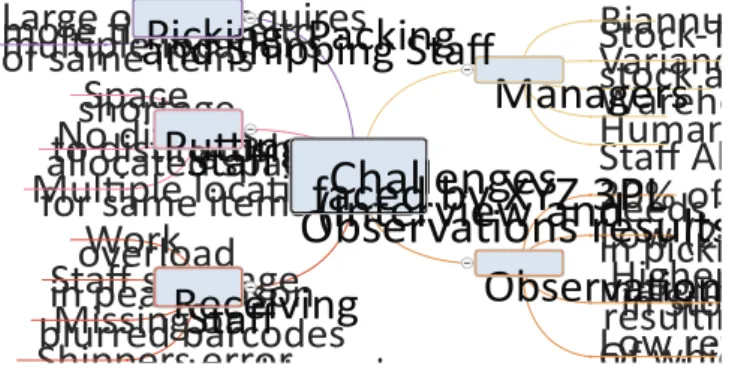
XYZ faces challenges in its receiving process as there are missing items or discrepancy between actual received items and document, it might rise from staff error or system or origin. Warehouse managers should consider offering a better training. In addition, short of staff in peak season is also one of concern. Putting-away, picking, packing, and shipping processes have a common issue that the items are located in different areas causing the process to slow down and increase inaccuracy. Combining with secondary data, this problem is further highlighted as there is more than the acceptable percentage of stock after checking inventory twice. On the other hand, the returned stock needs attention as 40% of the causes of return stock can be controlled by improving warehouse operations. Fig. 1 present a summary of current challenges faced by XYZ.
XYZ warehouse needs to address these challenges to improve their services and reliability. For this purpose, few recommendations are provided in the next section.
D. Recommendations
Based on warehouse objectives and plans for 2018, it is hard to expand the warehouse area because of the high capital investment requirement. Therefore, to ensure and increase the warehouse reliability within the currently available facilities, warehouse managers are recommended to take the following steps to improve their operations:
Improving the training process for both the old and new staffs to better utilize warehouse facilities, and by having a fundamental knowledge of warehouse processes and steps.
For managers, it is hard to have a concurrent holistic view of what actual operations and discrepancies are, as s/he cannot pay hourly or daily visits to observe the operations. Thus the possibility of ignoring the problems arisen and continuing without correcting is likely. The better option is to assign well-trained and knowledgeable supervisors at departmental levels, who can directly and immediately solve a minor problem. Periodical and monthly training for staffs will be highly beneficial to ensure that everyone is aware of any warehouse updates and/or productivity control.
with current clients and better market standing for potential ones to attract.
To improve and reduce the discrepancies, process management is very important. Proper scanning of items and any discrepancies at the time of receiving should be reported immediately to find the root of the problem before accepting to save the data in the system.
Return stock needs to be processed and re-shipped to clients as soon as possible because it will affect the quality of customer service at all ends. However, prior to shipping, it is highly important to ensure that all items are packed and shipped under good conditions. This will not only save time and cost for both parties but will greatly increase the reliability of the warehouse service level.
E. Implications for practice
Warehouse area is hard to change, as it mostly requires costly capital investments. Especially, as XYZ warehouse has been set up just a few years ago and there is no guarantee that they will break-even during the first few years. Therefore, for the short-term, it is recommended to keep the warehouse area as it is currently with the target to break-even during first two years and develop a reliable management system to perfectly operate at their current capacity and ability. Thereafter it would be time to explore improvements in new technologies such as Order Fulfillment Optimization Technology.
For now, the staff training is necessary as they directly handle the orders and their work directly impacts the quality of service provided by XYZ. Managers should set standard processes with instructions for every step in writing and/or video/animations. It will be helpful to have such information at hand at any given time and moreover it will provide less costly training tool. Hiring more staffs could be an option but it will be more efficient to hire temporary staff under casual contract during peak seasons.
Regarding warehouse allocations, all the shelves need to be divided with the visible labels in order to be easily recognized by staffs. As the warehouse resources location information is very important for effective and efficient operations (39). Warehouse manager needs to do a basic statistical analysis of their inventories and its frequency. This will help to organize the space and items allocation in right order and quantity resulting in reduced lead-time.
V. CONCLUSIONAND FUTURE RESEARCH DIRECTIONS The paper reviews several aspects of XYZ Warehouse in Australia, a 3PL and analyses its operations and WMS. The analysis revealed some fundamental issues at XYZ’s operations including receiving process, missing items, picking, locating items and human error. Both primary and secondary data revealed potential areas for improvements. As a result, several recommendations/ suggestions are made to deal with those problems without any significant capital requirements.
This research offers several directions for future research such as the cross-docking, anticipatory shipping, software system integration between supplier and retailers/customers, as well as the difficulties related to a higher level of demand forecasts in the 3PL industry in general and in XYZ Australia in particular.
Acknowledgment: Authors would like to express their appreciation for the cooperation and help of the 3PL company, XYZ Australia.
REFERENCES
1. Boysen N, Koster R de, Weidinger F. Warehousing in the e-commerce era: A survey. Eur J Oper Res. 2018;
2. Alawneh F, Zhang G. Dual-channel warehouse and inventory management with stochastic demand. Transp Res Part E Logist Transp Rev. 2018;112:84– 106.
3. Karim NH, Rahman NSFA, Shah SF, Shah SJ. Empirical Evidence on Failure Factors of Warehouse Productivity in Malaysian Logistic Service Sector. Asian J Shipp Logist. 2018;34(2):151–60.
4. De Koster RBM, Johnson AL, Roy D. Warehouse design and management. Int J Prod Res. 2017;55(21):6327–30.
5. Kembro JH, Danielsson V, Smajli G. Network video technology: Exploring an innovative approach to improving warehouse operations. Int J Phys Distrib Logist Manag. 2017;47(7):623–45.
6. Leuschner R, Carter CR, Goldsby TJ, Rogers ZS. Third-Party Logistics: A Meta-Analytic Review and Investigation of its Impact on Performance. J Supply Chain Manag. 2014 Jan;50(1):21–43.
7. Murphy PR, Wood DF. Contemporary Logistics. 8th ed. New York: Pearson Eductiion Inc.; 2004. 8. Jie F, Guoqing W. Joint optimization of dynamic lot
and warehouse sizing problems. Eur J Oper Res. 2018;267(3):849–54.
9. Armstrong & Associates I. 3PL Customers Report Identifies Service Trends, 3PL Market Segment Sizes and Growth Rates [Internet]. 2013 [cited 2018
Apr 4]. Available from:
https://www.3plogistics.com/3pl-customers-report- identifies-service-trends-3pl-market-segment-sizes-and-growth-rates-2/
10. Yadavalli VSS, Balcou C. A supply chain management model to optimise the sorting capability of a “third party logistics” distribution centre. South African J Bus Manag. 2017;48(1):77– 76.
2017;112:526–36.
12. Batarlienė N, Jarašūnienė A. “3PL” Service Improvement Opportunities in Transport Companies. In: 10th International Scientific Conference Transbaltica 2017: Transportation Science and Technology. 2017. p. 67–76.
13. Caridade R, Pereira T, Ferreira LP, Silva FJG. Analysis and optimisation of a logistic warehouse in the automotive industry. Procedia Manuf. 2017;13:1096–103.
14. Stoltz M-H, Giannikas V, McFarlane D, Strachan J, Um J, Srinivasan R. Augmented Reality in Warehouse Operations: Opportunities and Barriers. IFAC-PapersOnLine. 2017;50(1):12979–84. 15. Koster R de, Le-Duc T, Roodbergen KJ. Design and
control of warehouse order picking: A literature review. Eur J Oper Res. 2007;182(2):481–501. 16. Hübner A, Holzapfel A, Kuhn H. Distribution
systems in omni-channel retailing. Bus Res [Internet]. 2016;9(2):255–96. Available from: http:// link.springer.com/10.1007/s40685-016-0034-7 17. Singh RK, Chaudhary N, Saxena N. Selection of
warehouse location for a global supply chain: A case study. IIMB Manag Rev. 2018;In Press. 18. Guericke S, Koberstein A, Schwartz F, Voß S. A
stochastic model for the implementation of postponement strategies in global distribution networks. Decis Support Syst. 2012;53(2):294–305. 19. Kudelska I, Kosacka M, Lewandowska KW. How to Support Storage Process in Dismantling Facility with IT Solutions? – Case Study. Procedia Manuf. 2017;11:703–10.
20. Halčinová J, Trebuňa P, Janeková I, Živcák J, Janek J. The proposal of stock items reconfiguration on the basis of cluster analysis results. In: Procedia Engineering. 2014. p. 143–7.
21. Boysen N, Fedtke S, Weidinger F. Optimizing automated sorting in warehouses: The minimum order spread sequencing problem. Eur J Oper Res. 2018;270(1):386–400.
22. Faber N, de Koster MBM, Smidts A. Organizing warehouse management. Int J Oper Prod Manag. 2013;33(9):1230–56.
23. Richards G. Warehouse management: a complete guide to improving efficiency and minimizing costs in the modern warehouse. Kogan Page Publishers; 2017.
24. Martin D, Schouten J. Sustainable marketing. Vol. 1. Prentice Hall Boston; 2012.
25. Sampson SE, Froehle CM. Foundations and Implications of a Proposed Unified Services Theory. Prod Oper Manag [Internet]. 2009;15(2):329–43.
Available from:
http://doi.wiley.com/10.1111/j.1937-5956.2006.tb00248.x
26. Gonroos C. Service Management and Marketing A Customer Relationship Management Approach, John Wiley & Sons Co. New York-USA. 2000; 27. Manzini R. Warehousing in the global supply chain:
Advanced models, tools and applications for storage systems. Springer; 2012.
28. Kłodawski M, Jacyna M, Lewczuk K, Wasiak M. The Issues of Selection Warehouse Process Strategies. In: Procedia Engineering. 2017. p. 451– 7.
29. Hompel M, Schmidt T. Warehouse management: automation and organisation of warehouse and order picking systems. Springer Science & Business Media; 2006.
30. Supply Chain Brief. Warehouse Management Cost Savings: How to Build a Warehouse Management Strategy Built on Efficiency. Supply Chain Brief. 2018.
31. Hofstra N, Petkova B, Dullaert W, Reniers G, de Leeuw S. Assessing and facilitating warehouse safety. Saf Sci. 2018;105:134–48.
32. U.S. Bureau of Labor Statistics. Census of Fatal Occupational Injuries (CFOI) [Internet]. 2014. Available from: https://www.bls.gov/iif/oshwc/cfoi/ cfch0013.pdf
33. Goode N, Salmon PM, Lenné MG, Hillard P. Systems thinking applied to safety during manual handling tasks in the transport and storage industry. Accid Anal Prev. 2014;68:181–91.
34. De Koster RBM, Stam D, Balk BM. Accidents happen: The influence of safety-specific transformational leadership, safety consciousness, and hazard reducing systems on warehouse accidents. J Oper Manag. 2011;29(7–8):753–65. 35. Giannikas V, Lu W, Robertson B, McFarlane D. An
interventionist strategy for warehouse order picking: Evidence from two case studies. Int J Prod Econ. 2017;189:63–76.
36. Kim BS, Smith JS. Slotting methodology using correlated improvement for a zone-based carton picking distribution system. Comput Ind Eng. 2012;62(1):286–95.
37. Supply Chain Brief. Warehouse Statistics and KPIs Every Logistics & Warehouse Manager Should Know. Supply Chain Brief. 2018.
38. Supply Chain Brief. 7 Innovative Warehouse Management Technologies to Adopt. Supply Chain Brief. 2018.