Using a Lexical Semantic Network for the Ontology Building
Nadia Bebeshina-Clairet
LIRMM / LIMICS
Sylvie Despres
LIMICS 74 rue Marcel Cachin
93017 Bobigny
Mathieu Lafourcade
LIRMM 860 rue de St Priest
34095 Montpellier
Abstract
Building multilingual ontologies is a hard task as on-tologies are often data-rich resources. We introduce an approach which allows exploiting structured lex-ical semantic knowledge for the ontology building. Given a multilingual lexical semantic (non ontolog-ical) resource and an ontology model, it allows min-ing relevant semantic knowledge and make the on-tology building and enhancement process faster.
1 Introduction
Nowadays, termino-ontological resources are in-creasingly rich in terms of data they rely upon. The scientific community works intensively on data ac-quisition for the ontology building. In particular, the NeOn project1has been set up to provide a method-ology for the ontmethod-ology engineering by integrating preexisting knowledge resources into an ontology building process. The NeOn methodology contains a consistent framework for modular ontology build-ing as well as for settbuild-ing up ontology networks. Here we focus on exploiting Lexical Semantic Networks (LSNs) to enrich an ontology or accompany the ontology building process. We assume that LSNs represent knowledge as it is expressed through the human language whereas ontologies provide a for-mal description (specification) of a conceptualiza-tion (concepts and relaconceptualiza-tionships between those cepts) shared by a community of agents. A
con-1http://neon-project.org/nw/About_NeOn.html
cept corresponds to a set of individuals sharing sim-ilar characteristics and may or may not be lexical-ized. Thus, the ontology labels cannot be polyse-mous. The strength of ontologies is in their for-mal consistency. The weaknesses are linked to their coverage, size (as stated in (Raad and Cruz,2015), ”large ontologies usually cause serious scalability problems”), and human effort needed for their build-ing. The potential of the LSNs is linked to the large amount of explicit semantic information they con-tain. However, a filtering process is needed to dis-criminate irrelevant information (polysemy, noise).
2 State of the Art
can-didate concepts. They exploit such methods as for-mal concept analysis (Mondary,2011) or knowledge based methods (for instance, TextToOnto2). ”Lex-ical ontologies” (Abu Helou et al., 2014) are suc-cessfully used for ontology building. Numerous ap-proaches targeted at high level ontology or informa-tion retrieval ontology based on general knowledge (such as (Marciniak, 2013)) rely on PWN. Others use PWN and domain specific semantic lexicons for forming the concepts (Turcato et al.,2000). Many other ontology learning techniques use distributional semantics to learn lightweight ontologies, for exam-ple, (Wong,2009).
In the framework of corpora based approaches to the ontology building such as described in (Kietz et al., 2000), the idea of notable (salient, relevant) element orrelevant piece of knowledge (RPK) has been introduced. It corresponds either to the fre-quent terms appearing in a corpus and to the tacit knowledge contained in texts. Such tacit knowl-edge corresponds to the semantic relationships (sub-somption relationship and other specialized relation-ships). Their presence in texts may take the form of ”indices”. In contrast, the explicit elements may re-veal the presence of concepts. The main drawback such definition of RPKs is that it relies on the fea-tures defined or recorded for a particular language. In addition, statistical criteria are often preferred and it is difficult to qualify such RPKs from the semantic point of view and in a language independent man-ner. In this paper, we will detail the experiments we conducted to provide a new definition of the RPKs based on the structured lexical semantic information and describe the way so defined RPKs can be used to help the top down ontology building process.
3 Ressources
In the present section, we will describe the resources we used in our experiments.
The RezoJDM (Lafourcade, 2007) is a lexical se-mantic network (LSN) for French built using
crowd-2https://sourceforge.net/p/texttoonto/wiki/
sourcing methods and, in particular, games with a purpose (GWAPS) such as JeuxDeMots3 and addi-tional games . This commons sense network has been built since 2007. It is a directed, typed and weighted graph. At the time of our writing, Rezo-JDM contains 2.7 millions of terms that are modeled as nodes of the graph and 240 millions of relations (arcs).
TheMLSN(Bebeshina-Clairet,2019) is a multilin-gual LSN (it covers French, English, Spanish, and Russian) with an interlingual pivot built for the cui-sine and nutrition domain. This network is inspired by the RezoJDM in terms of its model. Structurally speaking, the MLSN is a directed, typed, and val-uated graph. It contains k sub-graphs correspond-ing to each of thek languages it covers and a spe-cific sub-graph which fulfills the role of the interlin-gual pivot. Similar to the RezoJDM, we callterms the nodes of the MLSN and relations - its typed, weighed, and directed arcs. The MLSN nodes may correspond to one of the following types : lexi-cal items (garlic), interlingual items (pertaining to the interlingual pivot and also called covering terms), relational items (i.e. relationship reifica-tions such assalad[r has part]garlic), andcategory itemsparts of speech or other morpho-syntactic fea-tures (i.e. Noun:AccusativeCase).
As it has been difficult to set up the pivot using a multilingual embedding (joining multiple spaces, one per language) as well as to avoid pairwise align-ment based on combinatorial criteria, the pivot has been started as a natural one using the English edi-tion of DBNary (S´erasset, 2014). It incrementally evolves to become interlingual. The pivot evolution relies on sense-based alignments between the lan-guages of the MLSN and aims at taking into account the difference of sense ”granularity” in different lan-guages. For example, asstewin English can be trans-lated as into French as pot-au-feu and ragoˆut. It reflects the conceptualization discrepancy asragoˆut refers to saut´e the ingredients and then add water
whereaspot-au-feurefers to boiling them together in a larger amount of water than used for theragoˆut. In the MLSN pivot we have the interlingual term cor-responding to stew (which covers the English term) with two hyponyms corresponding to 0rench terms. The alignments are progressively obtained through external resources or by inference. Thus it can be considered as a union of word senses lexicalized or identified in the languages covered by the MLSN. . Even though we assume the pivot as being inter-lingual, it is still close to a natural one. A relation
r ∈ R is a sextuplet r =< s, t, type, v, ls, lt >
wheresandtcorrespond respectively to the source and the target term of the relation. The relation
typeis a typical relation type. It may model differ-ent features such as taxonomic and part-whole re-lations (r isa, r hypo, r has part, r matter, r holo), possible predicate-argument relations (typical object r object, locationr location, instrumentr instrof an action), ”modifier” relations (typical characteristic r carac, typical mannerr manner) and more4. The relationship valuation v corresponds to the charac-teristics of the relation which are its weight, con-fidence score, and annotation. The relation weight may be negative in order to model noise and keep the information about erroneous relations easy to access programmatically so they could not affect the infer-ence processes. The confidinfer-ence score is a score at-tributed to a particular data origin (external resource, inference process). In practice, this feature is an ar-ray as different origins may provide the same rela-tion. The confidence information is provided as an argument to the function that maps from some ex-ternal knowledge resource to the MLSN. In case of relation calculated by an inference process, it cor-responds to the precision evaluated on a sample of candidate relations returned by this process. To an-notatea relation we add a complementary informa-tion that allows qualifying this relainforma-tion. The figure1
details and exemplifies the annotation scheme. The labelslsandltcorrespond to the language
(sub-4We also introduced more specific relation types such asr entailment,
r cause,r telic role,r incompatible,r before,r afteretc.
Figure 1: MLSN: relationship annotation scheme.
graph) labels. At the time of our writing, the MLSN contains 821 781 nodes and 2 231 197 arcs. It covers 4 languages : English, French, Russian, and Span-ish.
MIAM (Despr`es, 2016)5 is a modular termino-ontology for the digital cooking. It provides knowl-edge necessary for the elaboration of general nutri-tional suggestions. The knowledge model of this ontology gathers expert knowledge on food, food transformation, cooking actions, relevant dishes that reflect french culinary tradition, recipes necessary to cook such dishes. MIAM contains about 7 000 nodes and 30 000 semantic (non subsump-tion/ontological is-a) relations.
4 Method: Immersion - Projection
4.1 Summing up the Method
Our method is built upon the idea of projecting a model (the MIAM model) onto a multilingual or monolingual LSN (respectively MLSN and Rezo-JDM) in order to extract an intermediary resource that can be used by ontology or domain experts in the scope of information retrieval or validation of the automatically suggested pieces of knowledge. Our method differs from others by the definition of the RPK and by the use of a non ontological seman-tically structured resource for ontology building. We define RPK as follows : ”a relevant piece of knowl-edge is either a term or a relation or a semantic structure which is known as qualified and qualify-ing”. Qualified refers to the possibility to describe
5http://www-limics.smbh.univ-paris13.fr/
the RPK in a discrete way (i.e. by enumerating the typed relations). If the RPK is a term, it needs to have a high in-degree (which reveals its conceptual role as it is used to define other terms of the net-work). If the RPK is a relation, it needs to be con-textualized (through the annotation mechanism rep-resented on the figure 1 or through the constraints put on source and/or target terms of the relation). If the presumed RPM is a graph structure (path, sub-graph), it needs to possess a certain number of oc-currences in the network. Qualifying refers to the possibility to use the candidate RPK for endogenous inference process. If the RPK is a term, it needs to have hypernyms, hyponyms, synonyms among its neighbours. It has to be aligned with other terms pertaining to the other languages of the LSN (if such LSN is multiligual). If the RPK is a relation, it must not be unique (other real or potential6relations must exist in the network). If the candidate RPK is a struc-ture, its terms and relations must be qualifying. Here we detail the experiments that have been con-ducted on the basis of the MLSN in order to pro-pose ”pseudo-class” and ”pseudo-property” candi-date RPKs to enhance the MIAM ontology and those concerning the enrichment of an ontology draft us-ing the monolus-ingual LSN, RezoJDM (Lafourcade,
2007). These experiments rely on lexical knowl-edge. Therefore, the resulting RPKs have no pre-tension to the ontological validity. The decision per-tains to the human expert.
4.2 Immersion
The projection of a given ontology model onto a LSN starts by the immersion of such model. The immersion mechanism uses a set of manually de-fined mapping rules. It is possible to generate them automatically for the ontological resources that ex-ploit standard vocabularies (such as RDFS, SKOS and other machine readable formats). The input of the immersion algorithm is the reference ontology (MIAM) and the set of mapping rules whereas its
6Relations that can be calculated using inference.
output is the action of inferring terms and relations in the target LSN (MLSN, RezoJDM).
In their general form, the mapping rules state: ”If x and y are respectively domain and range of an Object Property p of the ontology to be immersed and y is a subclass of C, then x has a relation R with y and y has a relation is-a with C in the re-ceiving (target) LSN”. Such rules have been de-fined for the multilingual experiment for two rea-sons. First, for each of the 93 MIAM proper-ties, we determined relevant MLSN semantic re-lation types (or set of types). Thus, the Ob-ject Property aPourProduitInitial ( hasIni-tialProduct) corresponds to the substance and part-whole meronymy (MLSN relations typedr has part and r matter). Second, we mapped the ontology labels to the MLSN terms by coincidence (3 930 terms; i.e. poulet basquaise formally denotes a MIAM concept, a lexical item with the same la-bel already exists in the MLSN) or by composition (4 135 terms, i.e.: unit´e mesure capacit´e doesn’t correspond to any existing MLSN term because it doesn’t correspond to any commonly used colloca-tion in French; this label is split and integrated into MLSN with the semantic relations that link its parts. As part of the monolingual experiment, 115 descrip-tors have been automatically expressed in French on the basis of their Uniform Resource Identifier (URI) strings. All the terms except one were al-ready present in the RezoJDM network. We ex-ploited the relations typedr carac (typical charac-teristic) for this experiment. This relation has been annotated using the URIs of the ontology properties aPourDescripteurBruit ( hasSoundDescrip-toris immersed as follows: croˆuter carac::bruit
croustillant(”croˆutehas typical characteristic linked to the noise croustillant”7). The premises of the mapping rules rely on the contextualization of the LSN relations. Such contextualization is possible when using sets of hypernyms and neighborhood se-mantic relations of the source and target terms of a
7
relation. Meta-information attached to the LSN re-lations (annotations, weight) may also be used. For instance: p´etrir r objectpˆate ∧ p´etrir r isa tech-nique de base∧pˆater isapr´eparation8).
As part of the immersion process the ontology labels become LSN terms that can be polysemous.
4.3 Projection
4.3.1 Inference in the LSN Context
In the MLSN context we set up several algorithms to discover relevant pieces of knowledge (RPK) of the types ”class/individual” (ci) and ”ontology prop-erty”(op). To discover the RPK(ci) we compare the neighborhood terms inside an hierarchical chain which goes up to a high level MIAM concept im-mersed into the LSN. For the RPK(op) we look for (real or possible) MLSN relations similar to the im-mersed MIAM properties. The inference scheme we use is the abduction scheme. When we have two similar terms (such as cohyponyms) the relations de-tained by one of them can be proposed for the other. For a termT, the abduction implies selecting a set of similar terms (according to some criteria) in order to propose the relations detained by those similar terms toT.
4.3.2 Discovering the RPK(ci)
In MIAM, thegeneral axiomsconcern the disjunc-tion between the MIAM classes which is the basis of the ontology consistence. To translate them in terms of MLSN, we considered the labels of the classes listed in the axioms in order to identify the crite-ria that could have determined the disjunction. We manually analyzed a subset of the MIAM axioms and came up with the following criteria: affiliation (r has part i.e. a specific label (organic)), trans-formation(r carac i.e. boiled mixture, cubed veg-etable),composition(r matteri.e. produit `a base de poisson ”fish based product”), category based dis-tinctions(r hypoi.e.volaille type dinde”turkey type
8
kneadr objectdough∧kneadr isabasic technique∧doughr isa
mixture
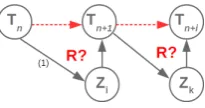
poultry”). This analysis allowed selecting a subset of relation types to consider during the experiment. The RPK(ci) inference includes two steps: valida-tion of the hierarchical chain (figure2) and RPK(ci) candidate suggestion.
Figure 2: Hierarchy chain validation.Tiare the terms of the
hierarchy chain. We check by triangulation their semantic relatedness and use a subset of relations types (such relations are notedR) for that.
We calculated and validated hierarchical chains cor-responding to 1 322 top MIAM concepts pertaining to the Aliment module. First we obtained 132 213 chains. After filtering them by weight, the set has been reduced to 53 749 chains (40% of the initial set). Still, a certain number of redundancies may ex-ist inside this statex-istically pre-filtered set since a long chain may include several shorter ones. The logical filtering by triangulation left us with a set containing 9 600 hierarchical chains (18% of the number of sta-tistically filtered chains and 7% of the initial number of candidates).
Hierarchical chain examples after filtering: (1) ”baguette compl`ete→pain complet→
pain→ingr´edient de recette de cuisine→aliment” (2) ”ang´elique→confiserie→bonbon”.
RPK(ci) examples:
truffe chocolatsubClassOfchocolat pomme `a cidresubClassOfpomme sucre de pommesubClassOfconfiserie
that the highest in-degree typedr isa in the French sub-graph of the MLSN is 5 264 (for the term al-iment) and that the maximum length l = 9, the complexity in the worst case would be O(dlisa or
O(5 2649) = 3,103436942×1033.
The table 1 introduces the results obtained for the discovery of RPK(ci) related to the top level concept Alimentin the French sub-graph of the MLSN. The
#candidates #valid %valid #new %new
11 520 11 289 98% 4 741 42%
Table 1: The RPK(ci) discovery.
automatic evaluation of the proposed RPK(ci) would mostly rely on similarity measures. However, the projection step implicitly relies on relatedness and similarity between the LSN terms. Thus, in our fu-ture work, the RPK(ci) evaluation will need human expert decisions.
4.3.3 The RPK(op) Discovery
The RPK(op) discovery seems to be particularly useful in the context of multilingual ontology building or localization of an existing ontology. In our experience, each module of the MIAM ontology has its own hierarchy of properties. While immersing them into the MLSN, these properties have been expressed in terms of semantic relations contextualized using annotations. The choice of the MLSN semantic relation type made for these properties allows us to distinguish the following cases for the MIAM Object Properties (OPs): composition based (aPourProduitInitial, ”hasInitialProduct”); related to processes ( aPourMethodeDeConservation, ”has-ConservationMethod”); temporal and spatial relation based (aPourMoisPrimeur, ”hasEar-lyMonth”); characteristic based (aPourEtat, ”hasState”); OPs with a specific sub-graph9 (aPourAlimentAmi, ”hasFriendlyFoodItem”).
9A subset of MLSN terms connected through semantic relations.
The MIAM ontology we try to enrich counts 21 565 instances of Object Properties. Once they are im-mersed into the MLSN, one could consider that we have the same number of inference rule instances that can be used for the cross-lingual RPK(op) dis-covery. A naive approach would be setting up a cross-lingual inference mechanism. However, such approach would be error-prone due to the poten-tial alignment and polysemy issues. In addition, as MIAM has been built according to the top-down methodology by a community of domain experts, it contains a variable number of instances per property. The naive approach would reiterate this imbalance. To refine the RPK(op) discovery, we experimented a rule based approach. First, the validity of the rule for the source language is calculated. Second, struc-tures similar to those specified by the rule are being discovered in the MLSN (in other languages). The rule has the following form:
property=aPourEtatPhysique (property name)
src=?s(domain, set of terms) reltype=r_carac(relation type) tgt=?o(range, set of terms)
source_isa=aliment(src hypernyms) target_isa=etat physique (tgt hypernyms)
annotation=int:physical state (meta-information)
src_feat=OUT/r_pos/int:Noun
(in and out relations that characterize terms in the source set)
asaPresenceLactose,aPresenceGluten); specific pattern(defined by rules);complex struc-turefor properties related to processes. The results obtained using possibly annotated relations(in par-ticular,Data Properties)) are presented in the table
2. the potential improvement is estimated as an in-crease compared to the initial number of property instances (impr.%).
#DP #MIAM #RPK(op) filt. +%
aTeneurLipide 0 4 741 3 271
-aPresenceLactose 2 593 530 408 +16%
aPresenceGluten 289 820 762 +263%
Table 2: The RPK(op) discovery on the basis of simple se-mantic relations.
Example of the output of the rule-based algorithm: ru:jarkoje aPourProduitDiscriminant podlivka (”stew hasDiscriminatingProduct sauce”) and en:stew aPourProduitInitial en:vegetable (produce) (”stew hasInitialProduct vegetable”). Our rule-based RPK(op) experiment (given the actual state of the MLSN) yielded the results listed in the table3.
Fully automated structure-based evaluation such as described in (Fern´andez et al., 2009) may be cho-sen to compare to other resources available on the Web such as (Dooley et al.,2018). To address the ontology accuracy, completeness, conciseness, ef-ficiency, consistency, and other features (Raad and Cruz,2015), a combination of methods is needed. In particular, gold standard ontology, specific tasks and corpora may be used for evaluation. A task-based evaluation such as semantic analysis ( Bebeshina-Clairet, 2019), dietary conflict detection from dish titles (Clairet,2017) have been used for the MLSN. To evaluate the output of the immersion- projection method, we need to organize our triples into a fully structured ontology. This will be one of the priorities of our future work.
4.3.4 Towards the Automatic Suggestion of the RPKs(op)
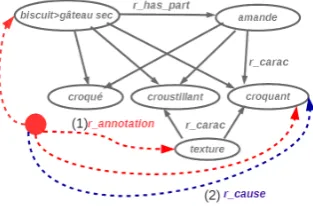
To extend the RPK discovery experiment, we tried to automatically suggest pseudo ontology proper-ties to be submitted to the domain and ontology hu-man experts. We considered the ontology Senso-MIAM10 for this experiment. This ontology is a MIAM module but we considered it as a ”draft” on-tology as the sensory aspect modeling is a flourish-ing research and development area and the Senso-MIAM could be improved. We used the monolin-gual LSN (RezoJDM). The SensoMIAM contains sensory descriptors such as DescripteurTact (”TactileDescriptor”) = {astringent, filandreux, ..., nerveux}; DescripteurSubstance (”Sub-stanceDescriptor”)={a´er´e, dense, . . . , ´epais} To calculate the RPK descriptors RPK(desc), we explored the semantics of the source terms of the relations typed r carac. If the set of outgoing relations of such terms connects them to a food item and if they have a set of typical character-istics shared with other terms with an hypernym ≈ ”food”, the target term of their outgoing rela-tions typed r carac that is not present in the Senso-MIAM can be suggested as a potential RPK(desc). The relation typed r carac is annotated. The pro-cess is represented on the figure 3. The experi-ence allowed to suggest the RPK(desc) such as: DescripteurArome={sucr´e-sal´e, miell´e, . . . , vinaigr´e} or DescripteurTact = {´ecailleux, spongieux,. . . , floconneux}.
We automatically suggested and semi-automatically validated 342 RPKs(desc). We explored the pos-sibility of suggesting relevant RPKs to human ex-perts. We defined 3 pseudo-properties for test-ing: aPourComposantFlaveur (”hasFlavourCompo-nent”), aPourComposantToucher (”hasTouchCom-ponent”), andaPourComposantAspect (”hasAspect-Component”). To populate them, we explored the RezoJDM relations typed r has part and r matter and considered the characteristics that can be shared
m prop #in en fr es ru #out %aug
A aPourProdInit. 2031 292 1208 203 2 245 3 039 +149%
A aPourEtatPhys. 543 30 29 10 53 85 +16%
A aPourForme 39 77 78 5 37 132 +338%
A aPourLabel 114 15 11 3 1 29 26%
A aPourMethodC. 115 94 101 13 156 309 +269%
A aPourMois 116 117 221 23 28 116 +288%
A aPourRegion 289 98 71 2 57 216 +75%
A aPourProdCon. 98 256 302 143 103 570 +582%
A aPourProdInitialA. 41 94 147 12 567 259 +633%
P aPourTypeDeCuis. 23 155 124 80 285 686 +2 986%
P aPourDomCul. 82 112 92 120 1313 1276 +1 557%
P aPourDecoupe 82 82 78 56 77 272 +332%
S aPourSaveur 752 51 78 47 98 232 +31%
S aPourDescripteurBr. 119 67 80 10 6 159 +134%
S aPourCouleur 233 192 451 59 423 911 +391%
S aPourAspectSurf. 176 40 35 12 52 101 +58%
S aPourSensationT. 54 84 77 21 12 155 +287%
- Total 5388 2384 3960 937 4953 9531 +177%
Table 3: Rule-based approach. m-name of module (Aliment(A),Preparation(P),Sensory(S)),prop- property,#in -MIAM triples,en,fr,es,ru- MLSN sub-graphs. #out- overall number of suggested RPK(op) after filtering, %aug -potential improvement.
Figure 3: (1) relation annotation. (2) RPK(op) suggestion.
by a ”whole” and its ”parts”. We tried to gener-alize to the ”whole” some of the characteristics of its parts. Automatically suggested toy triples: veau Orloff aPourComposantFlaveur lard from {gras, viande}”veal Prince Orloff has a component that influences its flavour lard because they share fat, meat”;gratinaPourComposantAspect fro-magefrom{gratin´e, gras, brˆul´e}”gratin has a com-ponent that influences its aspectcheeseas they share characteristics grilled, fat, burned”. We automat-ically suggested 1 709 RPKs(op) for the pseudo-properties we explored. They have been automat-ically validated by constraining the range of the
pseudo-property (it must be related to the terms ”flavour”, ”touch”, and ”aspect”) and by checking the sufficient intersection size between the relation sets typedr caracof the ”whole” and its ”part”.
Conclusion and Perspectives
We described a method that attaches an intermediary resource containing relevant pieces of knowledge harvested from semantically structured resources in different languages to the main building process. The method suits for other domains of knowledge and the amount of work necessary for the immersion process is proportional to the size and to the type of the ontological resource to be enhanced. It is also possible to use such resources as WordNets11as the basis for the intermediary resource. Among the dif-ficulties linked to our method appear the differences between formal representation paradigms as well as the availability of well structured and semantically rich resources.
Davide Turcato, Fred Popowich, Janine Toole, Dan Fass, Devlan Nicholson, and Gordon Tisher. 2000. Adapting a synonym database to specific domains. InACL-2000 Workshop on Recent Advances in Natural Language Pro-cessing and Information Retrieval. Association for Com-putational Linguistics, Hong Kong, China, pages 1–11. https://doi.org/10.3115/1117755.1117757.
Piek Vossen. 2012. Ontologies. The Ox-ford Handbook of Computational Linguistics https://doi.org/10.1093/oxfordhb/9780199276349.013.0025. Wilson Wong. 2009. Learning lightweight ontologies from text across different domains using the web as back-ground knowledge. Ph.D. thesis.