Proceedings of Recent Advances in Natural Language Processing, pages 52–57,
Translating Dialectal Arabic as Low Resource Language using Word
Embedding
Ebtesam H Almansor1,2, Ahmed Al-Ani1
1Faculty of Engineering and Information Technology, University of Technology Sydney, Sydeny, Australia 2Community College, Najran University, Najran, Saudi Arabia
[email protected] [email protected]
Abstract
A number of machine translation meth-ods have been proposed in recent years to deal with the increasingly important prob-lem of automatic translation between texts of different languages or languages and their dialects. These methods have pro-duced promising results when applied to some of the widely studied languages. Ex-isting translation methods are mainly im-plemented using rule-based and static ma-chine translation approaches. Rule based approaches utilize language translation rules that can either be constructed by an expert, which is quite difficult when deal-ing with dialects, or rely on rule construc-tion algorithms, which require very large parallel datasets. Statistical approaches also require large parallel datasets to build the translation models. However, large parallel datasets do not exist for languages with low resources, such as the Arabic language and its dialects. In this paper we propose an algorithm that attempts to overcome this limitation, and apply it to translate the Egyptian dialect (EGY) to Modern Standard Arabic (MSA). Mono-lingual corpus was collected for both MSA and EGY and a relatively small parallel language pair set was built to train the models. The proposed method utilizes Word embeddings as it requires monolin-gual data rather than parallel corpus. Both Continuous Bag of Words and Skip-gram were used to build word vectors. The pro-posed method was validated on four differ-ent datasets using a four-fold cross valida-tion approach.
1 Introduction
Globally, social media networking platforms have witnessed a rapid increase in the last few years (Albogamy and Ramsay, 2015). Social media messages usually contain large amounts of noisy text. Thus, issues of the noisy text generation are increasing. A noisy text is an informal text that contains spelling error, slang, dialects and ab-breviation (Li and Liu, 2012). Volumes of infor-mal texts require efficient processing and analy-sis techniques such as sentiment analyanaly-sis and sum-marization (Han and Baldwin,2011). Also, these noisy texts need to be translated to their standard form to be more understandable. Therefore, vari-ous studies in Natural Language Processing (NLP) were focused on translating these texts (Han and Baldwin,2011). This work explores dialectal Ara-bic translation.
Dialect Arabic words can be treated as non-standard words that are used in Arabic and thus, need to be translated to their standard forms (Sawaf,2010;El-taher et al.,2016;Shaalan et al.,
2007). Dialects are different from the Modern Standard Arabic (MSA), which is the official lan-guage in the Arab world. Studies that investigate dialectal Arabic mainly concentrate on rules and statistic level approaches (Sawaf, 2010; El-taher et al.,2016;Shaalan et al.,2007). While, these ap-proaches need more effort to build the rules, how-ever, the rules can not cover all the words. On the other hand, the static approach produced promis-ing results when applied to some other languages, however, it needs large parallel datasets, dictio-nary and phrase tables (Mikolov et al.,2013).
Parallel corpus is one of the main components in many machine translation approaches (Xiang et al.,2013). However, this represents a big bar-rier for low resource languages, such as Arabic and its dialects. There are only few small dialectal datasets, such as the one which was constructed
by Bouamor et al., (2014). Therefore, in this pa-per we proposed an effective approach that avoids using large parallel corpus and is based on word embedding.
Word embedding is also known also as dis-tributed word representation (Mikolov et al.,
2013). It can be implemented using neural net-works with the aim of representing words as vec-tors based on semantic features. Word embedding was used in numerous NLP tasks, such as classi-fication (Rahmawati and Khodra,2016), language model (Bengio et al.,2003) and sentiment analysis (Altowayan and Tao,2016). There are many types of word representation methods including Latent Semantic Analysis (LSA), Latent Dirichlet Allo-cation (LDA), Word2vec and Glove.
In this work, we employed Word2vec to trans-late the Egyptian dialect text to the Modern Stan-dard Arabic. Monolingual data sets were col-lected from publicly available sources and a rel-atively small language pair set was built to train the model.
2 Related work
Unlike English and other international languages, the number of dialectal Arabic NLP studies that involve translation is relatively low. This could be related to a number of reasons that include the existence of various dialects. Arabic and di-alectal Arabic could be considered as closely re-lated languages and hence can be transre-lated at the level of word level or character and rules ( Saj-jad et al., 2013; Durrani et al., 2010; Salloum and Habash, 2011). Previous research on ma-chine translation of dialectal Arabic has focused on normalizing the dialectal word to MSA. Saj-jad et al. (2013) have built character level model that attempts to map between dialect and Mod-ern Standard Arabic (MSA) and train on small parallel corpus (Sajjad et al.,2013). The authors used this model to make the translation between Arabic dialect and English more effective ( Saj-jad et al.,2013). Another proposed approach that can translate dialect to MSA was developed us-ing character level rule and morphological anal-ysis (Sawaf, 2010). Salloum and Habash (2011) proposed a rule based approach that generate the Modern Standard Arabic paraphrases of the low frequency and out-of-vocabulary (OOV) dialect words (Salloum and Habash,2011). A hybrid sys-tem that maps between the Egyptian Arabic and
MSA using Egyptian-MSA lexicon and morpho-logical analysis was suggested by Abo Bakr et al. (2008). Zbib et al. (2012) built a language model to translate between dialect and English and trained it on a parallel corpus (Zbib et al.,
2012). Furthermore, the Tunisian dialect (TUN) was translated to MSA with deep morphological process based on root and pattern (Hamdi et al.,
2013). El-taher et al. (2016) built a model that contains rules, dictionary and language model to understand the context of the Egyptian dialect and translate it to MSA (El-taher et al.,2016). Another method was proposed to translate the Egyptian di-alect using rules that are built on top of the Buck-walter Arabic Morphological Analyser (Shaalan et al.,2007).
The above approaches are mostly based on rules that can not cover every word. Also the lack of sufficient parallel data set is still a challenge to translate from any dialect to MSA. To overcome these limitations, we proposed a method that uses word embedding to capture semantic and syntac-tic features of the word without any rules. The proposed approach emanated from a monolingual data sets rather than parallel corpus. In this study, Word2vec is implemented using Skip-gram and Continuous Bag of Words (CBOW) translation models.
3 Proposed approach
3.1 Word2vec Translation Model
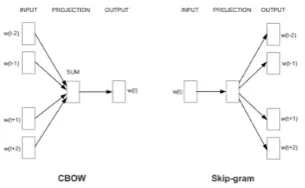
Figure 1: Continuous Bag-of-Word (CBOW) and Skip-gram models (Mikolov et al.,2013)
The model aimed to learn word representation and can be trained on large datasets. The CBOW attempts to predict the target word by combin-ing the distributed representation of its surround-ing words whereas, Skip-gram predicts the context by using the distributed representation of the input word (Mikolov et al.,2013). Also, there are two basic training objectives; hierarchical softmax and negative sampling. The Skip gram and CBOW use neural network (NN) to predict the neighbouring words by learning the word representation (Rong,
2014;Enr´ıquez et al.,2016). Moreover, CBOW is fast and appropriate for large corpus while Skip-gram can be trained on small monolingual data sets.
skip−gram(D) = 1
T T
X
t=1
[ Xk
j=−k
logp(wt+j|wt)]
(1)
CBOW(D) = T1 XT
t=1
[Xt−kj=klogp(wj|wj+t)]
(2) Suppose D= w1,.., wt where k is the size of
training context, equation (1) aims to maximize the average of log probability to predict the con-text words wt+j based on the current word wt
(Mikolov et al.,2013). Whereas equation (2) com-putes the log probability of the target word wi
based on the surrounding words in the context (Chen et al.,2015).
Linear mapping can capture similar vectors from the source and target languages. Therefore, this mapping can learn the word translation matrix between different languages.
Translation matrix is based on a set of word pairs and their vectors. Consider {xi, zi}ni=1,
wherexi andzi are word vectors. These vectors
have different dimensions(d1, d2),xi∈Rd1 is the
representation of word i in source language and
zi∈Rd2 is the vector of the translation (Mikolov
et al.,2013). The translation matrix can be learned by equation (3)(Mikolov et al.,2013).
minΣn
i=1||Wxi−zi||2 (3)
3.2 Language challenge
The Arabic language is considered as one of the six official languages of the United Nations (Aljlayl and Frieder,2002;Ibrahim et al., 2015). It is spoken by 300 million people globally and considered to be a morphologically rich language (Cheriet,2007;Aljlayl and Frieder,2002). It has different structures from English and other lan-guages. The Arabic language contains 28 letters and is written from right to left. There are two types of Arabic, Modern Standard Arabic (MSA) which is the formal Arabic language used in news-papers and books; and spoken varieties or Arabic dialect (DA), which is the language that is used in daily life and in social media (El-taher et al.,
2016). There are different DAs such as Egyptian, Yemeni, Gulf, Iraqi and Levantine (Sajjad et al.,
2013). However, these dialects are different from each other depending on the geographical distri-bution (Habash,2010).
Arabic Natural Language Processing faces many challenges because Arabic is a morpholog-ically rich language (Salloum and Habash,2011). Arabic dialects are different from MSA and dif-ferent from each other. Also, there are difdif-ferent features between dialects and Arabic as there is no rule for written set of grammar. For example, vari-ation might be appeard orthographically, lexically and morphologically (Habash, 2010). In dialects there is no standard orthography which lead every dialects to spell same word in different ways, for instance
(ZAÓ , éKñÓ , éJÓ)
for water. Also, the am-biguity due to using diacritical marks which called Tashkiil in Arabic, this changes the meaning for the same word for example(Qª ,Qª ,Qª )
for hair, feel and poetry respectively, where the dia-critical marks make these words that are formed using the same letters having different meanings. Another feature is misspelling in dialect as they spell differently in MSA; for example, the word gold can be written as(I.ë X)
in MSA and as3.3 Pre-processing (Normalization)
Pre-processing is recognized as an essential step for a number of NLP tasks. Text normaliza-tion is one type of text pre-processing, which is defined as a process of transforming the non-standard words to their non-standard forms. For ex-ample, 2morrw should be transformed into tomor-row. Text normalization plays a major role in a number of Arabic Natural Language Processing tasks, such as information retrieval which included sentiment analysis, summarization, keywords, and topic detection. Arabic normalization may include deleting the diacritical marks to reduce the ambi-guity. Consequently, we appliedd some normal-ization steps to clean our data sets and prepared them for the translation process. These steps in-cluded:
• Tokenization.
• Delete any diacritics from Arabic letter (Tshkula).
• Replace
(@c ,
@ ,@)
with(@)
, replace(è)
with(è)
, replace(ð)
with(ð)
and replace( ø)
with(ø)
.• Remove non-Arabic words and punctuation marks (?,!).
4 Experiment and Result
4.1 Building monolingual Corpus
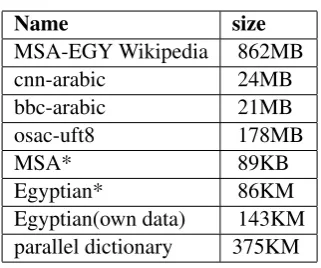
As a basic requirement for machine translation and other NLP tasks, data sets are needed to imple-ment and validate proposed models. Both of par-allel data and dictionaries are important for trans-lation tasks. However, Arabic lacks sufficient par-allel corpus. We could only find relatively small parallel corpus. Also, unlike some other languages there is no available parallel dictionary for Arabic dialects. Thus, we firstly built monolingual corpus for both the Egyptian and standard Arabic from Wikipedia and different resources that are publicly available. In this experiment we used four datasets for target language; MSA-EGY Wikipedia, bbc-arabic , osac-utf-8 corpus and lastly, cnn-bbc-arabic , Table 1 shows details for the data sets. Sec-ondly, for the Egyptian dialect we had to con-struct a database with a reasonable size that in-corporated the parallel data described in (Bouamor et al.,2014).
Table 1: Arabic and Egyptian data sets
Name size
MSA-EGY Wikipedia 862MB cnn-arabic 24MB bbc-arabic 21MB osac-uft8 178MB
MSA* 89KB
Egyptian* 86KM Egyptian(own data) 143KM parallel dictionary 375KM
4.2 Experiment
The following word2vec processes are used to translate the Egyptian dialect to the Modern Stan-dard Arabic. Firstly, we normalized both the Ara-bic and the Egyptian data sets by using the steps that were mentioned in the pre-processing section. Secondly, two separate word vector models for tar-get and source languages were built using CBOW and Skip-gram models. These models were ap-plied on the data sets that were described in the previous section. The model parameters were set as 100 for the size of features, 5 for window size and 2 for minimum count which mean deleting any word that appear less than two times. Then, trans-lation matrix was trained on the Arabic-Egyptian language pairs. In order to find semantic words translation based on the context, the model was trained on the monolingual data sets. Finally, test-ing was done in four-fold-cross-validation, i.e., 75% for training and 25% for testing.
4.3 Results
Skip-gram was not found to achieve good result for the remaining three data sets (see Table 2). These results pointed out that the CBOW monolingual model was able to capture better semantically re-lated words than Skip-gram. Also, the training time of CBOW is found to be faster than that of Skip-gram. Below are some examples of words and their translation as derived from CBOW and Skip-gram.
•
[éÖß , éKYË ,A JKYË , éKYË ,ÑîEYË] ÑëY J«
•
[È@ QKB ,YJ»AJÊË , Y gAK ,Qê ¢J ,ù®J.] ù®J.Jë
•
[ IË PA JK ,È PA JK ,úÎ
m' , IÊ®J@ , IÊ m' ] IË PA JK@
•
[
Aª ¯ , ªJ ¯ ,úG.QK , ªK , ªKð] ªKð
English translation :
• They have[they have, he has, we have, he has, there is]
• Will remain[will remain, will appear, takes, for confirmation, still]
• Waived[waived, abandoned, resigned, waive, give up]
• Live[live, live, grow up, lived, lived]
As presented in the list above the words lated without any rules and some words trans-lated based on the context. Even though, in some cases some words were not correctly translated, they still produced semantically related words e.g.
[ÉëQË@ , é kðYË@ ,l 'QË@ð ,QKñJË@ð ,Ðñ JË@] Ê®Ë@
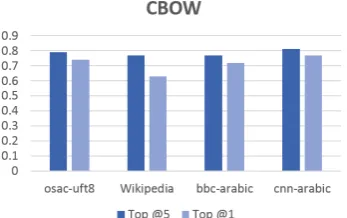
which means in English Anxiety [sleep, tension, grogginess, dizziness, sag ] which are all semanti-cally related to the word anxiety.Figure 2: Top@5 and Top@1 for CBOW model.
Figure 3: Top@5 and Top@1 for Skip-gram model
Table 2: The average of four-fold-cross-validation of all data sets
Model Name Data set Top@5 Top@1
CBOW
cnn-arabic 0.81 0.77 bbc-arabic 0.77 0.72 osac-utf8 0.79 0.74 Wikipedia 0.77 0.63
Skip-gram
cnn-arabic 0.56 0.54 bbc-arabic 0.79 0.76 osac-utf8 0.57 0.54 Wikipedia 0.54 0.50
5 Conclusion
Word embedding is a powerful approach in NLP. In this paper, word2vec was introduced to trans-late the Egyptian dialect to the Modern Standard Arabi. This approach solves the problem of paral-lel data as we can train the model on monolingual data. Word2vec has also shown that it can capture semantic features between MSA and EGY without any rules. Even though the model was only tested on small data set, it is expected to also perform well on large data sets. In future work, we plan to investigate the effect of other features at character level and other morphological features.
References
Fahad Albogamy and Allan Ramsay. 2015. POS Tag-ging for Arabic Tweets. InRANLP. pages 1–8.
A. A. Altowayan and L. Tao. 2016. Word
embeddings for Arabic sentiment
analy-sis. In 2016 IEEE International Conference on Big Data (Big Data). pages 3820–3825.
https://doi.org/10.1109/BigData.2016.7841054.
Yoshua Bengio, R´ejean Ducharme, Pascal Vincent, and Christian Jauvin. 2003. A neural probabilistic lan-guage model. journal of machine learning research
3(Feb):1137–1155.
Houda Bouamor, Nizar Habash, and Kemal Oflazer. 2014. A Multidialectal Parallel Corpus of Arabic. InLREC. pages 1240–1245.
Xinxiong Chen, Lei Xu, Zhiyuan Liu, Maosong Sun, and Huan-Bo Luan. 2015. Joint Learning of Char-acter and Word Embeddings. InIJCAI. pages 1236– 1242.
Mohamed Cheriet. 2007. Strategies for visual arabic handwriting recognition: issues and case study. In
Signal Processing and Its Applications, 2007. ISSPA 2007. 9th International Symposium on. IEEE, pages 1–6.
Nadir Durrani, Hassan Sajjad, Alexander Fraser, and Helmut Schmid. 2010. Hindi-to-Urdu machine translation through transliteration. In Proceedings of the 48th Annual meeting of the Association for Computational Linguistics. Association for Compu-tational Linguistics, pages 465–474.
Fatma El-zahraa El-taher, Alaa Aldin Hammouda, and Salah Abdel-Mageid. 2016. Automation of under-standing textual contents in social networks. In
Selected Topics in Mobile & Wireless Network-ing (MoWNeT), 2016 International Conference on. IEEE, pages 1–7.
Fernando Enr´ıquez, Jos´e A Troyano, and Tom´as L´opez-Solaz. 2016. An approach to the use of word embeddings in an opinion classification task. Expert Systems with Applications66:1–6.
Nizar Y Habash. 2010. Introduction to Arabic natural language processing. Synthesis Lectures on Human Language Technologies3(1):1–187.
Ahmed Hamdi, Rahma Boujelbane, Nizar Habash, and Alexis Nasr. 2013. The effects of factorizing root and pattern mapping in bidirectional Tunisian-standard Arabic machine translation. InMT Summit 2013. pages pas–d.
Bo Han and Timothy Baldwin. 2011. Lexical normal-isation of short text messages: Makn sens a# twit-ter. InProceedings of the 49th Annual Meeting of the Association for Computational Linguistics: Hu-man Language Technologies-Volume 1. Association for Computational Linguistics, pages 368–378. Hossam S Ibrahim, Sherif M Abdou, and Mervat
Gheith. 2015. MIKA: A tagged corpus for modern standard Arabic and colloquial sentiment analysis. In Recent Trends in Information Systems (ReTIS),
2015 IEEE 2nd International Conference on. IEEE, pages 353–358.
Chen Li and Yang Liu. 2012. Normalization of Text Messages Using Character-and Phone-based Ma-chine Translation Approaches. InINTERSPEECH. pages 2330–2333.
Tomas Mikolov, Quoc V Le, and Ilya Sutskever. 2013. Exploiting similarities among languages for ma-chine translation. arXiv preprint arXiv:1309.4168
.
Dyah Rahmawati and Masayu Leylia Khodra. 2016. Word2vec semantic representation in multilabel classification for Indonesian news article. In Ad-vanced Informatics: Concepts, Theory And Applica-tion (ICAICTA), 2016 InternaApplica-tional Conference On. IEEE, pages 1–6.
Xin Rong. 2014. word2vec parameter learning ex-plained.arXiv preprint arXiv:1411.2738.
Hassan Sajjad, Kareem Darwish, and Yonatan Be-linkov. 2013. Translating Dialectal Arabic to En-glish. InACL (2). pages 1–6.
Wael Salloum and Nizar Habash. 2011. Dialectal to standard Arabic paraphrasing to improve Arabic-English statistical machine translation. In Proceed-ings of the first workshop on algorithms and re-sources for modelling of dialects and language va-rieties. Association for Computational Linguistics, pages 10–21.
Hassan Sawaf. 2010. Arabic dialect handling in hybrid machine translation. In Proceedings of the confer-ence of the association for machine translation in the americas (amta), denver, colorado.
Khaled Shaalan, Hitham Bakr, and Ibrahim Ziedan. 2007. Transferring egyptian colloquial dialect into modern standard arabic. In International Confer-ence on Recent Advances in Natural Language Pro-cessing (RANLP–2007), Borovets, Bulgaria. pages 525–529.
Lu Xiang, Yu Zhou, and Chengqing Zong. 2013. An Efficient Framework to Extract Parallel Units from Comparable Data. InNatural Language Processing and Chinese Computing, Springer, pages 151–163. Rabih Zbib, Erika Malchiodi, Jacob Devlin, David