Introducing EVALD – Software Applications
for Automatic Evaluation of Discourse in Czech
Kateřina Rysová, Magdaléna Rysová, Jiří Mírovský, Michal Novák
Charles University
Faculty of Mathematics and Physics
Institute of Formal and Applied Linguistics
{rysova, magdalena.rysova, mirovsky, mnovak}@ufal.mff.cuni.cz
Abstract
In the paper, we introduce two software applications for automatic evaluation of coherence in Czech texts called EVALD – Evaluator of Discourse. The first one – EVALD 1.0 – evaluates texts written by native speakers of Czech on a five-step scale commonly used at Czech schools (grade 1 is the best, grade 5 is the worst). The second application is EVALD 1.0 for Foreigners assessing texts by non-native speakers of Czech using six-step scale (A1–C2) according to CEFR. Both appli-cations are available online at
https://lindat.mff.cuni.cz/services /evald-foreign/.
1
Introduction
Students of Czech often have problems with writ-ing a comprehensive and continuous text. The rea-son is that creating texts is more demanding for them than creating separate sentences. The text is not simply “a cluster of sentences” but its struc-ture has its own rules whose failure can result in the so called incoherent text, i.e. a text that is not fully functional in communication (see e.g. Halli-day and Hasan, 1976). The ability of creating text should thus be encouraged already in the teaching process. At the same time, appropriate tools de-veloped to assess such texts may reduce the amount of teachers’ manual work.
In this paper, we present the results of our in-vestigation of automatic evaluation of texts in Czech (written by native and non-native speak-ers), more specifically, possibilities of automatic evaluation of text coherence. We present the lin-guistic features (concerning mainly discourse phenomena) that may be observed and evaluated automatically. Our experiments in this area result-ed in a development of two software applications:
Evaluator of Discourse 1.0 (EVALD 1.0) and Evaluator of Discourse 1.0 for Foreigners (EVALD 1.0 for Foreigners).
The EVALD applications can function as assis-tant tools for evaluation of essays in Czech1 and
they can be also used by students and learners who can easily verify their level of coherence in Czech.
EVALD applications are available as online services2 and also as downloadable Docker
con-tainers.3
1.1 Czech as a Foreign Language – As-sessing Criteria
The process of learning a foreign language is long-lasting and continuous. The learner goes through several stages from a beginner to a highly advanced language user. These stages (or phases of learning) are described in the document of the Council of Europe Common European
Frame-work of Reference for Languages (CEFR). CEFR
distinguishes six categories: A1 (basic language user – lower level), A2 (basic language user – higher level), B1 (independent language user – lower level), B2 (independent language user – higher level), C1 (proficient language user – lower level), C2 (proficient language user – higher lev-el).
1
The EVALD applications were created for assessing the coherence of authentic essays written by native and non-native speakers of Czech. In other words, they are trained to evaluate (prosaic) texts whose content and form (e.g. length) correspond to the common essays created as a com-prehensive piece of writing on a given topic, e.g. during the Czech language exam. When evaluating a different type of text (e.g. too short texts, poems etc.), the software cannot work reliably because it is not trained for such text type.
2
https://lindat.mff.cuni.cz/services/evald/index.php; https://lindat.mff.cuni.cz/services/evald-foreign/
3
Motivations behind learning foreign languages, including the languages of smaller countries, may be diverse. For example, learning Czech is useful for foreigners who want to study in the Czech Re-public (most of the Czech universities require the CEFR level of B2). The knowledge of Czech is also compulsory for foreigners to be granted per-manent residence in the Czech Republic (the re-quired CEFR level is A1) or state citizenship (the required CEFR level is B1). Therefore, it is of a great importance to assess these examinations as objectively as possible and according to uniform criteria.
This requirement is rather difficult to meet be-cause the writing samples are evaluated only manually by human assessors (although according to the uniform rating grid) who naturally bring in a subjective human factor to the evaluation.
Therefore, we tried to find several objective cri-teria (concerning text coherence) for distinguish-ing the individual CEFR levels automatically. Specifically, we carried out research on text co-herence concerning mainly various discourse phe-nomena (e.g., the use and frequency of discourse connective expressions) and we tested the possi-bility of their automatic monitoring and evalua-tion.
1.2 Czech of Native Speakers
Creating a coherent text that is fully functional in communication is not easy and obvious even for native speakers. Native speakers are also gradual-ly learning to write a well-structured and compre-hensive text.
At the same time, students’ ability to create a coherent text is often examined at schools. For in-stance, writing an essay has been a compulsory part of the graduation examination at secondary schools in the Czech Republic for decades.
The essays by native speakers are not evaluated according to the CEFR levels, but according to a five-step scale commonly used at Czech schools (grade 1 is the best, grade 5 is the worst). EVALD 1.0 thus distinguishes 5 rating grades.
2
Previous Research
2.1 Text Coherence and Discourse
Text coherence (continuity) is a common property of each text that is fully functional in authentic communication. Linguistically, it is a complex phenomenon realized through various language
aspects like semantico-pragmatic relations, coref-erence and anaphoric relations, lexical relations, substitution or ellipsis (see e.g. Dressler and de Beaugrande, 1972, 1981; Halliday and Hasan, 1976 or Hoey, 1979, 2001). In present-day lin-guistics, text coherence is thus often studied through language interactions (see e.g. Long and Chong, 2001; Camblin et al., 2007 or Hajičová, 2011).
This paper describes especially the automatical-ly measurable aspects of semantico-pragmatic discourse relations (i.e. relations such as condi-tion, opposicondi-tion, reason, succession etc.) as one of the most important aspects of coherence. Dis-course relations constitute the whole structure of a text and each text thus may be imagined as a net of semantico-pragmatic relations that are arranged hierarchically, i.e. the smallest units are linked to form higher units etc.
The right interpretation of semantico-pragmatic relations (which is a core of discourse analysis, see mainly Harris, 1952) then leads to the right in-terpretation of the whole text. To make this inter-pretation easier for the reader to comprehend, each language has its specific expressions that signal these types of relations explicitly – dis-course connectives (cf. examples like proto
“therefore”, avšak “however”, v důsledku “in con-sequence” etc.). Discourse connectives may be di-vided into two groups: primary and secondary (see Rysová and Rysová, 2014, 2015). In short, primary connectives are mostly grammaticalized expressions often consisting of a single word, e.g
když “when”, protože “because”, a “and”, nebo
“or”. On the other hand, secondary connectives are not yet fully grammaticalized, mainly multi-word structures, e.g. za podmínky, že “on condi-tion that”, v důsledku “in consequence”, z tohoto důvodu “for this reason” etc.
2.2 Studies on Automatic Evaluation of Co-herence
con-cerning various aspects of text coherence and co-hesion.
In earlier studies, Foltz et al. (1998) and Wiemer-Hastings and Graesser (2000) have de-veloped systems which examine text coherence in students’ essays. Their systems focus on local co-herence (i.e. on such aspects of coco-herence occur-ring in smaller sequence of sentence, mostly be-tween adjacent sentences or within a single para-graph) and they measure lexical relatedness be-tween text units by using vector-based similarity between adjacent sentences.
Their work relates in terms of similarity scoring to the TextTiling scheme (see Hearst and Plaunt, 1993 or Hearst, 1997) that may be used to recog-nize the subtopic of a text. Miltsakaki and Kukich (2000) also deal with text coherence in students’ writing. They work with Rough Shift element of Centering Theory (Grosz et al., 1995) by examin-ing the similarity of adjacent text units.
Possibilities of automatic evaluation of global coherence is studied by Higgins et al. (2004) fo-cusing on four points: i) relatedness of a text to its topic, ii) relatedness to the thesis, iii) relatedness within a segment (i.e. each sentence in a text seg-ment should be related to at least one other sen-tence within the segment), iv) grammar accuracy (a text is of a low coherence if it contains gram-matical errors, incomplete sentences etc.).
To date, few attempts have been made to de-velop new methods for automatic evaluation of coherence in non-native (learners’) texts, see e.g. Yannakoudakis and Briscoe (2012) investigating learners’ coherence by monitoring part-of-speech distribution, number of (primary) discourse con-nectives (based on a fixed list) or word length.
Up to now, the research on automatic evalua-tion of students’ essays (written by both native and non-native speakers) seems to be a relatively unexplored topic. In this paper, we thus aim to contribute to it by discussing new aspects of co-herence that may be evaluated automatically (e.g. apart from primary connectives, we reflect also some types of secondary connectives, see Section 4.4). 4 At the same time, the EVALD applications
are the first attempts to measure text coherence automatically on Czech data.
4
The long-term investigation of discourse resulted in publi-cation of the first discourse annotated corpus for Czech – the Prague Discourse Treebank, see the first version in Poláková et al, 2012 and the second one in Rysová et al., 2016.
3
Language Material
Three corpora served as a source for basic linguis-tic research on coherence in Czech as well as for training of both software applications. Texts by the non-native speakers were obtained from the MERLIN corpus (Boyd et al., 2014) and CzeSL-SGT (Šebesta et al., 2014). Texts by the native speakers were taken from the corpus Skript2012 / AKCES 1 (Šebesta et al., 2016). EVALD 1.0 for Foreigners was trained on 945 texts in total and EVALD 1.0 on 1,118 texts.
4
Components of EVALD Applications
EVALD applications are based on supervised machine learning. Therefore, coherence must be first assessed on the text from the training corpora manually. Trained EVALD models then try to mimic this manual annotation using a set of lin-guistically motivated features. Many of the fea-tures take advantage of the linguistic information collected automatically on the texts during the pre-processing stage.
4.1 Assessment of the Texts by Linguists
Manual evaluation of texts from the corpora men-tioned in Section 3 was performed by two trained evaluators.5 The texts of non-native speakers were
categorized into 6 classes differentiated by CEFR (A1, A2, B1, B2, C1 and C2) according to their coherence. The texts of native speakers were di-vided into 5 categories in accordance with the rat-ings used at Czech schools: 1 (excellent), 2 (very good), 3 (good), 4 (satisfactory), 5 (fail/unsatisfactory). The inter-annotator agree-ment (IAA) was measured on 100 texts of non-native speakers and on 100 texts of non-native speak-ers of Czech assessed (simultaneously) by the two evaluators. The exact IAA agreement reached 51% (on texts by non-native speakers) and 64% (on texts by native speakers). With tolerance of one level distance (e.g. evaluator 1: A1, evaluator 2: A2), the IAA agreement is 93% on texts by non-native speakers and 90% on texts by native speakers. Our IAA agreement is comparable to other similar projects, see e.g. Östling et al. (2013) reaching 45.8% of exact agreement among teach-ers evaluating 1,702 school essays in Swedish.
5
Graph 1: Distribution of most frequent connective expres-sions in A2 of MERLIN texts.
Graph 2: Distribution of most frequent connective expres-sions in B1 of MERLIN texts.
4.4 Final List of Linguistic Features Evalu-ated by Both Software Applications
EVALD 1.0 and EVALD 1.0 for Foreigners work with the following language features.
Surface features consist of those using only tokenization and sentence segmentation, i.e. not any advanced part of the text analysis such as syn-tactic parsing and discourse parsing:
• number of all connective words per 100 sen-tences; • number of coordinating connective words per 100 sentences (e.g. a “and”, ale “but”,
nebo “or”); • number of subordinating connective words per 100 sentences (e.g. aby “in order to”,
když “when”, protože “because”); • number of to-kens (words) per sentence (i.e. sentence length); • richness of the vocabulary (i.e. variety of lem-mas).
Advanced features extract information from the automatically parsed tree structures and from automatically annotated discourse relations:
• number of intra-sentential discourse relations per 100 sentences; • number of inter-sentential discourse relations per 100 sentences; • number of all discourse relations per 100 sentences; • number of different connectives in all discourse relations; • ratio of discourse relations with connectives a
“and”, ale “but”, protože “because”, také “too”,
potom “then”, pak “then”, když “when”, nebo
“or”, proto “therefore”, tak “so”, aby “in order to”, totiž “that is”; • ratio of inter-sentential dis-course relations expressed by secondary connec-tives containing pronominal anaphor; • number of predicate-less sentences per 100 sentences (i.e. constructions without finite verbs like Lovely!); • ratio of discourse relations from class of Tem-poral, Contingency, Contrast and Expansion rela-tions; • ratio of occurrence of the most common connective within all connectives in a text; • ratio of occurrence of the first and second most com-mon connective within all connectives in a text.
4.5 Machine Learning Modelling
For machine learning experiments, the Random Forest algorithm implemented in WEKA toolkit (Hall et al., 2009) was chosen, as it provided the best results in the initial stages of the experiments among many other algorithms available in WE-KA. Details on machine learning experiments and discussion on them can be found in Rysová et al. (2016).
5
Experiments and Evaluation
EVALD applications were trained and evaluat-ed using 10-fold cross validation. In the first ex-periment, the whole datasets described in Sec-tion 3 were used (L1: 1,118 texts, L2: 945 texts) and for the evaluation, the F-score was measured, see Table 4 (the column F-Score).
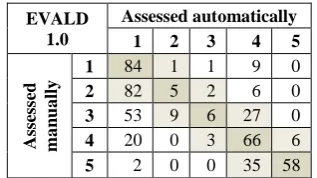
Since the available data do not reflect the real distribution of the individual assessed classes in population, the data sets were uniformed for the second experiment – the instances in all classes were reduced to achieve a uniform distribution of them across the individual categories (L1: 475 texts, L2: 600 texts; more details are given in No-vák et al., 2017). Confusion matrices are present-ed in Tables 2 and 3. The information for overall accuracy on these uniformed data sets is captured in the second column of Table 4.
and 69% but 9% when 2% because 8% so 1% in order to 0% too (také) 3% too (taky) 4% therefore 4%
Graph 3: Distribution of most frequent connective expres-sions in B2 of MERLIN texts.
and 52% but 17%
when 5% because 10% so 5% in order to 3% too (také) 4% too (taky) 4% therefore 2% and 49% but 14% when 10% because 5% so 6%
References
Srinivas Bangalore, Owen Rambow, and Steve Whit-taker. 2000. Evaluation metrics for generation. In
Proceedings of the INLG, pages 1–8.
Robert-Alain de Beaugrande and Wolfgang Dressler. 1981. Introduction to Text Linguistics. London: Longman.
Ondřej Bojar, Zdeněk Žabokrtský et al. 2012. The Joy of Parallelism with CzEng 1.0. In Proceedings of the 8th International Conference on Language
Re-sources and Evaluation (LREC 2012). European
Language Resources Association, İstanbul, Turkey, pages 3921–3928.
Adriane Boyd, Jirka Hana, Lionel Nicolas, Detmar Meurers, Katrin Wisniewski, Andrea Abel, Karin Schöne, Barbora Štindlová, and Chiara Vettori. 2014. The MERLIN corpus: Learner language and the CEFR. In Proceedings of the 9th International Conference on Language Resources and
Evalua-tion (LREC 2014). European Language Resources
Association, Reykjavík, Iceland, pages 1281–1288. Christine C. Camblin, Peter C. Gordon, and Tamara Y Swaab. 2007. The interplay of discourse congru-ence and lexical association during sentcongru-ence pro-cessing: Evidence from ERPs and eye tracking.
Journal of Memory and Language, 56(1):103–128.
Common European Framework of Reference for
Lan-guages. Language Policy Unit, Strasbourg.
http://www.coe.int/t/dg4/linguistic/Source/Framewo rk_EN.pdf. [cite 2017-04-30]
Wolfgang Dressler. 1972. Einführung in die
Textlin-guistik. Tübingen: Niemeyer.
Peter Foltz, Walter Kintsch, and Thomas K. Landauer. 1998. The measurement of textual coherence with Latent Semantic Analysis. Discourse Processes, 25(2&3):285–307.
Barbara J. Grosz, Scott Weinstein, and Aravind K. Joshi. 1995. Centering: A framework for modeling the local coherence of discourse. Computational
linguistics 21(2): 203–225.
Eva Hajičová. 2011. On interplay of information structure, anaphoric links and discourse relations.
In Societas linguistica europaea SLE 2011, 44th
Annual Meeting, Book of Abstracts. Universidad de
la Rioja, Center for Research in the Applications of Language, Logrono, Spain, pages 139–140. Mark Hall. Eibe Frank, Geoffrey Holmes, Bernhard
Pfahringer. Peter Reutemann, Ian H. Witten. 2009. The WEKA data mining software: an update. ACM
SIGKDD explorations newsletter 11(1), pages 10–
18.
Julia Hancke and Detmar Meurers. 2013. Exploring CEFR classification for German based on rich
lin-guistic modeling. Learner Corpus Research, 54– 56.
Marti A. Hearst and Christian Plaunt. 1993. Subtopic structuring for full-length document access. In
Proceedings of ACM SIGIR, pages 59–68.
Marti A. Hearst. 1997. TextTiling: Segmenting text into multi-paragraph subtopic passages.
Computa-tional Linguistics, 23(1):33–64.
Derrick Higgins et al. 2004. Evaluating multiple as-pects of coherence in student essays. In
Proceed-ings of the NAACL, pages 185–192.
Michael Hoey. 1979. Signalling in discourse. Bir-mingham UK: English Language Research Unit, University of East Angllia.
Michael Hoey. 2001. Textual Interaction: An
Intro-duction to Written Discourse Analysis. London:
Routledge.
Pavlína Jínová, Jiří Mírovský, and Lucie Poláková. 2012. Semi-Automatic Annotation of Intra-Sentential Discourse Relations in PDT. In Proceed-ings of the Workshop on Advances in Discourse Analysis and its Computational Aspects (ADACA)
at Coling 2012. Organizing Committee, Mumbai,
India, pages 43–58.
Michael Alexander Kirkwood Halliday and Ruqaiya Hasan. 1976. Cohesion in English. London: Long-man.
Claudia Leacock and Martin Chodorow. 2000. An un-supervised method for detecting grammatical er-rors. In Proceedings of the First Meeting of the North American Chapter of the Association for
Computational Linguistics (NAACL 2000), pages
140–147.
Debra L. Long, D. L and Jennifer L. Chong. 2001. Comprehension skill and global coherence: A para-doxical picture of poor comprehenders abilities.
Journal of Experimental Psychology Learning,
Memory and Cognition, 27(14):24–1429.
MERLIN for CEFR-related language learning,
teach-ing, and testing. 2014. WWW:
<http://merlin-platform.eu/index.php>
Eleni Miltsakaki and Karen Kukich. 2000. Automated evaluation of coherence in student essays. In
Pro-ceedings of LREC 2000, Athens, Greece.
Michal Novák, Kateřina Rysová, Magdaléna Rysová, and Jiří Mírovský. 2017. Incorporating Corefer-ence to Automatic Evaluation of Surface Coher-ence in Essays. In Proceedings of the Statistical
Language and Speech Processing (SLSP 2017).
Robert Östling, Andre Smolentzov, Björn Tyrefors Hinnerich, and Erik Höglin. 2013. Automated es-say scoring for Swedish. In Proceedings of the Eighth Workshop on Innovative Use of NLP for
Building Educational Applications, pages 42–47,
Atlanta, Georgia.
Kishore Papineni et al. 2002. BLUE: a method for au-tomatic evaluation of machine translation. In
Pro-ceedings of the ACL, pages 311–318.
Lucie Poláková, Pavlína Jínová, Šárka Zikánová, Eva Hajičová, Jiří Mírovský, Anna Nedoluzhko, Mag-daléna Rysová, Veronika Pavlíková, Jana Zdeňko-vá, Jiří Pergler, and Radek Ocelák. 2012. Prague
Discourse Treebank 1.0. Data/software, ÚFAL
MFF UK, Prague, Czech Republic, http://ufal.mff.cuni.cz/pdit/.
Kateřina Rysová, Jiří Mírovský, Michal Novák, and Magdaléna Rysová. 2016. EVALD 1.0. Da-ta/software, ÚFAL MFF UK, Prague, Czechia, http://hdl.handle.net/11234/1-1820.
[https://ufal.mff.cuni.cz/evald].
Kateřina Rysová, Jiří Mírovský, Michal Novák, and Magdaléna Rysová. 2016. EVALD 1.0 for Foreign-ers. Data/software, ÚFAL MFF UK, Prague, Czechia, http://hdl.handle.net/11234/1-1821. [https://ufal.mff.cuni.cz/evald/evald-10-foreigners]. Kateřina Rysová, Magdaléna Rysová, Jiří Mírovský. Automatic evaluation of surface coherence in L2 texts in Czech. 2016. In Proceedings of the 28th Conference on Computational Linguistics and
Speech Processing ROCLING XXVIII. 2016.
Tai-pei, Taiwan: The Association for Computational Linguistics and Chinese Language Processing (ACLCLP), pages 214–228.
Magdaléna Rysová, Pavlína Synková, Jiří Mírovský, Eva Hajičová, Anna Nedoluzhko, Radek Ocelák, Jiří Pergler, Lucie Poláková, Veronika Pavlíková, Jana Zdeňková, and Šárka Zikánová. 2016. Prague
Discourse Treebank 2.0. Data/software, ÚFAL
MFF UK, Prague, Czech Republic, http://hdl.handle.net/11234/1-1905.
Magdaléna Rysová and Kateřina Rysová. 2015. Sec-ondary Connectives in the Prague Dependency Treebank. In Proceedings of the Third Internation-al Conference on Dependency Linguistics (Depling
2015), Uppsala University, Uppsala, Sweden,
pag-es 291–299.
Magdaléna Rysová and Kateřina Rysová. 2014. The Centre and Periphery of Discourse Connectives. In
Proceedings of the 28th Pacific Asia Conference on Language, Information and Computing (PACLIC 28). Bangkok, Thailand: Department of Linguis-tics, Faculty of Arts, Chulalongkorn University, pages 452–459.
Jana Straková, Milan Straka and Jan Hajič. 2014. Open-Source Tools for Morphology, Lemmatiza-tion, POS Tagging and Named Entity Recognition.
In Proceedings of 52nd Annual Meeting of the
As-sociation for Computational Linguistics: System
Demonstrations. Association for Computational
Linguistics, Baltimore, Maryland, pages 13–18. Karel Šebesta, Zuzanna Bedřichová, Kateřina
Šormo-vá et al. 2014. AKCES 5 (CzeSL-SGT). LINDAT/CLARIN digital library at the Institute of Formal and Applied Linguistics, Charles Universi-ty in Prague, http://hdl.handle.net/11858/00-097C-0000-0023-95B1-E.
Karel Šebesta, Hana Goláňová, Jana Letafková et al., 2016. AKCES 1. LINDAT/CLARIN digital library at the Institute of Formal and Applied Linguistics, Charles University in Prague, http://hdl.handle.net/11234/1-1741.
Sowmya Vajjala and Kaidi Lõo. 2014. Automatic CEFR level prediction for Estonian learner text. Proceedings of the third workshop on NLP for computer-assisted language learning. NEALT Pro-ceedings Series 22 / Linköping Electronic Confer-ence Proceedings 107, pages 113–127.
Elena Volodina, Ildikó Pilán, and David Alfter. 2016. Classification of Swedish learner essays by CEFR levels. In S. Papadima-Sophocleous, L. Bradley & S. Thouësny (Eds), CALL communities and culture – short papers from EUROCALL 2016, pages 456– 461.
Peter Wiemer-Hastings and Arthur Graesser. 2000. Select-a-Kibitzer: A computer tool that gives mean-ingful feedback on student compositions.
Interac-tive Learning Environments, 8(2):149–169.
Helen Yannakoudakis and Ted Briscoe. 2012. Model-ing coherence in ESOL learner texts. In Proceed-ings of the Seventh Workshop on Building
Educa-tional Applications Using NLP. Association for
Computational Linguistics, pages 33–43.
Zdeněk Žabokrtský. 2011. Treex – an open-source framework for natural language processing. In
In-formation Technologies – Applications and Theory.