904
A Neural Network Component for Knowledge-Based Semantic
Representations of Text
Alejandro Piad-Morffis1,Rafael Mu ˜noz2,Yudivi´an Almeida-Cruz1, Yoan Guti´errez3,Suilan Estevez-Velarde1, andAndr´es Montoyo2
1School of Math and Computer Science, University of Havana, Cuba
{sestevez,yudy,apiad}@matcom.uh.cu
2Department of Languages and Computing Systems, University of Alicante, Spain 3U.I. for Computer Research (IUII), University of Alicante, Spain
{montoyo,ygutierrez,rafael}@dlsi.ua.es
Abstract
This paper presents Semantic Neural Net-works (SNNs), a knowledge-aware com-ponent based on deep learning. SNNs can be trained to encode explicit seman-tic knowledge from an arbitrary knowl-edge base, and can subsequently be com-bined with other deep learning architec-tures. At prediction time, SNNs provide a semantic encoding extracted from the in-put data, which can be exploited by other neural network components to build ex-tended representation models that can face alternative problems. The SNN architec-ture is defined in terms of the concepts and relations present in a knowledge base. Based on this architecture, a training pro-cedure is developed. Finally, an experi-mental setup is presented to illustrate the behaviour and performance of a SNN for a specific NLP problem, in this case, opin-ion mining for the classificatopin-ion of movie reviews.
1 Introduction
In recent years, the increase in the volume of avail-able data has provided both new techniques and new challenges for discovering relevant knowl-edge. The huge amount of information produced daily makes it impossible for humans to manu-ally build organized representations of all this formation. On the other hand, the surplus of in-formation enables the design of statistical learn-ing techniques which scale better with large data. Deep learning approaches have successfully ob-tained state-of-the-art results for many learning problems, from image recognition to natural lan-guage parsing. Instead of handcrafted representa-tions designed by experts, deep learning
automati-cally builds representations from raw data that are suitable for a given machine learning problem.
When deep learning is used, we can often iden-tify structures inside a neural network, which can be explained as high-level concepts that are au-tomatically discovered during the learning pro-cess (Bengio, 2012). For instance, in the im-age recognition domain, often internal neurons or groups of neurons can be identified to recognize common visual features such as textures or pat-terns or even specific objects (Le,2013). Hence, the neural network is able to build high-level con-cepts from low-level input (i.e., pixels). This abil-ity to discover higher-level features is one of the main strengths of deep learning and representa-tional learning in general (Bengio, 2012). How-ever, one of the main challenges of deep learn-ing is interpretlearn-ing the internal representations of a neural network in terms that can be understood by humans and mapped to clearly defined domain concepts (Montavon et al.,2017).
To address this challenge, our proposal is to“persuade” a neural network to build repre-sentations that can be interpreted in terms of a formal conceptualization (such as a knowledge base). This intuitive approach, as opposed to hand-crafting features, would still allow the neural network to learn the best representation of the in-put, while enabling a better interpretation and ex-planation of the whole learning process.
In this work, SNNs have been designed to repre-sent the relevant concepts of a knowledge base as part of the artificial network architecture. Hence, during the whole process, the structures that map to specific concepts and relations are clearly iden-tifiable inside the network. This process attaches a semantic meaning to the network architecture, which is useful for debugging and understanding the learning dynamics. Furthermore, the SNN is trained to learn the specific instances in the knowl-edge base and their relations. This way, the SNN not only encodes abstract concepts, but also true facts about instances of those concepts. Prelim-inary source code is available online for the re-search community.1
When used as a component of a larger deep learning architecture, a SNN that is trained for a specific knowledge domain can be seen as a se-mantic representational component. Its input con-sists of a low-level representation of data, (for ex-ample, words or entities), and its output consists of an implicit representation of this data expressed in terms of the learned domain. This representation can be seen as a type of embedding that maps raw input to a semantic space defined by the concepts and relations of the learned knowledge base. The SNN is used as a representational layer in a larger neural network, for a natural language processing problem in which the semantic representation in-duced by the learned knowledge base is expected to be a good representation.
The paper is organized as follows. Section 2
presents a review of related works and relevant concepts in the domain of representational learn-ing, with an emphasis on different semantic rep-resentations of natural language. In section3the architecture and training procedure for the SNN is formalized and explained. Section 4 presents a brief experimental setup designed to illustrate the behavior and performance of a SNN in a spe-cific natural language problem. Finally, section5
discusses the main contributions of this proposal, whereas section6presents the final conclusions of the research and highlights possible future lines of development.
2 Related Works
Building semantic representations of raw input data, specifically for natural language text, is a
1https://github.com/
knowledge-learning/snn
common task for many machine learning prob-lems. In this section we present different ap-proaches to the design of semantic representations for natural text.
Network-Based Approaches for semantic rep-resentations usually consist of defining some sim-ilarity metric based on the relations of terms in some knowledge base, interpreted as a graph. It is based in the assumption that words which are connected by short paths in a knowledge base should have similar semantics. WordNet is com-monly used as a knowledge base where differ-ent semantic relations among words can be ex-ploited for defining similarity metrics. Using WordNet (Miller, 1995), several semantic simi-larity metrics are defined by exploring the graph structure of the knowledge base, mostly depend-ing on the graph structure of words, such as Hirst-St-Onge (Hirst and St-Onge,1998) and Leacock-Chodorow(Leacock and Chodorow,1998). In this direction, other researchers include information content formulae to measure appearances of terms in a corpus, such as the Resnik metric (Resnik,
1999).
Corpus-Based Similarity Metrics are defined by some measure of the co-occurrence of terms in a corpus of natural text. The intuitive idea is that words which co-occur within the same con-text must have similar semantics. One such metric is PMI-IR (point mutual information - information retrieval) (Turney,2001), which considers the in-formation content of each pair of words(wi, wj), measured as the relative number of co-occurrences of wi and wj in a document, with respect to the individual count of occurrences of each word. Another corpus-based similarity metric based is ESA (explicit semantic analysis) (Gabrilovich and Markovitch,2007), which considers Wikipedia as a corpus for building a co-occurrence matrix of words. A similar approach is HAL (hyperspace analogue to language) (Lund and Burgess,1996), which also builds a co-occurrence matrix, but only considering words within a small window.
tech-niques, is the family of word embedding algo-rithms (Mikolov et al., 2013). In word embed-dings, similar to PCA, each word is mapped to a vector which encodes the semantics of the word. The embedding is chosen such that a word’s vec-tor contains an implicit representation of the prob-abilistic distribution of the word’s context in a given corpus. To achieve this, a neural network is trained to predict, given a word wi’s embed-ding, the probability that some other wordwj ap-pears in a small window centered around wi. In this sense, word embeddings can be seen as a generalization of corpus-based metrics, whereby the best representation is learned from the data, rather than handcrafted. Even though word em-beddings don’t explicitly model specific semantic relations (such as hypernymy, or synonymy), it has been shown that several interesting semantic rela-tions get encoded in specific direcrela-tions in the em-bedding space, enabling the solution of analogue inference queries (Schnabel et al.,2015).
Entity Embeddings are a specific type of em-bedding technique that encodes the context of en-tities in a knowledge base. Several metrics can be used to define the notion of “context similar-ity” when using a knowledge base for entity em-bedding. For example, embeddings can be de-signed such that a particular directiondr is asso-ciated with each particular relation of the knowl-edge base, such that ei +dr ≈ ej whenever ei andej are related byr. These formulations allow a semantic meaning to be attached to a particular algebraic operation and properties, and enable a whole new field of study that finds the “meaning” of, say, other directionsdwhich are orthogonal to or linearly dependent on a specific relation. Entity embeddings have been extended to encode also the hierarchical structure of knowledge bases (Hu et al.,2015) and mixed with word embeddings for tasks such as entity disambiguation (Yamada et al.,
2016).
Word and entity embeddings in general are promising approaches to deal with learning se-mantic representations of data. Moreover, recent research deals with finding ways to exploit the structure of these representations to explain why a specific answer is output by a neural network. Be-ing able to explain neural networks is a first step towards designing accountable machine learning systems that humans can trust for solving the most
crucial problems (e.g.medical diagnosis or legal advice). By carefully designing the learning crite-ria and structure of embeddings, it is conceivable that a semantic representation can be interpreted in terms of a formal conceptualization defined a priori.
3 Semantic Neural Networks
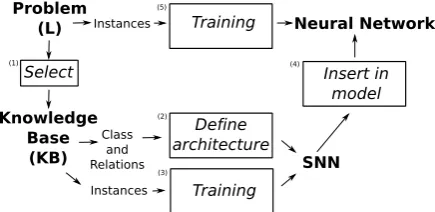
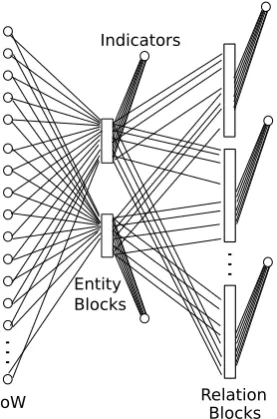
We define a Semantic Neural Network (SNN) as an artificial neural network architecture that en-codes knowledge. Two main semantic elements are encoded from the Knowledge Base. First, the graph structure of the Knowledge Base (i.e. en-tity classes and their relations) is directly repre-sented in the architecture of a SNN. Second from a Knowledge Base KB, the information about which instances belong to which entity classes and their specific relations are encoded into the weights of the SNN. By design, the architecture of the SNN is built to represent each specific entity class and relation in a clearly recognizable struc-ture (a set of neurons with a pre-designed connec-tion pattern). This allows a semantic meaning to be attached to an activation of the SNN in terms of the classes and relations defined in the Knowledge Base.
The purpose of the SNN is to provide a semantic representation of the input data that can be used as component inside a larger deep learning architec-ture, to solve a related learning problemL. If the knowledge represented inKB is useful for solv-ing the problem L, then the representation pro-vided by the SNN should be richer than plain bag-of-words or general purpose embeddings. With the same computational power (same number of parameters), a deep learning architecture using a SNN is expected to achieve equal or better perfor-mance than using other representations not specif-ically designed to exploit the knowledge inKB. Furthermore, the SNN architecture provides a se-mantic explanation for the model’s predictions.
BoW
Entity Blocks
Blocks Indicators
Relation
Figure 2: Schematic representation of a Semantic Neural Network, for an example knowledge do-main in the film industry. The input layer consists of a bag of words (BOW) representation. The mid-dle layer contains all the entity blocks (Movie and Person in this example) and the final layer con-tains all the relation blocks. The indicator outputs are one-dimensional sigmoid neurons.
ing problem, a standard training is performed. In this phase, the parameters of the rest of the net-work are adjusted. The internal parameters of the SNN can either be frozen, or optionally, adjusted together with the rest of the network in a post-optimization phase.
3.2.1 Structured Pre-Training
During the structured pre-training step, a knowl-edge base is used to extract random instances and adjust the SNN parameters. This knowledge base is the same as that chosen for designing the ar-chitecture, i.e., to choose the entities and relations which are represented in the SNN blocks. A ran-dom instance of this knowledge base is a tuple (ei, r, ej)which asserts the relationrbetween en-titiesei andej. In this instance,ei andej are as-sumed to have a natural text label associated (e.g., a name, description, tag, etc.).
The SNN learns to represent natural text in a manner which resembles the entity extraction pro-cess. Note that no natural text is associated to the label of the relation. Hence, in order for the SNN to accurately predict that relationr(e1, e2)is true
for a specific pair of entitiese1,e2, but false for
an-other pair of entities, the “list” of pairs of entities
that hold in each relation must be encoded in the Wr weights of the corresponding relation block. Furthermore, in order to differentiate the relations, the SNN needs to learn to differentiate the entities implicitly because there is no requisite to define the specific learning objective, namely represent-ing different entities and their correspondrepresent-ing en-codings.
3.2.2 Unstructured Training
After the pre-training phase is completed, standard training proceeds. In this phase, given the char-acteristics of the learning problem, the training is performed. For example, if the problem consists of text classification (i.e., opinion mining, topic detection, etc.), then the training examples con-sist of pairs of single-hot encoded text and the cor-responding class label. The exact parameters of the training depend on the problem characteristics, and are thus left unspecified in this proposal. Dur-ing this trainDur-ing phase, the parameters of the SNN are frozen, i.e., they remain unchanged through-out the training procedure. The reason for this is that the parameters of the SNN have already been adjusted, and the rest of the parameters are ran-domly initialized. Therefore, allowing the training algorithm to change the SNN parameters would destroy the learned mappings.
After the standard training, a final phase of fine-tunning can be optionally performed. In this final phase, all the parameters, both those of the SNN and those of the rest of the network, are allowed to change. In this phase, only small parameter up-dates are expected to happen, since the network should have converged in the previous phase.
4 Experimental Analysis
To analyze the behavior of the SNN, we selected a classic NLP problem and a suitable knowledge base. The selected problem is opinion mining in movie reviews, using the dataset from Pang and Lee (2004). The corpus contains 1000 positive and 1000 negative movie reviews written in En-glish. For building the knowledge base, raw data from IMDB2was processed obtaining a graph rep-resentation with 2 classes (PersonandMovie), 11 relations and a total 27,044,985 tuples. Table 1
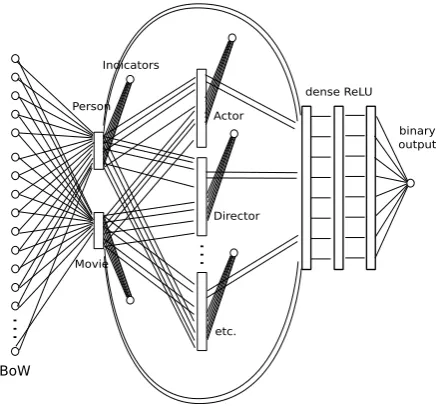
summarizes the statistics of the knowledge base. The SNN obtained from the IMDB knowledge base has the structure shown in figure3. The input
Classes Instances
Person 2 854 359
Movie 2 361 769
Relations
actor 6 531 498
actress 4 561 176
archive footage 160 467
archive sound 1 643
cinematographer 1 016 444
composer 1 030 405
director 2 871 640
editor 946 097
producer 1 646 903
production designer 221 315
self 4 739 853
writer 3 256 270
Table 1: Summary statistics of the knowledge base built from IMDB data.
size is 267,178 (number of unique words in a stan-dard English dictionary), the output size of each entity block is 10, and of each relation block is 20. The total number of indicator outputs is 14 (total number of concepts present in the IMDB knowl-edge base). Hence, the total number of trainable parameters in the SNN is 5,350,873.
The pre-training phase is executed for 10 epochs, each one with 100 batches, and each batch comprising 100 training examples. This cycle was repeated three times, first only with entities, then only with relations, and finally with both entities and relations. Hence, a total of 300,000 training examples were used in the pre-training phase. The final validation accuracy was 0.976 for the entities cycle, 1.00 for the relations cycle and 0.987 for the combined cycle. Since there are far fewer different relation types than actual entities, convergence is expected earlier when only training with relations.
4.1 Evaluating in the Opinion Mining Problem
The performance of the pre-trained SNN was eval-uated by including it as an internal component in a larger neural network. This neural network was applied to the original problem of classifying movie reviews. The architecture of this extended neural network consists of a single-hot encoding input which is connected to the SNN. The output of the SNN is connected to three sequential dense
BoW
Person
Movie Indicators
Actor
Director
etc.
dense ReLU
binary output
Figure 3: Schematic representation of the Seman-tic Neural Network trained in IMDB. Not all rela-tion blocks are shown, given space constraints.
layers with ReLU activation. A final dense layer with sigmoid layer was used, since the movie re-views problem is a binary classification problem. This network had an additional 141,361 trainable parameters.
Training was performed only on these new parameters for 10 epochs, using 100 batches each one with 100 samples per epoch. After this process, the SNN parameters were unfrozen, and a fine-tune training was performed with all 5,491,981 parameters.
This final training was performed for 50 epochs, until convergence was achieved. The validation accuracy obtained at this point was 0.702. Finally, an independent test set was used to measure test accuracy, obtaining 67.82% precision in the movie reviews problem.
For comparison purposes, a fully-connected feed forward neural network, with 4 dense ReLU layers and a total of 5,494,681 trainable param-eters was also trained from scratch in the movie review corpus. This network achieved a test accu-racy of 64.47% in the same test set used for testing the SNN. Hence, with roughly the same number of trainable parameters the SNN obtains a small, but statistically significant advantage (p≈10−39). Results are summarized in Table2.
5 Discussion
stan-Model Parameters Accuracy
SNN + 3 ReLU 5,491,981 67.82 4 Dense ReLU 5,494,681 64.47
Table 2: Comparison of performance in the opin-ion mining problem between different SNN-based architectures.
dard architecture. No comparison has been per-formed with more advanced architectures, such as Long Short Term Memory (LSTM) or Convolu-tional (CNN) networks. However, the purpose of SNNs is not to compete with, but rather to com-plement existing architectures with a new type of component that is knowledge-aware. Hence, the fact that the SNN performs effectively when com-bined with more traditional architectures encour-ages its use with other state-of-the-art deep learn-ing components.
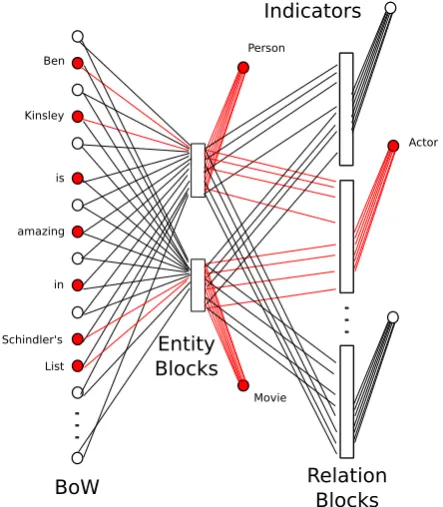
The most significant advantage of using a SNN is that it provides a semantic interpretation of the network’s behavior. The one-dimensional indica-tors used for guiding the SNN training could po-tentially act as a signaller for the high-level con-cepts that are being activated in any given exam-ple. By looking at the activation patterns inside the SNN, it may be possible to obtain an explana-tion of the network’s predicexplana-tion for a given exam-ple, in terms of the concepts in the knowledge base learned. Figure4presents an illustrative example in the context of the NLP problem presented in Section4.
Another advantage of SNNs is that once pre-trained with a given knowledge base, they can be reused in many different architectures. In a sense, SNNs can be seen as feature extractors or representational components that are associated with a given knowledge domain. It is also con-ceivable to use multiple SNNs trained in differ-ent knowledge domains in the same neural net-work. This provides a strategy for knowledge integration, when different and possible incom-patible knowledge domains are considered rele-vant for a particular problem. This opens the door to new strategies for transfer learning, from a more semantic perspective, where the transferred or reused knowledge can be tied to a particular do-main.
In our experimental setup we used a small natu-ral language dataset, since our purpose was not to obtain state-of-the-art results in the opinion
min-BoW
Entity Blocks
Relation Blocks Indicators
Ben
Kinsley
is
amazing
in
Schindler's
List
Person
Movie
Actor
Figure 4: Illustrative example of a Semantic Neu-ral Network activation in response to a particular input.
ing problem, but rather to illustrate the design of the SNN and explain its main architectural char-acteristics. We demonstrated that the SNN model provides effective support to learning approaches for resolving NLP problems.
6 Conclusions and Future Work
architectures, such as LSTMs, CNNs and differ-ent embedding strategies. Finally, the SNN inter-nal structure has a semantic meaning attached to each neuron block. This opens the door for the design of interpretation models that can automat-ically output an explanation of a neural networks response in terms of human-defined concepts.
Acknowledgments
This research has been supported by a Carolina Foundation grant in agreement with University of Alicante and University of Havana. More-over, it has also been partially funded by both aforementioned universities, the Generalitat Va-lenciana and the Spanish Government through the projects SIIA (PROMETEU/2018/089), LIVING-LANG (RTI2018-094653-B-C22) and INTEGER (RTI2018-094649-B-I00).
References
Yoshua Bengio. 2012. Deep Learning of Representa-tions for Unsupervised and Transfer Learning. In
JMLR: Workshop and Conference Proceedings.
vol-ume 27, page 17–37.
Evgeniy Gabrilovich and Shaul Markovitch. 2007.
Computing semantic relatedness using wikipedia-based explicit semantic analysis. In IJCAI Inter-national Joint Conference on Artificial Intelligence.
https://doi.org/10.1145/2063576.2063865.
Graeme Hirst and David St-Onge. 1998. Lexical chains as representations of context for the detec-tion and correcdetec-tion of malapropisms. WordNet:
An electronic lexical database305(April):305–332.
https://doi.org/citeulike-article-id:4893262.
Zhiting Hu, Poyao Huang, Yuntian Deng, Yingkai Gao, and Eric P Xing. 2015. Entity hierarchy
embed-ding. In Proceedings of the 53rd Annual
Meet-ing of the Association for Computational LMeet-inguis- Linguis-tics and the 7th International Joint Conference on Natural Language Processing (Volume 1: Long
Pa-pers). Association for Computational Linguistics,
Stroudsburg, PA, USA, volume 1, pages 1292–1300.
https://doi.org/10.3115/v1/P15-1125.
Quoc V Le. 2013. Building high-level features us-ing large scale unsupervised learnus-ing. InAcoustics, Speech and Signal Processing (ICASSP), 2013 IEEE
International Conference on. IEEE, pages 8595–
8598.
Claudia Leacock and Martin Chodorow. 1998. Com-bining Local Context and WordNet Similarity for Word Sense Identification. In: WordNet: An
elec-tronic lexical database. (January 1998):265–283.
https://doi.org/citeulike-article-id:1259480.
Kevin Lund and Curt Burgess. 1996. Pro-ducing high-dimensional semantic spaces from lexical co-occurrence. Behavior
Re-search Methods, Instruments, and Computers
https://doi.org/10.3354/ame01683.
Per Gunnar Martinsson, Vladimir Rokhlin, and Mark Tygert. 2011. A randomized algo-rithm for the decomposition of matrices.
Ap-plied and Computational Harmonic Analysis
https://doi.org/10.1016/j.acha.2010.02.003.
Tomas Mikolov, Greg Corrado, Kai Chen, and Jeffrey Dean. 2013. Efficient Estimation of Word Representations in Vector Space. Proceed-ings of the International Conference on
Learn-ing Representations (ICLR 2013) pages 1–12.
https://doi.org/10.1162/153244303322533223.
George A Miller. 1995. Wordnet: a lexical database for english. Communications of the ACM 38(11):39– 41.
Gr´egoire Montavon, Wojciech Samek, and Klaus-Robert M¨uller. 2017. Methods for interpreting and understanding deep neural networks. Digital Signal Processing.
Bo Pang and Lillian Lee. 2004. A sentimental educa-tion: Sentiment analysis using subjectivity summa-rization based on minimum cuts. InProceedings of the ACL.
Philip Resnik. 1999. Semantic Similarity in a Taxon-omy: An Information-Based Measure and its Ap-plication to Problems of Ambiguity in Natural Lan-guage. Journal of Artificial Intelligence Research
11:95–130.https://doi.org/10.1613/jair.514.
Tobias Schnabel, Igor Labutov, David Mimno, and Thorsten Joachims. 2015. Evaluation methods for unsupervised word embeddings. InProceedings of the 2015 Conference on Empirical Methods in
Nat-ural Language Processing. pages 298–307.
Peter D Turney. 2001. Mining the Web for Synonyms: PMI-IR versus LSA on TOEFL. Lecture Notes
in Computer Science
https://doi.org/10.1007/3-540-44795-4 42.