Constrained Dynamical Systems
Thesis by Mark B. Milam
In Partial Fulfillment of the Requirements for the Degree of
Doctor of Philosophy
California Institute of Technology Pasadena, California
2003
ii
c
° 2003 Mark B. Milam
iv
Acknowledgements
The work in this thesis would not of been possible without the help of many
in-dividuals. I would like to express my gratitude to Kudah Mushambi and Samuel
Chang for their contributions to the software package that resulted from this
re-search. I would like to acknowledge Simon Yeung, Jim Radford, Bill Dunbar,
Muruhan Rathinam, Michiel van Nieuwstadt, Sudipto Sur, and Francesco Bullo
for being generous with their time. Additionally, I would like to thank Youbin Mao
for the many invaluable discussions we have had over the years. Ryan Fran was
instrumental in getting the Caltech Ducted Fan experiment operational. I thank
him for his help on the experiment as well as introducing me to the sport of rock
climbing.
Prof. Nicholas Petit greatly influenced the work in this thesis. I would like to
thank him for his contributions to the micro-satellite project as well as evaluating
the performance of the proposed software algorithm in this thesis. I look forward to
collaborating with Nick in the future. My thanks go out to the dynamical systems
mavens: Wang Sang Koon and Prof. Jerrold Marsden provided the opportunity
to work on the micro-satellite project; Dong-Eui Chang for working with me on
the mathematical intricacies of differential flatness. I acknowledge Prof. Joel
Burdick for accepting to be a member of my thesis committee. Thanks to Prof.
John Hauser for contributing to the receding horizon control chapter of this thesis
as well as the design of the ducted fan experiment. I was surprised when we
met our goal of implementing receding horizon control on the experiment before
I graduated. I would like to reserve special acknowledgment for my mentor and
exemplary adviser, Prof. Richard Murray. Richard provided an unique
multi-discipline research environment as well as the inspiration, funding, guidance, and
motivation for my work.
I am indebted to Charmaine Boyd for handling the endless administrative
details of the Caltech ducted fan experiment. Thanks also to Rodney Rojas and
Rodney and I hoisted the 175 kg Caltech ducted fan experiment on its pedestal.
I owe gratitude to Northrop Grumman for providing a PhD fellowship to help
support my research.
I would like to thank to my parents, to whom I have dedicated this thesis,
for their support throughout the years. My wife, Joy, has always been loving
throughout this difficult experience while working full-time and raising our family.
She has always been my greatest source of energy to finish this thesis. For this, I
vi
Real-Time Optimal Trajectory Generation for Constrained
Dynamical Systems
by Mark B. Milam
In Partial Fulfillment of the
Requirements for the Degree of
Doctor of Philosophy
Abstract
With the advent of powerful computing and efficient computational algorithms,
real-time solutions to constrained optimal control problems are nearing a reality. In
this thesis, we develop a computationally efficient Nonlinear Trajectory Generation
(NTG) algorithm and describe its software implementation to solve, in real-time,
nonlinear optimal trajectory generation problems for constrained systems. NTG is
a nonlinear trajectory generation software package that combines nonlinear control
theory, B-spline basis functions, and nonlinear programming. We compare NTG
with other numerical optimal control problem solution techniques, such as direct
collocation, shooting, adjoints, and differential inclusions.
We demonstrate the performance of NTG on the Caltech Ducted Fan testbed.
Aggressive, constrained optimal control problems are solved in real-time for
hover-to-hover, forward flight, and terrain avoidance test cases. Real-time trajectory
generation results are shown for both the two-degree of freedom and receding
horizon control designs. Further experimental demonstration is provided with the
station-keeping, reconfiguration, and deconfiguration of micro-satellite formation
with complex nonlinear constraints. Successful application of NTG in these cases
demonstrates reliable real-time trajectory generation, even for highly nonlinear
and non-convex systems. The results are among the first to apply receding horizon
viii
Contents
1 Introduction 1
1.1 Previous and Parallel Work . . . 4
1.2 Overview and Statement of Contributions . . . 6
2 Background and Mathematical Framework 8 2.1 Optimal Control Problems under Consideration . . . 8
2.2 Necessary Conditions of Optimality for Constrained Systems . . . 9
2.3 Trajectory Generation Using Homotopy . . . 11
2.3.1 Algorithm Description . . . 12
2.3.2 Ducted Fan Example . . . 15
2.4 Nonlinear Programming Techniques . . . 19
2.4.1 Optimality Conditions . . . 20
2.4.2 Techniques for Global Convergence . . . 22
2.4.3 Trust-Region Methods . . . 23
2.4.4 Merit Functions . . . 23
2.4.5 Simple Infeasible Nonlinear Programming Algorithm Using a Line-search . . . 24
2.4.6 Active Set Methods . . . 25
2.5 Numerical Solutions of Optimal Control Problems Using Nonlinear Programming . . . 25
2.6 Trajectory Generation Using Feedback Linearization . . . 30
2.6.1 Mathematical Background . . . 30
2.6.2 Classical Feedback Linearization . . . 31
2.6.3 Devasia-Chen-Paden Non-minimum Phase Zero-Dynamics Al-gorithm . . . 36
2.7 Differential Flatness . . . 36
2.8 System Design and Differential Flatness . . . 39
2.9 Parameterization of the Output . . . 47
2.10 Summary and Conclusions . . . 51
3 The Nonlinear Trajectory Generation (NTG) Algorithm 53 3.1 Transforming the System Dynamics to a Lower Dimensional Space 53 3.1.1 Differentially Flat Systems . . . 54
3.1.2 An Algorithm to Map the System Dynamics to Lower Di-mensional Space . . . 56
3.2 Parameterization of the Flat Outputs and “Pseudo” Outputs . . . 59
3.3 Transformation into a Nonlinear Programming Problem . . . 59
3.4 Conclusion . . . 65
4 NTG Performance Comparisons 66 4.1 An Investigation of NTG, Differential Inclusion, and Collocation Integration Accuracy . . . 66
4.2 Comparison of NTG and RIOTS . . . 67
4.3 An Investigation of the Accuracy of NTG vs. Shooting: The God-dard Problem . . . 71
4.4 Variable Space Reduction . . . 72
4.4.1 Example . . . 76
4.5 Conclusion . . . 84
5 Two Degree of Freedom and Receding Horizon Control (RHC) of
x
5.1 Experimental Setup and Mathematical Model . . . 86
5.2 Two-degree-of-Freedom Design for Constrained Systems . . . 91
5.2.1 Optimization Problem Formulation . . . 91
5.2.2 Timing and Trajectory Management . . . 92
5.2.3 Stabilization around Reference Trajectory . . . 94
5.2.4 “Shuttle” Maneuver . . . 96
5.2.5 Terrain Avoidance . . . 96
5.2.6 Forward-Flight Trajectory Generation . . . 100
5.2.7 Conclusions and Future Work . . . 102
5.3 Receding Horizon Control for Constrained Systems . . . 105
5.3.1 Theoretical Background . . . 107
5.3.2 Receding Horizon Control Formulation . . . 112
5.3.3 NTG Setup . . . 113
5.3.4 Results . . . 117
5.3.5 Conclusion . . . 124
6 Micro-satellite Formation Flying 128 6.1 Introduction . . . 128
6.2 Problem Formulation . . . 131
6.2.1 Micro-Satellite Formation Flying Requirements . . . 133
6.2.2 Micro-Satellite Trajectory Generation . . . 133
6.3 Optimal Control Problem Formulation . . . 134
6.3.1 Station-Keeping with Guaranteed Earth Coverage . . . 135
6.3.2 Nonlinear Formation Reconfiguration and Deconfiguration . 137 6.4 Numerical Results . . . 138
6.4.1 Station-Keeping . . . 138
6.4.2 Results to Problems 2 and 3: Nonlinear Reconfiguration and Deconfiguration . . . 141
6.5 Conclusion . . . 142
List of Figures
1.1 Separation of different levels of trajectory generation. . . 2
1.2 Two-degree-of-freedom-design. . . 3
1.3 Receding horizon control design. . . 3
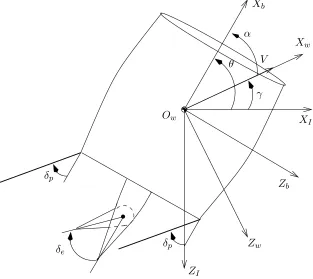
2.1 UCAV coordinate system conventions. . . 16
2.2 Ducted fan trajectory generation homotopy example: x: 0→ −.8 and z: 0→ −.8 with large time weight. . . 18
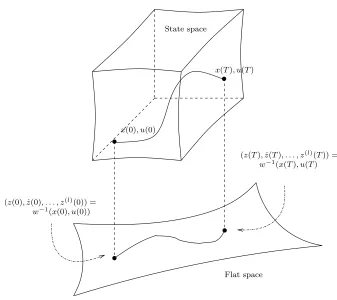
2.3 A flat system has the important property that the states and the inputs can be written in terms of the outputszand their derivatives. Thus, the behavior of the system is determined by the flat outputs. Note that the map wis bijective. . . 38
xii
3.1 In this hypothetical problem, the B-spline curve has six intervals
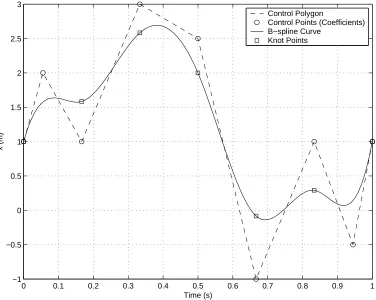
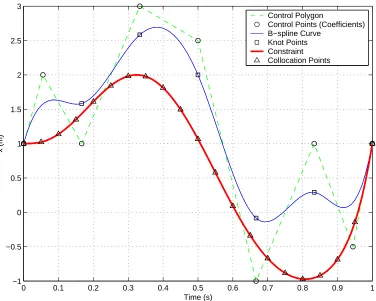
(l = 6), fourth order (k = 4), and is C3 at the breakpoints (or smoothness s = 3). The constraint on the B-spline curve (to be larger than the constraint in this example) will be enforced at the
21 collocation points. The nine control points are the decision
vari-ables. . . 60
4.1 RIOTS and NTG van der Pol comparison . . . 70
4.2 The different formulations of the optimal control problem for the
example. Top: full collocation. Bottom: flatness parametrization. . 78
4.3 Main results. The cpu-time is an exponential decreasing function
of the relative degree. Top: full collocation. Bottom: flatness
parametrization. . . 79
4.4 log(Number of variables) versus log(cpu-time). In each case 200
runs were done with random initial guesses. The variance of the results is represented by the error bar. The slope of the linear
regression of the mean values of cpu-time is 2.80 . . . 80 4.5 NTG direct collocation, “semi-flat” and “flat” convergence analysis.
The abscissa is the number of convergent test cases out of the 500
for each 6561 test case. The ordinate shows the number of 6561 test
cases. . . 83
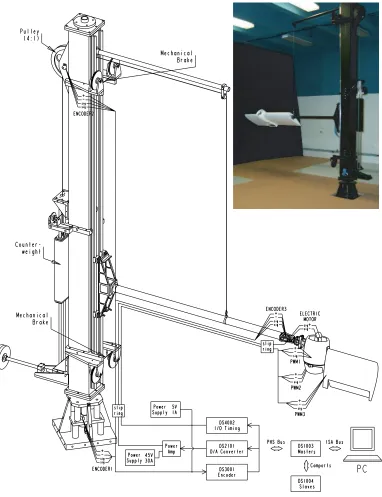
5.1 Ducted fan testbed . . . 87
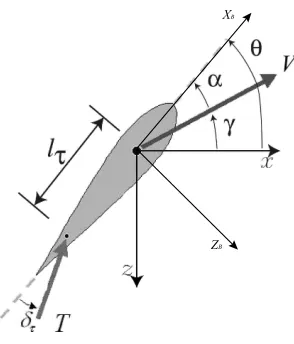
5.2 Ducted fan coordinate frames . . . 88
5.3 B-spline curve fits to wind tunnel and flight test results for the
CL(α),CD(α), andCM(α) aerodynamic coefficients. . . 90 5.4 forward-flight mode equilibrium manifold . . . 93
5.5 Sample run showing joystick input and timing concepts. The initial
conditions for each run are denoted with IC, and the final conditions
5.6 “Shuttle” maneuver depicting joystick command , NTG reference
trajectory, and actual state . . . 97
5.7 “Shuttle” maneuver depicting all the trajectories that are computed and which trajectories are accepted. For each trajectory, a fixed constant is added to the time axis so that all trajectories can be seen. “X” denotes the start of a trajectory. “O” denotes an accepted trajectory that was applied until completion; that is, the system reached a hover equilibrium. . . 98
5.8 “Shuttle” Maneuver run times . . . 99
5.9 Terrain avoidance position and pitch attitude of the Caltech Ducted Fan. NTG reference trajectory (dashed) and actual (solid). The attitude (θ) is denoted by the orientation of the airfoil. . . 99
5.10 Terrain avoidance commanded and actual forces . . . 100
5.11 Hover to hover test case: Altitude and x position for two different vertical trajectory constraints. The actual (solid) and NTG ref-erence trajectories (dashed). The attitude (θ) is denoted by the orientation of the airfoil. . . 101
5.12 Forward-flight test case: θand ˙x desired and actual. . . 102
5.13 Forward-flight test case: Desired FXb and FZb with bounds. . . 103
5.14 Forward-flight accepted trajectory errors . . . 103
5.15 Forward-flight test case: Altitude andxposition (actual (solid) and desired(dashed)). Airfoil represents actual pitch angle (θ) of the ducted fan. . . 104
5.16 Forward-flight test case: 60 second run, 30 computed trajectories, tsample= 2 sec. . . 104
5.17 Illustration of sub-level set of J∗ T(·) to which the state of the true system will converge . . . 112
5.18 Illustration of timing scheme without prediction. . . 114
xiv
5.20 Plot depicting the actual attitude and position of the ducted fan
throughout both step commands. . . 119
5.21 The commanded forces in the body frame. There is a nonlinear transformation between FXB, FZB and commanded current to the motor and the thrust vector bucket angle δτ. . . 119
5.22 Horizontal position of the ducted fan . . . 120
5.23 The attitude of the ducted fan . . . 121
5.24 The spatial horizontal velocity of the ducted fan . . . 122
5.25 Force constraints and computation times. . . 123
5.26 Vertical position of the ducted fan . . . 125
6.1 Orbit and inertial coordinate systems. . . 132
6.2 Micro-satelllite modes of operation: reconfiguration, station-keeping, and deconfiguration . . . 134
6.3 Station keeping with guaranteed earth coverage . . . 136
6.4 Station-keeping for three micro-satellites. Relative distances (m) . 139 6.5 Station-keeping for three micro-satellites. Projected area (m2). . . 140
6.6 Station-keeping for three micro-satellites. ∆V (m/s) . . . 141
6.7 Projected area for station-keeping with and without control. Pro-jected area (m2). Without control, the projected area becomes sin-gular. . . 142
6.8 Reconfiguration. Going into a formation with a projected area of 450m2. Top: projected area versus time. Middle: relative distances versus time. Bottom: thrusts in the body frame, where each colunm is a different satellite. . . 145
List of Tables
2.1 Summary of the flatness characteristics of several simple VTOL
con-figurations. Flat in forward flight implies that the mixing of hover
actuation and aerodynamic surfaces is possible. . . 46
4.1 Summary of results of simple cart comparison showing that
exploit-ing differential flatness compares favorably with other transcription
techniques. . . 68
4.2 RIOTS and NTG van der Pol comparison . . . 71
4.3 NTG Goddard example results showing the increase in accuracy in
solution as the number of knot intervals is increased . . . 73
5.1 Maximum acceptable periods as determined in simulation . . . 117
5.2 Maximum acceptable periods as determined on the real experiment 118
6.1 Station-keeping. Top: effect of S for a given d. Bottom: effect of e
1
Chapter 1
Introduction
A simple one-degree-of-freedom approach to tracking a real-time target using
feed-back control system is to subtract the current state of the system from the target
and feed this error to the controller. It is well known that this approach frequently
fails for a large class of nonlinear mechanical systems with constraints, where a
global asymptotically stable solution that satisfies the constraints does not exist.
Even when a solution is found, it is difficult to achieve high performance in the
presence of constraints.
When used in conjunction with a stabilization technique, generating a
trajec-tory that satisfies the system dynamics has been proven effective in mitigating the
deficiencies of the one-degree of freedom design. Typical applications of trajectory
generation include obstacle avoidance by a robotic vehicle, minimum time missile
interception of an agile target, formation flight of microsatellites with coverage
constraints, and a rapid change of attitude for an unmanned flight vehicle to evade
a dynamic threat. References [1] and [68] articulate the need for advanced control
techniques to accomplish these missions.
Depending on the system setup, there may be more than one level of trajectory
generation, as shown in Figure 1.1. At the mission level, an objective along with
a set of mission constraints are derived from high level mission inputs, with which
a desired trajectory is generated. The time-scale at this level of trajectory
1. Introduction 3
P
Plant ∆
Feedback
noise output
xd
Compensation ref
ud u
δu
Trajectory Generation
Figure 1.2: Two-degree-of-freedom-design.
P
Plant ∆
output noise
ref Trajectory u Generation
Figure 1.3: Receding horizon control design.
controls of this trajectory are then applied for a certain fraction of the horizon
length, after which the process is repeated. It has been shown theoretically that
receding horizon control is stabilizing if an appropriate cost function is chosen and
the trajectory can be computed quickly.
It is possible to combine the two-degree-of-freedom and receding horizon control
designs. For example, one could generate a feasible trajectory using the
two-degree-of-freedom design and stabilize with the receding horizon control design.
A prime example, where a two-degree-of-freedom or receding horizon control
design would be applied, is an unmanned flight vehicle. The desired objective of the
unmanned flight vehicle could be commanded by the operator or pre-programmed
certain point, pass through several way-points, or track a target. For some
mis-sions, unmanned flight vehicles will autonomously fly highly aggressive maneuvers,
frequently on the fringe of the flight envelope. The idea of directly commanding
the unmanned flight vehicle to track a target would be impractical, considering
the fast dynamics and constraints of a typical unmanned flight vehicle. Some
fu-ture unmanned flight vehicles could autonomously launch an attack and return
to base or land on aircraft carriers. These vehicles would provide more tactical
flexibility than a cruise missile because they would be able to loiter in the area and
search for a moving target, which it could then strike with its weapons. Future
unmanned flight vehicles will have the ability to respond quickly to a wide range of
unforeseeable circumstances in search and rescue, border patrol, and counter-drug
operations. A key feature of these unmanned flight vehicles will be their ability to
autonomously plan their own trajectories. Therefore, the important goal of opti-mal trajectory generation is to construct, in real time, a solution that optimizes the
system objective while satisfying system dynamics, as well as state and actuation
constraints.
Hence, it is the objective of this thesis to develop an efficient computational
algorithm for real time optimal trajectory generation of constrained systems and
demonstrates its effectiveness on an experiment testbed that represents a
real-world application.
1.1
Previous and Parallel Work
Most early numerical methods of solution to constrained optimal trajectory
gener-ation problems relied on either indirect or direct methods of solution. The indirect
method relies on finding a solution to the Pontryagin’s maximum principle [83].
This results in finding a numerical solution to a two-point boundary value
prob-lem, if no closed form solution can be found. The multiple shooting method, used
to solve two-point boundary value problems, is discussed in Pesch [77, 78] and
1.1. Previous and Parallel Work 5 the objective function, subject to the constraints of the optimal control problem.
An introduction to direct methods can be found in Hargraves and Paris [41] and
vonStryk [109]. Techniques were developed to optimally interpolate a set of stored
trajectories on-line by Chen and Allgower in [18] and [3], respectively. A
tech-nique for generating real time trajectories by searching and interpolating over a
large trajectory database in real time can be found in Atkeson [4].
Several randomized trajectory generation techniques have recently been
re-ported and have promising potential for real-time applications. For example, see
LaValle [55], Frazzoli [36], and Hsu [44]. These techniques are most applicable to
the mission level trajectory generation shown in Figure 1.1.
Another approach to solving the trajectory generation problem would be to use
nonlinear geometric control techniques. These techniques attempt to find ad hoc
outputs such that the complete differential behavior of the system can be
repre-sented in terms of these outputs and their derivatives. The theory of existence and
generation of these so-called flat outputs are subjects of Isidori [46], Rathinam [87],
Charlet et al. [16], Fliess [32, 33], Chetverikov, [19], and [62, 65]. Unfortunately, there are many classes of systems for which these outputs cannot be found, even
if they can be proven to exist. However, it is usually not very difficult to find
some outputs that will characterize at least part of the system behavior. In this
case, attention must be paid to the stability of the resulting zero dynamics which
could lead to unbounded controls and states. Techniques were developed in
Deva-sia and Chen [25], DevaDeva-sia [24], and Verma and Junkins [107] to circumvent this
problem. Some methods of real-time trajectory generation without constraints for
differentially flat systems are illustrated in van Nieuwstadt [103]. An approach to
find feasible trajectories for constrained differentially flat systems by
approximat-ing constraints with linear functions is given in Faiz and Agrawal [29]. Agrawal
and Faiz in [2] investigated higher-order variation methods to solve optimization
problems for feedback linearizable systems without constraints.
An example of work more related to the approach in this thesis can be found in
quadratic programming can drastically reduce computation times in robotic
mo-tion planning. The work of Oldenburg et al. [75] and [76] expands on Steinbach’s approach by including the case when the system is not feedback linearizable.
Old-enburg relies on the work of van der Schaft in [102], which provides a method to
represent a nonlinear state space system as a set of higher-order differential
equa-tions in the inputs and outputs. Mahadevanet al. in [60] and [61] use Oldenburg’s work and apply it to chemical processes. Veeraklaew et al. in [106] combines the concepts of differential flatness and sequential quadratic programming. However,
his choice of basis functions representing the outputs requires additional continuity
constraints to the resulting optimization problem. Bulirschet al. [37] discusses the use of sequential quadratic programming methods to solve trajectory optimization
problems.
1.2
Overview and Statement of Contributions
A brief summary and thesis contributions by chapter:
• Chapter 2: In this chapter we derive a novel homotopy method, which when used in conjunction with a stored database of trajectories, will find nearby
optimal trajectories. Additionally, we discuss the relationships between
Ver-tical Takeoff and Landing (VTOL) design and differential flatness. Finally,
we present a promising new VTOL design and demonstrate that it is
differ-entially flat.
• Chapter 3: In this chapter we first propose a generic algorithm to reduce the dimension of the system dynamics to facilitate real-time computation.
Sec-ond, we develop the Nonlinear Trajectory Generation (NTG) algorithm and
describe the software implementation intended to solve nonlinear, optimal,
real-time, constrained trajectory generation problems. NTG is a software
package that combines techniques of nonlinear control, B-splines, and
1.2. Overview and Statement of Contributions 7 • Chapter 4: In this chapter, we compare and contrast NTG with the optimal control problem solution techniques of direct collocation, shooting, adjoints,
and differential inclusions.
• Chapter 5: In this chapter, we investigate the performance of NTG on the Caltech Ducted Fan experiment. Results are presented for both the
two-degree-of-freedom and receding horizon control design. For the two-degree
of freedom design, aggressive constrained optimization problems are solved in
real-time for hover-to-hover, forward flight, and terrain avoidance test cases.
The results confirm the applicability of real-time, nonlinear, constrained
re-ceding horizon control. They are among the first to demonstrate the use
of receding horizon control for agile flight in an experimental setting, using
representative dynamics and computation.
• Chapter 6: In this chapter, we provide another example of complex, real-time nonlinear constrained trajectory generation for the station-keeping,
Chapter 2
Background and Mathematical Framework
In this chapter we will survey the techniques that are currently used for
con-strained trajectory generation, followed by background material that motivates
this research.
2.1
Optimal Control Problems under Consideration
Letx: [t0, tf]→Rndenote the state of the system and u: [t0, tf]→Rmthe input of the system
˙
x=f(x, u), (2.1)
where all vector fields and functions are real-analytic. It is desired to find a
tra-jectory of (2.1) in [t0, tf] that minimizes the performance index functional
J := Z tf
t0
L(x, u, t)dt+φf(xf, uf, tf) (2.2)
J : Rm×R+ → R subject to a vector of N0 initial time, Nf final time, and Nt trajectory constraints,
lb0 ≤ ψ0(x0, u0)≤ub0,
lbf ≤ ψf(xf, uf)≤ubf,
lbt ≤ S(x, u, t)≤ubt.
2.2. Necessary Conditions of Optimality for Constrained Systems 9 The functionsψ0 :Rn×Rm →RN0,ψf :Rn×Rm →RNf,S:Rn×Rm×R+→
RNt are assumed to be as least C2 on appropriate dense open sets. The final time
tf could be either fixed or free.
2.2
Necessary Conditions of Optimality for Constrained
Systems
Bryson and Ho [12] and Lewis and Syrmos [58] derive the necessary conditions
using the calculus of variations. Pontryagin et al. [83] show that finding an ex-tremal solution is equivalent to the requirement that the variational Hamiltonian
be minimized, with respect to all admissible inputs.
Without loss of generality, we will assume that there is one control (m = 1) and one state inequality constraint (Nt = 1, S(x, t) ≤ 0) and that the trajectory constraint is active on the time interval t∈[t1, t2]⊂[t0, tf]. An active constraint is known as a constrained arc.
Defining the HamiltonianH and the auxiliary functions Ξ and Φ,
H(x, u, λ, µ, t) :=L(x, u, t) +λTf(x, u) +µTS(q)(x, u, t) Ξ(x0, u0, t0, ν0) :=φ0(x0, u0, t0) +ν0Tψ0(x0, u0, t0) Φ(xf, uf, tf, νf) :=φf(xf, uf, tf) +νfTψf(xf, uf, tf),
(2.4)
where the λ : [t0, tf] → Rn, ν0 ∈ RN0, νf ∈ RNf and µ : [t0, tf] → R are La-grange multipliers. The number of time derivatives q of S such that u explicitly appears and Su(q)6= 0 is denoted byS(q)(x, u, t). In order thatS(q)(x, u, t) = 0 and
S(x, u, t) = 0 on [t1, t2] we also require that the entry conditions
NT(x(t1), t1) = [S(x(t1), t1), S(1)(x(t1), t1), . . . , S(q−1)(x(t1), t1)] = 0 (2.5)
be satisfied. See Bryson, Denham and Dreyfus [11] for more details. The Lagrange
An optimal solution of (2.2) and (2.3) must satisfy the the necessary conditions
˙
x=Hλ (2.6)
˙
λT =−Hx (2.7)
Hu = 0 (2.8)
λT(t0) = Ξx|t=t0 (2.9)
λT(t−1) =λT(t+1) +πTNx|t=t1 (2.10)
H(t−1) =H(t+1)−πTNt|t=t1 (2.11)
λT(tf) = Φx|t=tf (2.12)
µ= 0 if S(q)(x, u, t)<0 (2.13)
µ≥0 if S(q)(x, u, t) = 0 (2.14)
and if the final time tf is not specified we must include
(Φt+H)|tf = 0. (2.15)
Note: The partial derivativesHx, Ξx, and Φx are considered row vectors, i.e.,
Hx= (∂x∂H1, . . . ,∂x∂Hn) and the transpose of the column vector (.) is denoted by (.)T The necessary conditions result in a multi-point boundary value problem at
times t0, t1 and tf involving the differential equations (2.6) and (2.7). At each boundary there will be effectivelyn constraints derived from the total number of terminal equations minus the free variables.
Utilizing (2.11) and (2.15), we can determine t1 and tf. The input on the constrained arc can be found fromS(q)(x, u, t) = 0. Otherwise we can use equation (2.8). The Lagrange multiplier µis found from equation (2.13) off the constrained arc and equation (2.8) when on the constrained arc.
Generally, closed form solutions are difficult to find. Numerical methods based
on gradient descent or Newton’s method are usually invoked to find solutions to
2.3. Trajectory Generation Using Homotopy 11 guess to the free-variables ν0, νf, π, t1, and tf sufficiently close to a solution to guarantee convergence of the method.
The multiple shooting numerical method is advocated by Pesch in [77] and [78].
A thorough description of shooting techniques is provided by Stoer and Burlisch
[99]. One advantage of using shooting is that very accurate solutions are
obtain-able. Potential disadvantages of shooting include a high sensitivity to the initial
guess, as well as the need for robust integration techniques over large time intervals
since equations (2.6) and (2.7) will likely have both unstable and stable
compo-nents. An alternative to the shooting method, which is less sensitive to the initial
guess, is to replace the ordinary differential equations in equations (2.6) and (2.7)
by their finite difference approximations. Press et al. discuss so called relaxation methods solution methods in [86]. Due to the undesirable convergence rates and computation times, neither of these numerical methods are practical for real-time
implementation. In the next section, we will assume that a solution to an optimal
control problem can be determined off-line using the above mentioned numerical
techniques and stored in a database for on-line use. We will use a trajectory in the
database as the initial guess to solve a neighboring optimal control problem with
high confidence in real-time.
2.3
Trajectory Generation Using Homotopy
Homotopy can best be shown by a simple example. Suppose that one wishes to
obtain the solution of a system ofN nonlinear equations inN variables,
W(x) = 0, (2.16)
where W : RN → RN is a smooth mapping. Without a good initial guess ¯x, an iterative solution to equation (2.16) will often fail. As a possible remedy, one
defines a homotopy V :RN×R→RN such that
whereU :RN →RN is a smooth map having known solutions. Typically, one may choose a convex homotopy such that
W(x, ²) :=²U(x) + (1−²)V(x),
and continuously trace an implicitly defined curve from a starting point (x1,1) to a solution (¯x,0). Burlisch in [13] and [99] warns that morphing a simple system not related to the problem to a complex system may not succeed in critical cases.
In the following section, a homotopy method is presented without applying a
homotopy to the system dynamics. Chenet al. [18] also took a similar approach to singular optimal control problems.
2.3.1 Algorithm Description
It will be assumed that the desired objective is to move the system from a known
initial state to a known final state while minimizing a prescribed cost function.
The proposed homotopy algorithm will find an optimal trajectory connecting the
initial and final state. The central idea of the algorithm is to decompose the
operating envelope into regions. For each region a trajectory is computed off-line
and the initial and final states and costates are saved into a database for on-line
use. The boundaries of each region are determined such that for each trajectory
in the region, there exists a homotopy to any other trajectory in the region. The
advantages to this algorithm is that only a small subset of all trajectories need to
be stored on-board, and every trajectory is optimal with respect to a prescribed
cost function.
We tacitly assume that a solution has been found to the trajectory generation
problem for some specified system (2.1), with associated cost function in equation
(2.2), an initial state constraint ψ0(x0) = 0, and the desired state ψf(xf) = 0. A solution to this problem implies that we have also foundν0andνf in equation (2.4). Now suppose that we would like to determine the solution with the new boundary
2.3. Trajectory Generation Using Homotopy 13 tox(t0) andψ(x(tf)) = 0, respectively. By “sufficiently close” we mean that there exists a homotopy between x(t0) and ψ(x(tf)) = 0 and ˜x(t0) and ˜ψ(x(tf)). The implicit function theorem will dictate whether or not a homotopy exists. To obtain
a solution with the new desired goal ˜ψ(x(tf)) and initial state ˜x(t0), we will embed the known solution into a family of perturbed solutions through the parameter ²
using a convex homotopy. Define
ˆ
x(t0, ²) := x(t0)²+ ˜x(t0)(1−²) (2.17) ˆ
ψ(x(tf), ²) := ψ(x(tf))²+ ˜ψ(x(tf))(1−²), (2.18)
where ² ∈ [0,1] is a perturbation parameter, ˆx(t0, ²) : Rn ×[0,1] → Rn, ˆψ :
Rn×[0,1]→Rp. By making²go to zero, we obtain the solution to the trajectory generation problem of interest.
In principle, we know that the solutions of the differential equations (2.6) and
(2.7) are determined by x(t0) andλ(t0). That is, if we alterψ0 and ν0, we change
x and λfor allt. Thus, we may write at the final time tf:
x(tf) =x(ψ0, ν0, tf) λ(tf) =λ(ψ0, ν0, tf). (2.19)
For ease of notation, we will write the terminal boundary conditions as
G(y, ²) = 0, (2.20)
wherey = (ν0, νf) and Gis an (n +N0) vector-valued functional.
Suppose we are given a solution (z0, ²0) of (2.20). Using homotopy, we want to find a solution z(²0+ ∆²) for a small perturbation ∆². The implicit function theorem [50] gives conditions which one can solve (2.20) in some neighborhood of
(z0, ²0):
a. G(z0, ²0) = 0 for some z0 and ²0; b. Gz(z0, ²0) is nonsingular;
2.3. Trajectory Generation Using Homotopy 15 Changingz, while holding²constant, we have ∂x∂x
0(t0) = 0∈R
n×n,∂λ
∂λ0 =I6∈
Rn×n, ∂x
∂λ0 = 0 ∈ R
n×n, and ∂λ
∂x0 = 0 ∈ R
n×n . Now we can find G
z(z, ²) by integrating theη(t) and ξ(t) dynamics forward in time:
Gz(z, ²) =Gz(η(tf), ξ(tf), ²). (2.24)
In an analogous manner, the following differential equations are derived which
we will use to calculate the Jacobian G²(z, ²) (holdingz0 constant). Defining
ζ = ∂x
∂², χ= ∂λ
∂², ζ, χ∈R
n
we obtain
˙
ζ =Hλx·ζ+Hλλ·χ+Hλ² (2.25) ˙
χ=Hxx·ζ+Hxλ·χ+Hx² (2.26)
and observe that if we change², but holdzconstant, we have, referring to equation (2.17),ζ(t0) =x(t0)−x˜(t0) andχ(t0) = 0. Now we can findG²(z, ²) by integrating theζ(t) and χ(t) dynamics forward in time:
G²(z, ²) =G²(ζ(tf), χ(tf), ²). (2.27)
2.3.2 Ducted Fan Example
An example of the use of the homotopy technique will be illustrated using the
planar ducted fan. Figure 2.1 depicts the coordinate systems and conventions
used for the ducted fan. Writing Newton’s equations about Ow we have
mx¨ = FXbcosθ+FZbsinθ (2.28)
mz¨ = −FXbsinθ+FZbcosθ+mg (2.29)
The numerical values of the constants used in this example are the following:
m= 2.2kg mg= 4N rp =.2m J = 0.05kgm2. (2.31)
The optimal cost with free final time is
min u J ≡
Z T 0
(RT +R1FX2b+R2F
2
Zb)dt, (2.32)
with input constraints−5≤FZb ≤5 N, 0≤FXb ≤17 N, as well as constraints on
the initial and final state. The problem can be described as the following: Minimize
a balance between time and energy subject to initial and final time constraints as
well as a trajectory constraint on the input.
δe
Ow
Zb
Zw
γ
Xw
α
θ V
Xb
δp
δp
XI
ZI
Figure 2.1: UCAV coordinate system conventions.
In this example, the integration technique used was a predictor-corrector
2.3. Trajectory Generation Using Homotopy 17 For the first example we computed off-line a trajectory using the optimal
tra-jectory solver RIOTS [90] for the initial conditions x(t0) = (0 0 0 0 π/2 0)T and the final conditions ˆψ(x(tf)) = ψ(x(tf)) =x(tf)−(1 0 −1 0π/2 0)T. The cost function weights were chosen as RT = 4, R1 = 1, and R2 = 2. It is desired to deform the initial condition to ˜x(t0) = (−1 0 −1 0π/2 0)T. Note that the final unknown time is a free variable. The predictor-corrector algorithm was coded in
Matlab and consumed approximately 11 minutes of CPU time on a Sun Ultra 30.
The results of the simulation showed that the homotopy could be performed, but
the computation time was prohibitive.
The same setup was used for the second example, except that RT = 200 and ˜
x(t0) = (−.8 0 −.8 0π/2 0)T. The difference between the two examples is that, in the second, there is significant weight on the time. The results of this simulation
are shown in Figure 2.2. For this example, it took approximately 38 minutes of
CPU time.
At ² = .35 the trajectory suddenly changes. This can be explained by the significant positive to negative change of Lagrange multiplier λ3(t0). The sign of the determinant ofGz(z, ²) indicates a singularity. However, the implementation of the algorithm is robust enough so that we still proceed with the homotopy in effect,
jumping over the singularity. Note that this singularity is not explicitly occurring
the the time domain since the homotopy parameter does not enter explicitly in the
state or costate equations. It is the significant change inλ3(t0) that is causing the large change in the dynamical behavior seen in Figure 2.2.
The unexpected singularity illustrates the necessity of an off-line study to find
trajectories such that we can steer around singularities. The nonsingularity of
det(Gz(z, ²)) 6= 0 must be off-line. If a singularity occurred, a modification of the cost function would be of first consideration. If a modification of the cost
function does not work, one could break the problem into separate homotopy
problems: x(t0) → x¯(t0) and ψ(x(tf)) → ψ¯(x(tf)) and then ¯x(t0) → xˆ(t0) and ¯
2.4. Nonlinear Programming Techniques 19 would be a last resort.
In general, another fundamental problem with this technique is sensitivity. We
are using a form of shooting to find Gz(z, ²) by integrating a system of ordinary differential equation that have both stable and unstable components. Integrating
such a system of ODE’s over a significant time span can become ill-conditioned.
This results in the ODE solver proceeding very slowly, producing large CPU times.
This sensitivity is due the nature of the necessary conditions of optimal control.
Multiple shooting may help mitigate some of these integration problems.
2.4
Nonlinear Programming Techniques
The problem of finding a local minimizer x ∈ Rn for a nonlinear function F(x) subject to a set of nonlinear constraints c ≥ 0, where c(x) ∈ Rn, is a nonlinear
constrained optimization problem. All the problems of interest to be solved in this thesis can be generalized into the form
min x F(x)
subject to c(x)≥0.
(2.33)
Optimization problems of the form (2.33) can be a very difficult problem to solve.
For instance, it is NP-hard in the traditional complexity model [105]. Algorithms
to solve (2.33) may take many iterations and function evaluations. A promising
global optimization technique, based on surrogate functions, is given by Denniset al. [23]. Global optimization of (2.33) is a difficult problem and an open area of reserach . In this thesis, we will concentrate on using the well understood numerical
techniques that will find local minima of (2.33).
Sequential Quadratic Programming (SQP)and Interior Point Methods (IPM)
are popular classes of methods considered to be effective and reliable method for
locally solving Equation (2.33). At each iteration of an SQP method, one solves
a quadratic program (QP) subproblem that models (2.33) locally at the current
next iterate. Eliminating inequality constraints by adding slack variables and
incorporating them into a logarithmic barrier function in the objective function,
(2.33) is transformed into
min
x F(x)−µ m X i=1
logsi
subject to c(x)−s= 0.
(2.34)
Interior point refers to the fact that the slack variables are required to remain
strictly positive throughout the optimization.
Successful algorithms need to be both efficient and robust. Under reasonable
assumptions, a robust algorithm must be globally convergent (convergent from
any starting point) and able to solve, in practice, both well-conditioned and
ill-conditioned problems. NPSOL [38], SNOPT [39], CFSQP [57], KNITRO [110],
and LOQO [104] are the nonlinear programming solvers we consider in this thesis.
2.4.1 Optimality Conditions
Definition 2.1. A pointx∗ is a local minimizer of (2.33) if
1. c(x∗)≥0;
2. there exists a δ >0 such that F(x)> F(x∗) for allx satisfying
||x−x∗|| ≤δ and c(x)≥0.
The termactive constraint will be used to designate a constraint ci(x)≥ 0 if
ci(x) = 0. If ci(x)>0, a constraint is consideredinactive.
The LagrangianL(x, λ)≡F(x)−λTc(x) is a scalar function with then vari-ablesx and the mvariables λwhich correspond to the Lagrange multipliers. The Lagrangian is used to express first-order and second-order optimality conditions
for a local minimizer.
con-2.4. Nonlinear Programming Techniques 21 straint qualification ensures the existence of the Lagrange multipliers. One such
constraint qualification is that the gradients of the active constraints atx∗ be
lin-ear independent, i.e., that matrix ˆJ(x∗) should have full row rank. A point that
satisfies this particular constraint qualification is known as a regular point. Necessary conditions forx∗to be a local minimizer are that there exist Lagrange
multipliers λ∗ such that
c(x∗)≥0 (2.35)
∇xL(x∗, λ∗) =∇F(x∗)−Jˆ(x∗)Tλ∗= 0 (2.36)
λ∗≥0. (2.37)
These conditions are known as thefirst-order Karush-Kuhn-Tucker (KKT) neces-sary optimality conditions. Note that x∗ is a stationary point of ∇x(x∗, λ∗) but
not necessarily an unconstrained minimizer of the Lagrangian.
Suppose that x∗ is a local minimizer and a regular point. Then, x∗ is a KKT
point and
ZT∇2xxL(x∗, λ∗)Z is positive semidefinite, (2.38)
where Z is a basis for the nullspace of ˆJ. These conditions are known as the
second-order KKT conditions. If we replace (2.37) and (2.38) by
λ∗ >0
ZT∇2xxL(x∗, λ∗)Z is positive definite,
(2.39)
we obtain sufficient conditions for optimality.
A key challenge to developing a fast algorithm for solving this problem is to
find an accurate approximation to the Hessian of the Lagrangian ∇2
xxL(x, λ), the second derivative that reflects the curvature of the objective and constraints.
The common approach to approximating∇2
xxL(x, λ) has been to follow quasi-Newton techniques for unconstrained optimization. A single, positive-definite
(BFGS)quasi-Newton update, and typically the dependence of the Lagrange mul-tipliers is ignored. See Gill et al. [40] for a complete discussion on the BFGS method. The BFGS direct approximation may be poor, even for ideal problems,
but has been used in CFSQP and NPSOL successfully. KNITRO and LOQO use
analytical Hessians of the constraint and objective to form the approximation to
the Hessian of the Lagrangian.
2.4.2 Techniques for Global Convergence
Nearly all techniques for nonlinear programming are iterative, producing a
se-quence of subproblems related in some way to the original problem. Newton
methods have rapid local convergence rates, but fail to converge from all
start-ing points. Gradient descent methods converge from nearly any startstart-ing point but
have poor local convergence properties. Line-Search methods are one means of ensuring global convergence while attempting to maintain fast local convergence.
Line-Search methods limit the size of the step taken from the current point to the
next iterate. Such methods generate a sequence of iterates of the form
xk+1 =xk+αp,
wherep is the search direction obtained from the subproblem, and α is a positive scalar steplength. For unconstrained minimization, or if feasibility is maintained for the constraints as with CFSQP, the best steplength is one that minimizes
the objective function F(xk+1). However, determining a minimizer along p is an iterative process and frequently time consuming. Typically, x is determined by a finite process that ensures a reduction inF(x). The nonlinear programming code NPSOL and LOQO use line-search methods. See Fletcher [31] for an overview of
2.4. Nonlinear Programming Techniques 23
2.4.3 Trust-Region Methods
The main alternative to line-search methods aretrust-region methods. The moti-vation behind the trust-region approach is that the minimum of the local quadratic
model should be accepted so long as the model adequately reflects the behavior
of the function under consideration. Trust-region methods choose a radius δ and determine xk+1 that is the global minimizer of a model of the function subject to ||xk+1−xk|| ≤ δ. The nonlinear programming code KNITRO uses trust region methods.
2.4.4 Merit Functions
Regardless of whether a line-search or trust-region method is used, when
feasi-bility of the iterates is not maintained, it can be difficult to guide the choice of
steplength. For problems with linear constraints, it is straightforward to maintain
feasibility at every iteration. However, when even a single constraint is nonlinear,
maintaining feasibility at every iteration becomes difficult. For infeasible iterates,
it is not immediately obvious how to choose the step length; we would like the next
iterate to minimize the objective function, but we would also like to reduce the
in-feasibilities of the constraints. Merit functions are used to guide the improvement
of the feasibility and the optimum at the same time. Since NPSOL, LOQO, and
KNITRO use merit functions, they are considered infeasible methods. CFSQP is
a feasible method; thus, there is no need for a merit function. If we assume, for
simplicity that all constraints are equalities of the form c(x) = 0, two popular merit functions are the l1 merit function
M(x) =F(x) +ρ||c(x)||1
and the augmented Lagrangian
M(x, λ) =F(x)−λTc(x) +ρ 2c(x)
2.5. Numerical Solutions of Optimal Control Problems Using Nonlinear Programming25 Similarly, NPSOL solves quadratic program
min p g(x0)
Tp+1 2p
T∇2
xxL(x0, λ0)p (2.41) subject to G(x0)p−c(x0) = 0. (2.42)
2.4.6 Active Set Methods
The active set method starts with a feasible pointp0and a working set of variables. The active set method proceeds to move to a constrained stationary point of the QP
by holding a set of variables constant and temporarily ignoring the other bounds.
If the solution (the new search direction p) to the QP program (2.42) is feasible with respect to the bounds, a full step is taken. Otherwise, the maximum feasible
step is taken along the search direction and a bound is added to the working set.
This sequence repeats until a full step is taken. At the stationary point, if for any
bound there exists a negative Lagrange multiplier, the associate bound is dropped
from the working set and the procedure starts over. If all the multipliers are
positive, the algorithm stops. NPSOL and CFSQP are active set methods.
It looks promising that interior point methods may show a significant reduction
in the total number of iterations compared to active set methods. The subproblem
may take longer than any one QP subproblem computation, but the time of this
one iteration will be faster than the total QP computational time. Active set methods take a combinatorial number of iterations for the subproblem.
2.5
Numerical Solutions of Optimal Control Problems
Using Nonlinear Programming
2.5.1 Direct Methods of Solution Using Nonlinear Programming
We can deduce from Section 2.2 that the trajectory generation problem can be
formulated in terms of an optimal control problem. In general, the optimal control
Indirect methods are based on the calculus of variations and the maximum
principle. In the direct approach, the optimal control problem is transformed into
a nonlinear programming problem (NLP). In Section 2.2 an indirect method was
used to solve the optimal control problem. For an overview of the indirect and
direct methods see Betts [7, 5] and Stryk and Burlisch [109]. In this section we
will concentrate on the direct method of solution.
Direct methods are generally more robust to the initial solution guess than
indirect methods. This is a result of not having to explicitly solve the necessary
conditions of optimal control, which are frequently ill-conditioned. In addition,
unlike indirect methods, direct methods do not require an a priori specification of
the switching structure when inequality state constraints are present. However, it
appears that the computational requirements of direct methods are at least that
of indirect methods.
The collocation method of [42] and adjoint method [82] are the methods of
transcription that are most relevant to the trajectory generation problem.
Se-quential quadratic programming, presented in Gillet al( [40] and [56]et al.,is the technique we will use to solve the nonlinear programming problems presented in
this thesis.
The nonlinear programming problem can be stated as the following:
min y∈RMF(y)
subject tolj ≤cj(y)≤uj j= 1, . . . , mN,
(2.43)
where lj and uj ∈ R,the constraint function cj : Rn → R is at least C2, and the cost function F :Rn → R is also at least C2. We will rely on commercially available nonlinear programming packages. It will be required that the nonlinear
programming problem be provided, not only the cost function and the constraints,
but also gradients of cost function and constraints with respect to the decision
variables y.
2.5. Numerical Solutions of Optimal Control Problems Using Nonlinear Programming27 optimal control problem to the nonlinear programming problem.
2.5.2 Transcription Techniques from the Optimal Control
Prob-lem to the Nonlinear Programming ProbProb-lem
Collocation
A reliable method to convert an optimal control problem to a nonlinear
program-ming problem is collocation. For an overview of collocation methods see Stryk
[108].
The first step in collocation process is to break the time domain into smaller
intervals
t0 < t1 < . . . < tN =tf. (2.44)
The nonlinear programming decision variables then become the values of the state
and the control at the grid points, namely,
y= (u0, x1, u1, x2, u2, . . . , xN, uN). (2.45)
The key notion of collocation methods is to replace the original system in equation
(2.1) with a set of defect constraintsζi = 0, which are imposed on each interval of discretization. An expression ofζican be derived based on the choice of numerical integration.
If we assume, for illustration, that there is also a state variable equality
constraints and trajectory equality constraints, can be found in a similar manner.
Once the gradients are known, there is enough information to solve the nonlinear
programming problems in (2.43).
2.6
Trajectory Generation Using Feedback
Lineariza-tion
The system under consideration in this section is
˙
x=f(x) +g(x)u y =h(x)
(2.51)
x ∈ Rn, u ∈ Rm, y ∈ Rm. The non-affine system in equation (2.1) can be transformed into this form by adding integrators to all inputs.
2.6.1 Mathematical Background
We define adfgj = [f, gj] as the Lie Bracket of the smooth vector fields f and gj and
[f, g] = ∂g
∂xf − ∂f
∂xg=Lgf −Lfg.
where gj is the jth column of g(x) in equation (2.51). We note that ad0f =g and adk
fg= [f,adkf−1g] for all k≥1. Define the distributions
∆0 = span{gj,1≤j≤m}
∆i = span{adifgj,0≤l≤i, 1≤j≤m} i >0,
which have the recursion properties
∆i+1 = ∆i= adi+1f ∆0= ∆i+ adf∆i
2.6. Trajectory Generation Using Feedback Linearization 31 The Lie derivative of a functionh with respect to a vector fieldf
Lfh=
∂h
∂xf (2.52)
is the scalar function corresponding to the directional derivative of h along the direction off. Thek-th Lie derivative of hwith respect tof is defined recursively by the function
Lkfh=LfLkf−1h. (2.53)
A distribution ∆ is involutive if and only if, given any pair of vector fieldsg1 and g2 in ∆, their Lie Bracket [g1, g2] belongs to ∆.
2.6.2 Classical Feedback Linearization
We will make use of the notion of observability in the sequel. A system 2.51 is
said to be observable if
Theorem 2.1. Observability (Sontag [97])
dim(Span(h1, adfh1, . . . , adkf1−1h1, . . . ,(hm, adfhm, . . . , adfkm−1hm)) =n
for some ki such thatPm1=1ki =n.
Definition 2.2 (Feedback linearizability). The nonlinear system in (2.51) is
feedback linearizable if there is a dynamic feedback
˙
z=α(x, z, v) z∈Rp
u=β(x, z, v) v∈Rm
(2.54)
and new coordinatesξ =φ(x, z) andη=ψ(x, z, v) such that in the new coordinates the system has the form
˙
ξ =Aξ+Bη, (2.55)
1. ∆i is an involutive distribution of constant rank for everyi≥0; 2. rank∆n−1 =n.
Remark 2.1. The theorem implies that there exists outputs λ1(x), . . . , λm(x) such that, relative to the outputs λi the system has Pri = nin a neighborhood or the origin. The functions λ1(x), . . . , λm(x) can be constructed by solving a set of first order partial differential equations of the form
LgjL
k
fλi(x) = 0 for all 0≤k≤ri−1,1≤j≤m.
It has been shown by Charlet et al. in [16] that (2.51) with m = 1 local static feedback linearization is equivalent to dynamic feedback linearization. For
m > 1, necessary and sufficient conditions do not exist for dynamic feedback linearization. Thus, the difficulty of finding linearizing outputs for
multi-input-multi-output systems is compounded by the fact that the system may not be
static feedback linearizable, but still dynamically feedback linearizable.
Example 2.1. Consider the dynamics of the planar ducted fan shown in Figure 2.1 with unity mass, inertia, distance from the center of mass to theFZbapplication
point, and gravitational force.
¨
x = FXbcosθ+FZbsinθ (2.62)
¨
z = −FXbsinθ+FZbcosθ+ 1 (2.63)
¨
θ = FZb. (2.64)
Choosing outputs to be
essentially a dynamic feedback of the form (2.54), but with the added requirement
that the compensator can be uniquely determined as function of x, u and a finite number of derivatives ofu. They have shown that dynamic feedback linearization via endogenous feedback is equivalent to differential flatness.
2.6.3 Devasia-Chen-Paden Non-minimum Phase Zero-Dynamics
Algorithm
The Devasia-Chen-Paden provides a way to generate trajectories for a class of
systems with unstable zero dynamics. For this algorithm to work, the system must
have a well-defined relative degree and its zero dynamics must have a hyperbolic
fixed point. Chen et al. show in [17] and Devasia et al. in [25] that finding a solution to the two-point boundary problem
˙
η =s(η, Yd) η(±∞) = 0 (2.70)
will produce a bounded solution to the non-minimum phase zero-dynamics
prob-lem. The solution of the two-point boundary value problem in (2.70) will move
the zero dynamics along the zero dynamics unstable manifold for−∞< t≤t0, to an initial condition of the zero dynamics at t0, such that the zero dynamics will acquire the zero dynamics stable manifold at some future time tf.
Remark 2.2. Note that for −∞ < t ≤ t0 and tf < t < ∞ the output is zero. Truncation of the trajectory is necessary for practical implementation. In addition,
the non-casual part of the truncated trajectory can be shifted to t0.
2.7
Differential Flatness
Definition 2.3. The nonlinear system in (2.1) with statesx∈Rn isdifferentially
flat, if there exists a change of variablesz∈Rm, given by an equation of the form
2.7. Differential Flatness 37 such that the states and inputs may be determined from equations of the form
(x, u) =w(z,z, . . . , z˙ (l)). (2.72)
The change of variable will transform the system (2.1) into the trivial system
˙
z = v. Differential flatness is not bound to an equilibrium. The transformation may take place around arbitrary trajectories. We will refer to the change of
vari-ableszas theflat outputs. Theflat outputsare not necessarily the sensor outputs of a system. Note that equation (2.72) is only required to hold locally.
The significance of a system being flat is that all system behavior can be
expressed without integration by the flat outputs and a finite number of its
deriva-tives. That is, referring to Figure 2.3, the problem of finding curves that take the
system from x(0), u(0) to x(T), u(T) in equation (2.1) is reduced to finding any
sufficiently smooth curve that satisfies zk(0) andzk(T) up to some finite number. There is no need to solve a two-point boundary value problem if the system is
differentially flat.
Once all the boundary conditions and trajectory constraints are mapped into
the flat output space, (optimal) trajectories will be planned in the flat output space
and then lifted back to the original state and input space as shown in Figure 2.3.
The idea is that this methodology will alleviate adjoining the system dynamics in
the optimal control problem formulation. Consequently, the number of variables
in the optimal control problem will be reduced to expedite real-time computation.
It is debatable whether or not the necessary and sufficient conditions for
differ-ential flatness exist. Fliesset al. in [32] and [33] provide necessary conditions and Charletet al. [16] provide sufficient conditions for a class of systems. Chetverikov in [19] is the first to provide necessary and sufficient conditions, but the solution
appears to involve solving a set of nonlinear partial differential equations.
Al-though the work of Chetverikov is promising, one frequently has to resort to trial
and error to construct the flat outputs.
Flat space State space
x(T), u(T)
x(0), u(0)
(z(T),z(T˙ ), . . . , z(l)(T)) =
w−1(x(0), u(0))
(z(0),z(0), . . . , z˙ (l)(0)) =
w−1(x(T), u(T)
Figure 2.3: A flat system has the important property that the states and the inputs
can be written in terms of the outputsz and their derivatives. Thus, the behavior of the system is determined by the flat outputs. Note that the mapw is bijective.
the initial pointx(0), u(0) to the final point x(T), u(T):
˙
x1 = x2 ˙
x2 = u1 ˙
x3 = u2cosx2 ˙
x4 = u2.
(2.73)
2.8. System Design and Differential Flatness 39
z2=x3−x4cosx2. Taking derivatives, we have,
z1 = x1 z˙1=x2 z¨1 =u1 z1(3)= ˙u1
z2 = x3−x4cosx2 z˙2=x4sinx2u1 ¨
z2 = u2sinx2u1+x4cosx2u21+x4sinx4u˙1.
(2.74)
It can be shown that there is a local diffeomorphism between the variables
x1, . . . , x4, u2, u1,u˙1
and the variables
z1, . . . , z1(3), z2,z˙2,z¨2.
Therefore, by specifying the initial and final state, input, and auxiliary state (ξ= ˙
ui) we uniquely specify the flat outputs and their derivatives in flat output space. The problem has been resolved into one of solving an algebraic problem. Moreover,
any curve that satisfies the boundary conditions in the flat output space is a
trajectory of the original system (2.73).
Example 2.3. This example illustrates that the flat output may contain the input. This problem can be found in Martinet al. [66]:
˙
x1 = u1 ˙
x2 = u2 ˙
x3 = u1u2.
(2.75)
The flat outputs are z1 = x3 −x1u2 and z2 = x2. It can be shown that there is a local invertible map between the variables x1, x2, x3, u1, u2, u(1)2 , u(2)2 and the variables z1z1(1), , z
(2)
1 , z2, . . . , z2(3).
2.8
System Design and Differential Flatness
A salient feature of flight control systems is that the requirements imposed are
VTOL design.
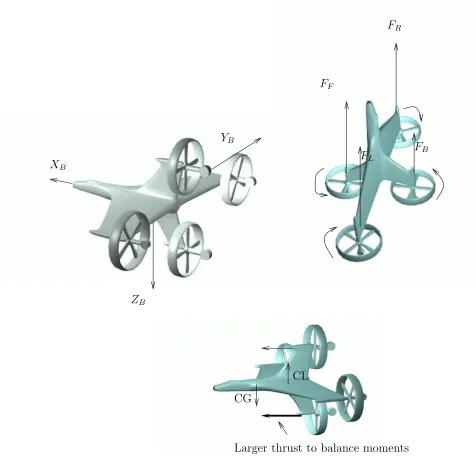
The four propeller “Aeroranger” is shown in Figure 2.4. The orientation of
FR
FF
ZB
YB
XB
CG
CL
Larger thrust to balance moments
FL
FB
Figure 2.4: The views of the “Aeroranger” show the body coordinate frame,
di-rection of rotation of the propellers, the definition of the applied forces due to the
ducted fan thrust, and a method used for stabilizing the aircraft in aerodynamic
Using Euler’s equation in body coordinates (assuming no products of inertia)
gives the rotational dynamics
Ix˙Ωx+ (Iz−Iy)ΩyΩz = MXb+MXa
IyΩy˙ + (Ix−Iz)ΩzΩx = MYb+MYa
IzΩz˙ + (Iy−Ix)ΩxΩy = MZb+MZa,
(2.79)
where Ix,Iy, and Iz are the principal moments of inertia, MXb, MYb, and MZb
are the body moments due to the differential thrust forces, MXa, MYa, and MZa
are the aerodynamic moments, and Ω1, Ω2, and Ω3 are the angular rates in body
coordinates given by
Ωx = φ˙−ψ˙sinθ
Ωy = θ˙cosφ+ ˙ψcosθsinφ
Ωz = ψ˙cosθcosφ−θ˙sinφ.
(2.80)
The body moments are
MXb = kw(FL+FR−FF −FB)
MYb = lF B(FF −FB)
MZb = lLR(FL−FR),
(2.81)
wherekw is the torque constant of the propeller, lF B is half the distance between the applied forceFF andFB, andlLR is half the distance between the applied force
FL andFR as seen in Figure 2.4.
Example 2.4. Near hover, the “Aeroranger” is differentially flat. Since the system is near hover, we will assume that the aerodynamic forces FXa, FYa, and FZa in
equation (2.78) are zero. Choose the outputs for the “Aeroranger” to be
z1 =x, z2 =y, z3 =z, z4=φ. (2.82)
Taking up to the fifth derivative of equation (2.82) and substituting equations
2.8. System Design and Differential Flatness 43 inputs, and their derivatives.
z1(1) = x˙ z1(2)=ζ1(cosθcosψ)
z2(1) = y˙ z2(2)=ζ1(cosθsinψ)
z3(1) = z˙ z3(2)=−ζ1sinθ−g
z4(1) = φ˙ z4(2) =f1(ψ, φ, θ,ψ,˙ θ,˙ φ, M˙ Xb, MYb, MZb)
z1(3) = f2(ζ1,ζ˙1, ψ, φ, θ,ψ,˙ θ,˙ φ˙)
z2(3) = f3(ζ1,ζ˙1, ψ, φ, θ,ψ,˙ θ,˙ φ˙)
z3(3) = f4(ζ1,ζ˙1, ψ, φ, θ,ψ,˙ θ,˙ φ˙)
z1(4) = f5(ζ1,ζ˙1,ζ¨1, ψ, φ, θ,ψ,˙ θ,˙ φ, M˙ Yb, MZb)
z2(4) = f6(ζ1,ζ˙1,ζ¨1, ψ, φ, θ,ψ,˙ θ,˙ φ, M˙ Yb, MZb)
z3(4) = f7(ζ1,ζ˙1,ζ¨1, ψ, φ, θ,ψ,˙ θ,˙ φ, M˙ Yb, MZb),
(2.83)
where
ζ1 =FL+FR+FF +FB (2.84)
is the combined force of the propellers along Xb as shown in Figure 2.4. In short,
(z1, . . . , z2(4), z2, . . . , z(4)2 , z3, . . . , z3(4), z4,z˙4,z¨4) = Ψ(ξ), (2.85)
where
ξ= (x, y, z, θ, φ, ψ,x,˙ y,˙ z,˙ θ,˙ φ,˙ ψ, M˙ Xb, MYb, MZb, ζ1,ζ˙1,ζ¨1).
The above relation is locally invertible, with the exception of a few points, since
det(∂Ψ
∂ξ) =
−ζ16cos 2θ−ζ16
2IxIyIz
in nonzero. The “Aeroranger” is differentially flat by Definition 2.3. For
ψ can be found from the following:
tanψ= z¨2 ¨
z1
. (2.86)
Second, θ can be found from the following:
tanθ= g−z¨3 ¨
z1cosψ+ ¨z2sinψ
. (2.87)
Using the information provided by two derivatives of equation (2.86), (2.87), the
flat output z4 and then substituting into equation (2.79), it is possible to recover
MXb,MYb, and,MZb. Using equation (2.84), ζ1 may be recovered from the
follow-ing:
ζ1 =m q
¨
z12+ ¨z22+ ( ¨z3−g)2. (2.88)
Finally, the applied forces may be recovered using equation (2.88) and equation
(2.81). As a result of using the two argument tangent function, we can avoid the
singularity at θ= π2.
Remark 2.3. It is not difficult to show that the “Aeroranger” is differentially flat, when the aerodynamic forces are not negligible. However, a closed form solution
may be elusive. We will assume that actuation for this system will not only be the
thrusts due to the propellers, but also four aerodynamic surfaces, one on each wing
of the “Aeroranger”. An additional assumption is needed, that the aerodynamic
surfaces only contribute to the aerodynamic moments and not the aerodynamic
forces. We choose the flat outputs the same as those in equation (2.82). We will
assume that the aerodynamic forces are a function of V,α,β. Moreover, we will assume that the aerodynamic moments are a function of V, α, β, and δi, where
δi i= 1, . . . ,4 is the deflection angle of theith surface.
First, we will solve forψ,θandζ1. Expressions forαandβ can be determined from
tanα= w
VTOL Hover actuation Flat near Flat in forward flight?
hover?
Ducted Fan Thrust vectored ducted fan Yes Yes, with no vectoring;
unknown otherwise
Two Ducted Fans Two ducted fans Yes Yes
“Aeroranger” Four propellers Yes Yes
“Aerojeep” Four ducted fans Unknown Unknown
Table 2.1: Summary of the flatness characteristics of several simple VTOL
con-figurations. Flat in forward flight implies that the mixing of hover actuation and
aerodynamic surfaces is possible.
Two Ducted Fans
Aeroranger Aerojeep
Ducted Fan with Thrust Vectoring
g
2.9. Parameterization of the Output 47
2.9
Parameterization of the Output
In the previous section, techniques were presented to reduce or eliminate the
dy-namic constraints by selecting a special set of variables (outputs) that could
com-pletely characterize the states and inputs of the system under consideration. In
this section, we will discuss how to select the outputs from a finite dimensional
space, in order that the problem under consideration can be efficiently solved.
There are many curves that can be used to approximate the outputs (Fourier
series, polynomials, rational segments, etc.). Aside from accurately representing a
basis of the solution of the trajectory generation problem under consideration with
a reasonable number of decision variables, the main requirements of the curve are
the ability to set a level of continuity Ck, without adding additional constraints. Local support is also a desirable property of the basis functions. Local support
means that the curves only influence a region of the curve local to the current
point of interest. Specifying the level of continuity is necessary, since the states
and inputs are a function of the outputs and their derivatives. Local support is favorable for numerically stable computer implementation. A high order single
polynomial would be necessary to satisfy complex constraints. Solving for the
coefficients of the polynomial would be an inefficient and ill-conditioned operation.
A solution that meets the main requirements is piecewise Bezier polynomials or
B-splines. An overview of B-splines, from which much of the following is derived,
can be found in Deboor [9].
An outputy(t) may be defined in terms an order kBezier curve by