
Copyright 2012 by Su Nam Kim and Timothy Baldwin
Extracting Keywords from Multi-party Live Chats
Su Nam Kim
School of Information Technology Monash University
Clayton, VIC, Australia
Timothy Baldwin
Dept. of Computing and Information Systems The University of Melbourne
VIC, Australia
Abstract
Live chats have become a popular form of communication, connecting people all over the globe. We believe that one of the simplest approaches for providing topic information to users joining a chat is keywords. In this paper, we present a method to automatically extract contextually relevant keywords for multi-party live chats. In our work, we identify keywords that are associated with specific dialogue acts as well as the occurrences of keywords across the entire conversation. In this way, we are able to identify distinguishing features of the chat based on structural information derived from live chats and predicted dialogue acts. In evaluation, we find that using structural infor-mation and predicted dialogue acts performs well, and that conventional methods do not work well over live chats.
1 Introduction
Keywords orkeyphrases1 are an effective way of
representing the core topic of a document, and can effectively summarize and/or help index documents. They are usually found in the form of either sim-plex nouns (e.g.library) or noun phrases (e.g.social issue). They have been studied in the past to pro-vide topic-related information for many applications such as text summarizers, search engines and index-ers. For example, Barzilay and Elhadad (1997) used keywords as semantic meta-information for summa-rizers. D ´Avanzo and Magnini (2005) used them to 1In this work, we use the term keywordsfor consistency, while noting that it can be used to refer to multiword terms.
organize documents for search engines. Dredze et al. (2008) used keywords as summaries of email in order to better manage and prioritize emails. Ham-mouda et al. (2005) used keywords extracted from multiple documents in order to discover the topics of documents for clustering. Gutwin et al. (1999) used automatically extracted keywords to refine the queries to improve precision of search in an online library browser.
There has been much research on automatic key-word extraction (Frank et al., 1999; Turney, 1999; Hulth, 2003, inter alia). The majority of work has been done over specific domains such as sci-entific articles and newspapers, including the re-cent SemEval-2010 shared task on keyword extrac-tion (Kim et al., 2010b). A small minority of re-searchers have used different sources of data such as email (Dredze et al., 2008) and HTML docu-ments (Mori et al., 2004), as outlined in Section 2. However, existing approaches tend not to work well when applied to different target sources, and are of-ten susceptible to domain-specific features of the tar-get documents (e.g. structure).
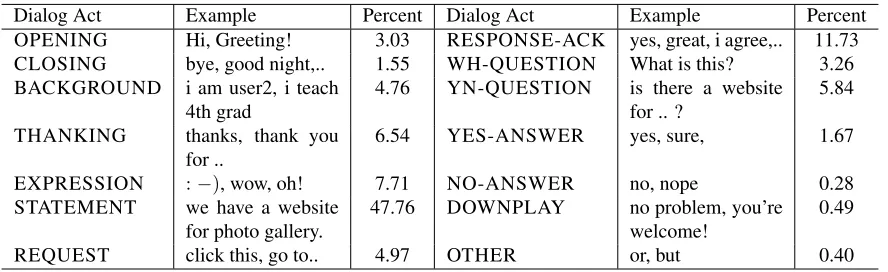
Dialog Act Example Percent Dialog Act Example Percent OPENING Hi, Greeting! 3.03 RESPONSE-ACK yes, great, i agree,.. 11.73 CLOSING bye, good night,.. 1.55 WH-QUESTION What is this? 3.26 BACKGROUND i am user2, i teach
4th grad 4.76 YN-QUESTION is there a websitefor .. ? 5.84 THANKING thanks, thank you
for .. 6.54 YES-ANSWER yes, sure, 1.67
EXPRESSION :−), wow, oh! 7.71 NO-ANSWER no, nope 0.28
STATEMENT we have a website
for photo gallery. 47.76 DOWNPLAY no problem, you’rewelcome! 0.49
REQUEST click this, go to.. 4.97 OTHER or, but 0.40
Table 1: Dialogue act tagset: definitions and examples
ods is to avoid manual annotation on dialogue acts, and thus we do not detail the effectiveness of ous methods nor evaluate our system against previ-ous methods.
We explored various features from recent work (Forsyth, 2007; Kim et al., 2010a) to automat-ically predict dialogue acts. Our features are based on high-frequency terms with respect to dialogue acts from Forsyth (2007), and contextual, structural, and dialogue act interaction from Kim et al. (2010a). Note that in Forsyth (2007), the author used the term
keyword. Keywords in Forsyth (2007) are defined as terms which are frequently associated with specific dialogue acts, and thus differ from our definition of keywords in this work. We thus refer to Forsyth’s “keywords” as high-frequency terms. Finally, we developed a linear-chain conditional random field-based dialogue act classification system using
Mallet (McCallum, 2002),4 based on Kim et al.
(2010a). We used 15 fold-cross validation (i.e. one dialogue for test and remainings for training), as our data contains 15 live chats.
After experimenting with various features, we found that contextual and high-frequency terms w.r.t. dialogue act features generally performed well, while structural and dialogue act interaction features did not achieve high accuracy, despite claims to the contrary in other studies. We hypothesise that since our data contains large numbers of users (unlike the two-party chat data of Ivanovic (2008), e.g.), the re-sulting entanglement of sub-threads confuses the di-alogue act tagger. To elaborate, stemming tended to reduce errors caused by ill-formed words (e.g.
4http://mallet.cs.umass.edu
noooooo as no). High-frequency terms also per-formed well since they are highly associated with specific dialogue acts (e.g.hi, hellofor OPENING,
ok, greatfor RESPONSE-ACK). However, it takes intensive manual intervention to extract such words associated with particular dialogue acts. Also,user information from structural features improves per-formance. We observed that user names mentioned in the dialogues resolve the entanglement to some degree, and thus perform well for dialogue act clas-sification (e.g. you’re right, USER25!!). The fea-tures used to automatically predict dialogue acts are listed below:
• Stemmed Bag-of-Words
• Highly frequent termsper dialogue act
• User/Participant information
To summarize, our best dialogue act classifier achieved an accuracy of 82.79%. We postulate that the lower accuracy compared to that reported in pre-vious work (e.g. Forsyth (2007; Kim et al. (2010a)) was mainly due to the different nature of the chats as well as the higher number of participants. How-ever, we found this was sufficient to semi-automate the annotation process.
5 Feature Engineering
beginning or end as well as specific parts of a doc-ument (e.g. Frank et al. (1999; Nguyen and Kan (2007)); and (3)keyphraseness, based on the obser-vation that keywords tend to share across documents with the same or similar topics.
For our system, we developed new features based on observation, and structural information. First, we observed that keywords occur across chats since the discussed topics change across time, unlike the globally-relevant keywords typically found in doc-uments such as scientific articles and news articles. Ideally, a topic shift detection method could iden-tify boundaries of topic change. However, automatic topic detection would introduce errors and manual topic detection would involve high cost and time. Thus, we leave this issue for our future work. Fi-nally, we decided to equally split each live chat into 10 smaller documents and to treat each as a single smaller document to compute IDF. To compensate for the erroneous topic boundaries due to the equal split, we used a variant of the sliding window ap-proach. That is, we also include the last 10% of dialogues from the previous split document, result-ing in each document partition containresult-ing approxi-mately 11% of the whole document.
Secondly, we found that some dialogue acts (e.g. STATEMENT, REQUEST) tend to contain most of the keywords. Also, utterances made by host users tend to have more keywords than those by non-host users. Based on these, we introduced two fea-tures: (1) TF of keywords in utterances tagged with selected dialogue acts; and (2) TF of keywords in ut-terances made by host users. Statistical analysis of these observations is provided in Section 6.
Thirdly, we used the distribution of candidate key-words over the 10 sub-documents. Ideally, when documents are well split by sub-topics, keywords would appear in only a few sub-documents and not the whole document.
We summarize our tested features below:
• Baseline Features fromKEA
F1: TF·IDFallIDF over all documents
F2: First Appearance F3: Keyphraseness
• Structural and Dialogue Features
F4: TF·IDFsplitIDF over 101 splits of the
doc-ument
F5: TF over utterances tagged with selected dialogue acts The association between keywords and utterances tagged with se-lected dialogue acts, in the form of raw, local proportion, and global proportion F6: TF over Host Utterances The
asso-ciation between keywords and utterances made by host users, in the form of raw, lo-cal proportion, and global proportion F7: TF over 10 Sub-documentsDistribution
of TF over each 10% of the original doc-ument, in the form of the raw count, lo-cal proportion, and global proportion. The distribution of TF is represented in 10 vec-tors, each representing 10% of the original document.
For features F5, F6 and F7, we tested three dif-ferent ways of calculating the feature values.Rawis the raw term count.Localis computed using the pro-portion of term counts in selected utterances against that in all utterances; the motivation behind this is that instead of using raw counts, we check if the term occurrence in selected utterances has an impact. Fi-nally,global proportionis computed using the term frequency in selected vs. all utterances, and is a com-bination of raw and local proportion values.
1. raw: TF in utterances tagged with selected dia-logue acts only (selU); cf. TF in all utterances is marked asallU.
2. local proportion: TF∈selU TF∈allU
3. global proportion: TF∈selU|selU| TF∈allU |allU|
6 Data
To evaluate our proposed keyword extraction method, we collected keywords from 15 live chat forums. To simplify the task, we only allowed the annotators to extract simplex nouns as keywords.5
One annotator manually extracted keywords, then
an-DA keyword DA keyword DA keyword
STATEMENT 1127 WH-QUESTION 62 THANKING 17
REQUEST 119 RESPONSE-ACK 37 OPENING 13
YN-QUESTION 99 BACKGROUND 31 CLOSING 1
Table 2: Distribution of keywords over dialogue acts
Top 5 Top 7 Top 10
Feature Pµ Rµ Fµ Pµ Rµ Fµ Pµ Rµ Fµ
Baseline Features using Original Documents (KEA)
F1 42.67 21.62 28.70 39.05 27.70 32.41 24.67 25.00 24.83 F1+F2 16.00 8.11 10.76 18.10 12.84 15.02 9.33 9.46 9.39 F1+F3 32.00 16.22 21.53 31.43 22.30 26.09 18.00 18.24 18.12 F1+F2+F3† 16.00 8.11 10.76 18.10 12.84 15.02 9.33 9.46 9.39 Baseline Features using Split Documents
F4 53.33 27.03 35.88 57.14 40.54 47.43 33.33 33.78 33.55 F4+F2 16.00 8.11 10.76 20.00 14.19 16.60 10.00 10.14 10.07 F4+F3 8.00 4.05 5.38 18.10 12.84 15.02 4.67 4.73 4.70 F4+F2+F3 16.00 8.11 10.76 20.00 14.19 16.60 10.00 10.14 10.07 Dialogue Features using Split Documents
F4+F5raw 48.00 24.32 32.28 54.29 38.51 45.06 30.00 30.41 30.20
F4+F5tf 1.33 0.68 0.90 3.81 2.70 3.16 2.00 2.03 2.01
F4+F5percent 1.33 0.68 0.90 3.81 2.70 3.16 2.00 2.03 2.01
F4+F6raw 49.33 25.00 33.18 54.29 38.51 45.06 30.00 30.41 30.20
F4+F6tf 5.33 2.70 3.58 7.62 5.41 6.33 4.00 4.05 4.02
F4+F6percent 5.33 2.70 3.58 7.62 5.41 6.33 4.00 4.05 4.02
F4+F7raw 48.00 24.32 32.28 55.24 39.19 45.85 29.33 29.73 29.53
F4+F7tf 12.00 6.08 8.07 10.48 7.43 8.70 6.00 6.08 6.04
F4+F7percent 12.00 6.08 8.07 11.43 8.11 9.49 6.00 6.08 6.04
Table 3: Effectiveness of keyword extraction overAll Utterances (allU)(the baseline [KEA] is marked with†, and its performance is in italics; the best performance is bold-faced).Original Documentsmeans IDF computed as is, while
Split Documentsmeans IDF calculated over 1
10 splits of the document.
(i.e. seen keyword heuristics), it did not work well since we have only 15 chats and many keywords oc-curred in most of the chats (whether as keywords or not).
Comparing all utterances vs. selected utterances, the performance was very similar. However, in some cases, using selected utterances performed better (e.g. with F4 +F6, 45.06% and 51.38% for allU
and selU, respectively). We estimate that since the discarded utterances are relatively short and often contain general terms, even if we include these ut-terances, the effect of these discarded utterances is insignificant. However, given the best performance over the two different utterance sets, we can argue
that using selected utterances achieves higher per-formance with much fewer candidates.
Among Top-5, 7, and 10, surprisingly, we found that the performance with the top-7 rated candidates consistently exceeded that with the top-10 rated can-didates. To analyze this, we checked Pµ, Rµ and
Fµ, and found that precision tends to drop as we add
more candidates.
Simi-Top 5 Top 7 Top 10
Feature Pµ Rµ Fµ Pµ Rµ Fµ Pµ Rµ Fµ
Baseline Features using Original Documents (KEA)
F1 41.33 20.95 27.81 40.95 29.05 33.99 24.67 25.00 24.83 F1+F2 18.67 9.46 12.56 23.81 16.89 19.76 12.00 12.16 12.08 F1+F3 32.00 16.22 21.53 31.43 22.30 26.09 17.33 17.57 17.45 F1+F2+F3† 18.67 9.46 12.56 23.81 16.89 19.76 12.00 12.16 12.08 Baseline Features using Split Documents
F4 53.33 27.03 35.88 58.10 41.22 48.23 33.33 33.78 33.55 F4+F2 20.00 10.14 13.46 24.76 17.57 20.55 12.67 12.84 12.75 F4+F3 5.33 2.70 3.58 16.19 11.49 13.44 5.33 5.41 5.37 F4+F2+F3 20.00 10.14 13.46 24.76 17.57 20.55 12.67 12.84 12.75 Dialogue Features using Split Documents
F4+F5raw 48.00 24.32 32.28 51.43 36.49 42.69 30.00 30.41 30.20
F4+F5tf 1.33 0.68 0.90 2.86 2.03 2.37 0.67 0.68 0.67
F4+F5percent 1.33 0.68 0.90 2.86 2.03 2.37 0.67 0.68 0.67
F4+F6raw 53.33 27.03 35.88 61.90 43.92 51.38 32.67 33.11 32.89
F4+F6tf 6.67 3.38 4.49 9.52 6.76 7.91 4.67 4.73 4.70
F4+F6percent 6.67 3.38 4.49 9.52 6.76 7.91 4.67 4.73 4.70
F4+F7raw 42.67 21.62 28.70 53.33 37.84 44.27 26.00 26.35 26.17
F4+F7tf 13.33 6.76 8.97 14.29 10.14 11.86 8.00 8.11 8.05
F4+F7percent 12.00 6.08 8.07 11.43 8.11 9.49 6.67 6.76 6.71
Table 4: Effectiveness of keyword extraction overSelected Utterances (selU)(the baseline [KEA] is marked with†, and its performance is in italics; the best performance is bold-faced). bold-faced). Original Documentsmeans IDF computed as is, whileSplit Documentsmeans IDF calculated over 1
10splits of the document.
larly, since keywords tend to appear in selected di-alogue acts, term frequency over the utterances la-beled with these dialogue acts only produced good results compared to term frequency over all utter-ances. Likewise, the distribution of keywords over the 10 sub-documents (F7) contributed to higher per-formance compared to the baseline system. Among the three different values we tested, we found that using raw counts performed the best. We speculate that due to the small size of the data, the normalised values did not work well.
8 Conclusion
In this paper, we proposed the task of automatic keyword extraction problem over multi-party live chats in order to provide in situ topic information. Based on our observations, we developed a system using structural information and automatically pdicted dialogue acts, and achieved preliminary re-sults applying an existing dialogue act classification
method to live chats. Unlike previous research (e.g. Forsyth (2007; Kim et al. (2010a)), features based on structure and interaction did not perform well since multi-party live chats impose problems due to the tangled and asynchronous nature of chats. Fi-nally, we showed that our method achieved higher performance thanKEA, which implies that conven-tional methods (KEAin this paper) do not work well over structured data like live chats and web forums.
keyphrase extraction. In Proceedings of 22nd In-ternational Conference on Computational Linguistics, pages 969–976, Manchester, UK.

![Table 4: Effectiveness of keyword extraction over Selected Utterances (selU) (the baseline [KEA] is marked with †,and its performance is in italics; the best performance is bold-faced)](https://thumb-us.123doks.com/thumbv2/123dok_us/1080793.1136140/8.612.105.508.70.376/effectiveness-keyword-extraction-selected-utterances-baseline-performance-performance.webp)
