CSEIT1833247 | Received : 10 March 2018 | Accepted : 21 March 2018 | March-April-2018 [ (3) 4 : 215-221 ]
International Journal of Scientific Research in Computer Science, Engineering and Information Technology © 2018 IJSRCSEIT | Volume 3 | Issue 4 | ISSN : 2456-3307
215
Challenges and Solutions of Mobile Cloud Computing
K MaheswarReddy1, B MasthanBaba2
1MCA Student, Department of MCA, Sree Vidyanikethan Institute of Management, Sri Venkateswara
University, Tirupati, AndhraPradesh, India
2Assistant Professor, Department of MCA, Sree Vidyanikethan Institute Of Management, Tirupati,
AndhraPradesh, India
ABSTRACT
Right now, portable application and computing is picking up a high force and assuming a huge part in improving the web figuring infrastructure. Also, the cell phones and their applications have high strategy in the administration at any point had, and grew quickly. Mobilecloud computing is relied upon to create fundamentally more imaginative with multi applications. Portable registering includes mobile correspondence, mobile equipment and portable programming, and as of now there are numerous mobile cloud applications, for example, web browsing, email get to, video playback, Cisco's web EX on the iPad, archive altering, picture altering, Google's Map, Gmail for iPhone, and so on. These applications are utilizing the product as an administration display. In this article, an instance of the craftsmanship portable cloud computing and its usage ways are displayed. A portion of the testing issues and additionally future research directions will likewise be talked about.
Keywords: Cloud Computing System, Mobile Cloud Computing, Security
I.
INTRODUCTION
Quick improvement of information technology (IT) industry throughout the previous quite a few years has presented us with numerous new terms. It began with the development of the main PC gadget and from that point forward, it has been upset commonly in different regions. In those beginning of computing, centralized server PC is required to lead the eventual fate of figuring, when immense scale machines and centralized server PCs were utilized to execute diverse errands and different applications. These days, we are doing likewise undertakings yet in an adaptable, considerably less expensive, and are in a convenient way, either by utilizing work station or cell phones to a few sorts of servers entwined to make an alleged Cloud Computing System (CCS). There are numerous methodologies and civil arguments about cloud computing. As it is currently
cloud computing resources are involving and uniting in another and the quick raising field of Mobile Cloud Computing (MCC). Notwithstanding support the request, mobile applications likewise require more resources to be prepared to improve the client encounter. The resources, for example, Google application Engine and Amazon EC2, are considered as an appropriate cloud stage in which MCC as new case for portable applications. In the content of MCC are isolated two methodologies, first is a basic approach and second is a cell phone approach. Straightforward approach suggests that the two information stockpiling and information preparing are actualized outside the cell phones. Then cloud resources are as of now used for handling and capacity reason. The advantage of this idea isn't obliged for MCC applications to certain sort of cell phones or working frameworks. Besides, there are no worries for the capacity limit and registering speed imperatives. In the meantime, cell phone approach suggests that the two information stockpiling and information preparing are performed through the cell phone. The fundamental reason is that every cell phone (advanced mobile phones, tablets, and so on.), right now are wiser and exceedingly proficient. The advantage of this approach is that it furnishes the client with a proprietorship to completely overhaul over store and keep up information on the client cell phone.
II.
TERMS FOR DEFINITION
Mobilecloud computing (MCC) by and large is the best in class portable scattered figuring which includes three segments: portable registering, cloud computing and remote systems. MCC expects to improve computational abilities of resource obliged cell phones towards rich and expanding client encounter. MCC prepares business and training areas the open doors for mobile system administrators and additionally cloud suppliers. All the more exhaustively, MCC can be characterized as a rich portable figuring innovation that impacts joined adaptable resources of various mists and systems
advances toward total asks , capacity, and portability to serve a large number of various cell phones anyplace, whenever over the extraordinary channel of Ethernet or Internet paying little mind to heterogeneous reasonable conditions and stages in light of the compensation as-you-utilize guideline may including buyer, venture, femtocells, trains coding , end-to-end security, home passages, and mobile broadband-empowered administrations. In this manner, MCC is characterized as a development of cloud computing with another impromptu framework which relies upon a cell phone.
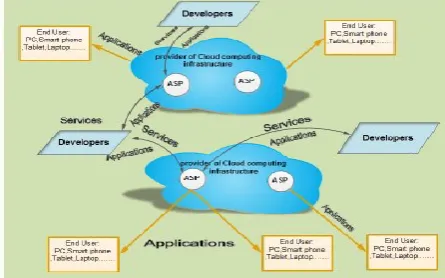
Figure 1. Mobile cloud computing components.
MCC comprises of a mind boggling system and
includes numerous connections between
infrastructure suppliers, Applications Services Providers (ASP), while end client and designers, are associated over the web.
III.
THE NEED FOR CLOUD COMPUTING
requirements, an answer is to instantiate altered administration programming close cloudlet. And afterward to utilize the administration over a remote system. Throughout the previous two decades, the quantity of portable clients in all areas has expanded colossally as are the every single advanced mobile phone. In the advanced period of inventive innovation, the greater part of cell phones is vastly improved whether in memory limit, speed of show, energy of battery or system availability for different highlights, which enable the client to adaptably get to by means of assorted applications and a considerable measure of administrations on the portable cloud. A. Stable Solutions for Mobile Cloud Computing There are numerous strategies help to prepare appropriate answers for portable cloud computing, and in this article, it will be arranged into two families: General reason MCC and application particular MCC. Every one of them has their focal points and weaknesses of not fundamentally unrelated.
IV.
GENERAL PURPOSE MOBILE CLOUD
COMPUTING (GPMCC)
In GPMCC, an open framework is fabricated which utilizes the cloud infrastructure to contribute in enhancing Mobile gadget execution proficiency. It is critical to acquire on the name is for a cell phone over web keeping in mind the end goal to utilize particular resource or extraordinary application is sought after with high way. A considerable measure of individual applications can play out these undertakings, however for what reason not utilizing these resources in a more broadly useful mode with the goal that the computational power constraint of cell phones is lightened incrementally to create mobile figuring. So some broad errands which are that nearby level figured on the numerous cell phones are outsourced to the cloud as they happen. By this way the PC resource of the numerous remote PCs is impacted and no compelling reason to create particular applications for that reason.
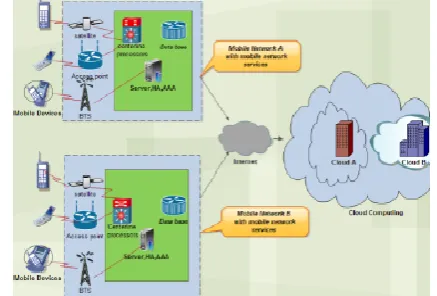
Utilizing Clone Clouds through Boost Performance for Smart Phones - Various analysts have presented the primary thought of enhancing and building up the execution of equipment confined advanced cells by utilizing their proposed clone cloud design to be utilized to help execution Fig. 2 clarifies a worldview for portable cloud computing. They have made virtual clones of the quantity of the advanced cell achievement condition in the cloud (PC, workstation or numerous servers) and exchange the expert undertakings to those virtual gadgets. So they led off load achievement from advanced mobile phone to a computational framework facilitating a billow of PDA clones. On the off chance that the advanced cell is lost or annihilate, the clone can be utilized as reinforcement. While another advantage is that equipment confinement of PDA is adapting – the errand is exchanged to viable and high calculation gadgets in the cloud. It additionally encourages and makes the designer's activity adaptable and simple as there are no or couple of corrections required for their applications.
Figure 2. Paradigm of mobile computing architecture.
V.
MOBILE CLOUD COMPUTING WITH
APPLICATION SPECIFIC (MCCAS)
assault. Portable registering administrations have disentangled all live in various segments particularly in training and business world. Joined to another gadget that incorporates a considerable measure of functionalities turned into consistently and depends on mobilecomputing, as cases, BlackBerry from RIM iPhone from Apple, Net-Book, and so forth]. Applications comprise of programming that keeps running on a cell phone and plays out specific assignments for the client of the cell phone like email or visiting needs ,MCCAS required on the grounds that the web is utilized to join as the correspondence resource and not just for capacity or different administrations that computational power for example announced by World Mobile Applications Market, around 7 billion (free and paid) application downloads were made all inclusive in 2009 for instance and expanding in one year from now's distant from everyone else from both local and outsider application stores, creating incomes of $3.9 billion around the same time. What's more, MCCAS has the most elevated capacity to make present day cell phones all the more intense registering gadgets and furnished with numerous applications. Here are a portion of the strategies for particular applications in mobilecloud computing.
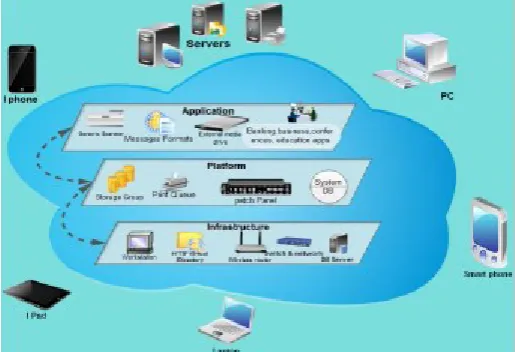
A. Administration of Mobile Clouds Various specialists have presented benefit mists for portable cloud computing and named Mobile administration mists. A great deal of their model empowers dynamic encapsulation, establishment, and course of action and adjustment of administrations to be utilized by the portable clients. Fig. 3 clarifies numerous gadgets that can be appended to cloud computing.
Figure 3. Devices with cloud computing.
B. Flexible Application Weblets
Quantities of scientists made adaptable applications that expansion and improve effective advanced mobile phones, using adaptable figuring resources from the cloud. An adaptable application can have at least one weblets in it, while wallets have the most critical element of versatility. Any given wallet can contribute in exchanged between both portable and stationary gadgets. One noteworthy trouble with this sort of use is the necessity of security for these application weblets. The weblets of single application as a rule can impart freely or with different applets. Wallets can be exchanged between cell phones and mists. The specialists have likewise proposed a decent answer for validation; secure session organization, secure decampment between weblets usage cell phones and those on the mists.
VI.
CHALLENGES AND ISSUES
From the above clarification, obviously portable cloud computing is an extended branch of cloud computing. Nonetheless, there are a few difficulties and issues that have all the earmarks of being boundaries to this dynamic change (from cloud computing to mobilecloud computing). Portable Computation Offloading, Seamless Connectivity, Long WAN Latency, Mobility Administration, Context-Computing, Constraint of Energy, Vendor/information Lock-in, Security, and Elasticity are a portion of the difficulties and issues that ruin MCC achievement and selection. The cloud is computationally capable while the cell phones have limited computational resources; hence, there is a need an adjust of the two segments. Here are the hindrances and possible issues:
A. Barriers of Services - There are three kinds of administration models upheld in cloud computing as an administration, including programming, stage and data. In any case, in current mobilecloud computing, just a single programming as an administration is actualized on the grounds that greater part of cell phones has deficient capacity limit, energy of the battery, poor show and computing power. Nonattendance of standards intense deficiency or absence of open standards is an another boundary for portable cloud computing that may prompt issues, for example, limited versatility, untrustworthy accessibility of administration and administration provider secure.
B. Possible Issues
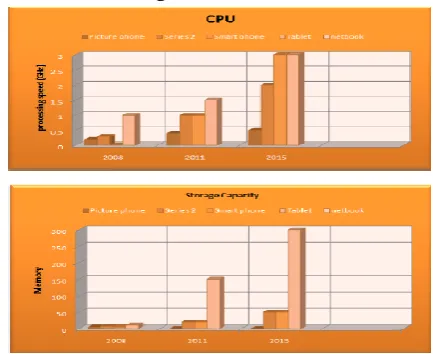
1) Mobile devices of resource poverty - One of the principle and vital issues in mobilecloud computing is confined resources in cell phones. For the most part, the cell phones have less computational power, stockpiling limit, poor show and power battery restriction when contrasted with the PCs. Fig. 4 shows the execution correlation of mobile and non-convenient gadgets with reckonings. A reasonable
answer for this issue is exhibited in numerous examinations. By introducing offloading calculation. Also, protection, security, dependability and taking care of issues ought to be considered into the high cost of vitality. In this manner more vitality is squandered in taking care of these issues.
Figure 4. Performance comparison of mobile and non portable devices.
2) Hiding and network bandwidth - There are numerous different issues related in portable cloud computing including limited transfer speed and high stowing away of the system. For example, the data transmission for 4G cell frameworks might be confined by cell tower transfer speed in another territory with less power flag gathering prompts bring down transmission capacity and higher covering up. Wi-Fi is an appropriate answer for enhance arrange stowing away however in the event that the quantity of portable clients is more than the transmission capacity is diminished. Moving up to 5G remote system or more can be a decent answer for the data transmission and concealing restrictions. Another helpful arrangement is the utilization of Cloudlets
3)Fragmentation and network availability
requirements. HTML5 as a present innovation accompanies an convenient arrangement by empowering information reserving over a cell phone and this make it feasible for a cloud application viably to continuous working if there should be an occurrence of interfered with network.
4) Security and concerns
The improvement in innovation has likewise brought numerous new security risks inside it. Each client needs the high security of his/her information and is interested about it. In this regard, there are two primary security issues with respect to the mobilecloud computing. To start with is cell phone security and the second is cloud security. Despite cell phones utilizing the mists for figuring resources and applications. The these days lion's share of PDA gadgets has worked in extraordinary security highlights and high calibre to ensure the gadgets of any manhandle. In the interim, Google Device Application private strategy expresses the office and adaptability for the clients to remotely bolt or clear the data and secure them with a stolen on the off chance that they lost their cell phones. Likewise, some counter measures cloud get to assurance and built up gadget character with high insurance to be received for better security of various PDAs and the mists.
VII.
CONCLUSION
This article has featured an extensive review of mobilecloud computing. The appropriate answers for mobilecloud computing have likewise been examined so the perusers can have a superior comprehension of the portable cloud computing and its applications. Some basic and difficulties issues and additionally issues that exist in portable cloud computing and the answers for those issues by a few specialists have likewise been introduced.
VIII.
REFERENCES
[1]. Z. Sanaei, S. Abolfazli, A. Gani, and R. Buyya, "Heterogeneity in mobile cloud computing:
Taxonomy and open challenges," IEEE Communications Surveys & Tutorials, issue 99, pp. 1-24, May, 2013.
[2]. K. Kim, S. Kang, and K. Lee, "GEO-based image computing on mobile cloud computing environment," Remote Sensing Letters, vol. 4, issue 11, pp. 1117-1126, 2013.
[3]. S. Abolfazli, Z. Sanaei, E. Ahmed, A. Gani, and R. Buyya, "Cloud-Based augmentation for mobile devices: Motivation, taxonomies, and open challenges," arXiv preprint arXiv:1306.4956, 2013.
[4]. B. Prajapat and M. Shrivastava, "Mobile cloud computing through J2ME application: Cloud enabled web services," International Journal of Advanced Computer Research, vol. 2, no. 4, issue 6, December, 2012.
[5]. P. Gupta and S. Gupta, "Mobile cloud computing: The future of cloud," International Journal of Advanced Research in Electrical, Electronics and Instrumentation Engineering, vol. 1, issue 3, September, 2012.
[6]. P. Yu, X. Ma, J. Cao, and J. Lu, "Application mobility in pervasive computing: A survey," Pervasive and Mobile Computing, vol. 9, issue 1, pp. 2-17, February, 2013.
[7]. C. Oriaku, N. Alwan, and I. A. Lami, "The readiness of mobile operating systems for cloud computing services," in Proc. 2012 4th International Congress on Ultra Modern Telecommunications and Control Systems and Workshops(ICUMT), 2012, pp. 49-55.
[8]. R. Bhadauria and S. Sanyal, "Survey on security issues in cloud computing and associated mitigation techniques," arXiv preprint arXiv:1204.0764, 2012.
[9]. S. Xinogalos, K. E. Psannis, and A. Sifaleras, "Recent advances delivered by HTML 5 in mobile cloud computing applications: a survey," in Proc. the Fifth Balkan Conference in Informatics, 2012, pp. 199-204.
resource-intensive tasks to hybrid clouds," International Journal of Pervasive Computing and Communications, vol. 8, pp. 344-367, 2012. [11]. M. Shiraz, A. Gani, R. Khokhar, and R. Buyya,
"A review on cloud application computing frameworks in smart mobile devices for mobile cloud computing," IEEE Communications Surveys & Tutorials, vol. 15, issue 3, pp. 1294-1313, 2013.
[12]. M. Nazir, "Cloud computing: Overview & current research challenges," IOSR Journal of Computer Engineering (IOSR-JCE), vol. 8, issue 1, pp. 14-22, Nov.-Dec. 2012.
[13]. S. Kitanov and D. Davcev, "Mobile cloud computing environment as a support for mobile learning," in Proc. The Third International Conference on Cloud Computing, GRIDs, and Virtualization, 2012, pp. 99-105. [14]. N. Fernando, S. W. Loke, and W. Rahayu,
"Mobile cloud computing: A survey," Future Generation Computer Systems, vol. 29, pp. 84-106, 2013
[15]. Y. Ge, Y. Zhang, Q. Qiu, and Y.-H. Lu, "A game theoretic resource allocation for overall energy minimization in mobile cloud computing system," in Proc. the 2012 ACM/IEEE International Symposium on Low Power Electronics and Design, 2012, pp. 279-284.
[16]. Z. Sanaei, S. Abolfazli, A. Gani, and R. Buyya, "Heterogeneity in mobile cloud computing: Taxonomy and open challenges," IEEE Communications Surveys & Tutorials, issue 99, pp. 1-24, May, 2013.
About Authors:
Mr. K MaheswarReddy is
currently pursuing his Master Of Computer Application, Sree Vidyanikethan Institute of Management, Tirupati, A.P.
Mr. B MasthanBaba is currently working as an Assistant Professor,
Department of MCA, Sree
Vidyanikethan Institute