DOI : https://doi.org/10.32628/CSEIT1952331
Data Mining Techniques to Predict Chronic Kidney Disease
Golam Murshid
*, Thakor Parvez, Nagani Fezal, Lakhani Azaz, Mohammad Asif
B.E. Computer Jamia Institute of Engineering and Management Studies, Akkalkuwa, Maharashtra India
ABSTRACT
Chronic Kidney Disease incorporates the state where the kidneys fail to function and reduce the potential to keep a person suffering from the disease healthy. When the condition of the kidneys gets worse, the wastes in the blood are formed in high level. Data mining has been a present pattern for accomplishing analytic outcomes. Colossal measure of un-mined data is gathered by the human services industry so as to find concealed data for powerful analysis and basic leadership. Data mining is the way towards extricating concealed data from gigantic datasets. The goal of our paper is to anticipate CKD utilizing the classification strategy Naïve Bayes. The phases of CKD are anticipated in the light of Glomerular Filtration Rate (GFR).
Chronic Kidney Disease (CKD) is one of the most widespread illnesses in the United States. Recent statistics show that twenty-six million adults in the United States have CKD and million others are at increased risk. Clinical diagnosis of CKD is based on blood and urine tests as well as removing a sample of kidney tissue for testing. Early diagnosis and detection of kidney disease is important to help stop the progression to kidney failure. Data mining and analytics techniques can be used for predicting CKD by utilizing historical patient’s
data and diagnosis records. In this research, predictive analytics techniques such as Decision Trees, Logistic Regression, Naive Bayes, and Artificial Neural Networks are used for predicting CKD. Pre-processing of the data is performed to impute any missing data and identify the variables that should be considered in the prediction models. The different predictive analytics models are assessed and compared based on accuracy of prediction. The study provides a decision support tool that can help in the diagnosis of CKD.
Keywords : Glomerular Filtration Rate, Chronic Kidney Disease, KNN, SVM, ESRD, USRDS
I. INTRODUCTION
The kidneys' functions are to filter the blood. All the blood in our bodies passes through the kidneys several times a day. The kidneys remove wastes, control the body's fluid balance, and regulate the balance of electrolytes. As the kidneys filter blood, they create urine, which collects in the kidneys' pelvis - funnel-shaped structures that drain down
there are twenty-six million adults in the United States who have CKD and million others are at increased risk. Kidneys filter the excess fluids and wastes from the blood and as CKD progresses, these wastes and fluids can build in the body and can cause heart and blood vessel disease. Patients who have CKD suffer from symptoms such as lack of energy, fatigue, drowsiness, pain, and purities [1]. The factors that increase the risk of Kidney disease include Diabetes, Hypertension, Smoking, Obesity, Heart Disease, Family History of Kidney Disease, Alcohol Intake, Drug Abuse/Drug Overdose, Age, Race/Ethnicity, and Male Sex [2]. CKD has five different stages of development. Each stage increases in severity as one progress from Stage 1 to Stage 5. In Stage 1, a person can develop below normal kidney functions and even experience a slight loss in kidney function. During Stage 2, a person can experience slight to moderate loss in kidney function. Stage 3 further intensifies, with a person experiencing moderate to severe loss in kidney function. In Stage 4, a person will experience a severe loss in kidney function. In Stage 5, a person will experience complete kidney failure. According to [3], there are no predictive instruments that are commonly accepted for CKD. This lack of a common predictive instrument is becoming a bigger issue as the amount of CKD patients continues to grow. It is also stated that the health burden due to CKD is likely to continue to rise with the aging population and world-wide increase in Type 2 Diabetes [4]. CKD is a disease that affects everyone differently and is progressive in some, but not all patients [5]. Even though different approaches for preventing, reducing, halting, and reversing CKD have been described in the medical writings, all related factors have not been identified comprehensively [6]. Data mining techniques are used to investigate renal disease and to analyse the differences among various administrative areas. Data mining methods used in the literature include Adaptive Neuro-Fuzzy Inference, Support Vector Machines, Artificial Neural Networks, etc. In this
study, we will develop predictive analytics models to study and analyse chronic kidney disease. The data set we use has some missing data and we will adopt methods to impute the missing data.
Data mining may have many approaches such as Naive Bayes, J48 , KNN , SVM , Supervised or Unsupervised learning and many more approaches. Data mining here, comes up with a number of techniques that gives knowledge to the healthcare industry which when applied to the processed data.
PROBLEM DEFINITION
The scope of this problem is to classify our dataset using different machine-learning algorithm, which includes training and testing the model. We will try to explore the correlation between the dataset attributes to find out there dependency on each other in the development of chronic kidney disease.
In India an automated diagnosis system would reduce the lengthy process in health care. With an improved symptom analyzing algorithm, the system can suggest diagnostic test to the users hence reducing time and cost in big hospitals.
II. LITERATURE SURVEY
McClellan WM. has proposed Epidemiology and risk
information about the occurrence and outcomes of care on all incident patients receiving treatment for ESRD in the United States. Chronic kidney disease (CKD) is defined by the presence of sustained abnormalities of renal function and results from different causes of renal injury. CKD can lead to progressive loss of renal function and may terminate in ESRD after a variable period of time following the initiating injury [1].
Cristóbal Romero Sebastia´n Ventura, Enrique
Garcı´a proposed on “Data mining in course management systems: Moodle case study and tutorial”
Educational data mining is an emerging discipline, concerned with developing methods for exploring the unique types of data that come from the interested in this new research area, and in particular to online instructors and e-learning administrators. We describe the full process for mining e-learning data step by step as well as how to apply the main data mining techniques used, such as statistics, visualization, classification, clustering and association rule mining of Moodle data. We have used free data mining tools so that any user can immediately begin to apply data mining without having to purchase a commercial tool or program a specific personalized tool [2]. risk of moderate-severe CKD and (b) the individual 5 year risk of developing End Stage Kidney Failure in a primary care population. Our final model for
moderate-severe CKD included: age, ethnicity, deprivation, smoking, BMI, systolic blood pressure, diabetes, rheumatoid arthritis, cardiovascular disease, treated hypertension, congestive cardiac failure; peripheral vascular disease, NSAID use and family history of kidney disease. In addition, it included SLE and kidney stones in women. The final model for End Stage Kidney Failure was similar except it did not include NSAID use [3].
Navdeep Tangri, Lesley A. Stevens, , John Griffith, PhD, Hocine Tighiouart, MS Ognjenka Djurdjev, David Naimark, Adeera Levin, Andrew S. Levey,
have developed a system to “A Predictive Model for Progression of Chronic Kidney Disease to Kidney
Failure”have developed a system to An Estimated 23
Million people in the United States (11.5% of the adult population) have chronic kidney disease (CKD) and are at increased risk for cardiovascular events and progression to kidney failure. Similar estimates of burden of disease have been reported around the world.6 Although there are proven therapies to improve outcomes in patients with progressive kidney disease, these therapies may also cause harm and add cost. Clinical decision making for CKD is challenging due to the heterogeneity of kidney diseases, variability in rates of disease progression, and the competing risk of cardiovascular mortality. Accurate prediction of risk could facilitate individualized decision making, enabling early and appropriate patient care [4].
S. H. Liao, P. H. Chu, and P. Y. Hsiao, have analyzed
“Data mining techniques and applications - A decade
classifies DMT, with respect to the following three areas: knowledge types, analysis types, and architecture types, together with their applications in different research and practical domains. A discussion deals with the direction of any future developments in DMT methodologies and applications: DMT is finding increasing applications in expertise orientation and the development of applications for DMT is a problem-oriented domain. It is suggested that different social science methodologies, such as psychology, cognitive science and human behavior might implement DMT, as an alternative to the methodologies already on offer. The ability to continually change and acquire new understanding is a driving force for the application of DMT and this will allow many new future applications [5].
III. IMPLEMENTATION
Classification – it maps data into predefined groups or classes. In classification the classes are indomitable before examining the data thus it is often mentioned as supervised learning . Classification is the process which classifies the collection of objects, data or ideas into groups, the members of which have one or more characteristic in common. In this research work Naïve Bayes, SVM, ANN and proposed algorithm namely ANFIS are used to classify different stages of Chronic Kidney Failure disease from the dataset [23].
Figure 3.1: Disease Detection
System Architecture
Figure.3.2 : Architecture Diagram of System
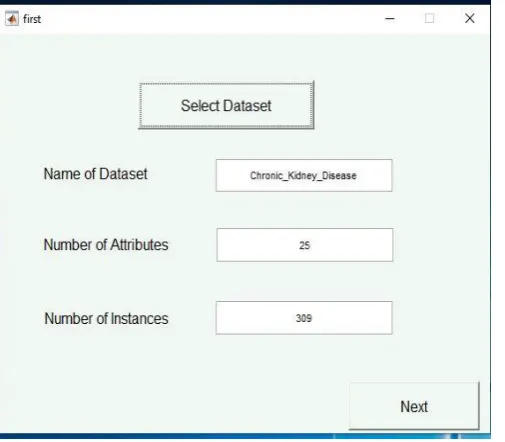
Figure 3.3 : First page after run
Figure 3.11 : Before selecting the dataset
Figure 3.13 : After selecting the dataset
Figure 3.14 : Build classifier & train the classifier output
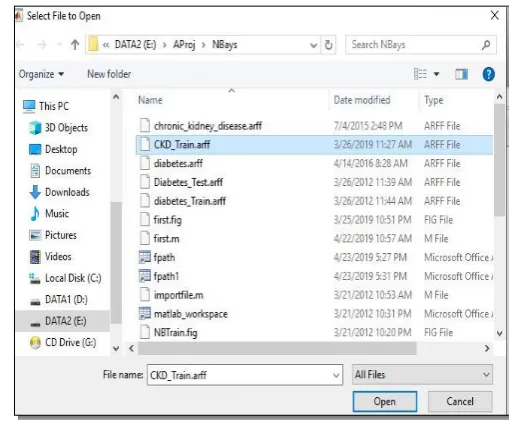
Figure 3.15 : Select Dataset for testing
Figure 3.16 : Selecting the Test Dataset
Figure 3.17 : Final output with best efficiency
Confusion Matrix
A confusion matrix is a technique for summarizing the performance of a classification algorithm.
A confusion matrix is a table that is often used to describe the performance of a classification model (or "classifier") on a set of test data for which the true values are known. The confusion matrix itself is relatively simple to understand, but the related terminology can be confusing.
There are two possible predicted classes: "yes" and "no". If we were predicting the presence of a disease, for example, "yes" would mean they have the disease, and "no" would mean they don't have the disease. the most basic terms, which are
True Negatives (TN): We predicted no, and they do techniques will be implemented in future[1].
The chronic kidney disease can be very well predicted using many classifiers in Data Mining. One can also predict the level of chronic kidney disease using classifiers. As per the observation of different experiments there are some classifiers which gave highest accuracy are Naïve Bayes and KNN[7].
V. REFERENCES
[1]. William M. McClellan WM. Epidemiology and risk factors for chronic kidney disease. The
“Predicting the Risk of Chronic Kidney Disease
in Men and Women in England and Wales: Prospective Derivation and External Validation
of the QKidney® Scores,” Hippisley-Cox and Coupland BMC Family Practice, 11 -49.
[4]. Navdeep Tangri, Lesley A. Stevens, John Griffith, PhD, Hocine Tighiouart, MS Ognjenka Djurdjev, David Naimark, Adeera Levin, Andrew S. Levey, “A Predictive Model for
Progression of Chronic Kidney Disease to
Kidney Failure” JAMA The Journal of the
American Medical Association · April 2011.
[5]. S. H. Liao, P. H. Chu, and P. Y. Hsiao, “Data
mining techniques and applications - A decade review from 2000 to 2011,”
[6]. Koushal Kumar, K., and Abhishek, 2012,
“Artificial Neural Networks for Diagnosis of Kidney Stones Disease”, International Journal
of Information Technology and Computer Science, 7, 20-25.
[7]. GeorgeDimitoglou, JamesA. Adams, andCarol M. Jim, Comparison of the C4.5 and a Naive Bayes Classifier for the Prediction of Lung Cancer Survivability.
[8]. Giovanni Caocci, Roberto Baccoli, Roberto Littera, Sandro Orrù, Carlo Carcassi and Giorgio La Nasa, Comparison Between an Artificial Neural Network and Logistic Regression in Predicting Long Term Kidney Transplantation Outcome, Chapter 5, an open access article distributed under the terms of the Creative Commons Attribution License.
[9]. Ziyad, A., 2013, “Prediction of Renal End Points in Chronic Kidney Disease,” Kidney International, 83(2), 189-191.
[10]. Kobayashi, T., Yoshida, T. 2014, “A
Metabolomics-Based Approach for Predicting
Stages of Chronic Kidney Disease,” Biochemical
and Biophysical Research Communications, 445, 412–416.
[11]. Lakshmi, K.R., Nagesh, Y., and VeeraKrishna,
M., 2014, “Performance Comparison of Three
Data Mining Techniques for Predicting Kidney
Dialysis Survivability,” International Journal of
Advances in Engineering and Technology, 7(1), 242-254.
[12]. Bala, S., and Kumar, K., 2014, “A Literature
Review on Kidney Disease Prediction Using
Data Mining Classification Technique,”
International Journal of Computer Science & Mobile Computing, 3(7), 960-967.
[13]. Vijayarani, S., and Dhayanand, S., 2015, “Data
Disease Prediction,” International Journal on
Cybernetics and Information, 4(4), 13-25. [14]. Ronald N. Kostoff, Uptal Patel., 2015,
“Literature-Related Discovery and Innovation:
Chronic Kidney Disease,” Technological
Forecasting and Social Change, 91, 341-351. [15]. Ravleen Singh Dr. Tariq Hussain Sheikh, “An
Overview of Data Mining Applications in
Healthcare” International Journal of Advance
Research in Computer Science and Management Studies ISSN: 2321-7782.
[16]. Pushpa M. Patil “Review On Prediction Of Chronic Kidney Disease Using Data Mining
Techniques” International Journal Of Computer
Science And Mobile Computing IJCSMC, Vol. 5, Issue. 5, May 2016, pg.135 – 141.
[17]. S.Dilli Arasu, Dr. R.Thirumalaiselvi “ Review of
Chronic Kidney Disease based on Data Mining
Techniques” International Journal of Applied
Engineering Research ISSN 0973-4562 Volume 12, Number 23 (2017) pp. 13498-13505.
[18]. Shahram Tahmasebian1, Marjan Ghazisaeedi1*, Mostafa Langarizadeh2, Mehrshad Mokhtaran1, Mitra Mahdavi-Mazdeh3, Parisa Javadian4 Applying data mining techniques to determine important parameters in chronic kidney disease and the relations of these parameters to each other J Renal Inj Prev. 2017; 6(2): 83-87.
[19]. Sahana B J, Dr Minavathi “Kidney Disease
Prediction Using Data Mining Classification
Techniquesand ANN” International Journal of
Innovative Research in Computer and Communication Engineering ISSN(Online): 2320-9801 Vol. 5, Issue 4, April 2017.
[20]. M. Mayilvaganan, S. Malathi & R. Deepa Data Mining Techniques For The Analysis Of Kidney Disease-A Survey International Journal Of Engineering Sciences & Research Technology-DOI: 10.5281/zenodo.829799. [21]. Tabassum S, Mamatha Bai B G, Jharna
Majumdar, “Analysis and Prediction of Chronic
Kidney Disease using Data Mining Techniques”
International Journal of Engineering Research in Computer Science and Engineering ISSN (Online) 2394-2320.
[22]. https://www.worldkidneyday.org/faqs/chronic-kidney-disease/ 04/11/2018.
[23]. R. Agrawal and G. Psaila, “Active data mining,”
Current, pp. 3–8, 1995. Bayesian Networks and Influence Diagrams, 10 May.
[27]. International comaparisons of ESRD. http://www.usrds.org/2008/pdf/V2_12_2008.pd f
[28]. Sunita B. Aher1 and Lobo L.M.R.J.2
“Comparative Study Of Classification
Algorithms ” International Journal of