The Greedy Algorithm
and its Application to the Construction of a Continuous Speech Database
H´el`ene Franc¸ois, Olivier Bo¨effard
IRISA - Institut de Recherche en Informatique et Syst`emes Al´eatoires Universit´e de Rennes 1, Enssat, Lannion, France
francois, boeffard @enssat.fr
Abstract
Databases containing varied linguistic features can be build by condensing large corpora; in this work we need to cover a set of phonetic units with a minimal set of natural phonetic sentences. With this aim in view we compare three set covering methods: the greedy method, its inverse which we call the spitting method, and the pair exchange method. Each method is defined with several criteria guiding the selection of sentences; they relate to the number of units of the sentences, to their length, and to the rareness of their units. A first experiment shows that pair exchange method doesn’t guarantee a total covering. Greedy and spitting methods performances are comparable; nevertheless greedy is a bit better and above all less time-consuming. Applying spitting method to a greedy cover increases performance by removing about 10% redundancy. So does pair exchange method, but it is more time-consuming. Most of the criteria guiding selections are sensitive to the sentences length. Criteria performances obtained for a total covering are not necessarily transposable to a partial covering.
1.
Introduction
This work1deals with the general framework of the con-struction of databases presenting varied linguistic features. We need a continuous speech database made of a maxi-mum of phonetic units, but remaining small at the same time. After its recording, this set of sentences will con-stitute the source from which the syntheziser of our text-to-speech synthesis system will draw the acoustic units it needs. The problem is to find, among the sentences of a large database, a subset of sentences which covers all the units we need, this subset being as small as possible. Solu-tions to this problem can be applied in other fields of Lan-guage Ressources, for example to build evaluation databas-es for speech recognition or dialogue, where sentencdatabas-es - or paragraphs, or dialogue transcriptions - are searched in a large base to cover some characteristics to ensure diversity in the evaluation corpus.
We tackle this question as a set covering problem (SCP) (Franc¸ois and Bo¨effard, 2001). Since it is NP-hard, we must resort to heuristics to solve it on large databases. Here we study greedy methods. They consist in building the cov-er ”step by step”. A first sentence is selected according to a criterion; for example, the number of units to cover that it contains. The sentence is added to the cover, and the covered units are removed from the set of units to cover. The process starts again; the second sentence, in this ex-ample, contains a maximum of non-already-covered units. The process stops when all the units are covered. Perfor-mance of this method depends on the way sentences are chosen therefore on the criterion which guided their selec-tion; several choices are conceivable.
Gauvain et al. (1990), who used the greedy method to build an evaluation base for speech recognition, organized criteria hierarchically. Sentences were first classified in ac-cordance with their length in words, which were short or long. Then they had to contain a minimum number of new
1
This work is financed by France Telecom R&D within con-tract with DIH/IPS/VMI laboratory.
units, and short sentences had to have a maximum number of 5 punctuation marks. 11 000 sentences on 170 000 were selected that way, with the aim of maximizing the num-ber of units types (triphones). This base was also used for speech synthesis (Prudon and d’Alessandro, 2001).
Black and Lenzo (2001) adapted the greedy algorith-m to the future database organization, that is to decision trees which are searched through to find units to synthesize speech. The cover related to the tree nodes.
Kawai et al. (2000) resorted to a pair exchange method. At initial state, the cover contains a given number of sen-tences chosen arbitrarily. An out-of-cover sentence and an in-cover sentence are chosen. The two sentences are ex-changed temporarily; if the covering is better, that is more units are covered and the cover is smaller, the change is kept, otherwise it is rejected. This process is repeated as many times as needed.
Rojc and Kaˇciˇc (2000) combined a ”reduction” ap-proach with a pair exchange method to build a 1200 sen-tences triphones-rich database, with at least 10 representa-tives per triphone type. They defined 4 corpora of 5 000 sentences. At first each corpus was relieved of its useless sentences, which removal did not damage the covering; this process stopped either when 1200 sentences remained or when removal was not possible anymore. This first phase is a kind of “inverse greedy” which spits useless sentences instead of eating useful sentences. Subsequently the poor-est sentences of the richpoor-est corpus - called the target corpus - were pair exchanged with the richest sentences of the 3 other corpora if it improved the covering, so that to enrich the target corpus.
G and H give the scores of the pair exchange method ap-plied to varied cases.
Applying the spitting algorithm to the covers obtained with the greedy algorithm (frame E) brings about an im-provement of (-18.6% sentences, -10.8% instances) in case “2g,2s”, (-15.3% sent., -7.0% inst.) in case “3g,2s”, and (-5.8% sent., -4.0% inst.) in case “4g,2s”, which is of in-terest. Besides general behaviours remain: the three best scores in instances are still the improved cases “2g,*s”, “3g,*s” and “4g,*s” for the greedy algorithm, and the cases “*g,2s” for the spitting algorithm.The spitting algorithm re-ject sentences which became useless after their selection by the greedy algorithm.
The pair exchange algorithm (frames F, G, H) pro-vides an improvement in case “3g,1e” (-5.9% instances) and in case “2g,2s,1e” (-2.4% instances), but not in case “2s,1e”. Improvements of case “3g” produced by spitting (case “3g,2s”) or pair exchange (case “3g,1e”) are compa-rable, nevertheless spitting is less time-comsuming, it only removes 33 sentences while pair exchange tests every of the 216 sentences several times.
The lowest of the lowest scores in instances goes to the case “2g,2s,1e” which cumulates the 3 methods; improve-ments are of 7.0% in instances with the spitting algorithm and of 2.4% with the pair exchange method, that is a total improvement of almost 10% in instances. These results are discussed in section 6.
5.3. Dynamic study of the greedy algorithm
The analysis of the cover cost progress according to the number of covered units gives the results we would have for a partial covering (fig. 3). For example, if we consider a greedy covering stopped at 2 000 instances, the number of covered units varies from 50 to 70% according to the crite-rion used. Methods having similar scores for total covering (“2g”, “3g”, “4g”) have not necessarily the same score for a partial covering: “4g” covers 62% of the units while “2g” and “3g” cover 70% of them.
0 1000 2000 3000 4000 5000 6000 7000
0 50 100 150 200 250 300 350 400 450 500
Cover cost in instances
Number of covered units
+ + + +
50% |
56%
| 62%
70% 1g 2g 3g 4g 5g
Figure 3: Cover cost vs. number of covered units. There are 493 units.
Figure 4 shows the value of the “3g” criterion along se-lections, that is to say the number of useful instances of the selected sentence weighted by its cost, which is its length in instances. We see that after the 73th sentence, sentences
bring more useless units than useful units, thus they con-tribute rather to the cost increase than to the covering in-crease.
0 0.1 0.2 0.3 0.4 0.5 0.6 0.7 0.8 0.9 1
0 50 100 150 200 250
Criterion h-uis-on-sc value
Sentences in greedy order (73,0.5)
3g
Figure 4: Number of useful instances in the sentence weighted by its cost (its total number of instances). After the 73th sentence, sentences bring more useless than useful instances.
6.
Discussion
The above results are commented in this section.
6.1. Algorithms used alone
The following considerations are associated with table 2.
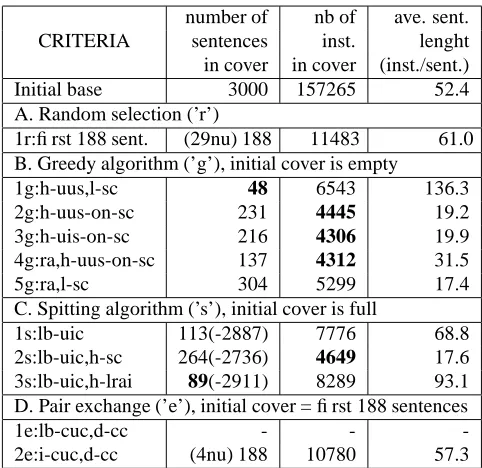
Criteria organization: hierarchic or simultaneous ? Criteria “1g” and “2g” (table 5.1.) both involve the number of useful units per sentence (h-uus) and the sentence cost (sc) in instances. Criteria “1g” considers them
hierarchical-ly: first sentences are extracted with “h-uus”, then among
them are extracted those with the least cost. Criteria “2g” uses them simultaneously by considering their ratio. Re-sults are really different both for the sentences number and for the instances number. In case “1g”, criterion “h-uus” has much more influence than “sc”, while in the “2g” case they are more balanced. Criteria organization can change results significantly.
A maximum of units types or of units instances ? Cri-teria “2g” and “3g” (table 5.1.) are close in their design and results, aside from the fact that criterion “2g” is interes-ted in the maximum weighinteres-ted number of useful units while criterion “3g” works with the maximum weighted number of useful instances. “3g” is a bit better than “2g”, but we consider this difference not significant, all the more so be-cause this difference may reduce with triphones, for which each unit has most of time only one instance per unit in a sentence; so the number of units equals the number of instances. It would probably not be so for phones. We chose criterion “2g” which is less time-consuming, never-theless “3g” makes more sens because it realises a “stan-dard” weighting, which is the ratio between the number of useful instances on the total number of instances of the sen-tence.
base has 52.4 instances per sentence on average (table 5.1.); criterion “2s” brings about sentences with 17.6 instances on ave., and criterion “1g” an average of 136.3 instances per sentences, so variance is substantial. The most length-independent criteria are cases “1s”, where no units count intervene directly, and “4g”. A way of weakening the crite-ria influence on sentences length is to look straightaway for several kinds of sentences, short and long, as Gauvain et al. (1990) did.
Criterion 3s disappointment. The spitting algorithm is interested in useless sentences, because they only bring redundancy. But how to choose, among these sentences, the one which have to be removed first to have a low cover cost at the end? Criterion “2s” consists in removing first the long sentences; it is the best among the 3 criteria. Be-ing removed at the beginnBe-ing of the algorithm may be their only chance to be rejected, otherwise they may fast become essential because they have many units types compared to short sentences. Criterion “3s” removes among the useless sentences the one which rarest unit in the base is the least rare in comparison with the other useless sentences. The governing idea is to protect the scores of the rarest units so that they don’t become essential, because so they would make essential the sentences they belong to. Nevertheless criterion 3s proved to be inefficient.
6.2. Algorithms combined
The following considerations come from table 3. Is it worth applying the spitting after the greedy al-gortihm ? The spitting algorithm removes up to 18.6% sentences and 10.8% instances. It does it rapidly, for us it-s utility iit-s blatant. Beit-sideit-s it heightenit-s a bit the average sentence length, it removes more short than long sentences. Does the spitting algorithm fit better with some of the greedy criteria ? We can’t really bring an answer to this question. “2g,2s” combination is more efficient than “3g,2s” while “3g” case was a bit better than “2g”, but dif-ferences are so weak that we consider them not significant.
Is it worth applying the pair exchange algorithm ? In the studied case the pair exchange algorithm proved to be of small interest, being too time-consuming, even if it helps to reduce the cover cost.
6.3. Dynamic study of the greedy algorithm
Which greedy criterion is performant with a partial covering aim ? Results presented in fig. 3 show that the performance in instances achieved with a total covering aim are not necessarily the same as those obtained with a partial covering goal. Cases “2g”, “3g” and “4g” are equivalent in instances at the end of the total covering, but “2g” and “3g” are better if the algorithm is stopped before this moment. Besides the “4g” case priviledges the cover of rare units, thus its set of covered units would be probably very diffe-rent from those obtained with criterion “2g” or “3g”, which would probably have rather the frequent types of units.
Where should partial covering be stopped ? Partial covering are often stopped at a cover cost threshold either in sentences or in instances. Nevertheless it seems to be worth looking at criterion ”h-uis-on-sc” (fig. 4) to take this deci-sion, because the performance ratio between the number
of brought useful instances and the cost increase decreases fast. This criterion can be a good tool to stop the algorithm.
7.
Conclusion
Three covering methods were compared experimental-ly with an evaluation database of 3 000 sentences so that to cover 500 diphones, each being represented 3 times at least. These are the greedy method, the spitting method which is a sort of inverse greedy, and the pair exchange method. Several criteria were studied for each method; they depend on the number of useful units types or instances of the sentences, on their length, or on the presence of rare units therein.
In the studied case, total covering is guaranteed only by the greedy or spitting methods. These methods have com-parable performance results as for the number of instances, the greedy being slightly better, but above all less time-consuming than the spitting method. The spitting method proved to be performant when applied after the greedy, re-moving up to 10% of the redundant instances. The pair exchange algorithm as well, with up to 6% instances re-moved, but it is more time-consuming. The greedy method followed by the spitting and the pair exchange method pro-duce the best results in the studied case. Results obtained for a total covering are not necessarily transposable to par-tial covering.
An other stake for these covering methods is the com-bination of several criteria which may be of varied na-tures; van Santen and Buchsbaum (1997) propose a greedy method with sub-vectorization or based on models, and present an optimized version of it (Buchsbaum and van Santen, 1996). This was applied by Chu et al. (2001) to cover about 1 600 Mandarin tonal syllabes according to a-coustic and prosodic criteria.
An interesting evolution would be to attempt to adapt to the studied case the GRASP, “greedy randomized adap-tative search procedure” (Resende, 1998), the “randomized rounding technique” (Raghavan and Thompson, 1987; S-rinivasan, 1995) and the “method of alteration” (SS-rinivasan, 2001).
8.
References
A. W. Black and K. A. Lenzo. 2001. Optimal data selection for unit selection synthesis. In Proceedings of the 4th
IS-CA Tutorial and Research Workshop on Speech Synthesis (SSW4), Perthshire, Scotland.
A. L. Buchsbaum and J. P. H. van Santen. 1996. Selecting training inputs via greedy rank covering. In Proceedings
of the 28th ACM Symposium on Theory Of Computing (STOC), pages 288–295, Philadelphia, PA, USA.
M. Chu, H. Peng, H. Yang, and E. Chang. 2001. Selecting non-uniform units from a very large corpus for concate-native speech synthesizer. In Proceedings of the 26th
In-ternational Conference on Acoustics, Speech, and Signal Processing (ICASSP), Salt Lake City, Utah, USA.
U. Feige. 1996. A threshold of ln
for approximating set cover. In Proceedings of the 28th ACM Symposium on
Theory Of Computing (STOC), pages 314–318,
H. Franc¸ois and O. Bo¨effard. 2001. Design of an optimal continuous speech database for text-to-speech synthesis considered as a Set Covering Problem. In Proceedings of
the 7th European Conference on Speech Communication and Technology (Eurospeech), Aalborg, Denmark.
J.-L. Gauvain, L.F. Lamel, and M. Eskenazi. 1990. De-sign considerations and text selection for BREF, a large French read-speech corpus. In Proceedings of the 1st
In-ternational Conference of Spoken Language Processing (ICSLP), volume 2, pages 1097–1100, Kobe, Japan.
H. Kawai, S. Yamamoto, N. Higuchi, and T. Shimizu. 2000. A design method of speech corpus for text-to-speech synthesis taking account of prosody. In
Proceed-ings of the 6th International Conference of Spoken Lan-guage Processing (ICSLP), Beijing, China.
L. Lovasz. 1975. On the ratio of optimal integral and frac-tional covers. Discrete Mathematics, 13:383–390. R. Prudon and C. d’Alessandro. 2001. A
selec-tion/concatenation text-to-speech synthesis system: databases development, system design, comparative evaluation. In Proceedings of the 4th ISCA Tutorial
and Research Workshop on Speech Synthesis (SSW4),
Perthshire, Scotland.
P. Raghavan and C. D. Thompson. 1987. Randomized rounding: a technique for provably good algorithms and algorithmic proofs. Combinatorica, 7:365–374.
M. G. C. Resende. 1998. Greedy randomized adaptative search procedures (GRASP). Technical Report 98.41.1, AT&T Labs.
M. Rojc and Z. Kaˇciˇc. 2000. Design of an optimal slove-nian speech corpus for use in the concatenative speech synthesis system. In Proceedings of the 2nd
Internation-al Conference on Language Resources and EvInternation-aluatio (L-REC), volume 1, pages 321–325, Athens, Greece.
P. Slav`ık. 1996. A tight analysis of the greedy algorithm for set cover. In Proceedings of the 28th ACM
Sympo-sium on Theory Of Computing (STOC), Philadelphia, PA,
USA.
A. Srinivasan. 1995. Improved approximations of packing and covering problems. In Proceedings of the 27th ACM
Symposium on Theory Of Computing (STOC), pages
268–276, Las Vegas, NV, USA.
A. Srinivasan. 2001. New approaches to covering and packing problems. In Proceedings of the 12th
ACM-SIAM Symposium On Discrete Algorithms (SODA),
pages 567–576, Washington, DC.
J. P. H. van Santen and A. L. Buchsbaum. 1997. Methods for optimal text selection. In Proceedings of the 5th