The K
NOWLEDGE
S
TORE
: an Entity-Based Storage System
R. Cattoni, F. Corcoglioniti, C. Girardi, B. Magnini, L. Serafini, R. Zanoli
Fondazione Bruno Kessler, Via Sommarive 18, 38123 Trento, Italy {cattoni,corcoglio,cgirardi,magnini,serafini,zanoli}@fbk.eu
Abstract
This paper describes the KNOWLEDGESTORE, a large-scale infrastructure for the combined storage and interlinking of multimedia re-sources and ontological knowledge. Information in the KNOWLEDGESTOREis organized aroundentities, such as persons, organizations and locations. The system allows (i) to importbackground knowledgeabout entities, in form of annotated RDF triples; (ii) to associate resources to entities by automatically recognizing, coreferring and linkingmentionsof named entities; and (iii) to derive new entities based on knowledge extracted from mentions. The KNOWLEDGESTOREbuilds on state of art technologies for language processing, including document tagging, named entity extraction and cross-document coreference. Its design provides for a tight integration of linguistic and semantic features, and eases the further processing of information by explicitly representing thecontextswhere knowledge and mentions are valid or relevant. We describe the system and report about the creation of a large-scale KNOWLEDGESTOREinstance for storing and integrating multimedia contents and background knowledge relevant to the Italian Trentino region.
Keywords:LR Infrastructures and Architectures, Knowledge Discovery/Representation, Metadata
1.
Introduction
In the digital World, relevant knowledge about entities of interest – such as persons, organizations and places – may be contained both in structured and unstructured resources. Examples of structured resources are databases and ontolo-gies; unstructured resources are textual documents, images, videos and multimedia documents in general.
Decades of research and technological advancements have led to the development of models, systems and best prac-tices to manage structured and unstructured information re-sources, but this has mainly happened by considering each kind of resource in isolation. Given the exponential in-crease of multimedia digital documents and the rise of the so-called Web of Data– mainly consisting of interlinked RDF (Carroll and Klyne, 2004) datasets published as part of the Linked Data initiative (Heath and Bizer, 2011) – the need arises for an advanced content management sys-tem supporting the joint management of structured and un-structured information resources. Above all, such a system should support the interlinking of the two kinds of resource, which can be obtained by (i) identifying mentions of named entities in multimedia resources, (ii) establishing ence among such mentions (i.e. cross-document corefer-ence) and (iii) linking entity mentions to corresponding structured entity descriptions.
In our vision, this advanced content management system should be inspired by the following principles:
• Scalability. As large multimedia collections and struc-tured datasets are becoming widespread and publicly accessible on the Web, scalability with respect to the size of managed data is a crucial matter.
• Traceability. Through the use of rich metadata, stored information should be traced back to its location in the original information sources, so to guarantee the proper use and exploitation of information contents.
• Reproducibility. The processes managing the inter-linking of information resources should be automatic and reproducible, given the initial raw resources.
• Incrementality. At any moment, it should be possible to add new information sources (or remove existing ones) and rely to the system for the proper merging and interlinking of new contents with existing ones, without the need to re-process all stored information.
• Contextualization. As stored information is gener-ally valid or relevant only in certain contexts and not universally, these contexts should be explicitly repre-sented and associated to information elements.
Based on that vision, in this paper we present the current re-sults of our ongoing work in developing the KNOWLEDGE -STORE, a system intended to fill the current gap in con-tent management systems. The KNOWLEDGESTORE com-bines a scalable storage infrastructure, able to store both multimedia resources and structured knowledge in form of annotated RDF entity descriptions, with state-of-the-art systems for document tagging, cross-document corefer-ence and mention-entity linking. We describe the KNOWL
-EDGESTOREas a general-purpose system and then we
fo-cus on reporting our experience in creating a specific large-scale KNOWLEDGESTORE instance in the scope of the LiveMemories project1. In this context, we exploited the KNOWLEDGESTORE to store and interlink large amounts of multimedia documents and ontological knowledge about the Italian Trentino region, with the aim of realizing a comprehensive repository of the knowledge and the digital memories of this area.
The remainder of the paper is structured as follows. Sec-tion 2 presents the KNOWLEDGESTORE system, with its data model (section 2.1) and the processing pipeline used to elaborate and interlink information contents (section 2.2). Section 3 presents the Trentino KNOWLEDGESTORE in-stance, with subsections describing step by step how we populated the system and processed the data. Section 4 re-ports on related works and section 5 concludes.
Multimedia resources Background Knowledge
KS API
C
on
te
nt
p
ro
ce
ss
in
g
m
od
ul
es
Knowledge store
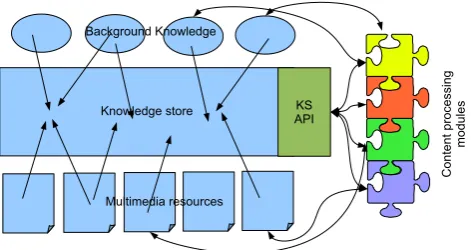
Figure 1: The architecture of the KNOWLEDGESTORE sys-tem: the KNOWLEDGESTORE core contains both Back-ground Knowledge and information extracted from multi-media data by the Content Processing modules. Such mod-ules interact with the KNOWLEDGESTOREcoreby means of web services provided by the KNOWLEDGESTOREAPI.
2.
The K
NOWLEDGES
TORESystem
The architecture of the KNOWLEDGESTORE system is shown in Figure 1: it is composed by the storing infrastruc-ture – the KNOWLEDGESTOREcore– and apipeline com-posed of content processing modulesinteracting with the corethrough a specific API. The KNOWLEDGESTOREcore is populated with several types of information: the original multimedia resources, the pre-existing background knowl-edge, and the data extracted from the multimedia resources by the content processing modules. It is worth noticing here that content processing modules may utilize the back-ground knowledge to perform their tasks.
Concerning the implementation, the KNOWLEDGE -STOREcoreis realized on top of the Hadoop2and Hbase3 frameworks. The API interacting with the content process-ing modules consists of a set of Web services realized with Tomcat servlets.
The remaining of the section first describes the data model adopted by the KNOWLEDGESTOREto represent and store the data (section 2.1). Then, the processing pipeline that populates the KNOWLEDGESTOREis presented with some details (section 2.2).
2.1. Data Model
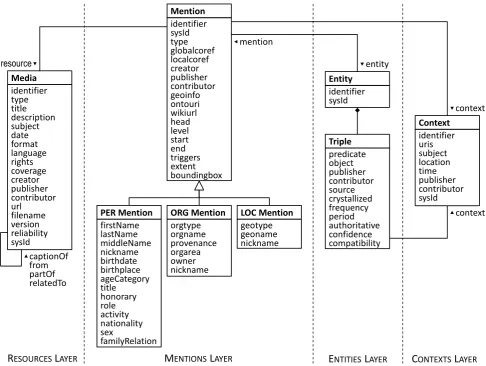
The data model of the KNOWLEDGESTORE is shown in the UML class diagram of figure 2. Information in the KNOWLEDGESTOREis represented at four interconnected layers: resources, mentions, entities and contexts.
Resources. This is the layer where physical files and their metadata are stored. Examples are multimedia data such as texts, images, audios and videos (or portions of them). Also the files derived from processing of original data such as Automatic Speech Recognition transcriptions and lin-guistic annotations are resources. Metadata of a resource are represented with an object named Media. The refer-ence for metadata description is the Dublin Core Meta-data Standard4. As figure 2 highlights, the Media class
2
http://hadoop.apache.org 3
http://hbase.apache.org 4
http://dublincore.org/documents/dces/
includes additional attributes introduced to represent rela-tions among resources:captionOf,from,partOfand
relatedTo. While the first three attributes encode spe-cific and self-explaining relations,relatedTois utilized for a generic relation between resources.
Mentions. This layer stores portions of a resource referring (i.e. mentioning) to a relevant content. Mentions may refer to persons (PER), organizations (ORG) and geo-political and location entities (GPE/LOC). Mentions can appear in medias of different types. For instance, a textual PER men-tion is a fragment of text (e.g. “President Mario Monti”), while a mention of the same person in a picture is repre-sented as the area of the picture where Mario Monti is de-picted. We have taken advantage of the definitions provided in the context of the ACE (Automatic Content Extraction) program5. Mentions are a kind of hybrid object as on the one side they are portions of the original resource, while, on the other side, they are enriched with semantic informa-tion that we extract and store in the KNOWLEDGESTORE. As an example, for the mention “President Mario Monti” we may store the fact that this mention represents a per-son, whosefirstNameis “Mario”, whoselastNameis “Monti” and whose activityis “President”. Semantic information for PER mentions is mainly extracted from cer-tain kinds of words – calledtriggers– that appear im-mediately before or after the mention (such as “President” in previous example). Mentions are defined in the context of the document they occur in, and, as a consequence, their semantic annotations hold only in that precise context.
Entities. This is the layer storing unique individuals that are referred through mentions occurring in resources. Entities are described through hsubject, predicate,
objecti triples (the subject being always the entity), which may derive both from automatically recognized men-tions and from pre-existingbackground knowledgeloaded into the KNOWLEDGESTORE. Under this view, entities are supposed to store information about individuals, such that multiple occurrences of the same information are rep-resented in a single triple, no matter how many variants are used to express it in documents. Typically, there is a many-to-one relation between mentions and entities, as the same entity can have several mentions, in different documents. The two mechanisms that allow to move from mentions to entities arecoreferenceandlinking: as an example, the two mentions “President Mario Monti” and “President Monti”, although different, are clustered together and linked to the same entity MARIO MONTI. As figure 2 points out, the Triple class includes additional attributes encoding triple metadata. In particular, attributesourcestores the prove-nance of a triple, while attributes fromcrystallizedto
compatibilityhave been added in the perspective of extending the KNOWLEDGESTOREwith a process for con-solidating knowledge extracted from mentions into triples.
Contexts. A piece of knowledge always holds in a cer-tain context. For instance, the fact that Mario Monti is President only holds in the context of a specific time pe-riod, and it is not true in other circumstances. Within the
5
task and the JQT2 system (Zanoli et al., 2011) has been used to cluster PER and ORG proper names. JQT2 is a Java implementation of the QT (Quality Threshold) algo-rithm (Heyer et al., 1999) and allows for two operations: re-clustering the whole dataset from scratch and incremen-tal clustering which consists in updating clusters that are affected by the new data only.
In contrast to other systems which adopt a fixed similarity threshold to group mentions referring to the same person, the introduced system uses a threshold capable of changing its value on the basis of the ambiguity of the name as esti-mated by using external resources (i.e. phonebooks). For each name to be clustered the algorithm was provided with a specific threshold value and with a rich set of features (e.g. Named Entities, triggers) co-occurring with the name in the same document.
As regards the system annotation speed common values are about 500 mentions/sec whereas accuracy on person names is about 93%.
Disambiguation of GPE/LOC mentions has instead been done by using Geocoder (Buscaldi and Magnini, 2010), a system designed for the coreference of ambiguous to-ponyms (e.g. “Cambridge” in UK or USA or “Alabama” as a river or a state). Geocoder uses geometric methods on top of the GeoNames7 geographical database and the Google Maps geo-referencing service8; as a side effect, it is often able to disambiguate mentions by linking them to well-known toponyms in GeoNames.
Mention-entity linking. In this step, each cluster of core-ferring PER and ORG mentions is linked to the corre-sponding entity in the KNOWLEDGESTORE background knowledge, if any, and the associations are stored back in the system (relationsmentionandentityin figure 2). Linking of GPE/LOC mention clusters is not considered, as Geocoder already links them to GeoNames toponyms and we assume that GPE/LOC entities in the background knowledge, if any, are already aligned to the corresponding GeoNames toponyms (e.g., viaowl:sameAstriples). As multiple entities may have a name compatible with the surface form of a mention, the problem ofambiguityarises. This is addressed using acontext-drivenentity linking algo-rithm (Tamilin et al., ) that processes each mention cluster in two step. First, the KNOWLEDGESTORE contexts that more closely match the textual contexts of mentions are identified and the associations are stored in the system (re-lationcontextin figure 2); matching is performed based on thesubject,timeandlocationvalues automat-ically extracted from resources and their metadata. Then, only selected contexts are searched for the matching entity, thus helping with disambiguation by reducing the number of candidates. Candidate entities are ranked based on the similarity of their description with the surface forms, the metadata and the textual context of mentions: above a cer-tain confidence threshold, the best candidate is chosen as the target of linking.
Entity Creation and Naming. For each unlinked men-tion cluster, a new entity is created and stored, with the
7
http://www.geonames.org/ 8http://code.google.com/apis/maps/
goal of populating the KNOWLEDGESTORE with descrip-tions of real-World entities whose existence is unknown in the background knowledge but can be inferred from stored resources. A triple is stored to denote the name of the new entity, which is chosen based on the surface forms of the mentions in the cluster: longer and frequently mentioned names are preferred. As a future development, we plan to aggregate the attributes stored at mention-level to extract additional triples, both for new and already defined entities.
3.
The Trentino K
NOWLEDGES
TOREIn the scope of the LiveMemories project, an instance of the KNOWLEDGESTOREsystem has been created and pop-ulated with multimedia contents and manually-acquired background knowledge relevant to the Italian Trentino re-gion; the language for textual and audio contents is Italian. In this section we report on this experience, covering with detailed statistics and a running example the initial popu-lation of the instance (section 3.1) and the application of the modules forming the content processing pipeline (sec-tions 3.2 – 3.5).
3.1. Initial Population
The KNOWLEDGESTOREinstance has been initially loaded with 100K multimedia resources and with∼350K triples of background knowledge describing∼30K entities.
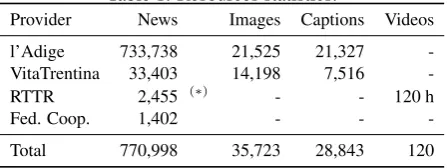
Multimedia resources consist of written news and images from three daily and weekly local newspapers – l’Adige9, VitaTrentina10, Federazione Trentina della Cooperazione (Fed. Coop.)11 – as well as videos of daily television news from the local television RTTR12. Statistics about loaded contents are reported in table 1.
Table 1: Resources statistics.
Provider News Images Captions Videos
l’Adige 733,738 21,525 21,327 -VitaTrentina 33,403 14,198 7,516 -RTTR 2,455 (∗) - - 120 h
Fed. Coop. 1,402 - -
-Total 770,998 35,723 28,843 120
(∗)
As result of the transcription segmentation.
Background knowledge has been manually collected from several Web sources, including the Italian Wikipedia, sport-related community sites and the official Web sites of local and national-level Public Administrations, economic and government bodies (e.g. the Italian Parliament Web site). Table 2 reports the number of loaded contexts, entities and triples aggregated along top-level topics.
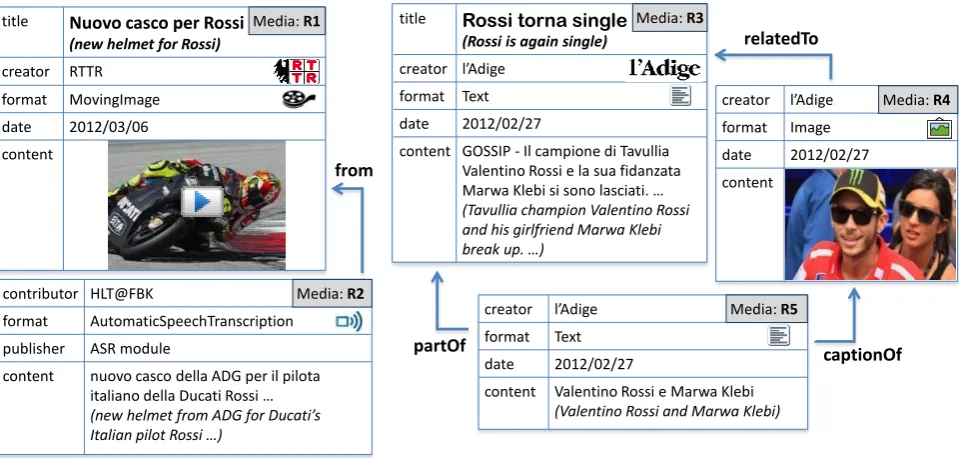
Figure 3 introduces our running example and shows how resources are managed in the KNOWLEDGESTORE. The image shows the media objects providing the metadata for a video from RTTR (media R1), that has been automati-cally transcribed (media R2) and a news (media R3) con-taining an image (media R4) and its caption (media R5)
9
http://www.ladige.it/ 10
http://www.vitatrentina.it/ 11http://www.ftcoop.it
12
creator l’Adige format Image date 2012/02/27 content
from
title Rossi torna single
(Rossi is again single)
creator l’Adige format Text date 2012/02/27
content GOSSIP - Il campione di Tavullia Valentino Rossi e la sua fidanzata Marwa Klebi si sono lasciati. … (Tavullia champion Valentino Rossi and his girlfriend Marwa Klebi break up. …)
contributor HLT@FBK
format AutomaticSpeechTranscription publisher ASR module
content nuovo casco della ADG per il pilota italiano della Ducati Rossi … (new helmet from ADG for Ducati’s Italian pilot Rossi …)
relatedTo
captionOf partOf
Media: R1
Media: R2
Media: R3
creator l’Adige format Text date 2012/02/27
content Valentino Rossi e Marwa Klebi (Valentino Rossi and Marwa Klebi)
Media: R4
Media: R5
title Nuovo casco per Rossi
(new helmet for Rossi)
creator RTTR format MovingImage date 2012/03/06 content
Figure 3: Running example – Examples of resources and their media content.
Table 2: Background knowledge statistics.
Main
Contexts PER ORG
(1)
Avg. (2)Total topic entities entities preds. triples
sport 136 8,570 191 3.81 192,115 culture 20 9,785 1 2.00 33,236 justice 7 354 10 2.16 1,575 economy 7 49 1,203 4.47 11,147 education 6 850 82 2.35 3,573 politics 535 8,402 319 4.64 98,780 religion 3 1,391 0 1.67 12,855
Total(3) 714 28,687 1,806 3.64 352,244
(1)
Avg. number of distinct predicates for each entity.
(2)A triple mentioned in multiple contexts is counted once.
(3)
An entity mentioned in multiple contexts is counted once.
from l’Adige. Furthermore all the relations among medias are specified: the transcription is derived from the video, the caption is associated to the related image and it is part of the news, and the image is related to the news.
3.2. Content Extraction
In the text media that we considered (see table 1), around 10% of the words are part of PER, ORG and GPE/LOC mentions. These mentions have been extracted using TextPro and table 3 provides the number of retrieved men-tions by data provider and entity type.
Continuing the running example, figure 4 shows how the transcription of media R2 and the text of media R3 have been annotated using TextPro (mention are enclosed in brackets). Starting from these two medias, the four men-tions M1-M4 depicted in the figure are extracted and stored in the KNOWLEDGESTORE, enriched with semantic infor-mation specified by nearby trigger words.
Table 3: Content Extraction statistics.
Provider PER ORG GPE+LOC
l’Adige 5,387,994 3,100,994 3,052,011 VitaTrentina 144,486 100,789 136,611 RTTR 19,290 15,493 27,404 Fed. Coop. 14,404 12,731 8,513
Total 5,566,174 3,230,007 3,224,539
helmet from [ADG]ORGfor [Ducati]ORG ’s Italian pilot [Rossi]PER.
[Tavullia]LOC champion [Valentino Rossi]PERand his
girlfriend [Marwa Kleby]PER
break up
Mention: M2
Mention: M1
extent Rossi type PER lastname Rossi activity pilot nationality Italian start 58
extent Valentino Rossi type PER firstname Valentino lastname Rossi start 33
Mention: M3
extent Ducati type ORG start 51
Mention: M4
extent Tavullia type LOC start 24
Media: R3
Menzioni con grafica che segue il formato di Francesco: l’identificatore e` posto in alto a destra.
Media: R2
Figure 4: Running example – Examples of mentions as they are extracted and stored in the KNOWLEDGESTORE.
3.3. Coreference
Mention: M3 extent Ducati type ORG start 51 globalcoref 7
Mention: M4 extent Tavullia type LOC start 24 globalcoref 9
Mention: M2
extent Valentino Rossi type PER firstname Valentino lastname Rossi start 33 globalcoref 115 Mention: M1
extent Rossi type PER lastname Rossi activity pilot nationality Italian start 58 globalcoref 115
Media: R3
Media: R2 Cluster 115
Cluster 9
Cluster 7
Menzioni con grafica che segue il formato di Francesco: l’identificatore e` posto in alto a destra.
Figure 5: Running example – Cross-document coreference. Mentions “Rossi” (M1) and “Valentino Rossi” (M2) have been put in the same cluster and assigned with the same
globalcorefidentifier 115. In contrast “Ducati” (M3) and “Tavullia” (M4) set up the new clusters 7 and 9.
the running example: the two mentions “Rossi” (M1) and “Valentino Rossi” (M2) have been grouped together (they are thought to be referring to the same entity), whereas “Ducati” (M3) and “Tavullia” (M4) form distinct clusters. Table 4 shows the number of different PER, ORG and GPE/LOC clusters as result of the coreference phase. Concerning GPE/LOC mentions, it is worth noticing that 48.64% of clusters produced by Geocoder have been also linked to GeoNames toponyms, thus disambiguating them (in terms of mentions, the percentage increases to 65.04%). As far as the PER entity names are concerned, their dis-tribution in texts has been studied ranking them according to their frequencies and listing the frequencies in descend-ing order. Figure 6 shows that the distribution follows the Zipf’s law.
Table 4: Coreference statistics.
PER ORG GPE+LOC Total
Mentions 5,566,174 3,230,007 3,224,539 12,020,720 Clusters 340,147 16,649 52,478 409,274
3.4. Linking
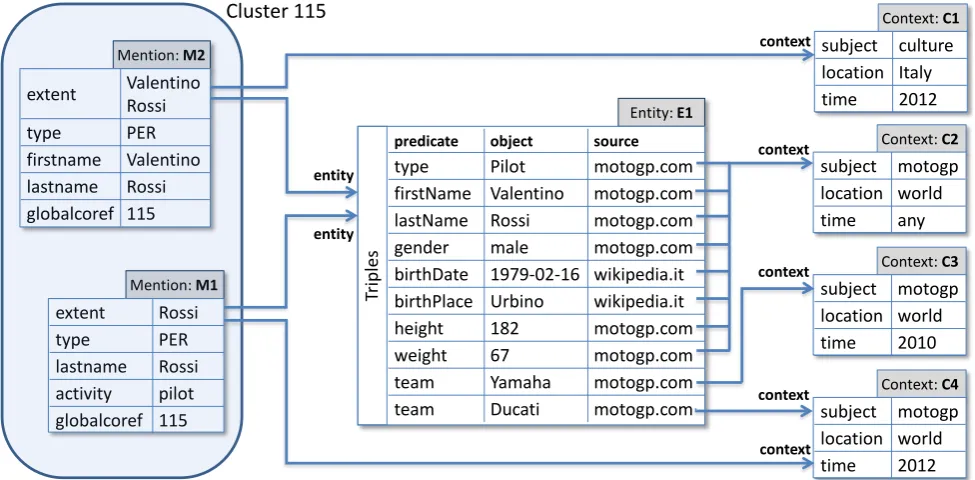
The linking of PER and ORG mention clusters to entities and contexts in the background knowledge is exemplified in figure 7. Cluster 115 with mentions M1 and M2 in the running example is linked to entity E1 for pilot Valentino Rossi. The link is stored in the KNOWLEDGESTOREby as-sociating both cluster mentions to E1. As part of the linking process, mentions M1 and M2 are also associated, respec-tively, to contexts C1 and C4 that more closely match their textual contexts: this information can be used, for instance, to extract and display only tripleh E1,team, Ducatii when presenting the media with mention M1 to a user. Table 5 reports the percentage of clusters and mentions
Figure 6: Persons Zipf’s law. The graph shows rank versus frequency using logarithmic scales.
linked by the system – i.e. thelinking coverage– for the different types of entities. Linking coverage is low in terms of entities and increases in terms of mentions, indicating that only the most popular (and thus frequently mentioned) entities are present in the background knowledge.
As the KNOWLEDGESTOREinstance contains a super-set of the news used in the Evalita 2011 evaluation campaign13, a rough evaluation of the quality of discovered links for PER mentions has been performed against a gold standard derived from the one used in Evalita for cross-document coreference. The gold standard built consists of 21,273 textual news from L’Adige containing 22,511 PER men-tions grouped in 298 clusters, 73 of which have been man-ually associated to corresponding entities in the background knowledge. The linking system scored 84.5% accuracy (i.e. the fraction of correct link/not-link decisions), 85.1% preci-sion (i.e. the fraction of linked clusters whose target entity is correct) and 89.5% recall (i.e. the fraction of manually established links discovered by the system).
Table 5: Linking coverage.
PER ORG Total
Linked clusters 5.03% 7.96% 5.17% Linked mentions 22.36% 12.02% 18.58%
3.5. Entity Creation and Naming
As the final step of the pipeline, starting from unlinked mention clusters new entities have been added to the KNOWLEDGESTOREinstance. For example, unlinked clus-ter for mentionM4in the running example is mapped to a new entityE2, whose name “Tavullia” is chosen based on the mention surface form and stored using anametriple. Table 6 presents the situation of the KNOWLEDGESTORE
after the addition of new entities, reporting the numbers
13
Mention: M2
Mention: M1
extent Rossi
type PER
lastname Rossi activity pilot globalcoref 115 extent Valentino
Rossi
type PER
firstname Valentino lastname Rossi globalcoref 115
Context: C4 subject motogp location world
time 2012
Entity: E1 predicate object source
type Pilot motogp.com
firstName Valentino motogp.com
lastName Rossi motogp.com
gender male motogp.com
birthDate 1979-02-16 wikipedia.it birthPlace Urbino wikipedia.it
height 182 motogp.com
weight 67 motogp.com
team Yamaha motogp.com
team Ducati motogp.com
Context: C3 subject motogp location world
time 2010
Context: C2 subject motogp location world
time any
Triples
entity
entity
context
context
context
Context: C1 subject culture location Italy
time 2012
context context
Cluster 115
Figure 7: Running example – Linking to background knowledge.
of stored entities by type and provenance (media vs back-ground knowledge, the latter either linked or unlinked to mention clusters). Entities induced from media correspond to 92.76% of all stored entities. The large percentage high-lights the limits of manually acquired background knowl-edge, which can only cover the most popular entities. It also suggests that there is a large potential for applying knowledge base population techniques on stored multime-dia resources, in order to (semi-)automatically populate the remaining long tail of less popular entities.
Table 6: Entities statistics.
Entity provenance PER ORG GPE+LOC all types
BK(∗) unlinked 11,566 480 – 12,046
linked 17,121 1,326 – 18,447 media induced 323,026 15,323 52,478 390,827
all provenances 351,713 17,129 52,478 421,320
(∗)
Background knowledge.
4.
Related Works
The attempt to build a pipeline for ontology population tasks in not new in the Natural Language Processing com-munity. On the Content Information Extraction side, al-though several linguistic taggers are available for a number of languages (e.g. OpenCalais14, Gate15 ), still there are no attempts to systematically store and make available the annotated data on a large-scale, and to integrate such data with background knowledge through Semantic Web tech-nologies. As a matter of fact, much more attention has been paid on the processing side (e.g. several taggers are offered
14
http://www.opencalais.com/ 15
http://gate.ac.uk/
as web services) rather than on the storage side. The fo-cus has been mainly on formats for single tasks, without a clear overall design, with the consequence that the inter-action between linguistic, semantic, and world knowledge is still underspecified and poorly investigated. In this di-rection, the KNOWLEDGESTOREis intended to exploit the benefits of a common place for representing linguistic, se-mantic, and world knowledge on a large-scale.
On the architecture side, a popular annotation framework is UIMA16 – Unstructured Information Management Ar-chitecture (Ferrucci and Lally, 2004) – developed by IBM and used as architectural basis for several NLP systems, including the recent Watson system. UIMA enables ap-plications to be decomposed into components, and each of them implements interfaces defined by the framework and provides self-describing metadata via XML descriptor files. UIMA might be considered as complementary to the KNOWLEDGESTOREin that it provides a general metadata schema (called CAS) which might eventually be adopted by our system, although there is no specific reference to the representation of large amounts of knowledge.
A recent initiative which shares some of the motivations with the KNOWLEDGESTOREis the NLP Interchange For-mat (NIF)17. NIF is an RDF/OWL-based format developed by the University of Leipzig that aims to achieve interop-erability between Natural Language Processing tools, lan-guage resources and annotations. The core of NIF consists of a vocabulary, which can represent strings as RDF re-sources. A special URI Design is used to pinpoint anno-tations to a part of a document. These URIs can then be used to attach arbitrary annotations to the respective char-acter sequence. Employing these URIs, annotations can be published on the Web as Linked Data and interchanged be-tween different NLP tools and applications. Although NIF
16
http://uima.apache.org/index.html 17
is very recent (November 2011) and there is no enough feedback from the scientific community, the main motiva-tions are shared by the KNOWLEDGESTORE approach we have presented in this paper.
As for the Semantic Web community and the Linked Open Data initiative, a significant research effort has gone along the direction of supporting the interlinking of knowledge and text documents at the representation and publication levels. This includes the standardization of metadata on-tologies for describing generic information resources (e.g. Dublin Core) and multimedia contents (Su˜arez Figueroa et al., 2011), and the deployment of mechanisms such as GRDDL (Connolly, 2007) and RDFa (Pemberton et al., 2008) for embedding RDF statements in XML and HTML documents, and HTTP content negotiation for relating the RDF description of an entity with its corresponding human-readable unstructured representation. All these solutions are complementary to the KNOWLEDGESTORE and can be used to expose its contents both for human and ma-chine consumption, achieving interoperability with Seman-tic Web applications.
Aiming at bridging the gap between the Web of documents and the Web of Data, several Web services have been de-veloped for recognizing mentions of named entities in an input text and linking them to URIs in relevant Linked Data datasets, such as DBPedia Spotlight18(Mendes et al., 2011), Zemanta19 and AlchemyAPI20. Most of these ser-vices rely on the direct or indirect link between Web of Data entities and corresponding Wikipedia pages for disam-biguation, whereas the KNOWLEDGESTORElinking mod-ule relies on the contextualization of knowledge.
Finally, it is worth noting that also in the Semantic Web community little attention has been paid to the storage of semantic data interlinked with multimedia resources. While triple stores have evolved into scalable solutions for storing, querying and reasoning with large amounts of knowledge, they currently provide only a limited support for integrating knowledge with multimedia, often consist-ing in simple full text search capabilities on RDF literals.
5.
Conclusions
With its management of fine-grain links between knowl-edge and multimedia resources, the KNOWLEDGESTORE
represents a valuable resource we plan to exploit to fur-ther investigate the mutual benefits of integrating multime-dia and knowledge processing. In particular, three relevant research directions supported by the KNOWLEDGESTORE
are (1) the development ofsemantic searchapproaches to jointly access multimedia and knowledge contents, (2) the ‘injection’ of background knowledge in NLP tools to im-prove their performances, as im-proven by recent works on coreference resolution (Bryl et al., 2010) and (3) the devel-opment of knowledge base populationmethods that build on the existing links between knowledge and multimedia to further enrich stored knowledge with information extracted from texts and other multimedia contents. Moreover, we
18
http://dbpedia.org/spotlight 19
http://www.zemanta.com 20
http://www.alchemyapi.com
plan to realize a feature outlined in the requirements for the KNOWLEDGESTORE (cfr. section 1) but not implemented
yet, namely the ability to populate the KNOWLEDGESTORE incrementally.
Concerning the developed software, we intend to release the code of the KNOWLEDGESTORE core as an open-source distribution.
6.
Acknowledgements
This work was partially supported by the LiveMemo-ries21project (Active Digital Memories of Collective Life) funded by Autonomous Province of Trento (Italy) under the call “Major Projects”.
7.
References
V. Bryl, C. Giuliano, L. Serafini, and K. Tymoshenko. 2010. Using background knowledge to support corefer-ence resolution. InECAI’10, pages 759–764.
D. Buscaldi and B. Magnini. 2010. Grounding toponyms in an italian local news corpus. InGIR’10.
J. J. Carroll and G. Klyne. 2004. Resource description framework (RDF): Concepts and abstract syntax. W3C recommendation.
D. Connolly. 2007. Gleaning resource descriptions from dialects of languages (GRDDL). W3C recommendation. D. Ferrucci and A. Lally. 2004. Uima: an architectural approach to unstructured information processing in the corporate research environment. Nat. Lang. Eng., 10(3-4):327–348.
T. Heath and C. Bizer. 2011. Linked Data: Evolving the Web into a Global Data Space. Morgan & Claypool Pub. L. J. Heyer, S. Kruglyak, and S. Yooseph. 1999. Explor-ing expression data: Identification and analysis of coex-pressed genes. Genome Research, 9(11):1106–1115. B. Magnini, E. Pianta, C. Girardi, M. Negri, L. Romano,
Bartalesi Lenzi, and R. Sprugnoli. 2006. I-cab: the ital-ian content annotation bank. InLREC’06.
P. N. Mendes, M. Jakob, A. Garc´ıa-Silva, and C. Bizer. 2011. Dbpedia spotlight: shedding light on the web of documents. InI-Semantics’11, pages 1–8. ACM. S. Pemberton, B. Adida, S. McCarron, and M. Birbeck.
2008. RDFa in XHTML: Syntax and processing. W3C recommendation.
E. Pianta, C. Girardi, and R. Zanoli. 2008. The TextPro tool suite. InLREC’08.
L. Serafini and M. Homola. 2011. Contextual representa-tion and reasoning with descriprepresenta-tion logics. In 24th Int. Workshop on Description Logics (DL 2011).
M. C. Su˜arez Figueroa, G. A. Atemezing, and O. Corcho. 2011. The landscape of multimedia ontologies in the last decade. Multimedia Tools and Applications, 55(3), 12. A. Tamilin, B. Magnini, and L. Serafini. Leveraging
en-tity linking by contextualized background knowledge: A case study for news domain in italian. In6th Workshop on SW Applications and Perspectives (SWAP).
R. Zanoli, F. Corcoglioniti, and C. Girardi. 2011. Dynamic threshold for clustering person names. InProceedings of EVALITA 2011.
21