Using semi-experts to derive judgments on word sense alignment:
a pilot study
Soojeong Eom, Markus Dickinson, Graham Katz
Georgetown University, Indiana University, Georgetown University [email protected], [email protected], [email protected]
Abstract
The overall goal of this project is to evaluate the performance of word sense alignment (WSA) systems, focusing on obtaining examples appropriate to language learners. Building a gold standard dataset based on human expert judgments is costly in time and labor, and thus we gauge the utility of using semi-experts in performing the annotation. In an online survey, we present a sense of a target word from one dictionary with senses from the other dictionary, asking for judgments of relatedness. We note the difficulty of agreement, yet the utility in using such results to evaluate WSA work. We find that one’s treatment ofrelatedsenses heavily impacts the results for WSA.
Keywords:word sense alignment, crowdsourcing, evaluation, WordNet, COBUILD
1.
Introduction
As is well-known, different word sense inventories con-tain non-trivial mappings between them. As one example, (Palmer et al., 2000) discuss the various problems in align-ing the senses ofshakein Hector (Atkins, 1993) with those in WordNet (Fellbaum, 1998), such as the TREMBLE and MOVEdistinctions in Hector being conflated in WordNet. Such differences arise from the different purposes of sense inventories, e.g., for lexicography, computational disam-biguation systems, or relevance to language learners. Each inventory also has its own particular design, with some in-cluding hierarchical information, some having illustrative examples for senses, some based on thesaurus information, and so forth.
Partly owing to these differences, there is a need to align senses between inventories for a number of applications, such as, e.g., building large-scale lexical databases for ma-chine translation which combine sources of information (Knight and Luk, 1994); comparing the performance of dif-ferent natural language processing (NLP) systems charac-terizing lexical semantics (Nastase and Szpakowicz, 2001); or reducing the granularity of an inventory for NLP (Nav-igli, 2006). This last case is particularly important, as aligning senses to coarser-grained ones can lead to high-performance word sense disambiguation (WSD) systems (Navigli, 2009; Navigli et al., 2007). Indeed, increasing the scale of sense inventories is an ongoing task, especially for newer resources such as Wikipedia and Wiktionary (see, e.g., (Meyer and Gurevych, 2011) and references therein).
Our starting point comes from a different perspective yet. We intend to map word senses between two sense inven-tories, to link up state-of-the-art automatic WSD systems employing WordNet with a sense resource containing ex-amples more appropriate to display for language learners, namely a resource like the COBUILD dictionary (Sinclair, 2006). COBUILD is a dictionary specifically designed for learners of English, and, although proprietary, it is used by
learners around the world.1 We are developing an online system to provide vocabulary assistance to learners of En-glish, allowing them to click on unfamiliar words and see examples relevant to that usage (cf. (Nerbonne and Smit, 1996; Heilman et al., 2006)). To do this, we need to de-velop a system which automatically maps from WordNet (output from an automatic WSD system) to something like COBUILD (for displaying examples).
This is a much different goal than much of the other align-ment work, in that we do not need to expand a resource and make it bigger, but instead map consistently from one to the other. Further, this mapping between the inventories needs to be reliable, as false mappings can lead learners astray— i.e., are worse than no mapping at all.
Thus, in this paper, we investigate the upper bound on au-tomatic word sense alignment (WSA) accuracy by testing human accuracy. Additionally, we need evaluation data for WSA; as far as we know, no such database exists for the types of inventories we are interested in, though other databases exist, predominantly for ones linking WordNet and Wikipedia or Wiktionary (Meyer and Gurevych, 2011; Niemann and Gurevych, 2011; Wolf and Gurevych, 2010; Fernando and Stevenson, 2010; Toral et al., 2009). We want to develop a gold standard of alignments between the in-ventories of interest, and we provide a methodology here which allows us to do so. Specifically, we explore pooling judgments from semi-experts—i.e., linguistic students and faculty. While this has the potential to speed up annotation efforts, we employ this methodology mainly to get a better grasp on how much people with linguistic knowledge can agree on meaning similarity.
The main contributions of this paper are to: 1) explore alignments between two resources which have not been ro-bustly investigated (WordNet and COBUILD); 2) add to the line of work allowing for gradable judgments for lexical se-mantics (Erk and McCarthy, 2009; Erk et al., 2009); and 3) test the effectiveness of using semi-experts to provide sim-ilarity judgments.
1
Figure 1: An example of a question and choices for one sense ofindicate.v
Figure 2: Confidence Scale
section (n) : a self-contained part of a larger composition ...
Same meaning
Related meaning
Unable to determine
No relation
1. A section of something is one of the parts into which it is divided ...
38.5% (5) 53.8% (7) 7.7% (1) 0.0% (0)
2. A section of an official document ... is one of the parts into which it is divided ...
76.9% (10) 15.4% (2) 0.0% (0) 7.7% (1)
3. A section is a diagram of some-thing such as a building ...
0.0% (0) 38.5% (5) 7.7% (1) 53.8% (7)
Table 2: Response Analysis for one WordNet sense ofsection.n
1 2 3 4 5
0.21 0.97 1.98 1.63 1.70
Table 3: Average number of responses for each point on the confidence scale (1=not confident, 5 = very confident)
1. The community is all the people who live in a particu-lar area or place.
2. A particular community is a group of people who are similar in some way.
3. Community is friendship between different people or groups, and a sense of having something in common.
When asked to align the WordNet sense ofcommon owner-ship, then, this property can cut across all three defintions, as it seems to be describing a different way at looking at communitycompletely.
Given the lack of agreement, an immediate question is: can we use these results to evaluate WSA systems? And if so, how? One answer is that the results should be used as weighted scores. That is, when evaluating measures such as precision and recall, instead of counting C2, for exam-ple, as a totally correct alignment for W1 ofsection.n(cf. Table 2), it counts as .769 of a correct alignment. One can see (Madnani et al., 2011) for such a proposal using binary crowdsourced data, and (Erk and McCarthy, 2009) for dif-ferent measurements related to graded word senses.
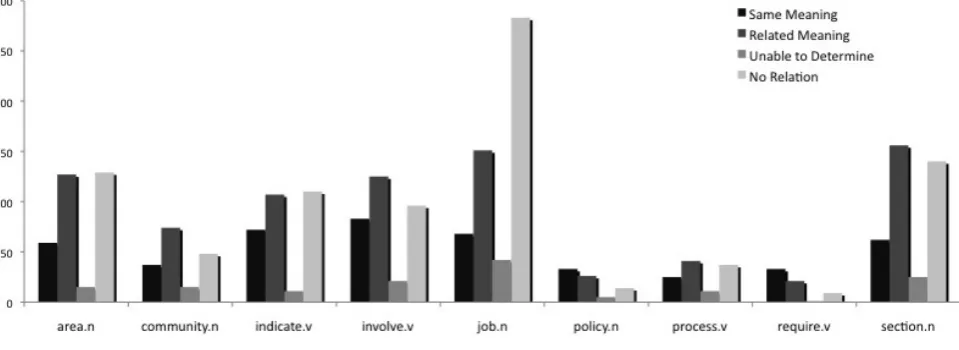
ear-Figure 3: Number of times each answer was used for every word
lier, and it can indicate at least two things: 1) the task was not clear, or 2) these particular sense inventories are diffi-cult to align. In the future, one may want to explore devel-oping further guidelines, balancing this with the fact that volunteers are being used.
4.1. Converting responses to scores
We convert the responses into scores for evaluation, in or-der to quantify to what extent—according to the various annotators—the senses from the two inventories express the same meaning. Specifically, we assign a weight of 1 for same meaning, -1 forno relation, and 0 for unable to determine; thus, higher scores indicate a greater degree of “sameness.”8 For related meaning, we test different weights (α)—1, 0.5, and 0—reflecting differing degrees of their contribution towards a correct alignment. For ex-ample, for the W1-C1 mapping in table 2, we obtain: 12 (= 5+7∗1+0),8.5 (= 5+7∗0.5+0), and5 (= 5+7∗0+0), respectively.
Participants were not required to complete all surveys, so the number of responses per survey is different. thus, we normalize the scores by the number of respondents: in this case, withα= 0.5, the score for W1-C1 is813.5 = 0.65. For example, normalized scores forinvolve.vare in Table 4.
4.2. Evaluating a basic WSA system
A simple word sense alignment system consists of running a basic WordNet-based WSD classifier on the COBUILD example sentences and averaging the scores, in order to find the best WordNet sense for a given COBUILD sense. Because we are interested in mapping from WordNet to a single-best COBUILD sense (see section 1.), we use these scores to take the most likely COBUILD sense for each
8
One could also use normalized judgment scores as in (Erk and McCarthy, 2009). In our context, this means:same=2,related=1,
none=0, and normalized score = score2 . Instead of ranging from -1 to 1, it ranges from 0 to 1, but shares the same basic intuition, es-pecially for whenα= 0, puttingrelated meaningexactly halfway between the others.
C1 C2 C3 C4 C5
W1 0.083 0.5 0.333 0.083 0.25
W2 -0.063 0.75 0.688 0.5 0.125
W3 1 -0.143 -0.286 -0.143 -0.429
W4 0.611 -0.111 -0.444 -0.056 -0.389
W5 0.893 0.679 0.25 0.357 -0.071
W6 -0.455 0.227 0.227 0.409 -0.318
W7 -0.571 -0.143 0.286 -0.214 0
Table 4: Scores forinvolve.v(α= 0.5)
WordNet sense (i.e., a 1-to-n mapping from WordNet to COBUILD). One could explore more robust alignment al-gorithms or take all senses above a given threshold to allow for many-to-many mappings, but this gives us a good start-ing point for teststart-ing evaluation data under the conditions we are interested in. We implement this by running SenseRe-late::AllWords (SR::AW) (Pedersen and Kolhatkar, 2009) on the COBUILD sentences.
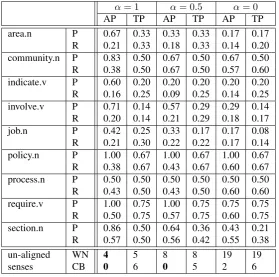
Using our scores, we perform two ways of counting dif-ferent cases as correct alignments, namely counting: 1) all positive scores (unshaded cells of Table 4); or 2) only the top positive score for each WordNet sense (i.e., the high-est score reading across a row). We could explore a graded notion of what counts as correct to calculate precision and recall (Erk and McCarthy, 2009), but we use our WSD sys-tem as a categorical one, returningyesornofor each align-ment link. Thus, for present purposes, we convert our gold standard to categorical decisions; obviously, it can also be used for non-categorical evaluation. After defining a set of correct alignments, we calculate precision and recall of alignments in the usual way. The results are in Table 5, where we also report the number of senses which do not align to the other inventory.
α= 1 α= 0.5 α= 0
AP TP AP TP AP TP
area.n P 0.67 0.33 0.33 0.33 0.17 0.17
R 0.21 0.33 0.18 0.33 0.14 0.20
community.n P 0.83 0.50 0.67 0.50 0.67 0.50
R 0.38 0.50 0.67 0.50 0.57 0.60
indicate.v P 0.60 0.20 0.20 0.20 0.20 0.20
R 0.16 0.25 0.09 0.25 0.14 0.25
involve.v P 0.71 0.14 0.57 0.29 0.29 0.14
R 0.20 0.14 0.21 0.29 0.18 0.17
job.n P 0.42 0.25 0.33 0.17 0.17 0.08
R 0.21 0.30 0.22 0.22 0.17 0.14
policy.n P 1.00 0.67 1.00 0.67 1.00 0.67
R 0.38 0.67 0.43 0.67 0.60 0.67
process.n P 0.50 0.50 0.50 0.50 0.50 0.50
R 0.43 0.50 0.43 0.50 0.60 0.60
require.v P 1.00 0.75 1.00 0.75 0.75 0.75
R 0.50 0.75 0.57 0.75 0.60 0.75
section.n P 0.86 0.50 0.64 0.36 0.43 0.21
R 0.57 0.50 0.56 0.42 0.55 0.38
un-aligned WN 4 5 8 8 19 19
senses CB 0 6 0 5 2 6
Table 5: Precision & recall of words using SR::AW (AP=all positives, TP=top positive), plus number of un-aligned senses
(W5,C1) and (W6,C2). Consequently, precision is 47 = 0.57and recall194 = 0.21.
Withα= 1, related senses are counted fully correct, mean-ing the system will match more, givmean-ing higher precision. Likewise,α= 0gives fewer alignments, producing gener-ally higher recall and more unalignment between the inven-tories.
These results do not indicate the best evaluation; they sim-ply illustrate how the treatment of related senses affects the results. The all positive (AP), α = 1evaluation, for in-stance, indicates how far off a system is from any correct answer, while, on the other side of the spectrum, the top positive (TP),α= 0evaluation indicates how well the best senses are being found. To display sense-specific examples for learners, we will want evaluations across the spectrum to know how often learners will be presented with related examples, as opposed to exact matches.
5.
Summary and Outlook
We have examined constructing a database of alignments of word senses between two sense inventories, specifi-cally WordNet and COBUILD, by pooling the judgments of semi-experts. Using online surveys, we presented a sense of a target word from one dictionary with senses from the other dictionary, asking for judgments of relatedness. Specifically, we have shown: 1) It is difficult for semi-experts to agree upon correct alignments, showing that the task is difficult, and it would seem to be infeasible for, e.g., crowdsourcing of non-experts. 2) Despite this, such data can be used to gauge accuracy of WSA systems, depending upon how muchrelated meaningone wishes to capture in the alignments.
Currently, we are obtaining more data from more surveys, focusing on words which are relevant to the system for reading assistance we are building. At the same time, we are investigating different ways to use the annotator judg-ments to evaluate WSA systems, building from work such as (Erk and McCarthy, 2009).
Acknowledgments
We wish to thank the survey respondents for their help, as well as three anonymous reviewers for their feedback.
6.
References
Sue Atkins. 1993. Tools for computer-aided corpus lexi-cography: the hector proje ct. Acta Linguistica Hungar-ica, 41:5–72.
Katrin Erk and Diana McCarthy. 2009. Graded word sense assignment. InProceedings of the 2009 Confer-ence on Empirical Methods in Natural Language Pro-cessing, pages 440–449, Singapore, August.
Katrin Erk, Diana McCarthy, and Nicholas Gaylord. 2009. Investigations on word senses and word usages. In Pro-ceedings of the Joint Conference of the 47th Annual Meeting of the ACL and the 4th International Joint Con-ference on Natural Language Processing of the AFNLP, pages 10–18, Suntec, Singapore, August.
Christiane Fellbaum, editor. 1998. WordNet: An Electronic Lexical Database. The MIT Press, Cambridge, MA. Samuel Fernando and Mark Stevenson. 2010. Aligning
M. Heilman, K. Collins-Thompson, J. Callan, and M. Eske-nazi. 2006. Classroom success of an intelligent tutoring system for lexical practice and reading comprehension. In Proceedings of the 9th International Conference on Spoken Language Processing.
Nancy Ide and Jean V´eronis. 1990. Mapping dictionaries: A spreading activation approach. InProceedings of the Sixth Annual Conference of the UW Centre for the New Oxford English Dictionary, pages 52–64, Waterloo.
Kevin Knight and Steve K. Luk. 1994. Building a large-scale knowledge base for machine translation. In Pro-ceedings of AAAI-94, Seattle.
Oi Yee Kwong. 1998. Aligning WordNet with additional lexical resources. In Proceedings of the Workshop on Usage of WordNet in Natural Language Processing Sys-tems, pages 73–79, Montreal.
J.R. Landis and G.G. Koch. 1977. The measurement of observer agreement for categorical data. Biometrics, 33:159–174.
Florian Laws, Christian Scheible, and Hinrich Schutze. 2011. Active learning with amazon mechanical turk. In Proceedings of EMNLP-11, Edinburgh.
Nitin Madnani, Martin Chodorow, Joel Tetreault, and Alla Rozovskaya. 2011. They can help: Using crowdsourc-ing to improve the evaluation of grammatical error detec-tion systems. InProceedings of the 49th Annual Meeting of the Association for Computational Linguistics: Hu-man Language Technologies, pages 508–513, Portland, OR, June.
Christian M. Meyer and Iryna Gurevych. 2011. What psy-cholinguists know about chemistry: Aligning wiktionary and wordnet for increased domain coverage. In Pro-ceedings of 5th International Joint Conference on Nat-ural Language Processing, pages 883–892, Chiang Mai, Thailand, November.
Kristiina Muhonen and Tanja Purtonen. 2011. Creat-ing a dependency syntactic treebank: Towards intu-itive language modeling. InProceedings of DepLing-11, Barcelona.
Vivi Nastase and Stan Szpakowicz. 2001. Word-sense dis-ambiguation in Roget’s Thesaurus using WordNet. In Proceedings of the Workshop on WordNet and other lex-ical resources, Pittsburgh.
Roberto Navigli and Simone Paolo Ponzetto. 2010. Ba-belnet: Building a very large multilingual semantic net-work. InProceedings of ACL-10, pages 216–225, Upp-sala, Sweden, July.
Roberto Navigli, Kenneth C. Litkowski, and Orin Har-graves. 2007. Semeval-2007 task 07: Coarse-grained english all-words task. InProceedings of the4th Inter-national Workshop on Semantic Evaluations (SemEval-2007), pages 30–35, Prague, Czech Republic.
Roberto Navigli. 2006. Reducing the granularity of a com-putational lexicon via an automatic mapping to a coarse-grained sense inventory. InProceedings of LREC 2006, Genova.
Roberto Navigli. 2009. Word sense disambiguation: a sur-vey.ACM Computing Surveys, 41(2):1–69.
John Nerbonne and Petra Smit. 1996. GLOSSER-RuG: in support of reading. InProceedings of COLING-96. Elisabeth Niemann and Iryna Gurevych. 2011. The
peo-ples web meets linguistic knowledge: Automatic sense alignment of wikipedia and wordnet. InProceedings of the 9th International Conference on Computational Se-mantics, pages 205–214, Oxford.
Martha Palmer, Hoa Trang Dang, and Joseph Rosenzweig. 2000. Sense tagging the Penn Treebank. InProceedings of LREC-00, Athens.
Ted Pedersen and Varada Kolhatkar. 2009. Word-Net::SenseRelate::AllWords - a broad coverage word sense tagger that maximizes semantic relatedness. In Proceedings of the North American Chapter of the Asso-ciation for Computational Linguistics- Human Language Technology 2009 Conference, Boulder, CO.
Maria Ruiz-Casado, Enrique Alfonseca, and Pablo Castells. 2005. Automatic assignment of wikipedia encyclopedic entries to wordnet synsets. In Advances in Web Intelli-gence, pages 380–386.
John Sinclair, editor. 2006. Collins COBUILD Advanced Lerner’s English Dictionary. Harper Collins.
Rion Snow, Brendan O’Connor, Daniel Jurafsky, and An-drew Y. Ng. 2008. Cheap and fast - but is it good? eval-uating non-expert annotations for natural language tasks. Proceedings of EMNLP-08.
Antonio Toral, Oscar Ferr´andez, Eneko Agirre, and´ Rafael Mu noz. 2009. A study on linking and disam-biguating wikipedia categories to wordnet using text sim-ilarity. InProceedings of RANLP 09, Borovets, Bulgaria. Aobo Wang, Cong Duy Vu Hoang, and Min-Yen Kan. 2009. Perspectives on crowdshourcing annotations for natural language processing. Language Resources and Evaluation.