Maintaining User Security in Public Shared
Clouds
Kiran S. Sawant1, Nilesh D. Prajapati2, Shrikant D. Chobhe3, Prof.Ashutosh Choudhary4
B.E. Student, Raisoni College of Engineering & Management Chas, Ahmednagar, Maharashtra, India1,2,3
Asst. Professor, Raisoni College of Engineering & Management Chas, Ahmednagar, Maharashtra, India4
ABSTRACT:In this paper, we describe a framework for data and operation security in IaaS, consisting of protocols for trusted launch of virtual machines and domain-based storage protection. The protocols allow trust to be established by remotely attesting host platform configuration prior to launching guest virtual machines and ensure confidentiality of data in remote storage, with encryption keys maintained outside of the IaaS domain. The protocols allow trust to be established by remotely attesting host platform configuration prior to launching guest virtual machines and ensure
confidentiality of data in remote storage, with encryption keys maintained outside of the IaaS domain. Presented experimental results demonstrate the validity and efficiency of the proposed protocols. The framework prototype was implemented on a test bed operating a public electronic health record system, showing that the proposed protocols can be integrated into existing cloud environments.
KEYWORDS:Security, Cloud Computing, Storage Protection, Trusted Computing.
I.INTRODUCTION
Cloud computing has progressed from a bold vision to massive deployments in various application domains. Howeverthe complexity of technology underlying cloud computing introduces novel security risks and challenges. A core enabling technology of IaaS is system virtualization [8], which enables hardware multiplexing and redefinition of supported hardware architectures into software abstractions. This redefinition is performed by the hypervisor, a software componentthat abstracts the hardware resources of the platform and presents a virtualized software platform where guest virtual machine (VM) instances can be deployed. In addition, the hypervisor also manages the I/O communication between VM instances and external components, including storage devices allocated to the VM instance. This is one of thevulnerable areas of IaaS environments since, as demonstrated in [6], improper allocationof block storage can lead to a breach of data confidentiality. There is a clear need for usable and cost-effective cloud platform security mechanisms suitablefor organizations that rely on cloud infrastructure. One such mechanism is platform integrity verificationfor compute hosts that support the virtualized cloud infrastructures everal large cloud vendors have signalled practicalimplementations of this mechanism, primarily to protect the cloud infrastructure from insider threats and advancedpersistent threats. We see two major improvement vectorsregarding these implementations. First, details of such proprietarysolutions are not disclosed and can thus not be implementedand improved by other cloud platforms. Second,to the best of our knowledge, none of the solutions providecloud tenants a proof regarding the integrity of computehosts supporting their slice of the cloud infrastructure.
In this project, we present DBSP (domain-based storage protection), a virtualdisk encryption mechanism where encryption of data is done directly on the compute host, while the key material necessary for re-generating encryption keys is stored in the volume metadata. This approach allows easy migration of encrypted data volumes and withdraws the control of the cloud provider over disk encryption keys. In addition, DBSP significantly reduces the risk of exposing encryption keys and keeps a low maintenance overhead for the tenant– in the same time providing additional control over the choice of the compute host based on its software stack.
tenantsin their VM instances, functionality and migration capabilities of such solutions are severely restricted. In most cases cloud providers maintain and manage the keys necessary for encryption and decryption of data at rest. This further convolutes the already complex data migration procedure between different cloud providers, disadvantaging tenants through a new variation of vendor lock-in. Tenants can choose to encrypt data on the operating system (OS) level within their VM environments and manage the encryption keys themselves.
II.RELATEDWORK
2.1. Towards trusted cloud computing
The design of atrusted cloud computing platform (TCCP). TCCP enables Infrastructure as a Service (IaaS) providers such as Amazon EC2 to provide a closed box execution environment that guarantees confidential execution of guestvirtual machines. Moreover, it allows users to attest to the IaaS provider and determine whether or not the service is secure before they launch their virtual machines [1].
2.2 Seeding Clouds with Trust Anchors
In this paper, we identify three main challenges that cloud providers face when generating proofs that can placate a user’s concerns:
1) That cloud vendors provide a proof of data security protection of their hosts and customer processing; 2) That such proofs have a clear meaning to cloud customers; and
3) That such proofs can be generated effectively and efficiently in a cloud computing environment [2]. 2.3 Domain Based Storage Protection with Secure Access Control for the Cloud
Despite the variety of available open source cloud management platforms (e.g. Open Stack, Eucalyptus, Open Nebula), allocation of read-write permissions for shared data betweencollaborating tenants still remains an open problem. In thispaper we address the outlined gap. We improve and extendprevious work by adding capabilities to both grant access to data to other IaaS cloud clients and assign access permissions [3].
2.4 Security aspects of e-health systems migration to the cloud
In this paper, we will present current state of the art research in this field. We focused of several shortcomings of current healthcare solutions and standards, particularly for platform security, privacy aspect and requirements which is a crucial aspect for the overall security of healthcare IT systems. [5]
III.PROPOSED SYSTEM
In this proposed system a “Trusted Cloud Compute Platform”(TCCP) to ensure VMs are running on a trusted hardware and software stack on a remote and initially un-trusted host. To enable this, a trusted coordinator stores
the list of attested hosts that run a “trusted virtual machine monitor” which can securely run the client’s VM. Trusted hosts maintain in memory an individual trusted key use for identification each time a client launches a
Fig1. System Architecture
3.1 Proposed AES algorithm
1. KeyExpansions—round keys are derived from the cipher key using key schedule. AES requires a separate 128-bit round key block for each round plus one more.
2. InitialRound
1. AddRoundKey—each byte of the state is combined with a block of the round key using bitwise xor. 3. Rounds
1. SubBytes—a non-linear substitution step where each byte is replaced with another according to a lookup table.
2. ShiftRows—a transposition step where the last three rows of the state are shifted cyclically a certain number of steps.
3. MixColumns—a mixing operation which operates on the columns of the state, combining the four bytes in each column.
4. AddRoundKey 4. Final Round (no MixColumns)
1. SubBytes 2. ShiftRows
3.
AddRoundKey.
IV.SYSTEMFLOW
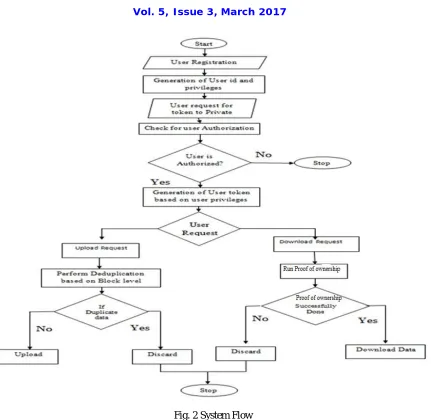
Fig. 2 System Flow
As per the above flow diagram total system get execute. User can only access the files if he have specific proof of ownership.
V.REQUIREMENTANALYSIS
5.1.1 HARDWARE REQUIRMENTS System: Pentium IV 2.4 GHz.
Hard Disk: 40 GB. Monitor: 15 VGA Colour. Mouse:Standard
Ram: 1GB.
5.1.2 SOFTWARE REQUIRMENTS Operating System: Windows 7 and above. Coding Language: java 1.7
Database: MYSQL. 5.5 .
VI.EXPERIMENTALRESULTS
Fig.3 PHR Registration Owner can register his details in PHR.
Owner login in to PHR for upload the data.
Fig.5 Upload Data
To share the data in PHR owner can upload history.
Fig.6 File Upload By PHR owner
Owner can upload file to the cloud.
VII.CONCLUSION
The cloud security model does not yet hold against threat models developed for the traditional model where the hosts are operated and used bythe same organization. However, there is a steady progress towards strengthening the IaaS security model. In thiswork we presented a framework for trusted infrastructure cloud deployment, with two focus points: VM deploymenton trusted compute hosts and domain-based protection ofstored data. We described in detail the design, implementation and security evaluation of protocols for trusted VM launch and domain-based storage protection. The solutionsare based on requirements elicited by a public healthcareauthority, have been implemented in a popular open-sourceIaaS platform and tested on a prototype deployment of adistributed EHR system. In the security analysis, we introduceda series of attacks and proved that the protocols holdin the specified threat model.This work has covered only a fraction of the IaaS attack landscape. The additional concept is also implementing attribute based file sharing system.
REFERENCES
[1] N. Santos, K. P. Gummadi, and R. Rodrigues, “Towards trustedcloud computing,” in Proceedings of the 2009 Conference on HotTopics in Cloud Computing, HotCloud’09, (Berkeley, CA, USA),USENIX Association, 2009.
[2] J. Schiffman, T. Moyer, H. Vijayakumar, T. Jaeger, and P. McDaniel,“Seeding Clouds With Trust Anchors,” in Proceedings of the 2010ACM Workshop on Cloud Computing Security, CCSW ’10, (NewYork, NY, USA), pp. 43–46, ACM, 2010.
[3] N. Paladi, A. Michalas, and C. Gehrmann, “Domain based storage protection with secure access control for the cloud,” in Proceedingsof the 2014 International Workshop on Security in Cloud Computing,ASIACCS ’14, (New York, NY, USA), ACM, 2014.
[4] M. Jordon, “Cleaning up dirty disks in the cloud,” Network Security,vol. 2012, no. 10, pp. 12–15, 2012. [5] Cloud Security Alliance, “The notorious nine cloud computing topthreats 2013,” February 2013.
[6] A. Michalas, N. Paladi, and C. Gehrmann, “Security aspects ofe-health systems migration to the cloud,” in the 16th InternationalConference on E-health Networking, Application & Services (Healthcom’14), pp. 228–232, IEEE, Oct 2014.
[7] B. Bertholon, S. Varrette, and P. Bouvry, “Certicloud: a novel tpm based approach to ensure cloud IaaS security,” in Cloud Computing, 2011 IEEE International Conference on, pp. 121–130, IEEE, 2011.
[8] M. Aslam, C. Gehrmann, L. Rasmussen, and M. Bj ¨orkman, “Securely launching virtual machines on trustworthy platforms in apublic cloud - an enterprise’s perspective.,” in CLOSER, pp. 511–521, SciTePress, 2012.
[9] A. Cooper and A. Martin, “Towards a secure, tamper-proof gridplatform,” in Cluster Computing and the Grid, 2006. CCGRID 06.Sixth IEEE International Symposium on, vol. 1, pp. 8–pp, IEEE, 2006.
[10] W. Wang, Z. Li, R. Owens, and B. Bhargava, “Secure and efficientaccess to outsourced data,” in Proceedings of the 2009 ACM workshopon Cloud computing security, pp. 55–66, ACM, 2009.