
University of Windsor University of Windsor
Scholarship at UWindsor
Scholarship at UWindsor
Electronic Theses and Dissertations Theses, Dissertations, and Major Papers
2016
Automatic Vehicle Detection and Recognition
Automatic Vehicle Detection and Recognition
Iqbal Singh
University of Windsor
Follow this and additional works at: https://scholar.uwindsor.ca/etd
Recommended Citation Recommended Citation
Singh, Iqbal, "Automatic Vehicle Detection and Recognition" (2016). Electronic Theses and Dissertations. 5780.
https://scholar.uwindsor.ca/etd/5780
This online database contains the full-text of PhD dissertations and Masters’ theses of University of Windsor students from 1954 forward. These documents are made available for personal study and research purposes only, in accordance with the Canadian Copyright Act and the Creative Commons license—CC BY-NC-ND (Attribution, Non-Commercial, No Derivative Works). Under this license, works must always be attributed to the copyright holder (original author), cannot be used for any commercial purposes, and may not be altered. Any other use would require the permission of the copyright holder. Students may inquire about withdrawing their dissertation and/or thesis from this database. For additional inquiries, please contact the repository administrator via email
Automatic Vehicle Detection and Recognition
By
Iqbal Singh
A Thesis
Submitted to the Faculty of Graduate Studies through the School of Computer Science in Partial Fulfillment of the Requirements for
the Degree of Master of Science at the University of Windsor
Windsor, Ontario, Canada
2016
Automatic Vehicle Detection and Recognition
by
Iqbal Singh
APPROVED BY:
______________________________________________ Dr. Walid Abdul-Kader
Department of Mechanical Engineering
______________________________________________ Dr. Boubakeur Boufama
School of Computer Science
___________________________________________ Dr. Imran Ahmad, Advisor
School of Computer Science
iii
DECLARATION OF ORIGINALITY
I hereby certify that I am the sole author of this thesis and that no part of this thesis has been published or submitted for publication.
I certify that, to the best of my knowledge, my thesis does not infringe upon anyone’s
copyright nor violate any proprietary rights and that any ideas, techniques, quotations, or any other material from the work of other people included in my thesis, published or otherwise, are fully acknowledged in accordance with the standard referencing practices. Furthermore, to the extent that I have included copyrighted material that surpasses the bounds of fair dealing within the meaning of the Canada Copyright Act, I certify that I have obtained a written permission from the copyright owner(s) to include such material(s) in my thesis and have included copies of such copyright clearances to my appendix.
iv
ABSTRACT
Security is extremely concerning point in distinctive applications, and in vehicle identification it is obligatory to raise alert on any suspicious activity. Such models can be utilized as a part of Border Security, Bank Security etc. In order to detect any vehicle we need to extract its features. Machine vision can be used to extract these features. Furthermore, vehicles have some of the features that may not be unique e.g. color, shape etc. Nevertheless, license plate is a unique identity of a vehicle which can identify its owner. Conversely, it can be tampered with and can be transferred to different vehicle easily. Hence we propose a new model which will combine automated license plate detection along with shape of the vehicle for e.g. SUV, Sedan and Hatchback. Finally, we compare our results with the database which has the legitimate features and information of that vehicle and which will automatically, raise an alert if any discrepancy is found.
v
ACKNOWLEDGEMENTS
vi
22T
TABLE OF CONTENTS
DECLARATION OF ORIGINALITY ... iii
ABSTRACT ... iv
ACKNOWLEDGEMENTS ...v
LIST OF TABLES ... viii
LIST OF FIGURES ... ix
LIST OF APPENDICES ... xi
LIST OF ABBREVIATIONS/SYMBOLS ... xii
CHAPTER 1: INTRODUCTION ...1
1.1 Thesis Motivation ...4
1.2 AVDR System ...8
1.3 Applications of the AVDR System ...24
CHAPTER 2: LITERATURE REVIEW ...26
CHAPTER 3: METHODOLOGY ...36
3.1 ALPDR system ...36
3.2 VSDR System ...43
3.3 Results ...49
CHAPTER 4: CONCLUSION ...59
REFERENCES ...61
APPENDICES ...67
Appendix 1: Character Templates ...67
Appendix 2: Pre-processing Demonstration ...68
vii
3.1 ALPDR System ...70
3.2 VSDR System ...77
viii
LIST OF TABLES
Table 1: Experiments ... 52
Table 2: Incorrect Instances ... 56
Table 3 - Experiment results for VSDR System ... 58
Table 4: Character Template ... 67
ix
LIST OF FIGURES
Figure 1 - Ambassador Bridge, Windsor, ON, Canada ... 4
Figure 2- Parking Enforcing System Diagram ... 5
Figure 3 - Security Check Post – Canadian Plaza, (Travelling to Canada) [38] ... 6
Figure 4 - Toll booths ... 7
Figure 5: Flowchart explaining an ALPDR System ... 11
Figure 6: Plate Geometry and Basic Syntax of a Licence Plate [11] ... 14
Figure 7: Low Spatial Resolution ... 15
Figure 8: Blurred and Motion Blurred image ... 15
Figure 9: Low Contrast Images... 16
Figure 10: Bad Lighting Conditions ... 16
Figure 11: License Plates of Different Developed Countries [39] ... 17
Figure 12: Licence Plates in Developing Countries [39] ... 18
Figure 13: Flowchart representing the process of OCR ... 42
Figure 14 – Top View of Camera Setup at the parking facility used by VSDR System ... 44
Figure 15 - Extracted frame of Vehicle ... 45
Figure 16 - Vehicle after converting the background with a Unicolor (white) ... 46
x
Figure 18 - Templates (i) Column 1 - Sedans (ii) Column 2 - SUVs (iii) Column 3 - Hatchbacks
... 48
Figure 19 - Input Image ... 49
Figure 20 - Image obtained after wavelet de-noising using Symlet4 wavelet ... 50
Figure 21 - Converting the Image to Gray Scale ... 50
Figure 22 - Image obtained after erosion ... 51
Figure 23 - Image after Background Subtraction ... 51
Figure 24 - Number of the vehicle Recognized in the Result ... 52
Figure 25 - Graph to show the Accuracy of OCR with respect to 130 Images ... 56
Figure 26 - Pie chart showing the proportion of images used in VSDR system ... 57
xi
LIST OF APPENDICES
33T
Appendix 1: Character Templates33T ... 67
33T
Appendix 2: Pre-processing Demonstration33T ... 68
33T
xii
LIST OF ABBREVIATIONS/SYMBOLS
AVDR – Automatic Vehicle Detection and Recognition
ALPDR – Automated Licence Plate Detections and Recognition
VLPDR - Vehicle Licence Plate Detections and Recognition
VSDR – Vehicle Shape Detection and Recognition
RADAR - Radio Detection and Ranging
LASER - Light Amplification by Stimulated Emission of Radiation
RFID – Radio Frequency Identification
OCR - Optical Character Recognition
IWT -Inverse Wavelet Transform
PD - Partial Discharges
SNR - Signal to Noise Ratio
MSE - Mean Squared Error
LTI - Linear Time Invariant
ROI - Region of Interest
DWT - Discrete Wavelet Transform
1
CHAPTER 1: INTRODUCTION
In the present period, the exponential rise of vehicular movement has turned into a huge reason of worry amongst the population staying in the capitals, metropolitans and urban areas. This subsequently has made it troublesome for different law implementation offices to monitor every one of the vehicles on streets. These agencies are responsible for nabbing the vehicles which are breaking many of the traffic rules. If we consider violations against security and how the culprits attempt to do their malign plans, we begin to acknowledge exactly how regularly a vehicle is part of it. Identification of the vehicle is also crucial for electronic toll machines. Thus, electronic toll accumulation depends profoundly on recognizable proof of the vehicle rapidly and precisely. Not just that, identification of vehicles play an important role in national security as well. In some countries, cross border security also requires the vehicle to be identified before they cross into another country.
2
To keep track of all the vehicles, law agencies worldwide implement licence plate techniques to give each vehicle its unique identification. Some history books say that in North America, New York was the first city to require that licence plates be appended to vehicles on April 25, 1901. Others assert West Virginia and Massachusetts ought to be given that respect, subsequent to their enactment was all inclusive and required the utilization of authoritatively delivered plates in 1903. In Canada, British Columbia began enlisting vehicles in 1903, yet it was up to the owner to make up markers to show the appointed enrollment number [37]. At present, all vehicles which are being used to transport people or goods across world are required by law to be registered with their respective state authorities. This registration helps in identification of the owner of the vehicle and the identity of the owner is linked to the vehicle plate.
Since we can see that the need of License Plate Detection and Recognition has not developed now but rather numerous years back, a few studies have been done in this field. So to better understand the previous studies it will be helpful to contemplate the set up frameworks under two classes; Active and Passive. The active ones use laser and radio frequency techniques to read the licence plate number of the vehicle. In this strategy, a scanner tag is put on the auto with the assistance of laser frameworks. These scanner tags makes it conceivable to introduce other data identified with the vehicle, alongside the licence plate. In the radio frequency technique, RFID reader is placed on the toll booth or traffic lights and can read the tag information of the vehicle from a distance. Hence, the vehicle is recognized. But the cost of these systems is very high and hence it is used where the risk of error is highly unacceptable.
3
noise such as intensity of light, shadows of objects apart from the vehicle etc. can always play a part in making the recognition of the plate difficult and hence, can lead to incorrect results.
But, these systems entirely depend on recognizing just one feature of the Vehicle and that is its Licence plate. The only unique feature of a Vehicle is its Licence Plate, but it can be easily tampered with. In 2012, more than 2000 Licence Plates were stolen off the cars in Edmonton and in the first six months of 2013, over 1,100 Licence Plates were reported stolen across the city of Edmonton. Calgary Police says that there is an increase of 80% of licence plate theft increase in 2015 as compared to 2014[34]. And these stolen plates can be used to perform various acts of malign nature and the owner can be falsely implicated for an act which he/she has not performed. This problem led to a system which recognizes the vehicle with not only just Licence plates but also tie another feature of the car with that recognition can help to eliminate such threats. In the approach taken in this thesis along with the Licence plate recognition, the shape of the vehicle is also taken into account. Such systems can be installed in facilities which rely on the correct authentication of the person to enter the premises.
4 1.1Thesis Motivation
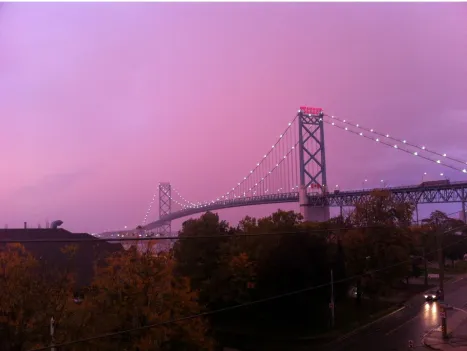
Figure 1 - Ambassador Bridge, Windsor, ON, Canada
5 1.1.1Convenience
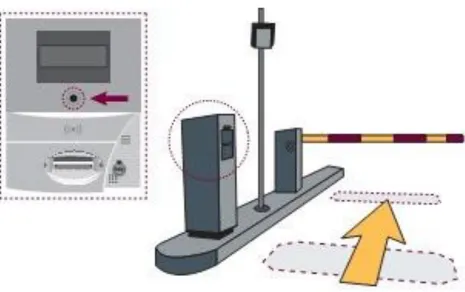
Figure 2- Parking Enforcing System Diagram
6
If we replace this system with a couple of cameras and eliminate the need to issue RFID tags, this will reduce the user’s effort to enter the facility which, he/she comes every day to perform certain daily tasks. This system can identify the car by recognising the Licence plate and also the shape of the vehicle. Then the system can match the vehicle’s credentials in its database, if it finds a match then the vehicle is allowed to enter the facility. This enables the vehicles which have been registered with the facility to pass without any delay. This saves time of the user as well as save the resources.
1.1.2Security
Figure 3 - Security Check Post – Canadian Plaza, (Travelling to Canada) [38]
7
cross. These types of systems have two aspects working together. The first part of this application consists of an officer who is there to identify the vehicle and its passengers. The officer does this by cross checking the credentials of the vehicle with the database. This system consists of a camera which aids the officer by recognition of the license plate. After recognition of the license plate, the system notifies the security personnel if this vehicle is involved in any type of illegal activity. This lets the officer to examine the vehicle more precisely and makes this time consuming and labour intensive process easier. Examples of such facilities are Border Security Systems, Industrial estates, Financial Institutes etc.
1.1.3Tracking of Vehicles
Figure 4 - Toll booth [44]
8
on the road for its travelers. This can be eliminated by the help of implementing the systems which read the Licence plate and sends the charge for using the toll road directly to the owner of the vehicle. This reduces the labor intensive work which involves stopping each vehicle and charging them before they use the toll road. Such system is in place on Highway 407, Ontario, Canada [43]. This system implementation is also cost effective as only cameras are required to install on the entry of the roads.
1.2AVDR System
Detection of the vehicle has become a serious initiative and an advanced area of research, which is possible through the application of VLPDR (Vehicle Licence Plate Detection and Recognition). Hence, VLPDR Systems can be taken into account, which primarily works by capturing the vehicular images and thus, interprets the Licence plate’s registration number automatically. AVDR (Automatic Vehicle Detection and Recognition) scheme proves to be an effective tool which helps to mechanize the hectic, tedious and the physical procedure of the workers which they encounter and deal with in their regular day life, and serves to provide efficiency in the identification of the vehicles from hundreds and thousands of vehicles observed in the regular patrolling task. AVDR combines Licence plate detection with the shape detection of the vehicle to make a system which is more susceptible to false intrusions.
AVDR system is divided into two separate modules:
1.2.1ALPDR System
“Automated Licence plate detection and recognition (ALPDR) technology was first invented in
9
system is to recognize the text in an image. This image contains the licence plate of the vehicle which is then analyzed to get the plate information. Each character of the licence plate is recognized by this system by comparing with the stored templates. Licence plate number of any vehicle is related to many features in a vehicle database which helps to describe it. Some of the features are listed below:
1. Make and Model of Vehicle 2. Colour of Vehicle
3. Year of Manufacturing 4. Engine type and size 5. Fuel type used the vehicle 6. Mileage recorded by the vehicle
7. Vehicle Identification (Chassis) Number
8. The name and address of the owner of the vehicle
1.2.1.1Types of ALPDR System
The need for the successful implementation of the Licence Plate Detection and Recognition (LPDR) system has evolved during many years and hence, many research algorithms, protocols and schemes have been proposed on the topic. Therefore, ALPDR (Automatic Licence Plate Detection and Recognition) System can be described under two main divisions [28]:
1. Online or Active ALPDR System 2. Offline or Passive ALPDR System
1.2.1.1.1Online or Active ALPDR System
10
In LASER System, a barcode is positioned on the car whereas in the case of radio frequency systems, a tag is installed in the vehicle. This tag includes the information of the Licence Plate along with the other necessary information. Surveillance Cameras keep a proper track of the positioning of the vehicles by interpreting the localized Licence place in an image from the arriving video frames. An RFID (Radio Frequency Identification Number) reader is installed in a location for the identification of the vehicle and it has a potential to interpret the information mentioned on the tag from a specific distance. Initially, the expenditure and the outlay of the proposed system were quite high, but with the advancement in the field of technology, the rate has gone comparatively much lower now. RFID System does not require the image of the vehicle to recognize the vehicles credentials, which eliminates any false recognitions. Hence, one can rely and trust on this particular system. The RFID System can be presented in a situation where a solemn answer to a problem is lacking and there is no acceptance of risk caused due to an error or in other words, there is no scope of an error [8].
1.2.1.1.2Offline or Passive ALPDR System
11 1.2.1.2Algorithms employed in the ALPDR System
ALPDR System is a system which is capable of recognizing the vehicle licence plate number from an image of the licence plate. But it has various stages which an image has to undergo to recognize the characters on the number plate.
In order to deal with variations among the characters in different Licence plates due to language, different jurisdiction, writing style or font difference, the segregated characters are required to go through few pre-processing that includes normalization and skew correction. Se we have some pre-processing steps that prove to be of great help in reducing the analytical and the computational duration before getting the final results. The plate image undergoes through the process of binarization and noises are reduced as much as possible in the preprocessing step
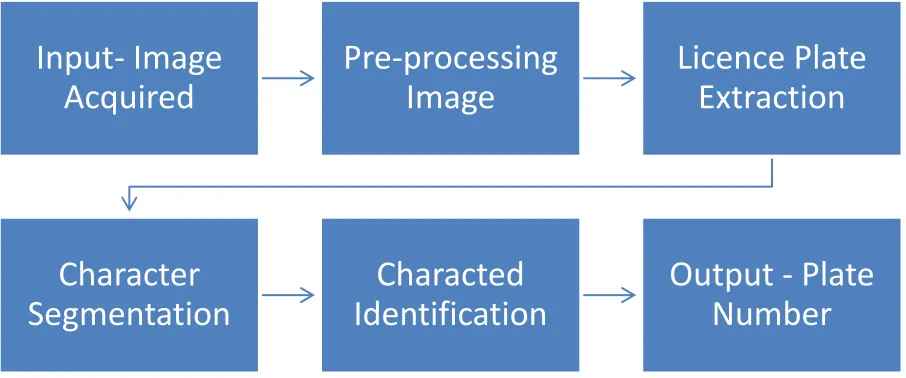
The flowchart below provides an overview of an ALPDR system [6].
Figure 5: Flowchart explaining an ALPDR System
Input- Image
Acquired
Pre-processing
Image
Licence Plate
Extraction
Character
Segmentation
Characted
Identification
12
The following five steps are primarily taken into account by the ALPDR (Automatic Licence Plate Detection and Recognition) System to successfully identify a Licence Plate [9]:
1. Plate Localization: This deals with the identification, judgement and separation of the Licence Plate on the images processed.
2. Plate Inclination and Size: This accounts for the compensation of the distorted/skew of the Licence Plate and helps in the adjustment of the magnitude and the proportions of the requisite range.
3. Normalization: Here, in this step, the brightness and the contrast in the images generated are adjusted and altered.
4. Character Segmentation: This step implies heavily on the searching of single or individual characters scripted on the Licence Plates of the Vehicles.
5. OCR (Optical Character Recognition): OCR is basically defined as the automatic transformation (both mechanical and electrical) of the descriptive images of the text, either written manually or typed, frequently captured by the scanner into machine text which is editable, hence, changes can be made into it. It functions by the successful implementation of two basic steps: Training and Recognition. The image is taken as an input, the characters and numbers are segmented, and the features are extracted from the segments and then finally recognized by matching the existing templates from the database of OCR process.
a. Training: The program is first trained with a set of sample images from database for each of the characters to pull out the important characteristics based on which next
13
b. Recognition: based on the closely matched template, the character is finally recognized and written to the output file.
1.2.1.3Technological Requirements for the ALPDR System
ALPDR (Automatic Licence Plate Detection and Recognition) System has certain prime technological requirements given as:
1. The quality of the Automatic Vehicle Licence Plate Detection and Recognition System along with its functional and practical recognition techniques.
2. Camera quality and the quality of technological software for image acquisition. If these recognition algorithms are implemented in a better manner, they will represent:
1. A hike in the quality of the ALPDR software
2. The rate of image recognition accuracy will be higher comparatively. 3. The image processing speed will be faster.
4. It will be able to handle a wider range of the image quality. 5. It will show its compliance to deal with a variety of plates.
6. It will witness tolerance power towards distortions of the input data.
14
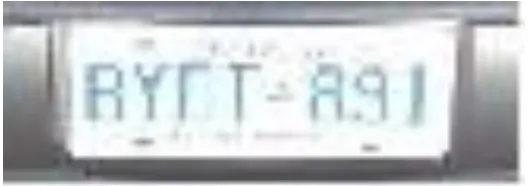
The figure given below provides the Plate Geometry and Basic Syntax of a Licence plate [11]
Figure 6: Plate Geometry and Basic Syntax of a Licence Plate [11]
Licence Plates are available in a wide range all around the world. These include [11]:
1. White Script on Black or a light background 2. Black Script on White or a dark background 3. Single Row Licence Plates
4. Multiple Row Licence Plates
15
The prime image acquisition algorithmic technique determines the quality of the captured image of the plate through which the image detection software has to be employed. The better the quality of the captured image, the better is the accuracy of the resulted image.
A good quality captured image witnesses the following properties:
1. Decent Angular View 2. High Sharpness
3. High Developed Contrast 4. Good Spatial Resolution 5. Adequate Lighting Conditions
The following figures describes the problems encountered in the image quality:
16
17 1.2.1.4Challenges faced by the ALPDR System
The attributes of the Licence Plates are maintained in a firm and specific manner in various developed countries. These attributes include the size and the color of the Licence plate, the number of lines included in the Licence plate, the font size, the font and the color of each and every character, the script used in the Licence plate, etc. [13].
The images below provide an overview of some of the standard Licence plates in some developed countries.
18
Whereas, in developing countries, a standard practice for the Licence plate is still not employed among different states which results in causing the process of localization and the recognition of the Licence plate an exceedingly complex and complicated task. Also, the script used in writing the Licence plate is not universal throughout the country or in other words, multiple scripts are used. The images given below provide an overview of the Licence Plates highlighting the variations in the script, shape, font, size, etc.
19
The various difficulties faced by the ALPDR System include [14]:
1. Poor Image/ File Resolution: This may arise on account of various reasons which include the distance of the Licence plate while taking the photograph, i.e. the Licence plate may be too distant which causes a decrease in the image quality or camera employed in capturing the images is not of high quality.
2. Blurred Images: The images here become motion blurred. The term motion blurred refers to the perceptible streaking of the moving objects in an immobile image or in a sequence of images, e.g. in a movie. This drawback primarily arises on account of rapid movement during the coverage or recording of an image, thereby resulting in creating disturbance in the image.
3. Poor Lighting and Low Contrast Images: This situation arises mostly on account of overexposure in the surroundings, reflection of various objects in the environment or shadows projecting on the licence plate.
4. Object Obscure: This happens when certain object or substance sticks on to the plate or a part of the plate, for example, dirt or tow bar wiring which causes complications in taking a clear image of the Licence Plate.
5. Problems due to the difference in the Licence Plates: The front and back reading of the Licence Plates are different in many jurisdictions. Some only require to put rear plates so the owner can install any custom characters to the front. This creates difference in licence plates in same vehicle.
20
about a change in the angular view of the surveillance camera and hence, results in low quality images.
7. Trouble caused on account of different fonts used: A different font is used on the Licence Plate of the Vanity Vans, which enhances the problem. However, various countries have completely boycotted this which has resulted in eliminating the trouble caused due to the employment of these dissimilar fonts.
8. Lack of Coordination between different states in a country: Sometimes, the vehicles from two different states or from different countries own the same Licence Plate number but the font and the script is different.
9. Circumvention Techniques: This technique increases the reflective properties of the script and develops a proxy setting through which it becomes difficult to trace the Licence Plate or to develop a high-level contract in the imaging which assists in coding the number. A plate cover or spray is employed for this technique.
Some of these drawbacks can be rectified through the software; however, those still left are transferred onto the hardware part of the scheme to find a solution for these problems. The complications that arise due to the objects obscuring onto the Licence Plate can be avoided by increasing the height of the surveillance camera. However, it gives birth to other difficulties, such as adjusting the amplified and enlarged skew of the Licence Plate [15].
21
erroneousness and imprecision would not be appreciated in various applications of ALPDR System.
1.2.2VSDR System
Vehicle Shape Detection and recognition is the second part of AVDR. The objective of this system is to recognize the shape of the vehicle. There are various types of shapes into which a vehicle can be classified. The various car classifications are Hatchbacks, Sedans, Crossovers, Sports Utility Vehicles (SUV), Vans and Trucks. These are the types which are used most often by the general public. This area has not been explored as much as the Licence plate detection. The reason for this is that only recognizing the vehicle shape does not give any unique feature of any vehicle. This approach combines vehicle licence plate detection with shape detection which helps to identify individuals for credibility.
The best angle to detect any vehicles shape is by looking at the side profile of the vehicle. Each and every class of vehicle can be distinguished by analyzing the image of that vehicle from side. The system recognises a pattern of the vehicle by recognizing the outer boundary of the vehicle.
1.2.2.1Classification of Vehicle
The system implemented can detect three types of vehicle classes. Each class has specific differences which are defined below:
22
back, except for some back-placed engine models [30]. The image in figure 18 is one of the templates used by the VSDR system to recognise the class of the vehicle to sedan. 2. Hatchback: “A hatchback is an auto body arrangement with a back door that swings
upward to give access to a load territory. Hatchbacks may have fold-down second column seating, where the inside can be adaptably reconfigured to organize traveler versus freight volume which it can haul” [31]. It is usually small in dimensions than a sedan or a SUV. Figure 18 is a typical template for a hatchback.
3. SUV: According to the Merriam-Webster dictionary, a "sport utility vehicle" is "a rugged automotive vehicle similar to a station wagon but built on a light-truck chassis". [32] The "SUV" term is defined as "a large vehicle that is designed to be used on rough surfaces but that is often used on city roads or highways.” [33]. Figure 18 is an example of template for an SUV.
1.2.2.2Challenges faced by VSDR System
Challenges with VSDR system are similar to many applications that use Images for extracting information.
23
2. Inconsistent background: For VSDR system to work correctly, the background has to consistent with all the images. This is necessary as VSDR system uses the background subtraction to get the object in the image. If the background is constantly changing then the VSDR system will not be able to get the desired output.
3. Over shadowing: Shadows cause a major problem for extracting information from image. Shadows created by the vehicle on the pavement also cause the background of the image to shift. The larger the shadow of the vehicle, more will be the inconsistency with its shadow. In a controlled environment the lighting can be controlled, hence the shadows can be controlled. But in an open setting these shadows cause a big issue in extracting information from the image.
24 1.3Applications of the AVDR System
AVDR System finds applications in various fields which are described below [12]:
1.3.1Parking Automation and Parking Security
This application provides mechanization in the efficient management of ticketless parking, accessing the parking mechanism, providing guidance in terms of parking location, preventing car robbery and theft, fraud caused on account of tickets exchanged or “lost tickets”, generating a fully automatic payment procedure. In addition to this, the face image of the driver captured proves to be beneficial in preventing the car hijacking to a great extent.
1.3.2Access Control
This application can be implemented through the identification of the Licence Plate and shape of the vehicle, thus providing security and safety, event management and logging, etc. Through the successful implementation of this application, the authorized members are provided with the facility of automatic door opening which provides assistance to the security guard on duty.
1.3.3Tolling or Motorway Tolling
On a Toll-Road, the travel fee or the toll fee is calculated considering the vehicle number and this generates the toll ticket. This application takes advantage of AVDR systems as they can recognize the vehicle rapidly, hence decreasing the time to enter the toll road for the passengers of vehicle.
1.3.4Law Enforcement
25
actively with national database to raise alert for any vehicle which is involved in any type of criminal activity.
1.3.5Better Traffic Management
AVDR Systems can be used to calculate how much time a specific vehicle is taking to travel between any two intersections. Thus gives the duration time information which can be used to find if there is any congestion on that particular road. By analyzing the time the traffic management system can control the traffic effectively and swiftly to reduce congestion.
1.3.6Border Control
The main reason of concern of any border control post is illegal border crossing. This can be minimized by effectively and quickly identifying the vehicles used in such activities. AVDR system can help in identifying the vehicle as it approaches the border security officer, hence providing him with information regarding the vehicle and the owner. This helps by raising an alarm for any suspicious vehicle. This vehicle could be involved in smuggling of illegal goods across border or worse, terrorism.
1.3.7Other Applications
In addition to the above mentioned applications, AVDR System helps the society in various other ways. These include:
1. Traffic Control 2. Marketing Control 3. Airport Parking
26
CHAPTER 2: LITERATURE REVIEW
An image extraction algorithm in Licence Plate Detection and recognition System was proposed by Salah Al-Shami et al [16]. Here, the optical character recognition is being implemented by assigning weights to characters. The tests were performed on real world licence plate images. Character recognition is undoubtedly a difficult task, and many researchers have worked with full authenticity to sort out this problem. This process depends upon manual selection of each line of character and also each character individually. This manual selection of characters is crucial to this technique as it produces ideal conditions to get accurate character recognition. Different stages are incorporated into this recognition plan of a character. Characterization depends on definitive features of that character which are stored earlier to compare. These characters are matched to the manually selected characters to get results. In KSA (Kingdom Of Saudi Arabia) this technique was utilized on a few datasets in License Plates. Consequently, the generated results showed the precise and the productive way of the proposed technique in contrast with the traditional proposed plans.
27
demonstrated in the effective law authorization. In this approach cameras are used to take pictures of the vehicles. These pictures are of the rear end of the vehicle which contains the licence plate. By applying the algorithm first the licence plate is localized from the image and then the character recognition algorithm is implemented to get licence plate information. This task is implemented effectively by the help of high definition cameras so that the image quality is high so that data can be extracted out of the image.
28
Amr Badr et al [20] proposed and presented an ANPR (Automatic Number Plate Recognition) System, which performs plate localization and character recognition. This method uses different techniques for the plate localization and character segmentation as well as recognition. Edge detection and morphological techniques are used to localize the licence plate from the image. Whereas the character segmentation and recognition are done by the help of artificial neural networks. This system also has a few drawbacks such as poor image quality, different angles of inclination in the image, bad lighting and low contrast to name a few. This system is only for images and not for continuous videos. And the images had to be taken while the vehicle is at a full stop, so that the image is not blurred which will result in poor recognition rate. Even the skewed images are also not recognized as the character segmentation is not effective. The main focus of this method was to study the results of this algorithm on random images and not to get the most accurate results.
29
30
1. Acquiring the contrasting features of the images through morphological operations
2. Recuperation process of the character segmentation is done through a reconstruction protocol.
3. A specific character identification technique is used to provide authenticity to the Licence plate in terms of the characters.
Lastly, a comparative analysis is provided between these four techniques. The result further revealed the inadequacy of the first method, since it requires a large memory space, therefore not feasible for the embedded systems, and also time-consuming, hence not suitable for the real-time system. The second technique is able to identify the background matters due to the presence of parallel lines. The third approach suffers a drawback with the vehicle that show a similar color as that of the Licence plate, and also with the snapshots having complex color. The final and the last step witness the low accuracy and the slow speed fault. Hence, the proposed work presents a comparative study on the protocols and the methodology of the Automatic Licence Plate Detection and Recognition (ALPDR) Systems in an efficient manner.
31
consideration to bring about the smooth functioning of process of identification of the vehicle number plate. The identification of the candidate regions in the vehicle number plate is carried out on the basis of the regulation of the plate, which primarily consists of the script, the color, the font, the font size, the pattern followed by the script and the count of letters, whereas the identification process through the implementation of neural network algorithm involves a simple rule, i.e., the candidate region which includes the alphabets and the numbers similar to the one justified by the motor vehicle regulation will be certified as a Licence plate region. The analysis carried out on the images of around seventy cars within an automatic parking system revealed the image extraction rate by 92%.
32
33
images in a single snapshot and can work on various kinds of number plates, e.g., car, bus, truck or motorbike. But it faces certain drawbacks while dealing with the poor quality image recognition process.
34
Recognition) Algorithm has also been considered which provides pixel-by-pixel comparison of the images. The results computed through a real-life test operating for twelve consecutive days demonstrated and revealed the identification rate of around 80%. There was no observance of false identification in the rate analyzed since each image in the database included a valid Licence plate number. Hence, the proposed thesis presented its benefits not just on all the frames and angles in the video streams but also on the motionless separated images within an Automatic Licence Plate Recognition system.
The following are the papers which were most relevant to the car shape detection and recognition.
35
36
CHAPTER 3: METHODOLOGY
ALPDR and VSDR systems have been explained separately. Each system has an independent control unit, which will work separately to give us the desired output.
3.1ALPDR system Dataset:
ALPDR System is developed for a specific application in the University. The dataset used for this System is gathered in University premises, by the consent of the University. This is done because there is no universal dataset in which this algorithm can be applied to get the accuracy. All the previous researches have been done using their own datasets which is not available to use for our algorithms. Sample Images of dataset are in Appendix 3.
The methodology implemented in the proposed project comprises of four main steps which are mentioned below [27]:
1. Pre-processing Stage
2. Licence Plate or Number Plate Localization 3. Character Segmentation
37 3.1.1Preprocessing Stage
The Preprocessing technique for the Licence Plate localization consists of the performing the following tasks in order to achieve the desired image.
3.1.1.1Wavelet-based De-noising
A wavelet is a wave-like oscillation along with amplitude which starts at zero, then increases and again comes back to the initial zero.
De-noising is defined as the process of construction of a signal taking into consideration a noisy one. Various de-noising scheme are taken into account for the successful elimination of noise although conserving the initiative data and certain other crucial constraints of the image, e.g., contrast, brightness, background, edge, color intensity, etc.
The wavelet de-noising process implemented in the current proposal has been discussed below:
1. A wavelet transform is applied to the noisy signal in order to generate the noisy wavelet coefficients, up to a certain level which is able to figure out and differentiate the occurrence of PD (Partial Discharges).
2. An appropriate threshold limit is selected at each stage along with a suitable threshold method (i.e. either hard or soft) for the successful removal of noise.
3. Application of IWT (Inverse Wavelet Transform) of threshold wavelet coefficients for acquiring a de-noised signal.
38 3.1.1.2Conversion of image to Gray Scale
In the present step, all the RGB colour components, i.e., the Red, Green and the Blue are estranged from the 24-bit colour value of each pixel (i,j), in order to calculate the 8-bit gray value. This is performed by the implementation of the following formula [40]:
Gray (i,j) = 0.30*R(i,j) + 0.59*G(i,j) + 0.11*B(i,j)
3.1.1.3Applying the Weiner Filter
The Weiner Filter is defined as the mean square error optimal filter and serves to minimize the MSE error caused due to the process of inverse filtering and noise smoothing between the probable random process and the preferred method. The main application of this filter is in signal processing where it helps to generate an average targeted random process through the implementation of LTI (Linear Time Invariant) filtering. The Weiner Filter serves as an optimization filter for the images which faces degradation on account of additive noise or blurred images. For calculating the Weiner Filter, the signal and the noise process are considered as second-order stationery and only those noise processes are taken into consideration which have mean to be equal to zero. It primary application is in the frequency domain and hence, it is given by the following formula:
G (u,v) = H*(u,v) PS (u,v)/ H(u,v)2 PS (u,v) + Pn (u,v)
Here,
H (u,v) denotes the Fourier Transform of the Point Spread Function (PSF)
PS (u,v) denotes the Power Spectrum of the Signal Process, and
39 3.1.1.4Enhancement of the Image Contrast
This can be achieved through the Histogram Equalization Technique, where the complete count of the image pixel is denoted with the term n and those in the gray level, k is defined as nk. Therefore, the probability of occurrence of the image in the gray level k is defined as:
PK – nk/N
3.1.2Licence Plate Localization
The primary step in the Licence Plate Identification System includes the localization of the Licence plate. The image captured constituting the complex background is filtered in this step and the resultant image provides the number plate image with high contrast regions. Due to the presence of the ambiance in the snapshots the scene becomes complex. There is a need to consider a specified frame, so that one can focus on the specific images, this can be achieved by excluding the background from the image. Hence, an appropriate and specific window frame size must be taken into consideration. The window size is predicted by the probable dimensions of the number plate.
40
proposed scheme, the number plates of a variety of vehicles can be extracted (both front and back). The results simulated through the analytical and experimental analysis reveal a good quality of localization results with small runtime and high accuracy in the detection rate.
3.1.3Character Segmentation
The process of character segmentation acts as a link or a connection between the localization process of the number plate and the Optical Character Recognition (OCR) modules. This step implies heavily on the searching of single or individual characters scripted on the Licence Plates of the vehicles. The prime function of this step is to provide separation to the characters that are selected in the candidate region or from the extracted number plate, so that each character would be transmitted individually to the OCR scheme to carry out the process of recognition. “Basically, this process focuses on the histogram computation and thresholding but recent
advanced protocol involves the implementation of the artificial neural networks” [7]. In order to carry out the segmentation process efficiently, there is prime requirement of normalized or standardized Licence plates, since various plates follow different font styles and also, the alphabets and the numeric formats are fancy. Therefore, the countries where the normalized Licence plates are absent, does not even have an efficiently running LPR (Licence Plate Recognition) System. In order to overcome this drawback, the government authorities in such countries should undertake an initiative with specific guidelines and make mandatory for all the drivers to include high security Licence plates in their vehicles.
41
holds the name of the state along with the different other text, there is a need to eliminate such text and words. Morphological operators are implemented for the elimination of the white regions that flee away the range rectification process, since sometimes the shadows and the text demonstrate similarity with the numerical characters. Finally, the extracted characters are passed onto the OCR (Optical Character Recognition) module.
The process of character segmentation is unique, novel and important in the ALPDR (Automatic Licence Plate Detection and Recognition) System since the functioning of all further processes depends upon it. Also, if the process of segmentation faces failure, then the character may not get divided decently into two sections, or two characters may inappropriately get merged together, which in turn causes a failure of the recognition process. If only one row number plates are provided consideration in the ALPDR (Automatic Licence Plate Detection and Recognition) System, then the process of segmentation works to identify the horizontal boundaries among the characters localized. The second stage in the segmentation process is the enhancement of the segmented characters. Since, the number plate includes the characters along with certain adverse rudiments, e.g. noise on account of shadows or defects in the cameras or other equipment, as well as undesired space on the character sides, therefore there is a need to remove these and extract out only the individual characters.
42
of the pixel value lesser than the specified threshold are transformed back to the background and thus, disregarded. Hence, what left is a comparatively moderate binarized number plate devoid of noise and undesired regions, and appropriate to carry out the segmentation process.
3.1.4Character Recognition
The premium aim of this step is to provide classification and complete identification to the binarized images that comprises of the characters obtained from the number plate localized regions.
The figure given below describes the functioning of the OCR via flowchart:
Figure 13: Flowchart representing the process of OCR
Following are the steps which result in Character Recognition:
1. Template Database: Production of format database is essential before the character recognition can begin. So according to the text style of the Licence plates, the database is
Create Template
Maintain Database
Compare
Extract Letters
Perform Segmentation
Load Alphabets
Security Check
Character Recognition
Text from Extraction
43
created. This database comprises of alphabets A-Z and digits 0-9. (See Appendix for the templates)
2. Comparing Segmented Characters After the templates are stacked in the memory, the ALPDR system compares each segmented character to every one of the templates and provide with the nearest positive value.
3. This process is repeated until all the segmented characters are recognised.
3.2VSDR System Dataset
The database which was created for the VSDRS system was collected in University of Windsor premises. To collect this data permission was taken from University of Windsor law office, on terms that the data will be solely used for educational purposes towards this thesis.
44
Figure 14 – Top View of Camera Setup at the parking facility used by VSDR System
Algorithm employed in VSDRS:
45 3.2.1Pre-processing
Figure 15 shows the extracted frame of a sedan. The VSDR system works when there is a unicolor background in the image. With unicolor background, the edges of the vehicle are precisely visible.
Figure 15 - Extracted frame of Vehicle
46
Figure 16 - Vehicle after converting the background with a Unicolor (white)
To get the shape of a vehicle we need two things, Foreground and Background. The image in in figure 16 and the background image is a unicolor image of same resolution as of the image taken. The various steps which are followed to identify a class of any vehicle are described below:
3.2.2Normalising the image
The images were taken by a camera with native resolution of 1980 X 1080 pixels. At this resolution the computation time for the program can be very high. Also the space requirement for storing these images will be high. So to make the system faster and also require fewer resources the images were normalised to 640 X 360 resolutions.
3.2.3Background subtraction
47
templates for different shapes. These templates are later used to get the closest match of the vehicle and determining the shape of the vehicle.
Figure 17 - Background subtraction and Blob Detection
3.2.4Template Creation
48
Figure 18 - Templates (i) Column 1 - Sedans (ii) Column 2 - SUVs (iii) Column 3 – Hatchbacks
3.2.5Template Matching
49 3.3Results
3.3.1Hardware Used
1. MATLAB version 2014a
2. Windows Operating System (WOS) 10 3. 1.8 GHz Intel "Core i5" Processor 4. 4 GB RAM
3.3.2Input
The pictures given below provide the screenshots of the proposed scheme methodology and results simulated by APLDR system.
50
Figure 20 - Image obtained after wavelet de-noising using Symlet4 wavelet
51
Figure 22 - Image obtained after erosion
52
Figure 24 - Number of the vehicle Recognized in the Result
3.3.3Experiments
Comparison of this process cannot be done to other techniques as there is no set of unified rules or a unified dataset on which tests can be run. The following table will list all the images on which the tests were run. Last column shows us the accuracy of this system which uses Soft Thresholding technique in the preprocessing phase.
Table 1: Experiments
Input Number 1ST 2ND 3RD 4TH 5TH 6TH 7TH No of correct Percentage
BYDT 891 B Y D T 8 9 1 7 100 %
AC 85013 A C 8 5 0 1 3 7 100 %
BMJX 617 B M J X 6 1 7 7 100 %
BXYY 291 B X Y Y 2 9 1 7 100 %
BPWC 879 B P W C 8 7 9 7 100 %
AVFL 214 A V F L 2 1 4 7 100 %
BRLR 548 B R L R 5 4 8 7 100 %
53
BTHX 314 B T H X 3 1 4 7 100 %
BYDT 423 B Y D T 4 2 3 7 100 %
BKYD 911 B K Y D 9 1 1 7 100 %
BYDT 819 B Y D T 8 1 7 7 100 %
BKYD 911 B K Y D 9 1 1 7 100 %
BPWC 879 B P W C 8 7 9 7 100 %
BXEL 499 B X E L 4 9 9 7 100 %
BVNK 986 B V N K 9 8 6 7 100 %
BUNK 986 B U N K 9 8 6 7 100 %
BSTY 229 B S T Y 2 2 9 7 100 %
BAWP 571 B A W P 5 7 1 7 100 %
AYDA 786 A HY D A 7 8 6 7 100 %
BYDT 891 B Y D T 8 9 1 7 100 %
BRLR 548 B R L R 5 4 8 7 100 %
BVJL 383 B V J L 3 8 3 7 100 %
BVMC 388 B V M C 3 8 8 7 100 %
BXPS 184 B X P S 1 8 4 7 100 %
BYDT 423 B Y D T 4 2 3 7 100 %
BWTP 026 B W T P 0 2 6 7 100 %
BLZP 686 B L Z P 6 8 6 7 100 %
BMJX 617 B M J X 6 1 7 7 100 %
BXYY 291 B X Y Y 2 9 1 7 100 %
BDPF 005 B D P F 0 0 5 7 100 %
BRXK 195 B R X K 1 9 5 7 100 %
AWVM 174 A W V M 1 7 4 7 100 %
BKLE 576 B K L E 5 7 6 7 100 %
BNKF 642 B N K F 6 4 2 7 100 %
BWHX 279 B W H X 2 7 9 7 100 %
BTHH 992 B T H H 9 9 2 7 100 %
BTHX 314 B T H X 3 1 4 7 100 %
BTWV 396 B T W V 3 9 6 7 100 %
BVMC 999 B V M C 9 9 9 7 100 %
BDYX 587 B D Y X 5 8 7 7 100 %
AZXR 671 A Z X R 6 7 1 7 100 %
AZYM 679 A Z Y M 6 7 9 7 100 %
AZYM 679 A Z Y M 6 7 9 7 100 %
ATEL 529 A T E L 5 2 9 7 100 %
AKXL 025 A K X L 0 2 5 7 100 %
AZHB 448 A Z H B 4 4 8 7 100 %
BSRR 480 B S R R 4 8 9 7 100 %
54
APLM 487 A P L M 4 8 7 7 100 %
BXSB 566 B X S B 5 6 6 7 100 %
BPSV 949 B P S V 9 4 9 7 100 %
BVLV 525 B V L V 5 2 5 7 100 %
BVLV 525 B V L V 5 2 5 7 100 %
BMCM 508 B M C M 5 0 8 7 100 %
BSET 296 B S E T 2 9 6 7 100 %
BNTC 140 B N T C 1 4 0 7 100 %
BVEY 094 B V E F 0 9 4 7 100 %
BXHX 633 B X H X 6 3 3 7 100 %
BVCC 862 B V C C 8 6 2 7 100 %
BWTP 739 B W T P 7 3 9 7 100 %
BTWV 047 B T W V 0 4 7 7 100 %
BVPN 776 B V P N 7 7 6 7 100 %
BWEX 889 B W E X 8 8 9 7 100 %
BDPF 005 B O P F 0 0 5 6 85.71 %
BXLE 576 B X L R 5 7 6 6 85.71 %
BWHX 279 B W H X 9 7 9 6 85.71 %
AWLF 209 A W L F 2 0 N 6 85.71 %
BTWV 396 B T W V N 9 6 6 85.71 %
BVMC 099 B V M C 9 9 9 6 85.71 %
BTTN 543 B T T N 5 4 N 6 85.71 %
BWTP 026 B W T P 8 2 6 6 85.71 %
BVNK 968 B V W K 9 6 8 6 85.71 %
BCAY 963 B C A Y 9 6 N 6 85.71 %
AZAE 976 B Z A E 9 7 6 6 85.71 %
BSZZ 287 B S Z 2 2 8 7 6 85.71 %
BKFD 850 B K F B 8 5 0 6 85.71 %
BKLE 056 B K L E 9 5 6 6 85.71 %
BKLE 056 B K L E 9 5 6 6 85.71 %
BRLW 549 B R L W 5 4 9 6 85.71 %
BLKD 209 B L K B 2 0 9 6 85.71 %
BVNK 037 B V N K 0 N 7 6 85.71 %
BHAT 088 B H A T N 8 8 6 85.71 %
BVWH 593 B V W H 5 9 N 6 85.71 %
BVFJ 380 B V F J N 8 0 6 85.71 %
B3NB 064 B 3 M B 0 6 4 6 85.71 %
BPWC 879 B P W E 8 7 9 6 85.71 %
BKYD 911 B K Y B 9 1 1 6 85.71 %
BNHX 344 B N H X N 4 4 6 85.71 %
55
AWLF 209 A W L F 2 9 9 6 85.71 %
BTTN 543 B T T M 5 4 3 6 85.71 %
BJHW 578 B J M W 5 7 8 6 85.71 %
BKMD 815 B K M B 8 1 5 6 85.71 %
BSYM 851 B S Y M 8 5 A 6 85.71 %
BCAY 963 B C A Y 9 6 H 6 85.71 %
BTXR 236 B T X R 2 N 6 6 85.71 %
BKTA 816 B K T A 8 9 6 6 85.71 %
BTMS 241 B T M S 2 4 9 6 85.71 %
ASAH 135 A S A M 1 3 5 6 85.71 %
BYJJ 395 B Y J J N 9 5 6 85.71 %
BSEB 409 B S E B 4 9 9 6 85.71 %
BRRS 004 B R R S 0 9 4 6 85.71 %
BJLZ 178 B J L 2 1 7 8 6 85.71 %
BMVD 166 B M V D 1 6 6 6 85.71 %
BSKY 087 B S K Y 9 8 7 6 85.71 %
BJPN 046 B J P M 0 4 6 6 85.71 %
BDKA 707 B B K A 7 0 7 6 85.71 %
AMTU 570 A M T U 5 7 8 6 85.71 %
BAPN 626 B A P M 6 2 6 6 85.71 %
BRAY 105 B R A Y 1 9 5 6 85.71 %
AXNV 710 A X W V 7 1 0 6 85.71 %
BNTC 238 B N T C 2 N 8 6 85.71 %
BPKF 037 B P K F 0 N 7 6 85.71 %
BYJR 959 B V J R 9 5 9 6 85.71 %
AK 18455 A K I 8 4 5 5 6 85.71 %
BWNR 438 B W N R 4 N 8 6 85.71 %
BTPN 709 B T P M 7 0 9 6 85.71 %
BNTC 140 B N T E 1 4 0 6 85.71 %
BWNF 936 B W M F 9 3 6 6 85.71 %
BWNF 936 B W M F 9 3 6 6 85.71 %
DFK 2865 D F K 2 9 6 5 6 85.71 %
BXHC 947 B X M C 9 4 7 6 85.71 %
BVWZ 331 B V V 2 3 3 1 6 85.71 %
AYDZ 755 A Y B 2 7 5 5 5 71.43 %
BJXU 005 B J X U 0 8 E 5 71.43 %
ANTZ 029 A N T 2 9 2 9 5 71.43 %
BPNT 130 B P N T 1 N 9 5 71.43 %
AZAF 933 A Z A F 9 N N 5 71.43 %
BKFD 833 B K F D 8 N N 5 71.43 %
56
Following table tells us the Incorrect Instances of all the alphabets and digits:
Table 2: Incorrect Instances
Character Number of Incorrect Instances
2 1
9 2
0 11
3 20
A 1
D 4
N 9
Z 3
C 2
B 2
H 2
Y 1
W 1
Figure 25 - Graph to show the Accuracy of OCR with respect to 130 Images 0 10 20 30 40 50 60 70 80 90 100
1 5 9 13 17 21 25 29 33 37 41 45 49 53 57 61 65 69 73 77 81 85 89 93 97
101 105 109 113 117 121 125 129
57 The following data is deduced from the experiments:
1. The experiments are done on 139 images.
2. Plate Localization is successful on 94.24 % of Images (131 out of 139) 3. OCR accuracy for all the Images is 93.34 %, out of which
a. 64 Images have 100% OCR rate
b. 60 Images have only 1 out of 7 character wrong c. 6 Images have 2 out of 7 characters wrong d. 1 Image have 4 out of 7 characters wrong
In VSDR system total of 102 images were used in experiments. The following are the categories:
1. Sedans : 58 2. SUVs: 38 3. Hatchbacks: 2
Figure 26 - Pie chart showing the proportion of images used in VSDR system
Total Images
58
The following are the results to the VSDR system. Out of 102 images of vehicles 98 were categorised correctly with an accuracy of 96.07 %.
Table 3 - Experiment results for VSDR System
Sedans SUV Hatchbacks
Total 58 38 6
No. of Correct 55 37 6
Figure 27 - Graph to depict the number of correct Image recognized
0 10 20 30 40 50 60 70
Sedans SUV Hatchbacks
VSDR System
59
CHAPTER 4: CONCLUSION
AVDR scheme proves to be an effective tool undertaken by the legislative and consumer safety forums. It helps to mechanize the hectic, tedious and the physical procedure of the officers which they encounter and deal with in their regular day life, and serves to provide efficiency in the identification of the vehicles from hundreds and thousands of vehicles observed in the regular patrolling task. This data significantly improves the undercover competency of the law enforcement agencies and hence, proves beneficial in the intelligence and the analytical functioning. In the current approach, wavelet de-noising process with soft thresholding in preprocessing step generates a system for successful recognition of the Licence plate, and Binary masking of the templates of shapes can effectively recognize and classify a vehicle.
From the above results, we draw the following conclusions:
1. In order to carry the localization process of the number plate efficiently, the prime requirement is the presence of the proper edge between the vehicle Licence plate boundary and the background. This provides assistance to the Weiner filter in detecting the edge.
2. The camera must be located at a specific distance from the number plate, in order to provide a suitable range to the count of the pixels within the Licence plate region and to make them constant in nature.
3. The major drawback encountered in the character segmentation process is the presence of fancy scripts and formats which results in the creation of obstruction during the procedure.
60
61
REFERENCES
1. Bora, Kayhan, Nergiz Ercil Çağiltay, and Dr. Hakan TORA. 2009. “Car Plate Recognition.” Turkey: Atilim University.
2. Tran Duc Duan, Tran Le Hong Du, Tran Vinh Phuoc, Nguyen Viet Hoang, “Building an Automatic Vehicle Licence-Plate Recognition System”, International Conference in Computer Science, RIVF’05, February 21-24, 2005, Can Tho, Vietnam.
3. David J. Roberts and Meghann Casanova, “Automated Licence Plate Recognition Systems: Policy and Operational Guidance for Law Enforcement”, a research report
submitted to the US Department of Justice, September 2012.
4. Ch. Jaya Lakshmi, A. Jhansi Rani, K. Sri Ramakrishna, and M. KatiKiran, “A Novel Approach for Indian Licence Plate Recognition System”, VI International Journal of Advanced Engineering Sciences and Technologies, Volume (11), Page(s): 10-14, October 14, 2011.
5. Lihong Zheng, Xiangjian He, Qiang Wu, Wenjing Jia, B. Samali, and M. Palaniswami. “A Hierarchically Combined Classifier for Licence Plate Recognition”, In 8th IEEE
International Conference on Computer and Information Technology, 2008. CIT July 8-11 2008, Page(s): 372–77, doi: 33T10.1109/CIT.2008.459470433T.
62
7. Caner, H., H.S. Gecim, and A.Z. Alkar. September 2008. “Efficient Embedded Neural-Network-Based License Plate Recognition System.” IEEE Transactions on Vehicular Technology, Volume (57), Issue (5), Page(s): 2675–83 doi: 10.1109/TVT.2008. 915524. 8. Yan, Dai, Ma Hongqing, Liu Jilin, and Li Langang. 2001. “A High Performance License
Plate Recognition System Based on the Web Technique.” In 2001 IEEE Intelligent
Transportation Systems, 2001. Proceedings 2001 IEEE August 25-29, 2001, Page(s): 325-29, doi: 10.1109/ITSC.2001.948677.
9. Asadollah Shahbahrami, Hadi Sharifi Kolour. 2011 “An Evaluation of Licence Plate Recognition Algorithms”, International Journal of Digital Information and Wireless Communications (IJDIWC), Volume (1), Issue (1), Page(s) 281–87, 2011 (ISSN 2225-658X).
10. Fukunaga K., “Introduction to Statistical Pattern Recognition”, Second Edition,
Academic Press, San Diego, USA, 1990.
11. Plate Geometry and Basic Syntax (33Thttp://www.platerecognition.info/1102.htm33T). (dd:
December 21, 2015)
12. Link: Applications of AVLPR System,
(33Thttp://www.anpr.net/anpr_09/anpr_applicationareas.html33T) (dd: December 22, 2015)
13. Satadal Saha, Subhadip Basu, Mita Nasipuri, and Dipak Kumar Basu “An Offline Technique for Localization of Licence Plates for Indian Commercial Vehicles”, IEEE National Conference on Computing and Communication Systems (COCOSYS-09), At UIT, Burdwan, March 4, 2010.
63
15. Drawbacks faced in Licence Plate Recognition (33Thttps://en.wikipedia.org/wiki/33TAutomatic_
number_plate_recognition). (dd: November 16, 2015)
16. Salah Al-Shami, Ali El-Zaart, Rached Zantout, Ahmed Zekri and Khaled Almustafa. 2015 “A New Feature Extraction Method for Licence Plate Recognition”, In 2015 Fifth International Conference on Digital Information and Communication Technology and Its Applications (DICTAP), Page(s) 64–69, IEEE 2015. doi: 10.1109/DICTAP.2015.7113172.
17. S.Kranthi, K.Pranathi, A.Srisaila. 2011 “Automatic Number Plate Recognition”, International Journal of Advancements in Technology, Volume (2), Issue (3), July 2011, ISSN 0976-4860.
18. Bolotova Yu.A., Druki A.A. and Spitsyn V.G., “Licence Plate Recognition with Hierarchical Temporal Memory Model”, 2014 9th International Forum on Strategic
Technology (IFOST), Page(s) 136-39, October 21-23, 2014, Cox’s Bazar, Bangladesh.
doi: 10.1109/IFOST.2014.6991089
19. Shih-Jui Yang, Chian C. Ho, Jian-Yuan Chen and Chuan-Yu Chang. 2012. “Practical Homography-Based Perspective Correction Method for Licence plate Recognition”, 2012 International Conference on Information Security and Intelligence Control (ISIC), Page(s) 198–201. doi:10.1109/ISIC.2012.6449740.
20. Amr Badr, Mohamed M. Abdelwahab, Ahmed M. Thabet, and Ahmed M. Abdelsadek, “Automatic Number Plate Recognition System”, Annals of the University of Craiova,
![Figure 3 - Security Check Post – Canadian Plaza, (Travelling to Canada) [38]](https://thumb-us.123doks.com/thumbv2/123dok_us/1389883.1171692/19.612.73.543.298.599/figure-security-check-post-canadian-plaza-travelling-canada.webp)
![Figure 4 - Toll booth [44]](https://thumb-us.123doks.com/thumbv2/123dok_us/1389883.1171692/20.612.73.545.329.623/figure-toll-booth.webp)
![Figure 6: Plate Geometry and Basic Syntax of a Licence Plate [11]](https://thumb-us.123doks.com/thumbv2/123dok_us/1389883.1171692/27.612.215.397.98.283/figure-plate-geometry-basic-syntax-licence-plate.webp)

![Figure 11: License Plates of Different Developed Countries [39]](https://thumb-us.123doks.com/thumbv2/123dok_us/1389883.1171692/30.612.143.453.307.588/figure-license-plates-different-developed-countries.webp)
![Figure 12: Licence Plates in Developing Countries [39]](https://thumb-us.123doks.com/thumbv2/123dok_us/1389883.1171692/31.612.167.445.247.599/figure-licence-plates-developing-countries.webp)
