
Improvement in Visual Searching Process
with Image and Word
Manisha M. Kundle 1, Shital Jadhav 2
PG Scholar, Dept. of CSE, G.H. Raisoni Institute of Engineering & Management, Jalgaon, Maharashtra, India1 Professor, Dept. of CSE, G.H. Raisoni Institute of Engineering & Management, Jalgaon, Maharashtra,India2 ABSTRACT: Mobile devices have undergo development into powerful image processing devices equipped with high-resolution cameras, color shown to the public, and hardware-accelerated graphics. This paper describes a novel multimodal interactive image search system on mobile devices. The system, the Joint search with ImaGe, Speech, And Word Plus (JIGSAW+ ), performs join image search by accepting input as text, image or speech. This technique is also popularized but it does not consider user’s intention to be search. Also, day by day the image dataset is increasing drastically so the amount of time taken to compare whole database will be raised. To overcome such kind of problem an effective algorithm is perceptual hashing. To improve classification we use SVM. The system is use text based and image based techniques to retrieve quality images by adding Perceptual Hashing Algorithm and SVM. The proposed method gives increased accuracy and improved retrieval performance as well as require minimum time to search.
KEYWORDS: Mobile visual search, multimodal search, interactive search, mobile device.
I.INTRODUCTION
mage search is a red-hot topic in both computer vision and information retrieval with lots of applications. The traditional desktop image search systems with text queries have ruled the user behavior for a quite long period. However, more consumers use phones or other mobile devices as their personal surfing on the Internet. Along this trend, searching is becoming permanent and one of the most popular applications on mobile devices [6]. It is told that one-third of the Internet search queries will come from phones by 2014 [7]. The bursting of mobile users puts forward the new requests for image retrieval.
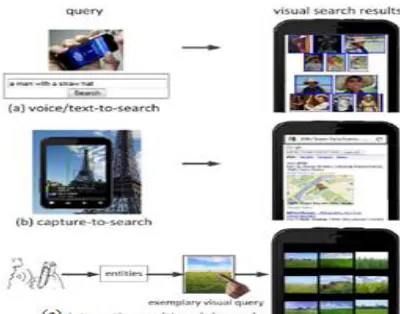
However, compared with text and location search by Mobile device, visual (image and video) search is still unpopular, because the user’s search experience on the phone is not always satisfied. On one hand, existing forms of queries (i.e., text or voice as queries) are always user unfriendly typing is a critical job, and voice cannot express visual purpose well. On the other hand, the user’s purpose in a visual search process is somewhat complicated and uneasily expressed by a piece of text. For example, as shown in Figure 1(a), the query like “find a picture of a person with a drinking straw, hat and a spade” will most likely not outcome in any appropriate search results from present mobile search engines.
To make easier, visual search on mobile devices, the work described in this paper aims at a more natural way to formulate a visual query, taking full benefit of multi-modal and multi-touch interactions on phones. As shown in Figure. 2(c), users can easily formulate a combine image as their search purpose by naturally interacting with the phone through voice and multi-touch. Although similar applications exist, such as Goggles[1] , iBing, and SnapTell[4] , which bear photo shots (using the inherent camera) as a visual query for fast search, as shown in Fig. 2(b), our work represents a complementary mobile visual search by which users can compose an arbitrary visual query (unnecessarily an existing image) through natural user interaction.
It is known that visual search on a mobile device is different from that on a desktop PC. Compared with a desktop which dominantly supports text-to-search mode, a mobile phone provides a big set of user interactions and thus achieves a more natural search experience. For example, beyond the orthodox keyboard and mouse inputs, mobile phones are usually able to receive multi-modal inputs. The most common interface of this kind combines a Figure 1: The main modes for mobile visual search: (a) voice/text-to-search, (b) capture-to-search, (c) Modular search. Visual way via the inherent camera with a voice way via speech recognition. In addition, the multi-touch phone screen, which
recognizes multiple simultaneous touch points, provides more interaction between users and devices. All of these benefits provide a more natural interaction to formulate search purpose and thus achieve a best search experience via mobile phone.
Figure 1 Three modes of mobile visual search: (a) voice/text-to-search, (b) photo-to-search, (c) Proposed interactive multimodal search (Improvement in Visual searching process)
II.LITERATUREREVIEW
There exist some visual search applications for mobile devices. Table 2 is a survey of the recent visual search applications on various mobile platforms. All of them require users to first take a image and then perform similar image searches in various domains (i.e., capture-to-search mode). However, many cases, the user’s search purpose is implicit and cannot be presented through capturing the image of surroundings. The user, can express his/her purpose via a part of voice description. For example, a user is looking for a restaurant with a red color door and two stone lions in front of the door, however s/he forgot the name of the restaurant. Therefore, a client-side tool that can transfer a long textual query into a visual query with user interaction is required to determine the restaurant’s name and location.
Table 2 RECENT MOBILE VISUAL SEARCH APPLICATIONS
App Features
Googgles[1] Product, cover, landmark, namecard
Digimarc Discover[19] Print, article, ads
Point and Find[2] Place, 2D barcode
SnapTell[4] Cover, barcode
SnapNow[20] MMS, email, print, broadcast
Kooaba[3] Media cover , print
Photo-to-search is becoming pervasive as the development of the computer vision and content-based image retrieval. This enables the user to capture photos using the inherent camera on the phone and then start search queries about objects in visual proximity. This offers lots of different applications such as recognize products, comparison shopping, finding information about buildings, movies, CDs, real estate, print media, artworks, etc. First deployments of such systems include Google Goggles [1], Digimarc Discover[19], Point and Find [2], SnapTell [4], SnapNow [20], Kooaba [3] to help users formulate their search purpose more conveniently and thus promote visual search performance.
The search procedure consists of the following phases: 1) the user speaks a natural sentence as the query to the phone,
3) the user selects the preferred exemplary images (given by an image clustering process according to the entities) that can visually represent each keyword and composes a query image through multi-touch,
4)the composed image is then used as a visual query to search similar images.
Therefore, the key component of JIGSAW is the combination of an exemplary image query generated from the natural speech via multi-touch user interaction and visual search based on the exemplary image. Through JIGSAW, users can develop their visual search purpose in a natural way like piecing together a jigsaw puzzle on the phone screen. It include speech recognition, entity extraction, image clustering, large-scale image search, and user interaction.
However, to initiate such a visual search, the user must have an existed image on hand as a query. Moreover, it needs partially duplicate images or exact the same thing present in the database. Another kind of image search engines designed for desktop, including GazoPa [8] and some other sketch-based image search researches like [9], [10], [11], use hand-drawn sketches to search for satisfied images. Though sketch-based search allows users to express their visual purpose in some way, it can hardly develop complex meanings and is difficult to use for users without drawing experience. MindFinder [12] and Concept Map [13] also provide visual aids to search for images. In these works, visually and semantically similar images are retrieved by multiple exemplary image parts. The user offers lexicons and then composes a visual query using multiple image parts given by the engine according to the lexicons. In these works, images are unnaturally divided into blocks in which features are then extracted. The performance is very sensitive to selections and positions of exemplars. For further information please refer to the papers. Interestingly, in [14] the authors build a Sketch2Photo system that uses simple text-annotated line sketch to automatically synthesize realistic images. However, they focus on image composing instead of image retrieval. A small screen limits the presentation of searching results, which requires the top results to be more relevant on the phone. However, using only text as search query can hardly meet this end because surrounding texts of the web images are not always correct. Moreover, the user must know the exact terms the annotator used in order to be able to retrieve the images he wants and textual annotations are also language-dependent. Actually, there are lots of pictures which have no text information on the web repository. All this deficiency can destroy a good user experience of text-based image search system on the mobile phone. Visual (image and video) search (compared with text search, map search and photo-to-search) is still not very popular on the mobile devise.
This [5] describes multimodal interactive image search system on mobile devices. The system, the Joint search with ImaGe, Speech, And Word Plus (JIGSAW+), takes multimodal input and natural user interactions of mobile devices. It is designed for users who have images in their minds but have no exact descriptions or names to address them. By describing it using voice and then the recognized query by interactively combining a visual query using exemplary images, the user can well find the desired images through a less natural multimodal interactions with his/her phone.
Author proposed an image retrieval framework that integrates efficient region-based representation in terms of storage and complexity and effective on-line learning capability is proposed [15]. The framework consists of methods for region-based image representation and comparison, indexing using modified inverted files, relevance feedback, and learning region weighting. By using a vector quantization method, both compact and sparse (vector) region-based image representations are reached. How to separate images containing objects from images containing scenes or textures is a difficult and exciting issue for the framework.
Author proposed a system for a query image (mobile image) taken by the mobile phone, our goal is to retrieve its most similar image in a large scale image database where usually the most similar image is the original image taken photos of and are associated with their appropriate information [16]. The method exploits spatial relationships between features and combines them with visual matching information to improve features discriminative power. The performance has to be improved further by exploiting better schemes that can utilize both visual and spatial information consistently
Author proposed a system for comparing the performance of MPEG-7 image signature tools, SIFT and CHoG in the context of mobile visual search applications [17]. With the review of MPEG-7 image signatures and CHoG descriptors and discuss feature level Receiver Operating Characteristic (ROC) experiments and pair wise image-matching experiments for the different descriptors. The image matching accuracy for schemes is low in between 70% and 76%.
The basic components of content-based image retrieval system are introduced. Image retrieval methods based on color, texture, shape and semantic image are discussed, analyzed and compared. The semantic based image retrieval is a better way to solve the semantic gap problem, so the semanticbased image retrieval method is stressed[21].
Perceptual Hash (P-Hash) Algorithm [22] for the similar image retrieval based on the Query-Image. The hash value of the Query image is matched with the medical training-set images and the corresponding keywords are automatically tagged. In this methodology, the system computes the similarity measure or score based on the Hamming Distance of two Hash strings. This methodology is faster and efficient approach for web-based application. In addition to this, robustness of the algorithm could be examined by altering (change in the image orientation) the query-image may not affect the hash value.
The [23] system enhances the mobile search experience and increases relevance of search results. It involves a natural interactive process through which user has to express their search intent very well. SVM [24] feature selection method can speed up the classification process and improve the generalization performance of the classifier. SVMs can solve linearly non-separable problems using kernel functions
III.PROBLEMSTATEMENT
Mobile visual search became an active filed area in pass few year. It involves methods from several research areas. Due to the complexity of visual information compared with text or voice signals. It is reported that one-third of the Internet search queries will come from phones by 2014. The bursting of mobile users puts forward the new requests for image retrieval. First, there is a huge difference in user interface between desktop and mobile devices particularly for the input methods.
On desktop, keyboards and mouse are the important input devices while new mobile devices all time provide multimodal input methods (cameras, GPS, microphones, and multi-touch screens). Finding information from large image/video sources puts a challenging problem. Two well-known barriers make impossible successful solutions to date are the semantic gap and the user gap. The former refers to the trouble in inferring high-level semantic labels from low-level pixel data. The latter reflects user’s frustration in expressing his/her information needs of visual content using existing systems.
Integrating multi-modal information to solve many challenging programs, such as 1) The image should contain the entities in the user’s query (image description).
2) The entities in the image should be similar to the exemplary images the user chooses (the Comparison approach). 3) The position of single entity or the relative layout of multiple entities in the image should consist with the composite
4) Information description methods, matching and retrieval.
IV.PROBLEMSOLUTION
The proposed system is to develop a mobile visual search system that can represent and retrieve images with similar visual content a facility for visual search on a mobile device By extracting lexical entities from a text query and matching the lexical entities to image tags, the facility provides candidate images for each entity. Selected ones of the candidate images are used to construct a composite visual query image on a query canvas. A novel class of applications that use images records to retrieve related information has been implemented on mobile devices. It is known as Mobile Visual Search (MVS). MVS technologies overcome the inherent limitations of text-based information re- trivial systems, such as semantic fuzziness and abstract expression of language.
4.1 Search Engines
The proposed system is inspired from the concept of a search engine. A web search engine is a tool designed to search for information on the web. On searching, relevant information is compiled in the form of a list and can comprise of web pages, images, videos etc. The objective is to design an efficient visual aided image search application on mobile phone combined with local spot and scene search.
Search procedure of our proposed system consists of the following phases: 1) user write text query a natural sentence to describe the intended images.
2) It is recognized and further decomposed into keyword(s) which can be represented by exemplary images.
3) Decomposing the text into keywords by entity extraction by selecting preferred exemplar(s) and composes a schematic collage as a composite image.
4) The composite image is then used as a visual query to search for similar images.
5) To improve quality of visual search process we adding Perceptual Hashing Algorithm and SVM.
6) Uploading the query, including picture from the user and GPS information generated by the client, and show detailed result both as text contents and markers on the Google Map.
7) Then using the image retrieval modules we can retrieve the images from server using CEDD. We can also retrieve images with the location using GPS.
8) The Result can be displayed with further information like GPS locations and image descriptions.
4.2 Algorithm
4.2.1 Support Vector Machines
Support vector machine is a machine learning technique that is well founded in statistical learning theory. Statistical learning theory is not only a tool for the theoretical analysis but also a tool for creating practical algorithms for pattern recognition. This abstract theoretical analysis allows us to discover a general model of generalization. On the basis of the VC dimension concept, constructive distribution-independent bounds on the rate of convergence of learning processes can be obtained and the structural risk minimization principle has been found.
(∝)≤ (∝) +∅ ℎ, −log ( )
The new understanding of the mechanisms behind generalization not only changes the theoretical foundation of generalization, but also changes the algorithmic approaches to pattern recognition. As an application of the theoretical breakthrough, SVMs have high generalization ability and are capable of learning in high-dimensional spaces with a small number of training examples. It accomplishes this by minimizing a bound on the empirical error and the complexity of the classifier, at the same time With probability at least 1 -ρ , the inequality holds true for the set of totally bounded functions. Here, R(α) is the expected risk, Remp(α) is the empirical risk, l is the number of training
examples, h is the VC dimension of the classifier that is being used, and log( ) is the VC confidence of the classifier.
4.2.2 Perceptual Hashing Algorithm
Perceptual hashing is a robust algorithm widely used for content identification. In our system, we used block-mean perceptual hashing algorithm where the algorithm takes the color pixels of an image to generate the hash value. The study says P-hash is reliable and fastest algorithm. In this methodology, similar like Block-Mean value Perceptual hashing image color mean value hashing technique is used. Where the hash string is generated using the color of an images. Pixel color average is taken as mean value based on the average rate the hash string is formed. The image is scaled to defined small size. We generate the hash value by observing the color pixel and its average color pixel value. Hash bit is generated, with respect to the
Figure 4.1 Pseudo code of the hash generation
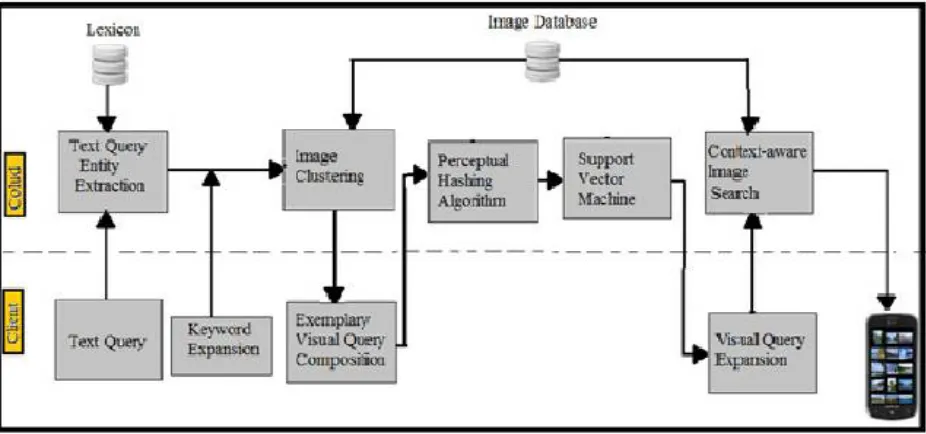
4.3 Architecture of proposed visual search system
Figure 4.2 Architecture of proposed visual search system
V.EXPERIMENTALERSULT
5.1 Implementation on the Mobile Phone
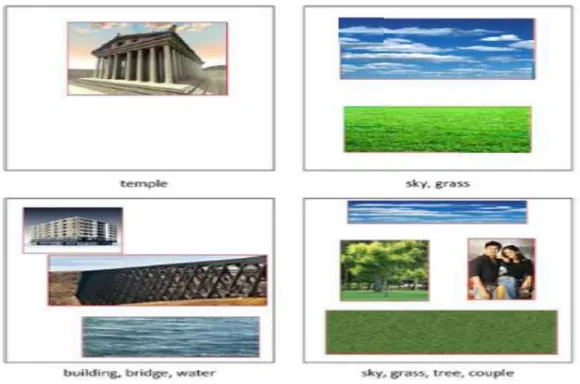
We deployed Improvement in Visual searching process as an application on Mobile Phone devices. It display speech query after tapping the button on the center and record a piece of speech. On the screen the text box to accept a textual query. By tapping the right button, the textual query in the text box will be parsed and the entity keywords will appear in the tag list. There is an exemplary image list which shows the exemplary images searched according to the selected keyword shown in Fig 5.1.1
Figure 5.1.1 An example of processing a visual query with multiple exemplars.
The user can select any exemplary image onto the composite (Visual) query , so that the exemplar will be displayed on the canvas as shown in figure 5.1.2 . Finally, if the user is satisfied with the composite query, s/he can click on submit button trigger the search. The search results will be displayed in a new page as shown in Fig 5.1.4. for visual query of grass and tower shown in figure 5.1.3 i.e. If the speaker button is tapped application transforms speech to text via Google speech recognition and display text input in a text box. After that keywords extracted and images corresponding to the keywords from web display alternatives. User can also choose exemplary images from gallery corresponding to entities.
Figure 5.1.3 visual query grass & tower
5.2 COMPARISON OF PROPOSED SYSTEM TO EXISTING SYSTEM
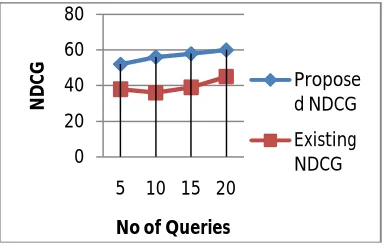
To test the performance of image search in our proposed image search, 20 queries were collected as the query set. We compared search performance among Existing System i.e. JIGSAW+ and the proposed Improvement in Visual searching process with Image and Word. The Normalized Discounted Cumulative Gain (NDCG) was used to evaluate the search performance. Figure 5.2.1, 5.2.2 and 5.2.3 shows average precisions, NDCG and Time of the 20 queries by comparing proposed and existing system
Figure 5.2.2 Precision curve of two different methods under 20 different queries
Figure 5.2.3 NDCG curve of two different methods under 20 different queries 0
20 40 60 80
5 10 15 20
P
re
ci
si
o
n
No of Queries
Propose d
Existing
0 20 40 60 80
5 10 15 20
N
D
C
G
No of Queries
Propose d NDCG
Existing NDCG
Figure 5.2.4 Avg. Time(sec) curve of two different methods under 20 different queries
VI.CONCLUSION
Text-based search engines are still available on mobile devices. But it is neither user-friendly on phone, nor machine-friendly for search engine. Voice queries must need general idea of expected pictures such as color configurations and compositions. Sketch-based search is difficult to use for users without drawing experience. Photo-to-search needs exact partial duplicate images in their database for search similar images. Thus user’s search experience on mobile device is significantly improved by interactive mobile visual search system compare to all other techniques, which allow the users to formulate their search through multimodal interactions with mobile devices. The proposed system will provides a game-like interactive image search scheme with composition of multiple exemplar by taking the advantages of multimodal and multi-touch functionalities on the phone.
REFERENCES
[1] (2009).Google Goggles [Online]. Available: http://www.google.com/mobile/goggles/ [2] (2006).Nokia Point and Find [Online]. Available:http://www.pointandfind.nokia.com [3] (2007)Kooaba [Online]. Available: http://www.kooaba.com
[4] (2007).SnapTell [Online]. Available: http://www.snaptell.com.
[5] Houqiang Li, Yang Wang, Tao Mei, Jingdong Wang, and Shipeng Li, “Interactive Multimodal Visual Search on Mobile Device”, IEEE TRANSACTIONS ON MULTIMEDIA, VOL. 15, NO. 3, APRIL 2013.
[6] K. Church, B. Smyth, P. Cotter, and K. Bradley, “Mobile information access: A study of emerging search behavior on the mobile internet,” ACM Trans. Web, vol. 1, no. 1, May 2007.
[7] [Online].Available:http://www.pwc.com/gx/en/communications/review/features/mobile-data.jhtml [8] GazoPa. [Online]. Available: http://www.gazopa.com/
[9] Y. Cao, H. Wang, C. Wang, Z. Li, L. Zhang, and L. Zhang, “MindFinder: Interactive sketch-based image search on millions of images,” in Proc. ACM Multimedia, 2010, pp. 1605–1608.
[10] M. Eitz, K. Hildebrand, T. Boubekeur, and M. Alexa, “Sketch-based image retrieval: Benchmark and bag-of-features descriptors,” IEEE Trans. Vis. Comput. Graphics, vol. 17, no. 11, pp. 1624–1636, Nov. 2011.
[11] M. Eitz,K.Hildebrand, T. Boubekeur, and M. Alexa, “An evaluation of descriptors for large-scale image retrieval from sketched feature lines,” Comput. Graphics, vol.34, no.5, pp. 482–498, 2010.
[12] C.Wang, Z. Li, and L. Zhang, “MindFinder: Image search by interactive sketching and tagging,” in Proc. Int. Conf. World Wide Web, 2010, pp. 1309–1312.
[13] H. Xu, J. Wang, X. Hua, and S. Li, “Image search by concept map,” in Proc. ACM SIGIR, 2010, pp. 275–282.
[14] T. Chen, M.-M. Cheng, P. Tan, A. Shamir, and S.-M. Hu, “Sketch2photo: Internet image montage,” ACM Trans. Graph., vol. 28, no. 5, pp. 124:1–124:10, Dec. 2009.
[15] F. Jing, M. Li, H.-J. Zhang, and B. Zhang, “An efficient and effective region-based image retrieval framework,” IEEE Trans. Image Process., vol. 13, no. 5, pp. 699–709, 2004.
[16] X. Liu, Y. Lou, A.W. Yu, and B. Lang, “Search by mobile image based on visual and spatial consistency,” in Proc. IEEE Int. Conf.Multimedia [17] V. Chandrasekhar, D. M. Chen, A. Lin, G. Takacs, S. S. Tsai, N. M.Cheung, Y. Reznik, R.Grzeszczuk, and B.Girod, “Comparison of local
feature descriptors for mobile visual search,” in Proc. IEEE Int. Conf.Image Process., 2010, pp. 3885–3888
[18] Jiemin wang, Yuanhai He, Yujie Zhou, Yu Qiao, “iGAPSearch: Using Phone Cameras to Search Around the World”, Article · June 2011 [19] Digimarc Discover [Online]. Available: https://www.digimarc.com/discover/
[20] LinkMe Mobile. [Online]. Available: http://www.snapnow.co.uk 0 0.2 0.4 0.6 0.8 1 1.2 1.4
5 10 15 20
A vg . T im e (S ec s)
No of Queries
Proposed Time
[21] Gulfishan Firdose Ahmed, Raju Barskar "A Study on Different Image Retrieval Techniques in Image Processing" International Journal of Soft Computing and Engineering (IJSCE)ISSN: 2231-2307, Volume-1, Issue-4, September 2011
[22] Suresh Kumar Nagarajan, Shanmugam Saravanan "Content-based Medical Image Annotation and Retrieval using Perceptual Hashing Algorithm" IOSR Journal of Engineering Apr. 2012, Vol. 2(4) pp: 814-818
[23] Anushma C R, "Multimodal Image Search System on Mobile Device", International Journal of Computer Organization Trends- Volume 7 Number 1- Apr 2014
[24] Zhi-Gang Fan, Kai-An Wang, and Bao-Liang Lu "Feature Selection for Fast Image Classification with Support Vector Machines" ICONIP 2004, LNCS 3316, pp. 1026?1031, Springer-Verlag Berlin Heidelberg 2004
BIOGRAPHY
Manisha M. Kundle received the B.E. degree in Information Technology in 2011 from Shivaji University Kolhapur. She is currently working towards the M. E. in Computer Science & Engineering from G.H. Raisoni Institute of engineering & Management, Jalgaon, North Maharashtra University , India. Her research interests include image analysis and information retrieval.
![Spain [stet] accession to the EMU: a long and hilly road](data:image/gif;base64,R0lGODlhAQABAIAAAP///wAAACH5BAEAAAAALAAAAAABAAEAAAICRAEAOw==)