Distributed Privacy Preserving Path
Detection Algorithm (DPPA) using Mobile
Adhoc Network
G.Vanithamani1, K.Mythili2
M.Phil Scholar, Hindusthan College of Arts and Science, Coimbatore, India1
Associate Professor & Head, Hindusthan college of Arts and Science, Coimbatore, India2
ABSTRACT: In distributed wireless network, Link based connectivity problems and cruel packets falling are source factors for packet losses. The packet falling time casing are equivalent to the channel distribution fault rate is based on noticing the message failure rate does not reached acceptable truthfulness. To improve the truthfulness, in this paper proposed a privacy preserving to develop the correlations between connectivity and packet losses. Meanwhile the proposed system to find the correlations, extend a Distributed Privacy Preserving Path Detection Algorithm (DPPA) based dynamic routing privacy preserving protocol structural design that permits to authenticate the reliability of the packet (message) loss information distributed by mobile nodes. Through the simulations, the system verifies and achieves extensively improved discovery accuracy across the previous techniques such as homomorphism linear authenticator based detection.
KEYWORDS: Packet dropping, secure routing, attack detection, dynamic routing, link path.
I. INTRODUCTION
In wireless network model the nodes are assists in transmitting/steering traffic. An adversary node can utilize the behavior of attacks. For illustration, the adversary could visualize being a mutual node in the path learning process. Once being inside a path, the malicious node begins the falling messages. The cruelest case the attacker node only ends forwarding each message received from up scaling nodes, entirely disrupting the link connecting the source and destination. Ultimately, such a relentless of denial-of-service (DoS) attack can analyze the network by screening its topology. In wireless networks the mobile nodes are communicated with each other using large wireless network links. Data to out of range nodes can be running scared through intermediate nodes. That is nodes in wireless networks can take action as both hosts and routers. There are many frequent application regions in which wireless networks can be used sorting from military actions and urgent situation tragedy relief to neighborhood linking and communication among gathering attendees.
Malicious nodes are the element the path preserve exploit its message information of the system procedure and the message perspective to begin a mobile within attack is irregular, except can accomplish the similar performance poverty result as a determined criticism at a much inferior threat of being identified. In particular, attacker node might assess the significance range of messages and then fall the tiny amounts that are believed extremely significant to the process of the network.
Identifying the discriminating packet-dropping attacks is very demanding in exceedingly distributed wireless environment. The complexity arises from the condition is to require to only notice the location where the message is crashed, but also identify whether the drop message is intended or unintended. In particular, the open surroundings of wireless area, a message fall in the model might be caused by cruel channel constraints (e.g., defeat, sound noise, and intrusion and path errors), or by the within node attacker.
surroundings of cruel channel constraints. In this following case, just by viewing the information failure error is not sufficient to precisely categorize the faithful cause of a packet fall.
The rest of this paper is organized as follows. In Section 2 review the existing related work. The proposed models and descriptions are described in Section 3. Finally conclude the paper in Section 4.
II. LITERATURE SURVEY
In [1] authors address the performance of upper layer protocols and to intend or fine adjust their initialization over the wireless environments and its general to presume that the fundamental guide is a level Rayleigh fading channel. Moreover the connections are usually modeled as limited state Markov chains. Newly, hidden Markov models (HMM) have also been engaged to distinguish these channels. In [2] authors introduced a imitation for provable data possession (PDP) that permits a user that has stored data at an un confidence server to confirm that the server possesses the unique data without recovering it. The model produces the likelihood verifications of possession by sampling arbitrary sets of chunks from the server, which radically decreases I/O costs. The user maintains a stable quantity of metadata to validate the proof. In particular, the transparency at the server is low down, as different to linear in the dimension of the data. In [3] presented Proofs of storage (PoS) are interactive protocols permitting a user to confirm that a server authentically stores a data. Existing work has revealed that PoS can be created from any homomorphic linear authenticator (HLA). They present a structure for public-key HLAs from any recognition protocol agreeable certain homomorphic properties.
In [4] authors discussed the ODSBR, the primary on-demand routing protocol for wireless networks that makes flexibility to complex attacks caused by entity or colluding nodes. The protocol employs an adaptive probing technique that finds a malicious link after log n errors have happened, where n is the distance end to end of the path. Challenging paths are cleared by using a path detection mechanism that relies on a novel metric that captures adversarial behavior. In [5] authors proposed the two network-layer recognition based models, expression the TWOACK and S-TWOACK
models, which can be fundamentally additional to any basis routing protocol. The schemes notice such misbehaving nodes, and then seek to improve the problem by reporting the routing protocol to avoid them in potential paths. In [6] authors proposed a short signature model based on the Diffie Hellman theory on positive elliptic and hyperelliptic curves. The normal security initiation, the signature distance end to end is regarding half that of a DSA signature with a parallel stage of protection. A short signature model is intended for systems where signatures are sorted in by a person or are sending over a low-bandwidth channel.
III.PROPOSED METHODOLOGY
A. NETWORK MODEL:
The network model is created N number of nodes in the simulations area. As the amount of nodes in the wireless network is increased, the dimension of the simulation region is also increased so that a reliable node weights are maintained. The network simulation areas dimensions are defined in 330m x 330m, 670m x670m and 1000m x1000m, in that order. Every node is moved according to the way of random mobility model.
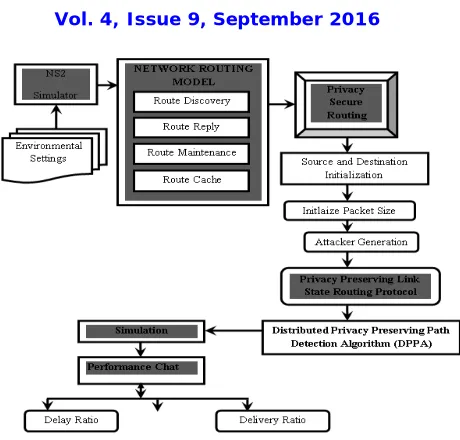
Figure 1: Proposed System Architecture
B.NETWORK ROUTING MODEL:
The route detection process mechanism is initiated whenever a node needs to send a HAI message to destination node which is not in the broadcast range consequently it must get a route to that corresponding node by initiation the Route detection process. This model usually the dispatcher must first finds the routes in its cache if there is no path it precedes as follow:
It generates a route request packets having its locate the path and the address of the terminal node then it transmit the HAI message packet to all its neighbors in broadcast manner.
Every neighbors, receiving this message request check with its cache is to find an final route to destination
path to be returned turn around to the sender or else it re-transmit the same message information to all its connected neighbors after adding its location to the header of the request and learns from this message to be added to its routing cache. The mobile node has previously delighted this route request it disregards the new received request by verifying its sequence number since each route request is identified by a unique sequence number.
The similar procedure is executed by each nearby node until the route requests arrive to destination which
adds its path at the end of the description and sends a route reply.
C .PRIVACY PRESERVING LINK STATE ROUTING PROTOCOL:
The Link state Routing path model is based on the shortest path technique is generally energy saving optimized method. So individual metrics are considered and energy load is allocated to the each link. The connecting the path end-to-end nodes, there typically exists more than one way path. In the possible relay node combinations, there will be comparatively energy best routes that achieve the lower cost based on the nodes’ battery force and broadcast loss of the paths. A simple multi model wireless network, with the transmit node set R between the source and terminal, and the instant neighbor set R^* for every node. Here exists an energy efficient route, for example, the route with dispatch nodes. The links with low broadcast power loss and mobile nodes with advanced remaining energy capacity are preferred. The problem is easy to minimize the power devoted during communication and exploit the battery energy of the nearby node to be used that is to minimize:
( )
( ( ) ∈ ℜ
∗ (1)
for local (the immediate next hop) optimization,
p(i)
for total nodes optimization where g(i) is the remaining battery capability of the ith node, and p(i) is the control cost for each packet from node i-1 to node I.
D. DISTRIBUTED PRIVACY PRESERVING PATH DETECTION ALGORITHM (DPPA)
The routing model selects the paths based on the present privacy information for the network. The privacy information can be calculated or considered although the path will change depending on the existing message information at the period of time traffic request. The privacy model can manage now with the distributed manner of collision and respond to real-time network monitoring consequently through real-time analysis and privacy preserving in order to manage jamming and to achieve optimal performance.
Dynamic routing protocol is distinguished by two factors:
The computational model that the routing service is using
The state information nature
There are two computational models used in dynamic routing process of centralized and the distributive. The basic operation of privacy preserving is to allow the resources to identify a
destination region and concurrently discover the multiple nodes in it. However, to maintain the description simple, to assume that only one node exists within each destination area.
IV.PERFORMANCE EVALUATION
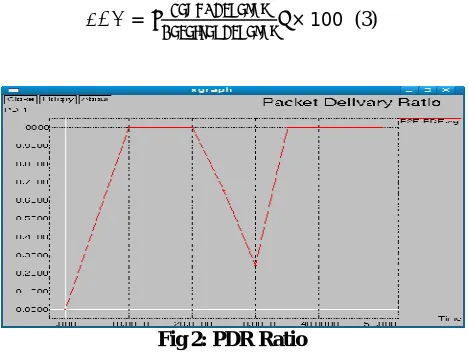
Packet delivery Ratio (PDR): the ratio of the data packets delivered to the destinations to those generated by the Constant Bit Rate (CBR) sources. The PDR shows how successful a protocol performs delivering packets from source to destination in figure 2. The higher for the value give use the better results. This metric characterizes both the completeness and correctness of the routing protocol also reliability of routing protocol by giving its effectiveness.
PDR is the ratio of the number of data packets received by the destination node to the number of data packets sent by the source mobile node. It can be evaluated in terms of percentage (%). This parameter is also called “success rate of the protocols”, and is described as follows:
= × 100 (3)
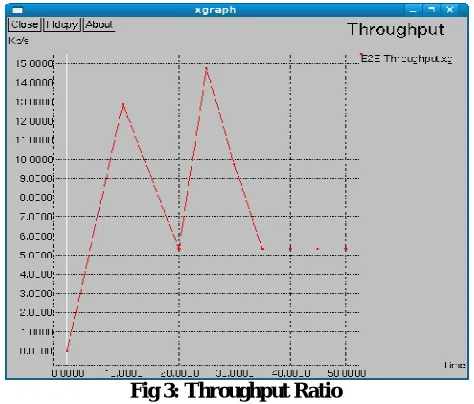
Throughput: The ratio of the total amount of data that reaches a receiver from a sender to the time it takes for the receiver to get the last packet is referred to as throughput. It is expressed in bits per second or packets per second. Factors that affect throughput include frequent topology changes, unreliable communication, limited bandwidth and limited energy. A high throughput network is desirable.Throughputis the average rate of successful message delivery over a communication channel. This data may be delivered over a physical or logical link, or pass through a certain network node.
= (4)
Where X is the throughput, C is the number of requests that are accomplished by the system, and T denotes the total
time of system observation.
Fig 3: Throughput Ratio
V. CONCLUSION AND FUTURE WORK
In this paper proposed an optimal dynamic routing privacy preserving mechanisms for wireless Networks for the controlling the packet dropping among the source to destination nodes during the packet delivering. The proposed technique using an extensive approach outperforms the alternate path search optimization technique in terms of energy level and throughput discovery. The suggested technique also provides link state routing path which can be easily interpreted by all mobile nodes.
In future work, we intend to enhance the dynamic preserving protocol to develop the experimental methods for non-linear optimization to control the growth of path of the result data
REFERENCES
[1] J. N. Arauz, “802.11 Markov channel modeling,” Ph.D. dissertation, School Inform. Sci., Univ. Pittsburgh, Pittsburgh, PA, USA, 2004.
[2] C. Ateniese, R. Burns, R. Curtmola, J. Herring, L. Kissner, Z. Peterson, and D. Song, “Provable data possession at untrusted stores,” in Proc. ACM Conf. Comput. andCommun. Secur., Oct. 2007, pp. 598–610.
[3] G. Ateniese, S. Kamara, and J. Katz, “Proofs of storage from homomorphic identification protocols,” in Proc. Int. Conf. Theory Appl. Cryptol. Inf. Security, 2009, pp. 319–333.
[4] B. Awerbuch, R. Curtmola, D. Holmer, C. Nita-Rotaru, and H. Rubens, “ODSBR: An on-demand secure byzantine resilient routing protocol for wireless ad hoc networks,” ACM Trans. Inform. Syst. Security, vol. 10, no. 4, pp. 1–35, 2008.
[5] B. Awerbuch, R. Curtmola, D. Holmer, C. Nita-Rotaru, and H. Rubens, “ODSBR: An on-demand secure byzantine resilient routing protocol for wireless ad hoc networks,” ACM Trans. Inf. Syst. Secur., vol. 10, no. 4, pp. 11–35, 2008.