IOT Based Smart Water Tank Using Android
Applications
C.Senthil kumar, C.Bhavani, S.R.Harshini priya, S.Jayalakshmi
Assistant Professor, Department of ECE, AVS Engineering College, Namakkal, Tamil Nadu, India
Department of ECE, AVS Engineering College, Namakkal, Tamil Nadu, India
Department of ECE, AVS Engineering College, Namakkal, Tamil Nadu, India
Department of ECE, AVS Engineering College, Namakkal, Tamil Nadu, India
ABSTRACT: This paper propose a more efficient water monitoring and control system for water utility to reduce the
current water wastage problem using IOT and android applications. Conventional water tanks can neither monitor nor control water level in tank, leading to large amount of wastage. Ultrasonic Sensor is used to measuring water level. The other parameters like pH, TDS and Turbidity of the water should be calculated. The calculated values from the sensors can be processed by the Microcontrollers and uploaded to the internet through the Wi-Fi module(ESP 8266). Some other technologies had certain drawbacks in some or other way. The need of removal of these short-comings and providing an efficient and economical solution has been the main focus of this project.
KEYWORDS: Water monitoring, Water resources, Ultrasonic sensors, Android applications, ESP 8266 and Internet of
things.
I. INTRODUCTION
Currently drinking water is very prized for all the humans. In recent times all the humans and creatures on the earth
facing troubles because of growing population, aging infrastructure etc. So it’s too important to find the solution for water monitoring and control system. Ultrasonic sensor is used to measuring water level. The parameters like pH, TDS and Turbidity of the water should be calculated. The calculated values from the sensors can be processed by the microcontrollers and uploaded to the internet through the Wi-Fi module (ESP 8266). The user can directly monitor and control through the smart phone and from any place in the world. The android application is developed in MIT app inventor .This project can be installed in existing water tanks with no requirement of new water tank in this purpose.
II. LITERACY SURVEY
In 2016, Divya kaur presented a paper on “IOT based water Tank control system” for prevent the water wastage. Making a control system to automatically control the water pump requires [1] careful observation of what people do as their daily activity to make sure that the tank is full. In almost all over India every state has a State Water Supply body which is responsible for development and [1] regulation of water supply in state. Due to scarcity of water the release of water is controlled and done at certain time(s) in a day. So this paper is aimed at presenting the project in embedding a control system into an automatic control system into an automatic water level controller using Wi-Fi module.
In 2013, Samia Maqbool, Nidhi Chandra presented a paper on “Real Time Wireless Monitoring and Control of water Systems using Zigbee 802.15.4” in which the architecture which comprises a number of elements likes water quality sensor water level sensor, GSM modem, PC, XBee and a database. Sensor nodes are performing the particular function or job, sense the data and those data are transmitted to the end tool or machine via inverter. Sensed data is coordinated by network equipments like router. [3]Router will gather data from the end tool like Xbees which in turn from sensors and sends the data to coordinator. In the computer all the information are presented. In the computer;river level, bore water level is shown by using C sharp program. From computer particular task can be executed like “SMS” is forwaded to user’s System and a alarm are blows at the desired level. All these data are kept and saved in database which will be utilized to implement a “water expert system” through a long term supervising and investigation.
In 2015, Thinagaran perumall, Md Nasir sulaiman, Leong presented “Internet of things (IOT) Enabled Water System”. They implemented “Water monitoring system using IOT” for real time scenario of water. Using Internet, relevant and includes system of integrated to a cloud server and these data can be received by user terminal which are owned by consumers. The water measurement’s end results is shown in cloud. A thingspeak[4] as a segment of alert system is integrated also. This type of organization can be utilized fairly effectively by residential user as by industrial user or more water utilities.
In 2016, B.Dhivyapriya, C. Gulabsha, S.P.Maniprabha, G.kandasamy, Dr.V.Chandrasekar, GSM based water tank level monitoring and pump control system. In which a new technique is proposed to continuously keeps track of the level of water in water systems like overhead water tanks. The user can send the message to the system to know the water level details of the tank and also be used to regulate the pump spontaneously by turning OFF the pump when the critical level of water in tank is reached and send the message to the user that the water in the tank is full[5]. This is aimed to control the level of water with support of ultrasonic sensor and GSM technology.
In 2015, Prachnet Varma, Akshay Kumar, Nihesh Rathod, Pratik Jain, Mallikarjun S,Renu Subramaniyam, Bhardhwaj Amrutur, M.S.Mohan kumar, Rajesh Sundresan presented a paper on “IOT based water management System for a Campus “proposed real time water monitoring system for campus. That work used off-the-shelf ultrasonic sensor HC-SR04 [6] which is mounted at the top of the tank. It sends so much ultrasound pulses at 40KHz towards the water surface and measure the time to receive the reflected waves by sensing when the reflected edge crosses a threshold. This approach works well when the received signals are large in amplitude and hence its range was limited to about 4km, which is sufficient for large distribution tanks that can be deep as 8m.
In 2013, Raghavendra. R, M. Uttara kumara, S.A. Hariprasad presented a paper on ‘Implementation of simulated water level Controller. Water is one in all the foremost vital basic desires for all living beings. However sadly an enormous quantity of water is being wasted by uncontrolled use[7]. Another machine-driven water level observance system is additionally offered thus far, however, most of the strategy has some shortness in observe. We have a tendancy to tried to beat these issues associated enforced an economic machine-driven water level observance and dominant system. The main connotation of this analysis work is to determine a versatile, economical and simple system.
In 2016, Jayti Bhatt, jignesh patoliya presented a paper on “IOT based water monitoring system” This system is useful to observe the quality which is one by microcontroller and zigbee module which is used make WSN (Wireless Sensor Network) which is low cost and more efficient. Futhermore, monitor data from all over the word IOT environment is provided using raspberry pi for creating gateway and also, cloud computing technology is used to monitor data on the internet.[8] Moreover, to make system user-friendly web browser application is there. Thus, they can fulfill aim and objective of the proposed system.
III. METHODS
A. ESP 8266
B. Ultrasonic sensor
Ultrasonic sensor is used to generate ultrasonic sound waves which are bombarded on the surface of water. This sensor consists of a speaker which emits an ultrasonic sound wave and a mic which detects that particular sound wave. As we have implemented the ultrasonic sensor, there is no contact of water with sensor which ensures long life of the sensor.
C. Cloud-Firebase
Firebase is a cloud provided by Google which implements JSON language. Here, the values from the android application and ESP are stored. The values are then accessed by ESP and app by using some functions. Special authentication key is required to access these values which ensure security of the data.
D. MIT app inventor-Android application
This is a scratch programming platform designed by MIT to help the programmers for developing and testing android applications. We have created our application with this software. In this app, the user has to set the maximum and minimum values of water level in the tank. Also, the current water level in tank is displayed in app. The app uses a login interface which ensured security in using the application.
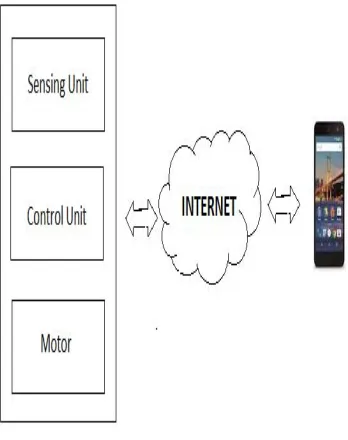
Fig 1: BLOCK DIAGRAM
IV. SYSTEM DESIGN AND IMPLEMTATION
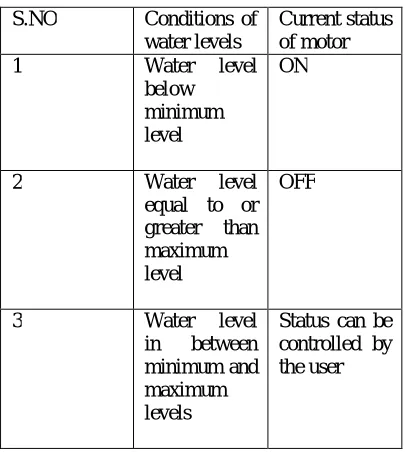
S.NO Conditions of water levels
Current status of motor 1 Water level
below minimum level
ON
2 Water level equal to or greater than maximum level
OFF
3 Water level in between minimum and maximum levels
Status can be controlled by the user
Table 1: Proposed working of water tank and motor
Depending on the water levels, as described above, the status of motor will be automatically controlled. If water level is in between both the Levels, then the user can exercise control by toggling the status of motor from the android application. Buttons – Start and Abort have been provided for the same.
The application is designed in such a way that it will show the instantaneous value of current status of water in percentage. The height of tank is to be set once in ESP. This height shall be used to determine the percentage of water. Calculations of the current water level will be done with this. Making decisions with percentage proves to be easier to implement the logic in programming.
V. RESULTS
After all the connections are done, through putty login and execute the command. Once the command is executed continuous values are read and stored on cloud and local database those values are been displayed on the putty terminal. The output of the putty terminal is shown. As the water flows, the turbine starts to rotate. It divides the amount of water into 3 levels.50%, 75% and 100%. The condition occurs when the water flow reaches 50%. Since we are uploading the values to both cloud and local database because we can’t assure the internet all the time. The values uploading to the cloud used here is thing speak it’s a free cloud available to some limits. Here the values will be uploaded in 15sec. just because to avoid the traffic in uploading the values. The values which are uploaded are represented in the form of graph this also called as reverse engineering.
VI. CONCLUSION
a flexible, economical, easy configurable and most importantly, a portable system which can solve our water wastage problem. We have used ESP and Ultrasonic sensor which reduces cost effectively and makes this project economical. Also, this project doesn’t require special different tank for it, existing water tanks can be used. And it is applicable for houses, hospitals, offices, colleges ete.We have successfully implemented this project.
REFERENCES
[1] Divya kaur, “IOT based Water Tank Control” [Article-embedded for you] Jan/Feb 2016
[2] N Vijaykumar , R Ramya, “The real time monitoring of water quality in IOT environment”, IEEE sponsored 2nd International Conference on
innovations in information, embedded and communication system (Iciiece)2015. [3] Saima maqbool, Nidhi Chandra, “Real Time Wireless Monitoring and control of Water Systems using Zigbee 802.15.4” 5th International Conference on Computational Intelligence and communication
Networks., 2013
[4] Thinagaran Permall, Md Nasir Sulaiman, Leong Internet of Things (IOT) Enabled Water System, IEEE 4th Global Conference on consumer
Electronics (GCCE), 2015.
[5]B.Dhivyapriya,C.Gulabsha,S.P.Maniprabha,G.Kandasamy,Dr.V.Chandrasekaran,Gsm Based Water Tank Level Monitoring And Pump Control System,2016 Ijarmate
[6] Prachet Varma, Akshay Kumar, Nihesh Rathod, Pratik Jain,Mallikarjun S,Renu Subramaniyam,Bhardhwaj Amrutur,M.S.Mohan kumar, Rajesh Sundresan, IOT based water management System for a Campus IEEE,IEEE First International Smart cities Conference (ISC2), 2015.
[7] In 2013, Raghavendra. R ,M. Uttara Kumari, S.A.Hariprasad presented a paper on “Implementation of simulated Water Level Controller”, International Journal of Advanced Research in Computer Science and Software Engineering.
[8] Jaytibhatt, jigneshpatoliya,IOT based Water Quality Monitoring System,, proceedings of 49th IRF International Conference, 21st February 2016,
Pune, India, ISBN: 978-93-85973-46-8.