ABSTRACT
PARROTTA, KYLIE LYNN. DISPARITY IN PROSECUTORIAL DECISION MAKING IN NORTH CAROLINA: THE EFFECTS OF PROCESSUAL FACTORS. (Under the direction of Rodney L. Engen.)
The impact of prosecutorial discretion ― by means of plea and charge bargaining ― on charging decisions under sentencing guidelines has not been thoroughly examined in the literature. For instance, few studies explicitly examine plea type and effectiveness of legal counsel in assessing favorable outcomes for offenders. Sentencing guidelines were
DISPARITY IN PROSECUTORIAL DECISION MAKING IN NORTH CAROLINA: THE EFFECTS OF PROCESSUAL FACTORS.
by
KYLIE LYNN PARROTTA
A thesis submitted to the Graduate Faculty of North Carolina State University
in partial fulfillment of the requirements for the Degree of
Master of Science
SOCIOLOGY AND ANTHROPOLOGY
Raleigh 2006
APPROVED BY:
Rodney Engen, Chair of Advisory Committee
Stacy De Coster
BIOGRAPHY
ACKNOWLEDGEMENTS
TABLE OF CONTENTS
Page
LIST OF TABLES………... vi
1. INTRODUCTION………. 1
2. STRUCTURED SENTENCING AND THE DISPLACEMENT OF DISCRETION……….. 3
2.1 North Carolina’s Structured Sentencing………...… 4
3. GENERAL THEORIES AND EVIDENCE………... 6
3.1 Empirical Findings……….. 9
3.2 Legal Factors……….. 10
3.3 Extralegal Factors………... 12
4. THE ROLE OF INDIGENT DEFENSE……… 14
4.1 Empirical Evidence……… 18
5. HYPOTHESES………... 22
6. METHODS………. 24
6.1 Dependent Variables……….. 26
6.2 Independent Variables………... 26
7. ANALYSIS AND RESULTS………. 27
7.1 Descriptive……….. 27
7.2 Multivariate Analyses………. 29
7.3 Charge Reductions to Misdemeanors………. 30
7.4 Charge Reductions to Less Serious Felonies……….. 33
7.5 Disposition Reductions from Active to Non-active……… 36
8. DISCUSSION………. 39
9. CONCLUSION………... 44
10. REFERENCES……… 61
LIST OF TABLES
Page
Table 1.1 Descriptive Statistics……… 47
Table 2.1 Crosstabulation: Race by Attorney Type………... 48
Table 3.1 Crosstabulation: Sex by Attorney Type……… 49
Table 4.1 Crosstabulation: Interaction of Race and Sex by Attorney Type………. 50
Table 5.1 Crosstabulation: Race by Plea Type………. 51
Table 6.1 Crosstabulation: Sex by Plea Type………... 52
Table 7.1 Crosstabulation: Interaction of Race and Sex by Plea Type………. 53
Table 8.1 Logistic Regression Models Predicting Reduction to Misdemeanor….... 54
Table 9.1 Predicted Probabilities For Reduction to Misdemeanor……… 55
Table 10.1 Logistic Regression Models Predicting Reduction in Charge
Seriousness……… 56
Table 11.1 Predicted Probabilities For Reduction in Charge Seriousness………….. 57
Table 12.1 Logistic Regression Models Predicting Required Disposition
(prison vs non-prison)……… 58
Table 13.1 Predicted Probabilities For Required Disposition………. 59
One aim of sentencing guidelines is to reduce unwarranted sentencing disparity among defendants with similar records and convictions by reducing the discretion of judges in the sentencing phase. However, some scholars argue that the limiting of judicial discretion merely has shifted unwarranted sentencing disparity to the discretion of prosecuting attorneys (Alschuler, 1978; Miethe, 1987; Boerner, 1995; Knapp, 1993; Standen, 1993). The argument is that guidelines shift power to prosecutors by increasing their ability to assert discretion over sentencing by means of charge bargaining and plea negotiations. Although these claims have been set forth in the literature, research on prosecutorial discretion in jurisdictions with sentencing guidelines is rare to date. The present study fills this gap in the literature by assessing the possibility that prosecutorial discretion undermines the objective of guidelines and reproduces inequality in sentencing. Specifically, I do this by assessing the effects of legal and extralegal factors on charge and disposition reductions in a jurisdiction with sentencing guidelines. The extent that extralegal factors impact these outcomes is one measure of inequality in the courts.
importance of charge bargaining (Savelsburg 1992).
The current work outlines theoretical arguments and empirical findings from research on prosecutorial discretion and the role of legal counsel, focusing on the efficacy of indigent defense versus private attorneys. Because I conduct this research in North Carolina courts, I will provide a detailed description of structured sentencing in North Carolina. Finally, I assess empirically whether or not attorney type and plea mediate race, sex, and class discrepancies in charge and disposition outcomes for offenders with similar records and offenses. This study examines three specific research questions. First, what impact do legal, extralegal, and case processing variables have on the likelihood of a defendant receiving a reduction in charge severity following indictment? Second, how do charge reductions affect the type of sentence that must be imposed (active vs. non-active), and is this related to legal, extralegal, or case processing variables? If it is the case that disparities in sentencing have not been reduced but simply shifted, extralegal factors, such as race, class and gender, and case processing factors will influence charging and disposition even when legal factors are controlled. Finally, do these processual factors – the type of plea entered or type of legal counsel –mediate racial disparity in charge reductions?
This research contributes to the literature in several ways. First, most studies
and for the perpetuation of inequality in the courts. Finally, this study tests the effects of attorney type on charging and disposition in more detail than previous studies. Previous studies assess simply whether private versus public defenders influence outcomes. The present study examines differences between private attorneys, public defenders, court appointed counsel, and non-representation.
STRUCTURED SENTENCING AND THE DISPLACEMENT OF DISCRETION Several authors have argued that sentencing guidelines increase the influence of prosecutors on sentencing outcomes, claiming that a shift has occurred from judicial to prosecutorial discretion as a result of implementing sentencing guidelines. However, these studies do not provide direct evidence of a shift in discretion. Miethe (1987) refers to the often hypothesized shift in sentencing discretion as the “hydraulic displacement of discretion” (for support see Cirillo, 1986; Boerner, 1995; and Austin et al., 1996). The transfer of discretionary sentencing power from judges to prosecuting attorneys is often mentioned as one of the unintended, but very important consequences of the implementation of federal and state sentencing guidelines that may affect the guideline goal of providing equality in sentencing (Alschuler, 1978; Nagel and Schulhofer, 1992; Engen and Steen 2000).
there is little empirical evidence documenting the extent to which this has happened (Austin et al., 1996), this assertion has two important implications for research on sentencing
guidelines. First, research on the process of formal social control must examine charging decisions by prosecutors because this may be the forum in which inequality in sentencing has be reintroduced when guidelines moved it away from other forums. Second, research is needed on the importance of legal counsel for the defense, given that the importance placed on charge bargaining prior to sentencing may be where inequality in sentencing occurs. The guidelines require defense attorneys to counterbalance the prosecutors’ new power (Hall, 1999).
North Carolina’s Structured Sentencing
North Carolina’s structured sentencing, adopted in 1994, is a good example of a comprehensive sentencing guideline system that might be compromised by the exercise of prosecutorial discretion. The Felony Punishment Chart (See Appendix A) is used to calculate presumptive sentences based on the seriousness of the offenders’ crime and their prior record (North Carolina Sentencing and Policy Advisory Commission, 2002b). The guidelines offer a range of allowable sentences for each cell in the Felony Punishment Chart, and also determines the type of sentence (disposition) that judges may order. In the higher cells (i.e., more serious crimes and more prior convictions) an “Active” prison sentence is required. In the lower cells of the grid, judges are given the option to sentence an offender to intermediate or community forms of punishment. Intermediate punishments include supervised or
community service. In the fiscal year 1999-2000 active (i.e., prison) sentences were given to approximately 33% of defendants that fell into discretionary cells where alternative
sentences, such as intermediate and community punishments were an option (NCSPAC, 2002b). Although structured sentencing does not permit departures, courtroom actors assert their discretion in sentencing recommendations about mitigating or aggravating
circumstances, imposing alternatives to active sentences (intermediate or community), through consecutive sentences, and in rare occasions by declaring extraordinary mitigation (NCSPAC, 2002b).
then indigent defendants that do not have the resources to retain such defense will be disadvantaged. Moreover, if prosecutors base decisions to offer plea bargains on the defendant’s ascribed characteristics, for instance, race, sex, or social class, this will undermine the effectiveness of the guidelines and may indirectly result in disparities in sentencing.
GENERAL THEORIES AND EVIDENCE
Several general theories of social control and/or sentencing are relevant to the study of prosecutorial discretion. Focal Concerns Theory (Steffensmeier et al., 1998, 2000;
Steffensmeier and Demuth 2000) is a social psychological perspective that argues judges and other court community actors make “situational imputations” and “attributions” about
males may be perceived to be more dangerous and blameworthy, thereby yielding harsher sentences (Steffensmeier et al., 1998).
Albonetti’s Uncertainty Avoidance Theory also offers a structural organizational framework to explain how extralegal variables, such as race and sex, are connected to the social-psychological factors highlighted by Focal Concerns Theory. Specifically, this theory argues that race, class, and the sex of the defendant influence perceptions of dangerousness and ultimately criminal justice outcomes. When complete information is not available about the defendant, courtroom actors attempt to reduce uncertainty and make rational decisions by relying on established habits in the courts. In other words, actors use past experiences and ‘patterned responses’ to compensate for missing information (March and Simon, 1958), to forum attributions for the defendant’s criminal conduct and to predict an individual’s
likelihood of future criminality. Specifically, Albonetti (1991, 1992) asserts that prosecutors and judges rely on stereotypes, which result in black defendants being perceived as more likely to recidivate. This reliance legitimates harsher sentences for black defendants. Several authors argue that black males especially elicit a sense of dangerousness and threat, resulting in harsher sentences for them than for white males (Blumer, 1965; Blalock, 1976; Horan et al, 1982; Zatz, 1984; Steffensmeier et al 1998).
“appropriate” passive demeanor, and have little evidence against them” (p 133). Elaborating the Chivalry hypothesis, Daly (1987, 1989) suggests that leniency in the courts toward female defendants results from “familial paternalism;” the idea that females are perceived as fulfilling the caretaker role. Therefore, leniency may be reserved for women with dependent children or even black females who may be stereotyped as being single mothers (Hill Collins, 2000). These theories suggest that courtroom actors would consider the same variables suggested by Steffensmeier and Demuth (2000) to predict the “offenders’ ability to do time,” or to indicate practical consequences of sentences (i.e., for families and the state).
While contemporary theories of sentencing disparity such as Albonetti’s (1991) Uncertainty Avoidance/Causal Attribution Theory and Steffensmeier et al.’s (1998) Focal Concerns Theory emphasize aspects of stereotypes and fear, conflict theorists point to economic inequality in the criminal justice system. Conflict theorists argue that because resources are not distributed equally across members of society, offenders with monetary resources will be able to obtain private counsel, while economically disadvantaged defendants will not be able to afford this luxury and may not receive the same
the legal system” (p 346). Defendants who are at an economic disadvantage do not have the resources to obtain private counsel and have to rely on a form of indigent defense.
Walker, Spohn, and Delone (2000) state that, “the standard measures of economic inequality are income, wealth, unemployment, and poverty status[sic],” all of which show “persistent inequality both in society generally and with respect to race and ethnicity” (p. 61- 62). Following Walker et al.’s (2000) claim, minorities likely retain private counsel at lower rates than white offenders. Similarly, males may obtain private counsel at higher rates than females, given gender disparities in wages and in recent trends in the feminization of poverty (Padavic and Reskin, 2004).
In summary, existing theories suggest that a variety of factors influence decision making in the courts, including prosecutors’ decision making. Some theories emphasize social-psychological processes and predict that offense seriousness, prior record level, and defendant characteristics influence prosecutors’ charging decisions. Other theories
emphasize processual factors and the ability of defendants to obtain effective counsel. Taken together, these theories suggest that inequality in sentencing based on race, class and gender may emerge for several reasons. First, these factors influence perceptions of defendants by court actors who draw upon stereotypes of certain groups as dangerous, likely recidivists, and blameworthiness when making decisions in the courtroom. Second these factors may
influence the ability to retain adequate court counsel and in turn impact their ability to obtain favorable plea agreements.
Empirical Findings
and the seriousness of their offense should be the only variables affecting punishment. However, research on prosecutorial discretion finds that legal variables, extralegal variables, and case processing variables each affect the prosecutors’ decisions to process cases and to reduce charges and dispositions, which can indirectly affect sentencing outcomes especially in jurisdictions with guidelines (Savelsburg 1992). My review of the prosecutorial discretion literature addresses the first two research questions: whether or not legal, extralegal, and case processing variables impact charge reductions and disposition reductions. Researchers studying the exercise of prosecutorial discretion have examined many of the theoretical predictions outlined above. Several critical decision points prior to the sentencing decision have been examined, such as the decisions to file charges (Albonetti, 1986, 1987; Horney and Spohn, 1996; Schmidt and Steury, 1989; Bynum, 1982; Spears and Spohn, 1996, 1997; and Spohn et al., 1987, 2001;), the dismissal of charges (Horney and Spohn, 1996; Spohn et al. 2001; Kingsnorth et al., 2002; and Miethe, 1987) charge reductions (Radelet et al., 1985; Nardulli et al., 1985; Spohn et al., 1987; Albonetti, 1992; and Miethe, 1987), and the
magnitude of reductions (Nardulli et al., 1985 and Miller and Sloan 1994).
Legal Factors
According to Rainville (2001), prosecutors use legal factors to justify their decisions to process cases. Legal factors include the prior record of the offender, the seriousness of the offense, the degree of injury, the amount of damage, the strength of evidence, and the
prosecutors deciding to file charges. Albonetti’s (1986) and Albonetti and Hepburn (1996) studies of drug courts further report that prior record level increases the likelihood of prosecution versus defendants receiving deferrals into a drug treatment program. Conversely, Albonetti (1992) find that prior record significantly increases the odds of receiving a charge reduction.
With regard to severity, the use of a weapon and injury to the victim are factors that may impact sentencing outcomes, by creating aggravating circumstances. Miller and Sloan (1994) find that more serious crimes and the use of a weapon are related to smaller charge reductions for felony cases. Kingsnorth et al. (2002) and Schmidt and Steury (1989)
similarly find that serious injuries inflicted on the victim yield a greater likelihood that cases are processed. Albonetti (1986) reports that the use of a weapon significantly affects
decisions to file and reduce charges (Albonetti, 1992).
Several studies report that the strength of evidence also has a significant effect on the decision to file charges (Albonetti, 1987; Spohn et al., 1987; Moore, 1998; Schmidt and Steury, 1989; Horney and Spohn, 1996). Albonetti (1987) notes that the likelihood of prosecution increases with the availability of physical and corroborative evidence. Evidence problems are given as a crucial reason for deciding to reject or dismiss charges against an offender. Moore (1998) finds the availability of physical evidence is related to the decision to prosecute a case, and Schmidt and Steury (1989) report the strength of evidence to be related to decisions to prosecute cases. The strength of evidence may influence a prosecutor’s decision to go to trial because weak evidence may result in a lost case.
is not related to the availability of physical evidence. Thus, the importance of evidence may depend on the type of crime involved.
Extralegal Factors
Extralegal factors include ascribed characteristics of defendants, such as age, race, sex, social class, and offender/victim relationship. Research on discriminatory treatment in the criminal justice system focuses typically on the effects of these variables, controlling for relevant legal factors. For instance, in the prosecution of sexual assault cases, both the credibility of the victim and the offender frequently are based on extralegal characteristics, which may lead to unfair dismissal of cases (Frohman, 1997 and Rainville, 2001).
Most disparity research centers on the race and sex of offenders and often results in mixed findings. Kingsnorth et al.’s (2002) and Albonetti’s (1986 and 1987) studies yield no significant effect of race on the decision to file charges. Albonetti (1992) finds race to have no effect on charge reductions. Race also has no effect in decisions to prosecute cases or in charge reductions in Horney and Spohn’s (1996) study. However, Bynum (1982) finds that race affects the decisions to prosecute and that blacks are significantly more likely than whites to receive gun charges, and Spohn et al. (1987) report race, ethnicity, and gender to be significant, with Hispanic males being most likely to be prosecuted fully. Empirical
program. In a study that explored interaction effects of race and sex, Spohn et al. (1987) find that both Hispanic and Black males are more likely to be prosecuted, than white males.
The results of several studies suggest that courtroom actors are being chivalrous toward female offenders. In Albonetti’s (1986) study investigating post-indictment decisions of prosecutors, she finds that prosecutors are more likely to discontinue cases when
defendants are female. Sex also influences charge reductions (Hagan et al., 1980), the decision to file cases and to dismiss them (Kingsnorth et al., 2002) and the decision to dismiss and to reduce charges (Miethe, 1987).
Research investigating disparities in the criminal justice system often shows that the age of the defendant can lead to both favorable and unfavorable outcomes, depending on the stage of the criminal justice process under study. Albonetti and Hepburn (1996) find that diversion into drug treatment programs is more likely for younger defendants, but Albonetti (1992) finds that older defendants are at an advantage in receiving charge reductions
compared to defendants younger than 23. A study exploring misdemeanor theft charges, reports that elderly defendants are more likely to receive economic penalties than younger defendants (Feinburg and McGriff, 1989).
Although the results are mixed, theory and empirical findings demonstrate that extralegal variables should be included in models when investigating decisions by
reductions and disposition reductions, and further, if these processual factors will mediate racial disparities.
THE ROLE OF INDIGENT DEFENSE
The common conception is that private counsel is more effective than the means of defense provided to indigent defendants (Sterling, 1987). Some argue that public defenders are less effective than private counsel due to their lack of resources and overwhelming caseloads. Others claim, however, that public defenders are just as effective because of their relationships with other courtroom actors. Empirical evidence on the effectiveness of legal counsel is mixed.
Typically, it is believed that indigents receive a lower quality of legal service
(Sterling, 1987), and some indigent defendants share this perception (Casper, 1971). Several authors note that public defenders are underpaid, poorly trained, lacking in resources for their caseloads lacking prestige (Cole 1980; Casper, 1972, 1980; Oaks and Lehman, 1970;
Guevara et al, 2004). Consistent with a conflict perspective, Walker et al. (2000) argue that economic discrimination is occurring, impacting sentence severity because poor defendants are less likely to have privately retained counsel and to be released prior to trial. Clarke and Koch (1976) argue that income impacts sentencing because low income defendants are at a “disadvantage in obtaining both bail and a skilled attorney, which in turn reduced his [sic] opportunity to prepare for trail, plea bargaining, and sentencing” (p 86). Emmelman (2003) asserts that indigent defendants are “offered less incentive to plea bargain, and have less to lose by taking their cases to trial” (p 124).
favorable dispositions because of their clients’ low socio-economic status, inability to make bail, and prior records.
Black defendants may face negative treatment from the criminal justice system both directly and indirectly, as a direct result from their race and an indirect result due to their socioeconomic status. Focal Concerns (Steffensmeier et al., 1998, 2000; Steffensmeier and Demuth 2000) and Uncertainty Avoidance/Causal Attribution Theory (Albonetti, 1986, 1987, 1991) both address the idea that black defendants may be seen as more blameworthy and dangerous. Kirschenman and Neckerman’s (1991) idea of “statistical discrimination” can help to explain attorney behavior. It could be possible that private attorneys are hesitant to take on cases of black defendants because they are concerned that stereotypes of criminality may influence other courtroom actor’s perceptions of their clients. Although indigent defenders do not have the same discretion as private attorneys in case selection, they may commit less to cases of black defendants if it is assumed that their client will be perceived as criminal, thus reducing the chances of winning the case. Further complicating the situation is the relationship between race and economic inequality, which may exacerbate the
discrimination that black defendants face. A relationship between ones’ race and
socioeconomic status may exists, in which blacks are more often disadvantaged, thereby negatively impacting their ability to afford a private attorney. The Bureau of Justice
racial discrimination, but instead may be an indirect result of economics and legal representation.
Some research challenges this view. Nagel (1973) argues that public defenders provide higher quality representation, while other scholars argue that there is no difference between public defenders and assigned counsel (Cohan, 1977 and Vining, 1978). The courtroom workgroup perspective offers an argument suggesting that public defenders will be able to offer their clients a high quality of representation due to their relationships with other actors within the court. From this perspective, working relationships are necessary between courtroom actors in order to maintain the efficiency of court processing. Familiarity among court actors helps one to anticipate their actions and can reduce uncertainty in the plea bargaining process. In an interview on plea bargaining, with “newcomer,” a defense attorney with less than a year of experience, a respondent revealed that “failure to cooperate leads to harassment, closing of all the files, refusal to plea bargain on all of the defense attorney’s cases, and finally, to higher sentences for the defendant” (Heumann, 1977 p. 69). Due to these consequences, public defenders may be more likely to negotiate pleas, thus gaining more favorable outcomes for their clients than private attorneys are able to achieve for their clients. Differences in favorable outcomes by attorney type may be a result of plea type rather than quality of representation. If courtroom relationships affect an attorneys’ ability to negotiate pleas, offenders with public defenders may be at an advantage.
Courtroom actors are concerned about reducing uncertainty, which is why plea
and his colleagues conclude that “public defenders are in a better position than private attorneys to negotiate favorable plea bargains and mitigate punishments” (p. 130). Oaks and Lehmann (1970), Heumann (1977), Croyle (1983), Heany (1991) Dixon (1995), Hall (1999) and Engen and Steen (2000) discuss courtroom actors’ disposal of cases by means of plea and charge bargaining in order to manage court organizations efficiently and to maintain working relationships. Heumann describes plea bargaining as a “necessary evil” because it has to occur in order for courts to be managed efficiently (1978, 1980).
Empirical Evidence
Several studies demonstrate that offenders represented by private attorneys receive more favorable outcomes. Using 1964 felony cases in Cook County, Oaks and Lehman (1970) report that public defenders had only 8% of their cases dismissed, while private attorneys achieved a dismissal rate three times greater, having 29% of their cases dismissed. They also report that 28 percent of public defenders’ clients received probation rather than jail time, while only 14 percent of other legal counsels’ defendants obtained probation (Oaks and Lehman, 1970). Champion (1989) notes that private attorneys have more cases dropped than the public defenders. Without controlling for relevant variables, Sterling (1983) reports that private attorneys are more likely to obtain deferred dispositions, public defenders are more likely to obtain charge reductions, and that court appointed counsel receives the least favorable outcomes with regard to both. Multivariate analysis shows that favorable
offenders not represented by private counsel (NCSPAC, 2002b).
Some scholars find that indigent defendants fare better than those represented by privately retained legal counsel. Guevera et al. (2004) explore the interactions of race with attorney type and find that white youths with public defenders are more likely than white youths with private attorneys to have charges dismissed. Similarly, non-white youths with public defenders are more likely than non-white youth with private attorneys to have charges dismissed (p 358). So, both white and non-white youths receive more favorable outcomes when represented by public defenders rather than private attorneys. Hanson et al. (1992) find that contract attorneys had the highest rates of convictions on reduced charges.
Finally, some studies find that favorable outcomes are similar between private
attorneys and public defenders. According to the Bureau of Justice Statistics, Hermann et al. (1977) and Hanson et al. (1992), conviction rates for privately funded and publicly funded defense are similar (Indigent Defense Statistics and Defense Counsel in Criminal Cases, 2000). Wheeler and Wheeler (1980) argue that conviction and jail disposition outcomes are similar for appointed counsel and private attorneys for felony defendants when controlling for pretrial status, previous convictions, and charge. Wheeler and Wheeler (1980) find in their study in Houston that differences in rates of conviction exist between attorney types, but these differences are based primarily offense type. Another study found that differences in dispositions for clients represented by private attorneys, court appointed, and public
defenders were found to disappear when bail status was taken into account (Taylor et al. 1972).
more likely to have plea bargaining suggested to them at their initial interviews because of time constraints. Oaks and Lehman’s (1970) data on felony cases from Cook County demonstrates a difference in the rates of pleas from legal counsels, while private attorneys and appointed counsel having similar percentages (68 and 69 respectively) and public defenders having 82 percent of their cases resulting in guilty pleas. Cohen et al. (1983) report that public defenders’ clients plead guilty nearly 87 percent of the time, while private attorneys’ clients plead guilty only about 59 percent of the time. Champion (1987) finds that public defenders obtain more convictions than private attorneys as a result of plea bargaining and that private attorneys obtained more convictions through trial than do public defenders.
Multivariate analyses show mixed results regarding the abilities of legal counsel to obtain favorable outcomes for their clients through plea negotiations. Feinburg and McGriff (1989) explore the relationship of plea and age, finding that plea is irrelevant for the elderly, but significant in predicting sanctions and fines for young defendants. In North Carolina, offenders who plead guilty are 26% more likely to receive a misdemeanor conviction, 19% more likely to be convicted of a less serious felony, and 29% less likely to receive an active sentence than offenders who go to trial (NCSPAC, 2002b). Hagan et al. (1980) find pleas to have a negative effect on charge reductions and Spears and Spohn (1996 and 1997) find that plea has no effect on the decision to file charges. Within the prosecutorial discretion
literature, plea is often ignored in analyses, even though it is commonly accepted in the sentencing literature to impact sentencing outcomes.
felonies reduced to and resulting in misdemeanor convictions 2) felonies reduced to and resulting in less serious felony convictions, 3) convictions resulting in the offender receiving an active sentence and 4) the severity of the active minimum sentence length. The North Carolina report conveys that several legal, extralegal and case processing variables are relevant when predicting charge reductions. Not surprisingly, in all four models, defendants with more serious criminal histories receive less favorable outcomes. The more serious the charge, the lesser the chances of receiving a reduction to a misdemeanor, but the more likely of receiving a reduction to a lesser felony. Race is not significant in any of the models, but sex is significant, with males being less likely than females to receive “breaks” (NCSPAC, 2002b). Older offenders also are disadvantaged at receiving reductions. Defendants represented by private attorneys and defendants that plead guilty are found more likely to receive reductions to misdemeanors and to less serious felonies.
In summary, the prosecutorial discretion and sentencing literatures convey mixed results on the impacts of legal, extralegal, and case processing variables on outcomes at different stages throughout the criminal justice process. If sentencing guidelines are to work effectively, legal variables such as offense seriousness and prior record level should be the only factors influencing prosecutorial decision making. However, evidence indicates that characteristics of the defendant and the victim, and processual factors such as the type of plea and type of legal counsel may impact charging and plea bargaining, which may undermine the goals of uniformity and equality in punishment.
dangerous and thus more likely to receive harsher sentences. Furthermore, within the prosecutorial discretion literature, few studies control for or measure the impact of attorney type in predicting charge reductions and sentencing outcomes. Some sentencing research investigates this relationship, but the studies tend to be from older data, focusing more on plea bargaining. A notable exception is Guevera et al.’s (2002) study, which examines attorney type within juvenile court. The literature is lacking because few studies utilize multivariate analyses to fully explore prosecutorial decision making and differences in favorable outcomes between attorney types. Finally, despite the argument that sentencing guidelines increase the importance of charging and plea bargaining, very little research has examined the exercise of prosecutorial discretion in jurisdictions with sentencing guidelines.
The analyses that follow examine whether the likelihood of receiving charge
reductions and disposition reductions are related to defendant characteristics, legal variables, such as the offense seriousness and prior record of the defendant, or case processing
variables. Specifically, how do the case processing variables – the type of legal
representation and the type of plea entered – impact the likelihood of a defendant having their charges reduced to a less serious charge, and how do these variables impact the disposition? Finally, do these processual variables mediate racial disparities in charge reductions and disposition reductions? The following section will outline the hypotheses for receiving charge reductions and disposition reductions.
HYPOTHESES
extra-legal variables on charging decisions, which in turn may affect sentencing and sentencing disparity. If the displacement hypothesis is supported, suggesting that disparity has not been removed but simply displaced, extra-legal factors will continue to exert
significant impacts on sentencing outcomes. Thus, I derive the following hypotheses related to hydraulic displacement:
Hypothesis one follows from the Chivalry Hypothesis. Hypotheses two and three are derived from the Focal Concerns and Uncertainty Avoidance/Causal Attribution
perspectives. Based on Focal Concerns Theory and Uncertainty Avoidance/Causal Attribution Theory, it is expected that males, especially black males, will receive the least favorable outcomes because they are most likely to be perceived as threatening and dangerous to society.
Hypothesis 1 – females will be more likely than males to receive charge reductions and disposition reductions, net of legal factors.
Hypothesis 2 – white offenders will be more likely than minorities to receive charge reductions and disposition reductions, net of legal factors.
Hypothesis three follows from Focal Concerns and Uncertainty Avoidance/Causal
Attribution Theory, it is expected that males, especially black males, will receive the least favorable outcomes because they are most likely to be perceived as threatening and dangerous to society.
Hypothesis 3 – The effect of race will be greater for males than females, such that non-white males are least likely to receive charge reductions and disposition reductions.
disposition reductions. It is also expected that people with previous records will be perceived as more dangerous to society and more likely to recidivate.
Hypothesis 4 – Offenders with extensive prior records will be less likely to receive charge reductions and disposition reductions.
Hypothesis 5- Offenders charged with more serious offenses will be less likely to receive charge reductions and disposition reductions.
The conflict perspective and literature on legal representation argues that offenders represented by indigent defense will not receive as high quality of representation as those being represented by private attorneys because of their inferior training, inadequate experience, and lack of time to invest in cases.
Hypothesis 6 - Offenders represented by privately retained legal counsel will be more likely than those represented by court appointed attorneys or by public defenders to receive charge reductions and disposition reductions.
Hypothesis 7 - Defendants that plead guilty will be more likely to receive charge reductions and disposition reductions.
Hypothesis 8 – The type of legal representation a defendant has and the plea type they enter will mediate racial disparity in charge reductions.
The hypotheses outlined above will be tested using data provided by the State of North Carolina Sentencing and Policy Advisory Commission and the Office of the Administrator for the Courts.
METHODS
defendant was charged with a felony and in turn was convicted of either a felony or
misdemeanor (N=42,204). North Carolina’s 100 counties are divided into 46 superior court judicial districts and 30 prosecutorial districts. Fourteen districts have public defenders (NCSPAC, 2002b). Indigent defense services vary by county. Approximately 22% of North Carolina’s population is comprised of African Americans, but they comprise 65% of the convicted felons and make up 63% of the state’s prison population. Of the felony conviction sample (N=27,015) 86.6% are males and 64.7% are females (NCSPAC, 2002b). The final analysis consists of a sample of 41,531 cases as a result of filtering out cases where the race of the offender is unknown (n=129) and first degree murder cases.
Dependent Variables
In order to examine the significance of the role of defense attorneys in the criminal justice process, I analyze three dependent variables that measure changes in the severity of charges post-indictment. The first dependent variable is a dichotomous measure that conveys whether the defendant’s most serious charge was reduced from a felony to a misdemeanor (1=yes, 0=no). The second dependent variable is also dichotomous and shows if the defendant was convicted of a less serious felony charge than that for which they were originally indicted (1=yes, 0=no). This measure is computed for all defendants convicted of a felony. The final dependent variable examines whether the disposition required by the sentencing guidelines changes between the initial indictment and conviction (1=yes, 0=no). This latter measure is computed for all cases for which conviction on the original indictment would result in a mandatory active prison sentence. It indicates whether the case falls below the dispositional line on the sentencing chart, meaning that an active prison sentence is no longer mandatory, based on the conviction offense.
Independent Variables
Plea type is coded so that zero represents offenders that plead not guilty and that one represents offenders that plead guilty.
North Carolina guidelines divide prior record points into six sub categories or levels, ranging from zero points (level 1) to nineteen or more points (level 6). Race1 is determined by court officials and is coded in the data set as White, Black, Unknown, Asian, Hispanic or Other. Since the sample sizes of the Asian, Hispanic, and Other group were small, I
compiled them into a category with Blacks, in order to make the analysis Whites (coded 0) versus Non-Whites (coded 1). Fiske (2000) notes that people detect each other’s probable race “within milliseconds of meeting” (p 306), which could lead several of the offenders to be incorrectly classified. Additionally, research notes that people may identify themselves different than others (Rodriguez and Cordero-Guzman, 2004). In the context of this research, how the individual is classified by others is what is important, being that courtroom actors may stereotype based on their perception of the defendant’s race. Although the race of the individual should legally not affect the charge or sentence received, theories reviewed above predict that race will matter and that race will interact with sex. Therefore, an interaction term (nwmale) is included in the models. Offense type and court district (dummy coded) are controlled in the models. Offense type categories, property offenses, person offenses, and drug offenses were included in the model, excluding “other” offenses for the reference category.
ANALYSIS AND RESULTS Descriptives
1
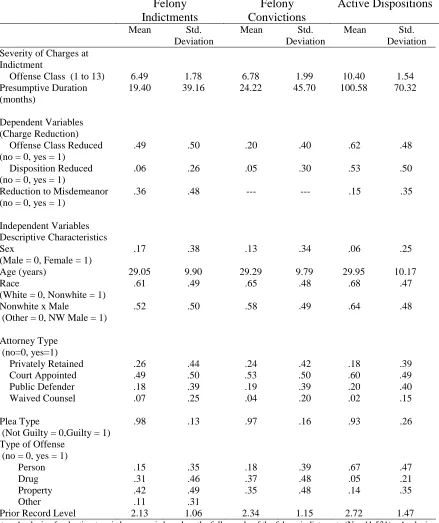
Descriptive statistics appear in Table 1. Seventeen percent of the sample is female and 83 percent is male. Thirty nine percent of the sample is white, while 61 percent is non-white. The average age of defendants charged with a felony in North Carolina is 29. Twenty-six percent of the sample are represented by private counsel, 49 percent by court appointed counsel, 18 percent by public defenders, and 7 percent of the sample waived their right to attorney. Nearly all the sample pled guilty (98%). Person charges make up 15 percent of the sample; drug charges, 31 percent of the sample; property charges, 42 percent of the sample; and “other” charges, 11 percent of the sample. Approximately half (49%) of the sample received a charge reduction, with 36 percent of the sample being convicted of misdemeanors. Only 6 percent (n=2,665) of offenders had their dispositions reduced to active sentences to discretionary portion of the grid, but this represents 53% of cases facing mandatory prison sentences if convicted of the original indictment.
appointed counsel (49.2% vs. 48.6%). Males are slightly less likely to be represented by public defenders than their female counterparts (18.1% vs. 19.1%), but males were slightly more likely to have retained private counsel (26.4% vs. 24.6%). A higher percentage of females waived their right to counsel than males (7.7% vs. 6.4%).
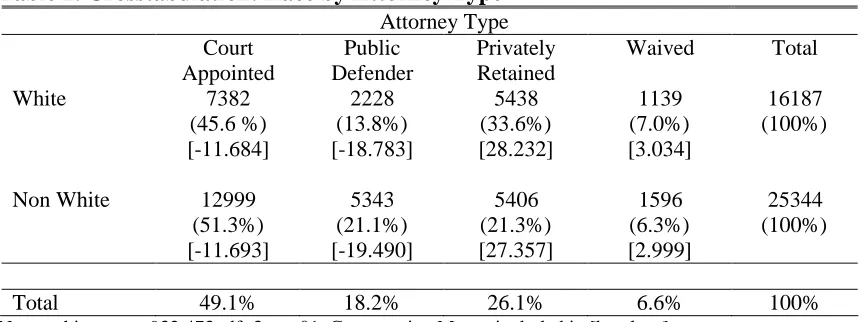
A crosstabulation3 of race and sex by attorney type shows that white females and non- white females are represented by court appointed attorneys at similar rates (48.5% vs. 48.8%) (see Table 4). Non-white males are more likely to be represented by court appointed
attorneys than white males (51.7% vs. 44.8%). Non-white females are the most likely to be represented by public defenders and white males are the least likely to be represented by public defenders (22% vs. 13.2%). Both white males (35.1%) and white females (27.9%) retain private counsel more often than their minority counterparts (21.3% and 21.6%), which is consistent with the Conflict theory. As suggested, non-whites are more likely to be at an economic disadvantage, and as a result, they are less likely to be able to afford private representation. Again, all groups have similar rates of waiving their right to counsel.
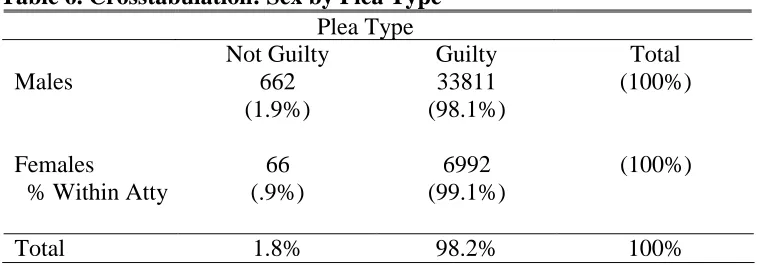
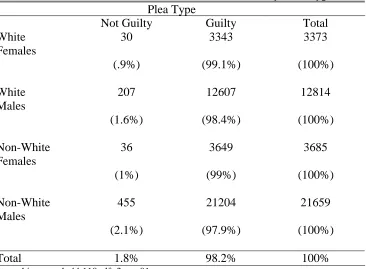
Rates of pleading guilty are similar across race and sex (see Tables 5 and 6). Females are only one percent more likely than males to plead guilty. Table seven shows that white females (99.1%) have the highest rates of guilty pleas and that black males have the lowest rates (97.9%). These rates are not surprising. The efficiency of the court relies on cases being processed quickly, which is achieved through plea negotiations, which allow attorneys to avoid the lengthy trial process.
Multivariate Analysis
3
I estimate a series of logistic regression models predicting the three dependent variables: charge reductions to misdemeanors, charge reductions to less serious felonies, and reduction in required disposition set by guidelines for the indictment charge. For each dependent variable, I estimate three models. The base model includes the extra legal variables race, sex, age of the offender at the time of conviction, and an interaction of race and sex. The base model also includes the legal variables offense class (i.e. seriousness) of the indictment charge, the offender’s prior record level, the type of offense (property, person, or drug, with other as the reference), the presumptive sentence at indictment, and the court district which is dummy coded. Attorney type is added to the second model, and an indicator of guilty plea is added to the third model. The analysis is performed in this order to test if attorney type or plea mediates any potential race disparities.
I first explore charge reductions to misdemeanors. This analysis
includes the full sample of felony indictments (n=41,531). Next, I investigate charge reductions to less serious felonies, using a sample (n=26,942) of felony convictions where the race of the offender is known. The three model specifications will remain the same; however, due to collinearity4 problems, the race x sex interaction is excluded from the base model. Finally, the third step of the analysis examines reductions in the required disposition. The sample (n=5,059) includes only cases for which prison would be required if the offender was convicted of their original indictment. Again, the race x sex interaction is excluded due to collinearity problems.
Charge Reductions to Misdemeanors
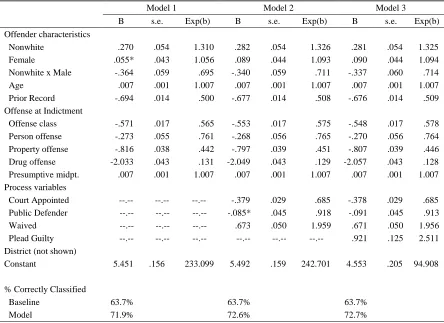
reductions to misdemeanors. In the base model the ascribed status characteristics of the defendant are all significant with the exception of sex. The odds of receiving a charge reduction to a misdemeanor are related to race, age, and the race x sex interaction. The main effect of race in the table represents the ratio of the odds of charge reductions for non-white versus white females and shows that non-white females have 31% greater odds than white females of receiving a charge reduction. The negative coefficient for the interaction term indicates the effect of race is negative among males – that is, non-white males are less likely to receive charge reductions to a misdemeanor.
The odds of receiving a charge reduction to a misdemeanor are related to all of the legal variables. The effect of offense class (seriousness) and prior record level are both negative, meaning that offenders charged with more serious crimes and those with more prior record points resulting from prior convictions are less likely to receive charge reductions. However, defendants facing longer presumptive sentences are more likely to receive a charge reduction to a misdemeanor. With regard to offense type, “other” offense is the reference group and the most likely to be reduced. Those charged with an offense against a person are the next most likely to be reduced, while offenders faced with drug charges are the least likely to have charges dropped to a misdemeanor.
counsel to have their charges reduced to misdemeanors. The effect of public defender is not significant, meaning that offenders represented by public defenders are equally as likely as clients represented by private attorneys to have their charges reduced to misdemeanors. All of the legal and extra legal variables are significant in this model. The only notable change that results with the addition of attorney type is that sex becomes significant, meaning that white females have a nine percent greater odd of receiving a charge reduction to a
misdemeanor than white males. The effects of the other variables remain significant and in the same directions as the previous model. The effects of race and drug offense increase slightly, while the effects of the interaction of race and sex, prior record level and offense class decrease slightly, but remain significant.
misdemeanors and those represented by public defenders are 8.7% less likely to receive reductions to misdemeanors, while those that waive their right to counsel have 95.6 percent greater odds of receiving a charge reduction to a misdemeanor.
To convey the magnitude of the effects on receiving a charge reduction to a
misdemeanor, I calculate predicted probabilities for the race by sex categories, the categories of attorney type, and for plea type while holding all other variables at their means. Table 9 displays the predicted probabilities for having charges reduced to a misdemeanor. Non-white females (.389) have the highest probability of having their felony charge reduced to a
misdemeanor, while the other categories of the race by sex interaction have similar rates. The probability of non-white females receiving a reduction to a misdemeanor is .067 higher than white females, .086 higher than white males, and .097 higher than non-white males. This suggests that the significant interaction between race and sex primarily reflects the more lenient treatment of non-white females, rather than more punitive treatment of non-white males. With regard to effectiveness of legal representation, those that waived their rights to attorney actually have the highest probability of having their charge reduced to a
misdemeanor (.502). The probability of defendants represented by private attorneys receiving a charge reduction to a misdemeanor is .340, which is .079 higher than the probability for clients of court appointed offenders and is .02 higher than for those
Charge Reductions to Less Serious Felonies
The second step of the analysis examines charge reductions to less serious felonies. This analysis is limited to 26,942 offenders who were both charged and convicted of felonies, thirteen percent of whom are female and 87 percent are male. Thirty five percent of the sample is white, while 65 percent is black. Descriptive statistics for this sample appear in Table 1.
Again, a series of logistic regression models are estimated, predicting the log-odds of receiving a charge reduction. Table 10 presents the results. The baseline model tests
hypotheses one through five, predicting the relationship of legal and extralegal variables in the likelihood of receiving charge reductions. In the baseline model (model 1) the extra legal variables of race and age are statistically significant, while sex is not. The effect of non-white indicates that non-whites have 17% greater odds than white offenders to receive charge reductions to less serious felonies. The legal variable prior record level is not
significant, but offense class is significant, meaning that offenders charged with more serious crimes have 2.3 times greater odds of having their charges reduced to lesser felonies. The effect of all the offense types are positive, with drug offenses having the greatest odds with a rate of nearly 6 times more likely than those charged with “other” offenses to receive a charge reduction. Presumptive sentence has a negative effect indicating that defendants facing longer sentences are less likely to receive charge reductions. District is also significant.
9.221; df =50; p<.05). The same variables remain significant, with the coefficient for race increasing slightly. The effect of court appointed attorney is significant, while the effect of public defender and waived right to counsel are not. Defendants represented by court appointed counsel have 11.3% lesser odds of receiving a charge reduction than those represented by a private attorney, whereas those represented by public defenders and those that waive their rights fare equally well as defendants represented by private attorneys.
The final model estimates the log-odds of receiving a charge reduction to a less serious felony when plea type is taken into consideration. It tests hypothesis seven, that offenders who plead guilty will be more likely to receive charge reductions and disposition reductions. Adding plea type improves the fit of the model (chi-squared = 235.788; df = 51; p<.05). Race, age, offense class, offense type, presumptive sentence, district and court appointed attorney remain statistically significant and in the same directions. The effect of race increases slightly and the effect of court appointed counsel diminishes slightly with the addition of plea type. As expected, if a defendant enters a guilty plea the odds of receiving a charge reduction are approximately 5.6 times greater than for those that plead not guilty.
Defendants represented by court appointed attorneys (.140) have a small disadvantage in comparison to those represented by public defenders (.152), those waiving their right to attorney (.152), and those represented by private attorneys (.153). As expected, offenders that plead guilty have a .12 greater probability of receiving a charge reduction to a less serious felony than offenders that plead not guilty.
Disposition Reductions from Active to Non-active
The last step of the analysis investigates reductions in charge severity that result in a change in the type of disposition required from prison to non-prison. The analysis is limited to cases where prison would be required if the offender was convicted of the original
indictment (n=5,059). Table 1 depicts that only six percent of this sample is female and more than two thirds of the sample is non-white (68%). Less than half (47%) of the sample have been convicted of crimes in which the guidelines mandate an active or prison sentence, whereas more than half (53%) have been convicted for crimes in which a judge may impose a non-active sentence, such as an intermediate or community-based sanction.
sex and age are statistically significant. Females have 60% greater odds of having their disposition reduced to a non-active sentence than males.
Unlike the previous analyses, race does not exert a significant effect on disposition reduction. Prior record level, offense type, presumptive sentence duration, and court district also have significant effects. The effect of prior record level is negative, which indicates that the more extensive the defendant’s prior record is, the lesser their odds of receiving a
disposition reduction. In reference to offenders charged with “other offenses,” those charged with property offense are about four times more likely to receive a disposition reduction to a non-active sentence. Those charged with crimes against people had odds two times greater than those charged with other offenses to receive reductions to non-active sentences. Finally, those charged with drug offenses have 86% percent greater odds than those charged with other offenses to have their disposition reduced to non-active. The effect of presumptive sentence suggests that those facing longer sentences have lower odds of having their disposition reduced to non-active sentences.
Model two includes attorney type and tests hypothesis six, that offenders represented by private attorneys will be more likely to receive charge reductions and disposition
attorneys.
The final model estimates the logistic regression predicting the odds of having a sentence disposition reduced from active to non-active with both attorney and plea type being considered. This model tests hypothesis seven, which posits that defenders that plead guilty will fare better than defendants that plead not guilty. Adding plea type improves the fit of the model (chi-square = 212.758; df = 51; p<.05). As expected, the effect of guilty plea is
statistically significant in a positive direction. Defendants that plead guilty are about 7.5 times more likely to have their dispositions reduced to non-active sentences than defendants that plead not guilty. The main effect of sex is a statistically significant and positive,
meaning that females have about 60% greater odds of receiving a disposition reduction to a non-active sentence. Race does not have a significant effect. All of the offense type variables are statistically significant with positive effects, with those charged with property offense having the greatest odds of receiving reductions to non-active sentences. All of the legally relevant factors remain significant and in the same direction. The results of the analysis depict that legal, extra legal and case processing variables are relevant in predicting the odds of dispositions reduced from active to non-active sentences.
To better understand what impacts whether a disposition will be reduced from active to non-active, I again calculated predicted probabilities for various groups. The results can be seen in Table 13. The calculation of predicted probabilities indicates the greatest
mandatory prison time than those represented by court appointed attorneys. It is .481 more probable that defendants that plead guilty will have their disposition reduced from an active to a non-active sentence than those that plead not guilty.
DISCUSSION
North Carolina adopted “Structured Sentencing” guidelines in 1994 to attempt
to reduce discretion in sentencing. Although the implementation of the sentencing guidelines has restricted judicial discretion, it is argued that the control over sentencing has shifted into the hands of prosecuting attorneys. Although extra-legal variables should be irrelevant under the guidelines, the results of the study convey that they impact the likelihood of receiving both charge and disposition reductions and that this may indirectly affect sentence outcomes. Partial support is gained for the hypotheses and for several theoretical standpoints.
result of this interaction, non-white females are in fact the group most likely to have their charges reduced, followed by white females, white males, and non-white males, respectively.
Hypothesis one and two are also tested directly in the analyses of charge reductions to lesser felonies and disposition reductions. The effect of sex is only significant in the
prediction of reductions in required dispositions. With regard to reductions to misdemeanors and disposition reductions, females are more likely than males to receive breaks; therefore, partial support is gained for the second hypothesis. Hypothesis three has very little support. Race is only significant in predicting charge reductions to lesser felonies, but not in
predicting disposition reductions. Also, the effect on charge reduction is in the opposite direction of the prediction. It was expected that whites would be more likely to receive reductions, but non-whites are actually more likely to receive reductions to less serious felonies. Predicted probabilities reveal that non-whites are about 2% more probable than whites to receive charge reductions to less serious felonies.
may assume that non-white females are single mothers and therefore may not want impose a sentence that will interfere with their dependent children.
Fourth, I predicted that defendants with more extensive prior record levels would have lesser odds of receiving charge reductions and disposition reductions. Prior record level is significant in predicting reductions to misdemeanors and reductions in required
dispositions, but not in charge reductions to less serious felonies. Therefore, only partial support is gained for this hypothesis. This finding is generally consistent with Focal Concerns and Uncertainty Avoidance/Causal Attribution, and may indicate offenders with criminal pasts are more likely to be seen as blameworthy, dangerous, and to recidivate.
Hypothesis five predicted that the more serious the defendants’ offense, the less likely they would be to receive both charge reductions and disposition reductions. Offense class is significant in predicting charge reductions to misdemeanors and to less serious felonies, but not in predicting required disposition reductions. Again, the seriousness of the offense may contribute to the blameworthiness and dangerousness attached to a defendant, lending more support to Focal Concerns Theory and Uncertainty Avoidance/Causal Attribution.
The evidence from my study clearly shows that the type of legal representation obtained by defendants significantly affects the likelihood of receiving post-indictment charge reductions, which substantially impacts the severity of punishment they can receive under structured sentencing. More specifically, the evidence partially supports the argument that those who retain private counsel are more likely to benefit from charge reductions. This is true in every model when comparing private attorneys to court appointed counsel, and also when comparing private and public defenders in the likelihood of receiving a reduction to misdemeanor. However, in the models predicting felony charge reductions and disposition reductions, there is no significant difference between public defenders and private attorneys.
These findings are complex, but important, and warrant further discussion. In only one model do private attorneys have significantly better odds of getting their clients’ felony charges reduced to a misdemeanor, compared with public defenders, and this results in only a two percent difference in the probability. This is a surprising finding, given that so much of the literature is dedicated to explaining why private counsel might provide a higher quality of defense. Alternatively, some scholars argue that public defenders have an advantage due to relationships that they have within the courtroom workgroup. North Carolina has fourteen districts that have public defenders, which are full time, state paid employees. It may be that in these prosecutorial districts public defenders are not faced with the same pressures as in other studies, or that private attorneys may be as likely to benefit from these networks of courtroom actors. Qualitative research could provide insight regarding whether caseloads, fees, and representation were comparable.
seemed to receive the least effective representation, based on court appointed counsel having the smallest odds of obtaining favorable outcomes for their clients5. Predicted probabilities show that compared to private attorneys, they were .079 less probable to have their clients’ felony charges reduced to misdemeanors and .013 less probable to have reductions to less serious felony charges. With regard to dispositions, offenders represented by court appointed attorneys were .156 less probable than those represented by private attorneys to have their dispositions reduced to a point where a judge can impose a non-active sentence. These probabilities translate to clients of court appointed attorneys being more likely to face prison time for their offenses, which can detrimentally impact their futures.
As expected, the seventh hypothesis, defendants that plead guilty will be more likely than those that plead not guilty of receiving both charge and disposition reductions, gains full support. Predicted probabilities demonstrate that offenders that plead guilty have a .291 greater probability of receiving a charge reduction to a misdemeanor than offenders that plead not guilty. Similarly, defendants that plead guilty have a .12 greater probability of receiving a charge reduction to a less serious felony than those that plead not guilty. Finally, the greatest difference can be seen with regard to disposition reduction. Defendants that plead guilty are .418 more probable to receive a reduction in disposition than those that plead not guilty. Courtroom actors may be rewarding defendants that plead guilty for respecting the court’s time.
The final hypothesis addressed the potential for legal counsel and plea type to
mediate racial disparities, but no support was gained for this claim. In North Carolina, access
5
to different types of legal counsel varies by race and sex and as a result has the potential to impact inequality in punishment. Since access to legal counsel varies, and since the type of legal counsel influences the plea entered, it was predicted that attorney type might explain disparities in outcomes. However, since the race effects that I found were not explained away suggests this is not the case, although the coefficients for race and the race by sex interaction did diminish slightly in two of the analyses. If attorney type does matter, and whites are more likely retain private counsel, then why are these race effects not explained away? The organization of North Carolina’s Indigent Defense Program may be one explanation. Although whites are more likely to have private attorneys, among indigent defendants, non-whites are more likely than whites to have public defenders. If, in fact, public defenders do as well as private attorneys, then the availability of public defender services may partially offset the economic advantage enjoyed by white defendants. Also, because there are differences between public defenders and court appointed counsel, offenders in districts without public defender systems may be at even more of a
disadvantage. More research is required to support this claim, but this could have important policy implications for the organization of indigent defense programs. Although there are differences by attorney type, it is important to note that they are relatively modest. Charge reductions in exchange for pleading guilty appears to be a common feature of North Carolina’s criminal justice system, regardless of a defendant’s legal representation.
CONCLUSION
treated equally. Whereas most studies of sentencing focus on punishment imposed post-conviction, most prosecutorial discretion research examines only the earliest stages of the criminal court process; the decisions to file or dismiss charges, thereby, ignoring the exercise of discretion post-indictment, but prior to the sentencing stage. Prosecutors are endowed with great discretion; they can decide whether to file or dismiss charges, decide the severity of the charges to be filed, and they can utilize plea bargaining by exchanging a guilty plea for a charge reduction. Under sentencing guidelines, plea bargaining post-indictment allows prosecutors to indirectly affect the punishment that a defendant will face during the
sentencing stage. Offenders who enter a guilty plea often have their charges reduced to less serious offenses, which relocates them on the sentencing grid to cells allowing shorter active sentences, or even allowing the judge to issue an intermediate or community sentence. If options to plea bargain are being based on status characteristics of the defendant, then the goal of uniformity of the sentencing guidelines is being undermined.
One of the strengths of the current study is that it investigates the post-indictment stage of the criminal justice system. The North Carolina data enabled me to explore charge reductions and disposition reductions because it contains both the initial charge with which the offender was faced and the charge for which they were convicted. By limiting the study to only an analysis of charge reductions and disposition reductions, I was not able to see how these reductions impact the magnitude of actual sentences imposed; but the analysis of disposition reduction shows the substantive impact that charge reductions can have on the type of sentence that is allowed under the guidelines.
defendants which warrants further investigation. The findings may help explain some of the conflicting evidence regarding the effectiveness of indigent defense in the United States because studies that fail to differentiate between these types of defense counsel may have produced misleading or biased results. Future research should attempt to explore disparities occurring in all stages of the criminal justice system. More qualitative research needs to be completed to understand how and why the type of legal counsel impacts charge reductions.
The data however, do not contain several important variables. Since the North Carolina data is a sample of convicted offenders, information on pretrial decisions, besides charge reductions, is not available. Most prosecutorial discretion research examines the decision to file charges, dismissals, and acquittals, but a major limitation of my study is that I was restricted to looking at post- indictment. This is detrimental because pretrial status factors, such as bond type, may greatly impact an offenders’ likelihood to be able to plea and charge bargain (Smith, 1970; Taylor, 1972; Wheeler and Wheeler, 1980; Emmelman, 1994). It is important to note, that I do not know how accurately the original indictment reflects the real underlying offense. It is possible that prosecutors have exercised their discretion to file less serious charges than what they could have in the original indictment. If they proactively reduced the charges, rather than at post-indictment, I would not know, which could bias my findings. However, according to the NCSPAC (2000b), interviews with court actors revealed that most respondents said indictment generally reflected the real offense. Although these analyses may underestimate the extent and impact of discretion being exercised by
Table 1. Descriptive Statistics Felony Indictments Felony Convictions Active Dispositions
Mean Std.
Deviation
Mean Std.
Deviation
Mean Std.
Deviation Severity of Charges at
Indictment
Offense Class (1 to 13) 6.49 1.78 6.78 1.99 10.40 1.54
Presumptive Duration (months)
19.40 39.16 24.22 45.70 100.58 70.32
Dependent Variables (Charge Reduction) Offense Class Reduced (no = 0, yes = 1)
.49 .50 .20 .40 .62 .48
Disposition Reduced (no = 0, yes = 1)
.06 .26 .05 .30 .53 .50
Reduction to Misdemeanor (no = 0, yes = 1)
.36 .48 --- --- .15 .35
Independent Variables Descriptive Characteristics Sex
(Male = 0, Female = 1)
.17 .38 .13 .34 .06 .25
Age (years) 29.05 9.90 29.29 9.79 29.95 10.17
Race
(White = 0, Nonwhite = 1)
.61 .49 .65 .48 .68 .47
Nonwhite x Male
(Other = 0, NW Male = 1)
.52 .50 .58 .49 .64 .48
Attorney Type (no=0, yes=1)
Privately Retained .26 .44 .24 .42 .18 .39
Court Appointed .49 .50 .53 .50 .60 .49
Public Defender .18 .39 .19 .39 .20 .40
Waived Counsel .07 .25 .04 .20 .02 .15
Plea Type
(Not Guilty = 0,Guilty = 1)
.98 .13 .97 .16 .93 .26
Type of Offense (no = 0, yes = 1)
Person .15 .35 .18 .39 .67 .47
Drug .31 .46 .37 .48 .05 .21
Property .42 .49 .35 .48 .14 .35
Other .11 .31
Prior Record Level 2.13 1.06 2.34 1.15 2.72 1.47