Make Your Stakeholders Wait for Minimum
Time – An Effective Time Management
Strategy
Suvra NandiM.E Software Engineering, Department of Information Technology, Jadavpur University, Kolkata, India
ABSTRACT: This article is a Technical Note which helps building a simple Time Management Scheduler which can ensure Minimum Waiting Time for all stakeholders who are dependent on completion of activities. The theory is based on Operating System’s scheduling algorithm Shortest Job First (SJF) which is the best scheduler for ensuring minimum waiting time. However, SJF has the disadvantage of big processes being starved to get CPU. So in this theory SJF concept is merged with Priority Scheduling with Aging of activities for avoiding that starvation. By aging of activities priority queue up gradation happens which ensures that every activity must be included in highest priority queue after a certain no. of days – hence there is no chance of indefinite starvation. It also addresses the normal human nature of delaying medium and low priority tasks till they become high priority and creates a sense of urgency – causing poor time management.
KEYWORDS: Scheduler, Time Management, Shortest Job First, Priority
I. INTRODUCTION
“Time management” refers to the way that we organize and plan how long we spend on specific activities.
It may seem counter-intuitive to dedicate precious time to learning about time management, instead of using it to get on with our work, but the benefits are enormous:
1. Greater productivity and efficiency. 2. A better professional reputation. 3. Less stress.
4. Increased opportunities for advancement.
5. Greater opportunities to achieve important life and career goals.
Failing to manage your time effectively can have some very undesirable consequences: 1. Missed deadlines.
2. Inefficient work flow. 3. Poor work quality.
4. A poor professional reputation and a stalled career. 5. Higher stress levels.
Spending a little time learning about time-management techniques will have huge benefits now – and throughout our career [1][2][7].
This article considers standard operating system scheduler algorithms along with Time Management strategies to build a simple to use Time Management Scheduler which ensures minimum waiting time.
Section II lists few studied theoretical aspects of time management, based on which proposed solution is built Section III details about potential causes of Inefficient Time Management by utilize Fishbone RCA technique Section IV details about existing knowledge of Operating System scheduling algorithms with their pros and cons Section V details about human tendency towards Priority Setting and execution of activities
Section VII lists the potential benefits that can be achieved by following the proposed technique
II. RELATED WORK
There are many theoretical effective Time Management strategies available in different Management Sites and Leadership Training Materials. Famous quote of H. Jackson Brown Jr. says, “Don’t say you don’t have enough time. You have exactly the same number of hours per day that were given to Helen Keller, Pasteur, Michaelangelo, Mother Teresa, Leonardo da Vinci, Thomas Jefferson, and Albert Einstein.” As per time management article “Work Smarter, Not Harder: 21 Time Management Tips to Hack Productivity” by Jordan Bates there are 21 management tips are given which are quite useful in managing time efficiently in any field of work[8].
"The aim of good time management is to achieve the lifestyle balance you want," says Emma Donaldson-Feilder, a chartered occupational psychologist. Emma’s top tips along with the “Four D” principle helps achieving better work-life balance [9].
Article published by University of Kent contains 11 time management strategies developed by Bruce Woodcock[10]. These strategies are useful for college student as well as professionals in overcoming conflicting situations in a systematic way.
Article “Principles of Effective Time Management for Balance, Well-being, and Success” published by McGraw Center – Princeton University is based on few principle which are derived from research on time management, motivation theory and much experience working with university student[11]
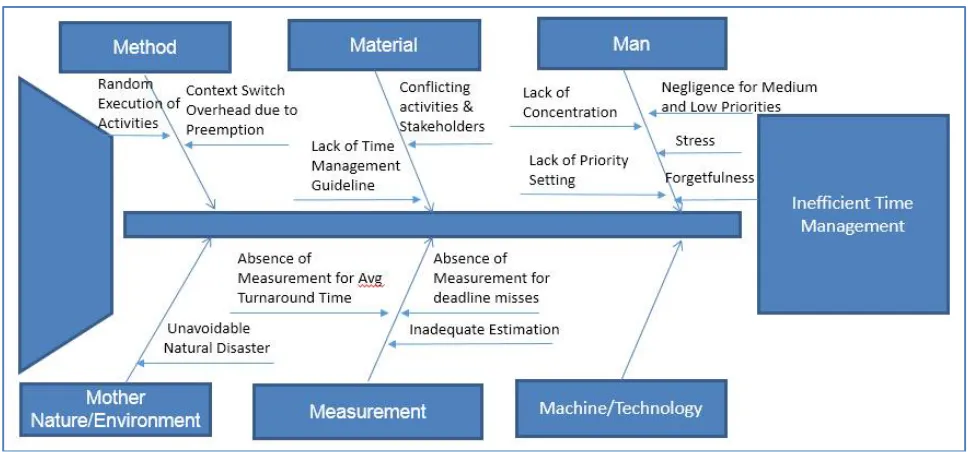
III.RCA–POTENTIAL CAUSES FOR INEFFICIENT TIME MANAGEMENT
Figure 1: Fishbone diagram for Inefficient Time Management
IV.OPERATING SYSTEM SCHEDULING ALGORITHMS
Listed are few common scheduling strategies, looking at only a single CPU burst for each of small processes under consideration.[3] – [6]
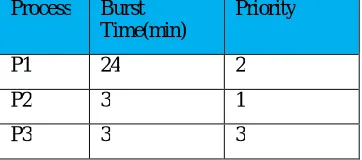
For explaining different scheduling algorithms we consider listed three processes with their respective burst time and priorities (for priority scheduling).
Table 1: Process List with Burst Time
Process Burst Time(min)
Priority
P1 24 2
P2 3 1
P3 3 3
In above table three processes P1, P2, P3 are consider with burst time 24 mins, 3 mins and 3 mins respectively. Their priorities are 2nd, 1st and 3rd respectively. This priority component will be used in explaining Priority Scheduling algorithm.
A. First Come First Serve(FCFS) Scheduling
Process that appeared first, gets CPU first – it is similar to FIFO queue concept.
If order of appearance for these processes is P1, P2, P3:
P1 P2 P3
0 24 27 30
P1 gets CPU at 0thmin, P2 gets CPU at 24th minand P3 gets CPU at 27th min.
Average waiting time for the processes to start execution = (0 + 24 + 27)/3 mins = 17 mins
If order of appearance for these processes is P2, P1, P3:
P2 P1 P3
0 3 27 30
P2gets CPU at 0thmin, P1 gets CPU at 3rd minand P3 gets CPU at 27th min.
Average waiting time for the processes to start execution = (0 + 3 + 27)/3 mins = 10 mins
If order of appearance for these processes is P2, P3, P1:
P2 P3 P1
0 3 6 30
P2gets CPU at 0thmin, P3 gets CPU at 3rd minand P1 gets CPU at 6th min.
Advantage: Algorithm is simple to execute
Disadvantage: FCFS cannot provide optimized waiting time as process execution order decides it.
B. Shortest Job First(SJF)Scheduling
Process with shortest execution time gets CPU first.Using shortest job first concept below is the execution sequence:
P2 P3 P1
0 3 6 30
P2gets CPU at 0thmin, P3 gets CPU at 3rd minand P1 gets CPU at 6th min.
Average waiting time for the processes to start execution = (0 + 3 + 6)/3 mins = 3 mins
This scheduling algorithm does not depend on process appearance sequence. After completion of each process execution it checks the queue and picks the process with minimum execution time.
Advantage: It ensures minimum waiting time
Disadvantage: Large processes often starve to get CPU
C. Priority(P) Scheduling
It is the more generalized version of SJF scheduling where processes are assigned to integer priorities. At any given point of time the processes with highest priority gets CPU.
Below is the execution sequence of three processes considering their assigned priority?
P2 P1 P3
0 3 27 30
P2gets CPU at 0thmin, P1 gets CPU at 3rd minand P3 gets CPU at 27th min.
Average waiting time for the processes to start execution = (0 + 3 + 27)/3 mins = 10 mins
Advantage: Process priorities get considered which ensures conflict avoidance
Disadvantage: Often low priority processes starve to get CPU and it does not guarantee minimum waiting time
D. Round Robin(RR) Scheduling
RR scheduling is similar to FCFS scheduling, except that CPU bursts are assigned with limits called “time quantum”. Assuming time quantum value as 5 mins below is the order of appearance for processes P1, P2 and P3:
P1 P2 P3 P1 P1 P1 P1
0 4 7 10 14 18 22 26
P1gets CPUfirst time at 0thmin, P2 gets CPU first time at 4th minand P3 gets CPU first time at 7th min, P1 gets CPU for subsequent iterations from 10th min to 22nd min and completes its execution.
Average waiting time for the processes to start execution = (0+4+7)/3 mins = 3.67 mins
Advantage: Elimination of process starvation
E. Multilevel Queue(MQ) Scheduling
In this approach multiple queues are created with different priorities assigned to them.
Jobs are included in appropriate queue based upon their priority. Jobs in one queue cannot start executing until all jobs in higher priority queues are finished. In one queue jobs get executed using Round Robin scheduling approach.
Jobs cannot change the queue, once assigned and each queue may execute different scheduling algorithm as appropriate for the assigned jobs.
Advantage: It creates a systematic scheduling strategy by differentiating priority levels and adding flexibility of scheduling
Disadvantage: More jobs getting added in high priority queue causes lower priority queue jobs to starve for CPU access
F. Multilevel Feedback Queue Scheduling
It is similar to MQ approach with flexibility added for a job to change its queue as required. Here a job can change its position from a high priority queue to lower priority queue.
Advantage: It is the most flexible scheduling option, with no starvation Disadvantage: Complex Design
From the above discussion it is evident that Shortest Job First scheduling can provide the most efficient way of scheduling jobs / activities in minimum waiting time without having complex design in place.
In our proposed solution we have tried to utilize this concept with little tweak by priority scheduling.
V. HUMAN TENDENCY TOWARDS PRIORITY SETTING AND ACTIVITY EXECUTION
For the purpose of creating effective time management strategy, it is important for everyone to set priorities. At any given point of time all set of tasks normally don’t have similar priority. Minority of them fall under High priority bucket, with most of the tasks in Medium or Low priorities.
It is the normal human tendency to delay the action for Medium or Low priority tasks till the point it becomes a High priority job to be completed as soon as possible.
Irrespective of role and designation, or the activities that we perform in our day-to-day life it is normal human nature to create sense of urgency all the time. This is one of the main cause of creating poor time management scenarios.
In our proposed solution we have addressed this issue by reusing Priority Scheduling with Aging concept.
VI.PROPOSED SOLUTION –BUILDING MSEXCEL BASED TASK SCHEDULER
Proposed solution elaborated here uses four main concepts:
1.Shortest Job First Scheduling for ensuring minimum waiting time for all stakeholders 2.Priority Queue formation
3.Aging and Moving to Upward Queue 4.Allowing Partial Preemption
The steps are elaborated below with purpose of each step:
1.Task Name: Cell Type General
2.Task Category: Cell Type General – this can be dropdown list containing standard task buckets 3.Expected Completion Date: Cell Type Date (as in system format)
4.Days Left: Cell Type Number with no decimal – this is a formula “Expected Completion Date – Today ()” 5.Estimated Completion Time (Hours): Cell Type Number with Two Decimal
6.Status: Cell Type General – this is a dropdown list containing status values “Open” and “Closed” 7.Date: Cell Type General – this is for holding actual closure date
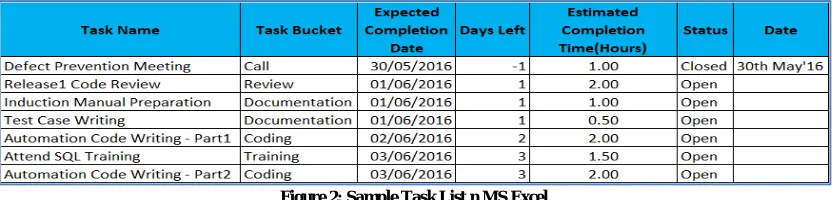
Sample task list format is shown below, created on 31/05/2016
Figure 2: Sample Task List n MS Excel
In above figure there are seven tasks listed: Defect Prevention Meeting (of Call category), Release1 Code Review (of Review category), Induction Manual Preparation (of Documentation category), Test Case Writing (of Documentation category), Automation Code Writing – Part1 (of Coding category), Attend SQL Training (of Training category) and Automation Code Writing – Part2 (of Coding category). All these tasks are listed with expected completion date and estimated execution time (or Burst Time as per OS example above).
Step2: Select the sheet and create a pivot table in a separate sheet (named as “Scheduler”) with below options: 1. “Task Name” in Rows
2.“Days Left” in Columns 3.“Status” in Filters
4.Sum of “Estimated Completion Time (Hours)” in Values 5.Select Status values open and blank
6.Sort “Column Labels” on “Days Left” ascending order
7.Sort “Row Labels” on “Sum of Estimated Completion Time (Hours)” ascending order
Notes:
• “Days Left” accts as Priority Queue – 0 priority queue (target completion today), 1 priority queue (target completion tomorrow) etc
• We sort Days Left in order to ensure that highest priority queue is at front
• Sorting in Ascending mode for “Sum of Estimated Completion Time (Hours)” ensures that activities are arranged in shortest job first order for each priority queue
Here is the sample Scheduler created from the example Task List:
In above figure all open tasks listed previously are arranged in Shortest Job First manner with priority queues as “0”, “1”, “2” etc. denoting tasks to be completed in 0th day(today), 1st day(tomorrow), 2nd day(day after tomorrow) etc.
Step3: Understanding Mode of Working
Below is the interpretation of the created scheduler:
1.Start working on activities from leftmost queue (0 priority queue), topmost activity
2.Whenever an activity is completed, that needs to be marked as “Closed” on Task List sheet and refresh the Scheduler pivot
3.0 – priority queue is the high priority queue which indicates activities must be completed “TODAY”. So one must extend current day’s working hour till that person has completed all pending activities in 0 queue
4.If a person has completed 0-priority queue activities and yet to consume full working hour, that person needs to pick up activity from next priority queue, top to bottom mode – this helps avoiding delaying medium / low priority activities till they become high priority
5.Every morning the task list’s “Days Left” column get updated automatically to decrement the count by 1 – this creates the aging of activity and after a predefined period every activity has to appear in 0-priority queue
6.For very large activity, it is better to span it across multiple days. In that case that activity needs to be segregated in Part-1, Part-2,…, Part-n etc. Then each smaller part needs to be put in Task List as separate activity
7.Partial Preemption needs to be enables for handling real life activities. Partial Preemption means taking inputs from Mails / Phone Calls / Chats etc only after completion of an ongoing activity. Preemption should be avoided when someone is in the middle of an activity – for best results. This can be done by showing appropriate status message on Chatting Software or sending busy message to phone call etc.
8.Inputs gathered from external preemption become new activities in Task List sheet and maximum allowable target date needs to be confirmed for each new activity for ensuring conflict avoidance and proper expectation setting
9. In this solution long tasks can be divided into elementary level sub tasks each of which can be scheduled as independent tasks with expected completion date setting
VII. BENEFITS
1.Proposed Solution is applicable for any type of activities, irrespective of industry, role and designation.
2.This solution helps achieving minimum waiting time for all stakeholders
3.This solution avoids starvation by introducing Aging with Priority Scheduling
4.It helps in predicting stress or extent of working hour extension for a particular working day by looking at the entries of 0-priority queue
5.It helps avoiding creation of urgent feeling by taking care of medium and low priority activities right after completion of high priority activities
6.It helps utilizing working hours more effectively
8.It helps making expectations clear to all stakeholders and effective Stress Management [7]
REFERENCES
[1] What is Time Management? – Time Management Skills From MindTools.com
https://www.mindtools.com/pages/article/newHTE_00.htm
[2] How to Manage Time With 10 Tips That Work
https://www.entrepreneur.com/article/219553
[3] CPU Scheduling, Abraham Silberschatz, Greg Gagne, and Peter Baer Galvin, "Operating System Concepts, Eighth Edition ", Chapter 5
https://www.cs.uic.edu/~jbell/CourseNotes/OperatingSystems/5_CPU_Scheduling.html
[4] Operating System Scheduling algorithms, tutorialspoint
http://www.tutorialspoint.com/operating_system/os_process_scheduling_algorithms.htm
[5] M.Ramakrishna, G.Pattabhi Rama Rao, “EFFICIENT ROUND ROBIN CPU SCHEDULING ALGORITHM FOR OPERATING SYSTEMS, ”(IJITR) INTERNATIONAL JOURNAL OF INNOVATIVE TECHNOLOGY AND RESEARCH Volume No. 1, Issue No. 1, December-January 2013, 103-109
[6] R.Nallakumar, Dr.N.Sengottaiyan, S.Nithya, “A Survey of Task Scheduling Methods in Cloud Computing, (IJCSE) International Journal of Computer Sciences and Engineering, Survey Paper,0020Volume-2, Issue-10, E-ISSN: 2347-2693
[7] Dr.R.Kausalya, Dr.V.Srinivasan “Time Management Technique to Mange Stress among Software Professionals”International Journal of Innovative Research in Computerand Communication Engineering, Vol. 2, Issue 11, November 2014
[8] Work Smarter, Not Harder : 21 Time Management Tips to Hack Productivity | The Creativity Post Jordan Bates Jan 27, 2014 http://www.creativitypost.com/create/work_smarter_not_harder_21_time_management_tips_to_hack_productivity [9] Easy time-management tips – Stress, anxiety and depression – NHS Choices
http://www.nhs.uk/conditions/stress-anxiety-depression/pages/time-management-tips.aspx
[10] How to manage your time effectively Bruce Woodcock, University of Kent
https://www.kent.ac.uk/careers/sk/time.htm
[11] Effective Time Management – McGraw Center – Princeton University
https://www.princeton.edu/mcgraw/library/for-students/effective-time-management/
BIOGRAPHY
Ms Suvra Nandi has completed her B.E in “Computer Science & Technology” from Bengal Engineering & Science University, Shibpur, Howrah during the year 2006.