Cellular Simulation for Distributed Sensing over
Complex Terrains
Tuyen Phong Truong1,2* ID, Bernard Pottier1* and Hiep Xuan Huynh2
1 Université de Bretagne Occidentale, Lab-STICC, UMR CNRS 6285, France
2 Can Tho University; Can Tho city, Vietnam
* Correspondence: [email protected], [email protected]
Abstract:Long range radio transmissions open new sensor application fields, in particular for environment monitoring. As an example, theLoRaradio protocol enables to connect remote sensors at distance as long as ten kilometers in line-of-sight. However, the large area covered also bring several difficulties, such as the placement of sensing devices in regard to geography topology, or the variability of communication latency. Sensing the environment also carries constraints related to the interest of sensing points in relation with a physical phenomenon. Criteria for designs are thus evolving a lot from the existing methods, especially in complex terrains. This article describes simulation techniques based on geography analysis to compute long range radio coverages and radio characteristics in these situations. As radio propagation is just a particular case of physical phenomena, it is shown how a unified approach also allows to characterize the behavior of potential physical risks. The case of heavy rainfall and flooding is investigated. Geography analysis is achieved using segmentation tools to produce cellular systems which are in turn translated into code for high-performance computations. The paper provides results from practical complex terrain experiments using LoRa, that confirm the accuracy of the simulation, scheduling characteristics for sample networks, and performance tables for simulations on middle range Graphics Processing Units (GPUs).
Keywords: Cellular automata; Complex terrain; LoRa; Parallel processing; Radio signal propagation
1. Introduction
Climate change and natural evolution impact seriously on several social and economic aspects, including living conditions, human health, and development. Autonomous observation is a key point for understanding evolution and the management of territories. This is achieved using small stations equipped with sensors, a transceiver, and power supply. Distributed sensors sample physical behavior. They enable to analyze environmental changes and to predict short term and medium term evolutions.
Wireless Sensor Networks (WSNs) have offered several frameworks to connect sensors. Radio standard such as 802.15.4 [1] have proposed short range mesh connected topologies suitable for indoor or local deployments. Recent innovations includelow power long range radiosystems, such asLoRa[2] or Sigfox [3]. Long range means covering of large surface, more risk during transmissions, long signal latencies, and more difficulties coming from the ground topology.Star organization, where a central node addresses remote sensors is the more natural technique to collect data on surfaces as in the order of ten thousand square meters.
Complex geographic areas such as shores or islands, hills, valleys oppose physical difficulties to the radio propagation. At the sensor level, thecoveragealso defines zones where information is accessible, whatever it is, wildlife including insects, physical elements such as water or gas.
Therefore, aprecise coverage computationis critical for monitoring efficiency matchingradio connectivity objectives, and sensing accuracy in regard to physical phenomena. This article describes principles of a general method based on geo-localized cellular systems. It explains how a radio coverage or a physical coverage can be computed from the same framework, allowing to obtain a better match between the observation engines and observed phenomena.
The introduction firstly gives a brief view on principles behind three components in the methodology: (i) the terrain analysis (Section1.1), (ii) the signal propagation and coverage (Section 1.2), and (iii) the representation of physical phenomena behaviors (Section1.3). Generic algorithms for sensing deployments can be built in relation with metrics for these components. This section will refer to a grid of points having geometric and geographic coordinates. Preliminary examples present a large region with mountains and creeks along the seashore, likely to be equipped with sensors. This level of explanation match needs at application engineering level.
Further sections will detail tool principles, with the presentation of the cellular methodology (Section2), then algorithms that simulate the physical case of flooding (Section3), and long range radio propagation (Section4). Appendices will present validation results obtained for these algorithms.
1.1. A characterization of terrain complexity
Sensor investigation in a zone almost certainly starts with a glance at a geographic map or an aerial photography. If the zone includes mountains, hills, rivers, or shores, two questions will come, about the sensing point locations, the reachability of an infrastructure network, the adequacy with the sensing objectives. Design tools will help to take into account the geography characteristics and possible obstacles to signal propagation, while keeping track of these objectives. Sensing systems are application specific, point to point, and differ a lot from mobile radio communication based on regular coverages.
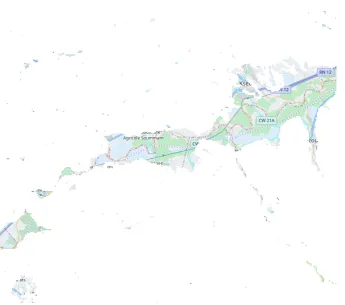
Terrain complexity metricsallow to measure ground irregularity, and offer the possibility to split and isolate zones of similar characteristics. Figure1displays complexity for a complex zone1 based on Digital Elevation Models (DEMs) analysis.
Several metrics are known for this.Terrain Ruggedness Index(TRI) andTopographic Position Index(TPI) for DEM provide a quantitative measure of surface turbulence [4]. TRI is the square root of the summed squared deviation in elevation between a cell and its eight neighbor grid cells [5]. TPI is the difference in elevation value of a center cell and the mean of eight adjacent neighbor cells [6]. Both TRIs and TPIs grids illustrate the distribution of terrain heterogeneity and may be displayed in the form of a map as shown Figure1. Figure2display analysis result for four cases, also showing how terrain characteristics allow separating concerns about sensor layouts. Partitioning the ground according to terrain complexity is a preliminary operation for network layout and selection of the pair to pair radio transmissions, to be obtained by computer programs.
Figure 1. TPI terrain complexity for Soummam river in Algeria (see also Figure4). Red lines represent higher points, difficult to overcome and blue lines are for lower points, difficult to reach. The white zone signals a flat ground without remarkable obstacles, the case of Soummam banks. This grid is 262 x 226 points, representing 30 x 25 kilometers.
Figure 3.The subsystem of low complexity. Progressive thresholding on TRI produces a space partitioning according Terrain complexity. This is a flat zone around river Soummam, with complexity below threshold line on the right (Figure2).
1.2. Designing for long distance radio coverage
Setup of long distance radio communication links is difficult if there is an opposition of the geographical topology.
In smooth terrain areas, radio propagation can be considered asnear line-of-sight (NLoS). In this case, the communication distance is expressed in relation with power reduction along the path.Free space path loss (FSPL)equation was proposed for this aim (see Section5and Formula9 in Section5).
Concerning complex terrains, the choice of a radio position can be application context dependent, topology-dependent, or it can come from a layout algorithm. Thus, it is critical to obtain a description of zones covered by a signal, plus other characteristics such as propagation delay from the source, and quality of the signal. Section5will explain how this can be done using cellular algorithms that mimic the spatial physical propagation over the terrain.
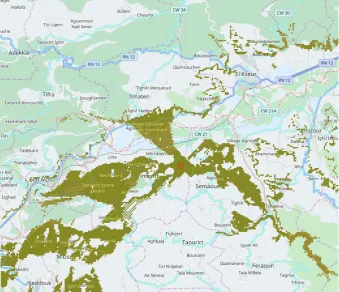
Figure 4. Display of a radio coverage for an emitter (red point), located above Soummam (36.622141028, 4.799995422)2, elev:165.0. Coverage is shown in dark yellow, spreading over 30 km on the zone width. This location was chosen at random, giving a percentage of 32% grid points receiving the long range signal.
1.3. Observing physical phenomena
Another component for observation methodology is the necessary focus on the phenomenon to monitor. The nature of the sensing varies a lot, depending on application field. Sensing can be related to biology, climate, geology, human activities, or composition of parameters. Complex terrains will bring a complex behavior, as it is the case for radio signal propagation.
To illustrate the observation problem, let us consider heavy rain in the same region as in Section1.2. The physical fact to be monitored is water streaming from the mountain to the river, then to the sea. Rain can be predicted from the meteorology services simulations, or just observed using radars, satellites, or ground devices. Causality for water flooding is the nature and shape of the terrain, sharing characteristics with terrain complexity and signal propagation.
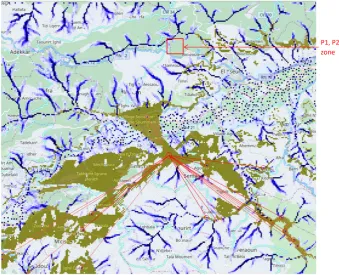
Cellular simulation presented Section2will compute propagation of water given an expected, or existing rain history taken from a public service (this case), or extracted from radar networks [7] or satellite observations [8]. Figure4displays the water streaming from the mountain down to the river in the case of a heavy storm which profile is shown Figure6.
In the resulting maps, high values represent flooding and possible risks. This analysis demonstrates that simulation allows establishing dependencies between risks and positions.
Figure 5.Heavy rainfalls context: a physical simulation has produced positions with the risk of flash flooding (dark blue color). The communication coverage of a base station with a star network is predicted for sensor nodes monitoring level of water in these positions. An algorithm select reachable sensor positions from a network sink, then sort, then extract 15 positions according to the flooding result simulation. More details about accuracy are given in Section3.
Choice of real sensing positions can be produced by computer programs. As an example, the control that appeared Figure5can connect on radio coverage zones and obtain measures from critical positions in the rivers. The difference in communication latencies is another problem in the long range. This is also a place where computer tools can help by producing a schedule of sensor communication automatically.
Table 1.Geo-locations of points where values of water level were recorded.
Point Color Latitude Longitude Elevation (m)
P1 Red 36.589895361 4.925651550 554.7 P2 Green 36.587414366 4.925651550 536.8
The flexibility of cells embedding local parameters makes possible to represent many physical phenomena such as ocean or river wave effects, rain effects and flooding, air or water pollution, species behavior, sound, and alerts reachable zones, etc. Parallel algorithms have been designed to simulate rain flooding (Section3) and propagation of the LoRa radio protocol (Section5.1), the objective being to obtain high performances on this kind of problems.
Figure 6.Chart of rainfalls and water levels at two positions in Soummam river zone during a tropical storm from 13 to 16 November 2017. The blue line shows rainfalls in 4 days recorded each 3 hours [9]. The two lines in red, green color present water level at P1, P2 respectively (also see Table1). The distance between P1 and P2 is in the order of 300 meters. Due to the significant slope of the ground surface in this complex terrain, a large amount of water was accumulated at lower points, causing a flash flood, and possibly catastrophic landslide.
2. Mapping geographic space into cell systems
2.1. Geographic map and user interfaces
Several domains such as physics, medicine, or biology need sensing systems and geometric references. The case of geography includes necessaryprojectionsof a spherical surface into flat maps, with many options depending on applications, precision and considered location. Software tools exist for conversions [10]. Designing observation systems implies to consider distances and geometry related to the applications, and thus use of one or several reference systems to manage physical phenomena and their perception coherently. This section proposes an explanation of map building and displays to support the meaning of map contents, and data abstraction for geo-localized information additionally fetched from other sources, including simulations.
Tiled web mapsare used to represent geographic data and to display information as flat graphics. This appears in proprietary software, or free access map systems such as OpenStreetMap. InTiled web maps, the Earth is accessed by a projection rule called Web Mercator[11], and most often by a 3D designation mechanismXYZused by web browsers and tile servers. The Z parameter provides azoom factorfrom the whole Earth to more and more detailed view of the Earth fragments. At a given zoom factor Z, XY gives the 2D index of a tile inside the rectangle of tiles of this level Z. Based on this, tiles of graphical information is composed and delivered by servers to clients, usually in the form of 256×256 pixel images (Figure8presents a map composed from such tiles). These images are composed by a server rendering engine that extracts objects from a database and draws them according to some style (see Figure7).
Figure 7.Tile map server architecture: tiles are requested from the web page server that either return a cached image or ask the rendering engine to compose it from a data base of geographical objects.
Figure 8.Quickmap tool [12] showing a tile coverage. For this case, zoom factor is 9, and last tile bottom right has x=251, y=177 indexes.
At a map browser level, users are specifying or observinggeometric points relative to a zoom level. Real points are geographical positions, with coordinates specified according to the current projection system. In the case of Quickmap, they are double precision floating point numbers for latitude and longitude. Another concern is the necessity to use real distances in meters, over the Earth surface, for a task such as coverage computation. In the case of Web Mercator transformations between addressing mechanisms for(lat, long)absolute geographical specifications (x, y) distance in meters, (x, y) pixels, and XYZ tile access operations can be managed with formula from [14].
2.2. Definition of cells
• Cell locationsare bounded to geometric locations on maps, in relation with tile containers, and when possible to geographical locations.
• Basic cell contents are extracted from the map or image fragment as supported by the browser tool.
• Cell content extensionsare obtained from external databases. Most of the cases are digital elevations, and also climate, or weather characteristics and histories.
• Cell sizeis chosen to match a particular physical phenomenon or sensing requirements. • Cell behaviorsare local procedures operating on a cell state. They need to be programmed
to produce simulation data that in turn can be returned to databases, or displayed on tiles.
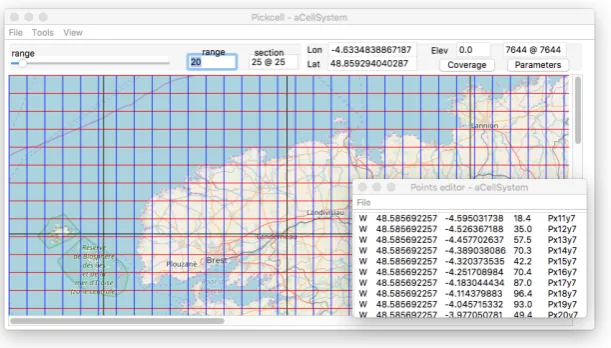
Figure 9.Presentation of a cell system organization over the tiles of Figure8. Each cell has an identity produced from its location inside the window, and a geographical location. The text window bottom right also displays a plus parameter for the elevation. The cell size is 25×25 pixels, representing 7644 meters.
Examples in Section1illustrate how geographical abstraction, representation, and simulation can interact (Figures1,4, and5).
Given a partitioning of a geographical zone into a cell system, we need to relate the observation system and physical behavior. The possibility to simulate physical processes will be of great help to correctly characterize a layout of sensors in regard to physical evolution.
Cellular automata (CA) allow modeling physical activities as processes that exchange information and evolve according to transition rules. The cell concept binds geographical fragments to such processes which assembly is generated automatically.
2.3. Cellular automata principles
• Thecellular spaceis represented by an assembly of similar cells. A common notion of neighborhoods defines local communications following observed physical dependencies. The spatial organization can be either regular or irregular, possibly with disconnected subsystems as shown Figure11, item 3.
• The evolution of each cell is defined in aset of statesas observed in a real system (quantities, colors, boolean). Change of states are operated by procedures associated representing transition rules from step to step: Statet→Statet+1.
• Theneighborhoodrepresents physical dependencies, for example, signal propagation, or downward flooding. These dependencies are connectivities from cell to neighbor cells. Common neighborhoods are Von Neumann and Moore with 4 and 8 cardinal directions respectively. Item"Process architecture"in Figure11illustrates a Moore neighborhood. • The transition rule defines the behavior of each cell evolution under influence of its
neighborhood and local sensedinfluences. The state of the whole cell system changes synchronously, time step by time step.
2.4. Cellular automata parallel execution models
A sequential execution model will read states in an arrayAtfor timet, and loop over, writing a similar arrayAt+1. Once the step is completed, the two arrays are exchanged, and a new turn begins. CA is easy to parallelize preserving this behavior, grouping operations together and observing turns completion. Parallelism is mandatory because problems are large, if not huge, a lot of small cells can be critical for simulation precision, and some applications require to examine very large geographical regions.
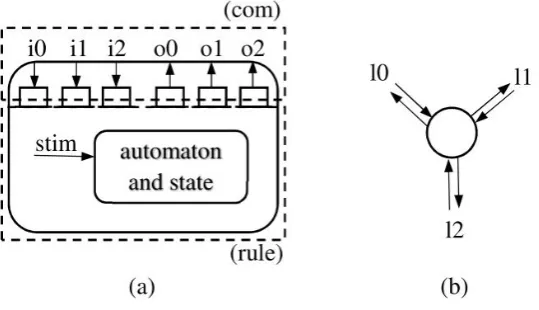
• The synchronous distributed messaging model [18] can support parallel computation by associating cells to communicating processes. In this case, process progress by locked steps, based on messages being sent and received to or from neighbor nodes. The steps are split into two phases, one for communications with the neighborhood, the other to execute the transition rule. Figure10shows an internal node representation and the outside connection with three input and output links. This model does not need to specify the relative speed of processes, and can therefore be used for multi-cores or supercomputers.
• Another way to take advantage of parallelism is to use data parallel Single Instruction Multiple Data (SIMD) processors to execute a group of processes simultaneously. Current graphics accelerators propose solutions up to two thousand processors working concurrently, and exchanging data synchronously in shared memory. State spaces must be copied to the accelerator memory, then a loop of steps can be run completely on the accelerator. This is very efficient.
Production of code from cell systems to this schema has been done for two targets:
1. Asynchronized Occam communicating processes [19,20] targeting KRoC compiler and multi-cores [21],
2. CUDA code production [22] targetingNVIDIAtools and accelerators.
2.5. Cellular systems work flow organization
Most of the work described in this article is supported by a set of dedicated tools from University of Bretagne Occidentale (UBO). The design flow can be summarized as follows:
1. Zone selectionis done by moving a graphical window anywhere, with any level of zoom. The tool extracts graphic tiles, and display the contents.
2. Cell segmentationis obtained by splitting the view into rectangles of a given size specified as a width×height value. Cells will carry an image and a geographical location from the underlying image.
3. Binding cell together and producing a cell system implies the choice of a connectivity (Moore, Von Neumann), and possibly filtering cells by colors or elevation. This step also injects external values from a variety of sources, including elevation.
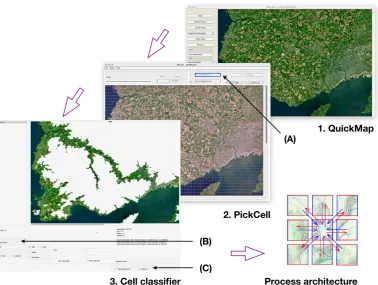
4. Adding behavioris programing the cellular system at the local level, given a cell system architecture that step 3 (Figure11) produces automatically.
Steps 1 to 3 are interactive and can be achieved in minutes. Step 4 is a concurrent programming activity specific to a concurrent platform it requires elaboration of CA transition rule and coding for the target platform.
Physical phenomena simulation can reveal places of interest for sensing. In the case of flooding, simulation track accumulation and circulation of water.
3. Heavy rain simulation on a complex terrain
To illustrate cell system interactions and behavior, we use the example of a zonereceiving andfloodingrain, as discussed in Section1.3.
3.1. Managing space
Space is defined by geographical coordinate bounds, and a possible selection operated on cells. Selected cells have common properties, such as an elevation above or under a threshold level (Figure11, step C), some color characteristics, or some signature produced from observed parameters. Thus the cell system can be rectangular or have arbitrary shapes and isolated subsystems.
Practically, cell systems first appear as arrays of objects that carry geometric coordinate, geographic coordinate, and a pixel array extracted from the original image.
1. QuickMap
2. PickCell
3. Cell classifier
(A)
(C) (B)
Process architecture
Figure 11.Cell synthesis flow: (1) a zone was located from a Quickmap navigation, and (2) was segmented into cells, then a subsystem was extracted filtering cells with elevations less than 45 m. (3) A cell system was generated following Moore topology. Annotations show controls for geographical positions with a cell size of 5×5 pixels representing a 191×191m2surface (A), classification was operated for elevation (B). The neighborhood was Moore, radius 1 (C).
Execution software and hardware will allow adaptation to the intermediate communicating process model.
The case of rain reveals several interactions:
1. Millimeters of water falling on the ground. For this simulation, we admit that the quantity can vary with the time, but will remain uniform.
2. Water disappearing locally for reasons such as absorption or evaporation. 3. Water passedlocallyfrom cell to cell according to elevation differences.
Other cases include different specific problems for signal propagation (Section 5), sound propagation [23], or insect swarms behavior [24]. For flood modeling, Von Neumann neighborhood is convenient. Figure12shows such a neighborhood, with the North cell lost, and some elevation differences appearing above and below a center cell.
3.2. Transition rule
+hw
West
East Center
−he
−hs
Rain
West Center East
absorbed
South
South
Figure 12.Physical exchange during rain. An incomplete neighborhood from a system shows a center cell with 2 neighbors west and east, and 1 in the south. The physical behavior is water flowing downward, represented here by synchronous messages sending water quantity west to center, and center to the east. Refer to [25] for more realistic behaviors.
characteristics, and current weather3. While real dependencies are water leaking from cell to cell, the abstract behavior is represented by messages sent and received to and from neighbors. Vertical water behavior is directly encoded in the transition rule that can be specified as follows:
t: timetrepresented by a step number
Qt: water quantity in a center cell at the beginning of time stept
αt: rainfall at timet
β: percentage of water remaining on each cell after each step
celli.elevation: elevation value ofcelli cellc.elevation: elevation value of center cell
δi: the difference of elevation between neighborcelliand the center cell
∆: sum of all elevation differences
outFi: amount of water out coming from center cell to neighborcelli inFi: amount of water in coming to center cell from neighborcelli
The water quantity of center cell at timet+1 after local absorption is
remaining=Qt×β (1)
But the center cell receives rainfall within its area as following
rain=αt (2)
The quantity of water coming from neighbors is taken into account
received=
n
∑
i=1inFi (3)
3 ECOCLIMAP [26] supporting French meteorology AROME model provide more than 20 parameters for cells of
wherenis a number of neighbors of the center cell.
A center cell also has to distribute water to surrounding neighbors in the proportion of elevation differences. This is calculated as follows
δi =cellc.elevation−celli.elevation (4) It is obvious that the water of a center cell only flows to neighbor cells with lower elevations so that only positive values ofdeltaiare used to compute the total proportion of all differences
elevationAbove=∆=
∑
δi,∀δi >0 (5) Equation6figures out the amount of water that a cell distributes to its lower neighbors. For higher elevation neighbors, withδi <0, there is no water flowing out,outFi =0.senti=outFi =Qt×(δi/∆),∀δi>0 (6) Eventually, center cell updates its own quantity of water by summing and subtracting. The whole system executes a synchronous transition fromttot+1.
Qt+1:=remaining+rain+received− n
∑
i=1senti (7)
Notice that this transition rule needs to know the neighbor relative elevationscelli.elevation. In reality, physical rules will discover these relations naturally. In the case of simulations, a preliminary procedure calledneighborhood discoveryis executed to establish initial knowledge such as the number and the elevations of cells around.
4. Parallel algorithms for cellular long range coverage computations
4.1. General idea
Figure 13. Radio signals propagate in concentric squares step by step. Reachable cells are represented in colored stripes.
program: communication with neighbors, updating the local state, and preparing next cycle communications. Theline of sight(LoS) is a ray broadcast in any direction from a root emitter. Propagation will be stopped or modified by ground obstacles such as hills, valley, etc. The simulation parallel algorithm mimics the physical behavior, by propagating the signal inside a spanning tree rooted at the emitter cell, and covering progressively all the space in concentric "circles".
Each new step in the algorithm adds a new circle, and the computation finish in 2×log(n) steps wherenis the number of cells. During ray propagation, the ground profile is collected into a route. A route profile is shown in Figure14. Routes are completed progressively based on positions and elevations. Each cell can thus decide if the emitter is visible or not by comparing its slope to root to previous ones in the received profile, as shown in Algorithm1.
Figure 14.A profile obtained along a route. Let assume that an emitter located at furthest left of the chart, with distance 0 m, elevation 350 m. According to LoS condition three points at distances 2997 m, 3269 m and 3541 m seem cannot receive the signal from the emitter.
Algorithm 1Setup visible nodes from emitter based on LoS condition 1: procedureFSPL
2: Input:celliand its neighborscellj 3: Output:cellj.visible
4:
5: foreachcelljdo
6: if(cellj.slope<=celli.slope)AND(receivedPower>sensibilityPower)then 7: cellj.visible=TRUE
8: else
9: cellj.visible=FALSE
10: end if
4.2. Vertical model
Signal propagation is progressing in steps according to the time. It builds progressively a route from the emitter to any other cell, as an array holding traversed locations and signal parameters (Figure14). As it is the case for most of the cellular simulation algorithms, nodes start with a discovery stage, where geometric coordinates are exchanged to bind communication channels to cardinal directions. This is mandatory to deal with the irregularity of cell system shapes as shown in Figure11, step (3), and also to maintain horizontal signal direction, as discussed in Section4.3.
To start the building a propagation, an emitter has to initialize a tracing route with its own identity and geographic location. Other cells start their processes with an empty tracing route. Note that the tracing route, in this system, is the payload of the message for communications within cell system. The root cell then sends its message to all neighbors via eight directions from Moore neighborhood. Each cell accepts only one message then assigns the corresponding owner of the accepted message as its parent. This cell must send an acknowledgment message back to parent cell to confirm the dependency relationship between them. The next step in the transition rule is to insert its own location into the tracing route, then to pack routes and spread out to neighbors. Ifsideis the maximum betweenwidthandheightthen at most,siderounds are necessary to cover a whole zone.
4.3. Horizontal model and Directed Breadth-First Search
The original Breadth-First search (BFS) algorithm build a tree covering a whole network starting from a root position. For radio propagation, this tree would allow reaching any cell in a minimum number of steps, propagating a route to this cell without managing signal horizontal directions. In the case of radio signals, there is the necessity to guide the route horizontally to maintain the best approximation of a straight line. A sequential algorithm that reduces horizontal errors to a minimum has been proposed by Bresenham to draw graphic lines on bitmaps [27]. In our case, it was preferred to find a parallel distributed approach based on Directed BFS (DBFS), that could also match particular geographic or electromagnetic dynamic considerations. Figure15 shows DBFS routes resulting from this algorithm according to an emitting node and some target receivers.
At the difference of a BFS, the cell transition function makes a decision on receipt of route messages based on the source position and its own source position. It adds its data to the route, and it forwards the route to neighbors of interest. The neighborhood has been discovered at initialization stage, associating link indexes and cardinal directions.
5. Radio signal propagation on complex terrains
Radio propagation modelsare used to describe the qualifications and reliability of links using radio frequency. These models based on the physics of the diffusion of electromagnetic waves with respect to both constructive and destructive interference of environment. They can be practically applied to parameters inside routes transmitted from cell to cell, according to Section4.
Figure 15.Directed BSF is a distributed parallel algorithm being able to manipulate data on grid cells. Its aim is to mimic point-to-point radio links adopting LoS condition. Segmented lines laid on a map to represent how cells forward incoming signal gradually from a root cell (x=10, y=1) to definite directions.
5.1. Free space path loss model
In terms of radio communication, aFree Space Conditionis a region where there is no obstacle along the propagation path of radio waves. A radio signal is emitted by a transmitter and then it propagates in any direction at the speed of light. In this case, the signal energy can be received by an antenna in inverse proportion of the distance away from the signal source. In addition, the received power depends on the transmitted power, and gains of both transmit and receive antennas. Fading margin and other loss such as system loss, cables, connectors are also considered. The power of the signal is lost on the path is called theFree Space Lossrepresented by
FSPL=20log10( 4Πd
λ ) (8)
Algorithm2is derived from Equation8in order to describe how to calculate the attenuation of signal power due to free space path loss. In consequence, the free space power received is given by equation9, Friis free space equation [30].
Pr(d) = PtGtGr
(λ)2
(4π)2d2L (9)
where
d: distance between transmitter and receiver in meters L: system loss factor
λ: wavelength in meters
Algorithm 2Received signal power in Free Space Path Loss Model 1: procedureSIGNALPOWER
2: Input: txPower, waveLength, distance 3: Output: receivedPower
4: foreach neighbor ofcellido 5: ifneighbor.visiblethen
6: receivedPower←txPower×(SQR(waveLen /(4.0×valuePi))×SQR(1/distance))
7: end if
8: end for 9: end procedure
5.2. Single knife-edge diffraction model
Diffraction appears around objects such as buildings, vegetation, etc. . . . The losses caused by these obstacles can be described by aKnife Edge Diffraction model. This is considered as a function of the path difference around the obstacles and could be explained by Fresnel zones. Diffraction loss of signal after a knife edge is calculated as a function of Fresnel parameterv.
v=h(
s 2 λ( 1 tt + 1 dr )) (10)
wherehis the height of obstacle. dt,dr are the distances from the obstacle to emitter and receiver, respectively. Algorithm3demonstrates the computation of received power within a shadowing area because of a single knife edge obstacle.
L(v) =6.9+20log(
q
(v−0.1)2+1+v−0.1) (11) In Algorithm3,receivedPoweris defines as the signal strength in dBm obtained at a receiver. In addition,sensibilityPoweris the minimum value of signal strength in which condition a receiver can detect and demodulate a message successfully.
5.3. Okumura-Hata model
This is a dedicated radio propagation model to predict the path loss regarding geographic environments such as urban, suburban, and open areas [30,31]. The formula for Okumura-Hata model is given by
L=69.55+26.16log10(f)−13.82log10(hb)−a(hm) + (44.9−6.55log10(hb))log10(d)−K (12) where
fMHz: center carrier frequency of transmission band in MHz. hb: antenna height of base station in meter.
hm: antenna height of mobile node in meter. dkm: distance in kilometers.
Algorithm 3Received signal power in Single Knife-Edge Diffraction Model 1: procedureDIFFRACTIONLOSS
2: Input: fsplPower, h,d1,d2 3: Output: diffPower
4: v = h * SQRT((valuePi/2)×((1/d1) + (1/d2))) 5: ifv<0then
6: diffLoss←0
7: else
8: ifv<2.4then
9: diffLoss←6 + (9×v) + (1.27×SQR(v))
10: else
11: diffLoss←13 + 20×log10(v)
12: end if
13: end if
14: diffPower = fsplPower - diffLoss 15: end procedure
The model is valid for radios using carrier frequencies from 150 to 1500 MHz with an effective height of antennas from 30 m to 1000 m and distances ranging from 1 km to 100 km.
Table 2.List ofa(hm)andKvalues for each type of area [30].
Type of area a(hm) K
Open
[1.1log10(f)−0.7]hm−[1.56log10(f)−0.8]
4.78[log10(f)]2−18.33log10(f) +40.94
Suburban 2[log10(f/28)]2+5.4
Small city 0
Large city 3.2[log10(11.75hm)]2+4.97 0
5.4. Correctness of the Different Radio Communication Models
The terrain was a mountain area investigated by applying the three models during simulations. The computation results are shown in Table3. FigureA7displays the coverage obtained by the model ofsingle knife-edge diffraction, and effective coverage measured by a mobile.
Table 3.Comparison in number of points found in coverage from a total of 96431 points.
Model Points
Free space path loss 19537 Single knife-edge diffraction 22305
Okumura-Hata 17621
6. Conclusion
areas, radio transmission can be considered as near line-of-sight (NLoS). As a result, the issue of topologies can be almost neglected and the communication distance is expressed in relationship with power reduction along the path. Free space path loss (FSPL) equation was proposed for this aim (Section5). For example, using LoRa technology for a point-to-point connection in NLoS condition, the distance for transceiving data is expected to reach hundreds of kilometers [32].
In complex terrain areas, heterogeneity of topologies causes serious impact on the quality of radio links, especially for low power and long range communication networks. Different propagation models allow representing the median of the expected path loss such as Longley-Rice model, ITU model, Okumura-Hata model, as described in Section5.
Appendices give details on experimental measurements, with the communication distance checked to be around 5 km in complex urban area and up to 20 km in rural and shore ones. Experiment results shown TableA1confirm the interest of a computer-aided approach. It may be concluded that communication in LoRa network is strongly dependent on the considered environment. Hence, the actual coverage prediction must take topographic complexity into account as a critical factor. An assessment of physical simulation was also conducted for flash flooding problem (Section3). This algorithm was applied to the practical case of an intense rain found in June 3, 2018, and compared with flooding observations. The rain occurred in a rough terrain urban area and the simulation was able to retrieve major flooding places and level of water. There is a major interest in this kind of physical simulations that reveals places of interest for sensing and establish causality between events.
Table 4.A characterization of space and signal relations.
Datagrid Model Resolution (m)
SRTM30 2D/3D 304
SRTM90 2D/3D 905
Weather broadcast 2D/3D 30006
LiDAR 3D 57
Coastal ocean 2D/3D 12008
Earth magnetic 2D/3D 37009
Ocean acoustics 2D/3D 250010 Road traffic noise 2D/3D 0.511
Pickcell 2D/2.5D 30
The software developed in this project is easy to use up to cellular system generation. Implementing cellular transition rules, tuning and verifying these rules necessitate in-depth investigations. Several domains were investigated, from sound propagation to insect behaviors. Thus the methodology appears very general and flexible (see Table 4). Parallel programs implement described algorithms very efficiently (Tables5and6). Efficiency is mandatory if space exploration strategies are to be developed.
4 https://lta.cr.usgs.gov/SRTM1Arc"https://lta.cr.usgs.gov/SRTM1Arc 5 https://blogs.esri.com/esri/arcgis/2015/06/26/terrain-3d-now-with-global-srtm-30-meter-content/"" 6 https://www.ncdc.noaa.gov/data-access/model-data/model-datasets/numerical-weather-prediction 7 https://content.meteoblue.com/en/research-development/data-sources/nmm-modelling/model-domain" 8 https://pdfs.semanticscholar.org/55be/a487827c28aaaf713017c499e4f33aed62fd.pdf 9 http://www.sciencedirect.com/science/article/pii/S0377042798002465 10 https://www.ngdc.noaa.gov/geomag/emag2.html
11 Peter Wille. Chapter 5: The Sea Floor - Natural Formations. InSound Images of the Ocean: in Research and Monitoring.
Table 5.Execution times for three processes. There are 58725 cells in regular squared grid with cell size 3 x 3 pixels corresponding to actual area 115 x 115 meters.
Processes Number of rounds Time (s)
Compute ruggedness index 1 0.026
Flood simulation 32 0.103
Coverage prediction 261 0.211
Table 6.Execution times for flood simulations which are performed on Linux Ubuntu PCs with IntelR CoreTMi3-4005U CPU @ 1.70GHz x 4, 8 GiB DDRAM, card NVIDIA GeForce 820M (96 CUDA Cores), IntelR CoreTMi7 CPU 920 @ 2.67GHz x 8, 4 GiB DDRAM, card NVIDIA GeForce GTX 680 (1536 CUDA Cores) and IntelR CoreTMi7-7700K CPU @ 4.20GHz x 8, 16 GiB DDRAM, card NVIDIA GeForce GTX 1070 (1920 CUDA Cores).
Execution time
Resolution (pixels) Number of cells 820M GTX 680 GTX 1070
3x3 58725 28.168 (ms) 6.5269 (ms) 1.3373 (ms) 5x5 21060 10.411 (ms) 2.1728 (ms) 518.64 (µs) 10x10 5226 2.5234 (ms) 454.59 (µs) 83.696 (µs) 15x15 2340 1.1155 (ms) 181.48 (µs) 65.916 (µs) 20x20 1287 602.47 (µs) 171.19 (µs) 62.085 (µs)
Acknowledgments:
City of Brest has supported a doctorate study that led to the initial design of tools shown figure .
Special thanks to France Ministry of Foreign Affairs (MAEDI) for the support of SAMES project in its STIC-Asia program, and to Vietnam MOET ministry for the support of doctorate studies in this project.
Significant student contributions helped the developments of high level tools and code generation targeting GPU accelerators. Combining several simulations using High Level Architectures was also investigated in this way.
High level software layers were developed on the Visualworks Smalltalk platform, while parallel processing was implemented using Kent Research Occam Compiler and NVIDIA CUDA tools.
All participants to the SAMES project have contributions to the project management, advising, developments and experiments [33], with special thank to Vincent Rodin. SAMES is a companion project of the Persepteur ANR project.
Appendix .1 A study in flash flood event
A case study for flash flooding prediction due to heavy rain during a storm on Monday, June 3, 2018, in Morlaix town, France12. The objective is for validating the accuracy of our proposed tool for flash flooding, especially for complex terrain areas.
Apart from data grid produced by QuickMap/NetGen/PickCell, to execute flooding simulation it is necessary the rainfall values measured in each hour during a storm, hurricane,
etc. as input data (see the blue line in FigureA3. The data can be retrieved from the database of weather broadcast services such as meteofrance.com, meteoblue.com, etc.
Figure A1.Heavy flooding in center of Morlaix, France due to a storm in June 3, 2018 (Photo: Le Télégramme).
Figure A3.Chart shows rainfall levels during 32 hours from 00:00 June 3, 2018, to 08:00 June 4, 2018. It is noticed that the serious flooding often comes several hours after a storm or heavy rain. After the rain stopped, it requires a couple of hours or days to drain all water.
Figure A4.Even though the heavy rain occurred just during few hours (3:00 -5:00 PM), simulation result shows that there are 50 points where water levels are from 30 to 70 cm.
Our proposed simulator can be efficient to predict risk places where flooding due to heavy rain often occurs.
In fact, flood simulation is utilized the frame tool flow as what being used for radio signal propagation simulation and radio coverage prediction as explained in Section3. For this study time step was one hour, we keepβat 20%,αtrainfalls were taken from public website shortly after the episode.
Appendix .2 Experimental measurements of radio coverages
Figure A5.A base station is equipped a LoRa board (emitter) and MacBook. This base station was deployed on the top of Roc’h Trevezel mountain, France. For receiver, another LoRa board is mounted on a car moving around.
Figure A6. Terrain complexity analysis for the Roc’h Trevezel using TPI metric. This shows remarkable landform splits in the North-South direction. This provides critical references for network deployment aiming to enhancing the robustness and range of system and reducing the cost as well.
showing the BS environment. To evaluate the impact of transmission environment on reliability and robustness of radio links in the context of wide-range wireless networks, several places with different terrains in Bretagne region, France were selected for our intensive investigations. In the case as shown in FigureA7have required a visit toArrée Mountainsin central Brittany. These mounts culminate at less than 400 m and are the site chosen for TV/Radio antenna. The car was driven in a loop, up to 10 km showing a good accuracy of simulation prediction.
Figure A7. The base station (emitter) is located on top of the mountain (latitude: 48.4051306, longitude: -3.9077762, elevation: 345 m). A receiver is placed on a car (receiver) traveling around the area with many hills, valleys, and big trees. From simulation results, places (cells) are able to receive the radio signal highlighted in yellow color. Blue circles show points where the receiver got messages successfully in our actual measurement.
Table A1. Three areas with different complexity terrains.ResolutionandActual sizecolumns give the size in pixels associated with actual size in meters of each cell in regular grid data. The maximum communication in each experiment is shown by columnRange.MatchandMismatch column provides a number of visible points which are right matched and mismatched respectively between simulation results and obtained values in real measurements.
Area name Description Resolution Actual size Range Match Mismatch % Error
Albert 1er Urban area 5×5 pixels 24 m 3 km 64 13 20.21%
Plougastel River and its banks 5×5 pixels 96 m 9 km 129 4 3.10 %
Trevezel mountain area 5×5 pixels 191 m 11 km 45 8 17.78%
Figure A9. Chart of radio coverage execution times for different resolutions of cell from 5 to 30 pixels. This statistics was recorded for the performance on PC equipped Core i7-7700K [email protected] x 8, 16 GiB DDRAM, card NVidia GeForce GTX 1070 (1920 CUDA cores).
References
1. Callaway, E.; Gorday, P.; Hester, L.; Gutierrez, J.A.; Naeve, M.; Heile, B.; Bahl, V. Home networking with IEEE 802.15.4: A developing standard for low-rate wireless personal area networks. IEEE Communications Magazine2002,40, 70–77.
2. Corporation, S. Sx1276/77/78/79 -137 MHz to 1020 MHz Low Power Long Range Transceiver. Rev. 4 - March 2015. Technical Report August, 2016.
3. Sigfox. Sigfox Technology Overview. https://www.sigfox.com/en/sigfox-iot-technology-overview, 2017. [Online; accessed on 15 December 2017].
4. Zhang, J.; Atkinson, P.M.; Goodchild, M.F.Scale in Spatial Information and Analysis; 2014; p. 362. 5. Riley, S.J.; DeGloria, S.D.; Elliot, R. A Terrain Ruggedness Index that Qauntifies Topographic
Heterogeneity, 1999.
6. Jenness, J. Topographic Position Index (TPI) v. 1.22006. p. 42.
7. Huuskonen, A.; Saltikoff, E.; Holleman, I. The Operational Weather Radar Network in Europe. Bulletin of the American Meteorological Society2014,95.
8. EUMETSAT. Monitoring The Atmosphere, Ocean and Climate from Space - Transforming Our World.
9. Online, W.W. Bejaia Historical Weather. https://www.worldweatheronline.com/bejaia-weather-history/bejaia/dz.aspx, 2017. [Online; accessed on 25 July 2017].
10. proj4.org. Proj4 documentation. https://proj4.org, 2018. [Online; accessed on 4 June 2018].
11. Wikipedia.org. Bejaia Historical Weather. https://en.wikipedia.org/wiki/Web_Mercator, 2018. [Online; accessed on 25 April 2018].
12. Lucas, P.Y. Modélisations, simulations, synthèses pour des réseaux dynamiques de capteurs sans fil. PhD thesis, Université de Brest (UBO), LabSTICC, UMR CNRS 6285, 2016.
13. Lucas, P.Y.; Van Long, N.H.; Truong, T.P.; Pottier, B., Wireless Sensor Networks and Satellite Simulation. InWireless and Satellite Systems: 7th International Conference, WiSATS 2015, Bradford, UK, July 6-7, 2015. Revised Selected Papers; Pillai, P.; Hu, Y.F.; Otung, I.; Giambene, G., Eds.; Springer International Publishing: Cham, 2015; pp. 185–198.
14. Pridal, K.P. Google Summer of Code 2008, project GDAL2Tiles for OSGEO.http://www.maptiler. org/google-maps-coordinates-tile-bounds-projection/, 2011. [Online; accessed on 25 April 2018]. 15. Neumann, J.V.Theory of Self-Reproducing Automata; University of Illinois Press: Champaign, IL, USA,
1966.
16. Frisch, U.; d’Humieres, D.; Hasslacher, B.; Lallemand, P.; Pomeau, Y.; Rivet, J.P. Lattice Gas Hydrodynamics in Two and Three Dimensions. Complex Systems Publications1987,1, 649–707. 17. Margolus, N.; Toffoli, T.Cellular Automata Machines: A New Environment for Modeling; MIT Press, 1987. 18. Lynch, N.Distributed algorithms; Morgan Kaufman, 1996.
19. Pountain, D.; May, D.A tutorial introduction to Occam programming; McGraw-Hill, Inc.: New York, NY, USA, 1987.
20. Iqbal, A.; Pottier, B. Meta-Simulation of Large WSN on Multi-core Computers. Proceedings of the 2010 Spring Simulation Multiconference; Society for Computer Simulation International, , 2010; SpringSim SCS Conference, p. 133.
21. Barnes, F.R.M. Blocking System Calls in KRoC/Linux. Communicating Process Architectures 2000; Welch, P.H.; Bakkers, A.W.P., Eds., 2000, pp. 155–178.
22. Dutta, H.; Failler, T.; Melot, N.; Pottier, B.; Stinckwich, S. An execution flow for dynamic concurrent systems: simulation ofWSNon a Smalltalk/CUDAenvironment. Proceedings of SIMPAR 2010 Workshops Intl. Conf. on simulation, modeling and programming for autonomous robots; , 2010; Dynamic languages for robotic and sensors systems (DYROS), pp. 290 – 295.
23. Keita, E.B. Physical models and perception, contributions to sound analysis in urban environment. Phd thesis, Université de Bretagne occidentale - Brest, 2015.
24. Traore, M. Modélisation cellulaire et simulation physique: contribution à l’analyse de la dynamique de population des insectes ravageurs. PhD thesis, Université de Bretagne occidentale - Brest. 25. Météo-France. Le modéle á maille fine Arome.
http://www.meteofrance.fr/prevoir-le-temps/la-prevision-du-temps/le-modele-a-maille-fine-arome, 2018.
26. Faroux, S.; Kaptué Tchuenté, A.T.; Roujean, J.L.; Masson, V.; Martin, E.; Le Moigne, P. ECOCLIMAP-II/Europe: a twofold database of ecosystems and surface parameters at 1 km resolution based on satellite information for use in land surface, meteorological and climate models. Geoscientific Model Development2013,6, 563–582.
27. Bresenham, J.E. Algorithm for Computer Control of a Digital Plotter. IBM Syst. J.1965,4, 25–30. 28. Rappaport, T.; (Firme), S.B.O. Wireless communications: principles and practice, 1996.
29. Seybold, J.S.Introduction to RF Propagation; 2005; pp. 1–330,[0712.0689].
30. Rappaport, T. Wireless Communications: Principles and Practice, 2nd ed.; Prentice Hall PTR: Upper Saddle River, NJ, USA, 2001.
31. Seybold, J.S.Introduction to RF Propagation; 2005; pp. 1–330,[0712.0689].
32. Manuka. Balloon project. http://www.instructables.com/id/Introducing-LoRa-/, 2015. [Online; accessed on 25 July 2017].
33. SAMES group, F.; Vietnam.; Indonesia. Stic-Asia Modeling for Environment Simulation (SAMES).