An investigation of control processes in bilinguals,
using visual word recognition tasks
Thesis submitted to the University of London
for the degree of Doctor o f Philosophy
Roswitha E. von Studnitz
Department o f Psychology
University College London
ProQuest Number: U642338
All rights reserved
INFORMATION TO ALL USERS
The quality of this reproduction is dependent upon the quality of the copy submitted.
In the unlikely event that the author did not send a complete manuscript and there are missing pages, these will be noted. Also, if material had to be removed,
a note will indicate the deletion.
uest.
ProQuest U642338
Published by ProQuest LLC(2015). Copyright of the Dissertation is held by the Author.
All rights reserved.
This work is protected against unauthorized copying under Title 17, United States Code. Microform Edition © ProQuest LLC.
ProQuest LLC
789 East Eisenhower Parkway P.O. Box 1346
ACKNOWLEDGEMENTS
PUBLICATIONS BASED ON THIS THESIS
von Studnitz, R.E. & Green, D.W. (1997). Lexical decision and language switching.
InternationalJournal o f Bilingualism, 1, 3-24. (Experiments la/lb )
von Studnitz, R.E. & Green, D.W. (2002). Interlingual homograph interference in German/English bilinguals: Its modulation and locus of control. Bilingualism: Language and Cognition, 5, 1-23. (Experiments 4a/4b)
von Studnitz, R E. & Green, D.W. (2002). The cost of switching languages in a semantic categorization task. Bilingualism: Language and Cognition, 5, part 3 (in press). (Experiment 3)
PRESENTATIONS BASED ON THIS THESIS
R.E. von Studnitz & D.W. Green, The cost o f switching languages: The effects o f varying the lexical decision task. International Symposium on Bilingualism, Newcastle upon Tyne, 9th - 12th April 1997.
R.E. von Studnitz & D.W. Green, Interlingual homograph effects in lexical decision.
International Symposium on Bilingualism, Newcastle upon Tyne, 14th - 17th April 1999.
ABSTRACT
How is competition between bilinguals’ languages resolved? This thesis contrasts two main accounts - an
internal (Bilingual Inliibitory Control [BIA] model, Dijkstra & van Heuven, 1998) and an external
account (Inhibitory Control [IC] model, Green, 1998). The internal account proposes varying the activation of languages within the lexico-semantic system; the external account proposes task schemata acting differentially to the signals emerging from this system. On-line visual word recognition tasks (with German/English bilinguals) measured RTs and errors.
Experiments la /lb : switching languages incurred a greater cost when language was task relevant than when it was not (‘language-specific’ vs. ‘language-general’ lexical decision task), consistent with both external and internal accounts. Experiment 2 sought to distinguish between the two accounts by refining Experiment 1. In a language-specific lexical decision task language^switch costs were reduced when this task followed the language-general task, but only for ‘pure-HF’ stimulus lists, not for ‘mixed’ (HP / LF) lists. Such patterns are consistent with an external, but not an internal account, and provide insight into lists’ effects on decision criteria. Experiment 3: animacy decisions (for German and English words) produced a language-switch cost only in the first half of the experiment, and only for response- repetition trials, not for response-switch trials. Tliis is consistent with an external, but not an internal account, and shows the influence of language signals on decisions even when task-irrelevant. Experiments 4a/4b: English-specific lexical decisions incurred a cost on interlingual homographs (vs. matched controls). Tlie degree of interference was greater if pure German words (to be rejected) were included than when none were included. Tliis enlianced interference diminished with time (Experiment 4a). Interference was less when indviduals were infomied about the presence of IHs than when not infoimed (Experiment 4b). IH interference and ‘carry-over’ effects dissociated, consistent with an external but not an internal account. Overall, the data are consistent with a non-selective access account. They further indicate that language activation levels can be raised exogenously, but not reduced endogenously. A mechanism reacting differentially to signals from the lexico-semantic system can account for the observed patterns. This mechanism appears to be influenced by task demands, experience, item constraints and available information. The external account is parsimonious, proposing tlie same mechanism for resolving competition between languages, as for control of action.
TABLE OF CONTENTS
Acknowledgements... 1
Publications and presentations based on this thesis... 2
Abstract ... 3
Table o f contents...4
List of tables...9
List of figures...10
Abbreviations used in this thesis... 11
I Introduction and review: Language processing in bilinguals 1.1 Introduction... 12
1.1.1 Siunmary: Why ‘control’ is an important issue... 14
1.2 Overview...15
1.3 The miilingual lexico-semantic system... 16
1.3.1 The Interactive Activation model - the basis of the Bilingual Interactive Activation m odel...17
1.3.2 ‘Dissociations’ and cognitive representations... 19
1.4 Experimental tasks and levels o f processing... 21
1.5 The bilingual lexico-semantic system... 23
1.5.1 Early models of the bilingual lexicon: How are the languages represented?...23
1.5.1.1 Separate lexica, one for each language?...25
1.5.2 Are L1/L2 representations independent or interdependent, and is access to them selective or nonselective?...28
1.5.2.1 Language-switching experiments... 28
1.5.2.2 Bilingual flanker task s... 32
1.5.2.3 Masked cross-language prim ing... 33
1.5.2.4 Cross-language word-neighbourhood effects... 34
1.5.2.5 Interlingual homograph (IH) interference effects... 35
1.6 The two ‘control’ models: Bilingual Interactive Activation / Inhibitory Control... 39
1.6.1 An internal account of control: The Bilingual Interactive Activation m odel...39
1.6.2 An external account of control: The Inhibitory Control m o d el... 43
1.6.2.1 Task schemata... 43
1.6.2.2 Task instructions and task schema ‘architecture’ ...45
1.6.3 List composition effects...49
1.6.4 Multiple signals available for use: The paralexical decision process...50
1.6.5 Competition between response units...52
1.6.6 Degree o f usage of the paralexical decision information...52
1.6.7 Asymmetric language-switch costs...53
1.7 Rationale for the methodology employed...54
1.8 Nummary and outlook... 57
II Experiments la & lb: Language-switch costs in specific and language-general lexical decision tasks 2.1 Introduction... 62
2.1.1 Predictions... 65
Experiment la; Language-specific lexical decision task ... 70
2.2 M ethod...70
2.2.1 Participants...70
2.2.2 D esign... 71
2.2.3 Materials... 72
2.2.4 Apparatus & Procedure...76
2.3 Results & Discussion of Experiment l a ... 77
2.3.1 Data treatment...77
2.3.2 Reaction time (RT) and error analyses for word trials... 79
2.3.3 RT and error analyses for a subset of high frequency word trials...81
2.3.4 RT and error analyses for nonword trials...82
2.4 Summary of Experiment l a ... 84
Experiment lb: Language-general lexical decision task... 85
2.5 Introduction... 85
2.6 M ethod...85
2.6.1 Participants...85
2.6.2 D esign... 86
2.6.3 Materials, Apparatus & Procedure... 87
2.7 Results & Discussion of Experiment l b ... 87
2.7.1 Data treatment...87
2.7.2 RT and error analyses for word trials... 87
2.7.3 RT analysis for a subset of high frequency word trials... 90
2.7.4 RT and error analyses for nonword trials... 91
2.8 Summary of Experiment l b ...93
2.9 Comparison between Experiments la and l b ...94
2.9.1 Task comparison for word trials (HF and LF together)... 94
2.9.2 Task comparison for HF-subset trials...95
2.9.3 Task comparison for nonword trials...95
2.10 General discussion... 97
2.10.1 Processes involved in carrying out the tasks... 97
2.10.2 Asymmetric language-switch costs...99
2.10.3 Nonword data patterns...99
2.11 Conclusion... 100
2.12 Outlook to Experiment 2 ... 100
III Experiment 2: The effects of task order and list composition on language-switch costs in language-specific and language-general lexical decision tasks 3.1 Introduction... 103
3.1.1 Summary o f predictions... 109
3.2 M ethod...110
3.2.1 Participants...110
3.2.2 D esign... 112
3.2.2.1 Design of the experimental blocks...113
3.2.3 Materials... 115
3.2.4 Apparatus & Procedure :...119
3.3 Results & Discussion...120
3.3.2 100/0 vs. 75/25 vs. 50/50: ‘Overall’ RT and error analyses on the critical HF
data s e t...121
3.3.3 100/0 vs. (75/25+50/50), planned comparison 1: Does the presence o f LF words modify the task order effect?... 125
3.3.4 75/25 vs. 50/50, planned comparison 2: Do fi*equency proportions modify the task order effect?...131
3.3.5 Word frequency effects (RT and error analyses) - HF vs. LF words... 133
3.3.6 RT and error analyses for nonword trials...134
3.3.6.1 The effects of switching on nonword trials... 135
33.6.2 Nonword type effects... 136
3.4 General discussion...139
3.4.1 Word data... 139
3.4.1.1 What role do language signals p lay ?... 140
3.4.2 Nonword data...142
3.4.3 Differences between Experiments la /lb and 2 ... 143
3.5 Conclusion...144
3.6 Outlook to Experiment 3 ...144
IV Experiment 3: Using bilingual animacy decisions to contrast an internal and an external account of language-switch costs 4.1 Introduction...147
4.1.1 Animacy decisions... 149
4.1.2 Bilingual animacy decisions and their use for differentiating between the internal and external accounts of control...150
4.1.3 Predictions... 151
4.1.4 The role of language signals and ‘language-change’ signals... 152
4.1.5 Representations targeted by the animacy decision task ... 155
4.2 M ethod... 157
4.2.1 Participants... 157
4.2.2 D esign... 158
4.2.3 Materials... 158
4.2.4 Apparatus & Procedure... 160
4.3 Results & Discussion...161
4.3.1 Data treatment...162
4.3.2 The main RT and error analyses... 162
4.3.2.1 Language-switching and response type - in Part 1 ... 166
4.3.2.2 Language-switching and response type - in Part 2 ... 168
4.4 General discussion...169
4.5 Conclusion...174
4.6 Outlook to Experiments 4a & 4 b ...175
V Experiments 4a & 4b: The locus of controlling interlingual homograph interference 5.1 Introduction... 176
Experiment 4a: Control in the presence o f pure non-target language w o rd s... 180
5.2 M eth o d ...183
5.2.2 D esign... 183
5.2.3 Materials... 187
5.2.4 Apparatus & Procedure... 190
5.3 Results & Discussion o f Experiment 4 a ... 191
5.3.1 Data treatment...191
5.3.2 IH interference effects... 191
5.3.3 Cany-over effects... 195
5.3.4 Responding to Gennan words and English-like nonwords... 198
5.4 Summary of Experiment 4 a ... 198
Experiment 4b: Implications of task instructions for controlling IH interference... 199
5.5 M ethod...201
5.5.1 Participants...201
5.5.2 D esign... 201
5.5.3 Materials...203
5.5.4 Apparatus & Procedure... 203
5.6 Results & Discussion of Experiment 4 b ...204
5.6.1 Assessing the influence o f the minor manipulations... 204
5.6.2 IH interference effects...205
5.6.3 Carry-over effects... 207
5.6.4 Responding to Gennan-like nonwords and English-like nonwords... 209
5.7 General discussion...209
5.7.1 The notion of a conjoint te s t... 212
5.7.2 Connection to other studies and implications...214
5.8 Conclusion... 217
VI General Discussion 6.1 Introduction...219
6.2 Review and discussion of findings...222
6.2.1 The source of language-switch costs...222
6.2.1.1 The Input-Switch account...224
6.2.1.2 The Associative Connections account...226
6.2.1.3 The internal account...227
6.2.1.4 The external account...230
6.2.2 Cross-language influences...234
6.2.2.1 Nonwords...235
6.2.2.2 Interlingual homographs...238
6.2.3 Bilinguals’ ability to adapt to the effects o f language signals...242
6.2.3.1 The internal account...243
6.2.3.2 The external account...244
6.2.4 Asymmetry o f language-switch costs...245
6.2.4.1 The internal account...247
6.2.4.2 The external account...248
6.2.4.3 The Associative Connections and Input-Switch accounts...250
6.3 Conclusion...252
6.4 Outlook...255
6.4.1 Ecological validity and converging evidence...255
R eferences...260
Appendices...276
Appendix 1 : Language Background Questionnaire (English version)... 277
Language Background Questionnaire (German version)... 288
Appendix 2: Language Self-Assessment Scale (adapted from Bachman & Palmer, 1989)... 299
Appendix 3: Experiment la, summary of analytical details (word and nonword data) not mentioned in the body of the text... 300
Appendix 4: Experiment lb, summary of analytical details (word and nonword data) not mentioned in the body of the text... 301
Appendix 5 : Experiment 2, analytical details pertaining to language proficiency, not mentioned in the text (overall analysis)... 302
Appendix 5a: Experiment 2, analytical details pertaining to language proficiency, not mentioned in the text (75/25 vs. 50/50)... 303
Appendix 6: Experiment 2, repeated-measures ANOVA on nonwords... 304
Appendix 7: Experiment 3, repeated-measures ANOVA on (mean correct) RT; for the full / reduced data sets on both languages; for each language...306
Appendix 8: Experiments 4a and 4b, additional group comparisons... 307
Appendix 9: Experiment 2, stimulus list (critical HF stimuli)... 308
Appendix 10: Experiment 3, stimulus list...310
LIST OF TABLES
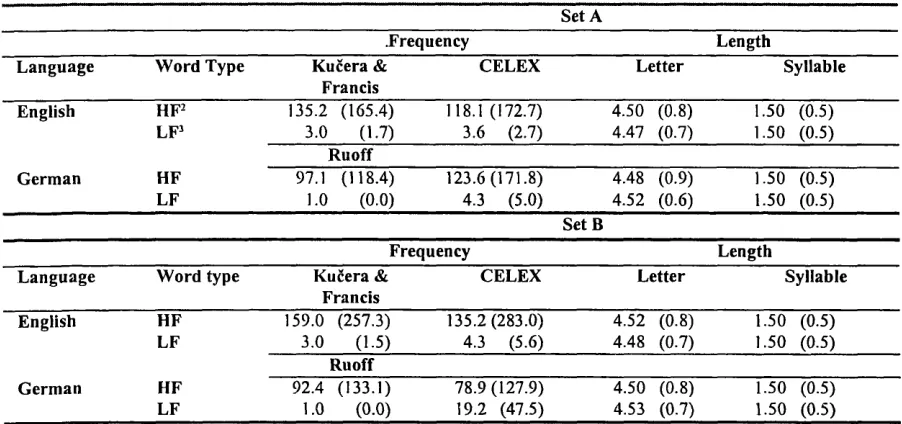
Table 2.1: Experiments la /lb , descriptives o f word stim uli...74
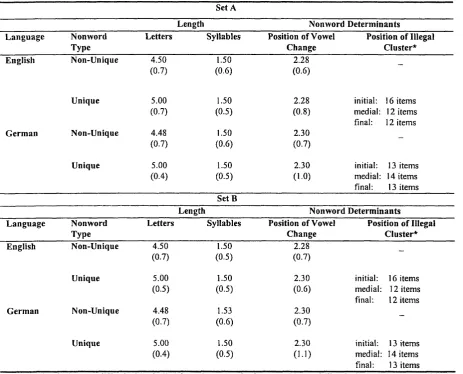
Table 2.2: Experiments la/lb , descriptives of nonword stim uli...76
Table 2.3: Experiment la, RTs and errors as a function of language, word frequency and language-switching...79
Table 2.4: Experiment la, RTs and errors as a function of language, nonword type and language-switching...83
Table 2.5: Experiment lb, RTs and errors as a function o f language, word fiequency and language-switching...88
Table 2.6: Experiment lb, RTs and errors as a function of language, nonword type and language-switching... 93
Table 3.1: Experiment 2, descriptives of critical HF word stim uli...116
Table 3.2 : Experiment 2, descriptives of all word stimuli... 117
Table 3.3 : Experiment 2, descriptives of nonword stimuli... 118
Table 3.4: Experiment 2, RTs and errors as a function o f task, task order, language and language-switching... 122
Table 3.5: Experiment 2, RTs and errors as a function o f frequency condition, task, task order and language-switching...129
Table 3.6: Experiment 2, RTs and errors as a function of task, language, nonword type and language-switching... 135
Table 4.1: Experiment 3, descriptives of stimuli... 159
Table 4.2: Experiment 3, part 1, RTs and errors as a function o f language-switching and response ty p e ... 168
Table 4.3: Experiment 3, part 2, RTs and errors as a function o f language-switching and response ty p e ... 169
Table 5.1: Experiment 4a, sequential order o f trials in the critical sequence...185
Table 5.2 : Experiment 4a, descriptives of IH and control stimuli... 188
Table 5.3: Experiment 4a, RTs and errors as a fiinction of condition, phase and item type...192
Table 5.4: Experiment 4a, RT and error carry-over effects as a function o f condition, phase and position ;...196
Table 5.5: Experiment 4b, sequential order o f trials in the critical sequence...203
Table 5.6: Experiment 4b, RTs and errors as a function of condition, phase and item type... 205
Table 5.7: Experiment 4b, RT and error carry-over effects as a function o f condition, phase and position...208
Table 6.1: Data summary table: The ability of different language-switch cost accounts to accommodate this thesis’ language-switch cost patterns... 224
Table 6.2: Data summary table: The ability of different language-switch cost accounts to accommodate IH interference and carry-over patterns...241
LIST OF FIGURES
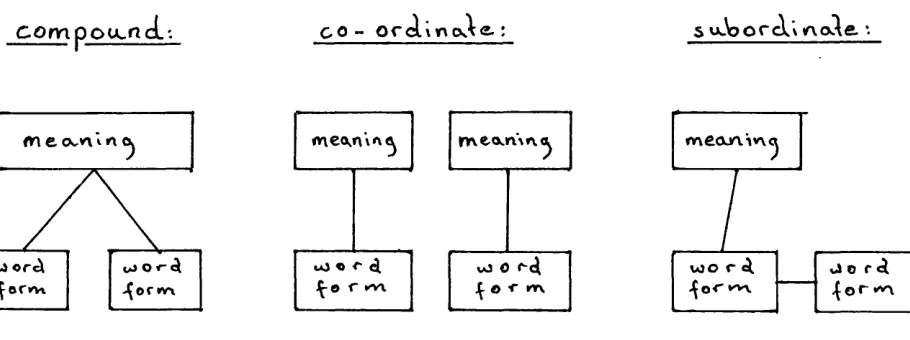
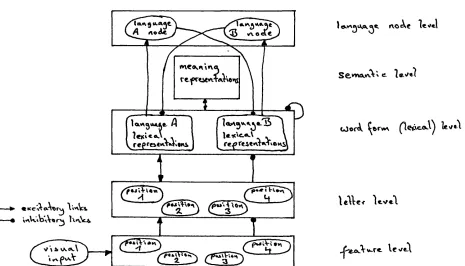
Figure 1.1: Co-ordinate, compound and subordinate language representations...24 Figure 1.2: The Bilingual Interactive Activation m odel...40 Figure 1.3: An Inhibitory Control model...47 Figure 2.1 : Language-switching effects for all German and English words
(Experiment la ) ...81 Figure 2.2: Language-switching effects for the HF subset (Experiment l a ) ... 82 Figure 2.3: Language-switching effects for all German and English words
(Experiment lb )...90 Figure 2.4: Language-switching effects for the HF subset (Experiment lb ) ... 91 Figure 3.1: Language-switching effects in the language-specific task (Experiment 2)
as a function of task order, for ‘pure’ and ‘mixed’ conditions separately 128 Figure 3.2: Language-switching effects in the language-general task (Experiment 2)
as a function o f task order, for ‘pure’ and ‘mixed’ conditions separately 130 Figure 4.1 : Language-switching as a function of response type
(Experiment 3, part 1)... 166 Figure 4.2: Language-switching as a function of response type
(Experiment 3, part 2)... 169 Figure 5.1: IH interference effects as a function of Condition and Phase
(Experiment 4a)... 193 Figure 5.2: IH interference effects as a function of Condition and Phase
(Experiment 4b)...206 Figure 5.3: A lexical decision task schema, showing the conjoint test
ABBREVIATIONS USED IN THIS THESIS
ADT animacy decision task (Experiment 3) ANOVA analysis o f variance
B&M Battig &Montague (1969) word typicality norms (Experiment 3)
BIA Bilingual Ineractive Activation model (e.g., Dijkstra & van Heuven, 1998) C matched control word (Experiments 4a/4b)
CELEX Centre for Lexical Information (word frequency norms for English, German & Dutch; Baayen, Piepenbrock & van Rijn, 1993)
CS contention scheduling HF high frequency word
H Fl the first high frequency word following a specific item (Experiments 4a/4b) HF2 the second high frequency word following a specific item (Experiments 4a/4b) IBM International Business Machines
IC Inhibitory Control model (e.g.. Green, 1998)
IH (non-cognate) interlingual homograph (Experiments 4a/4b) K&F Kucera & Francis (1967), word frequency norms
LI first (in some cases dominant) language L2 second (in some cases subordinate) language LD lexical decision (Experiments la /lb & 2) LDT lexical decision task (Experiments la /lb & 2) LF low frequency word
LLEX Lexical tests
(English, German and other language vocabulary tests, Meara, 1994)
ms milliseconds
MSE mean square error
NW nonword
PC personal computer PFC prefrontal cortex RT reaction time
SAS supervisory attentional system
SCT semantic categorisation task (Experiment 3)
SD standard deviation
Introduction and review:
Language processing in bilinguals'
1.1 Introduction
Two Gemian/English bilinguals spent a day conversing exclusively in English, as was their
habit. Late in the evening, when considering where to leave the car for the night, one said to
the other; “Let’s park the car over there, it’s nice and /bjait/ there, I mean, it is wide there”. The word /bjait/ was pronounced as an English word, i.e., as ‘bright’. When this word is
pronounced in Gennan (which differs only slightly from the English pronunciation o f the
word ‘bright’), it is the German word ‘breit’ (/bwait/), which means ‘wide’.
Tliis bilingual, who normally spoke English fluently, and had spoken only English
during the entire day, suddenly experienced interference from German. The bilingual did not
simply ‘borrow’ a German word, to insert into an English sentence (“it’s nice and breit
there”), which would have conveyed the intended meaning. Instead, this was clearly an
example o f an interlingual interference, which disrupted the intended message. Domic (1978)
and Clyne (1980) suggest that when tired, distracted, or unwell, bilinguals may experience
interference between their two languages, even if they do not under normal circumstances. If
it is possible for bilingual language processing to be ‘impaired’ from time to time, how is
such impairment/interference avoided normally? Or in other words, how is the bilingual
language processing system normally regulated?
Interesting evidence about disruption to bilingual language processing also comes
from cases of individuals with brain damaged From the domain o f cognitive
neuropsychology, there are reports that previously competent bilinguals may lose control over
their languages. For example, patient AD (Paradis, Goldblum & Abidi, 1982), previously a
fluent French/Arabic bilingual, presented with a distinctive pattern o f language impairment
following a head injury. She was able to speak French but not Arabic on one day, with a
' The term ‘bilingual’ when used in the following, is taken to mean a person with a high level o f competence in both languages; this includes cases where both languages were learned at the same time and cases where they were learned consecutively. The participants taking part in the experiments presented here almost all fall into the latter category.
reversal on the following day (‘alternate antagonism’). Compounding the first problem, when
spontaneous production in French was possible, she could not translate into French (although
she could translate into Arabic, which she could not produce spontaneously); this deficit too
was reversed on the following day (‘paradoxical translation’). (See also Albert & Obler, 1978;
Fabbro & Paradis, 1995.) Patient AD is interesting, as her case highlights the need for an
explanation involving the functioning o f the language processing system. An explanation referring only to the representation o f words is inadequate, as one cannot argue that impainnent o f AD’s ability to speak French derived from her ‘French language system’
having been impaired. After all, a language that she could not speak on one day, was available
on the following day, after which it would disappear again, and so on. Furthermore, a
language that she could not speak spontaneously, she could produce when translating.
What underlies interlingual interference in unimpaired bilinguals, and how is it possible for
this interference to be variable? How are alternate antagonism and paradoxical translation
possible? To answer such questions, one needs to understand how the bilingual language
system functions.
Early studies of bilingualism tended to ask how a bilingual’s two languages are
represented, leaving aside the question how the representational system functions (e.g.,
Weinreich, 1953; Ervin & Osgood, 1954). The views expressed by these early models
generally fell into one of two camps: Languages are represented in two independent systems,
to which access is selective; the other view was that languages are represented in
interdependent systems, to which access is nonselective (i.e., occurs in parallel). A problem
with these models (described in section 1.5) is that they were able to accommodate either
‘independent’ performance^ or ‘interdependent’ performance^ but not both. This is clearly a
shortcoming, particularly given that behaviour consistent with the languages being
independent, and behaviour consistent with the languages being interdependent, may exist
within the same individual (see introductory example).
Furthermore, if it is the case that a bilingual’s two languages are connected, then
should there not be constant interference between them? How does a proficient bilingual
^ e.g., Scarborough, Gerard & Cortese (1984): bilinguals at times fail to recognise an unexpected ‘other language’ word.
manage to avoid interference between his two languages? The examples given above suggest
that there is some means o f control, which averts interference, but which may fail at times.
The question then is, how is this control achieved? That is the topic of this thesis.
This thesis examines the notion of an ‘extemaT control mechanism (e.g., Green, 1986; 1998a,
b) which regulates interlingual interference (in language perception) from outside the
bilingual language processing system. This external model is contrasted with an ‘intemal’
control mechanism, that regulates interlingual interference by modulations within the
language processing system (e.g., Grainger & Dijkstra, 1992; Dijkstra & van Heuven, 1998).
Both models are described in detail in section 1.6.
At present the notion of a control mechanism is comparatively new. It needs to be
tested and better understood. Achieving this would provide the basis for gaining a better
understanding o f disorders of AD’s type (and thus be able to develop suitable therapeutic
intervention - this is further discussed in Chapter 6). Given that this approach to investigating
bilingual language processing is relatively recent, several fundamental issues need to be
addressed. For example, to study the processing of whole sentences, it is necessary to have an
understanding o f what is involved in the processing o f single words. Consequently, this thesis
focuses on single word processing. Specifically, the experiments presented here required
competent adult bilinguals (German / English) to process visually presented single words,
under various task instructions.
1.1.1 Summary: why ^controV is an important issue
Striking clinical cases, such as the patient AD mentioned above (Paradis, Goldblum & Abidi,
1982; but see also Albert & Obler, 1978; Fabbro & Paradis, 1995), point to a control
mechanism which may break down, affecting the ability to use a language system which may
otherwise be intact. Secondly, in unimpaired, competent bilinguals, interlingual interference
may occur from time to time.
Thirdly, bilinguals use both their languages intentionally; in a controlled, not
haphazard, manner. To translate text, the bilingual must avoid simply reading the text. In
speaking, bilinguals may speak only one language, or switch from one to another at will.
There must be some mechanism which controls this apparent ability to select output in
must be some means of avoiding the accidental insertion of a word from the other language^
which might not be understood by the listener (one language must be selected, and
maintained as such). For intentional switching between languages^ there must be some means
of changing between output in language A and output in language B (there must be a shift
from having one language ‘selected’ to having the other language ‘selected’).
There is also the less obvious issue of what effect language switching has when it
concerns input. For example, how is mixed-language input processed, i.e., what happens in
the language processor when the language o f input changes? To understand language input,
the incoming stimulus must be matched to an existing mental representation o f that word. As
discussed in detail in the second half of this chapter, there is evidence that there are separate
word form representations for each language, to which access is parallel (rather than serial)
and which are interdependent (rather than independent). This type of set-up could explain
interference between languages. However, how does such an arrangement accommodate the
finding that it takes longer to process mixed language input compared to pure-language input
(e.g., Kolers, 1966; Macnamara, 1967; Macnamara, Krauthammer & Bolgar, 1968;
Macnamara & Kushnir, 1971; Thomas & Allport, 1995)7 If the two language systems are
interconnected, and sensory information is fed into them simultaneously, then why should
switching languages incur a temporal cost? The assumption pursued here is that there is some
means o f control, which allows the system to behave in what appears as a language-selective
or language-non-selective manner, depending on the circumstance. The question is, how and
where this control is achieved. This is the question addressed by this thesis.
An explanation for this co-existence of language-selective and language-non-selective
behaviour cannot be found simply with reference to representation, since the two phenomena
suggest opposite explanations. The first suggests separate representations, the latter
integrated, or at least interacting, representations. Looking for an answer to this seeming
contradiction in the functioning of the bilingual language system, is more successful, as shall be shown in this thesis.
1.2 Overview
To provide a background for the questions addressed here. Chapter 1 first furnishes an outline
^ “I could go out now, oder I could go later” ( ‘oder’ is German for ‘or’)
o f the unilingual lexico-semantic system’ (Votaw, 1992). This approach is adopted on the
basis that it is simpler to describe for unilinguals, and that the fundamental principles o f
language representation are similar in unilinguals and bilinguals (e.g., Paradis, 1977;
Beardsmore, 1980; Grosjean, 1982; Kirsner, Lalor & Hird, 1993). Then, a review o f the
literature pertaining to bilingual language processing is provided, focusing on language
perception, which is the area relevant to the research presented here. Using tliis background,
the question about function, how bilinguals control language processing, can be addressed.
Starting from early models (e.g., Macnamara & Kushnir's 1971 ‘input-switch’ model), the
development o f selected models is sketched, up to two key contenders: the ‘internal control’
and the ‘external control’ models. An important aspect of these two is that they, for the first
time, directly address how the system may be controlled. The intemal account is exemplified
by Dijkstra & van Heuven’s (1998) Bilingual Interactive Activation (BIA) model. The
external account is exemplified by Green’s (1998a, b) Inhibitory Control (IC) model. The
ensuing experiments (Chapters 2 to 5) were designed to test these two models. Where
relevant, some early ‘representational’ models are re-assessed. Chapter 6 summarises and
discusses the key findings.
1.3 The unilingual lexico-semantic system
This thesis asks how bilinguals control their lexico-semantic system, not how words are
represented in bilinguals. Nonetheless, selected aspects of language representation and
processing shall be outlined here for various reasons. 1) The experiments presented in this
thesis require word recognition, so it seems necessary to address the underlying
representations and processes at least to some degree. 2) In the remainder of the thesis
references will be made to ‘lexical representations’ and ‘semantic representations’®; this
section serves to give these terms some meaning. 3) The BIA model was developed from an
earlier unilingual model (McClelland & Rumelhart’s [1981] Interactive Activation model), so
it is important to describe those underpinnings here.
’ Lexico-semantic system: tlie mental system in which words and the parameters defining them (e.g., word form, pronunciation, syntactic propeities, meaning) are represented.
The view that shall be outlined here is that the lexico-semantic system includes some
means of analysing letter features (e.g., horizontal lines, angles, curves), some representation
o f letters, of words, of word properties (e.g., syntactic properties), of meaning, and of the
sounds o f words (which allows print to be turned into sound).
1.3.1 The Interactive Activation model - the basis o f the Bilingual Interactive Activation m odel
An influential account of word recognition is the Interactive Activation (lA) model o f
McClelland & Rumelliart (1981). This model is relevant insofar as it was the basis for
developing the Bilingual Interactive Activation model (Grainger & Dijkstra, 1992; Dijkstra &
van Heuven, 1998), which is one o f the two models tested in this thesis. Note that the lA
model accounts for the recognition of four-letter words, which clearly is only a small
proportion o f what humans are capable of.
In the lA model there are three levels of representation: for features, for letters, and for
words. Each level stores information as a Tocalist’ representation. There are connections
between the representations (or ‘units’) at a given level, as well as between units at different
levels. These links allow other units to be activated or inhibited. The feature level detects
letter features and activates all letter representations containing that feature (e.g., detecting a
discontinuous left hand curve activates C and G), all other letter representations must be
inhibited (e.g., O, Q, D). Letter units activate compatible word representations, while
inhibiting all incompatible ones. Activation is restricted to certain representations, in that
feature and letter representations are coded for position. Thus perceiving a word-initial C
activates CAT but not ICE\ ‘Word neighbours’ (words identical to the target word bar one
letter'®) receive some activation as well, since they have aspects that are compatible with the
input. Following Coltheart et al. (1977), it is assumed that access to relevant lexical
candidates occurs in parallel, rather than in a serially ordered search process (e.g., Forster,
1976, 1979). Since the target word’s lexical representation matches the presented letter string
best, it receives most activation. Receiving most activation, this representation can rise above
® But note that tliere are word-siniilarity findings which suggest that positional coding is not very strong. Chambers (1979) found that, in a lexical decision task, TRIAN is more difficult to reject than TRUAN; yet, as regards letter positions, both are equally dissimilar to TRAIN, posing difficulties for a positional coding account.
a tlireshold level of activation", surpassing other potential candidates, and can thus be
selected (cf. Grainger, 1992; Johnson, 1992; for a comparable theory for acoustic word
perception, see Luce & Pisoni, 1998).
There are some established factors about language processing that the lA model does
not cover. Those relevant to the issues addressed in this thesis are outlined next.
The lA model assumes that word recognition is determined by visual information; yet
there is evidence that sounds of words can influence word recognition as well. For example,
in a lexical decision task'% nonwords that sound like words (e.g., brane) are more difficult to reject than ‘true’ nonwords (e.g., hrene) - see Morton (1996). Secondly, reading a word (e.g.
‘frog’) is facilitated not only if a previously read letter string is a related word (‘toad’), but
also if it is a nonword that soimds like a related word (‘tode’) - Lukatela & Turvey (1994).
Such results suggest that, upon letter identification, both orthographic and phonological
representations are activated, both of which have access to semantic representations.
McClelland & Rumelhart’s (1981) lA model does not account for meaning storage or
retrieval (the same applies for the early versions of the BIA model). Meaning is language’s
raison d ’être, so this is an aspect that needs to be considered. Meaning representations of
words are addressed in section 1.3.2 (below).
At the beginning of this section it was noted that apart from the word’s form and
meaning, there must also be some way o f representing its syntactic properties. McClelland &
Rumelhart’ s (1981) lA model does not clearly address this aspect. Levelt (e.g., Levelt, 1989;
Bock & Levelt, 1994) allocates this role to ‘lemmas’. He proposes that (in a network model),
there is a lemma level of representation that stores the syntactic properties of represented
words (e.g., CAT = noun). For an individual who speaks more than one language it is
important to know which language a word belongs to and what its syntactic properties are in
that language. Language affiliation may also be coded at the lemma level (see Green, 1998a).
For example: ‘CAT: it is an English word, it is a noun, its determiner is neutral (the)’;
‘KATZE: it is a German word, it is a noun, its determiner is feminine (die)’.
" Note, the point at which a word’s (localist) representation is recognised is characterised in different ways by different models. Morton’s logogen model (e.g., 1969) is based on the assumption o f different thresholds for each representation (the higher the word’s frequency, the lower its threshold). McClelland & Rumelhart’s lA model (1981) is based on the assumption o f a common threshold o f activation, but different ‘resting levels’ or ‘baseline levels’ o f activation (the more frequent the word, the higher the baseline activation). Gordon’s resonance model (1983, 1985) is based on the assumption o f different rates at which words can gain activation (the higher the frequency, the faster the gain).
Another problem with the lA model is that it does not speak clearly to the question of
new word acquisition (how does one develop a new lexical ‘unit’?). This is something
distributed models address more easily (e.g., Seidenberg & McClelland’s [1989] ‘distributed
developmental model of word recognition and naming’). In distributed models, recognising a
word does not involve the identification of a single word unit, or node, as localist models
presume. Instead, word recognition involves reinstating a pattern of activation distributed
over several nodes and the comiections between them. In Seidenberg & McClelland’s (1989)
distributed model, there is no position coding for letters as in the localist lA model
(McClelland & Rumelhart, 1981). Instead, letters are coded in triples, such as _CA, CAT,
AT_ for the word CAT ( _ denotes an empty position). These triples (comparable to
Wickelgraphs, see Wickelgren, 1969) are encoded as an activation pattern over a network of
units. A word is recognised once the network of units associated with that word has reached a
stable state o f activation.
Note, this thesis does not address the manner in which words are represented in the
lexico-semantic system, it simply takes as given that there is some form of a representation
which is activated following (visual) presentation of a stimulus. Therefore the debate over
localist vs. distributed representations shall not be pursued here. Let it suffice to say that the
distinction between ‘localist’ and ‘distributed’ is not as clear as it might seem: Localist
models generally assume some degree of distributed representation as well, in that while
words are represented in a ‘localist’ manner at the lexical level, word representations are
‘distributed’ at the lower levels (i.e., in terms of letters and features) - cf. Page (2000).
1.3.2 ^Dissociations* and cognitive representations
Much pertinent evidence about the unilingual language-processing system has come from
cognitive neuropsychology, where it was shown that impairment could be restricted to certain
abilities. Special cases of such selective impairment'^ as well as double d isso ciatio n sp lay ed
a significant role in formulating models of the language processing system. Examples
relevant in particular to Experiment 3 pertain to animacy/inanimacy of things around us (e.g..
or ‘single dissociation’, meaning that patient X is impaired in task A but not in task B.
patient X is impaired in task A but not in task B, whereas patient Y is impaired in task B but not task A; e.g., different types o f aphasia: intact word order with concurrent omission o f inflections (Tissot, Mounin & Lhermitte, 1973), impaired word order concurrent with accurate use o f inflections (Saffran, Schwartz & Marin,
dog vs. house), and the differentiation between lexical and semantic representations (i.e., the
word-fonn DOG vs. the meaning {domestic animal, furry, four-legged, barks}).
For instance, Warrington & Shallice (1984) found impairments in naming, verbal
description, object recognition, miming and picture-word matching of animate but not of
inanimate entities, suggesting some difference between the way in which the two are
represented semantically (see Johnson-Laird, 1987). Regarding lexical and semantic
representations of words. Funnel & Allport (1987) and Schwartz, Marin & Saffran (1979)
found cases of people able to distinguish between real words and nonwords, without being
able to understand the real words’ meanings, suggesting that lexical and semantic infoimation
have separate cognitive representations. There is converging evidence for this view from
experiments with healthy individuals. For instance, Besner, Smith & MacLeod (1990)
showed participants two letter strings simultaneously, asking them to determine whether they
had a letter in common (Tetter matcliing task’). Decisions were faster for strings that were
real words than for strings that were not, suggesting lexical involvement (rather than
processing the task at a letter level of representation). Critically, letter matching was slower
when the two letter strings were semantically related words (e.g., bread - butter), than when
they were unrelated (e.g., bingo - butter). In short, semantic relatedness and lexicality had
opposite effects on task performance, suggesting separate representations o f lexical and
semantic information. (See also Barron & Henderson [1977]; Henik, Friedrich & Kellogg
[1983]; Smith [1979]; Smith, Theodor & Franklin [1983], who used other paradigms to
address this notion; see Smith [1997] for a discussion.) This notion o f separate lexical and
semantic representations is of importance for the experimental work presented later on
(specifically. Experiment 3), in that it provides an opportunity to devise a task that
distinguishes between the Bilingual Interactive Activation model and the Inhibitory Control
model, which are tested here (further details are in section 1.6.1).
The suggestion that lexical and semantic information are represented separately does not
entail that processing at, for example, the lexical level is uninfluenced by semantic factors.
Indeed, there is evidence that lexical decisions are influenced by semantic properties (for a
discussion see Balota, 1994), which suggests that lexical processing is not isolated from
semantic processing, and that accessing semantic information may not be strictly consecutive
that semantic propeities of a word can influence processing in a ‘lexical’ task (a task that
theoretically would require information only from the lexical level), Whittlesea & Cantwell
(1987) showed that nonwords provided with a meaning showed a word superiority effect.
Using a different approach, Kellas, Ferraro & Simpson (1988) demonstrated faster reaction
times to homographs than to nonliomographs (e.g., organ vs. bugle) in a lexical decision task
(stimuli were controlled for potential confounding factors such as familiarity). Gemsbacher
(1984) and Chumbley & Balota (1984) provided converging evidence from yet another angle:
Lexical decision times were found to be sensitive to concreteness, a semantic variable.
1.4 Experimental tasks and levels of processing
Two tasks frequently encountered in the literature of language experimentation are lexical
decision tasks and semantic categorisation tasks (an instance of which is the animacy decision
task). These are the two types of task employed in the course of this thesis, and thus they shall
be explained briefly.
In a lexical decision task (‘LDT’ - developed by Landauer & Freedman, 1968;
Rubinstein, Garfield & Millikan, 1970), participants need to differentiate between real words
(e.g., CAT) and nonwords (e.g., NOF). Finding a lexical representation in the lexicon would
theoretically suffice to provide an answer, no further processing is necessary. That is, a signal
emerging from the lexico-semantic system indicating ‘a lexical representation has been
found’, would suffice. Apart from identifying a specific representation, it may also be
possible to judge that the item in question is a real word rather than a nonword on the basis
that there is much general activation in the lexicon (cf., for example, Grainger & Jacobs,
1996). This is further discussed later on in this chapter.
Noimal language processing is concerned with conveying meaning. Therefore, apart
from activating representations within the lexicon, the corresponding representation at the
semantic level would presumably, quite naturally, be activated as well, even though the task
does not require it. Activation of a semantic representation would give rise to a signal that
also emerges from the lexico-semantic system (‘a semantic representation has been found’).
Phonological word representations could play a role as well. According to Ellis & Young’s
(1988) model for the recognition and production of spoken and written words (based on
evidence predominantly from cognitive neuropsychology), written words activate not just
phonological representation would also provide evidence that the letter string is a word.
In short, for a lexical decision task, the ability to determine whether a letter string is a
word or a nonword may come from various signals, including signals from the lexicon and
the semantic system, that are the most relevant for the tasks presented here.
In an animacy decision task (ADT) participants are asked to differentiate between
words pertaining to animate entities and those referring to inanimate ones (e.g., LION and
CAR, respectively). For this task, finding a corresponding representation in the lexicon is
insufficient grounds for an accurate response. It is necessary to identify the meaning o f the
letter string, and on this basis decide whether the word in question refers to an animate or
inanimate entity (how ‘animacy’ may be coded is discussed in Chapter 4). From the semantic
system the relevant information emerges - this is the cmcial signal in order to be able to give
a response. Signals from the lexicon will presumably become available in this task as well,
indicating that there is a corresponding lexical representation. However, these will not be of
use for distinguishing between animate and inanimate (nor would any signals about
phonological representations).
To summarise, a task aimed at a specific level o f representation does not just ‘tap into’
that level, but may reflect processing at other levels as well. Secondly, task instmctions
determine which signals are o f use for responding and which are not (e.g., lexical signals are
useful given instmctions to distinguish between words and nonwords, but not given
instmctions to distinguish between animate and inanimate entities).
Signals from the various systems need to be organised in some way, in order for a participant
to provide an answer in an experimental task. For example, it is not sufficient to recognise a
letter string as being a real word. The participant needs, somehow, to convey the knowledge
that the item is a real word, to a response mechanism. Only then will he be able to give an
overt “yes” or “no” response. For the current purposes, this is envisaged as a sort o f ‘linking
mechanism’, which (based on task demands) links appropriate signals emerging from the
lexico-semantic system to the units underlying the appropriate response. For example, in a
lexical decision task, all signals indicating that the letter string is a word, are linked to the
units underlying a ‘yes’ response, while all signals indicating that it is not a word, are linked
to the units underlying a ‘no’ response. When either one of the response units has achieved
more detail later on, in conjunction with the bilingual data. Such a mechanism, is, in fact, the
locus o f control proposed by the external account (e.g.. Green, 1998a, b), which is tested here.
Given this background, it is an appropriate juncture to introduce the bilingual language
processing system. The first part of this chapter addressed the question why it is important to
consider the question how bilinguals control their languages (bilinguals showing behaviour
consistent both with ‘independent’ and ‘interdependent’ language systems; cases like patient
AD [Paradis, Goldblum & Abidi, 1982]). As will become clear in the following review o f the
bilingual language processing literature, the question how bilinguals acliieve such control is a
relatively recent one. Following an initial impetus by Green (1986), some researchers have
attempted to model how such control might be effected. Two key models shall be described:
The Bilingual Interactive Activation model ([internal account] e.g., Grainger & Dijkstra,
1992; Dijkstra & van Heuven, 1998) and the Inhibitory Control model ([external account]
e.g.. Green, 1998a, b). These two models are important since the control mechanism, which
they address, is clearly necessary, yet was not accounted for in any of the early bilingual
studies. The following section describes these early investigations and shows how, by
focusing solely on the question o f representation, they were unable to accommodate
behaviour consistent with both ‘independent’ and ‘interdependent’ language representations,
or to account for the range o f abilities bilinguals have (such as translation, or code-switching).
1.5 The bilingual lexico-semantic system.
1.5.1 Early models o f the bilingual lexicon: how are the languages represented?
The early models (Weinreich, 1953; Ervin & Osgood, 1954) focused on how the languages
are represented, and suggested three possible representational arrangements for the two
languages in bilinguals: 1) the Co-ordinate Type, where two separate word-form lexica are
each linked with two separate meaning systems; 2) the Compound Type, where two separate
word-form lexica link into one unified meaning system; 3) the Subordinate Type, where a
weaker language’s word-form lexicon is linked to one common meaning store via the stronger
Figure 1.1
Co-ordinate, compound, and subordinate language representations in bilinguals (see Weinreich, 1953).
d L -.
m c i n
A number of questions arise for these models. How does a compound bilingual manage to
select between the two possible lexical (or ‘word-form’) encodings available for a particular
meaning? (For example, a German/English bilingual can express the meaning {cat} either by
the word-form CAT or the word-form KATZE [‘cat’ in German].) Secondly, how does a co
ordinate bilingual manage to translate? With two separate systems, it is not clear how the
necessary links between the languages are made, and, concerning the question o f control, how
the individual is able to select language A output when the input was language B. (For
example, having read the word ‘cat’ and retrieved the meaning {cat}, the bilingual knows
what meaning he is meant to convey, but how does he manage to express that meaning as
‘Katze’?) In short, Ervin & Osgood’s (1954) account leaves open the question o f how control
is achieved.
The compound/co-ordinate distinction was upheld for a while, on the basis that there
appeared to be evidence of culture-specific differences in the mental images triggered by
translation equivalents (Lambert, Havelka & Crosby, 1958). For example, the terms ‘BROT’
and ‘PAIN’ (‘bread’ in German and French, respectively) produce different mental images for
a German than for a Frencliman. When further research failed to find significant differences
between associations produced by the two types of bilinguals (e.g., Dillon, McCormack,
primary determinant of mental language organisation'^ There was a change in emphasis,
whereby the focus o f attention turned to issues of language processing.
Experimental methodologies were developed which allowed bilingual language
processing to be investigated more scientifically, focusing on statistical validity and
controllability of the dependent variables. For instance, the time taken for comprehending
passages of text, modified by the number of language switches within the text (e.g., Kolers,
1966); the time taken for tme/false decisions for sentences (that are either sensible or
nonsensical), again modified by the numbers o f language switches within the text (e.g.,
Macnamara & Kushnir, 1971); synonym judgement task with mixed- and same-language
word pairs (McCormack, 1977).
Research building on the pioneering work of Weinreich (1953) and Ervin & Osgood
(1954) continued to address the question of representation, still without considering how the
system might be controlled. The focus had turned to the question whether words o f the two
languages access separate cognitive representations (one for each language), or whether they
access common, abstract, representations (e.g., Kolers, 1963; McCormack, 1974, 1977). For
some time this question remained unresolved, not least because no clear theoretical
distinction was made between lexical and semantic representations o f words. Some studies
focused on the former, others on the latter (Durgunoglu & Roediger, 1987, and Smith, 1991
evaluate and discuss this problem in detail). In fact, as early as 1979, Domic noted that it was
problematic not to make this distinction. Today, there is generally a consensus that lexical
representations are coded for language (i.e., there are separate lexical representations for each
language, possibly represented in separate lexica, or possibly represented in an integrated
lexicon; see van Heuven, 2000; Kroll & Dijkstra, 2001), while semantic representations
appear to be language-neutral (and hence presumably represented in a single, common
system); see, for example, Durgunoglu & Roediger (1987); Kroll & de Groot (1997). This
difference has led to the conflicting experimental results and interpretations.
1.5.1.1 Separate lexica, one fo r each language?
Different languages have different word forms to encode the same meaning (e.g., CAT vs.
KATZE [‘cat’ in German]). To account for this orthographic difference, one presumably must
assume separate lexical representations for CAT and KATZE, just as one would for CAT and
DOG (see Grainger & Dijkstra, 1992). How are these words represented in the bilingual? Are
there two lexica, one for each language, or are words o f both languages represented in one
common lexicon? Additionally, each lexical representation must be coded for language in
some way, as bilinguals are able to determine whether a word belongs to language A or to
language B. This coding could be envisaged, for example, as a language tag associated with
each lemma (e.g.. Green, 1998a), or as a language node to which all words o f a given
language are comiected (e.g., Dijkstra & van Heuven, 1998). The implication is not two
neuroanatomically distinct systems, but of two neurofunctional systems. As shall be discussed
next, there does not appear to be clear evidence for the assumption of separate lexica.
The assumption of separate lexica (and a shared semantic store) is made by various
researchers (e.g., Scarborough, Gerard & Cortese, 1984; Kroll & Sholl, 1992; Kroll, 1993;
Smith, 1997). It is frequently based on the experimental finding o f within-language repetition
priming, but no between-language repetition-priming (also known as translation-priming).
For example, Kirsner, Brown, Abrol, Chadha & Sharma’s (1980) Hindi/English bilinguals
performed a lexical decision task, divided into two blocks. The language of decision was
either the same in both blocks, or different in the two blocks (e.g., block 1: Hindi words and
Hindi-like nonwords; block 2: Hindi words and Hindi-like nonwords [within-language
condition], or, block 2: English words and English-like nonwords [between-language
condition]). Some words were repeated between blocks. A German/English example for a
within-language condition is CAT ... CAT; for a between-language condition an example is
CAT ... KATZE. The repeated word was responded to faster only in the within-language, not
the between-language condition. Kirsner, Smith, Lockhart, King & Jain (1984, Experiment 1)
repeated the experiment with English/French bilinguals, which meant using two languages
sharing an alphabet. Here too, within-language, but not between-language, effects were found.
(See also Scarborough, Gerard & Cortese, 1984.)
However, these results camiot be taken as evidence for separate lexica. The interval
between the prime and target was several minutes long. If one regards translation pairs (CAT
/ KATZE) as the bilingual equivalent of synonyms in unilinguals, then the lack o f a
translation priming effect could be seen as the equivalent to the lack o f long-term synonym
priming in unilinguals (e.g., reaction times to WOMAN are unaffected by having seen
repetition-priming was found when the prime / target interval was reduced to some hundreds
of milliseconds, rather than minutes (de Groot & Nas, 1991). The short-term between-
language repetition-priming was found even when primes were masked to hinder integration
strategies. This led de Groot & Nas (1991) to conclude that translation equivalents are linked
to one another at the lexical level (“lexical links”)- Activation, they suggested, could spread
from one lexical representation to the other directly, allowing a translation equivalent to
receive activation even if a prime were not processed sufficiently to retrieve meaning'^. De
Groot & Nas (1991) suggested, following Forster & Davies (1984), that at long prime/target
lags, the spreading activation between lexical representations (which would lead to the
translation-priming effect) would have decayed, hence giving the impression o f there being
no between-language repetition-priming.
Gerard & Scarborough (1989) also employed a long-term between-language repetition
design, showing Englisli/Spanish bilinguals words and nonwords blocked for language in a
lexical decision task. Their study differed from those by Kirsner and others (above), in that
they included non-cognate interlingual homographs, that is, words sharing spelling but not
meaning across languages (e.g., RED, meaning ‘net’ in Spanish). Reaction times to these
words were apparently unaffected by the other-language word frequency. That is, in the
Spanish block reaction times to RED were slow (in line with it being low frequency in
Spanish), while they where fast when the same word appeared in an English block (in line
with it being high frequency in English). Such results were considered as meaning that there
are separate lexical representations for the words of each language, and flirthermore, that there
are two lexica, one for each language, which do not interact. Note that tliis is contrary to the
masked repetition-priming evidence provided by de Groot & Nas (1991). Furthermore,
Gerard & Scarborough’s (1989) finding can be reinterpreted as being consistent with separate
but interacting (“interdependent”) lexica. This is discussed later on.
In sum, there does not appear to be clear evidence that a bilingual has two separate
lexica. However, given that lexical representations are distinct for each language, and that
they must be coded for language, it makes sense to envisage functionally separate, but
interacting lexica. From now on, when reference is made to separate lexica, this is meant
simply in a functional sense, not in an anatomical sense, and allows for the two systems to
interact. If there are two lexica, the next question is how they are related to one another.
1.5.2 A re L I / L2 lexical representations independent or interdependent, and is access to them selective or nonselective?
This section describes evidence that has been taken as indicative of how words of different
languages are represented. Different lines of investigation have given rise to conflicting
viewpoints. Some researchers argued for two independent systems, to which access is
selective; others for interacting (interdependent) systems to which access is nonselective. The
following inspects the data taken to support these conflicting views.
1.5.2.1 Language-switching experiments
This section outlines evidence that switching languages takes time. This Tanguage-switch
cost’” was taken as evidence that a bilingual’s languages are stored separately, and that access
to these stores is selective.
Kolers (1966) asked French/English bilinguals to read different types o f paragraphs
(of ca. 110 words): written either in one language only, or with languages alternating from
sentence to sentence, or with languages mixed randomly within sentences. In a silent reading
condition, there was no significant difference between the time taken to read the ‘pure’ and
the ‘m ixed’ passages. In contrast, in a loud reading condition, mixed text was read
significantly more slowly than pure text. That is, at least when output was required, there
appeared to be a cost for switching languages.
Macnamara & Kushnir (1971) adapted Kolers’ (1966) method o f silent reading
comprehension in order to test their proposal of the switch cost’s origin. They presumed that
there should be a cost not just for switching languages at output, as Kolers (1966) had
suggested, but also for switching languages at input. The idea of the Unput-switch''^ was that language input was channelled into one or other of the two lexica (which were considered to
be independent of each other). The input-switch was assumed to be set to channel the input
” For the studies ia this section, ‘switch-cost’ meant the overall time increase when processing mixed- rather than pure-language text. For the experiments o f this thesis, which investigate on-line processing rather than overall completion times, ‘switch cost’ refers to the difference between reactions on language-switch trials as opposed to language-non-switch trials (this difference may be an increase in RT or in eiTors).