Liquid Sloshing in Containers with
Flexibility
A thesis submitted in fulfillment of the
requirements for the degree of Doctor of
Philosophy
School of Engineering and Science
Faculty of Health, Engineering and Science Victoria University
Melbourne, Australia
by
Marija Gradinscak
Summary
Sloshing is the low frequency oscillations of the free surface of a liquid in a
partially filled container. The dynamic response of structures holding the liquid
can be significantly influenced by these oscillations, and their interaction with the
sloshing liquid could lead to instabilities. It is critical to predict and to control
sloshing in order to maintain safe operations in many engineering applications,
such as in-ground storage and marine transport of liquid cargo, aerospace vehicles
and earthquake-safe structures.
Contributions to the state of knowledge in predicting and controlling sloshing are
the main objectives of the proposed research. To this end, a numerical model has
been developed to enable reliable predictions of liquid sloshing. The numerical
results are compared with experimental results to determine the accuracy of the
numerical model. Further, the research addresses the employment of intentionally
induced sloshing to control structural oscillations. The novelty of this research is
in its use of a flexible container. Results indicate that intentionally introduced
flexibility of the container is capable of producing effective control. The practical
application of the proposed research is in the early design stages of engineering
Declaration
I, Marija Gradinscak, declare that the PhD thesis entitled Liquid Sloshing in
Containers with Flexibility is no more than 100,000 words in length including
quotes and exclusive of tables, figures, appendices, bibliography, references and
footnotes. This thesis contains no material that has been submitted previously, in
whole or in part, for the award of any other academic degree or diploma. Except
where otherwise indicated, this thesis is my own work.
Signature: Date:
The research and execution of this thesis would not have been possible without
the support, advice and comments from those who have taken the time to either
contribute or inquire into what has been keeping me busy for the last few years. I
am grateful for every person with whom I have discussed the subject for in some
way they have each contributed to the end result of this thesis.
Special acknowledgment must go to my supervisors; Associate Professor Özden
F. Turan and Dr Eren S. Semercigil for their encouragement and guidance during
the course of this investigation. For the generous contribution of their time during
the preparation of the draft, I am extremely grateful.
Thanks also go to my parents, Nikola and Tinka for creating the opportunity for
me to pursue this path. Great thanks to my son Marin and daughter Mariana for
supporting me in a difficult time.
And finally I would like to dedicate this thesis to my late husband Zlatko who
encouraged and supported my passion and gave me the strength and belief to
Table of Contents
Summary ii Declaration iii
Table of Contents iv
List of Illustrations vi
List of Tables xiii
CHAPTER 1 1
Introduction
CHAPTER 2 7
Control of Liquid Sloshing Using a Flexible Container
2.1 Introduction 7
2.2 Background 8
2.2.1 Literature Review 8
2.2.2 Summary of Literature Review 12
2.3 Numerical Model and Procedure 13
2.3.1 Description of the Model and Test Conditions 13
2.4 Computational Simulations 19
2.4.1 Selection of Mesh Size 22
2.4.2 Time Step Size 29
2.4.3 Selection of Length of Simulation Time 34
2.5 Numerical Prediction 41
2.5.1 Numerical Prediction Summary 60
2.6 Experiments 62
2.7 Summary 66
CHAPTER 3 68
A Flexible Container Modified Using Straps for Sloshing Control
3.1 Introduction 68
3.2 Numerical Model and Procedure 69
3.2.1 Computational Setup 69
CHAPTER 4 91 Using a Flexible Container for Vibration Control
4.1 Introduction 91
4.2 Background 92
4.2.1 Literature Review 92
4.2.2 Summary of Literature Review 96
4.3 Numerical Procedure 96
4.4 Numerical Predictions 100
4.4.1 Selective Cases with Different Critical Structural damping Applied to the Container.
114
4.4.2 Selective Cases with Different Mass Ratios 124
4.5 Summary 134
CHAPTER 5 136
Conclusions and Suggestions for Further Work
References 139
APPENDIX A
Tuned Absorber 145
APPENDIX B
Selection of the Length of Simulation Time 155
APPENDIX C
Cases with Different Critical Structural Damping Applied to the Container
161
APPENDIX D
Cases with Different Mass Ratio 170
List of Illustrations
Figure 1.1:
Liquid sloshing in a rigid container
1
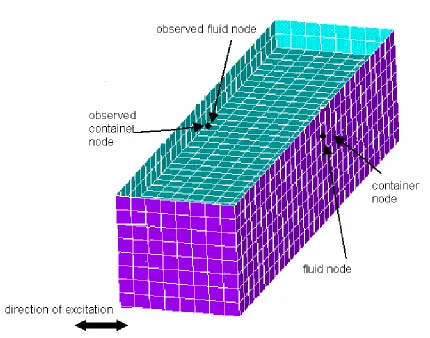
Figure 2.3.1:
The numerical model and the location of the observed nodes
15
Figure 2.3.2:
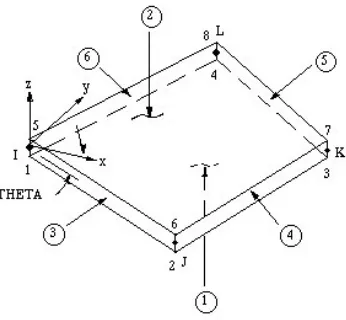
Two-dimensional rectangular shell finite element.
16
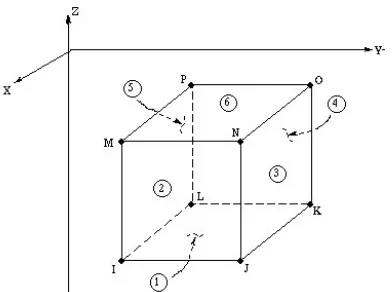
Figure 2.3.3:
Three-dimensional brick finite element.
17
Figure 2.3.4:
Structural mass element.
18
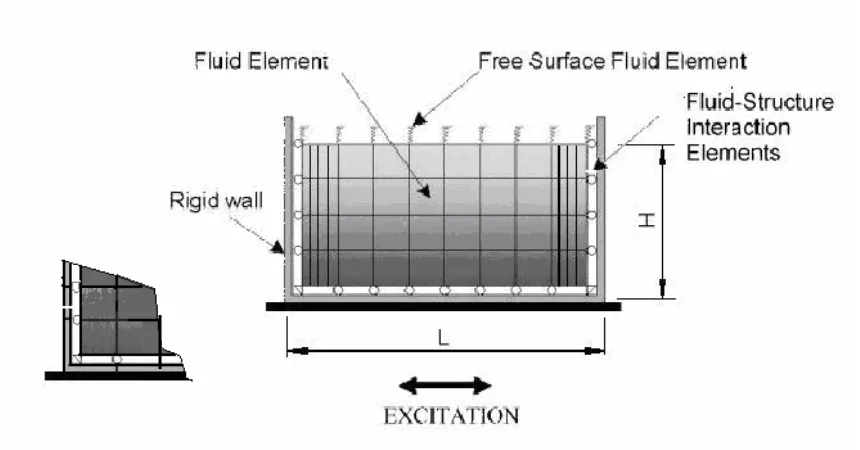
Figure 2.3.5:
Liquid-Structure interaction model
18
Figure 2.4.1:
Mode shapes of oscillation for the container with no added masses and no liquid.
21
Figure 2.4.1.1:
Predicted displacement histories of chosen fluid and structure nodes in a flexible container with various added masses, for the 25 mm mesh size runs. Added mass amounts: (a) 0 kg, (b) 5 kg, (c) 9 kg, (d) 13 kg.
23
Figure 2.4.1.2:
Predicted sloshing amplitude of chosen fluid nodes in a flexible container with various added masses, for the 25 mm mesh size runs. Added mass amounts: (a) 0 kg, (b) 5 kg, (c) 9 kg, (d) 13 kg.
24
Figure 2.4.1.3:
FFT plot of sloshing liquid (dashed-line) and structural vibration (solid-line) with various added masses, for the 25 mm mesh size runs. Added mass amounts: (a) 0 kg, (b) 5 kg, (c) 9 kg, (d) 13 kg.
25
Figure 2.4.1.4 Same as in Figure 2.4.1.1 but for the 50 mm mesh size runs and 10 ms time steps.
26
Figure 2.4.1.5 Same as in Figure 2.4.1.2 but for the 50 mm mesh size runs and 10 ms time steps.
27
Figure 2.4.1.6 Same as in Figure 2.4.1.3 but for the 50 mm mesh size runs and 10 ms time steps.
28
Figure 2.4.1.7: Predicted displacement histories of chosen fluid and
structure nodes in a flexible container with various added masses, for the 25 mm mesh size and 10ms time steps runs. Point mass amounts: (a) 0 kg, (b) 5 kg, (c) 9 kg, (d) 13 kg.
29
Figure 2.4.1.8: Predicted sloshing amplitude of chosen fluid nodes in a flexible container with various added masses, for the 25 mm mesh size and 10 ms time step runs. Point mass amounts: (a) 0 kg, (b) 5 kg, (c) 9 kg, (d) 13 kg.
30
Figure 2.4.1.9: FFT plot of sloshing liquid (red-line) and structural vibration (blue-line) with various added masses, for the 25 mm mesh size and 10 ms time step runs. Point mass amounts: (a) 0 kg, (b) 5 kg, (c) 9 kg,
Figure 2.4.1.11: Same as in Figure 2.4.1.8 but for the 25 mm mesh size and
5 ms time step run. 33
Figure 2.4.1.12: Same as in Figure 2.4.1.8 but for the 25 mm mesh size and
5 ms time step run. 34
Figure 2.4.2:
Displacement histories of the liquid in a flexible container with 1mmwallthickness and no added mass (a).The liquid is undamped and structure has 1% damping. Predicted sloshing amplitude for the same case (b). Corresponding frequency spectrum of sloshing liquid (red) and structure (blue) (c).
36
Figure2.4.3:
Displacement histories of the liquid in a flexible container with 1 mm wall thickness and 9 kg added mass (a).The liquid is undamped and structure has 1% damping. Predicted sloshing amplitude for the same case (b). Corresponding frequency spectrum of sloshing liquid (red) and structure (blue) (c).
37
Figure 2.4.4:
Displacement histories of the liquid in a flexible container with 1 mm wall thickness and 13 kg added mass (a).The liquid is undamped and structure has 1% damping. Predicted sloshing amplitude for the same case (b). Corresponding frequency spectrum of sloshing liquid (red) and structure (blue) (c).
38
Figure 2.5.1:
(a)Predicted absolute displacement histories of the liquid in a rigid container, (b) sloshing amplitude for the same case, (c) corresponding displacement frequency spectrum of sloshing liquid.
42
Figure 2.5.2:
(a) Predicted displacement histories of the liquid in a flexible container with 1mm wall thickness and0 kg added mass, (b) sloshing history, (c) frequency
spectrum of sloshing liquid (——) and structure (——), (d)
cross-correlation between container wall displacement and liquid sloshing and (d) its frequency spectrum. The liquid is undamped and structure has 1% damping.
46
Figure2.5.3:
(a) Predicted displacement histories of the liquid in a flexible container with 1mm wall thickness and 3 kg added mass, (b) sloshing history, (c) frequency spectrum of sloshing liquid (——) and structure (——), (d) cross-correlation between container wall displacement and liquid sloshing and (d) its frequency spectrum. The liquid is undamped and structure has 1% damping.
48
Figure 2.5.4:
(a) Predicted displacement histories of the liquid in a flexible container with 1mm wall thickness and 5 kg added mass, (b) sloshing history, (c) frequency spectrum of sloshing liquid (——) and structure (——), (d) cross-correlation between container wall displacement and liquid sloshing and (d) its frequency spectrum. The liquid is undamped and structure has 1% damping.
Figure 2.5.5:
(a) Predicted displacement histories of the liquid in a flexible container with 1mm wall thickness and 7 kg added mass, (b) sloshing history, (c) frequency spectrum of sloshing liquid (——) and structure (——), (d) cross-correlation between container wall displacement and liquid sloshing and (d) its frequency spectrum. The liquid is undamped and structure has 1% damping.
54
Figure 2.5.6:
(a) Predicted displacement histories of the liquid in a flexible container with 1mm wall thickness and 9 kg added mass, (b) sloshing history, (c) frequency spectrum of sloshing liquid (——) and structure (——), (d) cross-correlation between container wall displacement and liquid sloshing and (d) its frequency spectrum. The liquid is undamped and structure has 1% damping.
56
Figure 2.5.7:
(a) Predicted displacement histories of the liquid in a flexible container with 1mm wall thickness and 11 kg added mass, (b) sloshing history, (c) frequency spectrum of sloshing liquid (——) and structure (——), (d) cross-correlation between container wall displacement and liquid sloshing and (d) its frequency spectrum. The liquid is undamped and structure has 1% damping.
59
Figure 2.5.8.
Variation of the rms of sloshing magnitude in m with mass for rigid (▬▬) and flexible () containers.
60
Figure 2.5.9.
Probability distribution for sloshing in rigid container ( ▌) and flexible container with 9 kg added mass ( ▌).
61
Figure 2.6.1:
Schematic view of the experimental setup for the base excitation. 1: personal computer, 2: power amplifier, 3: electromagnetic shaker, 4: container.
62
Figure 2.6.2:
Absolute sloshing magnitude in m with mass for rigid (▬▬) and flexible () containers.
64
Figure 3.2.1:
The numerical model and the location of straps and observation nodes. 70
Figure 3.2.2:
Finite Element-Straps. 71
Figure 3.3.1:
Mode shapes of oscillation for the container with straps on the top and no liquid.
74
Figure 3.4.1:
Displacement histories of the liquid in a flexible container with three straps on top, 1mm wall thickness and 0 kg added mass (a). The liquid is undamped and structure has 1% damping. Predicted sloshing amplitude for the same case (b). The frequency spectra of the container displacement (blue) and sloshing (red) are presented (c).
76
the same case (b). The frequency spectra of the container displacement (blue) and sloshing (red)are presented (c).
Figure 3.4.3:
Displacement histories of the liquid in a flexible container with three straps on top, 1mm wall thickness and 5kg added mass (a). The liquid is undamped and structure has 1% damping. Predicted sloshing amplitude for the same case (b). The frequency spectra of the container displacement (blue) and sloshing (red)are presented (c).
81
Figure 3.4.4:
Displacement histories of the liquid in a flexible container with three straps on top, 1mm wall thickness and 7kg added mass (a). The liquid is undamped and structure has 1% damping. Predicted sloshing amplitude for the same case (b). The frequency spectra of the container displacement (blue) and sloshing (red)are presented (c).
82
Figure 3.4.5:
Displacement histories of the liquid in a flexible container with three straps on top, 1mm wall thickness and 9kg added mass (a). The liquid is undamped and structure has 1% damping. Predicted sloshing amplitude for the same case (b). The frequency spectra of the container displacement (blue) and sloshing (red)are presented (c).
83
Figure 3.4.6:
Displacement histories of the liquid in a flexible container with three straps on top, 1mm wall thickness and 11kg added mass (a). The liquid is undamped and structure has 1% damping. Predicted sloshing amplitude for the same case (b). The frequency spectra of the container displacement (blue) and sloshing (red)are presented (c).
85
Figure 3.4.7:
Displacement histories of the liquid in a flexible container with three straps on top, 1mm wall thickness and 13kg added mass (a). The liquid is undamped and structure has 1% damping. Predicted sloshing amplitude for the same case (b). The frequency spectra of the container displacement (blue) and sloshing (red)are presented (c).
86
Figure 3.4.8:
Variation of rms sloshing amplitude with added mass for cases: rigid container (――), flexible container without () and flexible container with (z) straps.
87
Figure 3.5:
Absolute sloshing amplitude with added mass for cases: rigid container (――), flexible container with () straps.
88
Figure 4.3.1:
Showing (a) the computational model and (b) the displacement history of the structure after an initial displacement.
97
Figure 4.3.2:
Three dimensionalsolid structure element (ANSYS 2002)
99
Figure 4.3.3:
Figure 4.4.1:
a) numerically predicted displacement histories of the sloshing absorber: liquid displacement histories in container with rigid walls. b) predicted sloshing amplitude, c) structure displacement and d) FFT of sloshing liquid (red) and plate displacement (green).
102
Figure 4.4.2:
a) numerically predicted displacement histories of the container walls and liquid. b) predicted sloshing amplitude in flexible container with 9 kg added mass, c) structure displacement and d) FFT of wall displacement (blue), sloshing liquid (red) and plate displacement (green).
105
Figure 4.4.3:
a) numerically predicted displacement histories of the container walls and liquid. b) predicted sloshing amplitude in flexible container with 3 kg added mass, c) structure displacement and d) FFT of wall displacement (blue), sloshing liquid (red) and plate displacement (green).
107
Figure 4.4.4:
a) numerically predicted displacement histories of the container walls and liquid. b) predicted sloshing amplitude in flexible container with 5 kg added mass, c) structure displacement and d) FFT of wall displacement (blue), sloshing liquid (red) and plate displacement (green).
108
Figure 4.4.5:
a) numerically predicted displacement histories of the container walls and liquid. b) predicted sloshing amplitude in flexible container with 7 kg added mass, c) structure displacement and d) FFT of wall displacement (blue), sloshing liquid (red) and plate displacement (green).
110
Figure 4.4.6:
a) numerically predicted displacement histories of the container walls and liquid. b) predicted sloshing amplitude in flexible container with 9 kg added mass, c) structure displacement and d) FFT of wall displacement (blue), sloshing liquid (red) and plate displacement (green).
111
Figure 4.4.7:
a) numerically predicted displacement histories of the container walls and liquid. b) predicted sloshing amplitude in flexible container with 11 kg added mass, c) structure displacement and d) FFT of wall displacement (blue), sloshing liquid (red) and plate displacement (green).
112
Figure 4.4.8:
a) numerically predicted displacement histories of the container walls and liquid. b) predicted sloshing amplitude in flexible container with 13 kg added mass, c) structure displacement and d) FFT of wall displacement (blue), sloshing liquid (red) and plate displacement (green).
113
Figure 4.4.1.1:
a) numerically predicted displacement histories of the container walls and liquid. b) predicted sloshing amplitude in flexible container with 0 kg point mass, c) structure displacement and d) FFT of wall displacement (blue), sloshing liquid (red) and plate displacement (green). Liquid is undamped and container has 5% damping.
115
Figure 4.4.1.2:
and container has 5% damping. Figure 4.4.1.3:
a) numerically predicted displacement histories of the container walls and liquid. b) predicted sloshing amplitude in flexible container with 13 kg point mass, c) structure displacement and d) FFT of wall displacement (blue), sloshing liquid (red) and plate displacement (green). Liquid is undamped and container has 5% damping.
118
Figure 4.4.1.4:
a) numerically predicted displacement histories of the container walls and liquid. b) predicted sloshing amplitude in flexible container with 0 kg point mass, c) structure displacement and d) FFT of wall displacement (blue), sloshing liquid (red) and plate displacement (green). Liquid is undamped and container has 10% damping.
120
Figure 4.4.1.5:
a) numerically predicted displacement histories of the container walls and liquid. b) predicted sloshing amplitude in flexible container with 9 kg point mass, c) structure displacement and d) FFT of wall displacement (blue), sloshing liquid (red) and plate displacement (green). Liquid is undamped and container has 10% damping.
121
Figure 4.4.1.6:
a) numerically predicted displacement histories of the container walls and liquid. b) predicted sloshing amplitude in flexible container with 13 kg point mass, c) structure displacement and d) FFT of wall displacement (blue), sloshing liquid (red) and plate displacement (green). Liquid is undamped and container has 10% damping.
122
Figure 4.4.9:
Variations of the rms of (a) sloshing amplitude and (b) structure’s displacement. (▬▬ structure alone, ▬▬ rigid container; and flexible container with structural damping of 1.5% , 5% and S 10%) .
123
Figure 4.4.2.1:
a) numerically predicted displacement histories of the container walls and liquid. b) predicted sloshing amplitude in flexible container with no added mass, c) structure displacement and d) FFT of wall displacement (blue), sloshing liquid (red) and plate displacement (green). The mass of the structure is 1500 kg.
126
Figure 4.4.2.2:
a) numerically predicted displacement histories of the container walls and liquid. b) predicted sloshing amplitude in flexible container with 9 kg added mass, c) structure displacement and d) FFT of wall displacement (blue), sloshing liquid (red) and plate displacement (green). The mass of the structure is 1500 kg.
127
Figure 4.4.2.3:
a) numerically predicted displacement histories of the container walls and liquid. b) predicted sloshing amplitude in flexible container with 13 kg added mass, c) structure displacement and d) FFT of wall displacement (blue), sloshing liquid (red) and plate displacement (green). The mass of the structure is 1500 kg.
Figure 4.4.2.4:
a) numerically predicted displacement histories of the container walls and liquid. b) predicted sloshing amplitude in flexible container with 0 kg point mass, c) structure’s displacement and d) FFT of wall displacement (blue), sloshing liquid (red) and plate displacement (green). The mass of the structure is 1000 kg.
129
Figure 4.4.2.5:
a) numerically predicted displacement histories of the container walls and liquid. b) predicted sloshing amplitude in flexible container with 9 kg point mass, c) structure’s displacement and d) FFT of wall displacement (blue), sloshing liquid (red) and plate displacement (green). The mass of the structure is 1000 kg.
130
Figure 4.4.2.6:
a) numerically predicted displacement histories of the container walls and liquid. b) predicted sloshing amplitude in flexible container with 13 kg point mass, c) structure’s displacement and d) FFT of wall displacement (blue), sloshing liquid
131
Figure 4.4.10:
Variations of the rms of (a) sloshing amplitude and (b) structural displacement. (▬) rigid container; and flexible container with mass ratio of 2000 kg , 1500 kg and S 1000 kg).
Table 2.4.1:
First, second and third natural frequencies of the container without liquid for different masses. Selective cases were experimentally verified at the fundamental mode.
22
Table 2.6.1:
Observed liquid surface vertical peak displacement.
64
Table 3.3.1: First, second and third natural frequencies of the
Chapter 1
Introduction
The liquid surface in a partially full container can move back and forth (in standing or
traveling waves) at discrete natural frequencies. This low frequency oscillation of the
liquid is defined as sloshing. In Figure 1.1, L indicates the width of the container (also the
wavelength), and H the height of the static liquid level. The shaded area indicates the
expected shape of the free surface at its fundamental mode. Sloshing at the fundamental
frequency mobilizes the largest amount of liquid, and may produce excessive structural
loads that can lead to structural failure. Welt et al. (1992) showed that sloshing resulting
from external forces is critical when the excitation frequency is close to the fundamental
sloshing frequency.
engineering applications, such as in ground and marine transport of liquid cargo,
aerospace vehicles and earthquake–safe structures. Most commonly, the harmful effect of
sloshing is experienced in transportation and storage of liquid cargo, Popov et al. (1992).
In marine engineering, sloshing plays a significant role in defining maneuverability and
safety of vessels, Fotia et al. (2000).
The inherent flexibility of a liquid container is usually treated as a problem since
achieving a perfectly rigid container is a practical impossibility. Container flexibility, on
the other hand, may be treated as a design parameter to gain benefit, rather than a
nuisance to overcome. The novelty of the presented thesis is to investigate the required
flexibility parameters of a container to achieve either the suppression of its content or to
utilize intentionally induced sloshing as a vibration control agent for light and flexible
structures. To the best of the author’s knowledge, this is the first attempt to make use of
flexibility as a design parameter in the control of liquid sloshing. Most of the reported
efforts in this thesis are of numerical nature. Limited simple experiments are presented to
validate some of the numerical predictions.
The research in this thesis is divided into three areas. Firstly, the observations from
extensive numerical predictions of liquid sloshing in a container with flexible walls are
presented. Efforts are summarized to determine the tuning condition of the container
flexibility to the dynamics of sloshing liquid for effective sloshing control. Second area
of the focus deals with improving the design of the flexible container to facilitate
controlling structural vibrations. Hence, as mentioned earlier, the general objective in this
research is to explore the possibilities of using the flexibility of the container as a design
parameter. To clarify the specific objectives, a brief description of the content of each
chapter is given next. Each of these chapters is presented as a self-contained entity, with
its own relevant literature and conclusions.
Chapter 2 explores the possibility of using a container with flexible walls to control the
sloshing of its liquid content. The flexibility of a container may be employed to suppress
excessive sloshing only when there is a strong interaction between the container and the
liquid. This strong interaction is ideally achieved when the fundamental structural
frequency of the container, in the direction of sloshing, is tuned to the fundamental
sloshing frequency. However, this ideal condition may not be possible and multiple
vibration modes may be involved in the process, due to the structural complexity of the
container and strong fluid-structure interactions.
The flexible container used in this study has its critical frequencies higher than the
sloshing frequencies involved. Hence, tuning requires lowering the container frequencies.
The method chosen to lower these frequencies is to add mass to the container. Control in
the order of 80% has been demonstrated to be possible as compared to the sloshing levels
observed with a rigid container. The following list includes the published work relevant
to this chapter:
Gradinscak, M. Semercigil, S. E. and Turan, Ö. F., 2001, Sloshing Control with
Container Flexibility, 14th Australasian Fluid Mechanics Conference, Adelaide
Engineering Division Summer Meeting, Montreal, Quebec, Canada.
Güzel, U. B, Gradinscak, M., Semercigil, S. E. and Turan, Ö. F., 2004, Control of
Liquid Sloshing in Flexible Containers: Part 1. Added Mass, 15th Australasian Fluid
Mechanics Conference, University of Sydney, Sydney, Australia.
Güzel, U. B., Gradinscak, M., Semercigil, S. E. and Turan, Ö. F., 2005, Tuning Flexible
Containers for Sloshing Control, Proceedings of the IMAC-XXIII: A Conference and
Exposition on Structural Dynamics, January 31-February 3, Orlando, Florida.
Gradinscak, M., Semercigil, S. E. and Turan, Ö. F., 2006, Liquid Sloshing in Flexible
Containers, Part 1: Tuning Container Flexibility for Sloshing Control, Fifth International
conference on CFD in the Process Industries, CSIRO, Melbourne, Australia, 13-15
December.
Chapter 3 deals with improvement of the container design by adding auxiliary structural
elements to it. The motivation for this chapter comes from the observations made in
Chapter 2 when rather large structural deflections are required to achieve the reported
levels of sloshing control. These large deflections may be difficult to accommodate in
some practical applications. Hence, it is desirable to limit them while maintaining the
effectiveness of control.
Large deflections are observed at the open top of the container, away from the centre of
the container. Hence, rigid links (or straps) which are attached at the opposite sides of the
open top, may limit these outward deflections. Observations are reported in Chapter 3, to
limit the container deflections to practical levels, with almost identical levels of sloshing
Gradinscak, M., Güzel, U. B, Semercigil, S. E. and Turan, Ö. F., 2004, Control of
Liquid Sloshing in Flexible Containers: Part 2. Added Straps, 15th Australasian Fluid
Mechanics Conference, University of Sydney, Sydney, Australia.
Tuned liquid dampers may be employed for structural vibration control, similar to that of
a classical tuned vibration absorber. For such cases, the fundamental sloshing frequency
is tuned at a critical frequency of the structure to be controlled. The pressure forces, as a
result of the intentionally induced liquid sloshing, are used as control forces. Such an
absorber has the benefits of being effective and practically free of maintenance. The work
presented in Chapter 4 demonstrates the effects of container flexibility on structural
vibration control. The supression of structural response can improve by up to 80% as
compared to that can be obtained with a tuned sloshing absorber with a rigid container.
Work related to this chapter has been presented in:
Gradinscak, M. Semercigil, S. E. and Turan, Ö. F., 2006, Liquid Sloshing in Flexible
Containers, Part2: Using a Sloshing Absorber With a Flexible Container for Structural
Control, Fifth International conference on CFD in the Process Industries, CSIRO,
Melbourne, Australia, 13-15 December.
Chapter 5 of this thesis summarises the efforts presented in the earlier content chapters,
and presents recommendations to further the findings. Since the working principles of the
classical tuned vibration absorber is the starting point of most the presented material of
this thesis, Appendix A is allocated for a summary of tuned vibration absorbers, for
completeness. Appendix B presents results obtained in forty second time frames of the
displacement of the controlled structure. Appendix D presents the effect of different mass
Chapter 2
CONTROL OF LIQUID SLOSHING
USING A FLEXIBLE CONTAINER
2.1 Introduction
This chapter presents the outcomes of investigations conducted into the possibility of
using a container with flexible walls to achieve an effective control of liquid sloshing. It
is the primary contribution of this thesis to the state of knowledge. The chapter is
organized as follows:
• Section 2.2 presents the literature review of the relevant previous work
concerning liquid sloshing.
• Section 2.3 gives detailed explanations of the finite element model developed to
simulate liquid–flexible structure interaction.
• Section 2.4 deals with the further details of the numerical process.
• Section 2.5 discusses numerical observations.
• Section 2.6 outlines relevant experimental observations.
• Section 2.7 reiterates the primary findings on employing container flexibility in
Sloshing generally refers to the low-frequency oscillations of the free surface of a liquid
in a partially filled container. When liquid mass represents a large percentage of the total
mass of a structure, sloshing could induce disturbance to its stability. This is mainly
contributed to by the induced dynamic loads and shift of the centre of gravity.
The study of sloshing is critical both industrially and environmentally, thus attracting
research and academic literature which explores sloshing and attempts to control its
impact. Study of sloshing generally proves challenging due to the presence of strong flow
interactions with its container. These interactions become even more challenging if the
container is flexible. The primary cause of these greater complexities is the moving
boundaries of the fluid as the flexible container deforms under the effect of dynamic
sloshing loads. As a result, the dynamic responses of a flexible container may be
significantly different than that with rigid walls.
2.2.1 Literature Review
Early research on sloshing in flexible containers can be found in Kana and Abramson
(1966) which reports experiments to determine the response of a cylindrical elastic tank.
Experiments revealed nonlinearity in the deformation of the shell wall when the elastic
shell contained liquid with a free surface. High frequency, small amplitude vibration
excitation of the elastic structure, in a circumferential mode, led to a low frequency, large
amplitude free surface motion of the liquid, in a rotationally symmetric mode. The
were used in this reference, to obtain analytical solutions for restricted ranges of input
conditions.
Haroun and Housner (1981) and Veletos (1984) developed a mechanical model for
flexible tanks. The liquid-tank system was converted into an equivalent spring-mass
system which brought hydrodynamic simplification. Jain and Medhekar (1993a, 1993b)
draw attention to this mechanical model and suggest separate models for rigid and
flexible tanks. They recommend that the Haroun and Housner (1981) model be used for a
flexible tank, and Veletsos (1984) model to be used for a rigid tank. Malhotra et al.
(2000) continued to investigate the possibilities of simplification of the previously
developed flexible tank model, but their results are not significantly different from the
rigid container model. These mechanical models convert the container-liquid system into
an equivalent spring-mass system and considerably simplify the analyses.
Chen and Haroun (1994) and Jeong and Kim (1998) report investigations on container
flexibility with a primary interest to determine natural frequencies and mode shapes of
containers with liquid. Chen and Haroun (1994) report a numerical model for a
two-dimensional system consisting of a liquid and a flexible tank. The liquid was considered
to be inviscid, incompressible and irrotational. The model required the addition of
artificial energy dissipation to stabilize the numerical simulation. Jeong and Kim (1998)
present an analytical method for determining the natural frequency of shells filled with
liquid. In this research, liquid movement was restricted by rigid plates placed at the top
fluid elements for the sloshing fluid model.
Tang (1994) reports results of an investigation on the dynamic response of a tank
containing two different liquids under seismic excitation. Both analytical and numerical
approaches are considered. Research is based on assumptions that, in its fixed-base
condition, the tank-liquid system responds in its fundamental mode of vibration as a
single-degree-of-freedom system and that the convective component of the response is
not affected by the soil-structure-interaction.
Yao et al. (1994) develop a numerical model to simulate three-dimensional waves in
narrow tanks. Energy dissipation was added to match predicted wave amplitudes to
experimental data. Takahara et al. (1995) simulated sloshing of fluid in cylindrical tanks
subjected to pitching excitation at a frequency in the neighborhood of the lowest resonant
frequency. The nonlinearity of the liquid surface oscillation and the nonlinear coupling
between the dominant modes and other modes are considered in the response analysis of
the sloshing motion. The equations governing the amplitude of liquid surface motions are
derived and the stability analysis of each motion is conducted. Equivalent damping terms
were added to their formulation to account for the energy dissipation.
Movement of vessels containing liquid is a common operation in the packaging industry.
Yano et al. (2002) reported research on a container gradually accelerating on an inclined
path, paying special attention to the suppression of the sloshing. Garrido (2003)
investigates modeling efforts of sloshing in a rectangular container which is first
pendulum model and experiments are reported as satisfactory whilst acknowledging the
limitations of the simplicity of the model. Grundelius and Bernhardsson (2000)
investigate industrially relevant problems of movement of a carton container, from one
position to another in the packaging machine. An open container with liquid has to be
moved without excessive sloshing. It is acknowledged that the severity of sloshing
depends on how the package is accelerated and on the properties of the liquid. It proposes
an iterative learning control approach and attempts to find an open loop acceleration
reference using the obtained results in the next iteration with repeating the same
procedure until the desired outcome have been accomplished.
For flexible structures, only recently researchers begin to use the fully nonlinear theory to
explain more accurately the phenomenon of flow physics associated with liquid sloshing.
Pal et al. (2003) study non-linear free surface oscillation of a liquid inside elastic
containers using the finite element technique. The finite element method based on
two-dimensional fluid and structural elements is used for the numerical simulation. A
numerical scheme is developed on the basis of a mixed Eulerian–Lagrangian approach,
with velocity potential as the unknown nodal variable in the fluid domain and
displacements as unknowns in the structural domain. Numerical results obtained by this
investigation for rigid containers are first compared with existing solutions to validate the
code for non-linear sloshing without fluid–structure coupling. Bauer et al. (2004) employ
an elastic membrane in a rigid container, resulting in considerable reduction of liquid
sloshing. Although theoretical and numerical observations compare favorably, cases are
finite element method. Mitra and Sinhamahapatra (2005) present a new pressure-based
Galerkin finite element that could handle flexible walls, but the cases are restricted to
linear problems with small amplitude waves.
Anderson (2000) mentions for the first time, the possibility of using container flexibility
for the control of liquid sloshing. Numerical predictions show that the sloshing wave
amplitude can be significantly reduced by tuning the interaction of the flexible container
with liquid sloshing. Experiments were carried out to verify the numerical model.
Gradinscak et al. (2001, 2002 and 2006) and Guzel et al. (2004, 2005) report the design
potential of flexible containers for significant reduction of sloshing. The flexibility of a
container may be employed to suppress excessive sloshing only when there is a strong
interaction between the container and the liquid. This strong interaction is achieved when
the fundamental structural frequency, in the direction of the sloshing, is tuned to the
fundamental sloshing frequency of liquid. Throughout this thesis the research is discussed
in further detail.
2.2.2 Summary of literature review
In summary, the published work of the previous research has certainly provided direction
for further research throughout this thesis. The author gratefully acknowledges these
contributions. However, a good portion of the current research has been restricted to the
approximation, and unavoidable simplification, of the liquid sloshing problem. On the
other hand, the complexity of sloshing, such as non-linearity and ‘liquid-structure
solutions for control. Reporting of container flexibility as a design tool to control sloshing
has not been found in the literature. It is the intention of this thesis to explore such
possibility and demonstrate its promise.
In this thesis, the dynamic interaction of a flexible container and liquid sloshing is
utilized for the purpose of controlling liquid sloshing. The primary concern is the
reduction of liquid sloshing using container flexibility. This concept is a novel one. This
work is important in applications involving the storage and transportation of liquid goods
where sloshing can either damage the liquid product or compromise the structural
integrity of the container. In practice, the advantages of using a flexible container are two
fold. First, if sloshing of liquid is suppressed effectively, then the safety of the intended
operation is enhanced. Secondly, a flexible container is lighter than its rigid counterpart
which should result in cost reductions and material savings.
2.3 Numerical Model and Procedure
2.3.1 Description of the model and test conditions
ANSYS (2002) finite element analyses package was used to model the flexible container
and the sloshing liquid. The flexible container used for the numerical model was of
aluminium, an open top rectangular prism of 1.6 m in length, 0.4 m in width and 0.4 m in
height. The wall thickness was 1 mm. The container was filled with water to a depth of
0.3 m. The total weight of the container was 6 kg. The Young’s modulus, Poisson ratio
container was modeled with two-dimensional rectangular shell elements. Three
dimensional brick elements were used to model the liquid. Fluid-structure interaction was
achieved by coupling the liquid displacement with that of the container walls with
relative velocity vector in the direction of the normal equal to zero. Hence, the liquid was
constrained by the walls.
The objective of the simulation was to obtain the displacement histories at several
locations of both the container and liquid. Sloshing was induced by imposing a transient 5
mm – sinusoidal displacement of one cycle to the base of the container in y-direction, as
shown in Figure 2.3.1. The frequency of this disturbance was chosen to be 1.34 Hz,
which is the fundamental sloshing frequency of a rigid container of the same dimensions,
Milne-Thomson (1968). In Equation (1) below, a closed form expression is given of the
fundamental sloshing frequency, where h and d are the liquid height and container width,
respectively.
⎟
⎠
⎞
⎜
⎝
⎛
=
d
h
tanh
d
g
2
1
π
π
π
f
(1)The concept of using a flexible container to control sloshing of a liquid is similar to that
of using a tuned absorber to control excessive vibrations of a mechanical oscillator. For
completeness, a brief description of the tuned vibration absorber is given in Appendix A.
For a tuned absorber, the natural frequency of the absorber is tuned to that of the structure
to be controlled, to maintain minimum oscillation amplitudes, whilst this same absorber
the structure to be controlled, whereas the flexible container is expected to act like the
tuned absorber.
Tuning the container dynamics to that of the sloshing liquid is attempted by adding point
masses on the flexible container. Two masses are added directly above the “observed
container node” indicated in Figure 2.3.1, on the free edge of the flexible walls.
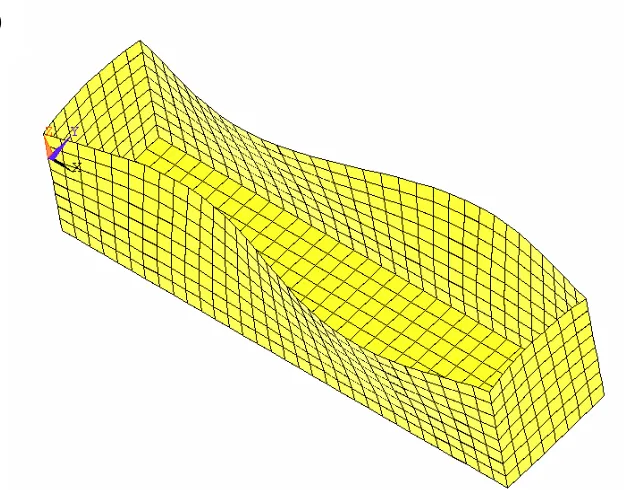
Figure 2.3.1: The numerical model and the location of the observed nodes.
The finite element model of the container was created using two-dimensional rectangular
shell elements, SHELL63 (ANSYS 2002) with the characteristics as shown in Figure
simulations for elastic and rigid definitions of the container. As outlined earlier, 0.001 m
(1 mm) wall thickness is assigned to the flexible container. This thickness was increased
to 0.005 m (5 mm) in order to predict the response of a rigid container having the same
dimensions as those of the flexible container.
Numerous trials were undertaken with the intention to verify grid cell size and its
explanation proceeds in this chapter. As an outcome from those trials, the grid cell size of
50mmx50mm was selected as sufficient for numerical accuracy for both container and
liquid models. The full finite element model of the container was discretised into 896
elements.
Figure 2.3.2: Two-dimensional rectangular shell finite element.
FLUID80 (ANSYS 2002), three-dimensional brick finite elements were used to model
the liquid. The total weight of the liquid content is 192kg. The brick finite element is
shown in Figure 2.3.3, which is defined by eight nodes having three degrees of freedom
at each node. The parameters for the finite element model were defined for a
The complex physical behavior of the free surface liquid utilizes formulations of
nonlinear wave theory and is defined by the gravity springs attached to each node of the
liquid. The full liquid finite element model was discretised into 1536 elements.
Figure 2.3.3: Three-dimensional brick finite element.
To control sloshing, the objective is to tune the container’s fundamental natural frequency
to the fundamental sloshing frequency. The tuning has been attempted by adding mass
elements at the top edge and in the middle of the 1.6 m long sides of the container. The
structural mass element, MASS21 (ANSYS 2002), is defined as a single node as shown
Liquid boundary conditions are shown in Figure 2.3.5. These boundary conditions have
been defined using separate coincident nodes for each liquid element. These nodes were
then coupled with the structural elements in the direction normal to the interface.
2.4 Computational Simulations
The dynamic response and natural frequencies of both the liquid and the container are
influenced by strong interactions between them. The strong interaction between liquid
and container is achieved when the fundamental frequency of the liquid (in the direction
of sloshing) is tuned to the fundamental frequency of the container.
The response of the container’s structure depends primarily on its natural frequencies,
damping characteristics, and the frequency content of the time-varying loads. Eigenvalue
modal analysis has been used first to determine the container’s natural frequencies and
mode shapes. Three mode shapes of oscillation of the container are obtained and given in
Figure 2.4.1. Natural frequencies for different added masses are determined and are given
in Table 2.4.1.
The first mode shape of oscillation, in Figure 2.4.1 (a), shows that oscillations along the
longest walls of the container are out of phase. The second mode shape of oscillation in
Figure 2.4.1 (b), shows that the oscillations along the longest walls are in phase, whilst
the third and higher modes showed much clearer separation of frequencies, Figure 2.4.1
(c). The first and second modes are plate modes with the first one an out-of-phase mode,
Figure 2.4.1.: Mode shapes of oscillation for the container with 0 kg point mass and no liquid.
From Table 2.4.1, the frequency for the simulation without mass is significantly higher
than the theoretical fundamental sloshing frequency of liquid, which is calculated at 1.34
Hz. By adding masses those natural frequencies of the container become closer to
sloshing frequency. However, it should be remembered that the frequencies changed
when container contained liquid. Hence, the information in Figure 2.4.1 and Table 2.4.1
Mass [kg] 1st natural
frequency [Hz]
2nd natural
frequency [Hz]
3rd natural
frequency [Hz]
0 6.38 6.47 9.25
3 1.41 1.42 9.25
5 1.1 1.1 9.25
7 0.94 0.94 9.25
9 0.83 0.83 9.25
11 0.75 0.75 9.25 13 0.69 0.69 9.25
2.4.1Selection of Mesh Size
As mentioned earlier in this chapter, the container walls have been represented with
standard shell elements in the FEA model. 3-D fluid elements have been used for the
liquid in the container. The container is meshed with square elements of 0.05 m x 0.05 m
size and the liquid is meshed with cubic elements of 0.05 m x 0.05 m x 0.05 m size. The
solution is independent of the mesh size at this resolution. Grid independence has been
verified by testing 0.025 m square and cubic elements for the same selected cases of forty
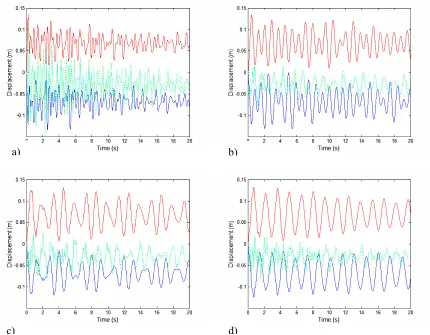
Figure 2.4.1.1: Predicted displacement histories of chosen fluid and structure nodes in a flexible container with various added masses, for the 25 mm mesh size and 10 ms time steps runs. Point mass amounts: (a) 0 kg, (b) 5 kg, (c) 9 kg, (d) 13 kg.
Figure 2.4.1.1 gives the displacement histories of the container and fluid nodes for 0.025
m mesh size tests. Figure 2.4.1.4 gives the displacement histories of the container and
fluid nodes for 0.05 m mesh size tests. Top and bottom solid lines in red and blue indicate
the container nodes. Dashed lines in the middle in green indicate the fluid node
displacement histories. Very similar displacement patterns are seen in Figure 2.4.1.1 with
0.025 m mesh, in comparison to Figure 2.4.1.4 with 0.05 m mesh, for 0 kg, 5 kg, 9 kg, 13
kg added point masses cases, respectively, indicating negligible difference between 0.025
m and 0.05 m mesh sizes.
a) b)
Figure 2.4.1.2: Predicted sloshing amplitude of chosen fluid nodes in a flexible container with various added masses, for the 25 mm mesh size and 10 ms time steps runs. Point mass amounts: (a) 0 kg, (b) 5 kg, (c) 9 kg, (d) 13 kg.
Sloshing amplitudes for the selected cases with 0.025 m mesh size are shown in Figure
2.4.1.2. Figure 2.4.1.5 gives the sloshing amplitude for 0.05 m mesh size tests. The high
sloshing amplitude around 0.05 m for the case with 0 kg point mass is gradually
decreasing until the 9 kg point mass case in Figure 2.4.1.2 (c) to a level just below 0.02
m. The tuning effect is assumed to be lost beyond this point as seen in Figure 2.4.1.2 (d),
where sloshing amplitude is increasing back to above 0.02 m. Figure 2.4.1.5 give the
same sloshing histories obtained with the 0.05 m mesh size. Differences between
respective plots for the selected cases are again insignificant.
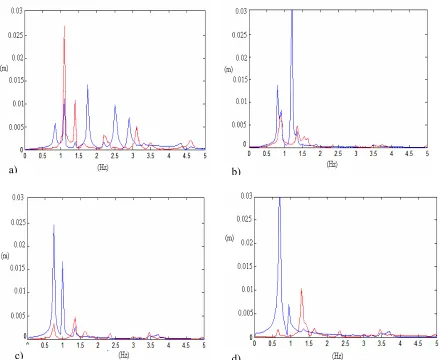
Figure 2.4.1.3: FFT plot of sloshing liquid (red-line) and structural vibration (blue-line) with various added masses, for the 25 mm mesh size and 10 ms time steps runs. Point mass amounts: (a) 0 kg, (b) 5 kg, (c) 9 kg, (d) 13 kg.
The FFT plots of liquid sloshing and structural vibration data for 0.025 m mesh size are
given in Figure 2.4.1.3. The FFT plots of liquid sloshing and structural vibration data for
0.05 m mesh size are given in Figure 2.4.1.6. Red line indicates sloshing, and blue line
indicates structural spectral distributions. The horizontal axis represents frequency in
[Hz] and the vertical axis represents spectral magnitude [m]. All spectral plots presented
in this section and for the rest of this thesis are single-sided.
a) b)
Figure 2.4.1.4 Same as in Figure 2.4.1.1 but for the 50 mm mesh size runs and 10 ms time steps.
The sloshing frequencies are dominant in Figure 2.4.1.3 (a), around 1.2 Hz and 1.4 Hz.
The main structural frequencies that are around 0.8 Hz, 1.2 Hz and 1.75 Hz are lesser in
magnitude. By looking at the highest peak around 1.2 Hz attributed to sloshing, it is
possible to say that the structure is driven by the fluid. The addition of 5 kg and then 9 kg
point masses in Figures 2.4.1.3 (b) and (c) seems to transform the system to one that is
structurally driven, as opposed to one driven by the sloshing. The structural peak around
1.3 Hz in Figure 2.4.1.3 (b) which then shifts to 1.1 Hz in Figure 2.4.1.3 (c) is clearly
suppressing the sloshing peaks in this range.
Figure 2.4.1.5 Same as in Figure 2.4.1.2 but for the 50 mm mesh size runs and 10 ms time steps.
The same observation can be made for the other major structural peak around 0.8Hz and
0.75 Hz for 5 kg and 9 kg point mass cases respectively. Again by looking at Figure
2.4.1.3 (d) it is possible to see that the fluid and the structure are not effectively
controlling each other any more. Rather they are both acting in their separate ranges, -
structure around 0.7 Hz and sloshing around 1.4 Hz.
c) d)
0 0.5 1 1.5 2 2.5 3 3.5 4 4.5 5 0
0.005 0.01 0.015 0.02
(Hz)
(m
)
0 0.5 1 1.5 2 2.5 3 3.5 4 4.5 5
0 0.005 0.01 0.015 0.02
(Hz)
(m
)
0 0.5 1 1.5 2 2.5 3 3.5 4 4.5 5
0 0.005 0.01 0.015 0.02 0.025 0.03
(Hz)
(m
)
0 0.5 1 1.5 2 2.5 3 3.5 4 4.5 5
0 0.005 0.01 0.015 0.02 0.025 0.03
(Hz)
(m
)
Figure 2.4.1.6 Same as in Figure 2.4.1.3 but for the 50 mm mesh size runs and 10 ms time steps.
The FFT plots of 0.0550 m mesh size are given in Figure 2.4.1.6. It can be observed that
it is possible to predict the same behavior with 50 mm mesh size as that for the 25 mm
mesh. This leads to the conclusion that obtained results with a finer mesh are very similar
to the results of the chosen mesh size.
a) b)
2.4.2 Time Step Size
A transient analysis has been conducted with 10 milliseconds (ms) time step. These 10
ms time steps were selected as there was minimal difference between 10 ms and 5 ms
time steps, to be more cost effective. For verification, 25 mm mesh size run and 10 ms
time step for the same selected cases have been presented here in Figures 2.4.1.7, 2.4.1.8
and 2.4.1.9
Figure 2.4.1.7: Predicted displacement histories of chosen fluid and structure nodes in a flexible container with various added masses, for the 25 mm mesh size and 10ms time steps runs. Point mass amounts: (a) 0 kg, (b) 5 kg, (c) 9 kg, (d) 13 kg.
a) b)
Figure 2.4.1.8: Predicted sloshing amplitude of chosen fluid nodes in a flexible container with various added masses, for the 25 mm mesh size and 10 ms time step runs. Point mass amounts: (a) 0 kg, (b) 5 kg, (c) 9 kg, (d) 13 kg.
Again, Figures 2.4.1.7 give the displacement histories; Figures 2.4.1.8 give the sloshing
amplitude and Figures 2.4.1.9 give the FFT plots for structural displacement and sloshing
data for the selected cases of 0 kg, 5 kg, 9 kg and 13 kg point mass respectively.
Figure 2.4.1.9: FFT plot of sloshing liquid (red-line) and structural vibration (blue-line) with various added masses, for the 25 mm mesh size and 10 ms time step runs. Point mass amounts: (a) 0 kg, (b) 5 kg, (c) 9 kg, (d) 13 kg.
A comparison with Figures 2.4.1.7, 2, 4.1.8 and 2.4.1.9 leads to the conclusion that there
are no substantial differences between 5 ms and 10 ms time step runs and time step
independence assumption is verified.
a) b)
Figure 2.4.1.10: Same as in Figure 2.4.1.7 but for the 25 mm mesh size and 5 ms time step run.
Figure 2.4.1.11: Same as in Figure 2.4.1.8 but for the 25 mm mesh size and 5 ms time step run.
a) b)
Figure 2.4.1.12: Same as in Figure 2.4.1.8 but for the 25 mm mesh size and 5 ms time step run.
2.4.3 Selection of the Length of Simulation Time
The introduction of water to the numerical model at time zero, has been of concern in
determining the total duration of simulations. The flexible container gets elastically
deformed by the addition of water at time zero. This deformation leads to structural
oscillations of some considerable magnitude and long duration. It should be pointed out
that this initial period for the container to seek the “static equilibrium” is peculiar only to
the numerical process. The dynamic events of interest start only after the container
reached its deformed state to accommodate the weight of its static liquid load. Until such
a state is reached, container walls oscillate in the horizontal direction, and the “flat”
liquid free surface oscillates in the vertical direction. No sloshing takes place.
To understand the effect of the initial settling period in which the flexible container seeks
its static equilibrium, long runs of forty seconds have been obtained for the selected cases
of 0 kg, 3 kg, 5 kg, 7 kg, 9 kg and 13 kg point masses. For these cases, the excitation has
been introduced after twenty seconds, to allow the static equilibrium to be established.
For brevity, only 0 kg, 9 kg and 13 kg point mass cases are presented here, while the
remainder of the cases are in Appendix B, for completeness.
In Figures 2.4.2, 2.4.3 and 2.4.4, simulation results with a total duration of forty seconds
are presented (where there is an initial twenty second waiting period before the base
excitation is applied). By keeping the test conditions the same but altering the simulation
time to twenty second duration (and skipping the initial twenty second period) the
simulations are repeated and the corresponding results are presented in Figures 2.5.2 to
-0.20 -0.15 -0.10 -0.05 0.00 0.05 0.10
0 2 4 6 8 10 12 14 16 18 20 22 24 26 28 30 32 34 36 38 40
TIME [s]
DI
S
P
L
AC [
m
]
-0.08 -0.06 -0.04 -0.02 0.00 0.02 0.04 0.06 0.08
0 2 4 6 8 10 12 14 16 18 20 22 24 26 28 30 32 34 36 38 40
TIME [s]
D
ISPL
A
C
[
m
]
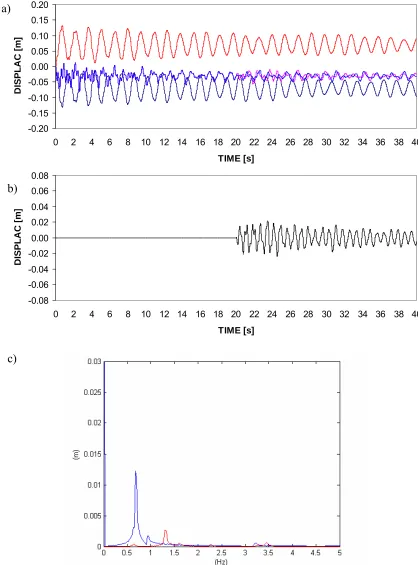
Figure 2.4.2: Displacement histories of the liquid in a flexible container with 1 mm wall thickness and 0 kg point mass (a).The liquid is undamped and structure has 1% damping. Predicted sloshing amplitude for the same case (b). Corresponding frequency spectrum of sloshing liquid (red) and structure (blue) (c).
b)
-0.20 -0.15 -0.10 -0.05 0.00 0.05 0.10 0.15 0.20
0 2 4 6 8 10 12 14 16 18 20 22 24 26 28 30 32 34 36 38 40
TIME [s]
DI
S
P
L
AC [
m
]
-0.08 -0.06 -0.04 -0.02 0.00 0.02 0.04 0.06 0.08
0 2 4 6 8 10 12 14 16 18 20 22 24 26 28 30 32 34 36 38 40
TIME [s]
DI
S
P
L
A
C
[
m
]
Figure 2.4.3: Displacement histories of the liquid in a flexible container with 1 mm wall thickness and 9 kg point mass (a).The liquid is undamped and structure has 1% damping. Predicted sloshing amplitude for the same case (b). Corresponding frequency spectrum of sloshing liquid (red) and structure (blue) (c).
a)
b)
-0.20 -0.15 -0.10 -0.05 0.00 0.05 0.10
0 2 4 6 8 10 12 14 16 18 20 22 24 26 28 30 32 34 36 38 40
TIME [s]
D
ISPL
A
C
[m
]
-0.08 -0.06 -0.04 -0.02 0.00 0.02 0.04 0.06 0.08
0 2 4 6 8 10 12 14 16 18 20 22 24 26 28 30 32 34 36 38 40
TIME [s]
DI
S
P
L
AC [
m
]
Figure 2.4.4: Displacement histories of the liquid in a flexible container with 1 mm wall thickness and 13 kg point mass (a).The liquid is undamped and structure has 1% damping. Predicted sloshing amplitude for the same case (b). Corresponding frequency spectrum of sloshing liquid (red) and structure (blue) (c).
b)
In these figures, frame (a) contains the histories of the horizontal motion of the container
nodes located in the middle of the wall near the top, as marked in Figure 2.3.1, and the
vertical motion of the liquid free surface nodes. In all the following figures in frame (a),
colors (, magenta) and (, light blue) present vertical displacement of the liquid and
colors (,red) and (, dark blue) present horizontal displacement of the container. In the
frame (b), the resulting sloshing amplitude is shown. In the frame (c), the frequency
spectra of the container displacement (blue) and sloshing (red) are presented. The
40-second displacement histories in Figures 2.4.2, 2.4.3 and 2.4.4, and the 20-40-second ones in
Figures 2.5.2, 2.5.6 and 2.5.7 are quite different in appearance, as expected.
Sloshing amplitudes for the selected cases are shown in frame (b) of Figures 2.4.2, 2.4.3
and 2.4.4. These figures represent the difference between the vertical displacements of
the two liquid nodes on either side of the container. Without excitation, the two free
surface nodes of the liquid are completely in phase, as mentioned earlier, thus making the
sloshing amplitude zero for the first twenty seconds.
After excitation, the value of the sloshing amplitude changes. The sloshing amplitude is
around 0.06 m for the 0 kg added point mass case, and this value drops to below 0.02 m
for 9 kg point mass case. Following the addition of the 13 kg point mass, the sloshing
amplitude again starts climbing over the 0.02 m level. Exactly the same trend is seen for
the sloshing amplitude in Figures 2.5.2, 2.5.6 and 2.5.7 (b) and the sloshing patterns look
quite similar (except for the first twenty seconds of the longer runs, of course). In both
sets of runs, sloshing is best suppressed near the 9 kg point mass but this effect is lost by
indicates the sloshing amplitude frequency, whereas the blue line indicates the container
frequency.
Sloshing frequencies which are dominant in Figure 2.4.2 (c) are around 1.2 Hz and 1.4
Hz. Major structural peaks for the 0 kg point mass are around 0.8 Hz, 1.2 Hz and 1.75
Hz. Looking at these frequency amplitudes, sloshing liquid should be driving the
structure for this case scenario especially around the highest peak of 1.2 Hz.
For the 9 kg point mass case scenario, in Figure 2.4.3 (c), structural frequencies are even
more dominant over the fluid ones. The structural frequency that was around 0.8 Hz
significantly increases in amplitude and shifts in the spectrum to 0.75 Hz level, further
suppressing the sloshing at the same frequency. The highest structural peak is switched
from 1.2 Hz to 0.7 Hz. for this case.
With the introduction of 13 kg point masses, the interaction between the fluid and the
container is seen to diminish as in Figure 2.4.4 (d). Sloshing peak is around 1.4 Hz once
again and the structural frequency is decreased to 0.65 Hz. The fluid and the structure
seem to be acting independently beyond this point. As in displacement history and
sloshing amplitude plots, FFT plot results of longer runs are quite similar to results of
twenty seconds runs that are displayed in Figure 2.5.7 (c). The only major difference is
the higher frequency amplitudes of the forty second run plots. However, relative
From a detailed comparison of the twenty second and forty second simulations, it is seen
that a twenty second settling period is insufficient for the liquid to stabilize. However, it
appears that applying the excitation at the start of a simulation, even without a settling
period, the difference in the dynamic response is quite minimal. Therefore, as suggested
earlier, the computational time can be halved by using a twenty-second total time, and by
introducing the excitation at the beginning of the simulation.
2.5 Numerical Predictions
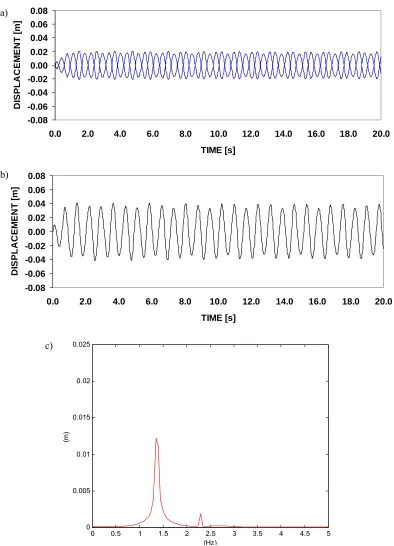
In Figure 2.5.1 (a), the predicted vertical displacement histories of the free surface of the
liquid are given at the nodes which are located at the middle of the container near the top
of two long sides of the rigid container (also indicated in Figure 2.3.1). These two
histories are 180-degrees out of phase, indicating that when the liquid climbs at one wall,
it drops at the other one. At the completion of one period of excitation, the liquid climbs
approximately 20 mm on one wall, and it comes down by about 20 mm on the opposite
wall. As there is no viscous dissipation, liquid sloshing continues with almost constant
amplitude. No displacement history for the container walls is given as the walls have no
detectable deflection.
The resulting sloshing amplitude for the rigid container is around 40 mm and is shown in
Figure 2.5.1 (b). Sloshing history in figure (b), is given as the difference between the
vertical displacements of the two liquid nodes, on the opposite sides of the container as
-0.08 -0.06 -0.04 -0.02 0.00 0.02
0.0 2.0 4.0 6.0 8.0 10.0 12.0 14.0 16.0 18.0 20.0
TIME [s] DI SPL A C E M E NT -0.08 -0.06 -0.04 -0.02 0.00 0.02 0.04 0.06 0.08
0.0 2.0 4.0 6.0 8.0 10.0 12.0 14.0 16.0 18.0 20.0
TIME [s] DI SP L ACE M E NT [ m ]
0 0.5 1 1.5 2 2.5 3 3.5 4 4.5 5
0 0.005 0.01 0.015 0.02 0.025 (Hz) (m )
Figure 2.5.1: (a)Predicted absolute displacement histories of the liquid in a rigid container, (b) sloshing amplitude for the same case, (c) corresponding displacement frequency spectrum of sloshing liquid.
In Figure 2.5.1 (c) where the corresponding frequency spectrum of the sloshing history is
given, the fundamental sloshing frequency is suggested to be around 1.4 Hz, quite close
to the theoretical fundamental frequency of 1.34 Hz. Another small spectral peak is
apparent, around 2.3 Hz, indicating the second sloshing frequency.
A series of numerical trials was conducted to determine the most promising container
flexibility. The objective of the trials was to tune the container’s natural frequency to the
sloshing frequency. As mentioned before, two point masses of various magnitudes were
attached to obtain tuning at the middle point of the longer container walls. The presence
of significant energy transfer between the liquid and container is considered to be the sign
of appropriate tuning. Tuning generally produces a beat envelope in the displacement
history and two dominant spectral peaks in the corresponding frequency spectrum. This
beat should be apparent both in the displacement histories of the container and at the
liquid surface level.
The displacement history for the flexible container with 0 kg point mass is presented in
Figure 2.5.2 (a). The horizontal displacement histories of the container nodes are the top
and the bottom ones. The vertical displacement histories of the liquid surface nodes are
indicated with two middle lines, with smaller displacement magnitudes than those of the
container. Also, the container walls deflect substantially (an average of 0.075 m) after
filling the flexible container with water. As a result, the free surface oscillations take
place about a level lower that zero.