TRISOMIC TYPES OF THE TOMATO AND THEIR RELATION TO T H E G E N E S
J. W. LESLEY
University of California Citrus Experiment Station, Riverside, California
Received March 22, 1932
TABLE O F CONTENTS
PAGE
. . . 545
ic and tetrasomic types. . . . . . 546 Trisomic inheritance. . .
Discussion of the characteristics of trisomic types. ...
SUMMARY . . . . . . 558
LITERATURE CITED.. . .
INTRODUCTION
The tomato provides rather favorable plant material for study of the effects of changes in chromosome number. Haploid (n = 12), diploid, auto- triploid, and autotetraploid forms are known. Eleven of the twelve primary simple-trisomic types expected and two tetrasomic types have been identi- fied, and some double and triple-trisomic types are viable. Moreover, in the same race, the simple-trisomic types and three or four which contain a chromosome fragment in addition to the normal complement can be identified phenotypically. MACARTHUR (1931) refers to twenty pairs of genes now under investigation. The loci of fifteen of these are reported to be in seven different chromosomes. I n Zea mays the number of known genes is vastly greater but the simple-trisomic types (n = lo), according to MCCLINTOCK and HILL (1931), are not easily distinguishable externally from diploids.
I n the present paper two new simple-trisomic and two tetrasomic types of the tomato are described, more evidence is presented concerning the location of known mutant genes, and an attempt is made to interpret some of the phenotypic effects associated with the presence of extra chromosomes in simple-trisomic types.
As in a previous paper (LESLEY 1928) the twelve chromosomes of the haploid set will be designated by the first twelve letters of the alphabet. Triplo-A then denotes a simple-trisomic plant containing an A chromo- some in addition to the normal complement of twelve pairs, and triplo-DF a double trisomic containing a D and an F chromosome in addition to
Paper No. 269, UNIVERSITY OF CALIFORNIA Graduate School of Tropical Agriculture and Citrus Experiment Station, Riverside, California.
the normal diploid complement. The term non-hybrid is again applied to plants of the two closely similar races of Dwarf Aristocrat in which the triploids used as parents occurred.
NEW SIMPLE-TRISOMIC AND TETRASOMIC TYPES
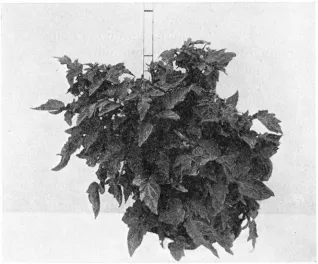
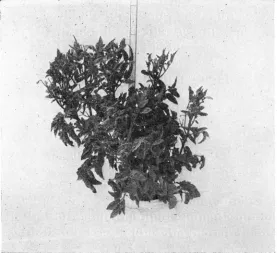
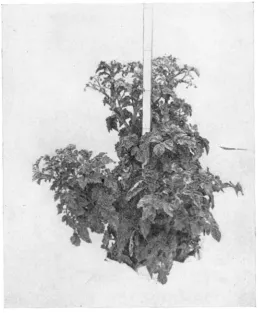
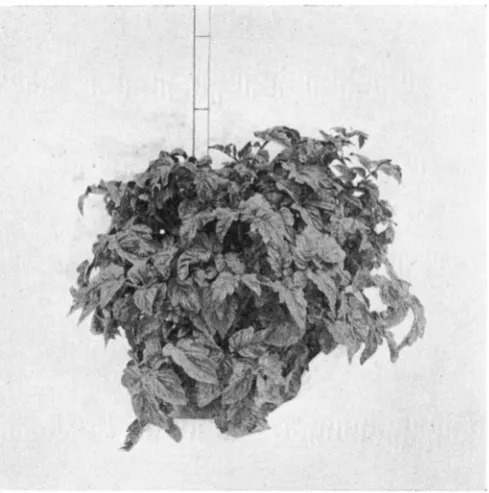
For comparison with other field-grown simple-trisomic types, non- hybrid plants of triplo-F, triplo-G, triplo-H and triplo-I are shown in figures 1 to 4.
FIGURE 1.-Triplo-F non-hybrid.
I n one instance a single seed from triploidxdiploid gave rise to two seedlings. One of these proved to be normal triplo-B, the other was a
TMSOMIC TYPES OF TOMATO 547
cause other than chromosome unbalance is indicated also by the occur- rence of runts from diploid parents.
As triplo-I (figure 4) contains the locus of the Rr gene pair, a somewhat fuller description than that already published (LESLEY 1928, p. 25) seems desirable. Compared with diploid Dwarf Aristocrat (figure
7),
the surface of the leaf lamina is more even and the texture is more leathery. The mar- gin of the folioles is less indented and the foliolules are fewer in number. The color of the leaves is somewhat grayer green, with more purple alongFIGURE 2.-Triplo-G non-hybrid.
the midribs and in the axils of the leaflets. I n the seed bed it is easily dis- tinguishable from the diploid by the appearance of the first true leaves. The flesh, especially of the walls and placentae, of the fruit of RRR triplo-I plants tends to be paler red than that of RR diploids. Like other trisomic types, triplo-I grows more slowly than the diploid. It is one of the less fruitful and less fertile trisomic types. Non-hybrid plants seldom set fruit in the field at Riverside without hand pollination.
Further study of the type thought to be a secondary of triplo-I (LESLEY
1928, figure 17) has led to the conclusion that it is identical with the primary triplo-I.
The simple-trisomic type shown in figure 5 was first identified in an
FZ
progeny of triploidxdiploid. It was notable for the compound or much- branched character of its inflorescences. This branching was similar to that caused by the recessive mutant gene s (compound inflorescence) which
CRANE
(1915) showed to be a simple recessive toS
(simple inflores- cence). The mean number of nodes between successive inflorescences wasFIGURE S.-Triplo-H non-hybrid.
2.8, approximately the same as in a diploid
SS
race, as compared with about 4 in Grape Cluster (ss). It is believed that the plant in figure 5 isTRISOMIC TYPES OF TOMATO 549
pollination in which not only the 3 trisomic but also the 24 diploid progeny had a tendency to be compound. This can scarcely be explained by acci- dental cross-pollination and is being studied further.
I n the F1 progeny of triplo-BC Xdiploid Dwarf Aristocrat, a new simple- trisomic type appeared which bore no special resemblance to either the triplo-B or the triplo-C plants occurring in the same progeny. It con- tained an extra chromosome apparently of normal size (not a fragment),
FIGURE 4.-Triplo-I non-hybrid.
and is therefore believed to be a primary. Triplo-K (figure 6) has not been found in the FI progenies of triploidxdiploid, perhaps owing to its close resemblance in general appearance to the diploid. The leaves are smaller, darker green, and more curled. The flower is smaller, the style more slender, and the number of loculi in the ovary about one-third less than in the diploid. A similar reduction in number of loculi occurs in triplo-D. In floral characters triplo-K suggests the small-fruited types of tomato
which grow wild in western Mexico and in Peru. Triplo-K is less fruitful and the fruits contain fewer seeds of normal size than the diploid.
The existence of 11 different simple-trisomic types agrees with t h e con- clusion of LINDSTROM and Koos (1931) from the absence of pairing among the chromosomes of the haploid that the basic number of chromosomes is 12.
FIGURE S.-Triplo-J hybrid.
TRISOMIC TYPES OF TOMATO 551 and triplo-D hybrids selfed, respectively. One tetra-B plant was shown to have 11 bivalent and 1 quadrivalent chromosomes in its pollen mother cells, and several other closely similar plants occurred in the same prog- eny. (The author is indebted to his wife, Doctor MARGARET M. LESLEY,
for the chromosome counts reported in this paper.) The tetra-B plant had the distinctive characteristics of triplo-B but to a somewhat greater degree. Unlike its triplo-B sibs, it was unfruitful in the field without hand pollination.
FIGURE 6.-Triplo-K non-hybrid.
Two tetra-D plants were identified by chromosome number in the progeny of triplo-D selfed. The presence in this progeny of 13 percent of apparently tetrasomic plants indicates a t least that amount of pollen transmission of the D chromosome. The tetra-D plants also had the char- acteristics of triplo-D to an increased degree. Although less fruitful than triplo-D sibs, both the tetra-D plants identified produced a few seeds of normal size.
TRISOMIC INHERITANCE
The extra chromosome of triplo-A contains the locus of the gene d
(dwarf), as already reported (J.
W. LESLEY
1926). C49-la was a triplo-Aplant (it was probably a double trisomic but the other extra chromosome was not identified). The ratio of standard to dwarf from selfing C49-la (table 1) shows that this plant was probably Ddd. The small
F1
progenies C77 and C79 (table 1) originate from two dd (diploid) plants pollinated by a single flower of C49-la7 the triplo-A (Ddd) plant. This flower was staminate and entirely without a gynaecium. As was expected, the extra A chromosome was not transmitted by the pollen and no other trisomics occurred, but instead of standard and dwarf plants in the ratio 1 : 2 in thei f
r l-
FIGURE _ - 'I.-Diploid^Dwarf Aristocrat..-
diploid progeny, C77 contained 11 standard and 10 dwarf, and C79 con- tained 8 standard and 6 dwarf. If the numbers are combined the odds against such a departure from the 1:2 ratio in simple sampling are 115 to 1. Apparently an aberrant somatic cell division in C49-la resulted in the loss of an A chromosome or, more probably, part of an A chromosome containing d, and also prevented the development of the gynaecium.
TABLE 1
f
Trisomic inheritance of habit (D, standard; d, dwarf), foliage and stigma color (L, normal green; I, lutescent) andjlesh color of fruit (R, red; r, yellow) in the tomato. The numbers expected are printed ilz italics under the observed numbers.J
5
-
> VIPARENTAGE
-
v, w h)Triplo-A selfed* (C49-la) ~ TEEORETICAL GENETIC CONSTITUTION OF PARENTS DIPLOID PROQENY TRISOMIC PROGENY8
- U - .. .. .. .. .. .. 2 3 30 25 5 5 24 23 .. .. 2 4 .. .. -
- D - 71 71 11 11 8 7 19 19 34 30 .. .. .. .. .. .. .. .. .. .. - d - 44 # 1c 1I t 7
c
6 6 1G .. .. .. .. .. .. .. .. .. .. - - C - .. .. .. .. .. .. 17 19 29 30 .. .. .. .. .. .. .. .. .. .. - - C - .. .. .. .. .. .. 8 6 11 10 .. .. .. .. .. .. .. .. .. .. - - A - .. .. .. .. .. .. 19 19 31 30 .. .. .. .. .. .. .. .. .. .. - - a - .. .. .. .. .. .. c 6 9 fG .. .. .. .. .. .. .. .. .. .. - - L - .. ....
.. .. .. 23 22 32 29 .. .. .. .. .. .. .. .. .. .. - - 1 - .. .. ....
.. .. 2 3 7 10 .. .. .. .. .. .. .. .. .. .. -- R - ..
..
.. .. .. .. 13 9 58 57 19 19 90 91 lo! IO! 34 24 .. .. -- r - .. .. .. .. t. .. 0 3 14 $5 2 2 12 11 14 14 39 19 .. .. -
- Y - .. .. t. .. .. .. 11 9 72 77 16 16 58 19 .. .. 10 8 .. .. -
- D - .. .. .. .. .. .. 27 27 5 5 .. .. .. .. .. .. .. .. .. .. -
- d - .. .. .. .. .. ..
s
I 2 2 .. .. .. .. .. .. .. .. .. .. -- C - .. .. .. .. .. .. 27 27 6 5 .. .. .. .. .. .. .. .. .. .. -
- E - .. .. .. .. .. .. 9 9 1 2 .. .. .. .. .. .. .. .. .. .. -
- A - .. .. .. .. .. .. 26 27 5 5 .. .. .. .. .. .. .. .. .. .. -
- a - .. .. .. .. .. .. 1( 5 1 i .. .. .. .. .. .. .. .. .. .. -
- L - .. .. .. .. .. .. 35 all 6 5 .. .. .. .. .. .. .. .. .. .. -
- 1 - .. .. .. .. .. .. 0 .. 0 1 .. .. .. .. .. .. .. .. .. .. -
- R - .. .. .. .. .. .. 13 13 1 2 .. .. 7 zll 7 Ill 13 13 4 all -
- r _. 4 4 2 1 0 .. 0 .. 7 7 0 .. -
- Y - .. .. .. .. .. .. 12 13 3 2 .. .. 6 5 .. .. 1 1 .. .. -
Ddd Dwarf Aristocrat diploid> triplo-A* (staminat flower) (C77) Dwarf Champion diploid> triplo-A* (staminat, flower) (C79) Triplo-B selfed
ddXDd ddXDd Dd
Y yCc and DdCcAaLllRr Yy RrrYy and DdCcAaLlRrr Y y RRrYy Triplo-I selfed Triplo-I selfed Triplo-I selfed RRrYy and RRr Triplo-I selfed Triplo-I X diploid RRr (all) Rrr Yy Xrr Yy and
RrrXrr RRrXrr
doubt that the locus of the
RT
pair of genes is in the I chromosome. The total numbers obtained from selfing parents of theoretical genetic con- stitution Rrr or RRr agree very nearly with the trisomic expectation. Two plants of constitution Rrr were backcrossed with rr diploids. Owing to the deficiency of recessive-type (yellow-fleshed) diploids in both progenies (table l), the R : r ratio was nearer that from disomic inheritance and the odds against a difference as great or greater between the observed and the expected ratios in simple sampling are 60 to 1. LINDSTROM (1926) found evidence of linkage between the Rr pair of genes and some of the genes for size of fruit. Consequently an overbalance of genes with a re- sultant effect on fruit size might be expected in triplo-I. The few data available indicate that the fruit size of non-hybrid triplo-I and diploid Dwarf Aristocrat is approximately the same, but some difference might be found in other races. It is possible also that an overbalance of genes for increased fruit size exists, but its effect is neutralized by the deficiency of viable seeds and lack of vigor of triplo-I compared. with the diploid. However, there is other evidence that the grade of a character is not necessarily changed by the presence of an extra chromosome carrying a major gene for that character.A triplo-B
R
plant, (2218-4, from green triploid (LLL) Xlutescent (ZZ) diploid was selfed. The observed L : I ratio among the diploid and trisomic progeny (table 1) approaches closely that expected if the triplo-B parentwas LIZ, and differs from a disomic ( 3 : l ) ratio by nearly six times the
probable error. The locus of the LZ pair therefore is believed to be in the B chromosome.
From the presence of the locus of the
Dd
gene pair in the A chromo- some, it may be assumed to contain the loci of the gene pairs P p , 00, andSs,
which are linked with it. The direct evidence in table 2 and in a previ- ous publication (LESLEY 1928, table 8) and the indirect evidence of linkage relations, which is wholly consistent with the direct evidence, lead to the following negative inferences. The locus of the Y y gene pair is not in chromosomes A, B, C, D, or I and is probably not in E, F, H, or J. TheCc locus is not in chromosomes A, B, C, D, E, F, or I and probably not in J. The A a locus is not in chromosomes A, B, D, F, or I .
DISCUSSION O F THE CHARACTERISTICS O F TRISOMIC TYPES
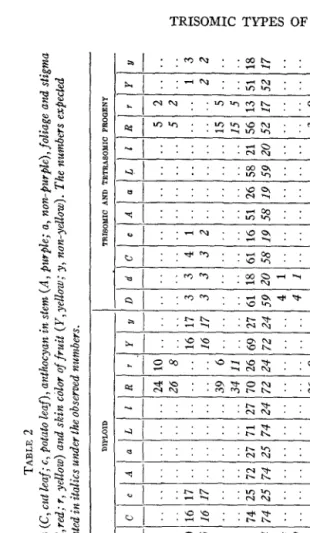
TABLE 2 Disomic inheritance of habit (D, standard; d, dwarf), leaf form (C, cut leaf; c, potato leaf), anthocyan in stem (A, purple; a, non-purple), foliage and stigma color (L, normal green; I, lutescent),$esh color of fruit (R,red; r, yellow) and skin color of fruit (Y, yellow; y, non-yellow,). The numbers expected are printed in italics under the observed numbers.
2
2
E I 2 v) c W (U NTHEORETICAL GENETlC CONSTITUTION OF PARENTS DIPLOID TRISOMIC AND TETRABOMIC PROGENY PARENTAGE
- C - .. .. 16 16 .. .. 74 74 .. .. .. .. 34 34 .. .. .. .. 23 23 17 ..
- I - .. .. 17 17 .. .. 27 ?4 .. .. .. .. 14 I1 20 ?2 7 9 4 8 6 ..
- d - .. .. 3 3 .. .. 18 20 1 1 .. .. 5 3 .. .. .. .. .. .. .. 3 9 -
- U - I. ,. 3 2 18 '7 0 0 1 2 3 1 3 0 -
- D - .. .. 23 17 .. .. 76 73 91 86 .. .. 14 14 .. .. .. .. .. .. 19 .. .. - - d - .. .. 10 16 .. .. 21 24 24 29 .. .. 5 5 .. .. .. .. .. .. 6 .. ..
- a - !7 ?5 5 5 7
- L - .. .. .. .. .. .. 71 74 .. .. .. .. 13 14 .. .. .. .. .. .. 20 .. ..
- I - .. .. .. .. .. .. 27 24 .. .. .. .. 6 5 .. .. .. .. .. .. 5 .. ..
- R - 24 26 .. .. 39 34 70 72 .. .. 26 ?6 LO 13 21 ?2 24 ?8 .. .. 15 ..
- r - 10 8 .. .. 6 11 26 24 .. .. 9 9 7 4 23 22 13 9 .. .. 6 ..
- Y - .. .. 16 16 .. .. 69 72 .. .. .. .. 30 33 24 22 30 28 27 23 15 .. .. -
- D - .. .. 3 3 .. .. 61 59 4 4 .. .. 7 9 .. .. .. .. .. .. .. 17 13 - C - .. .. 4 j .. .. 61 58 .. .. .. .. 13 13 .. .. .. .. 5 4 .. 13 17
- C - 1 2 6 '9 4 4 0 1 7 5
- A - .. .. .. .. ., .. 51 58 .. .. .. .. 8 9 .. .. .. .. ..
..
.. 14 17 - - L - .. ....
.. .. .. 58 59 .. .. .. .. 9 9 .. .. .. .. .. .. .. 12 13 -- I - .. .. .. .. .. .. 21 20 .. .. .. .. 3 3 .. .. .. .. .. ..
..
8 4 -- R - 5 5 .. .. 15 15 56 52 .. .. 3 2 1 1 .. .. 7 5 .. .. .. 16 2 -
- Y - .. .. 1 2 .. .. 51 52 .. .. .. .. 1 1 .. .. 7 5 2 4 .. 15 2 -
A - .. .. .. .. .. .. 72 74 .. .. .. .. 14 14 .. .. .. .. .. .. 18 .. ..
C - .. .. 17 17 .. .. 25
25 .. .. .. .. 12 I2 .. t. .. .. 8 8 8 .. ..
I - 2 2 .. .. 5 5 13 I7 .. .. 0 1 0 0 .. .. 1 2 .. .. .. 2 0 -
a - .. .. .. .. .. .. 26 19 .. .. .. .. 4 3 .. .. .. .. .. .. .. 6 5 -
Triplo-C selfed Triplo-C Xdiploid Triplo-D selfed Triplo-D selfed 2n+D/2 selfed Triplo-E selfed Triplo-F selfed Triplo-H X diploid Triplo- J selfed Triplo-J selfed Triplo-DF sued
Rr DdCcYy
Xddccyy
Rr DdCcAaLlRr
Yy
Dd Rr CcYy
and
DdCcAaLlRr
Yy
RrYyXrryy RrYy CcYy DdCcAaLlRr
diploid
on the fruit which resemble externally those caused by sunburn. Appar- ently R is completely dominant over r , but is incompletely dominant over
rr. A similar paleness of flesh color was often seen in the fruits of RRR and
RRr plants. Apparently modifying genes are present in the I chromo- some, whose effect upon color is cumulative and opposed to that of R.
The flesh color of rrr plants is yellow like that of rr diploids. Except in style length and sepal shape, Ddd plants of triplo-A are not more dwarf- like than Dd diploids, and ddd plants of triplo-A are distinctly less dwarf- like than dd plants of triplo-E or triplo-K (compare LESLEY 1928, figures 6, 7 and 12, and figure 6 in present paper). The presence of an extra gene is not indicated by the shade of green of LLL plants of triplo-B. A gene 0 for non-elongated (spherical or oblate) fruit shape is partially dominant to 0, a gene for elongated fruit shape, and is linked with dwarf (LINDSTROM 1927). The fruit shape indices (equatorial diameter divided by length) of 00 diploid, 000 triplo-A and 00 triplo-D plants of Dwarf Aristocrat were 1.2, 1.4 and 1.0 respectively. A similar relation was found in the shape of 00 diploid, 000 triplo-A and 00 triplo-D hybrids.
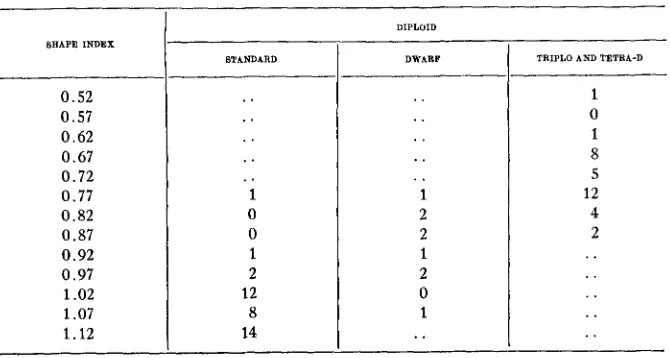
The effect of an extra D chromosome on fruit shape therefore was as great as that of an extra A chromosome carrying 0, a major gene for that character. A triplo-D F1 plant, C150-3, from the cross Dwarf Aristocrat triploid XRed Pear diploid, had elongated slightly pyriform fruits. Its diploid Fz progeny consisted of 35 non-elongated and 10 elongated-fruited plants. All the 22 triplo-D progeny had elongated fruit. The progeny from
TABLE 3
Frequency distributioiz of shape index of fruit of diploid standard, diploid dwarf and friplo and tetra-
D, all progeny of a triplo-D hybrid (CZl8-1).
SHAPE INDEX
0.52 0.57 0.62 0.67 0.72 0.77 0.82 0.87 0.92 0.97 1.02 1.07 1.12 STANDARD .. 1 0 0 1 2 12 8 14 DIPLOID DWARF . . . . . . .. . . 1 2 n
TRlPLO AND TETRA-D
TRISOMIC TYPES OF TOMATO 557
selfing another triplo-D hybrid, C218-1, are classified in table 3 . I n the progenies of these triplo-D hybrids inheritance of elongated h i t shape seems to be disomic.
It appears from the foregoing that the characteristics of the simple- trisomic types give, a t the most, a rather uncertain clue to the position of known mutant genes. I n simple-trisomics an extra chromosome con- taining a mutant gene may have no more or even less effect on the grade of the character concerned than an extra chromosome not containing the locus of the mutant gene pair. The elongated fruit shape of triplo-D seems to be due to non-mutant genes which are cumulative in effect. If these genes had mutated to non-elongated, triplo-D plants with spherical fruits might have appeared in these cultures, and inheritance of elongated shape from triplo-D would in some cases be trisomic.
The D chromosome probably does not contain the locus of the
Dd,
Rr,Y y , Cc, A a or
LZ
gene pairs, but the presence of genes for fruit size is sug-gested by the small size (weight) of the fruit of triplo and tetra-D. The mean weight per fruit of 10 fruits of each plant for part of the progeny of C218-1 (triplo-D) grown in the field is shown in table 4. The difference is 4.16 times the probable error and is significant. Since the fruits of triplo- D and even tetra-D contain abundant seeds of normal size, the size of their fruit can scarcely be limited by deficiency of seed. However, the small fruit size may possibly depend on the slower growth and lack of vigor of triplo and tetra-D and not on an overbalance of genes for small size.
TABLE 4
Mean w&ht d p r fruit nf dihlnid rind nf trihln n dt o t r n - n nll & ~ W M W n t n fAn1n-n h h & d ( r 7 1 R . l l
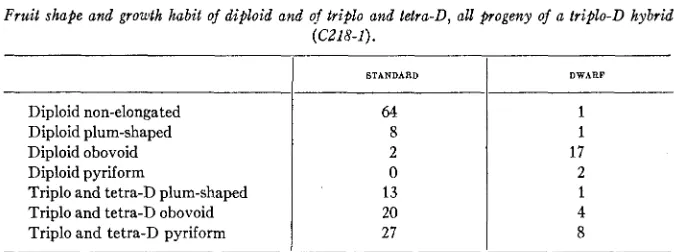
Pyriform fruit shape appeared in the progeny from selfing the triplo-D hybrid C218-1. The fruit of the parent was predominantly plum-shaped (ellipsoid) but slightly pointed a t the distal end. A classification of the progeny based on the predominant shape of several fruits from each plant, is shown in table 5 . All the pyriform-fruited progeny were elongated. Among the 30 diploids having elongated fruit only 2 were pyriform, but among the 73 triplo and'tetra-D plants, all of which were elongated, 35
were pyriform. These figures suggest that pyriform shape, in the strict sense, is not determined by a single pair of genes. The large proportion
of triplo and tetra-D pyriform-fruited plants is apparently due to an overbalance of genes in the D chromosome which influence the pyriform character. These genes may either determine pyriform shape directly or, by reducing the number of loculi or the size of the fruit, may affect the expression of the pyriform character.
TABLE 5
Fruit shape and growth habit o j diploid and
cf
triplo and tetra-D, all progeny of U triplo-D hybrid (CZ18-1).BTANDARD
I
DWARFI
Diploid non-elongated Diploid plum-shaped Diploid obovoid Diploid pyriform
Triplo and tetra-D plum-shaped Triplo and tetra-D obovoid Triplo and tetra-D pyriform
64 8 2
0
13 20 27
1
1 17
2 1
4
8
The suggestion, in table 5 , of linkage, between dwarf and pyriform is weakened by the uncertainty experienced in distinguishing standard and dwarf habit among the triplo and tetra-D plants.
The difference in mean weight between diploid non-elongated and diploid elongated was five times the probable error. Since larger size and non-elongated shape of fruit came from the same parent in the original cross Dwarf Aristocrat Xa small-fruited dwarf yellow pear race, this re- sult agrees with LINDSTROM’S (1929) finding of an association between genes for size and shape of fruit.
SUMMARY
Two new simple-trisomic types of tomato are described, of which triplo-J was found in Fz from triploidxdiploid, and triplo-K in F1 from triplo-BC Xdiploid. Probably 11 of the 1 2 primary simple-trisomic types expected have been identified.
I n the simple-tetrasomic types tetra-B and tetra-D the characteristics of the corresponding simple trisomics are accentuated.
The I chromosome contains the locus of the Rr pair of genes. The B chromosome probably contains the locus of the
LZ
gene pair.TRISOMIC TYPES OF TOMATO 559
of genes for fruit size in the D chromosome, which does not contain the locus of any of the 3 gene pairs known to be linked with genes for fruit size.
Evidence is given that pyriform fruit shape is not determined by a single pair of genes and that the D chromosome contains genes which influence the expression of this character.
LITERATURE CITED
CRANE, M. B,, 1915 Heredity of types of inflorescence and fruits in tomato. J. Genet. 5: 1-11. LESLEY, J. W., 1926 The genetics of Lycopersicum escdentum Mill. I. The trisomic inheritance of
1928 A cytological and genetical study of progenies of triploid tomatoes. Genetics 13: 1-43. LESLEY, M. M., 1926 Maturation in diploid and triploid tomatoes. Genetics 11: 267-279. LINDSTROM, E. W., 1926 Hereditary correlation of size and color characters in tomatoes. Iowa
1927 Inheritance of ovate and related shapes of tomato fruits. J. Agric. Res. 34: 961-985. 1929 Fruit size and shape genes on the first chromosome of the tomato. Proc. Iowa. Acad.
LINDSTROM, E. W., and KOOS, K., 1931 Cyto-genetic investigations of a haploid tomato and its
MACARTHUR, J. W., 1931 Linkage studies with the tomato. 111. Fifteen factors in six groups.
MCCLINTOCK, B., and HILL, H. E., 1931 The cytological identification of the chromosome asso- “dwarf.” Genetics 11: 352-354.
Agric. Expt. Sta. Res. Bull. 93: 99-128.
Sci. 36: 189-190.
diploid and tetraploid progeny. Amer. J. Bot. 18: 398-410.
Trans. Roy. Canadian Inst. 18: 1-19.
ciated with the r-g linkage group in Zea mays. Genetics 16: 175-190.