| PERSPECTIVES
The Full Breadth of Mendel
’
s Genetics
Peter J. van Dijk*,1and T. H. Noel Ellis *Keygene N.V., 6708 PW Wageningen, The Netherlands
ABSTRACTGregor Mendel’s“Experiments on Plant Hybrids”(1865/1866), published 150 years ago, is without doubt one of the most brilliant works in biology. Curiously, Mendel’s later studies onHieracium(hawkweed) are usually seen as a frustrating failure, because it is assumed that they were intended to confirm the segregation ratios he found inPisum. Had this been his intention, such a confirmation would have failed, since, unknown to Mendel,Hieraciumspecies mostly reproduce by means of clonal seeds (apomixis). Here we show that this assumption arises from a misunderstanding that could be explained by a missing page in Mendel’sfirst letter to Carl Nägeli. Mendel’s writings clearly indicate his interest in “constant hybrids,” hybrids which do not segregate, and which were“essentially different”from“variable hybrids”such as inPisum. After thePisumstudies, Mendel worked mainly onHieraciumfor 7 years where he found constant hybrids and some great surprises. He also continued to explore variable hybrids; both variable and constant hybrids were of interest to Mendel with respect to inheritance and to species evolution. Mendel considered that their similarities and differences might provide deep insights and that their differing behaviors were“individual manifestations of a higher more fundamental law.”
KEYWORDSGregor Mendel; genetics;Hieracium; constant hybrids; apomixis
The publication of Mendel’s letters to Carl Nägeli by Correns in 1905 was a service to genetics which seems not to have been fully appreciated by most of those who have since written accounts of Mendel’s life and work (Mann Lesley 1927).
“
T
HESE [seedlings] have rooted well, and shouldflower next year. Whether they willretain the characteristics of the hybrid, or whether they will show variations, will be determined by next year’s observations” (our emphasis). These lines about the progeny of hisfirst artificial hawkweed (Hieracium) hybrid were written by Gregor Mendel on No-vember 6, 1867, in a letter to Carl Nägeli, professor of botany at Munich (Letter III, Stern and Sherwood 1966, p. 73). They indicate that from the beginning of his experiments with Hieracium, Mendel expected that constant-hybrid offspring may well occur. Mendel ends the letter with:“I look forward to the coming summer with impatience since the progeny ofseveral fertile hybrids will bloom for the first time. They should be very numerous and I only hope that they repay the yearning [Sehnsucht!] with which I await them with much information concerning their life histories.” (quoted in Mann Lesley 1927). These are not the words of a frustrated man.
Gregor Mendel’s fame is based on hisPisum(pea) crossing experiments that were published 150 years ago. His only sub-sequent publication on plants is a preliminary communication on artificialHieraciumhybrids (Mendel 1870). The usual sup-position about Mendel’sHieraciumexperiments, which were carried out over 7 years, is that they were intended to verify the results he obtained with hisPisumexperiments (Nogler 2006; Bicknellet al. 2016). Hawkweeds are related to dandelions and, like them, often reproduce by a peculiar and rare breed-ing system called apomixis. The seeds of apomictic plants are produced clonally and are thus genetically identical to the mother plant. This is achieved by the avoidance of meiosis and the parthenogenetic development of the egg cell. In apo-mictic hawkweeds, most seeds produced are apoapo-mictic, but some may develop after cross-fertilization (for more informa-tion on apomixis see Supplemental Material, Secinforma-tion 1,File S1). Hawkweeds are hermaphrodites and produce haploid pollen, so they can act as pollen donors in crosses. Thus the prevalence of apomixis inHieraciumwould have made it im-possible for Mendel to replicate hisPisumfindings in this ge-nus. Apomixis was unknown in Mendel’s time; indeed it Copyright © 2016 van Dijk and Ellis
doi: 10.1534/genetics.116.196626
Available freely online through the author-supported open access option.
This is an open-access article distributed under the terms of the Creative Commons Attribution 4.0 International License (http://creativecommons.org/licenses/by/4.0/), which permits unrestricted use, distribution, and reproduction in any medium, provided the original work is properly cited.
Supplemental material is available online atwww.genetics.org/lookup/suppl/doi:10. 1534/genetics.116.196626/-/DC1.
1Corresponding author: Keygene N.V., Agro Business Park 90, 6708 PW Wageningen,
The Netherlands. E-mail: [email protected]
was many years after his death that the Danish botanist Carl Hansen Ostenfeld (1904) discovered apomixis inHieracium. The usual interpretation of Mendel’sHieraciumexperiments then is that his work on this genus was a frustrating failure; we suggest this misinterprets Mendel’s purpose.
In“Experiments on Plant Hybrids”Mendel (1866) gives an exemplary description of the formation of hybrids and the diversity among their offspring. Most of the work concerns Pisum, but he confirmed hisfindings in the genusPhaseolus (common bean). When self-fertilized, F1hybrids within these species produce variable progeny. Toward the end of this article, Mendel contrasts his results with the case where “We encounter anessential differencein those hybrids that remain constant in their progeny and propagate like pure strains.”(Mendel 1866; Stern and Sherwood 1966, p. 41. Mendel used“reinen Arten”, so“pure species”would be a better translation than“pure strains”). When self-fertilized, F1hybrids of these other species breed true: their progeny do not vary. Mendel designated these two distinct classes as var-iable hybrids (Stern and Sherwood 1966, p. 42) and constant hybrids (Stern and Sherwood 1966, p. 41), respectively1.
Historians of science (e.g., Olby 1979, 1985, 1997; Callender 1988; Müller-Wille and Orel 2007) have argued that Mendel’s main motivation for theHieracium(andPisum) experiments was his interest in hybridization and speciation rather than the inheritance of traits, and they proposed that Mendel stands in the tradition of earlier plant hybridizers like Joseph Gottlieb Kölreuter (1733–1806) and Carl Friedrich Gärtner (1772–1850). Recently this“Mendel as a nongeneti-cist”view has received considerable attention in popular science books (e.g., Endersby 2007; Numbers and Kampourakis 2015) and education journals (e.g., Peterson and Kampourakis 2015). Although we agree with these historians of science that Mendel selectedHieraciumto study constant hybrids, we do not think that speciation by hybridization was his only or main motiva-tion. Mendel was also interested in reproductive cells and segregation vs. nonsegregation in the successive genera-tions of progeny from a hybrid (i.e., inheritance). Mendel had multiple reasons for selectingHieraciumas an object for experimental crossing and the importance of these reasons may have shifted over the years of his study. The opportu-nity to come into contact with Carl Nägeli, the person most likely to value his Pisumfindings, would have been addi-tionally attractive.
In addition to his articles, there is a series of 10 letters that record part of his communication with Nägeli. Mendel’s notebooks were destroyed after his death, so we must rely on these few documents to form an understanding of his scientific thoughts and motives. From these documents we know that afterPisumandPhaseolus, Mendel investigated many other species from the generaAquilegia,Antirrhinum,
Calceolaria,Campanula,Cheiranthus,Cirsium,Dianthus,Geum, Hieracium, Ipomoea, Linaria,Lychnis,Matthiola,Mirabilis, Tropaeoleum,Verbascum,Zea, and more were planned (Letter II). By far, the largest number of these experiments was con-ducted inHieracium(Cetl 1971). In this article, we argue that a (mis)reading of Mendel’sfirst letter to Nägeli has led to the incorrect idea that Mendel’sHieraciumexperiments were intended to verify hisPisumfindings.
Correspondence Between Mendel and Nägeli
Carl Nägeli
Carl Nägeli was one of the most important botanists of the 19th century (Junker 2011). His research interests were on natural hybrids, an area where he was recognized as the leading researcher; andHieracium, where again he was the leading authority. Nägeli was the person who could best see the relevance of Mendel’s pea results and Mendel also wanted his advice as aHieraciumexpert (Section 2,File S1).
Mendel’s letters to Nägeli
Carl Correns (1900), one of the three“rediscoverers”of Mendel’s work, clearly acknowledged Mendel’s contribution. Correns was a student of Nägeli’s and (after Nägeli’s death) was married to his niece. From Mendel’sHieraciumnote and from conversations with Nägeli in the past, Correns knew that Mendel and Nägeli had collaborated closely, so he asked the Nägeli family whether they had any letters from Mendel. Correns published the 10 letters that were discovered (Correns 1905), labeling them with the Roman numerals I to X (Table S1). In 1925, Correns wrote in a letter to Herbert Fuller Roberts that these “first came to light through an accident in 1904”(Roberts 1929, p. 338). Fragments of some of Nägeli’s letters to Mendel were found in the monastery in Brno (German: Brünn) and were published by Iltis (1924). The records of their correspondence are thus incomplete. Correns also published some of the keyword summaries that Nägeli had made of his letters to Mendel. The only in-depth analysis of this scientific correspondence we are aware of is Hoppe (1971), in which she discusses it especially in relation to Nägeli’s work, but not in relation to Mendel’sHieraciumresults.
Mendel’s Hieracium work has been misunderstood as a frustrating failure to replicate his Pisum work
The traditional interpretation of Mendel’s motivation for studying Hieraciumis expressed by Hartl and Orel (1992): Mendel’s“studies ofHieraciumand other species were un-dertaken to verify, with other plants, the result obtained with Pisum,”and“the experiments withHieracium, as recounted in the letters to Nägeli, were one long chronicle of failure and frustration.”In 2006 the journalGENETICSmarked the 140-year jubilee of Mendel’sPisumarticle. Crow and Dove (in Nogler 2006) commented negatively about Mendel’s Hiera-cium work: “Here, on this anniversary, instead of extolling his success, we present a scholarly account [Nogler 2006]
1By“constant hybrids,”Mendel means true-breedingAahybrids. In modern genetic
terms these are heterozygotes that remain heterozygotes in subsequent generations. This must be clearly distinguished from true-breeding new trait combinations in variable hybrids (e.g.,AAbb,aaBB).
of Mendel’s frustrating attempts to repeat his findings in another species, which, unbeknownst to him, reproduced apomictically.” Nogler (2006) starts with: “Mendel hoped that the highly polymorphic genusHieraciumwould be par-ticularly promising for verifying the laws of inheritance that he had discovered while working on Pisum.” According to Mawer (2006, p. 167), Mendel’sHieraciumarticle is“of no more than curiosity value.”Modern articles on the genetics of apomixis often refer to Mendel’s frustrating experiences with Hieracium e.g., Koltunow et al. (2011): “Apomixis in hawkweed: Mendel’s experimental nemesis.”At the Mendel Museum at the Monastery in Brno, Mendel’sPisum experi-ments, meteorological studies, and beekeeping activities can be seen, but not his Hieraciumwork, perhaps due to their associated negativity.
It has been argued that Nägeli was instrumental in Mendel’s selection ofHieracium(as discussed in Nogler 2006), but from Letter I it is clear that Mendel had already made crosses in Hieracium,Geum, andCirsiumin the summer of 1866, so the parental species must have been collected at least one season earlier. Mendel had thus embarked on hisHieracium exper-iments by 1865 at the latest. Therefore Nägeli cannot have pushed Mendel to work onHieraciumas is sometimes sug-gested (Iltis 1924; Mayr 1982); his choice of Hieracium predates his communication with Nägeli and Nägeli’s ex-pertise withHieraciumwas a likely motivation for Mendel initiating this correspondence.
Contradiction in Mendel’sfirst letter to Nägeli
Mendel’s first letter to Nägeli, written on New Year’s Eve 1866, was a covering letter for the reprint of hisPisumarticle. In the letter (Letter I) Mendel clarified his Pisum studies, mentioned his future research plans, and asked if he could rely on Nägeli for the determination of difficultHieracium andCirsium(thistle) species, on which Nägeli was an expert. To understand why it is widely believed that Mendel chose Hieraciumto test thePisumfindings, paragraphs four andfive are crucial, so these are copied below with the paragraph numbers added in parentheses:
(4) In order to determine the agreement, if any, with
Pisum, a study of those forms which occur in the first generation2should be sufficient. If, for two differentiating characters, the same ratios and developmental series which exist in Pisumcan be found, the whole matter would be decided. Isolation during theflowering period should not present many difficulties in most cases, since we are dealing only with few plants; those plants whoseflowers are being fertilized and a few hybrids which have been selected for seed production. Those hybrids which are collected in the wild can be used as secondary evidence only, as long as their origin is not unequivocally known.
(5) Hieracium,Cirsium, andGeum I have selected for further experiments. In thefirst two, manipulation in arti-ficial pollination is very difficult and unreliable because of
the small size and peculiar structure of theflowers . . . (Stern and Sherwood 1966, p. 57–58).
From this it has been concluded that Mendel chose the generaHieracium,Cirsium, andGeumto test thePisumfi nd-ings. William Bateson (1909, p. 246) wrote: “This genus [Hieracium] being one of the most strikingly polymorphic, he chose it after his discovery regarding the inheritance of peas, as the subject of further[our emphasis] research. We may surmise that he expected tofind in it illustrations of the new principles.”Bateson’s use of the word“further”suggests that he came to this conclusion based on the two paragraphs mentioned above3. This interpretation has become the com-mon belief of geneticists. For example, Iltis (1924, translation of Iltis 1966) wrote:“For Mendel the behavior of the hawk-weeds remained an enigma, and his experiments upon these composites shattered the hopes he had entertained offinding confirmation of the principles of inheritance worked out by him in the case ofPisum, and thus establishing these princi-ples as universally valid general laws. . . . He had certainly been lucky in his original choice ofPisumas the object of his experiments. But fate played him an ill turn when he went on to hybridize the hawkweeds; and when, with peasant dog-gedness, urged on by Nägeli, he persevered so long in his researches upon this unsuitable genus.”(pp. 174–175). Ernst Mayr (1982, p. 723) stated:“Instead, he [Nägeli] encouraged Mendel to test his theory of inheritance in the hawkweeds (Hieracium), a genus in which, as we now know, partheno-genesis [apomixis] is common, leading to results that are incompatible with Mendel’s theory. In short, as one histo-rian has put it,‘Mendel’s connection with Nägeli was totally disastrous.’ ”
Was it ill fate, as Iltis suggested? One of the very few who has interpreted this differently is the historian L.A. Callender (1988), who wrote:“Mendel, on the other hand, and before he was certain that he had obtained a singleHieraciumhybrid surmised exactly the opposite [of Bateson’s proposal that Mendel expected to verify hisPisumresults]”and cites a later paragraph from Letter I:“The plantGeum urbanum+rivale deserves special attention. This plant, according to Gärtner (1849), belongs to the few so far4 known hybrids which produce nonvariable progeny as long as they remain self-pollinated.” And subsequently: “The surmise that some species of Hieracium, if hybridized, would behave in a fashion similar to Geum, is perhaps not without founda-tion. It is, for instance, very striking that the bifurcation of the stem, which must be considered an intermediate5trait
2For Mendel, the“first generation”referred to thefirst generation derived from the
hybrid—today this would be called the F2.
3The wording“further experiments”(“weitere Versuche”) is somewhat awkward or
ambiguous in this context. Since Mendel gave a detailed protocol as to how the
Pisumfindings could be tested in the previous paragraph, his having written “Hieracium,Cirsium, andGeumI have selected for further experiments”rather than “. . . such experiments”might suggest he was referring to a different kind of experiment.
4“bisher”(meaning“so far”) was not translated by Piternick and Piternick (1950).
However, it indicates that Mendel expected that more constant hybrids would be found, which is logical if he already suspectedHieraciumhybrids to be constant.
5Piternick and Piternick (1950) use“transitional,”but we think“intermediate”is a
better translation of“Zwischenbildung.”
among thePiloselloids, may appear as a perfectly constant character, as I was able to observe last summer on seed-lings ofH. stoloniflorumW. K.6”
This suggests that Mendel expected thatHieraciumspecies could be constant hybrids (see also Orel 1998). Why would Mendel select a genus in which he expected tofind constant hybrids, to validate the segregation of variable hybrids? This would be irrational. The eminent Mendel-expert Franz Weiling (1970) expressed it very carefully:“From Mendel’s first letter to Nägeli one gets the impression that he, with his crosses in Hieracium, Cirsium as well as Geum-species, wanted to test the generalities which he had found inPisum” [“Aus dem 1.Brief Mendels an Nägeli(31.Dezember 1866) gewinnt man den Eindruck, daß er mit seinen Kreuzungen bei Hieracium-, Cirsium-, sowie Geum-Arten die bei Pisum gewonnenen Gesetzmäßigkeiten prüfen wollte.”(p. 99)]. The wording “one gets the impression” suggests Weiling was aware of the contradiction in the letter. As far as we know, this major contradiction has never been discussed. Here we suggest that the present paragraphs four andfive in Mendel’s first letter were originally not linked, but were separated by
one or more lost pages. The two paragraphs are not logically connected and we propose that Mendel did not select these species to test thePisumfindings.
Could a missing page explain the contradictions in Mendel’sfirst letter?
Because of the contradiction in Letter I, we wondered whether a part of the letter could be missing. Witte (1971), who had photocopies of all the handwritings, compared the original text with the transcript of Correns and found only a few small typographical errors. Therefore an error in the transcription can be ruled out.
We have examined a facsimile of Letter I (December 31, 1866) published by Jelinek (1965) because, despite our ef-forts, the original could not be traced. In Figure 1 it can be seen that paragraph four ends at the bottom of page two and paragraphfive begins at the top of page three. Since the page break does not result in a broken sentence, a missing sheet would go unnoticed, especially in a transcript, where the relationships between paragraphs and pages are different from the original handwriting. In the facsimile, parts of the words written on page two can be seen mirror-wise on page one and vice versa; the same for pages three and four (Figure S4). This means that the sheets of paper are written
Figure 1 Letter I (December 31, 1866). A comparison between Correns’publication (left) and Mendel’s original handwriting. In Correns’publication, paragraph four andfive are on the same page, but in Mendel’s original letter, paragraph four is at the end of page two and paragraphfive is at the top of page three. The handwriting shows that an entire page could be missing. In Correns’publication a missing page would not be noticed, unless the flow of the content was illogical. Courtesy of the Mendelianum Archives of the Moravian Museum.
6Nägeli (1845) mentioned a forked stem as a characteristic ofPilosellahybrids.
on both sides and that one or more sheets could be missing (i.e., two or an even number of pages). We examined copies of Mendel’s handwritten pages to see whether there were any structural clues that would enable us to discount the possi-bility that one or more pages is missing. From a statistical consideration of the location of page and paragraph breaks in Mendel’s letters, we concluded that paragraphs usually end in the middle of pages, so the location of a paragraph end at the bottom of a page is consistent with this being deliberate. The paragraph need not have ended there: align-ment of the text using the ink marks that can be seen through the paper from one side to the other shows that there was adequate room to continue writing on this piece of paper (Section 3,File S1andFigure S4). If paragraphfive begins at the top of the page, as it does according to Correns’ tran-script, then a missing page is required to end with a para-graph break. The analysis which leads us to conclude that this is not improbable is set out in Section 3,File S1.
Mendel’s Research Interests Were Broad
Mendel’s hypothesis about the germ cells of constant vs. variable hybrids
In the concluding remarks of the Pisum article, Mendel stressed the importance of the“essential difference”between variable and constant hybrids; between hybrids like those of pea, which produced variable offspring; and hybrids that produced constant offspring. He also mentioned that “For the history of the evolution of plants this circumstance is of special importance, since constant hybrids acquire the status
of new species” (Mendel’s emphasis, Stern and Sherwood 1966, p. 41). By “new species” Mendel meant being true breeding and having morphological distinctness. Clearly speciation was one of the interests that Mendel had in con-stant hybrids.
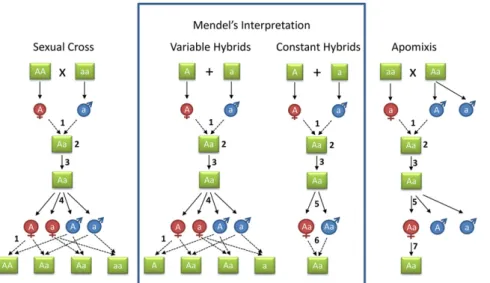
Mendel was interested in the mechanisms of inheritance and the composition of reproductive cells. So far, this aspect of Mendel’s work has not received much attention. According to the report of Mendel’s second lecture on March 8, 1865 in the Brünn newspaper Neuigkeiten,“he spoke about cell forma-tion, fertilization and seed production in general and in the case of hybrids in particular . . .”(Olby 1985). In hisPisum article, Mendel developed a hypothesis about the segregation of antagonistic elements among reproductive cells and their reassortment among progeny, based on the different types of progenies of variable and constant hybrids (Figure 2). This was .20 years before meiosis was discovered and understood by the contributions of van Beneden, Hertwig, Weismann, and others (Mayr 1982).
Mendel (1866) proposed that in variable hybrids that were derived from parents that differed, both the antagonis-tic elements were temporarily accommodated during the vegetative stage, and separated during the formation of the reproductive cells (egg cells and pollen). In contrast, in constant hybrids, Mendel proposed a permanent mediation. “This attempt to relate the important difference in the devel-opment of hybrids as to permanent or temporary association of differing cell elements can, of course, be of value only as a hypothesis which, for lack of well-substantiated data, still leaves some latitude.” (Stern and Sherwood 1966, p. 43).
Figure 2Mendel’s 1865/1866 views of inheri-tance in constant and variable hybrids. Mendel’s interpretation (boxed) of the behavior of deter-mining elements is compared to our current un-derstanding.“Sexual Cross”refers to the specific case of a cross between two homozygotes fol-lowed by self-fertilization, and should be compared to“Variable Hybrids”which is classically described in his 1866 article. Mendel’s interpretation of “Constant Hybrids”should be compared to“ Apo-mixis.”Note that Aa has a different meaning in our current understanding from that in Mendel’s scheme; Mendel did not know about meiosis and the distinction between diploid and haploid. Num-bers indicate: (1) The union of germinal cells from the female and male (egg and pollen). (2) The pri-mordial cell (zygote): differences between antago-nistic elements are mediated (in the mediating cell). (3) Vegetative period, the balance/mediation estab-lished in the primordial cell continues. (4) In vari-able hybrids, at the formation of the reproductive cells (gametes) the antagonistic elements are separated and represent“all constant forms which result from the combination of the characters united in fertilization.”The“arrangement between the conflicting elements is only temporary,”that is, no germinal cells carry the union of conflicting factors. (5) In constant hybrids, at the formation of the reproductive cells (gametes) the antagonistic elements are not separated. The essential difference in the development of constant hybrids is that the union of the factors is permanent. (6) In constant hybrids, the union of germinal cells of identical constitution is proposed (i.e., no parthenogenesis). (7) For comparison, the genetic transmission of apomixis is shown: the unreduced egg cell develops into an embryo by parthenogenesis. Note that in the case of apomixis a breeding system is inherited, which willfix the segregating genetic background of both parents; producing many different apomictic lineages. For simplicity only diploids are shown, but apomixis is often associated with polyploidy. Because apomicts have a simplex dominant genotype (Aaaa) this convenience is used. The type of apomixis shown here is typical for the subgenusArchieracium, which Mendel also used in crosses.
Constant hybrids, such as Hieracium, could provide such well-substantiated data; so, after having studied the variable Pisumhybrids, it was logical that Mendel would have gone on to study constant hybrids, as presaged by his comments in the Pisumarticle. Moreover, Mendel may not have been satisfied with Gärtner as an “eminent observer” as he wrote in the Pisum article, since in Letter I (Stern and Sherwood 1966, p. 57) to Nägeli he criticized Gärtner’s observations with re-spect to variable hybrids (“it is very regrettable that this wor-thy man did not publish a detailed description of his individual experiments”). Taken together, these considerations would have provided the impetus for Mendel to investigate con-stant hybrids himself.
Mendel’s interest in Hieracium, Cirsium, and Geum
As he neared the completion of hisPisumexperiments, Men-del had started looking for species for new crossing experi-ments. In 1864 he had made crosses betweenVerbascumand Campanula species and some of his artificial hybrids were
shown at the June 14, 1865 meeting of the Natural Science Society (Naturforschender Verein) of Brünn. TheVerbascum hybrids, however, were completely sterile (Letter III, Stern and Sherwood 1966, p. 77). The timing shows that Mendel’s interest in variable hybrids continued while he was also studying constant hybrids.
Why did Mendel select Hieracium, Geum, and Cirsium? Mendel mentioned in Letter I that the artificial hybrid Gärtner had made betweenGeum urbanumandGeum rivalewas one of the few hybrids known so far that produced constant progeny plants. Both parental species showed discrete alter-native states of traits, which had been a methodological re-quirement for Mendel’s study of variable hybrids. Moreover, the taxonG. intermediumwas found in nature, which could be the constant hybrid betweenG. urbanumandG. rivale. The last page of Mendel’s personal copy of Gärtner’s (1849) Versuche und Beobachtungen über die Bastarderzeugung im Pflanzenreich(Experiments and Observations on Hybridiza-tion in the Plant Kingdom) contains many notes onGeum,
Figure 3 Variation in inflorescence color and size inHieraciumhybrids. Ostenfeld (1910) illustrated 23H. auricula3aurantiacumhybrids that he obtained. Mendel obtained 84flowering hybrids from the same cross. The parental species are shown at the top;H. auriculaleft, with a yellow small inflorescence; andH. aurantiacumright, with a larger orange inflorescence. Next to the inflorescence a singlefloret is shown. The original image is from the Biodiversity Heritage Library. Digitized by the Mertz Library, New York Botanical Garden (http://www.biodiversitylibrary.org).
and two interesting designations of multigene genotypes of G. intermedium:ABcDEeandABcdEe(Olby 1985). In these, the heterozygote Ee would be constant and would not segregate.
Mendel was an active member of the Natural Science Society where he gave the two 1865 lectures about hisPisum experiments. In 1869, he was elected as vice president of the society and in June of that year he gave a lecture about his Hieracium hybridization experiments. Both Hieracium and Cirsiumwere genera in which intermediate and transitional forms between species were common (Nägeli 1866). Nägeli speculated that these might be constant hybrids or products of transmutation. Natural hybrids ofHieraciumandCirsium had already been discussed at several meetings of the society (see Section 4,File S1; Weiling 1969; Orel 1996). In general, the society was more interested in interspecific hybridization (“Bastarde”), than in intraspecific hybridization (“Hybriden”). Although Mendel saw only a graduated difference between varieties and species, he used “Hybriden”in the title of hisPisumarticle and“Bastarde”in the title of hisHieracium article; showing that he was well aware of the difference. His interest in speciesvs.varieties may have been influenced by the publication of Darwin’s (1859)Origin of Species[Mendel had a copy of the second edition of the German translation of theOrigin of Species(1863), see Fairbanks and Rytting 2001]. Mendel’s selection ofHieracium,Geum, andCirsiumfor study is therefore something to be expected in the intellectual atmosphere of Brünn at that time.
Hieracium
Two phases of Mendel’s Hieracium research
Mendel’s letters to Nägeli give a unique insight into his char-acter, showing the evolution of his views, his openness and honesty, and his admission that some of his earlier expecta-tions were incorrect. In some places the letters are witty and self-deprecating. Also striking, and contrary to what is often claimed, the correspondence between Mendel and Nägeli is friendly: Nägeli was not arrogant or controlling toward Mendel (Schwartz, 2008, and see salutations and signings
Table S1). Although Mendel wrote about experiments with other species, in these letters the Hieracium experiments were by far the most important. GeumandCirsiumdid not produce constant hybrids and soon Mendel concentrated on Hieracium. Mendel’s letters and his provisional Hieracium communication makes it possible to reconstruct hisHieracium crossing experiments (seeTable S2for a timeline, andTable S3in relation to Mendel’s interspecific crosses). A large part of the correspondence is about the identification ofHieracium species and the exchanges of plant material, which, although they were important at the time, obscure the purpose of the investigation.
Based on the content of the correspondence, two research phases can be distinguished (see Section 5,File S1); in the first phase Mendel, with great effort, managed to produce some hybrids which indeed propagated constantly. The
preliminary communication onHieraciumhybrids of June 9, 1869 can be seen to conclude this phase. In the second phase, Mendel tried tofind a solution to the fact that, con-trary to his expectation, he found multiple types of constant hybrid. Nogler (2006) gives a good biological description and analysis of Mendel’s Hieracium experiments, although it is chronologically incorrect. He wrote that Mendel was first surprised by the many different F1hybrids and then by the fact that these hybrids were true breeding. This chronology reinforced the image of a frustrated Mendel. In reality, Mendel initially obtained very few hybrids. It must have been an exciting vindication that thefirst hybrid was true breed-ing, fulfilling hisSehnsucht. Only later, to his surprise, he found that there were many different but constant F1hybrids. In total, Mendel obtained hybrids in 21 interspecific combi-nations.Table S3lists the most important interspecific hybrids and the variability of their offspring.
Mendel’s most successful cross was that between H. auricula 3aurantiacum from which he obtained 84 fertile
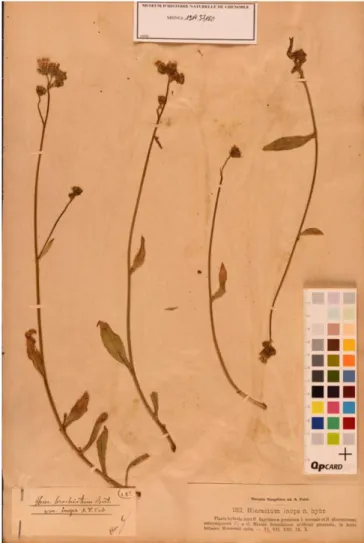
Figure 4 Mendel’sfirst constantHieracium hybrid (H. praealtum3H.
flagellare). Mendel observed no variation in three generations of this artificial hybrid. From herbarium “Hieracia Naegeliana” (Peter 1885). Courtesy of the Museum of Grenoble (H. inopsn. hybr., GRM. Arv.-Touv. MHNGr. 191437180).
hybrids (40 years later Ostenfeld repeated this cross, Figure 3). Remarkably, some of Mendel’s hybrids still exist as dried specimens in the Herbarium of the Museum of Grenoble (Mendel’s first constant hybrid, Figure 4; several H. auricula3aurantiacumhybrids, Figure 5). The hybrids that Mendel sent to Nägeli were grown in the experimental garden of the University of Munich. Nägeli’s student and later col-league, Albert Peter, edited a collection of exsiccatae“Hieracia Naegeliana” (1885), consisting of 300 herbarium sheets of Hieracium subgenus Pilosella plants, which included 16 of Mendel’s hybrids and 12 parental forms. Weiling (1969) lo-cated the“Hieracia Naegeliana”in 23 other herbaria in 11 coun-tries throughout Europe, although these are often incomplete. In thefirst phase of Mendel’sHieraciumexperiments, he demonstrated the constancy of the hybrid in subsequent gen-erations. He could have hoped to use this, for example, to study dominance relationships among determinants for the differentiating characters. However, the observation of more than one type of constant hybrid was unexpected because the parents were also true breeding and only one F1hybrid type was anticipated. The second phase of theHieracium experi-ments was therefore to determine what caused the multiplic-ity of F1 types. Mendel knew from hisPisum methodology that he should collect very many F1hybrids to“determine the number of different forms in which the hybrid progeny ap-pear . . . and ascertain their numerical interrelationships” (Stern and Sherwood 1966, p. 2). He was well aware of the amount of work this would require and in trying to im-prove the efficiency of the microscopicHieraciumcrosses he nearly ruined his eyesight permanently. In hisfinal letter to Nägeli, reflecting his realization that he did not have suffi -cient time to complete the necessary experiments, he wrote: “I am really unhappy about having to neglect my plants and my bees so completely. Since I have a little spare time at present, and since I do not know whether I shall have any
next spring, I am sending you today some material from my last experiments in 1870 and 1871.” (Letter X, Stern and Sherwood 1966, p. 97). All he could do was pass on his experimental material to someone who may have the oppor-tunity to continue the work. If he was frustrated, it was not because his experiments had failed, but because they showed what needed to be done next and his duties as abbot pre-vented him from continuing this work.
Concluding Remarks
In this article we have argued that Mendel’sHieracium ex-periments, and the reasons underlying them, have been mis-understood for more than a century. We propose that this misunderstanding rests on the obscurity of the originals of his written letters and that a missing page (or pages) in his first letter to Nägeli would explain the common misreading of that letter. There is no proof that a page is missing; this could become a certainty only if it were found, which seems highly unlikely. Notwithstanding, the traditional view of Mendel’s Hieraciumexperiments is not the only one possible. The in-terpretation we set out here is consistent with the whole of Mendel’s known writings and does not involve the contra-diction necessary for the traditional view. We therefore con-sider our interpretation the more likely. A missing page is not a necessary requirement for our interpretation, but its suggested location would help to explain the prolonged misinterpretation.
Although Mendel’s letters to Nägeli mainly concern the Hieracium crosses, as would be expected because of their collaboration, the letters also contain important information about his variable hybrids and this has been neglected, per-haps because of the negative view of hisHieraciumwork. In July 1870 (Letter VIII), Mendel wrote:“Of the experiments of previous years, those dealing with Matthiola annuaand
Figure 5 Four of Mendel’sH. auricula3aurantiacumhybrids from the herbariumHieracia Naegeliana(Peter 1885). All hybrids were fully fertile. In 1869, 1870, and 1873 Mendel sent material to Nägeli in Munich where they were cultivated in the common garden. Eight of these are described in Peter (1884). Courtesy of Museum de Grenoble (H. pyrrhanthes n. hybr. GRM. Arv.-Touv. MHNGr. 191437163, 191437164, 191437165, and 191437173).
glabra, Zea, and Mirabilis were concluded last year. Their hybrids behave exactly like those of Pisum. Darwin’s state-ments concerning hybrids of the genera mentioned in The Variation of Animals and Plants Under Domestication, based on reports of others, need to be corrected in many respects.” (Stern and Sherwood 1966, p. 93). This clearly shows that Mendel had found additional support for his understanding of inheritance in variable hybrids. In the same letter and in the next (Letter IX, September 27, 1870), Mendel also described repeated experiments to test whether a single pol-len grain is sufficient to fertilize a single egg cell and an experiment with two pollen grains, each from a different flower color genotype, to investigate if an egg cell could be fertilized by two pollen grains simultaneously. These experi-ments are a rigorous test of the basic principles of his theory of inheritance inPisum. Contrary to the historians’view, there can be no doubt that Mendel was above all a geneticist.
“My time is yet to come”are the famous prophetic words attributed to Mendel by his friend Gustav von Niessl. It is not widely known that Mendel said these words in the garden among hisHieraciumandCirsiumplants. (“aber ich hörte im Garten,an den Beeten seiner Hieracien und Cirsien von ihm die prophetischen Worte: ‘Meine Zeit wird noch kommen,’ ”Von Niessl 1905, p. 8). A more appropriate location is hard to imagine. Mendel’s interest in hybrids (both inter- and intra-specific) was broadly based and encompassed the mechanism of their formation, inheritance in general, as well as the consequences of hybridization for evolution. He clearly recog-nized two contrasting types of hybrid (constant and variable) and he chose to study both. In one of his last letters to Nägeli, he commented: “Evidently we are here dealing only with individual phenomena, which are the manifestation of a higher, more fundamental, law”(Stern and Sherwood 1966, p. 90). With hindsight we see this to be entirely correct. Mendel’s observations inHieraciumdemonstrated the pollen transmission of apomixis that can now be understood in terms of the Mendelian genetics of the process of inheritance itself.
Acknowledgments
The idea for this article sprouted from the“Research in Plant Genetics”Conference on September 7–10, 2015, organized by the Mendel Museum of the Masaryk University at Brno, Czech Republic. We thank Bengt Olle Bengtsson, Julie Hofer, and John Parker for critically reading and commenting on draft versions of the manuscript. We are grateful to Brigitte Hoppe for discussions and help with the transcription of Nägeli’s first letter. Welcome and insightful comments of the reviewers helped to improve the manuscript. We thank Thomas Notthoff of the Archives of the Max Planck Society in Berlin for proving us with a photocopy of the handwriting of Mendel’s letter II. We thank the following organizations for permission to reproduce images they own: The Muséum d’Histoire Naturelle de Grenoble, Catherine Gauthier, and Matthieu Lefebvre for pictures of herbarium specimens of Mendel’s Hieraciumhybrids which are part of the Casimir
Arvet-Touvet collection; The Mendelianum Archives of the Moravian Museum, Brno, Czeck Republic, and Jiˇrí Sekerák for photocopies of Letter I; The Mendel Museum of Masaryk University, Brno, Czech Republic, and director Ondˇrej Dostál for Notizblatt 2; and The Uppsala University Library for Mendel’s covering letter Kerner (Dörfler Till spec. mottagare: Kerner L–Z).
Literature Cited
Bateson, W., 1909 Mendel’s Principles of Heredity. Cambridge University Press, Cambridge, United Kingdom.
Bicknell, R., A. Catanach, M. Hand, and A. Koltunow, 2016 Seeds of doubt: Mendel’s choice of Hieracium to study inheri-tance, a case of right plant, wrong trait. Theor. Appl. Genet. 10.1007/s00122–016–2788-x.
Callender, L. A., 1988 Gregor Mendel: an opponent of descent with modification. Hist. Sci. 26: 41–57.
Cetl, I., 1971 An attempt at a reconstruction of Mendel’s experi-ments with plants other thanPisum,Phaseolus, andHieracium. Folia Mendeliana 6: 105–112.
Correns, C., 1900 G. Mendel’s Regel über das Verhalten der Nach-kommenschaft der Rassenbastarde. Ber. Dtsch. Bot. Ges. 18: 158–168.
Correns, C., 1905 Gregor Mendel’s Briefe an Carl Nägeli, 1866– 1873. Abhandlungen der Mathematisch-Physischen Klasse der Königlich Sächsischen Gesellschaft der Wissenschaften 29: 189–265.
Darwin, C., 1859 On the Origin of Species by means of Natural Selection, or the Preservation of Favoured Races in the Struggle for Life. John Murray, London.
Endersby, J., 2007 A Guinea Pig’s History of Biology. Arrow Books, London.
Fairbanks, D. J., and B. Rytting, 2001 Mendelian controversies: a botanical and historical review. Am. J. Bot. 88: 737–752. Gärtner, C. F., 1849 Versuche und Beobachtungen über die
Bas-tarderzeugung im Pflanzenreich. Hering, Stuttgart, Germany. Hartl, D., and V. Orel, 1992 What did Gregor Mendel think he
discovered? Genetics 131: 245–253.
Hoppe, B., 1971 Die Beziehung zwischen J.G. Mendel und C.W. Nägeli auf Grund neuer Dokumente. Folia Mendeliana 6: 123–138. Iltis, H., 1924 Gregor Johann Mendel: Leben,Werk und Wirkung.
Springer, Berlin.
Iltis, H., 1966 Life of Mendel. Second impression. Hafner, New York.
Jelinek, J., 1965 Iconographia Mendeliana. Moravian Museum in Brno, Brno, Czech Republic.
Junker, T., 2011 Der Darwinismus-Streit in der deutschen Botanik: Evolution, Wissenschaftstheorie und Weltanschauung im 19. Jahrhundert, Ed. 2. Books on Demand, Norderstedt, Germany. Kˇríˇzeneckӯ, J., 1965 Gregor Johann Mendel 1822–1884. Texte und Quellen zu seinem Wirken und Leben. Johann Ambrosius Barth Verlag, Leipzig, Germany.
Koltunow, A. M. G., S. D. Johnson, and T. Okada, 2011 Apomixis in hawkweed: Mendel’s experimental nemesis. J. Exp. Bot. 62: 1699–1707.
Mann Lesley, M., 1927 Mendel’s letters to Carl Nägeli. Am. Nat. 61: 370–378.
Mawer, S., 2006 Gregor Mendel: Planting the Seeds of Genetics. Harry N. Abrams, New York.
Mayr, E., 1982 The Growth of Biological Thought. Diversity, Evolu-tion and Inheritance. Bellknap Press, Cambridge, MA.
Mendel, G., 1866 Versuche über Pflanzen-Hybriden. Verhandlun-gen des naturforschenden Vereines in Brünn. 4: 3–47.
Mendel, G., 1870 Über einige aus künstlicher Befruchtung gewon-nenen Hieracium-Bastarde. Verhandlungen des naturforschenden Vereines in Brünn. 8: 26–31.
Müller-Wille, S., and V. Orel, 2007 From Linnaean species to Men-delian factors: elements of hybridism, 1751–1870. Ann. Sci. 64: 171–215.
Nägeli, C., 1845 Über einige Arten der Gattung Hieracium. Zeitschrift für wissenschaftliche Botanik 1: 103–120.
Nägeli, C., 1866 Die Zwischenformen zwischen den Pflanzenarten, pp. 294–339 inBotanische Mittheilungen, by C. Nägeli (Aus den Sitzungsberichten de K. b. Akademie der Wissenschaften in Muenchen) F. Straub. Munich.
Nogler, G. A., 2006 The lesser-known Mendel: his experiments on
Hieracium. Genetics 172: 1–6.
Numbers, R. L., and K. Kampourakis, 2015 Newton’s Apple and other Myths about Science. Harvard University Press, Cambridge, MA. Olby, R. C., 1979 Mendel no mendelian? Hist. Sci. 17: 53–72. Olby, R. C., 1985 Origins of Mendelism, Ed. 2. University of Chicago
Press, Chicago.
Olby, R. C., 1997 Mendel, Mendelism and Genetics. Available at:
http://mendelweb.org/. Accessed: April 2016.
Orel, V., 1996 Gregor Mendel: The First Geneticist. Oxford University Press, Oxford.
Orel, V., 1998 Constant hybrids in Mendel’s research. Hist. Philos. Life Sci. 20: 291–299.
Ostenfeld, C. H., 1904 Weitere Beiträge zur Kenntnis der Fruch-tentwicklung bei der GattungHieracium. Ber. Dtsch. Bot. Ges. 22: 537–541.
Ostenfeld, C. H., 1910 Further studies on the apogamy and hy-bridization of theHieracia. Z. Indukt. Abstamm. Vererbungsl. 3: 241–285.
Peter, A., 1884 Ueber spontane und künstliche Gartenbastarde in de Gattung Hieraciumsect. Pilosella. Englers Bot. JB. 5: 203– 286.
Peter, A. (Editor), 1885 Hieracia Naegeliana. 3 Centurien + 1 Supplement-Centurie. Munich.
Peterson, E. L., and K. Kampourakis, 2015 The paradigmatic Mendel at the sesquicentennial of “Versuche über Pfl antzen-Hybriden”: introduction to the thematic issue. Sci. Educ. 24: 1–8. Piternick, L. K., and G. Piternick, 1950 Gregor Mendel’s letters to
Carl Nägeli. Genetics 35: 1–29.
Roberts, H. F., 1929 Plant Hybridization Before Mendel. Princeton University Press, Princeton, NJ.
Schwartz, J., 2008 In Pursuit of the Gene. From Darwin to DNA. Harvard University Press, Cambridge, MA.
Stern, C., and E. R. Sherwood, 1966 The Origin of Genetics. A Mendel Source Book. Freeman, San Francisco.
Von Niessl, G., 1905 Jahresbericht. Verhandlungen des naturfor-schenden Vereines. Sitzungsberichte 44: 5–9.
Weiling, F., 1969 DieHieracium-Kreuzingen J.G. Mendels sowie ihr Niederslag in Literatur und Herbarien. Z. Pflanzenzücht. 62: 63–99.
Weiling, F., 1970 Commentary. Versuche über Pflanzenhybriden von Gregor Mendel. Ostwalds Klassiker der exakten Wissenschaften. Springer, Wiesbaden, Germany.
Witte, U., 1971 Vergleichende Untersuchung der in den Abhand-lungen der Koniglich Sächsischen Gesellshaft der Wissenschaf-ten abgedruckWissenschaf-ten, von C. Correns herausgegebenen “Gregor Mendels Briefe an Carl Nägeli 1866–1873”mit einer Photokopie der Orginale. Folia Mendeliana 6: 117–122.
Communicating editor: A. S. Wilkins
C
A
C
A
Supplemental Table ST1. Timeline of the Mendel - Nägeli correspondence
Year Date Letter Mendel's salutation Mendel's signing Nägeli' s salutation Nägeli's signing
1866 December 31st I Highly Esteemed Sir I subscribe myself
1867 February 24th Most honored colleague
With esteemed consideration, yours
sincerely
April 18th II Highly Esteemed Sir Your devoted
November 6th III Highly Esteemed Sir Sincere admirer
1868
April 28th unknown unknown
February 9th IV Highly Esteemed Sir With greatest respects for
your honor
May 4th V Highly Esteemed Sir Your devoted
May 11th Esteemed Sir and
friend
With esteemed consideration, your
June 12th VI Highly Esteemed friend Your devoted friend
September* unknown unknown
M1** unknown unknown
1869
April 15th VII Highly Esteemed Sir and
friend
Your always respectfully
April 18th unknown unknown
M2*** unknown unknown
1870
April 27th unknown With highest esteem and admiration,
your most devoted friendship
July 3rd VIII Highly Esteemed friend Your devoted friend
September
27th
IX Highly Esteemed Sir and
friend
Your very devoted
1871 May 30th unknown unknown
1873
spring M3**** unknown unknown
November
18th
X Highly Esteemed Sir and
friend
Yours very respectfully
1874 June 23rd unknown unknown
1875 date unknown unknown unknown
Sources:
Correns (1905)
Hoppe (1971)
Stern and Sherwood (1966)
*) In September 1868, Nägeli sent Hieracium plants from the Brenner Pass to Mendel
**) A missing letter from Mendel is inferred from the contents of letter VII
***) A letter from Mendel may be missing because there is no letter from him between two successive letters from Nägeli; there is an unusually long
time span between letters VII and VIII (almost 15 months)
Supplemental Table ST2. Time line of the key events related to Mendel’s Hieracium research.
1
Sources: Correns (1905), Kříženeck (1965), Stubbe (1965), Stern and Sherwood (1966) and Orel (1996). 2
Year Key events
1840 Nägeli's PhD thesis on Cirsium
1841 1842 1843 1844
1845 Nägeli's paper on the systematics and taxonomy of Hieracium , section Pilosella
1846 1847 1848
1849 Gärtner’s Versuche und Beobachtungen über die Bastarderzeugung im Pflanzenreich published
1850
1851 November 5th, Mendel starts to study at the University of Vienna 1852 Mendel studies at the University of Vienna
1853 July 21st, Mendel returns to Brünn 1854
1855
1856 Beginning of the Pisum experiments 1857
1858
1859 Darwin’s Origin of Species published
December, Natural Science Society of Brünn founded at a meeting attended by Mendel 1860
1861 1862
1863 End of the Pisum experiments 1864 Hieracium plants collected
December, von Niessl discusses wild Hieracium hybrids at the Natural Science Society 1865 February 8th, Mendel's first Pisum lecture at the Natural Science Society of Brünn
March 8th, Mendel's second Pisum lecture at the Natural Science Society of Brünn True breeding Hieracium lines established
1866 Mendel's Pisum paper is published First Hieracium crosses
December 31st, Letter and Pisum article reprint to Nägeli (I)
1867 January 1st, Letter and Pisum article reprint to Anton Kerner von Marilaun February 24th, reply letter from Nägeli to Mendel
March 5th, reply letter from Kerner to Mendel (lost) April 18th, letter II
March 31st, Mendel elected as abbot April 28th, letter from Nägeli
May 4th, Letter V
May 11th, letter from Nägeli June 12th, Letter VI
September, Letter from Nägeli Missing letter
Darwin’s The Variation of Animals and Plants under Domestication published
Idem, German translation published
Idem, August 21st review in the newspaper Neuigheiten under the header “Plant Breeding” 1869 April 15th, Letter VII
April 18th, Letter from Nägeli May - June many Hieracium crosses
June 9th Reading of Mendel's Hieracium paper from July onwards serious eyesight problems
Experiment with fertilization by single pollen grain in Mirabilis
Reports codominance of flower colour in Mirabilis
1870 Mendel becomes a member of the Association of Moravian Beekeepers April 27th, letter from Nägeli
Publication of Mendel's Hieracium paper July 3rd, Letter VIII
Summer: 84 hybrids of H.auricula x H.aurantiacum in flower Experiment with fertilization by single pollen grain repeated
Experiment with simultaneous pollination with two pollen grains from white and yellow flowered Mirabilis underway
September 27th, Letter IX 1871 May 30th, Letter from Nägeli
last Hieracium crosses 1872
1873 Spring, Missing letter (not received byNägeli ) November 18th, letter X
1874 June 23rd, Letter from Nägeli
1875 date unknown, letter from Nägeli
Nägeli awarded with the Bavarian Order of Merit and becomes: von Nägeli Mid 1870's: Notizblatt 1: segregation in variable hybrids
Mid 1870's: Notizblatt 2: multiple constant hybrids in Hieracium
1876 Kerner publishes a paper about putative parthenogenesis in Antennaria alpina
1877 1878 1879 1880
1881 Focke publishes Die Pflanzen-Mischlinge, mentioning Mendel’s research 15 times 1882
1884
January 6th Mendel dies of kidney failure Mendel’s letters and notebooks burned
Nägeli publishes his Mechanisch-physiologische Theorie der Abstammungslehre 1885
1886 1887 1888 1889
1890 Weissmann concludes that meiosis consists of an equatorial and a reductional division 1891 Nägeli dies
1892 Correns marries Nägeli's niece 1893
1894 1895 1896 1897 1898 1899
1900 de Vries, Correns & Tschermak's rediscovery of Mendel's work
1901 Correns asks the Nägeli family if letters from Mendel to Nägeli still exist 1902
1903 Sutton formulates chromosome theory of heredity
1904 Ostenfeld suggests that Mendel's Hieracium results can be explained by apomixis 1905 Mendel's letters to Nägeli found 'due to an accident' (!), and published
1906 1907 1908
1909 Bateson suggests that Mendel hoped to confirm his Pisum findings in Hieracium
1910 3
Supplemental Table ST3. Mendel’s most important Hieracium crosses
The variability / uniformity of the F1 and later generations, based on Correns (1905). Note that the distinct types of hybrid in the first generation
had uniform offspring so they are not 'variable hybrids', but distinct lineages of 'constant hybrids'.
female male 1866 1867 1868 1869 1870 1871
H. praealtum H. stoloniflorum (= H. lagellare) crossed 1 hybrid G1 uniform G2 uniform G3 uniform
H. praealtum (?) H. aurantiacum crossed 2 hybrids, distinct types
G1 uniform G2 uniform
H. praealtum (Bauhini?) H. aurantiacum crossed 2 hybrids, distinct types
G1 uniform G2 uniform
H. auricula H. pilosella crossed 1 hybrid G1 uniform
H. echoides H. aurantiacum crossed 1 hybrid G1 uniform
H. auricula H. pratense crossed 3 hybrids,
distinct types
H. auricula H. aurantiacum crossed 2 hybrids, distinct types
H. pilosella H. auricula crossed 1 hybrid
H.cymigerum H. pilosella (Brünn) crossed 29 hybrids,
distinct types
H. auricula H. aurantiacum crossed 98 hybrids,
distinct types
G1 uniform
H. auricula H. pilosella vulgare (München) crossed 84 hybrids,
H. auricula H. pilosella vulgare (Brünn) crossed 25 hybrids, distinct types*
H. auricula H. pilosella niveum (München) crossed 35 hybrids,
uniform / distinct**
* Mendel’s letter X is ambiguous about F1 variation, but Peter (1884) distinguishes two hybrid forms.
1
Supplemental Files
1
Supplemental file S1 Apomixis in Hieracium
2
3
Hawkweeds (genus Hieracium) belong to the family Compositae (or Asteraceae), named after the flower 4
head, which is an inflorescence composed of many small flowers (florets) on a basis (capitulum). In 1904 5
Carl Hansen Ostenfeld discovered apomixis in the genus Hieracium and in most of the Hieracium species 6
that Mendel had used in his crosses (Ostenfeld 1904). Apomixis is reproduction through clonal seeds as 7
a consequence of two developmental processes: 1. Avoidance of meiosis (apomeiosis) and 2. 8
Parthenogenesis (the development of the egg cell into an embryo without fertilization). Ostenfeld was 9
the first to suggest that the enigmatic results of Mendel’s Hieracium crossing experiments might be 10
related to the occurrence of apomixis in this genus (Nogler 2006). Apomixis is rare and estimated to be 11
the mode of reproduction in about 1 in 1,000 angiosperm species (Mogie 1992). 12
13
The genus Hieracium is divided into three subgenera of which the two largest, Pilosella and Archieracium
14
(now Hieracium sensu stricto), have an original Eurasian distribution and were both studied by Mendel. It 15
is now known that in both Pilosella and Archieracium, diploids are sexual and polyploids are sexual or 16
apomictic. The mechanism of apomeiosis in the subgenera is different: apospory in Pilosella and 17
diplospory in Archieracium (for details see Hand et al. 2015). As a consequence, Pilosella species are 18
facultative apomicts, with a small percentage of residual sexual reproduction, whereas Archieracium
19
species are virtually obligate apomictic. This largely explains why Mendel was much more successful in 20
making interspecific hybrids in Pilosella than in Archieracium, viz. 19 species combinations in Pilosella
21
versus only two in Archieracium (Correns 1905). 22
2
Species of the Pilosella subgenus differ in their degree of apomixis; some are completely sexual, e.g.H.
24
auricula, some are partially apomictic, e.g. H. praealtum, and some are fully apomictic, e.g. H.
25
aurantiacum. Initially Mendel used a partially apomictic seed (female) parent, which explained why only
26
one or a few hybrids were produced in a background of apomicts. When two hybrids from the same 27
cross differed, Mendel initially attributed this to contamination with outcross pollen (see Letter VIII). 28
Later, Mendel used fully sexual H. auricula as seed parent in conjunction with a male we now know to be 29
apomictic, which explains why he obtained many more hybrids, in which variation was much more 30
obvious and could no longer be explained by contamination; in Letter VIII Mendel records this change in 31
his opinion. 32
33
Not knowing of the existence of apomixis, Mendel assumed that Hieracium species were true breeding 34
due to self-fertilization. To prevent presumed selfing he had to emasculate the tiny florets in the 35
inflorescence. Since Mendel found maternal offspring even after emasculation, he assumed that 36
emasculation had been unsuccessful and concluded that selfing had occurred before emasculation (at 37
least two days before the florets opened). The immature florets were very sensitive to mechanical 38
damage so the success rate of crossing was low. Mendel complained about exhaustion of his eyes due to 39
the intense light needed for these manipulations and he suffered from a serious eye ailment for six 40
months (Letter VIII). In retrospect all this effort was not necessary, since apomictic offspring do not result 41
from selfing and sexual Hieracia are self-incompatible (due to a sporophytic self incompatibility system; 42
Gadella 1987). Ironically, in his first letter, Nägeli advised Mendel to use pollen-sterile plants. Mendel 43
was aware of the fact that such pollen sterile plants occurred in Hieracium; in the Hieracium paper he 44
writes: "It not rarely happens that in fully fertile species in the wild state the formation of the pollen fails, 45
3
advice and made crosses onto pollen-sterile plants, an unexpectedly large number of maternal 47
descendants would have led inevitably to the conclusion of parthenogenetic reproduction. 48
49
Why did Mendel and Nägeli not consider that parthenogenesis was operating in Hieracium? The 50
occurrence of parthenogenesis in seed plants had been passionately discussed a decade before Mendel’s 51
Hieracium publication; in which Nägeli had taken a prominent part and had stressed that
52
parthenogenetic offspring would be highly uniform (Fürnrohr, 1856). One of the reprints that Nägeli sent 53
to Mendel even mentioned the word “parthenogenesis”. Moreover, parthenogenesis was known to 54
occur in bees, and being an ardent bee keeper Mendel must have known this. However, in the second 55
half of the 1850’s after thorough evaluation, many cases of supposed parthenogenesis were shown to be 56
caused by pollen contamination and therefore rejected. In 1869, when Mendel gave his lecture, the 57
occurrence of parthenogenesis was widely accepted only in the Australian dioecious species 58
Coelebogyne ilicifolia (Alchornia ilicifolia). At Kew Gardens three female specimens of this plant produced
59
exclusively female offspring (Smith 1839/1841). Parthenogenesis in a dioecious stonewort Chara crinita
60
was also widely accepted and in 1876 Kerner reported on a supposed case of parthenogenesis in 61
dioecious Antennaria alpina. All these dioecious cases (separate male and female plants) were supported 62
by reproduction in geographic regions where no male individuals were found, which raised questions 63
about their mode of reproduction. Parthenogenesis in a hermaphroditic pollen producing seed plant like 64
Hieracium was not obvious. Nogler (2006) noticed that Correns, De Vries and Bateson did not foresee
65
parthenogenesis in Hieracium either and the same can be said about Sutton (1903). It was only in 1904, 66
when Ostenfeld showed that seed development still occurred after removal of both anthers and styles, 67
that parthenogenesis became obvious. 68
4
Christoff (1942) repeated Mendel’s H. auricula x aurantiacum crosses and concluded that high levels of 70
heterozygosity were masked by apomictic reproduction. Heterozygosity becomes apparent when the 71
apomict is used as a pollen donor in crosses with sexual plants, resulting in segregation of traits like 72
inflorescence color, but also segregation for the apomictic mode of reproduction. Therefore some (but 73
not all) of the F1 hybrids reproduce by apomixis and become “constant hybrids”, as Mendel had found. 74
Christoff also concluded that apomixis was controlled by a dominant gene. In other Hieracium species, 75
separate loci for apomeiosis, parthenogenesis and autonomous endosperm development have been 76
identified (Catanach et al. 2006; Koltunow et al. 2011; Ogawa et al. 2013). Genetic studies on the control 77
of apomixis in other genera have shown that apomixis is generally controlled by one or a few dominant 78
apomixis loci that are transmitted through pollen in a Mendelian way (Ozias-Akins and Van Dijk 2007). 79
80
References not in the main text
81
Catanach, A.S., Erasmuson, S.K., Podivinsky, E., Jordan, B.R., and R. A. Bicknell 2006. Deletion mapping of 82
genetic regions associated with apomixis in Hieracium. Proceedings of the National Academy of 83
Sciences, USA 133:18650-18655. 84
Christoff, M., 1942 Die genetische Grundlage der apomiktischen Fortpflanzung bei Hieracium
85
aurantiacum L. Z. lndukt. Abstammungs-Vererbungsl. 80: 103-125.
86
Fürnrohr, A.E., 1856 Verhandlungen der Section fur Botanik und Pflanzenphysiologie bei der 32. 87
Versammlung deutscher Naturforscher und Aertzte zu Wien. Flora 38: 593-602. 88
Gadella, T. W. J., 1987 Sexual tetraploid and apomictic pentaploid populations of Hieracium
89
pilosella (Compositae). Pl Syst Evol 157: 219–245.
90
Hand, M. L., Vít, P., Krahulcová, A., Johnson, S. D., Oelkers, K., Siddons, H., Chrtek. J. Jr, Fehrer, J. and A. 91
5
the conservation of apomixis-linked markers in natural and experimental populations. Heredity, 114: 93
17–26. 94
Kerner, A., 1876 Parthenogenesis bei einer angiospermen Pflanze. - Sitzb. Math. Nat. Klasse Akad. Wiss. 95
Wien, Abt. I, Bd. 54, p. 469-476. 96
Mogie, M. 1992 The evolution of asexual reproduction in plants. Chapman & Hall, London 97
Ogawa, D., S.D. Johnson, S.T. Henderson and A.M. Koltunow, 2013 Genetic separation of autonomous 98
endosperm formation (AutE) from the two other components of apomixis in Hieracium. Plant Reprod. 99
26: 113-23. 100
Ozias-Akins, P. and P. J. van Dijk 2007. Mendelian genetics of apomixis in plants. Ann. Rev. Genet. 41: 101
509-37. 102
Smith, J. 1839/1841 Notice of a plant which produces perfect seeds without any apparent action of 103
pollen. Trans.Linn.Soc.Lond. 18: 509-511. 104
6
Supplemental file S2 Carl Nägeli and Mendel's letters
106
Carl Nägeli, the person who could best see the relevance of Mendel’s pea and hawkweed results
107
Carl Nägeli1 became professor in botany in Zürich in 1850 and later in Munich in 1857. His PhD thesis 108
(Nägeli, 1841) concerned the systematics of the genus Cirsium. Subsequently he published a paper on 109
the species and natural hybrids of Hieracium, subgenus Pilosella (Nägeli, 1845). At a meeting of the Royal 110
Bavarian Academy of Science on December 15th 1865 he presented a paper reviewing the literature on 111
artificial hybridization in plants ‘The formation of bastards [interspecific hybrids] in the plant kingdom’ 112
(Nägeli, 1865) where he tried to deduce generalities, or rules, out of the many non-structured 113
experiments conducted mostly by Gärtner. Until the appearance of Die Pflanzen-Mischlinge, Focke’s 114
book on plant hybridization (Focke 1881)2, Nägeli’s review remained the most important publication in 115
this field. He published six more papers on the evolution and systematics of plant species, of which three 116
were specifically about the genus Hieracium (Nägeli 1866 a,b,c,d,e). 117
118
Although Nägeli’s review was presented more than six months after Mendel’s two Pisum lectures, the 119
timing was such that it was published too soon to include reference to Mendel's work. All of Nägeli's 120
1866 (and earlier) papers were available to Mendel in summer of that year and it is likely that he read 121
them before he sent his first letter to Nägeli (Weiling 1969). 122
123
Even before the publication of Darwin’s 'Origin of Species' in 1859, Nägeli had accepted that species 124
were not constant but could evolve (Junker 2011). The genus Hieracium seemed to be particularly 125
suitable for empirical studies on the process of speciation. This highly polymorphic genus consisted of 126
many different forms with clear species (“Hauptarten”) connected by a continuum of intermediate forms 127
1
Often also referred to as Carl von Nägeli, however “von” was inserted when he was awarded with the Bavarian Order of Merit in 1875, after the correspondence with Mendel had ended.
2
7
(“Mittel- or Zwischenformen”). Nägeli, “in the spirit of the Darwinian teaching, defended the view that
128
these forms are to be regarded as [arising] from the transmutation of lost or still existing species” 129
(Mendel 1870, Stern and Sherwood, 1966, p. 51). In other words, in Hieracium, the ‘missing links’ 130
between the species were still present. In contrast to other Hieracium experts, Nägeli did not deny 131
hybridization, especially in the early steps of speciation. After his early studies of the subgenus Pilosella
132
(between 1841 and 1846), Nägeli returned to studying this subgenus in 1864 when, with the publication 133
of Darwin’s work, speciation became topical. 134
135
Nägeli was an expert in the identification of natural Hieracium hybrids. He collected Hieracium seeds and 136
plants from many different taxa and localities and grew these in the common garden at Munich. By 1884 137
he had cultivated almost 4500 Hieracium accessions (Nägeli 1884). Although Nägeli did not carry out 138
artificial hybridizations himself, spontaneous hybrids between different accessions were found in the 139
common garden (Peter 1884). 140
141
A collaboration in the field of Hieracium would give Mendel the opportunity to bring his Pisum work to 142
the attention of Nägeli, who was the best qualified person in the world to appreciate and therefore 143
promote his work. Interestingly, in addition to Mendel’s covering letter for the Pisum reprint which he 144
sent to Nägeli, the covering letter for the reprint which he sent to Anton Kerner von Marilaun has 145
survived. The latter was written on New Year’s day 1867, one day after the former. Kerner was Professor 146
in Botany in Innsbruck and had studied with Mendel in Vienna. Although a lesser authority than Nägeli, 147
Kerner was a distinguished professor who was well known for his research on natural hybrids. Whereas 148
Mendel wrote a long letter to Nägeli of at least 4 pages, his letter to Kerner is only half a page, identical 149
8
Mendel did not consider it worthwhile to explain his Pisum work and his future plans to Kerner. Kerner’s 151
reprint of Mendel’s paper was found later, uncut. 152
153
Translations of Mendel's letters to Nägeli
154
In 1950, at the Golden Jubilee of the rediscovery of Mendel’s work, the American Genetics Society 155
published a full English translation of Mendel’s letters to Nägeli, together with the 1900 publications of 156
de Vries, Correns and Tschermak. This translation was done by Piternick and Piternick (1950) and was 157
also used in the Mendel Source book of Stern and Sherwood (1966); it can be found at the Electronic 158
Scholarly Publishing website: (http://www.esp.org/foundations/genetics/classical/browse/). In places, 159
the Piternick and Piternick (1950) German to English translation of Mendel’s letters tends to be rather 160
negatively biased compared to other translations, but since the Piternick and Piternick translation is the 161
most extensive, we use this translation in our 'Perspective', unless otherwise indicated. 162
163
164
Missing letters from Mendel to Nägeli
165
We know that at least two of Mendel's letters to Nägeli are lost. In the most obvious case it is clear that 166
Nägeli did not receive Mendel’s letter written in the spring of 1873 (Letter M3 of Supplemental Table 167
ST1). In his last letter (X) Mendel wrote that despite his best intentions he could not keep the promises 168
he had made in spring. From this Nägeli deduced that Mendel had sent a letter in spring which he had 169
not received, which he recorded in his notes (Correns 1905). 170
171
Secondly, in his letter of April 15th 1869 (Letter VII) Mendel commented on the hybrid samples that he 172
had sent to Nägeli for identification. He remarked, of Cirsium hybrid: nr. 15, “I already reported on the 173