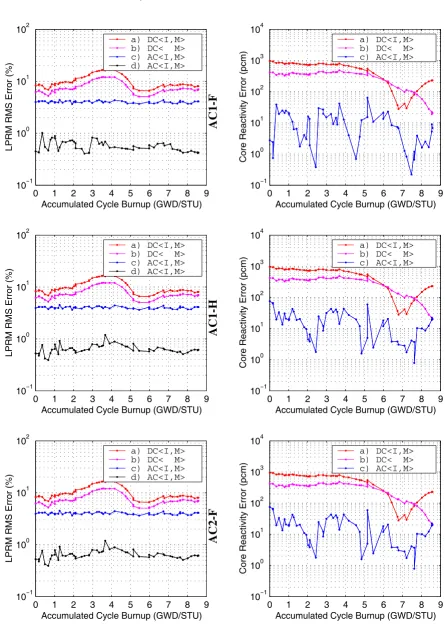
Abstract
ABDEL-KHALIK, HANY SAMY
.
Inverse Method Applied to Adaptive
Core Simulation
.
(Under the direction of Paul J. Turinsky).
The work presented in this thesis is a part of an ongoing research project
conducted to gain insight into the applicability of inverse methods to developing adaptive
simulation capabilities for core physics problems. Adaptive simulation is a simulation that
utilizes past and current reactor measurements of reactor observables (e.g. core reactivity
and incore instrumentation readings) to adapt the simulation in a meaningful way to
improve agreement with reactor observables. To perform such adaption, we utilize a
group of mathematical techniques which address the problem of given a current core
simulator model and the associated input data (e.g. cross-sections, thermal-hydraulic
parameters), how should the values of selected input data be adjusted to improve
agreement with observables without changing the core simulator model, (i.e. how can we
obtain the best agreement utilizing our current modeling capability). This is usually
referred to as an inverse problem, which is difficult to solve due to its ill-posedness nature.
Major advances have been made by mathematicians to overcome the ill-posedness nature
of such problems. The proposed project is of an exploratory nature serving to develop
expertise in this area, to which the nuclear power community has not participated to any
great extent over the last two decades since their earlier contribution during the design,
research and developments stages of a proto-typical fast breeder reactor. Exploratory
where little expertise is available, and to provide a basis on whether there is potential for
the proposed techniques to be useful and successful.
The current work addresses BWR core simulators since their prediction accuracy
is inferior to PWRs’, providing marginally acceptable agreement between measured and
predicted core attributes. This implies that BWRs could benefit from utilizing an adaptive
simulation tool. In the work done so far, a virtual approach has been utilized in which two
versions of a core simulator (i.e. FORMOSA-B) are utilized. The first one represents
actual plant data, and is referred to as the ‘virtual core’. In that version, the LPRM
readings and their associated instrumental noise have been simulated. The second one is
an altered version of the same core simulator, in which modeling and input data errors are
introduced to give rise to disagreement between the two versions of the core simulator,
and is referred to as the ‘design basis core simulator’. That disagreement is made to be of
the same magnitude as the actual disagreement which exists between plant data and
current core simulators in regard to LPRM readings and core criticality. The virtual core
observables at nominal conditions, including the noise component of the LPRM readings,
are then utilized to adapt the design basis core simulator. A larger set of virtual core
observables including those at nominal and various off-nominal core conditions, with and
without the noise signal, is then contrasted to those predicted by the ‘adapted design basis
core simulator’. Results indicate that the disagreement between the adapted design basis
core simulator and the virtual core can be decreased by an order of magnitude, indicating
the high fidelity and robustness of the adaptive techniques and that adaption can be
of this project. If successful in improving prediction fidelity when utilizing actual plant
data as the basis for adaption, this could lead to an increase in design margins and relaxing
of technical specifications, which will have a beneficial impact on reactor operation and
Inverse Method Applied to
Adaptive Core Simulation
by
Hany Samy Abdel-Khalik
A thesis submitted to the Graduate Faculty of
North Carolina State University
in partial fulfillment of the
requirements of the Degree of
Master of Science
Nuclear Engineering
Raleigh, North Carolina
2002
APPROVED BY:
ii
‘
Wisdom lies in Truth
’
iii
Biography
1
Hany S. Abdel-Khalik was born in Alexandria, Egypt on July 15th, 1978. He is the oldest of the five children of Samy I. Abdel-Khalik and Yousria M. Nourel-Deen. He
received his elementary education locally, graduating from Gamal Abdel-Naser High
School in 1995. He received his Bachelor of Science from Alexandria University in July
2000 from the department of Nuclear Engineering and he was the college valedictorian
that year. He was looking forward to continuing his graduate studies in the area of reactor
physics. Upon graduation, he had the wonderful opportunity to join the Electric Power
Research Center at North Carolina State University as a research assistant. Since the fall
of 2000 he has been working under the supervision of Dr. Paul J. Turinsky. He will
con-tinue his work on the project proposed in this thesis as a part of his PhD work. Hany holds
the ANS Allan F. Henry/Paul A. Greebler graduate scholarship, and is a recipient of the
ANS Reactor Physics Division best paper award at the Summer 2002 ANS national
meet-ing.
1. The author may be contacted at: Address: 1222 Burlington Labs,
North Carolina State University, P. O. Box 7909,
Raleigh, NC 27695-7909, USA.
iv
Acknowledgements
I would like to say thank you to many wonderful people in this very short space.
First, I thank my parents for their continuous support and strong will to provide for me the
best life possible. I also thank my siblings for their enormous love and self-sacrifice for
me. Dr. Mohamed E. Nagy has supported and encouraged me during my undergraduate
study, and to him I am indebted. I would like to thank my advisor Dr. Paul J. Turinsky for
giving me the chance to work on this wonderful project. His patience and support through
the first two years of my graduate study are very well appreciated. His innovative ideas
were among the main reason we won the ANS RPD best paper award. I have enjoyed the
insightful and intuitive discussions with Dr. Dmitriy Y. Anistratov and Dr. Carl D. Meyer.
I am very thankful to my uncle Dr. Said I. Abdel-Khalik; he has given me unconditional
support and care. His wife Sharon has given me invaluable advice. Finally, I thank Dr.
Youssef A. Shatilla for his recommendations and advice throughout my graduate and
v
Table of Contents
List of Tables . . . . vii
List of Figures . . . viii
Nomenclature . . . x
1. Adaptive Core Simulation. . . 1
1.1. Importance to Advanced and Current Reactors . . . 1
1.2. Description of Core Simulators . . . 3
1.3. Sources of Simulation Errors. . . 4
1.4. Adaptive Simulation Approach (Main Assumptions) . . . 5
1.5. Previous Development and Motivation for Adaptive Techniques. . . 6
1.6. Current Practice . . . 8
1.7. Inverse Problem . . . 10
1.7.1 Definition and Areas of Application . . . 10
1.7.2 Mathematical Description . . . 12
1.7.3 Ill-Posed Problems. . . 14
1.7.4 Regularization of Ill-Posed Problems . . . 15
1.8. Scope of Work . . . 16
2. Virtual Approach. . . 17
2.1. Description of the Virtual Approach . . . 17
2.2. Advantages of Virtual Approach Utilization . . . 18
2.3. Core Parameterization . . . 18
2.3.1 Thermal-Hydraulics Core Parameterization (Simulation of Modeling Errors) 19 2.3.2 Reactor Physics Core Parameterization. . . 20
2.4. Simulation of Input Data Errors. . . 23
3. Discrete Inverse Theory . . . 27
3.1. Objective . . . 27
3.2. Definitions . . . 28
3.2.1 Parameter Space. . . 28
3.2.2 Data (Observables) Space . . . 29
3.2.3 Linear Transformation . . . 29
3.2.4 SVD Decomposition . . . 30
3.2.5 Anatomy of Linear Transformation. . . 32
3.2.6 Reverse Transformation. . . 33
vi
3.2.8 Ill-posedness and Ill-conditioning . . . 36
3.2.9 Forward Problem . . . 39
3.2.10 Inverse Problem . . . 39
3.2.11 Measure of Distance . . . 39
3.2.12 Best Approximation. . . 41
3.2.13 Inner Product and Orthogonality . . . 43
3.3. Adapting the Core Simulator Model . . . 46
3.3.1 Model Linearization. . . 47
3.3.2 Least-Squares Approach . . . 48
3.3.3 Geometrical Interpretation of Least-Squares Solution and Its Deficiencies . . 50
3.3.4 Sources and Consequences of Ill-Conditioning. . . 52
3.3.5 Regularized Least Squares Problem . . . 54
3.3.6 Determination of the Regularization Parameters and Weighting Matrices . . . 56
3.3.7 Tuning of Adaptive Techniques . . . 58
4. Cases Studied, Results and Conclusions . . . 60
5. Future Work and Recommendations. . . 79
References . . . 83
Appendices. . . 88
A. Data Information Content . . . 89
vii
List of Tables
Table 2.1: Isotopics treated in the core simulator model. . . . 21
Table 2.2: Selected set of adjusted microscopic cross-sections. . . . 21
viii
List of Figures
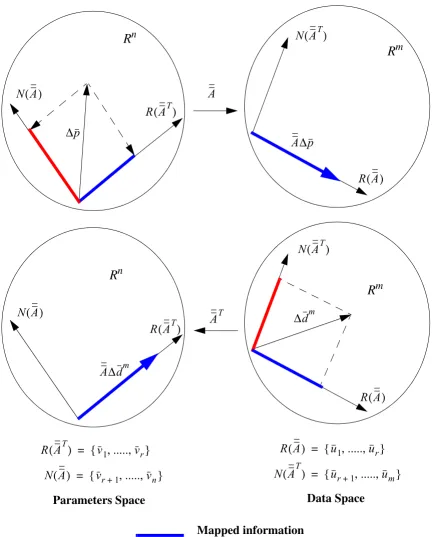
Figure 3.1: Mapping Information between Parameters and Data Spaces. . . 34
Figure 3.2: Notion of Best Approximation. . . 42
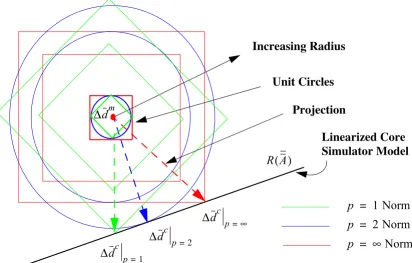
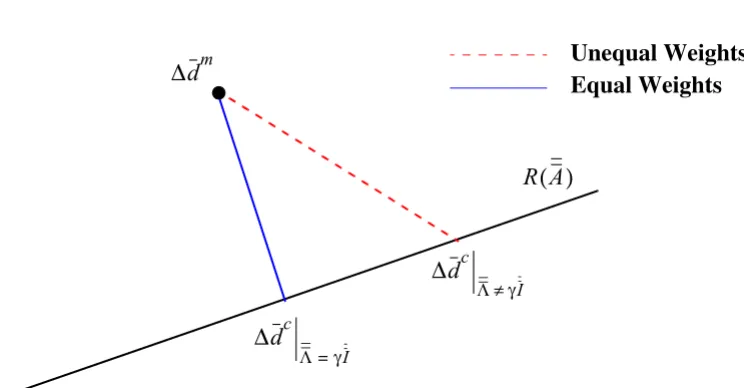
Figure 3.3: Projection of the Measured Observables onto the Linearized Core Model (Different Matrices). . . . 46
Figure 3.4: Inverse Mapping of Information in a ‘Discrete Ill-Posed System’. . . 53
Figure 3.5: Supplying A Priori Information about Model Parameters. . . . 56
Figure 4.1: Detectors’ Layout. . . 61
Figure 4.2: Control Rod Pattern For Core Follow Data. . . . 71
Figure 4.3: Detectors’ Signals Mismatch & Core Reactivity Error (Rated Conditions). 72 Figure 4.4: Simulated Core Follow Data at Rated Conditions, High Void and Low Void. . . 73
Figure 4.5: Detectors’ Signals Mismatch & Core Reactivity Error (High Void Fraction). . . . 74
Figure 4.6: Detectors’ Signals Mismatch & Core Reactivity Error (Low Void Fraction). . . 75
Figure 4.7: Detectors’ Signals Mismatch & Core Reactivity Errors (Different Criteria). . . 76
Figure 4.8: Detectors’ Signal Mismatch & Core Reactivity Errors.. . . 77
Figure 4.9: A Posteriori and A Priori Information About Model Parameters . . . 78
Figure 5.1: Road Map for Adaptive Core Simulation Project . . . 82
ix
Core Observables’.. . . 94
Figure B.2: Effect of Regularization on the Conditioning of the
Unconstrained Least-Squares Problem . . . 96
x
Nomenclature
Acronyms:
AC Adapted Design Basis Core Simulator.
BOC Beginning Of Cycle.
BWR Boiling Water Reactor.
CRH Control Rod History.
CRD Control RoD Insertion Branch Case.
DC Design Basis Core Simulator.
EOC End Of Cycle.
FP Fission Products Branch Case.
HFP Hot Full Power.
LPRM Local Power Range Monitors.
MWD Mega-Watt-Day
PWR Pressurized Water Reactor.
RMS Root Mean Square.
REF REFerence or Base Depletion Case.
STU Short-Tonnes-U, STU=1.1023113 MTU.
TIP Traveling Incore Probe.
TF Fuel Temperature Branch Case.
xi
Physical Symbols:
Void-quality concentration parameter.
Void-quality terminal velocity parameter.
Density of the vapor phase.
Density of the liquid phase.
Void fraction.
x Flow quality.
G Coolant mass flux.
Surface tension, microscopic cross-section or standard deviation.
Void-quality drift velocity parameter.
g Gravitational acceleration constant.
keff Core criticality eigenvalue.
Microscopic fast absorption cross-section.
Microscopic thermal absorption cross-section.
Microscopic fast fission cross-section.
Microscopic thermal fission cross-section.
Number of neutrons emitted per fission.
Energy emitted per fission.
C0 k3
ρg
ρg
α
σ
Vgj
σa1
σa2
σf1
σf2
v
xii
Variables’ Notations:
k Iterate number, (i.e. ).
m Measured Observables, (i.e. ).
c Calculated (e.g. predicted) Observables, (i.e. ).
Scalar quantity.
Vector quantity.
Matrix Operator.
pk
dm
dc
*
*
CHAPTER 1: ADAPTIVE CORE SIMULATION 1
1. Adaptive Core Simulation
1.1. Importance to Advanced and Current Reactors
The accurate prediction of core behaviour is a fundamental requirement to the design
and operation of any nuclear reactor system. That is achieved through the utilization of high
fidelity core simulators. Core simulators can be utilized in either an on-line or off-line mode.
In the online mode, they provide support for the successful control and protection of the
reactor. Control systems are required to determine the optimum trajectory in moving the
reactor from the current state to a final desired state with all operational and safety limits
satisfied. Protection systems are required to be capable of determining current and near-term
reactor states for a range of reactor conditions to advise reactor operators, or to automatically
activate safety systems to help take the appropriate actions to avoid and/or mitigate any
accident scenarios. Off-line core simulators are also as important during the design as well as
operational phases of the plant to determine the optimum operating core conditions (i.e. fuel
loading pattern, control rod programming, etc.). They are also utilized to interpret
experimental results.
The quality of core simulators’ predictions will impact the reactor economy through
the introduction of design margins on the core design to ensure an operation, in which the
safety and operational limits are satisfied[1]. How tight or relaxed these margins are depends
on how accurate the predictions of core behaviour are. The uncertainties of core simulators’
calculations are thus very crucial to the determination of these margins. Large uncertainties
will result in diminishing core design freedom and hence adversely impact economics. On the
CHAPTER 1: ADAPTIVE CORE SIMULATION 2
reactor economy such as reducing fuel and/or operating cost or even initial capital investment
for a new plant. By way of a few examples[2]: 1) By accurately calculating thermal limits, one
can reduce thermal margins, and be able to operate the reactor at higher power densities which
is economically more favorable (operating cost reduction). That translates into smaller sized
cores for new reactors (reduction in capital investment). 2) With more accurate calculations of
core reactivity for various states, one may be able to reduce the number of control rods
(reduction in capital investment), or reduce the U235 enrichment margin required in the fresh
fuel for the core to reach the desired cycle life at the desired rated power (reduction in fuel
cost).
High fidelity core simulators are hence essential components for any reactor system
during the design and/or the operational phases. To achieve, in the near term, this high level of
fidelity, dictated by economic, operational and safety considerations, will require high fidelity
and robust adaptive techniques[3]. Adaptive simulation techniques utilize past and current
reactor measurements of reactor observables to adapt the simulation in a meaningful way to
improve agreement with observable values. Fidelity denotes the ability of an adapted
simulator to accurately predict the measured observables. Robustness denotes the ability of
the adapted simulator to accurately predict measured core attributes which are not directly
observed, for example, the measured observables recorded at future times; and the observables
for core conditions that differ from those at which adaption is completed. Adaptive simulation
can also be useful in establishing a basis for deciding where future experimental efforts should
be focused to decrease core attributes’ uncertainties. That can be achieved by contrasting the
CHAPTER 1: ADAPTIVE CORE SIMULATION 3
the impact their adjusted values will have on different core attributes, the costs associated with
uncertainties on these core attributes, and the costs of experiments to reduce core attributes’
uncertainties. The need for adaptive simulation is viewed to be greater for Generation IV
versus Generation II and III reactors, since limited applicable experience will be available for
Generation IV reactors. Adaptive simulation can also be used to effectively interpret
experimental results done in the course of developing Generation IV reactors, help determine
the major causes of discrepancies between predicted and measured values, and hence help
direct how the experimental program should be designed to reduce the uncertainties in the
evaluation of the important parameters.
1.2. Description of Core Simulators
The behaviour of a nuclear reactor core is governed by the neutron flux distribution in
space, energy and time. One of the central problems of core simulation models is to accurately
predict this distribution. The core simulator model consists of models for both reactor physics
and thermal-hydraulics, which is necessary to account for the non-linear feedback
mechanisms through cross-sections. Typically, reactor physics behavior is modeled
employing few-group neutron diffusion theory, hydraulics behaviour is modeled employing
some 1-D approximate form of the Navier-Stokes equations (e.g. drift flux model), and the
thermal behavior is modeled using some approximate thermal model (e.g. functionalizing fuel
temperature as a function of linear power density).
Input data to the core simulator are enormous and determined by the needs of the
models employed within. Note that we include in input data, the coefficients that appear in
CHAPTER 1: ADAPTIVE CORE SIMULATION 4
thermal-hydraulic simulations require user input of core geometry as well as many empirical
parameters, such as local form loss coefficients and heat transfer coefficients. The input data
to the core simulator, in many cases, are determined using computer codes that model aspects
of the core physics in more detail than the core simulator models do, such as with the
determination of few-group homogenized cross-sections using lattice physics codes. So, in
general, the input data include any data directly passed to the core simulator or indirectly
through any preprocessor code.
Core observables include the readings of incore detectors (e.g. LPRMs and TIPs),
which are usually positioned throughout the core in between flow channels which do not have
control rods. Since core simulators are usually based on a steady state model and measured
observables are normally taken at steady state conditions, core reactivity could also serve as a
basis for adaption (e.g. at all times).
1.3. Sources of Simulation Errors
Core simulators introduce errors in the predicted core attributes, including core
observables, due to input data and computational (e.g. modeling) errors. Input data (e.g.
cross-sections and thermal-hydraulic parameters), whether they are experimentally measured or
theoretically calculated, contain uncertainties associated with their evaluation which are
described by standard deviation values reported as part of the data evaluation process.
Modeling errors occur due to different reasons: 1) The common practice in modeling is to
avoid sophistication by introducing approximations in the mathematical description to
simplify the treatment, that results in the introduction of errors in the calculations (i.e.
CHAPTER 1: ADAPTIVE CORE SIMULATION 5
diffusion versus transport theory calculations for the whole core). 2) Inadequacies in the
mathematical model utilized for simulating the core (e.g. failure to present all aspects of the
physics governing the core behaviour). 3) Numerical solution techniques’ approximations (i.e.
spatial domain discretization).
The pre-processing codes also introduce errors into the core simulator’s input data,
hence into the core simulator’s predictions of core attributes. This follows since, just like the
core simulator, errors exist in the input data to the pre-processor codes, in the mathematical
models of the physics, and in the numerical solution techniques employed in these codes.
Computational methods and input data uncertainties have always been the sources of
the limitation of nuclear calculations. In some instances, the computational uncertainties
dominate the sources of discrepancies, however, over the last few decades computational
methods have reached a stage of maturity in their sophistication and applicability.
Computational power has also increased considerably enabling the solution of bigger
problems in relatively shorter computer execution times. With the current status of models’
sophistication and huge experience obtained from power plants’ operations, we believe that
more attention should be directed towards input data errors and show how these data can be
adjusted using measured plant data to effectively reduce the disagreement between the
measured (e.g. core observables) and predicted core attributes.
1.4. Adaptive Simulation Approach (Main Assumptions)
Adaptive simulation is a mathematical algorithm which deals with given a
mathematical model of certain physical phenomena and the associated input (model
CHAPTER 1: ADAPTIVE CORE SIMULATION 6
input data, without adjusting the model, to reduce the disagreement between the measured and
predicted observables. The sources for the disagreement are either due to noise in the
measured output or simulation errors which, as described before, consist of modeling and
input data errors. Accordingly, it will be assumed that the dominant sources of errors in
predicted core attributes, including the core observables, originate due to errors in the input
data to the pre-processor codes and pre-processor codes’ independent input data to the core
simulator. That implies that input data will be adapted (e.g. adjusted) to improve the
agreement between predicted and measured observables, even though components of the
sources of disagreement are due to both input data and modeling errors. This assumption is
likely valid and also necessary in order to avoid the issue of simultaneous adaptation of the
core simulator’s models, since the combined adaptation problem of core simulator’s input data
and models is beyond current and foreseeable capabilities. However, a justification for that
assumption has to be investigated in this study by checking the fidelity and robustness of the
adaption.
1.5. Previous Development and Motivation for Adaptive Techniques
The art of data adjustment had been used extensively during the 1970s for fast
reactors’ experimentation. The data selected for adjustment were the cross-sections obtained
from differential experiments. The uncertainty level of the differential experiments’ evaluated
cross-sections did not meet the requirement for an accurate description of certain integral core
parameters, (i.e. breeding ratio[4] or keff eigenvalue). Uncertainty in the basic cross-section
data affects the uncertainty of the core integral parameters, which necessitate the introduction
CHAPTER 1: ADAPTIVE CORE SIMULATION 7
allowances result in cost increases and reduction from optimum core performance. Integral
experiments’ results were used in conjunction with differential experiments to adjust
cross-sections, in a hope that this will reduce the important core parameters’ uncertainties[5] .
Integral experiments are typically critical assemblies operating at zero power, in which a
small-scale mock-up of the large-scale core is built to mimic the reactor core behaviour as
much as possible in regards to composition and geometry.
The idea for the proposed work of adaptive core simulation stems from these past
experiences[6]-[11]; but, with two major differences: The first is that instead of using small
scale experiments to simulate the operation of the real reactor, one can use the full-scale
experiment, (e.g. real core), as one’s integral experiment. This is advantageous when
considering the huge amount of core follow data from our operating experience with current
power plants. However, the interpretation of these data is much more complex than the
“clean” integral experiments, since the quality of the data in uneven. For integral experiments,
the quality of the data is considered to be the same, since there are no depletion effects and no
thermal-hydraulic feed-back effects. However for a power plant, these effects are present,
transient phenomena might be occurring at anytime yet a steady state core model is employed,
and instrumentation may not be properly calibrated or failed. Those are examples of such
difficulties one might encounter when interpreting plant data.
The second difference is in the mathematical formulation of the problem. The problem
at hand can be treated as an “inverse problem”, which is an extremely difficult problem.
However, over the last four decades, since the early papers by Tikhonov in 1963[12]-[13],
inverse methods have been extensively developed on a solid mathematical basis and have
CHAPTER 1: ADAPTIVE CORE SIMULATION 8
advanced considerably using powerful inverse methods[14]. The nuclear power community
however has not participated to any great extent in these activities, in spite of their earlier
significant participation in the data adjustment area.
There are different issues and concerns that need to be analyzed when adjusting input
data. Reliability of the adjusted data denotes how well they will perform at different core
conditions and how consistent they are with the unadjusted data[15]. Uniqueness of the
adjustments denotes, would one obtain the same results if one starts from two different data
sets utilizing the same measured observables to adapt the core simulator? This type of analysis
can also help answer some other questions such as: 1) How well do the existing cross-section
or thermal-hydraulic data predict the core attributes of interest with the current modeling
capabilities? 2) How sensitive are certain core attributes to changes in the data, (i.e. use of an
alternative cross-section data set)? 3) How does one identify the sources/causes of
discrepancies between the core simulator’s predicted and measured core attributes?
Answering question (3) will provide direction to those areas of uncertainty where more
detailed experimental programs are required.
As a preable to the following discussion, note that the adaption approach we are
proposing to develop is for off-line application utilizing the observable data from many
different sources, including different reload cycles for the same nuclear power plant, different
nuclear power plants of the same type, and ultimately different types of nuclear power plants.
1.6. Current Practice
Very limited or no adaption is employed in current on-line core simulators, completed
CHAPTER 1: ADAPTIVE CORE SIMULATION 9
between measurements and predictions are usually fitted using surface response
methodologies and are used to predict the discrepancy between future predictions and
measurements. Similar versions of this approach were utilized during the course of fast
reactors experiments, and are referred to as “bias factor methods”[16]. The “bias operator
method” is another mathematically elegant tool that has also been proposed in the past as a
method for adaption[17]-[20]. Neither of these methods will be utilized in our work, since we
believe they do not have a physical justification. In the proposed work, however, the
adjustments are done to the input data in a mathematically consistent way in which the physics
of the problem is satisfied. That is achieved by first limiting the input data adjustments by the
uncertainty information, sometimes propagated through the pre-processors’ codes to the core
simulator to preserve the proper pre-processor codes’ core physics behaviour. In doing so, the
proposed adjustments will be consistent with their known uncertainties. Second, the input data
adjustments will be propagated through the core model satisfying the physics described by the
core simulator. Physical justification is required when adapting core input data, since if the
physics of the core are not satisfied, one would not be able to predict core behaviour at
different operating conditions than those adapted to, defeating the whole purpose of the
adaption. Third, the uncertainties in the core observables will be accounted for during the
adaption, assuming that the input data adjustments are consistent with the quality of the
CHAPTER 1: ADAPTIVE CORE SIMULATION 10
1.7. Inverse Problem
1.7.1 Definition and Areas of Application
From a mathematical point of view, the definitions of a direct problem and an inverse
problem are always ambiguous. This can be well illustrated by a frequently quoted statement
of J. B. Keller[22]: “We call two problems inverses of one another if the formulation of each
involves all or part of the solution of the other. Often, for historical reasons, one of the two
problems has been studied extensively for some time, while the other has never been studied
and is not so well understood. In such cases, the former is called the direct problem, while the
latter is the inverse problem.” So one of the two problems has been studied well, and the
physical model used to describe it is well understood and has been justified by experiments,
and usually is considered to be more fundamental than the other problem.
The notion of direct and inverse problems in engineering however can be described in
a more straightforward way[14],[21]. A forward problem can be defined to be the process in
which data are the output of some physical model, whose input are some physical parameters.
However, an inverse problem is one in which we are interested in estimating those parameters
on which the model depends, based on a prior knowledge of the data (the output of the
forward problem). From an experimental point of view, usually data are collected from any
system, to gain more information about the behaviour of that system, and if these data can be
described by a certain model we can predict the behaviour of that system under different
conditions. However, what we are interested in knowing is usually different from what we
measure, so, if we can use our mathematical model to extract information about what we want
CHAPTER 1: ADAPTIVE CORE SIMULATION 11
unknowns) are the quantities that one is trying to estimate. The matter of how to choose these
parameters is usually problem dependent and quite often somewhat arbitrary. The inverse
problem is however less suited to provide the fundamental mathematics or physics of the
model itself. The main role of the theory is to infer numerical information about unknown
parameters of the model and not the type of the model itself; so a good idea of the applicable
forward model must be available in order to take advantage of the inverse theory. For
example, inverse theory can not suggest a new void-quality equation form to calculate the
amount of voiding in a BWR core; however it can determine the best values for the parameters
associated with a given void-quality evaluation form. Possible goals of an inverse analysis
might include 1) estimates of a set of model parameters, 2) estimates of the bounds on the
range or acceptable model parameters, 3) estimates of the formal uncertainties in the model
parameters, 4) sensitivity of the solution to noise (or small change) in the data, 5)
determination of the best set of data suited to estimate a certain set of model parameters, 6) the
adequacy of the fit between the predicted and observed data, and 7) directions to decide
whether a more sophisticated model will be significantly better than a more simple one or not.
All these goals emphasize that inverse theory is not just used to determine the optimum values
for model parameters but also provides different criteria by which the quality of those
estimated parameters can be judged. It is to be noted, however, that a solution to an inverse
problem might contain not a “single” answer like a forward problem, so one of the parts of the
inverse analysis is the ability to determine which answer is reasonable, valid, and acceptable.
Inverse theory has found many applications in many different branches of physical
CHAPTER 1: ADAPTIVE CORE SIMULATION 12
and earthquake location determination, (c) satellite navigation, (d) molecular structure by
x-ray diffraction, and (e) medical tomography.
1.7.2 Mathematical Description
Inverse theory has been developed over the past four decades by scientists and
mathematicians having various backgrounds. This has resulted in presenting the theory in
many different ways[21], tending to superficially look very different in spite of the strong and
fundamental similarities that exist between them. Inverse theory can be derived from (1) pure
statistical concepts, (i.e. Bayesian decision analysis, and information content concepts), or
from more (2) deterministic ways which avoids mentioning terms like probability distribution
and prefer terms like inverse transformation, (i.e. minimum variance approaches). Inverse
theory can also be classified according to the type of both the model parameters and the
observed data by whether they are continuous functions or discrete values. The problem we
are interested in is a discrete-discrete problem, which means that both the data and the
parameter space are discrete or finite dimensional spaces. This will make our mathematical
analysis much easier than the general inverse theory. The reasons behind the finite
dimensionality of our problem is that our observables are instrument readings, and the
parameters we are looking for are ones associated with the thermal-hydraulic and reactor
physics model, (e.g. thermal property constants and cross-sections).
A discrete inverse problem is much simpler than the continuous one, since the
mathematical vehicle needed for the discrete case is linear algebra, and ideas like vector
spaces and matrix representation of linear transformations are sufficient to fully describe the
CHAPTER 1: ADAPTIVE CORE SIMULATION 13
techniques by vector space methods[23],[24]. For the continuous case, the problem gets much
more complicated and more abstract elements from the theory of functional analysis are
needed to describe the problem. Functional analysis abstracts our intuition about geometry of
ordinary vector spaces by merging linear algebra and analysis. The functional analysis
approach reveals itself to be tremendously more powerful and elegant than the linear algebra
approach. That leads some readers to hope that these elegant tools might help solve much
more complicated problems beyond the reach of the simple mathematical analysis provided by
linear algebra. Unfortunately, realization of such hopes is rarely encountered in practice. The
primary role of functional analysis is to unify and abstract our simple ideas about vector
spaces in a more mathematical and rigorous fashion.
In general, inverse theory can be described in a continuous form and then the special
discretization for the specific problem of interest can subsequently be introduced[25],[26].
However, since the problem of interest is a discrete one, the fully mathematical rigorous
treatment of the continuous inverse problem will be considered to be beyond the scope of this
work, and only the discrete inverse problem will be presented.
Inverse problems can be either under or over-determined. For the core simulator[3],
the problem is under-determined in that there are many more input data items that can be
adjusted than there are observables. Parametrization of the system is one way to recast the
problem from an under to over-determined one. Parametrization, within the context of our
application, is the process of characterizing core simulator data in terms of a minimal set of
parameters, which we shall refer to as core parameters. Care is required in the selection of
those parameters since improper choices made will be reflected in poorer fidelity and/or
CHAPTER 1: ADAPTIVE CORE SIMULATION 14
approach to determine the unknown core parameters, so as to minimize the differences in the
predicted and measured values of the observables. The weights can be selected to reflect the
uncertainties in both the observables and input data. This least squares problem will likely be
ill-posed or at least ill-conditioned.
1.7.3 Ill-Posed Problems
A problem is said to be ill-posed if it is not well-posed. According to the french
mathematician Jacques Hadamard[27], for a problem to be well-posed, the following three
conditions, within the context of the current application, must exist: 1) There is a solution for
the core parameters. 2) The solution for the core parameters is unique. 3) The values of core
parameters change smoothly with smooth changes in the values of the observables. Item (1) or
Item (2) if not satisfied is obviously troublesome in that either no or a non-unique solution for
the core parameters exists. Item (3) if not satisfied is troublesome since it implies that the
values of core parameters are highly sensitive to the values of observables. Given that
observables contain experimental errors, one cannot tolerate the high sensitivity associated
with Item (3). This item also has implications with regard to robustness of adaptation. The
mathematical distinction between a well- and an ill-posed problem is very clear. However, in
practice, when considering the discretization of the problem and the associated errors (noise)
in the measured observables, that distinction reveals itself to be less apparent. In some cases,
one cannot obtain an accurate, unique solution for a well-posed problem due to the finite
precision of the computations, forcing us to treat such problems as ill-posed. Further details
CHAPTER 1: ADAPTIVE CORE SIMULATION 15
1.7.4 Regularization of Ill-Posed Problems
In Hadamard’s opinion, an ill-posed problem does not have a physical meaning.
However, it turns out that an ill-posed problem can be extended to a well-posed one. That
extension is usually obtained by recognizing that the information supplied by the observables
about model parameters is not sufficient to give rise to a well-posed problem. Regularization
refers to the mathematical methods utilized to incorporate extra information about model
parameters necessary to recast an ill-posed problem into a well-posed one. An ill-posed
problem is regularized by either altering the mathematical model of the physical processes or
by restricting the space of the solutions allowed. The first technique of altering the
mathematical model will not be addressed in this study, since the intention is to enhance the
current models’ prediction accuracies without changing these models. Functionalization is one
manner of restricting the space of the solutions allowed to address ill-posedness, but many
times, is not adequate. Therefore, additional constraints may need to be applied to restrict the
solution space. There are many manners of performing regularization, ranging from those
based upon “energy” minimization approaches to those based upon Bayesian decision
analysis. A solid mathematical basis has been developed for unifying various regularization
approaches and understanding under what conditions regularization is effective[25]-[29].
Effective regularization methods factor in uncertainties in observables (measurements), a
priori and a posteriori knowledge of uncertainties in parameters to be adjusted, and robustness
of adaptation. The a priori and a posteriori information are the best available information
CHAPTER 1: ADAPTIVE CORE SIMULATION 16
1.8. Scope of Work
Our target is to reduce the disagreement between actual plant data and core simulators’
predictions of core attributes, however, at the current stage of project development, a virtual
approach is utilized to develop insight into the proposed adaptive techniques. Chapter 2
discusses this approach in details and briefly discusses the core simulator we employed in the
study (e.g. FORMOSA-B1). The selected core simulator’s parameterization is also presented.
Chapter 3 is devoted to introducing the discretized version of the inverse theory which has
been employed in our work. In chapter 4, some selected test cases associated with the virtual
approach are investigated to assess the adaptive techniques. Chapter 5 presents our
recommendations for further development in the area of adaptive core simulation.
CHAPTER 2: VIRTUAL APPROACH 17
2. Virtual Approach
2.1. Description of the Virtual Approach
As mentioned in the introductory chapter, this thesis presents elementary work
undertaken as a part of an exploratory project to develop adaptive simulation techniques
which will enhance the agreement between measured and predicted core attributes, including
core observables. Therefore, the main target in this work is to contrast the predictions of the
adapted core simulator to actual plant data, in an effort to assess and validate the proposed
techniques. However, since the project is still in its exploratory stages, a virtual approach will
be adopted for assessing the fidelity and robustness of the techniques. In this approach, the
actual plant data will be produced by an existing version of a core simulator, that will be
referred to as a virtual core, denoted by VC. Since the plant data consists of the readings of
incore detectors (i.e. LPRMs and TIPs signals), the virtual core will be used to simulate those
detectors’ responses, and in doing so the noise on those responses will also be simulated by
perturbing their signals from their simulated values by sampling them from a Gaussian
distribution of standard deviation of 0.04 of the average relative detectors’ response which is a
representative value of the actual instruments’ noise signals. Since adaptive techniques are
supposed to address and adjust for the different sources of prediction errors, an altered version
of the same core simulator will be used after deliberately introducing two major sources of
errors, specifically, in its modeling and in its input data. This version of the core simulator will
be referred to as the design basis core simulator, denoted by DC. The size of the introduced
errors in the DC will be chosen so as to create discrepancies between the predictions of the VC
CHAPTER 2: VIRTUAL APPROACH 18
the actual discrepancies found between real plant data and existing core simulators’
predictions. A representative value for the core reactivity prediction error is around
pcm, and the RMS error for relative detectors’ signals is about 6%. The
FORMOSA-B core simulator[30]-[32] was utilized to both generate the values of the
experimental observables and as the core simulator to be adapted.
2.2. Advantages of Virtual Approach Utilization
In contrast to utilizing operating power plant observables, the virtual core approach
has several attractive properties in regard to developing an adaptive core simulator
methodology, such as the following: 1) Knowing exactly the sources of errors in the method,
input data and observables. 2) Providing a basis to study the effects of the parametrization of
core simulator model on the fidelity and/or robustness of the adaptive simulator. 3) Having not
to contend with the complexities of core simulator and pre-processor introduced methods’
errors. 4) Being able to evaluate the prediction accuracies of non-observables (i.e. thermal
margins) obtained from pre- and post-adaptation.
2.3. Core Parameterization
This section presents a brief description of the core models and input data which were
perturbed and/or adapted in the virtual approach. In practice, as mentioned in the introductory
chapter, the input data to be adapted will be first functionalized in terms of core parameters to
render an over-determined problem. A detailed discussion of the parameterization selected in
CHAPTER 2: VIRTUAL APPROACH 19
2.3.1 Thermal-Hydraulics Core Parameterization (Simulation of Modeling Errors)
The first major source of prediction errors included in the virtual approach is the one
due to modeling errors. The modeling of voids in a BWR core has a large impact on the
prediction of different core attributes. Predictions of power distribution and reactivity are
known to be very sensitive to the moderator void (density) distribution. That necessitates the
utilization of a reasonably high fidelity void-quality correlation in order to predict core
attributes to a reasonable degree. Based on that fact, the void-quality correlation was elected
to be perturbed in the DC. The void-quality1 relationship is given by the form first identified
by Zuber-Findlay[33],
, (2-1)
where
. (2-2)
The DC utilized the Zuber-Findlay void-quality correlation in which two variables, the
concentration parameter (C0) and terminal velocity parameter (k3), were assumed spatially
independent throughout the core and given by their best known values,
(2-3)
Both variables were elected as input data to be adapted according to the relationship:
(2-4)
1. Refer to Moore’s PhD thesis for more details[32].
α x C0 x ρρg
l
---(1–x)
+ ρgVgj
G
---+
⁄ =
Vgj k3 (ρl–ρg) ρl2 ---σg
1 4⁄
=
C0 = 1.13 ; k3 = 1.41
CHAPTER 2: VIRTUAL APPROACH 20
where the factors represent the selected thermal-hydraulics core parameters
which are to be determined by the adaptive techniques, and are the adapted
void-quality constants utilized in the adapted design basis core simulator, denoted by AC, to
calculate the void fraction. The virtual core utilized the Lellouche-Zolotar EPRI
methodology[34] to determine C0 and k3, which can be thought of as using spatially
dependent C0 and k3. The purpose of this difference in functionalizing the void-quality
relationship between the VC and the DC is to investigate how well the adaptive technique will
perform when the functionalization of the data is not consistent with reality, and how an
adaptive technique can account separately for the combined sources of errors due to
inconsistent modeling and input data errors.
2.3.2 Reactor Physics Core Parameterization
The second major source of errors included in the virtual approach is the one due to
input data errors (e.g. hydraulics and reactor physics input data). The
thermal-hydraulics data in the current study consists of only the C0 and k3, coefficients of the
Zuber-Findlay void-quality correlation. The reactor physics input data consists of all types of
few-group homogenized fast and thermal microscopic cross-sections of all nuclides, included
explicitly or implicitly in the microscopic depletion model of the utilized core simulator (e.g.
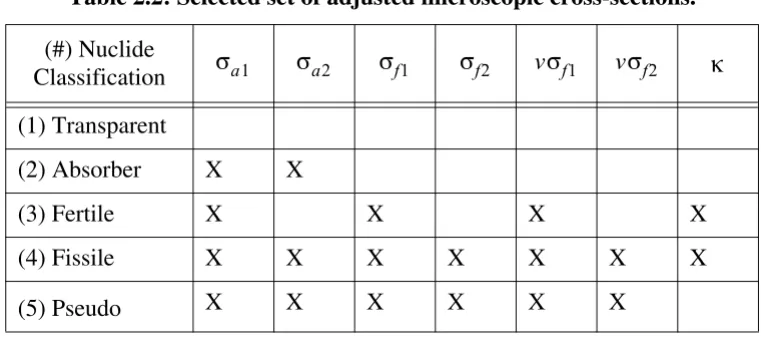
FORMOSA-B). Table 2.1 presents the set ( ) of all the fuel, burnable poison and pseudo
isotopes considered in the core simulator model, and Table 2.2 presents the corresponding
microscopic cross-section set ( ) selected for adjustment according to each nuclide’s
fc0
and fk3
C˜0 and k˜3
ζ
CHAPTER 2: VIRTUAL APPROACH 21
classification. The cross-section representation developed in FORMOSA-B[35] requires that a
number of ‘cases’ be generated at the lattice physics level. Base micro and/or macroscopic
cross-sections are obtained from a lattice physics unit assembly depletion at the nominal hot
full power (HFP) average core conditions at different vapor void fractions. From these base
depletions, branch cases are performed to capture the instantaneous effects of perturbing (#) Nuclide Classification
(X) Denotes a cross-section type that is adjusted.
Table 2.1: Isotopics treated in the core simulator model.
Treatment in Depletion
Model Element Element-Isotope (Classification)
Explicit Actinides
U-234(1), U-235(4), U-236(4), Np-239(1), U-238(3) Pu-239(4), Pu-240(4), Pu-241(4), Pu-242(4), Am-243(4)
Burnable
poisons Gd-154(2), Gd-155(2), Gd-156(2), Gd-157(2), Gd-158(2)
Implicit
Pseudo isotope
Represents background macroscopic cross-section(5) for ele-ments not directly included in the depletion model.
Table 2.2: Selected set of adjusted microscopic cross-sections.
(#) Nuclide Classification
(1) Transparent
(2) Absorber X X
(3) Fertile X X X X
(4) Fissile X X X X X X X
(5) Pseudo X X X X X X
CHAPTER 2: VIRTUAL APPROACH 22
different core conditions like fuel temperature, coolant void, and control rod insertion. This
requires that different branch case calculations be made at various exposures within the set of
the reference depletion exposures like fuel temperature decrease or increase, instantaneous
void fraction correction, and control rod insertion at HFP. The data read from these branch
cases along with the base depletions are used to model the local thermal-hydraulic feedback
and transient fission product feedback effects. The cross-section is constructed as the
summation of a reference and a set of correction terms given by:
, (2-5)
where the reference term is the first term on the R.H.S. and is a function of fuel exposure, and
instantaneous and history void fractions. The rest of the terms can be considered as correction
terms, the first one is a function of control rod history, second one represents fuel temperature
Doppler broadening effect, third one is due to fission products poisoning, and the last one
represents the instantaneous control rod insertion effect. The reference and the correction
terms are constructed using piece-wise cubic splines and quadratic fitting polynomials. A
reference or correction term k of a cross-section type j for a nuclide n in a fuel color c is given
by:
, (2-6)
where is a state variable describing the dependence of the specific cross-section reference or
correction term on different core conditions (i.e. fuel temperature, void fraction, etc.),
{ } are the polynomial coefficients calculated based on the lattice physics data, and are Σ = ΣREF+ΣCRH+ΣTF+ΣFP+ΣCRD
Σn j k c, , , (Bu) dn j k ci, , , (Bu) yi( )x
i=1
I
∑
=
x
CHAPTER 2: VIRTUAL APPROACH 23
functionalized in terms of the fuel exposure, Bu, and { } are polynomial functions. The base
or correction terms are adapted according to the relation:
(2-7)
where the factors are functionalized in terms of fuel exposure according to the
following relation:
(2-8)
with the factors representing the reactor physics core parameters which
are to be determined by the adaptive techniques, and is a scaling factor with exposure
units.
2.4. Simulation of Input Data Errors
The direct approach to simulate input data errors would be one in which each input
data from the set studied (e.g. and the lattice physics few-group homogenized
cross-sections library) is randomly selected from a normalized Gaussian distribution whose standard
deviation corresponds to the relative uncertainty for that specific input data. One can then
assume that the perturbed values are our current best knowledge of these data.
The uncertainty information is not directly available though, and to obtain it, one
would need to propagate the uncertainty information starting from an energy point-wise or
resonance parameters presentation like ENDF/B to a few group, spatially homogenized
yi
Σ˜n j k c, , , (Bu) fin j k c, , , (Bu)din j k c, , , (Bu) yi( )x
i=1
I
∑
=
fin j k c, , ,
fn j k ci, , , (Bu) fn j k ci,, , ,1 (1–fin j k c,, , ,2 )Bu
Bu˜
---+
=
fin j k c,, , ,1 ,fin j k c,, , ,2
{ }
Bu˜
CHAPTER 2: VIRTUAL APPROACH 24
presentation provided by most lattice physics codes. This is not a trivial task to do and requires
substantial calculational efforts. For that reason and for the sake of an exploratory
investigation, a cruder approach will be utilized. In this approach, the input data are
considered to be fully characterized by the selected core parameters1 (e.g. , and
{ }). To simulate input data errors in this cruder approach, each of the core
parameters will be randomly selected from a normalized Gaussian distribution whose standard
deviation is assumed now to be the same for all core parameters. A constant standard
deviation (1%) is selected, so as to give rise to discrepancies between the predictions (LPRMs
readings and core reactivity) of the VC and DC which are representative of the actual
magnitude of such discrepancies found between real plant data and existing core simulators.
After perturbing the core parameters in this fashion, the original input data can be represented
by:
(2-9)
where now the perturbed core parameters (e.g. , and { }) will be
assumed to constitute our best knowledge (e.g. the a priori information) about the input data to
simulate input data errors in the virtual approach.
Note that each of the reference and corrections terms are functionalized in terms of the
void fraction (through ), so when one is adapting the void-quality parameters and the
polynomial coefficients as well, one is explicitly correcting separately for the void-quality
1. Note that the unperturbed values for the selected core parameters are all equal to 1.0.
fc0
fk3 ,
fin j k c,, , ,1 ,fin j k c,, , ,2
Cˆ0 ˆfc0
C0; kˆ3 ˆfk3
k3; dˆin j k c, , , fˆn j k ci,, , ,1 (1–ˆfin j k c,, , ,2 )Bu
Bu˜
---+
d
i n j k c, , ,
= = =
f
ˆc0
f
ˆk3
, fˆin j k c,, , ,1 ,fˆin j k c,, , ,2
CHAPTER 2: VIRTUAL APPROACH 25
modeling error and the input data errors (to a first-order approximation). Consider a small
perturbation in all the core parameters, the resulting perturbation in the cross-section is given
by,
where to a first order approximation, is given by,
,
and hence,
.
However, if one is not adapting the void-quality correlation, the adjusted reactor physics core
parameters { } will be accounting both for input data and modeling errors as well, but
only for those specific core conditions at which the adaption was completed (e.g. certain core
average void fraction). That could lead to a less robust adaption when trying to predict core
behaviour at different core conditions. This issue will be investigated in the study to show how
powerful the adaption can be utilized to separately adjust for the different sources of
prediction errors and give insight to situations when adaption is performed on the wrong input
parameters.
Σn j k c, , , +∆Σn j k c, , , (fin j k c, , , +∆fin j k c, , , )dn j k ci, , , (yi( ) ∆x + yi( )x ) i=1
I
∑
=
∆yi( )x
∆yi( )x
fc0 ∂
∂ y
i( )∆x f c0
fk3 ∂
∂ y i( )∆x f
k3 +
=
∆Σn j k c, , , fin j k c, , , din j k c, , , fc0 ∂
∂ y i( )∆x f
c0 =
fin j k c, , , din j k c, , , fk3 ∂
∂ y i( )∆x f
k3
+
yi( )x din j k c, , , ∆fin j k c, , ,
i=1
I
∑
+
CHAPTER 2: VIRTUAL APPROACH 26
To simplify the adaption, dependencies of the reactor physics core parameters
{ } will be restricted to nuclides (n) and reactions types (j) with dependencies on
correction terms (k), fuel colors (c) and fitting polynomials (i) dropped. In reality, correction
terms are expected to be dependent upon branch cases and fuel color, since the unit lattice flux
energy and spatial shapes are dependent upon these attributes. Hence, the few-group
homogenized cross-sections errors are also dependent on different branch cases and fuel
colors. As this project moves forward, more sophistication will be introduced. Even with this
simplification, a total of 108 core parameters were free to adapt.
CHAPTER 3: DISCRETE INVERSE THEORY 27
3. Discrete Inverse Theory
3.1. Objective
The applications of the inverse theory are diverse and include many areas of science;
however, the emphasis in this work will mainly be on core physics problems. Most of the
introduced nomenclature, notations and examples are selected specifically to serve our
application. Minor modifications are required to generalize the methods and discussion to
other areas of interest. The subject of the generalized inverse theory is very mathematical in
nature and most of the ideas need extensive rigor and mathematical abstraction to be
comprehensively and concisely presented. The mathematical tools necessary for our work will
be presented; however, the discussion will not be highly mathematical and is not intended to
be neither comprehensive nor complete. The intent is to present the more intuitive ideas
behind the utilization of these tools rather than the more abstract mathematical rigor. We
choose to do this for three reasons: 1) The more extensive and rigorous treatment of the
subject is already well established in the literature and stands on a very firm basis[25]-[26], so
it would be redundant to reproduce these mathematical results in this work even in part. 2) We
believe in a more realistic illustration of the abstract mathematical ideas, and that heavy
abstraction serves to generalize rather than to develop our understanding about certain
phenomena. Hopes for solving more complicated problems by utilizing the abstract and more
complicated version of the theory are rarely encountered in practice. 3) Our work is intended
primarily for engineers rather than for mathematicians. For these reasons, the concepts are
emphasized more than the technicalities in order to avoid confusion. Narrative discussions and
CHAPTER 3: DISCRETE INVERSE THEORY 28
However, to avoid a speculatory type discussion, an extensive bibliography will be referenced
to support the discussion whenever necessary.
The discussion will be confined to the discrete linear inverse theory. This implies that,
in order to apply the theory, we will need to linearize the core simulator model and employ an
iterative strategy to search for the optimum core parameters’ values. Almost every problem in
discrete inverse theory can be recast into an optimization problem, where a function must be
minimized subject to various constraints. Optimization techniques for discrete problems can
best be described by vector space methods since the whole theory can then be derived from a
few simple, intuitive and geometric relations. A large number of problems can be analyzed
utilizing those simple relations. The texts by Luenberger[30] and Dorny[24] present
comprehensive and insightful approaches to optimization methods using vector space
methods.
3.2. Definitions
In this section an informal survey of some of the essential definitions, within the
context of our application, is introduced[21],[36].
3.2.1 Parameter Space
The parameter space is defined as the vector space whose elements represent the set of
core parameters we are trying to estimate. Let n be the number of such parameters, and a
vector of dimension n which lies in the parameters space ( ) and denotes the core
parameters.
∆p
CHAPTER 3: DISCRETE INVERSE THEORY 29
3.2.2 Data (Observables) Space
The data space is defined as the vector space whose elements are the values of the core
observables. Let m be the number of such observables, and let be vectors of
dimension m which lie in the data space ( ) and denote the measured and
predicted (calculated) observables, respectively1.
3.2.3 Linear Transformation
A function that associates with every point in the parameters’ space a
point in the data space is said to be linear if it satisfies the following condition,
(3-10)
where . The action of a linear function is referred to as a linear transformation
which can be characterized by a matrix operator . One can visualize the operation of such a
transformation from different view points. Meyer[37] presents one such rigorous and
insightful discussion of the subject. Linear transformation is the process in which each point
in the parameters space is mapped to a unique point in the observables
space, this unique correspondence determined by the matrix , where and can be
described by,
1. The notations are enforced here to avoid introducing extra notations later in the discussion since the linearization of the core simulator model will require the utilization of these notations. nota-tion denotes the difference between the variable of interest (e.g. core parameters or observables) and some reference value.
∆dm and ∆dc
Rm ∆dm,∆dc∈Rm
∆
∆
Ψ ∆p∈Rn
∆dc∈Rm
Ψ α( 1∆p1+α2∆p2) = α1Ψ ∆( p1) α+ 2Ψ ∆( p2) for all scalars α1 and α2
∆p1,∆p2∈Rn
A
∆p∈Rn ∆dc∈Rm
CHAPTER 3: DISCRETE INVERSE THEORY 30
. (3-11)
3.2.4 SVD Decomposition
To gain more insight into the anatomy of such a transformation, the SVD
decomposition of the matrix is introduced[38]-[40]. Any matrix has an
orthogonal decomposition such that,
, (3-12)
where and are orthogonal matrices (their columns constitute orthonormal bases for the
spaces and , respectively). The columns of and are called the left and right
singular vectors of the matrix . is a diagonal matrix containing the singular values of the
matrix . These matrices are given by,
,
,
where
,
, ∆dc = A∆p
A A∈Rm n×
A = USVT
U V
Rm Rn U V
A S
A
Um m× = u1 u2 ... um , Vn n× = v1 v2 ... vn
Sm n×
σ1 σ2
.. σr
0 ..
0 .. 0 =
uiTuj= δij for 1≤i j m, ≤