ISS N(Online): 2320-9801 ISS N (Print): 2320-9798
I
nternational
J
ournal of
I
nnovative
R
esearch in
C
omputer
and
C
ommunication
E
ngineering
(An ISO 3297: 2007 Certified Organization)
Vol. 3, Issue 4, April 2015
The Learning Method of Speech Recognition
Based on HMM
Vidwath R Hebse
1, Anitha G
2Student, Dept. of CSE, UBDTCE, VTU, India
Associate Professor, Dept. of CSE, UBDTCE, VTU, India
ABSTRACT: This paper helps to improve the student’s interest towards speech recognition. It imp le ments Automatic Speech Recognition System based on the following : Preprocessing, Feature Extraction Technique (MFCC- Me l Frequency Cepstrum Coeffic ients) and Hidden Markov Model (used in recognition phase) .Its purpose is that the human voice can be converted to a computer-readable input, Such as buttons, binary-coded, or sequence of characters. Acoustic phonetic approach, Knowledge based approach and Pattern re cognition approach are the three approaches used in speech recognition. In this paper Pattern recognition technique is used. This approach requires no explic it knowledge of speech. This approach has two steps – namely, train ing of speech patterns based on some generic spectral parameter set and recognition of patterns via pattern comparison.
KEYWORDS:Automatic Speech Recognition (ASR), HMM mode l, M FCC-Mel Frequency Cepstrum Coefficients
I. INTRODUCTION
Co mmunicating with a machine in a natural mode such as speech brings out not only several technological challenges, but also limitations in our understanding of how people communic ate so effortlessly. The key is to understand the distinction between speech processing (as is done in human commun ication) and speech signal processing (as is done in a machine). When people listen to speech, they apply their accumulated knowledge of spee ch in relation to a language to capture the message. The language is unique to humans; it is the most basic form of human transmission of information. As the development of co mputer technology, communicat ion between people and computers become more e xtensive and in-depth, so that the computer can understand human language, is not only a cherished ideal of mankind since the birth of the computer, but also an important research direction of mu ltip le disciplines.
Real time continuous speech recognition is a computationally demanding task, and one which tends to benefit fro m increasing the available co mputing resources. A typical speech recognition system starts with a preprocessing stage, which takes a speech waveform as its input, and extracts from it feature vectors or observations which represent the informat ion required to perform recognition. This stage is efficiently performed by software. The second stage is recognition, or decoding, which is performed using a set of phoneme -leve l statistical models called hidden Markov models (HMMs). Word-level acoustic models are formed by concatenating phone-level models according to a pronunciation dictionary. These word models are then comb ined with a language model, which constrains the recognizer to recognize only valid word sequences.
II. LITERATURE S URVEY
ISS N(Online): 2320-9801 ISS N (Print): 2320-9798
I
nternational
J
ournal of
I
nnovative
R
esearch in
C
omputer
and
C
ommunication
E
ngineering
(An ISO 3297: 2007 Certified Organization)
Vol. 3, Issue 4, April 2015
In [2]authors present a research method to directly recognize greeting voice without segmentation to avoid error recognition because of error segmentation. The basic principle of b io metric pattern recognition is applied to speaker-independent and continuous speech recognition of greeting. The high -dimension space covering theory is applied to the learning process of speaker-independent and continuous speech recognition of greeting during the construction of voice pattern. And the dynamic search method of high -dimensional space covering is imp le mented on the dynamic search of continuous speech of greeting to recognize it. So me satisfactory recognition results are obtained by experiment.
In [3] authors proposed Robust Features for Noisy Speech Recognition using MFCC Co mputation from Magnitude
Spectrum of Higher Order Autocorrelation Coeffic ients. Noise robustness is one of the most challenging proble ms in automatic speech recognition. The goal of robust feature ext raction is to imp rove the performance of speech recognition in adverse conditions. The me l-scaled frequency cepstral coefficients (MFCCs) derived fro m Fourier transform and filter bank analysis are perhaps the most widely used front -ends in state-of-the-art speech recognition systems. One of the major issues with the MFCCs is that they are very sensitive to additive noise. To improve the robustness of speech front-ends we introduce, in this paper, a new set of MFCC vector which is estimated through three steps. First, the relative higher order autocorrelation coeffic ients are extracted. Then magnitude spectrum of the resultant speech signal is estimated through the fast Fourier transform (FFT) and it is diffe rentiated with respect to frequency. Finally, th e diffe rentiated magnitude spectrum is transformed into MFCC -like coeffic ients. These are called M FCCs e xtracted fro m Diffe rentiated Re lative Higher Order Autocorrelation Sequence Spectrum (DRHOASS). Speech recognition e xperiments for various tasks indicate that the new feature vector is more robust than traditional mel -scaled frequency cepstral coeffic ients (MFCCs) in additive noise conditions.
III. HMM-B AS ED SPEECH RECOGNITION
A. Principle and System for Speech Recognition (AUTOMATIC SPEEC H REC OGNITION)
Vo ice recognition technology, also known as automatic speech recognition (ASR), its purpose is that the human voice can be converted to a computer-readable input, Such as buttons, binary-coded, or sequence of characters. Speech recognition, is different from speaker recognition, Speaker Recognition is not to identify words which is in the vocabulary content.[1] Speech recognition systems usually assumed that the voice signal is encoded into one or a plurality of symbol sequence of the information entity. In order to achieve the reverse operation, namely to identify the sequence of symbols of a given speaker's voice, the first continuous speech waveform is converted into a long discrete parameter vector sequence. Assuming that the sequence of this parameter vector is a speech waveform accurately represented in a vector corresponding to the period of time (typically, 10ms and so on), the voice signal can be regarded as smooth. This characteristic can be used to good description of the HMM. The concept of the Markov model is a discrete-time do main finite state automata, hidden Markov model HMM refers to the internal state of this Markov model is not visible to the outside world, the outside world can only see the output value of each moment. The acoustic characteristic of the speech recognition system, the output value is usually calculated fro m the respective fra mes. HMM portrayed speech signal the need to make two assumptions, one internal state of the transfer is only re lated to a previous state, and the other is that the output value is only re levant to the current state (or the current state of the transfer), these two assumptions greatly reduced the model co mple xity.
ISS N(Online): 2320-9801 ISS N (Print): 2320-9798
I
nternational
J
ournal of
I
nnovative
R
esearch in
C
omputer
and
C
ommunication
E
ngineering
(An ISO 3297: 2007 Certified Organization)
Vol. 3, Issue 4, April 2015
A.1 Pre-e mphasis:
In order to flatten speech spectrum, a p re-e mphasis filter is used before spectral analysis. Its aim is to co mpensate the high-frequency part of the speech signal that was suppressed during the human sound production mechanis m.
A.2 Frame Blocking and Windowing:
The speech signal is divided into a sequence of frames where each fra me can be analyzed independently and represented by a single feature vector. Since each fra me is supposed to have stationary behavior, a co mpro mise, in order to make the fra me blocking, is to use a 20-25 ms window applied at 10 ms intervals (fra me rate of 100 fra mes/s
and overlap between adjacent windows of about 50%), as Ho lmes & Holmes e xposed in 2001. In o rder to reduce the
discontinuities of the speech signal at the edges of each fra me, a tapered window is applied to each one. The most common used window is Ha mming window[2].
Speech Endpoint Detection
In the process of speech recognition, When the system receives a signal containing voice, system will detect and locate speech endpoint, removal of e xcess noise before and after the speech, Co mplete voice will be submitted to the next level recognition. Vo ice endpoint detection algorithm is ma inly base d on the energy of the voice,zero crossing rate, LPC coeffic ients, information entropy, cepstral, band variance and so on. The endpoint detection effects and the actual environmental noise has a great relationship, Therefore, the endpoint detection of pre -denoising can improve the recognition rate. We introduce a traditional detection methods based on short -term energy, short-time zero-crossing rate.
Characteristic Parameter Extraction
ISS N(Online): 2320-9801 ISS N (Print): 2320-9798
I
nternational
J
ournal of
I
nnovative
R
esearch in
C
omputer
and
C
ommunication
E
ngineering
(An ISO 3297: 2007 Certified Organization)
Vol. 3, Issue 4, April 2015
(2)Good independence between the order parameter;
(3)The characteristic para meters have an efficient method of calcu lating.
A.3 Mel-Cepstrum
Davis & Merme lstein (1980) pointed the Mel Frequency Cepstrum6 Coefficients (MFCC) representation as a beneficia l approach for speech recognition (Huang et al., 2001).[3] The MFCC is a representation of the speech signal defined as the real cepstrum of a windowed short-time signal derived fro m the FFT of that signal (Huang et al, 2001) which, is first subjected to a log-based transform of the frequency axis (me l-frequency scale), and then decorrelated using a modified Discrete Cosine Transform (DCT-II). Figure illustrates the complete process to extract the MFFC vectors from the speech signal. It is to be emphasized that the process of MFCC e xt raction is applied over each fra me of speech signal independently.
MFCC e xtraction process
After the pre-emphasis and the frame blocking and windowing stage, the MFCC vectors will be obtained from each speech fra me. The process of MFFC e xt raction will be described below considering in any instant that all the stages are being applied over speech frames.
The first step of MFCC e xt raction process is to compute the Fast Fourier Transform (FFT) of each fra me and obtain its magnitude. The FFT is a computationally effic ient algorith m of the Discrete Fourier Transform (DFT). If the length of
the FFT, is a power of two (K=2n), a faster algorithm can be used, so a zero-padding to the nearest power of two within
speech fra me length is performed.
The next step will be to adapt the frequency resolution to a perceptual frequency scale which satisfies the properties of the human ears (Molau et al., 2001), such as a perceptually me l-frequency scale. This issue corresponds to Mel filterbank stage.
ISS N(Online): 2320-9801 ISS N (Print): 2320-9798
I
nternational
J
ournal of
I
nnovative
R
esearch in
C
omputer
and
C
ommunication
E
ngineering
(An ISO 3297: 2007 Certified Organization)
Vol. 3, Issue 4, April 2015
B. HIDDEN MARKOV MODELS
B.1 Introduction
The Hidden Markov model (HMM) is a very powerful mathemat ical tool for modeling time series. It provides efficient algorith ms for state and parameter estimation, and it automatically performs dynamic time warping for signals that are locally squashed and stretched. It can be used for many purposes other than acoustic modeling.
B.2 Mark ov Chains
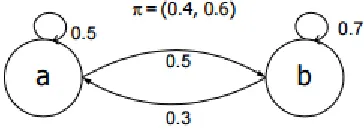
Hidden Markov models are based on the well-known Markov chains from probability theory that can be used to model a sequence of events in time. Figure belo w shows such a graphical network representation of such a model, it has two states a and band some connections indicated by arrows that show how one can get from one state to another The topology of the network shows an important property of Markov chains, name ly that the next state only depends on the current state the model is in, regardless of how it got in the current state; this property is often referred to as the Markov property. By starting in one of the two states and at each time step moving through the model fo llo wing the arrows out of the current state to the other state or once again to the same state, sequences of a’s and b’s can be generated[4].
Fig 1: A Markov Cha in
The arrows leaving a state are annotated with a probability that indicates how like ly it is that this particular transition out of the state will be chosen. As a transition has to be made the probabilities associated with all a rrows leaving a state should sum to one. The distribution π indicates how likely each state is to be the start state, in Figure 1 both states are equally like ly to be the start state. Using these probabilit ies a Markov model can be used for recognition. Imagine that we have two processes that produce outputs that can be encoded as sequences of a’s and b’s and each of these processes can be modeled by a Markov model, the one fro m Figure 1 and the one fro m Figure 2.
If we now receive for e xa mp le a sequence abba we can calculate for each model the probability that it generated this sequence by simp ly mult iplying the probabilities along the path that corresponds to the sequence 2 .
Probability model 1: 0.5 •0.3 •0.6 •0.4 = 0.036 Probability model 2: 0.4 •0.5 •0.7 •0.3 = 0.042
After wh ich we may conclude that the output is most like ly to be generated by the second process.
Fig 2: A second Markov model
ISS N(Online): 2320-9801 ISS N (Print): 2320-9798
I
nternational
J
ournal of
I
nnovative
R
esearch in
C
omputer
and
C
ommunication
E
ngineering
(An ISO 3297: 2007 Certified Organization)
Vol. 3, Issue 4, April 2015
scoring decoding algorith m and corresponding training forwa rd algorith m, Vite rbi a lgorith m and fo rwa rd-backwa rd algorith ms.
C. PROCESSES AND IMPLEMENTATION
HMM is one of the ways to capture the structure in this sequence of symbols. In order to use HMMs in speech recognition, one should have some means to achieve the follo wing:
Evaluation: Given the observation sequence O = (o1, o2, …,ot) and a HMM λ = (A,B, π) to choose a corresponding
state sequence Q = q1, q2,…,qtwhich optima l in some mean ingful sense, given the HMM.
Training: To adjust the HMM parameters λ = (A,B, π) to maximize P(O | λ).
The following are some o f the assumptions in the Hidden Markov Modeling for speech.
Successive observations (frames of speech) are independent and therefore the probability of sequence of observation
P = (o1, o2, …,ot) can be written as a product of probabilities of indiv idual observations, i.e . O = (o1, o2, ….ot)=
𝑃𝑇 𝑖 (Oi)
Markov assumption: The probability of being in a state at time t, depends only on the state at time t-1.
The proble ms associated with HMM are e xp lained as follows:
(a) Eval uation: Evaluation is to find probability of generation of a given observation sequence by a given model. The recognition result will be the speech unit corresponding to the model that best matches among the different competing models. Now to find P(O | λ), the probability of observation sequence O = (o1, o2, …,ot) given the model λ i.e. P(O | λ).
(b) Decodi ng: Decoding is to find the single best state sequence, Q = q1, q2,…,qt, for the given observation sequence O
= (o1, o2, …,ot). Consider δt(i) defined as
that is δt(i) is the best score along single path at time t, which accounts for the t observations and ends in state i. by
induction,
(c) Tr aining (Le arning): Learning is to adjust the model parameters (A, B, π) to maximize the probability of the
observation sequence given the model. It is the most difficult task of the Hidden Markov Modeling, as there is no known analytica l method to solve for the para meters in a ma ximu m like lihood model. Instead, an iterative procedure should be used. Bau m-Welch algorith m is the extensively used iterative procedure for choosing the model para meters. In this method, start with some in itia l estimates of the model para meters and modify the mode l para meters to ma ximize the training observation sequence in an iterative manner t ill the model para meters reach a crit ical va lue.
(d)Identification
Use the Viterbi a lgorith m to dynamically find the hidden Markov model state transition sequence (ie identify the results), the time co mple xity is far less than the total probability formu la.
ISS N(Online): 2320-9801 ISS N (Print): 2320-9798
I
nternational
J
ournal of
I
nnovative
R
esearch in
C
omputer
and
C
ommunication
E
ngineering
(An ISO 3297: 2007 Certified Organization)
Vol. 3, Issue 4, April 2015
IV. CONCLUS ION
The conclusion of this study of recognition and hidden markov model has been carried out to develop a voice based user machine interface system. In various applications we can use this user machine system and can take advantages as real interface, these application can be related with disable persons those are unable to operate computer through keyboard and mouse, these type of persons can use computer with the use of Automatic Speech Recognition system, with this system user can operate computer with their own voice commands (in case of speaker dependent and trained with its own voice samp les). Second applicat ion for those computer users which are not co mfortable with English language and feel good to work with their native language i.e. English, Kannada, Hindi
REFEREC ES
[1] R.Cardin, Y. Normadin and E. Millen, Inter-word coarticulation modeling and MMIE training digit recognition, ICASSP, p243-246-199. [2] Hong Ye,Youzheng Zhang and Jianwei Shen Study on Speech Recognition of Greeting Based on Biometric Pattern Recognition.
[3] Amita dev and Bansal poonam , Robust Features for Noisy Speech Recognition using MFCC Computation from Magnitude Spectrum of Higher Order Autocorrelation Coefficients.
[4]Mingjia An,Zhengtao Yu, Jianyi Guo , The Teaching Experiment of Speech Recognition based on HMM. [5] Ir. P. Wiggers, Dr. drs. L.J.M. Rothkrantz, AUTOMATIC SPEECH RECOGNITION USING HIDDEN MARKOV MODELS. [6] Noelia Alcaraz Meseguer, Speech Analysis for Automatic Speech Recognition .