BILATERAL. ASYMMETRY AND ITS RELATION TO CERTAIN PROBLEMS OF GENETICS
F. B. SUMNER AND R. R. HUESTIS Scrijjs Institution, La Jolla, California
Received March 28, 1921
TABLE OF CONTENTS
Inherited and non-inherited deviations from bilateral symmetry.
...
445Specificity of transmission in respect to the side affected.
...
447The inheritance of asymmetry per se with no agreement between corresponding sides of the body in related individuals.
...
451The non-inheritance of asymmetry in the case of a single or paired structure or abnor- mality, the latter in itself being inherited.
...
452Discussion.
...
456Non-inherited deviations from symmetry and the theory of multiple factors.
...
463Studies of the mandible.
...
466The femur..
...
470Femur length.. ... 471
Thepelvis..
...
477Discussion.
...
478SUMMARY..
...
,
...
482LITERATURE CITED.
...
484Femur weight. ... 475
INHERITED AND NON-INHERITED DEVIATIONS FROM BILATERAL SYMMETRY
446 F. B. SUMNER AND R. R. HUESTIS
among the vertebrates alone, the birds have but a single functional ovary, the left, while in the snakes the left lung is greatly reduced. The flounders lie upon one side, which may be either the right or the left, but in most cases this is the same in all members of the species. Extensive structural differentiation has arisen among these fishes in connection with this habit. Certain cetaceans have conspicuous asymmetry in the structure of the skull. I n all of the true vertebrates, including man, there are marked asymmetries of a constant character, affecting the internal organs, par- ticularly the digestive and circulatory systems. Finally, in man, we have the familiar functional differentiation of the right and left fore-limbs, accompanied by a no less marked functional differentiation of the two sides of the brain. Less evident, though quite measurable, structural differen- tiations are to be found in the bones of the two sides of the skull, of the fore-limbs, and perhaps also of the hind-limbs.
That all these cases of normal asymmetry are hereditary in a real sense hardly needs argument. The sole alternative explanation, namely, that they are due to environmental influences which affect the two sides un- equally, and which are repeated generation after generation, needs only to be stated in order to be refuted. The absurdity of such an explanation is most evident in those cases, e.g., the bony fishes-in which no intra-uterine development occurs. It may be true that much of this asymmetry arises during development as a result of the mutual pressure of the various parts, but it must, a t the outset, have a germinal basis. As to the “mode of inheritance,” in the Mendelian sense, of these cases of fundamental struc- tural asymmetry we know practically nothing. Indeed it is not a t all clear at present how far the Mendelian principles of segregation, dominance, etc., apply to the normal ground-plan of organization. We shall discuss this phase of the subject later.
BILATERAL ASYMMETRY 447
I n investigating the inheritance of such cases of asymmetry, three possible alternatives should be borne in mind. (1) We might have the specific transmission either of the same unilateral character on the same side, or a t least of corresponding inequalities in size in the case of paired structures.
(2) We might find the asymmetry or lack of balance alone to be inherited, without there being any agreement between parents and offspring as to which side was better developed. (3) The structure or abnormality in question might itself be inherited, even as to varying grades in size or weight, yet there might be no inheritance in respect to its relations to the axis of symmetry.
After a considerable search for previously recorded data and a careful study of our own, it seems evident to us that each of these three modes of
inheritance is realized in different cases, and that no general law can be formulated to cover all characters of all organisms. I n certain cases, there seems to be an undoubted specificity in the transmission both of the char- acter and of its position as Ieft or right; in certain others, the mere asym- metry or lack of balance is transmitted, without reference to the side of the body; in others yet, the structure or structures themselves may be transmitted, though departures from symmetry either in size or position seem to be strictly non-hereditary. We shall proceed to give a few illus- trations of each of these conditions.
Specijcity of transmission
i~
respect to the side afectedThe available data are derived mainly from incidental mention of such cases by various writers. It is surprising that so few geneticists have recognized a distinct problem here.
448 F. B. SUMNER AND R. R. HUESTIS
cited by him (loc. cit., p. 451), of a father “who lost his left eye by inflam- mation fifteen years before he was married, and who had two sons with left eyes malformed (microphthalmic) .” The point of present interest is the statement that the defect in each of these cases was on the same side among all the related individuals.
WEISMANN (1893, p. 55) also states: “ I know of a family in which a de- pression of the size of a pin’s head in the skin in front of the left ear has been transmitted through three generations.’’
A similar and much more recent case is that reported by SCHOFIELD (1917, p. 517), of “ a family in which a bilobed ear has been transmitted through four generations,‘ and in which “only the right ear shows the characteristic in question.
.
. .
.
I t s appearance is not constant, for it may skip one or even two generations and then be present.’’ Further- more, there is no indication of sex-linkage. SCHOPIELD’S chart represents eight affected individuals out of 22, all of whom he has seen “except the female shown in the first generation.” The chance that this abnormality should occur upon the same side in eight cases out of eight is only one in 128 (i.e., 2 X =), according to the laws of probability. It is likely, therefore, that we have to do here with a mode of transmission which insures a specificity in the position as well as in the nature’of the defect. The chances of coincidence are much greater in the cases cited by DARWIN and WEISMANX, inasmuch as the numbers of related individuals are smaller.An interesting case, which unfortunately has not been as carefully studied as we might wish, is furnished us by a prominent business and professional man, X, who takes considerable interest in larger biological problems, particularly those bearing on heredity. This man has a left eye which shows a decided outward squint, and which is defective in visual power, though not wholly blind.2 The defect has appeared, with varying degrees of intensity in a considerable number of X’s relatives, and so far as he knows, is always on the left side. X’s maternal grandmother and the latter’s father both had “the eye,” though it is not definitely known which -one was affected. I n X’s mother the left eye was defective to such an ‘extent that she did not use it. Three of his children and a t least two of
his grandchildren have likewise shown muscular defects of a similar nature, which may or may not be accompanied by somewhat impaired vision. In
1
1 This abnormality seems to be of a nature closely similar to one described and figured by
WEISMANN (1891, pp. 453-455), and discussed by him in connection with the alleged inheritance
of mutilations.
BILATERAL ASYMMETRY 449
all cases, it is the left eye which is said to. be affected, though the direc- tion of the “squint” does not agree in all cases. The same defect has occurred in some of X’s more distant relatives, and the character was said by his mother to have appeared so frequently that it was called the “B-- eye” after his mother’s family. Unfortunately, however, the evidence is not sufficient as to the identity of this defect, in its nature and incidence, among all the various members of this family. We, ourselves, have not been able to make any personal observations in the matter. But even as it stands, the case seems sufficiently striking to be recorded, and it gives evidence of a specificity of transmission, in relation to the side affected.
Dr. C. B. BRIDGES has kindly consented to our including here an account of a curious asymmetrical mutant which appeared in his Drosophila cul- tures several years ago, and of which he has not yet published a descrip- tion. This mutant, “ rotated abdomen,” writes Dr. BRIDGES, appeared among the offspring of (‘a star pale dichaete male” which was “crossed to a female showing none of these characters, but taken from a stock related to the pale. Rather less than a quarter of the offspring showed a new mutant character,-the abdomens were twisted a t the end. T h i s mutation was in
all cases to the left, and was through from 60 to 90 degrees, with no apparent overlap between the rotate and the normal conditions. It was equally frequent among females and males. Neither of the parents had shown this character, which was evidently a simple recessive.” Linkage rela- tions showed that “the gene for rotate
.
. .
.
is in the third chromo- some..
.
. .
The viability of the rotates was not good, as evidenced by their low percentage.. . .
.
Both sexes proved sterile, probably because of difficulty in copulation..
. .
.
The race was continued for some generations, by breeding together heterozygous brothers and sisters.. .
. .
Aside from the rotation no structural changes were observed.” (BRIDGES, MS.).
Equally definite evidence of a specificity of transmission in relation to the right and left sides of the body is to be drawn from various cases of reversed asymmetry. I n exceptional individuals among normally asym- metrical species we meet with a lateral inversion, which may affect leither the entire body structure, or certain organs only. The case of left-handed- ness in man is a familiar illustration of this phenomenon. This condition has long been known to be hereditary, in the sense that left-handed parents are far more likely to have left-handed offspring than are normal, right- handed parents. JORDAN (1911, 1914) has compiled a large number of
450 F. B. SUMNER AND R. R. HUESTIS
pears to behave as an alternative character in inheritance, though ambi- dextry and the lower grades of right- and left-handedness may be regarded as intermediate conditions. Far less certain is the possibility of classifying left-handedness as a dominant or recessive character. I n many pedigrees it seems to behave as a simple recessive, though in acleast three pedigrees the children of two left-handed parents were in part right-handed. I n some cases the pedigree seems more intelligible on the assumption that left-handedness is dominant. (‘A strict Mendelian interpretation of this group of charts,” says JORDAN (1914, p. 68), “involves the further assump-
tions of degrees of bias to sinisterity and variation in relative hereditary prepotency
.”
It is interesting that this lateral inversion of the functions of the fore- limbs (and apparently also of the brain) seems to be quite independent of that more radical transposition of internal organs known as ‘(situs inver-
sus.” The latter condition (BARDELEBEN 1909) occurs only about once
in 10,000 individuals, while left-handedness occurs in two to four percent of individuals. Again, the reversed position of the organs does not appear to be more common in left-handed persons.
Concerning the inheritance of dextrality and sinistrality in mollusks, the evidence is somewhat contradictory. That the conditions normal to entire species or genera are transmitted, in the same sense that other bodily characters are transmitted, can hardly be questioned. But the case of exceptional reversed individuals of a species is somewhat different.
CRAMPTOX (1916), in his study of Tahiti land-snails of the genus Partula, examined many broods of young taken from the brood pouches of the females. Several subspecies, foremost among these being P. otaheitana sinistrorsa, and P. ota.heitana sinistralis, differ from most of the other varie- ties of their species in being predominantly sinistral. There is, however, in each case, a considerable minority of dextral specimens. CRAMPTON’S
tables make it plain that there is a strong coTrelation between mothers and offspring in respect to the dextrality and sinistrality of the shell. Despite the relatively small proportion of dextral individuals in the generai popu- lation, an overwhelming majority of their offspring were likewise dex- tral. The correlation here shown is between offspring and female parents only, since the condition of the father was in no case known. Either in- heritance, in respect to this character, is in some way strongly ‘(matro- c l i n o ~ s ~ ’ ~ or there must be a high degree of assortative mating.
It must here be added, however, that LANG “had no success in raising
BILATERAL ASYMMETRY 451 sinistral snails by inbreeding two sinistral individuals for two generations” (PRZIBRAM 1911); but LANG was dealing with a very different species.
T h e inheritance of asymmetry per se, with n o agreement between corresponding sides of the body in related individuals
Some species of mollusks are indifferently right- or left-handed, within a given species, and LANG’S experiments, just cited, make it probable that in such cases the direction of growth is not inherited. Likewise certain species of flatfishes (JORDAN and EVERMA“ 1896, pp. 2623, 2625) are indifferently
right- and left-handed, and in certain fiddler crabs (YERKES 1901) the large cheliped of the male may occur indifferently on the right or left side. Concerning the last two cases we have no genetic evidence, but we are perhaps justified in asserting the probability that in these cases also the condition of asymmetry is inherited, but that dextrality or sinistrality is not. I n some of the teleost fishes, the relative positions (dorsal or ventral) of the right and left optic nerves in the optic chiasma are quite inconstant, and LARRABEE (1906) has shown that .there is no tendency for these rela- tions to be inherited.
NEWMAN (1917) offers evidence, for the armadillo, that unsymmetri- cally placed abnormalities in the scutes may be inherited, either in the same specific position as in the parent, or in a position corresponding, to a
mirror image of the latter. He likewise describes some less simple cases of inherited asymmetry of position, for which he devises special interpre- tations, and finally there are many cases in which the only thing inherited seems to be the abnormality itself, without regard to its position, whether dextral or sinistral, symmetrical or unsymmetrical.
WILDER (1904, p. 452) who studied the resemblances in finger-print pattern between duplidate twins found in some cases that there was a simple agreement in the pattern, without reversal; in other cases, a “mir- ror-image’’ relation between corresponding fingers of the two twins, while in still others there was no close correspondence.
452 F. B. SUMNER AND R. R. HUESTIS
The non-inheritance of asymmetry in. the case of a single or paired structure or abnormality, the latter in itselj being inherited
Illustrations of this class of phenomena could probably be multiplied indefinitely. From an admittedly very incomplete survey of the litera- ture, we gather the impression that such human abnormalities as harelip, cleft palate, polydactylism, congenital cataract, etc., while in a high de- gree hereditary, have no tendency in related individuals, to have a corre- sponding position in relation to the main axis of symmetry. The defects may be either symmetrical or unsymmetrical, and if the latter, they may occur indifferently on one side of the body pr the other. I n fact, the vari- ous observers have been so little impressed by any such tendency toward agreement in position that they frequently fail to state which side of the body is affected (see PEARSON et al. 1912).
CASTLE (1906), starting with a single male guinea-pig having a small supernumerary digit on the left hind foot, built up, by selection, a strain having four toes on each hind foot. Although, from the first, a slight ma- jority of the animals were sinistral in this regard,4 there was no specificity in transmission, and an endeavor to increase the sinistrality through selec- tion was unsuccessful. CASTLE and others have likewise found that the position of the asymmetrical color patches in the hair-coat of the guinea- pig could not be fixed by heredity, though the spotted condition itself, as well as the colors, were inherited (WRIGHT 1917).
From the data offered by SOLLAS (1909) we may conclude that there is no obvious inheritance of asymmetry in the case of supernumerary mammae in guinea-pigs.
Another case of non-inheritable disturbance of symmetry, regarding which we are able to offer rather extensive data, is derived from our own studies of the skeleton of the deer-mouse, Peromyscus. We offer no apolo- gies for giving a rather detailed account of this case, despite the fact that the results are so completely negative. Indeed we introduce it a t this point in our discussion just because it is so conclusively and satisfactorily negative. We regard i t as not altogether fortunate that so many writers
on genetics have an aversion to offering negative results, or to dealing with material which is likely to yield negative results. As we shall point out in a later section, the entire significance of certain of our findings depends upon the fact that the characters under consideration are demonstrably non-heredi tary.
The case to be considered a t this point is that of certain abnormalities
BILATERAL ASYMMETRY 453
of the sacrum. It has long been known that in man and certain other vertebrates (BATESON 1894, p. 110; BUMPUS 1897) the attachments of the two sides of the pelvis may be unsymmetrical, the ilium on one side being fastened to the vertebral column, one vertebra in advance of that on the opposite side. Related to this (perhaps its direct consequence) is the fact that the vertebrae concerned are likewise unsymmetrical. The anterior of these has, on one side, the characteristically modified transverse pro- cess of a sacral vertebra, on the other the type of process proper to the lumbar series (figure 1).
An examination of the skeletons of 2288 specimens of Peromyscus manu-
ulatus, of several subspecies, brought to light 99 specimens showing an asymmetrical sacrum. The normal sacrum of this species consists of four
PICURE I.-Normal and abnormal conditions of the sacrum and pelvic bones O! f'ero?ttgsC?fS
mnrricrdalus (subsp.), in ventral view. A, the normal condition. l3, the case in which the chief attachment of the ilium, on the left side, is in advance of that on the right. C, the reverse case to the last. D, symmetrical sacrum, abnormal in having the main attachments of both ilia to
the second sacral vertebra. 1 and 2, in each case, denote the first and second sacral vertebrae.
vertebrae, though five are met with in rare cases. The main attachment of the ilium, on each side, is to the anterior one of these vertebrae though in a
454 F. B. SUMNER AND R. R. HUESTIS
being smaller or lacking on the left; in 47 cases the situation was reversed.
It is curious that very few border-line cases were found. With two or three exceptions, the sacrum was either almost perfectly symmetrical or quite obviously unsymmetrical. Thus the abnormality was of a sort which one might reasonably have believed to arise through mutation, and which we should expect to be inherited in alternative fashion. Our evidence seems to be conclusive that it is not inherited a t all.
I n addition to the 99 cases of asymmetry above mentioned, 6 cases were found in which the sacrum was perfectly symmetrical, though the speci- mens were abnormal in having the chief attachment, on both sides, to the second vertebra, with only a minor attachment to the first (figure 1, D).
I n the unsymmetrical specimens the chief attachment of the ilium may be said to have been shifted back on one side, while in these last-named speci- mens the attachments have been shifted back on both sides.
When pedigree charts were plotted, it seemed probable a t the outset that the abnormal individuals tended in a high degree to be related to one another. I n one case, indeed, four affected specimens occurred among the offspring of a single father and two mothers (all three parents being sibs). But a more thorough study of the data showed quite conclusively that the occurrence of the abnormality was fortuitous, and that the ap- pearance of the charts as originally plotted was illusory. When all mem- bers of a family, normal as well as abnormal, were included, this appearance of concentration in particular descent lines vanished.
A brief synopsis of these pedigree studies is worth while. Let us first consider the proportion of abnormal individuals among the offspring and more remote descendants of abnormal ones. Of the 105 abnormal indi- viduals (99
+
6) only 13 were parents of specimens whose skeletons were preserved. These 13 had 49 offspring, of which only 1 (= 2 percent) was abnormal. The percentage of abnormal ones in the general popula- tion was 4.6 percent.Considering more remote descendants, as well as offspring, 1S5 abnormal ancestors had 136 descendants, of which 4 (= 2.9 percent) were abnormal. Here again, the proportion of abnormal individuals was smaller among the descendants of abnormal individuals than it was in the population at large. Unfortunately, there was no case in which two abnormal individuals were mated, or a t least had offspring.
Again, let us consider the proportion of abnormal individuals among Of course all the “ancestors” are also to be ranked as “parents.” The difference in number
is due to the fact that the skeletons of certain members of intermediate generations were not
BILATERAL ASYMMETRY 455
the parents and ancestors of abnormals. The total number of parents and ancestors was 161 (eliminating duplications), of which 5 (= 3.1 percent) were abnormal. We once more meet with the unexpected result that the proportion .of abnormal individuals was smaller among the ancestors of abnonnals than among the general population! ‘
Lastly, we present figures showing the proportion of abnormality among the sibs of abnormal individuals. Sixty-seven abnormal individuals had 880 sibs (including half-brothers and half-sisters)‘j of which 52 (= 5.9 percent) were abnormal.
I n this last instance, the percentage is slightly higher than among the population.at large. We do not believe, however, that either here or in the cases previously cited, the slight differences among these percentages have any significance. On the contrary, the figures as a whole, seem to furnish d e h i t e proof that the character in question is strictly non- hereditary.
Another question which was tested in connection with these sibs, was whether related individuals having the abnormal sacrum tended to agree in respect to the type of abnormality. Those cases in whieh the attach- ment of the pelvis to the first sacral vertebra was stronger on the right side t e r e termed “right-handed,” the opposite condition being termed “left- handed.” As has just been stated, there were 52 cases in which an abnormal individual had an abnormal sib. I n 20 of these cases, both related indivi- duals were right-handed or both were left-handed; in 26 one was right- handed and the other left-handed; while in the remaining six, one was asymmetrical, while ‘the other displayed the symmetrical type of abnor- mality shown in figure 1. Thus there were actually more cases of disagreement than of agreement.
As a corollary of the doctrine that somatic modifications are non-heredi- tary, it is frequently assumed that all non-hereditary characters are of somatic origtn, and indeed the terms somatic and non-hereditary have come to be used interchangeably. If, by calling a character “somatic,” we mean that it has arisen during ontogeny through some specific influence of the physical environment, it seems probable that the term is inappli- cable in the present case. It is not at all obvious how any feature of the environment (even of the intra-uterine environment) could exercise such a
localized influence on the developing fetus as to cause unilateral displace- ments in the attachment of the pelvis. It is more likely, perhaps, that this condition has arisen through one of those chromosomal mishaps which are commonly held to be responsible for the phenomena known as “bud
456 F. B. SUMNER AND R. R. HUESTIS
variation” and ‘(somatic segregation.” That such an unstable condition of the chromosomes, in these cases, arises de novo during ontogeny has not,
so far as we know, been proven. May there not be characters of strictly germinal origin which are, none the less, not transmitted to further generations?
Certain further examples of non-hereditary asymmetry in hereditary structures will form the chief subject-matter of the second half of this paper. These are slight deviations from strict bilateral symmetry occur- ring among certain paired bones of the body. As already stated, the significance-of certain of these results for genetics depends upon ’the very fact that the characters in question are not hereditary.
Discussion
We have thus far found that departures from symmetry in normally symmetrical parts, as well as reversals of asymmetry in normally unsym- metrical parts, may be inherited, in the same sense that any other structure or character of an organism is inherited. We have also found that quite similar conditions may be strictly non-hereditary. Various theoretical questions, of course, crowd themselves upon us. Why, for example, should there be such a disagreement in the hereditary behavior of these characters in different cases? And how is it possible, according to current ideas of the mechanism of heredity, that there should be any specific transmission of right- and left-handed characters as such? A satisfactory solution of such questions is probably impossible in the present state of our knowledge, but certain reflections may not be unprofitable a t this’ point.
I n the first place, to repeat certain former statements, there seem to be
at least three more or less independent factors concerned in the hereditary transmission of bilateral asymmetry. (The word factor is not here used in the Mendelian sense.) One of these is the inheritance of a character, structure, or abnormality, single or paired, regardless of symmetry. A second is the inheritance of a tendency toward balance or lack of balance, regardless of whether related individuals agree in respect to the side of the body (right or left) on which the character in question is better devel- oped. A third is the specific transmission of dextrality or sinistrality, as affecting a particular part or the general organization of the body.
BILATERAL ASYMMETRY 457 Again, it would seem that, in some cases, a t least, the third process is something superadded to the second. Within a single group, e.g., the gastropod mollusks, we have a hereditary tendency toward asymmetry, which is commonly specific,-related individuals being constantly dextral or sinistral,-but which may be quite neutral, related individuals being indifferently dextral or sinistral. And similarly, in certain unsymmetri- cal crustaceans, the larger cheliped of the male is normally on the same side of the body in some species, indifferently on the right or left in others. The asymmetries of a gastropod are due primarily to a more rapid gxowth of one side of the body, just as the various contortions in the ali- mentary canal of a higher vertebrate arise, during development, from the fact that the originally straight inner tube grows faster than the inclosing body. Teleologically speaking, it is necessary that the digestive system should be asymmetrical in order that it should be sufficiently long. And
a similar statement would probably apply to the molluscan body. The question is why the excess of growth should occur predominantly on the same side in related individuals.
CRAMPTON (1894) was the first to show that in the development of a sinistral gastropod (Physa heteroslropha) there occurs a reversal in the direction of the oblique cell-divisions which give rise to the 4-cell and later cleavage states. This principle may be one of very general applicability. According to CONKLIN (1916, p. 177):
“In these sinistral snails, and probably in all animals showing inverse symme-
try, the embryo is inversely symmetrical and every cleavage of the egg from the
first to the last is the inverse of that which occurs in dextral snails. There is
a good reason to believe that in such cases the unsegmented egg is also inversely symmetrical as compared with the more usual type. In all of these cases there
is a direct correspondence between the polarity and symmetry of the oijsperm and the polarity and symmetry of the developed animal.”
458 F. B. SUMNER AND R. R. HUESTIS
theless retain the same type of structure (“crusher” or “nipper”) as the main pincer of the appendage to which they are attached. PRZIBRAM concludes, very reasonably, that these cases of inverted symmetry cannot be “due to the presence there of latent determinants of the opposite body- side.” But he goes much further than this and draws “the conclusion that there are no distinct determinants for right and left body-sides; but that the bilaterality depends entirely upon the distribution of anlagen in opposite directions with reference to the dorso-ventral and antero-posterior axes.” He admits that such a conclusion seems inconsistent with the existence of asymmetries which “are manifested in the structural plan of the entire organism” and which “are transmitted unchanged from one generation to the other.” He sets aside such objections as inconclusive, however, “because, even though rarely, we do nevertheless find a reversal of the fundamental asymmetry,” and because the two instances of such reversal which he cites (situs inversus in man and sinistrality in Helix) happen to be, so far as he knows, non-hereditary. PRZIBRAM concludes with the admission that we know nothing “of the causes of these asymmetries and why in certain species one side of the body is particularly predisposed to modification.”
We are not arguing for the existence of “distinct determinants for right and left body-sides,” but we do regard the evidence which we have pre- sented as showing conclusively that there may be, and frequently is, a
specific transmission of deviations from bilateral symmetry. To say that the normal dextrality of a crab’s claws is not inherited because we can reverse this relation by removing one of them is like saying that the eye of the same animal is not inherited because its removal under certain conditions will result in its replacement by an antenna.
If all unilateral, or otherwise asymmetrical, inheritable structures were correlated in such a way that any reversal of symmetry affected all of these parts alike, the mechanism of their transmission would be more readily conceivable. Some slight variation in the relative position of substances in the egg might sufKce to account for the initial bias which determined whether the organization as a whole should become dextral or sinistral. But no such constant relation seems to exist. Right- and left-handedness,
in man, seem to bear no relation to situs inversus, and while the latter condition may not be inherited (of this we have no knowledge) the normal position of the viscera certainly is hereditary, in the same sense that any other major feature of our organization is hereditary.
BILATERAL ASYMMETRY 459 pelled to assume a particular element of the germ-plasm for each peculiar- ity of this sort, not because heredity may be manifested in details so mi- nute, but because the transmission of such details may be independent.” The modern chromosome school of geneticists regards every such independently inherited character as conditioned primarily by a single genetic factor or “gene” having a particular “locus” in one or another chromosome. These two views, which, for present purposes do not differ very widely,’ have one common weakness, namely, that they fail to render any account of the spatial relations of the fully developed parts. According to the investi- gations of MORGAN and his school, there is a very precise spatial arrange- ment within each of the chromosomes, of the genes which condition the various inheritable characters of the adult. But there seems to be no possible relation between the spatial arrangement of these genes and the arrangement of the adult parts. Genes which affect the development of widely separated parts of the body may occur alongside of one another, while genes which produce closely similar modifications of the same organ may be parcelled out among different chromosomes. If there is any bilat- erality, either of chromosomes or genes, it certainly bears no relation
to
the bilaterality of the adult organism.
Such a mechanism, while accounting admirably for the segregation, link-
age, etc., of the various Mendelian factors with which these authors are chiefly .concerned, seems ill-adapted to account for spatial arrangement among the inherited parts. Various writers have seen in the cytoplasm a more fit medium for carrying such fundamental characters as symmetry, polarity, and the general ground-plan of organization. Since the cytoplasm available for the purposes of heredity is nearly or quite restricted to the egg, it has been contended that the ground-plan of organization is of purely maternal origin. Says CONKLIN (1916, p. 184):
“We are vertebrates because our mothers were vertebrates and produced
eggs of the vertebrate pattern; but the color of our skin and hair and eyes, our sex, stature, and mental peculiarities were determined by the sperm as well as
by the egg from which we came. There is evidence that the chromosomes
of the egg and sperm are the seat of the daerential factors or determiners for Mendelian characters, while the general polarity, symmetry and pattern of the embryo are determined by the cytoplasm of the egg.”
It is true that CONKLIN (1917) later receded somewhat from this position, conceding -that while “there is cytoplasmic inheritance through the female onIy
. . . .
. .
these cytoplasmic characters are themselves of biparental origin.’’ This, he added “is Mendelian inheritance though somewhat com-460 F. B. SUMNER AND R. R. HUESTIS
plicated by the fact that every ontogeny has its beginnings in the preceding generation.” Still later, however, CONKLIN (1920) has definitely committed himself to a non-Mendelian origin of (‘a few orienting differentiations such as polarity and symmetry.” If the genes or Mendelian factors of the nucleus were the only differential factors of development, as is sometimes assumed, these genes would of necessity have to undergo differential division and distribution to the cleavage cells; since this is not true, i t must be that some of the differential factors of development lie outside of the nucleus and if they are inherited, as most of these early orientations are, they must lie in the cytoplasm.”
LOEB (1916, pp. 246, 247) takes a similar and yet more radical position. H e offers evidence in support of “the view, according to which the deter- miners in the chromosomes only tend to give special characters to the embryo or to the adult while the cytoplasm of the egg may be considered the real embryo.” Expressed in other words, this author regards as most tenable “the idea that the Mendelian factors of heredity must have the embryo to work on and that the organism is not to be considered a mere mosaic of Mendelian factors.”
I n apparent contradiction to the viewpoint just outlined is the fact that certain of the disturbances of symmetry discussed in the preceding pages are known to be transmitted by the male parent as well as by the female. This is true of left-handedness in man,8 of the ear defect described by SCHOFIELD, and the eye defect of the “X” family. It is also true of the mutant “rotated abdomen” discovered by BRIDGES. I n the latter case, indeed, the character is definitely known to be a Mendelian recessive, and its linkage relations have been partially determined. As regards its mode of transmission, therefore, this character seems to be quite comparable with many other mutant characters which have been described for Drosophila.
How then can we reconcile the facts referred to in the last paragraph with the viewpoint set forth in the immediately preceding ones? Only, it would seem, by bearing in mind the distinction, already insisted upon, between the inheritance of a structure or abnormality itself and the in- heritance of its position in relation to the axis of symmetry. The former may be supposed to be transmitted alike by the male and female parents, the latter by the female alone. This statement may appear paradoxical in more than one respect, but our meaning will become clearer, we trust, in the ensuing discussion.
< (
(p. 403).
I n a number of the family histories given by JORDAN, 1914, left-handedness appears to have
BILATERAL ASYMMETRY 46 1
It is a well-known fact that the ovarian eggs of certain animals already show a marked bilateral symmetry, and that this symmetry corresponds to the bilateral symmetry of the adult organism. It is well within the range of possibility that the symmetry of the unfertilized egg, even when this is unrecognizable, dates back to the earlier stages of oogenesis,and indeed that there is just as much a “continuity of symmetry” for the egg cytoplasm as there is a “continuity of germ-plasm,” for the constituents of the chromatin of both sexes.
It may also be assumed that this bilateral symmetry of the egg implies a correlative asymmetry, in the case of organisms displaying hereditary asym- metries in their adult structure. What else, for example, can account for the reversal in the direction of cleavage in the case of sinistral gastropods? And does it seem improbable that more specific and definitely localized departures from bilateral symmetry may be accounted for in the same way? May there not be, even in the egg, qualitative differentiations of the future right and left halves of the body, similar in nature, though less in degree, to those obvious differentiations of the cytoplasm which foreshadow the anterior and posterior, dorsal and ventral, regions of the body in the eggs of certain ani mal^?^
Thus far, such an explanation would seem to leave out of account the possibility of inheritance through the male parent. But we think that a conceivable mechanism for such inheritance can be discerned here. .The sperm nucleus, and for that matter the egg nucleus, is believed to play its part in ontogeny through its influence upon the cytoplasm. Suppose the case of a unilateral abnormality, say an eye defect, which is inherited in a specific manner, and through the male as well as the female descent lines. This means that something in the sperm nucleus-be it “determinant,” “determiner,” “factor,” or “gene,”-is so constituted as to impair the normal growth of the tissues of the human eye in a certain specific manner. But it does this only in collaboration with certain materials of the egg, including those of the egg cytoplasm. If we grant qualitativk differentia- tions in the cytoplasm of the two bilateral halves of the egg, is it not con- ceivable that a “gene” of a certain constitution from one sperm-nucleus would combine more readily with components of the cytoplasm of the right side of the egg, whereas a similar “gene” from another sperm-nucleus (a “stereo-isomer,” perhaps, of the first) would combine more readily with the cytoplasm of the left side? I n this way, the male parent could
0 Such a suggestion does not necessarily imply any thorough-going preformation view, i.e.,
462 F. B. SUMNER AND R. R. HUESTIS
determine a condition of asymmetry in the offspring, without this condi- tion being present, in any sense, in the paternal chromosomes.lo
It is not, of course, necessary to assume that such a combination takes place in the undivided egg. Since division products of the original sperm- nucleus are contained in every cell of the adult organism, it is quite possible that these effects could take place a t any stage of ontogeny. It has been contended by some writers that the left eye, along with some other parts, is normally inferior in right-handed persons (JORDAN 1911, pp. 20, 21);
and such a difference might be due to an inferiority in the fetal blood-supply on that side. It is thus plain that the left-handed incidence of an inherited eye defect does not necessarily imply any specific pre-localization of eye- determining parts in the cytoplasm of the egg. Only a pedigree combining left-handedness and some inherited unilateral eye-defect could furnish critical evidence on this point We are badly in need of evidence upon the simultaneous inheritance of independent unilateral variations.
The authors are not in a position to elaborate this hypothesis in detail; nor do we pretend that it is a wholly original one. But it harmonizes, we believe, with various speculations which have been made in the fields of stereochemistry, immuno-chemistry, etc.”
Those cases in which the heritable abnormality in question consists in nothing else than a departure from a normal condition of symmetry (e.g., BRIDGES’S flies), or in the reversal of a normal condition of asymmetry (e.g., left-handedness), could be explained in a quite similar manner. Some hereditary factor from the left-handed male might be supposed to have the effect of stimulating (or retarding) the growth of tissues having a cer- tain chemical constitution, irrespective of their position in the body. Ow- ing to the preexisting differentiation of the egg cytoplasm into qualitatively unlike right aBd left halves, this paternal factor might be supposed to favor the growth ofThe left side (or the right, if the brain is to be regarded as taking the initiative in the process). Such a differential result would be due to the selective affinity of the chemical substances constituting this factor for substances in the cytoplasm of one or the other side of the body. I n the case of a right-handed parent, the affinities involved would be of a reverse nature.
lo CONKLIN (1920, p. 403) asks the question: “How can identical factors give rise to different
products in different cells,” and answers: “This is evidently due to the fact that while the division of chromosomes is non-differential, that of the cell body is often differential and the same chromosomes and genes acting upon different kinds of cytoplasm will produce different results.’’
BILATERAL ASYMMETRY 463
We may suppose the existence of eggs in which the materials responsible for more rapid growth passed indifferently to the right or the left side of the body, at (or before) the time of the first cleavage. This would result in an inherited asymmetry, indifferent as to whether dextral or sinistral. Finally, the cytoplasmic substances with which the paternal ‘ I gene” com-
bined might be disposed without any relation to the main axis of symmetry. The last two conditions would give rise to the second and third alternatives
in respect to transmission which have been discussed above (page 447).
NON-INHERITED DEVIATIONS FROY SYMMETRY AND THE THEORY OF MULTIPLE FACTORS
The “multiple-factor” hypothesis of the inheritance of quantitative dif- ferences which display no obvious tendency to segregate is now too well known to need any explanation in this paper. Those readers who are not familiar with this highly interesting outgrowth of Mendelism are referred to the excellent discussions of CASTLE (1916, chapter XXI), and of BAB- COCK and CLAUSEN (1918, chapter X).
As is well known, the chief evidence for the theory that quantitative genetic differences depend upon the cumulative action of independently segregating Mendelian factors consists in the fact that the second and subsequent generations of hybrids frequently show increased variability over the first hybrid generation, when races presenting such differences are crossed.12 This hypothesis is logical and consistent, and, formally a t least, it saves the theory that all inheritance belongs to the Mendelian category. One element of its strength is the surprising facility with which its exponents are able to meet classes of facts which, on first glance, seem quite irreconcilable.
Thus, various authors have found that the range of variation in the sec- ond and subsequent hybrid generations may exceed that of the parent races themselves. Such results would, on the face of things, seem to prove too much. But an answer lies ready a t hand. PUNNETT and BAILEY (1914), for example, found that in crossing races of fowls of widely differ- ent size the later hybrid generations included some individuals which were larger and smaller, respectively, than either of the parent extremes. These authors conclude that the larger race had the constitution AABBCCdd, I n a previous paper (SUMNER 1920) the senior author presented data showing that in sub- specific crosses in Peromyscus there was a slightly preponderating tendency toward an increase of
4454 F. B. SUMNER AND R. R. HUESTIS
the smaller being aabbccDD. As a consequence of the independent segre- gation of these size factors, individuals having the constitution A A B B C C D D
and aabbccdd were obtained.
Other cases have been described in which there was an increase in variabil- ity in the Fz generation, in respect to characters in which the parent races did not differ a t all. When the senior author first encountered cases of this sort in his own material, he devised the following interpretation as being possible, though he believed far from p r ~ b a b l e . ' ~ The two parental races, though not differing phenotypically, in respect to the character in question, none the less might be supposed to differ genotypically. The quantitative value of the character in the two races might be supposed to be due to different factor combinations which merely chanced to bring about the same resultant condition. Thus, to take an imaginary example, the value 20, which is common to the two races, might be due, in one case, to the cumulative action of two pairs of factors, having the potential values 14 and 6 respectively; while their allelomorphs in the other race might be supposed to have the values 8 and 12. Segregation and recombination would give us the values 14, 17, 20, 23, and 26, with 20 as the modal condi- tion.14 This explanation was so obvious and plausible (albeit wholly un- convincing) that it gave us no surprise to learn that practically identical interpretations had been offered by other writers some time previously
(see, for example, EAST and JONES 1919, pp. 174, 175.)
I n the present paper we are setting forth data which would seem to be much more baffling to the radical Mendelian. We are presenting cases in which the F2 variability shows a marked increase, in respect to characters which are not inherited at all. We think, too, that the numbers are sufficient to establish this fact statistically, with reasonable certainty, and that other causes than hybridization are not likely to be involved. If this be true, the current explanation of the increased variability of second-generation hybrids, as being due wholly to gametic segregation of the Mendelian type, is, to say the least, weakened. We may have to fall back upon the unanalyzed fact that variability does increase in later generations of hy- brids, a fact which has been recognized by breeders for over a century, and for which Mendelian segregation only partially accounts.
For a number of years the senior author has been accumulating osteo- logical material derived from the wild races of one species of deer-mouse
(Peromyscus maniculatus) as well as from various pure and mixed strains
13 These results have not thus far been published.
I4This, of course, is on the assumption that t h e duplex condition of each factor calls forth
BILATERAL ASYMMETRY 465
used in the course of genetic experiments. The bones constituting this collection have been cleaned by trained preparators, according to a fairly constant method.15 The number of these partial skeletons now exceeds 2000, of which some 800 are derived from individuals so related that their bones can be used in studies of parent-offspring correlation. At first, the bones which were prepared comprized the skull (including the mandi- ble), certain regions of the vertebral column, the left femur and left innominate bone. For these earlier series, therefore, the two halves of the mandible are the only paired structures available. Later, both femurs and both innominate bones were saved, expressly for use in connection with these studies of asymmetry. The numbers of the various bones which have been available for measurement differ in different cases and are stated below in the separate discussion of each.
The chief question which it was sought to answer by means of these rather laborious studies is this : Are the slight differences between the right and left members of a bilateral pair of bones inherited? The method employed was as follows: The two members of a pair were weighed or measured, as the case might be. The value obtained for the left side was divided .by that obtained for the right side, and the resulting “sinistro- dextral” ratio was expressed as a percentage. These percentages were then treated like any other values derived from the measurement of a
series of organisms. The means, standard deviations and probable errors were computed, and finally the coefficients of parental-filial correlation were determined.
I n computing these correlation coefficients, the values for parents and offspring were lined up in neighboring columns, the parental value, in each case, being taken as many times as the number of offspring of that partic- ular parent. Thus the “n” of the formula is the number of offspring in a given series, not the number of parents. As is doubtless true of most other investigators who have computed parent-off spring correlation coeffi- cients in this way, we are confronted with the question of the proper deter- mination of the probable error of this coefficient. What shall be the “n”
employed in this latter formula? Shall it be the number of parents, or the number of offspring, or some intermediate value? It seems to be commonly believed that the last of these alternatives is the correct one. Surprising as it may seem, we learn on the high authority of Professor KARL PEAR SON'^ that no satisfactory method of determining the proper value of “n” has
l6 Any slight inequalities of treatment due to the strength of the fluids, temperature, duration of maceration, etc., might conceivably lead to differences between two individuals, but they should not lead to differences between the right and left members of the same individual.
466 F. B. SUMNER AND R. R. HUESTIS
been formulated for such cases. This being true, we have adopted, as a makeshift, the use of the arithmetical mean between the number of parents and number of offspring. This seems quite as legitimate as the use of the more elaborate formula proposed by MAC DOWELL (1920, p. 428).
Studies of the mandible
The two halves of the mandible were carefully separated with a scalpel, in those specimens (a small minority) in which they had not already fallen apart in the process of maceration or of subsequent cleaning. I t was found possible to effect a fairly clean fracture in practically all cases, and we are convinced that no appreciable part of the differences found are due to this possible source of error. Specimens which were damaged in any way- whether through the breakage or loss of a tooth, or the breakage of the bony substance-were rejected from the series, and each half mandible was carefully searched for such defects before being weighed. This led to the rejection of a considerable percentage of the entire collection.
I n weighing, the procedure was as follows. The weight of the left half
of the mandible was first determined to the nearest milligram. The two halves were then placed in opposite scale-pans, and the lighter side was compensated by the movement of the rider until a n exact balance was established. This gave the difference between the two halves, which was recorded in tenths of a milligram.” As a check on the first reading of this difference, the two halves were in every case transposed, and a second reading made, the mean of the two values being employed in the subse- quent computations. The absolute difference (L-R) was then divided by the (approximate) weight of the left half of the jaw, the quotient being the percentage difference between the two sides. The latter was added (algebraically) to 100 percent, thus giving the sinistro-dextral ratio. A
ratio of 100 denoted, of course, perfect equality. Figures lower than this denoted a preponderance of the right side, higher ones a preponderance of the left side. Fractional percentages were not used. Differences of less than half a percent were discarded, fractions greater than this being counted as one percent.
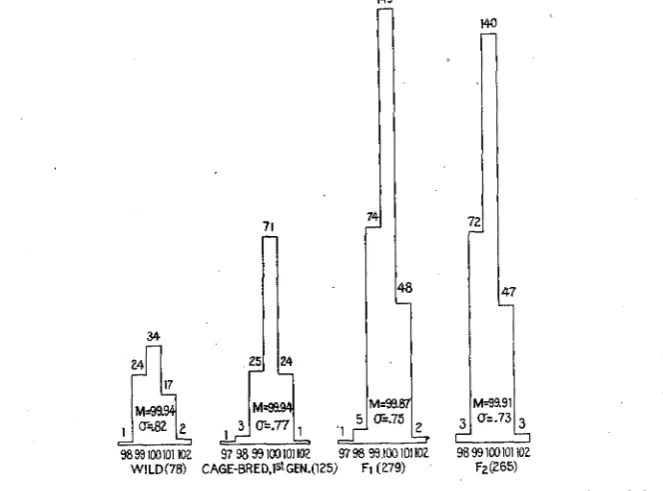
The mean ratio was 100.027 f .027. I n other words, the mean indicates a very slight and quite non-significant sinistrality. The purely accidental character of this departure from symmetry is further evidenced by the fact that of the four means included in figure 2, two indicate a condition of dextrality, two of sinistrality.
gram, but this was sufficiently accurate for present purposes.
The total number of jaws weighed was 1202.
BILATERAL ASYMMETRY 467
Two main problems have been investigated in relation to these jaw weights, as well as to the other measurements of paired bones: (1) the heredity or non-heredity of the individual deviations from symmetry;
(2) the variability of first- and second-generation raoial hybrids in respect to this character.
(1) Are individual deviations f r o m symmetry in the weight of the two halves
of the mandible hereditary? Under this head would be included either the specific inheritance of dextrality or sinistrality in respect to jaw weight, or the inheritance of a mere lack of balance, without regard to which side preponderated in two related individuals.
Considering in order the two aspects of this question, coefficients of of parental-filial correlation were first worked out in respect to the sinistro- dextral ratio. According to the mode of treatment just described, i t is obvious that sinistral individuals would give plus deviations, dextral indi- viduals giving minus ones. A positive correlation coefficient would imply a tendency toward correspondence, either as to dextrality or sinistrality. To consider the father-off spring correlation first, the available material comprizes 87 fathers and 779 offspring. A small proportion of those which figure as “offspring” likewise figure as “fathers” since three successive generations are included in some cases. The coefficient resulting from this entire lot, treated collectively, is - .072 f .032. The relative size of the coefficient and its probable error would render it improbable that the former was significant, even though it had not been negative. Separate coefficients were computed for the 11 different groups of individuals into which the population may be divided, and for the sons and daughters separately, within each of these groups. The various groups differed among themselves in respect to either the subspecies (or hybrid form) comprized, or to differences in the history of the stock which need not be detailed here. Of these 22 single coefficients, 16 chanced to be negative and only 6 positive, the mean being -.082.
For the computation of the mother-offspring coefficient, 173 mothers and 766 offspring were available. The coefficient for this lot, taken col- lectively, was
+
.OS7 f .031. Here again, the relative size of the probable error would in itself render the coefficient of very doubtful significance. One’s doubts are greatly strengthened when the fact is considered that the evidence of a positive correlation for the mothers is even less than that of anegative one for the fathers!
468 F. B. SUMNER AND R. R. HUESTIS
Our experiences in the computation of these results compel us to call attention to the danger of attributing any considerable significance to mere coincidences of sign in a series of coefficients or of differences. There was more than one point, in the course of these studies, when the prob- ability seemed to us high that we had significant positive coefficients of mother-offspring correlation, and negligible ones for the father-offspring relation. For example, the first 8 group-coefficients which were computed for the mothers were all positive, while the first 16 of these comprized 13 positive, two negative and one zero coefficient. These sixteen groups included, indeed, all the individuals that it was originally intended to deal with in these studies. The remaining 6 groups considerably reduced this preponderance of plus signs; and the significance of this preponderance is entirely destroyed by the fact that the father-offspring series shows an even greater preponderance of negative coefficients.
Finally, there is no evidence, either for the mothers or fathers, of a sex- linked transmission of this character, which might be obscured by the throwing together of sons and daughters in computing these general coefficients.
As regards the inheritance of dextrality and sinistrality in jaw weight, accordingly, the verdict for both sexes seems to be that there is none. At least, this seems to be true of those small deviations which form the basis of our coefficients. Whether single, heritable “mutations,” large or small, ever occur in respect to this character, we do not know. We can only say that we have found no evidence of such in our tables.
The second question regarding inheritance relates to the possible trans- mission of asymmetry per se, regardless of sign. For this purpose, the departure of each individual ratio from 100 percent, in either direction, was set down; and these differences (or grades of asymmetry) were used as the variables, instead of the ratios themselves. Averages were computed for these differences, and the plus and minus deviations of the individual variants from their mean were entered, as in any other case of correlation.’*
Thus proceeding, a father-offspring correlation of - .026 f .032 and a mother-offspring correlation of f.007 f .031 were obtained. There is, accordingly, as little tendency for parents and offspring to resemble one another in respect to the degree of asymmetry in their jaw-bones as there
l 8 To illustrate: Animals having ratios of either 99 or 101 would be credited with the differ-
BILATERAL ASYMMETRY 469
is for them to resemble one another in respect to which side of this member
is the heavier.
(2) Dijerences beheen the first and second generations of race-hybrids in respect to variability in bilateral asymmetry. The standard deviation for the 1202 sinistro-dextral ratios is 1.386 f .019. The variability differs somewhat in the four major groups into which the material has been divided. Thus we have:
Wild (174 specimens).
...
1.44 f .OS2 Subspecies hybrids, FI (326)....
1.35 i .036 Subspecies hybrids, F2(264)...
1.71 f .OS8 Pure races, cage-bred, first generation (438)19....
1.18 f .027The frequency distributions for the various lots are shown in figure 2.
1
.
J
;::M;i.I,
rl.
89 93 91 92 93 94 95 96 97 98 99 100 101 102 103104105 106107
F2 (26W
FIGURE 2.-Histograms showing frequency distributions of the sinistro-dextral ratios of the two halves of the mandible. The abscissas are the ratios, the ordinates being the frequencies of each. The frequencies are also indicated by the numbers a t the tops of the various columns. The number in parenthesis under each of the four histograms is the total number of individuals on which i t is based.
The difference between the figure for the FI and F2 generation (.36) is nearly six times its probable error (.062) and is therefore of highly prob-
470 F. B. SUMNER AND R. R. HUESTIS
able statistical significance. The histograms show that this difference of variability cannot be due wholly, or even mainly, to the influence of a
few extreme variants.20 An obvious feature of the F2 histogram is the decrease in the central column, as compared with the lateral ones.
But there are other differences among these four standard deviations which are of more than possible significance, notably that between the wild and the cage-bred mice, belonging to pure races (Le., subspecies). The difference in this case is more than four times its probable error.
We shall postpone a discussion of these differences until the various other cases of asymmetry have been considered. It is well to state here, however, that this increase of variability in passing from the F1 to the
F2
generation holds true for each of three different crosses when treated separately. The figures are as follows:21Calistoga-Carlotta FI..
...
1.25 f .049{Fz..
...
1.66f .091Carlotta-Victorville
...
1.31 f .065Fz..
...
1.63 i .076("
Fi..
...
1.54 f .OS0 {Fz.....
1.84f .096The probable errors are of course larger here, owing to the smaller num- bers comprized in these separate groups. The differences are 4.0, 3.3
and 2.4 times their probable errors, respectively.
The femur
Femur measurements of 960 individuals are available for these studies. The measurements made were of two sorts, linear measurements and weights. These two have been treated as quite independent characters.
It v a s early found that there was no constant correspondence in individual cases between preponderance in weight and preponderance in length. The longer bone of a pair was frequently the lighter and vice versa. I n fact, the correlation between the sinistro-dextral ratios for femur length and femur weight was only
+
.285. More surprising yet is the fact that when we consider the grand averages for the entire series, the femur is preponder- antly dextral in respect to length and preponderantly sinistral in respect to weight. The figures are 99.882 f .027 and 100.226 f .055,respectively.As already stated, these figures are based upon nearly a thousand indi-
2O The omission of the only really extreme variant (89 percent) reduces the standard deviation to 1.58, which is still far removed from that of the F1 group.
BILATERAL ASYMMETRY 47 1
viduals. It would seem not only that the difference between these two figures is statistically significant, but that the departure of each from 100
percent is of very probable significance.
Various writers have reported significant differences in length between the right and left femurs in man and even in some other animals. But these results have not been wholly consistent, and as a rule have been based upon insufficient numbers. The most extensive biometric study of
this bone is doubtless that of PEARSON and BELL (1919). This is based upon some 900 separate human femurs (not paired), derived from disin- terred remains. These writers find that “the differences in right and left members of none of the chief lengths
. .
. .
appear to have any significance” (p. 130). Certain other characters, on the other hand, were found to display marked dextro-sinistral differentiations. For example, “the torsion.
.
.
.
is always markedly greater in the left than the right bone. Further the obliquity is most definitely and markedly greater in the left bone than in the right” (p. 132).DONALDSON and CONROW (1919, p. 304), conclude that “the post-natal asymmetries which appear to arise largely from use in man (GAUPP 1909) are not evident in the rat, and there is nothing systematic in the slight deviation which we have observed for the values of symmetrical bones.”
Femur length
The measurement employed by us was the “maximum length from top of head to bottom of internal condyle” (PEARSON and BELL 1919, p. 4).
A dial.caliper was employed for this purpose, graduated to tenths of a millimeter. Each femur was measured twice, the two being measured in alternation. Differences less than 0.1 millimeter were not included. Dif- ferences of one-tenth or more could be relied upon as due, in the great majority of cases, to actual differences in the length of the femur. Instru- mental errors and differences due to the presence of foreign matter rarely reached this magnitude. Roughly speaking, the femur length of these mice averages about 15 millimeters.
1
75
41
JM=Y3.k
~
Gl.72
[.@I
98
99
IOOIflI
IOZ1031041fl5106107108IM
110
Ill
112113
114115
WILD
(96)
W
FIGURE
3.-Showing
sinistro-dextral
ratios
for
femur
length.
(See
legend
for
figure