Embedded based Automation System for
Industrial Process Parameters
Godhini Prathyusha1
Lecturer, Department of Physics (P.G), Govt .Degree College, Anantapur, Andhra Pradesh, India1
ABSTRACT: Automation of industrial process parameters plays a crucial role in process industries. The measurement
and control of certain process parameters like Temperature, Level, Flow rate and Relative Humidity are the widely used in process industries. In the present work developed an integrated hardware system with software program for FPID algorithm using Arduino by using embedded ‘C’ for develop total integral Automation system for certain industrial process parameters.
KEYWORDS:Temperature, Level, Flow rate, Relative Humidity, FPID.
I. INTRODUCTION
Most of the industrial processes run with different degrees of non-linear parameter variability and uncertainty of mathematical model of the system. In the present work a system developed and implemented by manual tuning method of PID control with mean of maxima fuzzy logic and maintained critically damped oscillation so that there is no overshoot takes place. The industrial process parameters such as Level, Temperature, Flow and Humidity automated by using embedded ‘C’ with Arduino software.
II. PROCEDURE
The control architecture is implemented with the FPID logic to control the process parameters, due to its excellent control characteristics. The Fuzzy [1] and PID [2] controllers are successfully applied to many practical process control applications involving the physical parameters like liquid temperature, liquid level, liquid flow, pressure, humidity, rotational speed of motor etc. The methodology encompasses the design of FPID controllers [3] for process parameters controlling with less rising time, settling time as well as steady state error. Fuzzy with PID control is the best algorithm compared to PID and Fuzzy control algorithms. Result of it is reducing the rise time as well as settling time and steady state error. It improves robustness, good dynamic response, rising time, overstrike characteristics.
The advantage of the designed model over the available auto tune PID using tuning methods is that, it does not requires any mathematical modeling of the process. While conventional PID [9] [10]controllers are sensitive to variations in the system parameters, fuzzy controllers do not need precise information about the system variables in order to be effective. However, PID controllers are better able to control and minimize the steady state error of the system. Hence, a FPID system was developed to utilize the advantages of both PID controller and fuzzy controller[11] [12].The development of present system the time, labour drastically will be reduced and the quality and accuracy of the system is enhanced.
III.HARDWARE SYSTEM
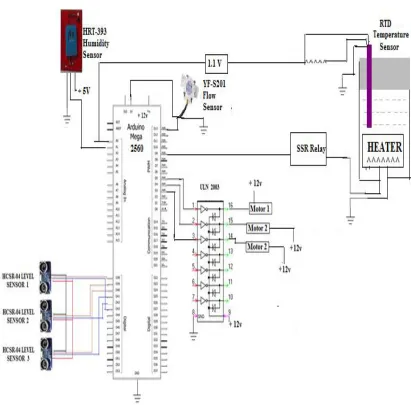
Figure 1 Circuit of Total integrated automation system for industrial process parameters
An Ultrasonic sensor (HCSR-04) is used for level measurement and controlled by a DC motor using ULN 2003 as a driver using PWM of microcontroller .
RTD temperature sensor is used for temperature measurement and controll with SSR relay through the PWM of the microcontroller signal which is decided by software program implementing FPID control depending on the error.
The humidity sensor (HRT-393) is used for humidity measurement system and controlled by implementing FPID control software program using ULN 2003 as a driver through PWM of microcontroller.
A DC Motor which operates on +12V / 1Amp power supply for pumping the liquid. It consists of one inlet and one outlet for maintaining the humidity in a closed system by pumping water. In this work the motor controlled by a controller line of PWM which operates with 5V/12V by using Fuzzy with PID software. The application software for the present work developed through communication interfacing with PC and USB.
When a current flows through a conductor of resistance, heat is produced and there is temperature rise of conductors in electrical circuits. Temperature rise is undesirable and must be limited by design to avoid overheating of the conductor or its electrical insulation. This is often termed as permissible surface loading of a conductor. The conductor could be in the form of wire, strips or any other shape. Permissible surface loading is often a prime consideration in choosing the best size of the conductor or heating element.
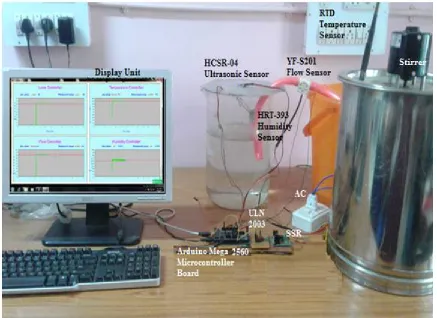
Figure 2 Snapshot of Total integrated automation system for industrial process parameters
IV.EXPERIMENTAL RESULTS
Table 1. Temperature measurement and control implementing FPID
Table 2. Level measurement and control implementing FPID
Table 3. Flow measurement and control implementing FPID
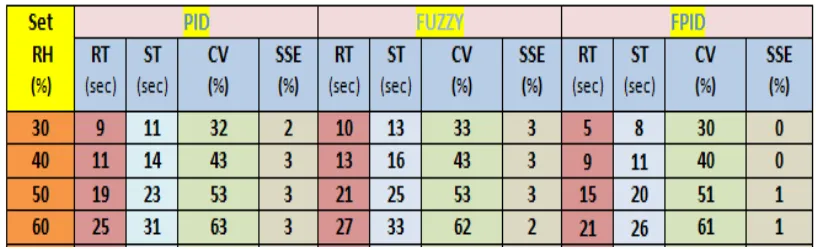
Tables show the results of Automation for Process Parameters like Temperature, Level, Flow rate and Relative Humidity by using FPID algorithm.
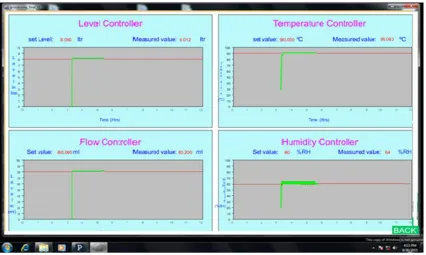
The graph represents the relation between realtime and present value of different parameters.
Figure 3 Graph for Total integrated automation system for industrial process parameters
V. CONCLUSION
The ARDUINO based certain process parameter control using software FPID logic presented in this thesis yields a better dynamic performance as compared to all other existing microcontroller based parameter control. The simple designing flexibility of the FPID controller is observed to be the principal attraction. The application of ARDUINO based controller as a programmable controller for drives is found to be efficient, yielding the following advantages:
1. The hardware design for controlling data acquisition has been reduced, since ARDUINO based controller has built-in 10 bit A/D and PWM generator. This has allowed high precision in measurement and achieved high precision of control in combination with the FPID control.
2. The manual tuning PID method and Mean of Maxima method of Fuzzy control is highly immune to external disturbances of oscillations and exhibited better performance in Process parameters control.
3. There is no overshoot by implemented critically damping technique for controlling all the parameters.
REFERENCES
[1] A. Rubaai, M. J. Castro-Sitiriche, A. R. Ofoli, “Design and implementation of parallel Fuzzy PID controller for high-performance brushless motor drives: An integrated Environment for rapid control prototyping,” IEEE Trans on Industry Applications, Vol.4, No.4, pp. 1090-1098, . 2008.
[3] Subrata Chattopadhyay and Satish Chandra bera, “Design and Testing of a Low Cost PID Controller Combined with Inverse Derivative Control Action and Its Application in Voltage Control Systems of DC Generator”, Sensors & Transducers Journal. Vol. 87, Issue 1, pp. 74-84, January 2008.
[4] William L. Luyben, “Effect of derivative algorithm and tuning selection on the PID control of dead–time process”, Ind. Eng. Chem. Res, Vol. 40, No. 16, pp. 3605 –3611,2001.
[5] W. K, Hang C. C, Cao L. S “Tuning of PID controllers based on gain and phase Margin specifications”, Automatica, Vol. 31, 3, pp. 497– 502,1995.
[6] A. Visioli, “Fuzzy logic based set-point weighting for PID controllers,” IEEE Trans. Syst. Man, Cybern,- Pt. A, Vol. 29, pp. 587-592, 1999. [7] R. Yusof, S. Omatu, and M. Khalid, “Application of self-tuning PI (PID) controller to a Temperature control system”, IEEE Conf. on Control
Application, vol.2, pp. 1181-1186, August 1994.
[8] Brinkschulte, U, Pacher, M, “Improving the real-time behavior of a multi-threaded Java Microcontroller by control theory and model based latency prediction”, 10th IEEE International Workshop on Issue 2-4, pp.82-93, Feb 2005.
[9] Curtis D. Johnson, “Processes control instrumentation technology”, Person education, Seventh edition, International Symposium on Neural Networks, vol. 3973, pp. 1096-1103, 2006.
[10] Yuon Fong Chan, Moallem, Wei Wang, “ Design and implementation of modular FPGA-Based PID Controllers”, Industrial Electronics, IEEE Transactions on Volume 54, Issue 4, pp(s): 189801906, Aug. 2007.
[11] M H Moradi, “New techniques for PID Controller Design”, IEEE, pp 903-908, 2003.