Staging Rain Water Reuse in Temporary
Concrete Structure by Activated Carbon
Treatment
Kalyanabooshnam.M1, Pallavhee.R2, Rajasundara Krishnan.T3, Alarmelumangai.S4
U.G. Student, Department of Civil Engineering, A.V.C. College of Engineering, Mannampandal, Tamilnadu, India1
Assistant Professor, Department of Chemical Engineering, Pondicherry Engineering College, Pondicherry, India2
U.G. Student, Department of Civil Engineering, J.J College of Engineering& Technology, Trichy, Tamilnadu, India3
Assistant Professor, Department of Civil Engineering, A.V.C. College of Engineering, Mannampandal,
Tamilnadu, India4
ABSTRACT: Rainwater is a natural Source, so we need to preserve as large contribution in our daily lives. Staging and improper rainwater harvesting lead to lagging of rainwater in empty plots. In an empty plotnormally 2400sqft the rain water staggered there where there is no drainage to the water. In that case the water can stagger upto 2400cft. We can use that water for the temporary construction purpose on the plots. The water is collected as samples and tested as per procedure then the test results are checked for the water can be used for concrete as per IS 456:2000.In casethe water is not suitable for concrete as per specification we need to treat the water. Hence the attempt was made to analyze the state of rainwater re usage in construction.
KEYWORDS: Staggered rainwater, Aggregates, Flame photometer, BOD, Mortar.
I. INTRODUCTION
II. RELATED WORK
Staggered rain water from the empty plots from Mayiladuthurai area is collected as a test samples and they are tested in a laboratory. The test conducted on the water is pH, NACL, COD and BOD for the contaminant content in the water measurement. The water is free from NaCl and itsnot acidic in nature. So the water is used for concrete surely but the others tests must be conducted to prove the water cannot become harm and corrode the reinforcements in concrete. Further test conducted are Tss, Tds, Ts. If the water contain calcium, potassium it affect the nature of the concrete and lead to deterioration. IN that case the test for calcium and potassium is conducted in flame photo meter.
Preparation and testing of raw materials:
Materials: Aggregates
In general aggregates are chemically inactive materials. These large inert materials are used in concrete to reduce the cost because the cost of the cement is more when compare to aggregates. The properties of the raw materials used in preparing mortar and concrete mixtures were tested in laboratories according to national and international standards. These materials include coarse aggregate, Fine aggregate, and cement.
III TEST CONDUCTED ON THE RAW SAMPLE pH:
pH is a scale used to specify the alkalinity or acidity of an liquid solution. It is basically the negative of the logarithm to base 10 of activity of the hydrogen ion. Pure water is neutral. Samples with a pH value less than 7 are acidic and samples with a pH greater than 7 are basic. At pH 7, being neither an acid nor a base.
FLAME PHOTOMETER:
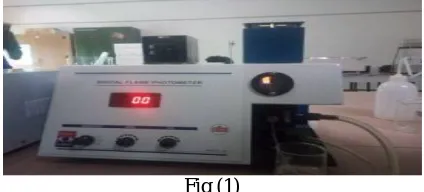
A flame photometer is a equipment which is used to determine the concentration of certain metal ions, among Potassium, Calcium and Sodium as shown in fig (1). It is a controlled flame test with intensity of the flame color. It has the range of metals that could be analyzed and the limits are also considered. The intensity of color will depend on the energy that has been absorbed by the atoms that was sufficient to vaporize.
Fig (1)
DISSOLVED OXYGEN (DO):
FIG(2)
AMMONIA NITROGEN TEST
To find out the concentration of ammonical nitrogen in the water sample the test is conducted as per standard procedure. The initial value of the test is orange in color as shown in fig (3). Then the water is titrated against 2N sulphuric acid the sample water turns from orange to yellow as result as shown in fig (4)
INITIAL fig(3) FINAL fig (4)
Treatment of water
The rainwater sample is treated by using activated carbon with fly ash. Treatment is conducted by slow horizontal flow method. The rainwater sampleused is collected from the wastelands staggered rainwater. For 1m length of pipe approximately 5 liters of rainwater sample is to be collected.
The samples are collected from the source properly. The water waste used for the test is kept without any changes before treatment. Sufficient quantities of rainwater sample samples were taken from the source periodically. The initial effluent characteristics such as pH, DO and COD were determined in the raw effluent.
After the initial process the rainwater sample were treated with Activated Carbon as adsorbent which is mixed with uniform size fly ash in the ratio of 1:27 (1part activated carbon-27 part fly ash) for the reduction of chemical oxygen demand. The burned coconut shell is used as an adsorbent.
Concrete preparation:
After the test results, the treated water is used to made concrete of M10 grade as per IS 456:2000. The concrete is placed as cube of diameter 150mmx150mmx150mm as per specification. Then the concrete is cured for 28 days and tested in the compression testing machine for find out the compression values. The concrete can have the compression value of 9.13n/mm2 as shown in the result.
IV. TEST CONDUCTED IN COCNRETE
COMPRESSION TEST:
To find out the compression strength the cube made with the water sample as mixture is taken out after cured for 28 days and dried for 1 hour and cleaned with the white cloth. After that the cube is tested in the compression testing machine as shown fig (5)
Fig(5)
RESULT AND DISCUSSION FOR CONCRETE
GRADE DAYS
TESTED
COMPRESSION LOAD
M10
7 143.25KN 14 199.49KN 28 205.60KN
LOAD CALCULATION
After 28 days it attains a load of 205.6 kn it has been converted in to a load of n/mm2 so the actual load byarea gives the perfect load.
Load:
V. RESULT AND GRAPH DISCUSSION FOR SAMPLE WATER AFTER TREATMENT
VI. CONCLUSION
From this the water from waste lands which is staggered during the rainy seasons are used efficiently for temporary construction in concrete structures .This decrease the lead to the lack of water in the world for construction and drinking purpose. By using that water the depletion of water for construction is reduced in greater level.
REFERENCES
[1] Shekarchi, M.; Yazdian, M.; Mehrdadi, N. Use of biologically treated wastewater in concrete. Kuwait J. Sci. Eng. 2012, 39, 97–111. 8.
STUDY OF TREATMENT PROCESS:
Day 1 Day 2 Day 3 Day 4 Day 5 Day 6 Day 7 Day 8 Day 9 Day 10
pH 7.40 7.21 7.03 6.98 6.97 6.97 6.96 6.96 6.97 6.96
DO
(mg/l) 4.2 4.9 5.6 6.2 6.9 7.9 8.8 8.9 9.0 9.1
TDS
(mg/l) 10120 9830 9440 8990 8590 8110 7400 7250 6850 6420
TSS
(mg/l) 1210 1160 1090 1020 970 920 840 750 690 550
TS
(mg/l) 10080 9920 9870 9790 9820 9690 9410 9210 9010 8990
COD
(mg/l) 11350 11300 11250 11230 11120 10470 10060 9160 8590 8160
0 5000 10000 15000 20000 25000 30000 35000
DAY 1 DAY2 DAY3 DAY4 DAY5 DAY6 DAY7 DAY8 DAY9 DAY10
COD
TS
TSS