Efficient Power Saving of Electrical Devices by
Using Image Processing
Krutika Lokhande 1, V. B. Padole 2
P.G. Student, Department of Electronics and Telecommunication, P R Pote College of Engineering and Management,
Amravati, Maharashtra, India1
Assistant Professor, Department of Electronics and Telecommunication, P R Pote College of Engineering and
Management, Amravati, Maharashtra, India2
ABSTRACT: The major problem in the most populated and developing countries like India, is Energy or Power crises.
Hence there is a too much need of save energy. We use a several ways to save power like using the electric and electronic gadgets whenever and wherever needed and switching them off while not in use. But there are many places like classrooms, large auditoriums and meeting halls there will be a fan or an Air-conditioner keeps running in unmanned area too, even before the people arrive. That improves the wastage of power in large amount and contributes to a considerable amount of electricity loss. As we all know about various methods for saving electricity like installing IR sensors to detect people etc. but it is quite costier and complex in large areas. here we propose a method of controlling power supply of auditoriums and classrooms using Image Processing. In this firstly we take reference image of empty classroom and if any changes in that reference image accordance with that power supply will turned on and off. This is very simple, efficient and cheaper technique to save energy. Also we include temperature sensor to sense temperature and calculate need of fan or equipments. Another big advantage is, we can extend this up to application like home automation etc.
KEYWORDS:MATLAB, Image Processing.
I. INTRODUCTION
As all know electricity is basic need of any business and we have to minimize any wastage of electricity. video surveillance system are widespread now a days. And it is widely use at airports, banks, casinos and correctional institutions. But now it is increased up to government agencies, business and even schools for increase security and provide video surveillance. As the availability of high speed ,broad-band wireless networks and with the proliferation of inexpensive cameras ,deploying a large number of cameras for security surveillance has become feasible with economical and technical manner. Several important research questions remain to be addressed before we can rely upon video surveillance as an effective tool for crime prevention, crime resolution and crime protection.
Maintaining comfort ability in your office or building, while keeping a check on your energy bills is what we would wish for. Forgetting to turn off your classroom lights and office appliances for a period of long time can really add up on your electricity bills. Reducing energy costs by controlling the lighting and temperature based upon the real time occupancy and predicted schedule is an efficient way. A smart and intelligent system to maintain your routine chores is not only an efficient but a robust way to automate your heating and lighting system. The system automatically set the setting as per schedule or the real time occupancy which also allows to manually controlling the main setting with easy controls Touchscreen.
Intelligent building efficiency is not just to offices but also homes and institutes. The efficiency of home automation system is improving and features are adding up which will prove to be a smart investment and easy on the pockets too. This paper proposed an system to control power supply for minimizing power consumption and wastage of electricity by using Image processing. This is very simple, efficient and cheaper technique to save energy.
II. EXISTING WORK
8]Shraddha Dhirade paper on Monitoring and Controlling of an Auditorium:
They proposed a system on the basis of Raspberry pi. The monitoring and controlling of electric equipments are developed using Raspberry-pi3. Automatic power controlling and monitoring system is designing for making an auditorium’s lighting system as well fans easily controllable and monitoring. Raspberry pi’s camera will detect the persons with the help of face detection, which are seating in the auditorium along with their location. The fans and light will be automatically turn ON in auditorium after detecting number of persons seating with their respective location. Raspberry pi-3 is implemented on NOOBS operating system using python language. Now days, multi-block local binary pattern (MB-LBP) is useful method which is used for face detection of person. MB-LBP is required to implement on the Raspberry pi3 to detect faces of humans for extracting of attributes of faces [8].
[4]N. Shribhagat Varma paper on Automatic Electrical Appliances control based on Image Processing:
They design a power management system which will sense if the room is vacant and accordingly turn the lights off. To avoid this sheer loss of money and resources, automated power management system looks to detect whether the room is empty and accordingly switch off the lights and fans. The camera captures live feed of the room and gives it to the computer to process it. The face detection module then detects human presence.
The strength and contribution of this work lies in the combination of a large number of sensors readings which allows deriving higher level semantics as compared to reacting on single sensor readings only [4].
[10]Viola Jones paper on Rubust Real Time Object Detection:
III.PROBLEM SPECIFICATION
The main problem in country is power wastage. Each room has dedicated switches for controlling the fans and lights in a particular room. Often people using the room vacate it without bothering to turn off the lights and switches. As a result whenever the room is vacant someone has to visit each room and manually switch off the lights and fans. But onetime it is impossible and impractical due to following reasons:
1. Dedicated man power for this purpose is not feasible. Thus following results i) Higher bills
ii) Power wastage
iii) Painstaking process to switch off lights and fans every time class is empty. 2. Difficult to manually keep track of which class is empty.
IV.SOLUTIONARCHITECTURE
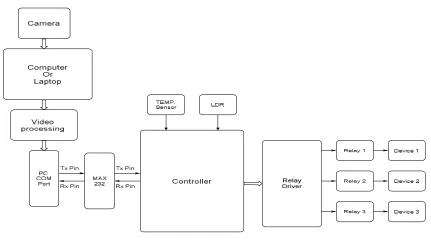
Figure describes the complete idea of project. This architecture is convenient to use and it also shows that image processing is better technique to track image variation. Here both the implementation that is LDR and Temperature sensor makes the system more convenient and easy to use. MAX 232 pin is use for convert the signals from serial port to the proper signal which can be use by TTL compatible circuit.
The 3 main part is laptop, PIC microcontroller and ULN 2803 IC.
FIGURE 1:BLOCKDIAGRAM
lights also. In this project six relays are use for connecting six equipments. We can increase the number of relays in accordance with programming of microcontroller. In that classroom gets divided into 3 partitions. With respect to the presence of human the lights or fan gets active for that selected partition only. Humans are track by centroid of gray image.
V. IMPLEMENTATION
Detection: The main difficulties of such approach lie in the fact that, even in controlled environments, the background
undergoes a continual change, mostly use to the existence of lighting variations and distracters (example: clouds passing by, braches of trees moving with the wind). The robustness towards lighting variation of the scene is achieved using adaptive background models and adaptive per-pixel thresholds. Detection is done on the basis of centroid of object is present.
Tracking: The purpose of tracking is to determine the spatial temporal information of each target present in the scene.
Since the visual motion of targets is always small in comparison to their spatial extends, no position prediction is necessary to construct the strokes. The association of regions and their classification is based on a binary association matrix computed by testing the overlap of regions in consecutive frames. Whenever there is a match, the stroke is updated. Tracking also interacts with the detection.
VI. SIMPLIFIED OVERVIEW
First take a reference image through web camera and read image sequence. From initial frame of sequence estimate background. Now take a current image and subtract that image from background image. Then apply further processing that is converting the resultant image into the gray scale image.
Flow chart:
On that gray scale image perform the filtering operation on image and find area of object. Now for calculating centriode sort-out the biggest object in image using area value. Then at the last find out the zone in which centriode is present and accordance with that switch on corresponding relay
VII.RESULT AND DISCUSSION
The proposed intelligent automated system for an efficient power management is being deployed and tested over institutional building in which the light of the classroom are automatically controlled by the Image processing by comparing reference image and real time image. By using temperature sensor and LDR we can controlled power with respect to need of light and temperature. Also we are dealing with centroid of object which is present so that system will detect the humans only.
Table I:
Case Steps to execute test case
Centroid Calculated Expected result Actual result
Detect Test human presence
Start the system ask the person to set in front the camera
Greater threshold value
Lights should turn on Lights turn on.
Detect object or animal present
Start the system place an object in front of camera
Less threshold value
Lights should not turn on
Lights remain off.
Table 1: Testing the Intelligence.
In this section we check the intelligence of system. In that firstly the reference image is captured, from that background gets introduced and when human is being recognized in that background then automatically the lights under that partition gets ON. But system does not recognize the object or animal which having the less centriod then threshold value. Thus system tested and analyse by two different conditions on the basis of intelligence.
Table II:
Test case Steps to execute the test case
LDR work Expected result Actual result Test Result.
Check if lights switch off when room is empty
Empty the room run the system.
Light intensity is high.
Lights should switch off.
Light switch off Met
Check if lights switch on when room occupied
Ask people to occupy room Run the system
Light intensity is low.
The light should remain on
The lights remain on
Met
Check if lights switch is on when room occupied
Run the system and Ask people to live the room.
Inactive The lights should turn off
The lights gets off
Met
Table2: Testing the circuit.
In this way the system met all the requirement and provide 98% accuracy. By adding LDR and temperature sensor, the system provides more coverage to the atmospheric changes and need. Thus power wastage is minimize when the class room is empty, thus reduces the electric bill And also minimizes the cost of dedicated manpower who is there for investigate each room.
VII.CONCLUSION
Efficient Power saving of electrical devices is developed using parameter like temperature and light sensors by using Image processing. Human detection is carried out by comparing both the reference image and real time image together and by calculating centriod for each detected gray scale image. Also adding temperature sensor and LDR we can calculate atmospheric need of fan and light. This is one of the method which is effective to control the electrical equipmenr and reduce power consumption. The study showed that image processing is better technique to control the power supply in the classroom.This shows that it can minimize the wastage of electricity and avoid the free running of equipments. Also by using real time image we make it more consistent in detecting presence of people. By adding temperature and light sensor we make this system more accurate and convenient to use.
REFERENCES
[1] Vankatesh K1 and Sarath Kumar P2. “Automatic Real Time Auditorium Power Supply Control Using Image Processing” Association of
Computer Electronics and Electrical Engineers,DOI:03.LSCS.2013.6.524.
[2] Patteri Sooraj1, Faizankhan Pthan2, Gohil Vishal3, Pritesh Kukadia4,”Automatic Controlling Of Electrical Appliances in Classroom Using
Image Processing”.IJERD ISSN:2278-067X (RTEECE 08th-09th April 2016).
[3] Anisha Gupta/Punit Gupta2, Jasmeet Chhabra3.”IoT based Power Efficient System Design Using Automation For Classroom”
978-1-5090-0148-4/15/$31.00 IEEE 2015.
[4] N. Sribhagat Varma, Ganesh Taduri, N. Bhagirath Sai.”Automatic Electrical Appliances control Based on Image Processing”. IJERT ISSN:
2278-0181 Vol. 2 issue 9, September 2013.
[5] Kavya P Walad,Jyothi Shetty “Traffic Light Control System Using Image Processing”. IJIRCCE Vol.2, Special Issue 5, Octomber 2014.
[6] Manoj Kumar.”Power Saving in Electrical Devices Using Image Processing”. In IJEAST , Vol 1, Issue 6, ISSN No.2455-2143, pages
63-66,May 2016.
[7] Omkar Ramdas Gaikwad, Anil Vishwasrao, Prof. Kanchan Pujari, Tejas Talathi “Image Processing Based Traffic Control” IJSETR Volume 3,
Issue 4,April 2014.
[8] Shraddha Dhirde1, Priyanka Ghuge2, Sneha Khulape3 “Monitoring and Controlling of an Auditorium ” IJESC Volume 7 Issue No.3,march
2017.
[9] Kiruthika G1, Meenatch i R1,Mohan Raj V1, Pradeepa S1.”Device Power Consumption avoidance using Image Processing” in IJARMET
Special issue, March 2017, ISBN 978-1-63535-324-2.
[10] Sunil Kumar Matangiand, Sateesh Prathapani, “Design of Smart Power Controlling and Saving System in Auditorium by using MCS 51
microcontroller” , Advanced Engineering and Applied Sciences: International Journal 2013:3(1): 5-9.
[11] VikramadityaDangi, AmolParab, KshitijPawar & S.S Rathod,” Image Processing Based Intelligent Traffic Controller”, Undergraduate
Acedemic Research journal (UARJ), ISSN: 2278-1129, Volume-1, Issue-1, 2012
[12] Sandeep Patel, Punit Gupta, Mayank Kumar Goyal, “Low Cost Hardware Design of a Web Server For Home Automation System”,