R-KNN Algorithm for Privacy Protection in
Moving Query and Moving Object (MQMO)
Anjali Phaltane 1, Prabhudev S 2
P.G. Student, Department of Computer Engineering, VACOE, Ahmednagar, Maharashtra, India1 Associate Professor, Department of Computer Engineering, VACOE, Ahmednagar, Maharashtra, India2
ABSTRACT: The Location based service (LBS) market is growing tremendously fast due to the growth in mobile phones. Many applications such as store finder, car navigation, friend finder make use of LBS. Location based service is a service offered to the user based on the data profile and location information of the user. Hence, private information of the user may get violated because most solutions proposed only protection for snapshot query and no support for moving continuous query. We proposed a system to reduce communication in client- server architecture as an object only need to report its location to the server when it leaves the safe region or server sends location update request. Voronoi diagram is used for space partitioning and cell binding, Hilbert curve is applied over Voronoi to find the shortest path to reach the destination. For evaluating moving continuous query over moving object(MQMO) efficiently, the motion sensitive bounding boxes(MSBs) are model which uses motion adaptive indexing scheme(MAI) where indexes are updated automatically using MAI.
KEYWORDS: Location Based Service, MQMO, MSB, MAI, Hilbert Transform, Voronoi diagram.
I. INTRODUCTION
The Location Based service is a service which is offered to the user based on the location information of the user.. LBS make use of location as well as data profile of user, hence privacy of the user may get violated. If the user wants to keep his location privacy then he has to either turn-off his location detection device or has to temporarily unsubscribe from the service. When the user is surfing for a point of interest over an online road spatial network , the third party servers stores the users location information on a third party servers and the hacker can hack the location as well as private data of the users as third party servers are not secured. LBS trade their services with privacy, so in order to protect user private information from getting violated different privacy protection mechanisms are used such as location perturbation, spatial cloaking, temporal cloaking and K-anonymity. K-anonymity method of privacy protection deals with finding nearest neighbour query. There are two different ways to issue the NN-query:1) Snapshot Query .2) Continuous Query[1]. In snapshot query for users each query the response is initiated by LBS server providing the answer to the query. But snapshot query does not work efficiently when the queried object is continuous changing its location. Continuous query comes into figure here, for single query request in continuous query LBS server continuous sends the response for single initiated query. The query processing should be fast when mobile user and the point of interest object is continuously moving on a road network and updates to the indexes should also be automatically updated in the database. Query retrieval of LBS should be clear and complete with no redundant data.
II. RELATEDWORK
In order to provide efficient privacy protection, the location based service should considered two main issues: 1) Anonymization of users personal location information.2) Providing high quality service on these anonymized locations. G.Ghinita et al [2] offered solutions deal with anonymizer for providing service based on fake locations but trusted anonymizer act as a third party and has single point of attack and also user needs to compute its NN so extra computational overhead at client side. To reduce the computation at client side [3] proposes two algorithms for retrieving K-NN using cPIR(computational PIR) [3] , first returns approximate K-NN POI with computational cost of O(k) and O(log(k)) computation. Several privacy protection techniques like one addressed in [3][4] only addresses on snapshot queries but does not considers moving continuous query. Main challenge in moving query is to efficiently manage the location updates of an object and provide fast network-distance computation while supporting POI on the road network. Moving continuous query is also supported in [5][6] but it does not provide privacy and security to LBS. In [1] privacy protection technique for C-NN query in location based services is evaluated with focus on moving query and static object which uses the offline space partitioning using voronoi diagram as in [7][8] over Hilbert curve[9]. It uses R* tree indexing scheme[10] which increases updates over indexes and K-NN algorithm that increases verification cost on mobile client. K-NN approach for finding the nearest neighbourhood is used in [1] but this approach needs to verify the query result so it increases the query verification cost at client side and also produces some duplicate result. Hence the redundancy increases by using K-NN. In order to reduce the redundancy and increase speed of query processing in [11] reverse K-NN query processing is used which assign each query and object a safe region to decrease the communication cost in client-server architecture. As the object only reports to the server when either server sends the location update request to the server or object leaves the safe region.
III. PRIVACY AWARE LOCAL SEARCH APPLICATION USING R-KNN. A. Design Considerations:
The algorithm was developed in java with J2ME environment.
The client and server experiments are conducted on Glassfish server running on windows 7 operating system with Intel-I3 processor operating at 1.90GHz with 500 GB RAM.
To access mobile emulators for moving queries and moving object J2ME SDK is installed on Windows. Various emulators run using J2ME environment.
For moving purpose we use GPS location to track the current location of mobile client.
Sunfrancisco dataset file is used for GPS location which contains various locations of sanfrancisco city.
B. Description of the Proposed Algorithm:
Aim of the proposed algorithm is to reduce the computation at client side with low verification cost. It also updates the indexes in the database continuously as the mobile user is continuously moving on a road network. The proposed algorithm is consists of three main steps.
Step 1: Submitting Query and Key Generation:
Step 2: Spatial Network Formation:
The network of mobile user, servers and query processor is formed using java platform. The user queries over a spatial network to gather the location information, the server stores and gives the location information stored in their database to the user and the query processor gets queries from user and retrieves the results from the servers.
Step 3: Space Partitioning using Hilbert Curve over Network Voronoi Diagram:
Voronoi diagram [8] space partitions the space into different regions and the Hilbert curve [9] is a space filling curve which is used to find the shortest path to reach the destination. Voronoi diagram over Hilbert curve provides higher confidentiality to the mobile user in protecting the private user information. The transformation protects the mobile user locations from getting reveal.
Step 4: Query Processing and Query Retrieval:
In [1] k-NN algorithm is used to retrieve k-NN spatial query results for the given spatial query but it is highly dependent on the training data, includes redundant data and also requires high processing time for retrieving query result. To overcome these drawbacks RK-NN algorithm is used for retrieving spatial query result with high security and efficient query retrieval process.
IV. THE SYSTEM MODEL.
Let S be the System which we use for An efficient algorithm for the nearest neighborhood search for point clouds.. The system used in this paper uses different method to higher reliability and strong security.
S = System
SETP = Set up of client and Sever
VD = Voronoi Diagram
VKNN=verify k-nn algorithm
HSC = Hilbert Space Curve
RIPP / QRP-RKNN = PIR Protocol / Query Retrieval Process using Reveres K-NN OC = Outcomes
A. SETP = Set up of client and Server:
We first model object using a directional weighted graph G (V; E), where V and E is the vertex and edge respectively, if
we assign the edges weight w ( + ), then the path P of an object can be represented as,
= ( + )
The shortest distance d ( , ) between POI is therefore defined as min w(P) for all paths between , . The result of
[ , ] is the query interval divided into non-intersecting sub-intervals n. =[ , ] , and =[ , ] for ( < <
< ). The time stamps ( , , … , ) are known as transition points.
B. VD = Voronoi Diagram:
Given a set of distinct objects P={p , p … , p ,} in ℝ , the Voronoi diagram of P, denoted as (P), partitions
the space of ℝ intondisjointregions, suchthateachobjectp in P belongs to to only one region is closer to p The
region around p is called the Voronoi cell of p , denoted as VC(p), and p is the generator of the Voronoi cell.
Therefore, the Voronoi diagram of P is the union of all Voronoi cells (P)={(p ), VC(p ), … . , VC(p )}.
Property 1: Given a set of distinct points P ={(p ), VC(p ), … . , VC(p )}⊂ ℝ , the Voronoi diagram (P) and the
corresponding Delaunay triangulation (P) of P are unique.
Property 2: The average number of Voronoi edges per Voronoi polygon does not exceed six. That is, the average
number of Voronoi neighbors per generator does not exceed six.
Property 3: Given the Voronoi diagram of P, the nearest neighbor of a query point q is p, if and only if q ∈ V C(p).
Property 4: Letp ,...., p be the k (k > 1) nearest neighbors in P to a query point q. Then, p is a Voronoi neighbor of at
least one point p= {p , p … , p ,}
C. VKNN=VERIFY K-NN ALGORITHM :
Let q be the query point, υ is the verification object, k is parameter. h is min-heap which sorts points according to
their distances to query q, the H ⟵ φ; and L⟵ υ .result(); where υ . result() is the kNN result returned by the
server.VCP ⟵ compute VC(p ); where p is the first object of voronoi cell, L[i+1].location ≠ H.pop(), Let (L[i]) is
last verified object of voronoi cell and has not been visited yet, is inserted into the min-heap H.
D. QRP- RKNN:
For RKNN algorithm To check whether all candidates in P for the RkNN query are returned in the .To compute
the Delaunay distance from q to each p ∈ P, we need to verify the first NN p1 of q by checking whether, q ∈ VC (p1),
where p is Voronoi diagram, q is the nearest neighbor of a query point. The neighbors of in ( ∪ { }) are
computed based on 1 and it’s neighbors, and the result contains all objects with ( ; ) = 1 ( ∪{ }),
where DG is Delaunay triangulation, DL is Delaunay distance ∈ , p is one of the kNNs in partition , and is
verification object . ( ∈ )where is the candidate list for partition .
( ; ) <
V. EXPERIMENTAL RESULTS
We compare transmission time on different k and n values for both user and server. As above fig.1.1 shows server
transmission time changes from n=16 to upwards. As k value is small then there is no significant change, but when n
changes there are significant change in graph.
Figure 1.1
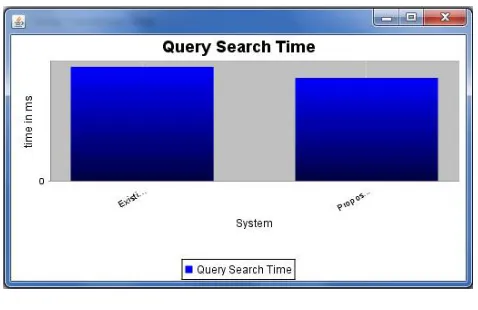
Above fig 1.2 shows comparison between existing system and proposed system. In the graph, x axis will be the methods K-NN and RK-NN and y axis will be time in ms. From the graph it is easily understand that the proposed system consumes less time, so the proposed system has low time complexity compared to the existing system.
Figure 1.2
VI. CONCLUSION
REFERENCES
[1] Charles Asanya and Ratan Guha, ”Space Partitioning for Privacy in Location-Based Services Continous Nearest Neighbor Query”,IEEE Transaction on Mobile Computing, pp 1408 – 141 , 3 June 2015.
[2] G.Ghinita et al, ”Privacy queries in location based services: Anonymizers are not necessary”, pp.121-132,Jun.9-12,2008.
[3] C.Asanya and R.Guha,”Anonymous Retrieval of k-NN POI in Location Based Services(LBS)”, In Proc.WORLDCOMP International Conference on Security and Management, SAM’13, pp.294-300, Jun.22-25,2013.
[4] Y.Huang and R. Vishwanathan, ”Privacy Preserving Group Nearest Neighbor queries in location-based services using cryptographic techniques” ,in Proc.GLOBECOM’,Conference Publication,pp.1-5., 10,Dec,6-10,2010.
[5] H.G.Elmongui, M.F.Mokbel and W.G.Aref,”Continuous aggregate nearest neighbor queries”, in Journal on Advances of Computer Science for Geographic Information Systems,Vol.17 ,pp.63-95, Jan 2013.
[6] Y.Tao,D.Apadias and Q.Shen(2002, Aug.) Continuous nearest neighbor search.
[7] O.Atsuyuki, B.Boots and K.Sugihara,”Spatial Tessellations: Concepts and Applications of voronoi Diagram”, John Wley and Sons Ltd ,vol 2, 2002.
[8] Z.Geng,K.Xuan,W.Rahayu,D.Taniar,M.Safar,M.L.Gavrilova and B.Sr.inivasun,”Voronoi-based continuous k-NN search in mobile navigation”,in IEEE transaction on Industrial Electronics ,Vol.58 ,pp.2247-2257, 1997.
[9] R.J.Nicholas,”Hilbert-type space-filling curves”,2001.
[10] A.Guttman,”R-trees: A Dynamic Index structure for spatial searching ”,P4.roc-Int’l Conf. management of Data,pp.47-54,198, Dec 2010. [11] V. Srilakshmi and P. Dhamodharan, “Higher Confidentiality through Grouping Hilbert and Voronoi over Validation of K-Nearest Neighbor