TFIDF Classification Using Movie Datasets
Ganesh K. Shinde1, Sachin N. Deshmukh2
M.Tech Student, Dept. of Computer Science and Information Technology, Dr B. A. M. University, Aurangabad,
Maharashtra, India1
Professor, Dept. of Computer Science and Information Technology, Dr B. A. M. University, Aurangabad,
Maharashtra, India2
ABSTRACT: In Sentiment Classification refers to the computational techniques for classifying whether the sentiments of movie review are positive or negative. Statistical Techniques based on Term Frequency and Term Presence, using Support Vector Machine used Sentiment Classification. This paper presents approach for classifying a term as positive or negative established on its frequency in positively labeled documents is compared with negatively labeled documents. Our approach is related on term weight methods that are used for information obtain and sentiment classification. It differs particularly from these standard methods due to our model of logarithmic differential term distribution for sentiment classification. Terms with approximately equal to distribution in positively labeled documents and negatively labeled documents were classified. Our model was estimated by compare with state of art methods for sentiment classification using the movie review dataset.
KEYWORDS: Sentiment Analysis, TFIDF, Term presence and Term Frequency, Support Vector Machine..
I. INTRODUCTION
The Internet world which is vastly enlarging facility of information has recognized from read only to read write. The development of the internet as a means of discussion between people, many advanced methods have been recognized in order to agree people to treat themselves additional in this form of communication. As a result of this happening, increasing numbers of sentiments and feelings are being spread and declare over the internet. Organizations now supply opportunity to the user to express their visions on the products, judgments and news that are released [1].Word-based information can be distributed into two main domains: facts and opinions. While facts focus on objective data transmission, the opinions express the sentiment of their authors. The research has frequently focused on the categorization of the accurate data. We have web search engines which enable search based on the keywords that describe the topic of the text. The search for one keyword can return a large number of pages. Articles contain both objective facts about the movie franchise (e.g. Wikipedia article) and subjective opinions from the users (e.g. review from critics).In current years, we became observers of a vast number of websites that allow users to contribute, modify, and evaluation the content. Users have chance to express their own opinion about particular topics. The examples of such web sites include blogs, product review sites, movie reviews,forums, social networks. Opinion can be expressed in different forms. These reviews tend to be longer, usually consisting of a few paragraphs of text. With respect to their length and comprehensiveness they tend to resemble blog messages. Other type of web sites contain commonly short comments, like status messages on social networks like Twitter, or article reviews on Digg. Additionally many web sites allow rating the popularity of the messages which can be related to the opinion expressed by the author [2].
sentimental i.e. subjective or objective. Lin, He and Everson have also worked on extracting only subjective part from a given document before classifying its polarity [7].A set of documents is used as training set to the classifier. These documents are represented as vectors. Every term in the document is an element in the vector in SVM approach for text mining. Term Presence and Term Frequency are two popular techniques for Information Retrieval when representing documents as vectors. In Term Presence technique an element can take a binary weight. This element is set to “1”, if the term is present in document otherwise set to “0” if the term is not present in document. In Term Frequency technique an element in the document vector is a non-negative integer that is set to count of the given term in a document [8].Sentiment Classification the training dataset consists of reviews tagged as positive and negative. All reviews tagged positive are called positively tagged documents whereas all reviews tagged negative are called negatively tagged documents. Every element in the vector represents a term that occurred in some document/s of training set. Each element of vector has two counts associated with it. One count is number of times of occurrence of that term in positively tagged documents and other is number of times of occurrences in negatively tagged documents [9].
II. RELATEDWORK
Pang, Lee and Vaithyanathan prepared the foundation of connecting supervised machine learning techniques for Sentiment Classification. They are also establishes for extracting, transforming and tagging 2000 reviews of the popular movie review dataset. Naive Bayes, Support Vector Machinesand Maximum Entropy classification algorithms were useful on unigrams and bigrams features and weights, retrieved from this movie review dataset. They determined that sentiment analysis problematic requirements to be controlled in a extra sophisticated method as compared to traditional text categorization methods. SVM classifier applied on unigrams created best results distinct information retrieval where bigrams generate accuracy as compared to unigrams [10].
Zaidan, Eisner, and Piatko presented “annotator rationales”. Phrases and words that describe the polarity of the document giving to human annotators. By removing rationale text lengths from the original documents they created some difference documents and controlled the SVM classifier to classify them less confidently than the originals. Using the largest training set size, their method meaningfully improved the accuracy on movie review data set. Wang and Dong determined semantic information and grammatical knowledge into a lower dimension vector to characterize text for the resolves of sentiment classification. Grammatical knowledge-embedding representation methods were used to provide extra information for the classification algorithm. Reduced the space complexity. Larger text contained more information about the semantic orientation features. Sometimes larger text contained subjective information that had opposing sentiments [11].
Ghosh and Iperrotis establish that reviews with combination of subjective and objective sentences had more control on sales of a product as associated to reviews with decently subjective sentences. Random forest established classifier was used to classify reviews. The impact of subjectivity, readability,linguistic,information correctness in reviews affected in manipulating sales and apparent usefulness. Li and Liu obtained stable clustering for opinion clustering by applying a TFIDF weighting method, voting mechanism and introducing term scores [12].
Lin, Everson and Ruger preprocessed reviews to retrieve words. Noise such as numbers,punctuation and non-alphabet characters were deleted. Stemming was useful so that the associated terms fall in clusters, thus dropping the vocabulary classes. MPQA and lexicons were combination stemmed and cleaned to generate a new lexicon which was used to classify the document regardless of the domain [13].
III.PROPOSED TECHNIQUES
Term Frequency–Inverse Document Frequency is a statistical method to index the term as per their importance. TFIDF is based on review and term vectors that represent term presence as well asterm frequency. Term presence could be created if term frequency vector is obtainable but vice-versa is not possible.
a term in positively tagged documents is larger than its average frequency in negatively tagged documents the term is assigned positive polarity.
If the average frequency of a term in negatively tagged documents is larger than its average frequency in positively tagged documents the term is assigned negative polarity. The average frequency of a term for positively tagged documents is calculated by dividing total count of the term across positively tagged documents by total count of documents in which the term is present. The numerator can be computed and from term frequency matrix and denominator using term presence matrix.
Movie dataset with 250 positively tagged text documents and 250 negatively tagged text document were used in all the experiment. These review text files size varied from 1KB to 10 KB. Number of words per document varied.
A list of terms that occurred in the documents was prepared. A term is entered only once in this term list. A document vector was constructed for every document. Every ith element in this vector was count of ith term in this document. If a term in term list was not present in the document the count associated with that term was set to zero. These vectors were used to calculate term polarity for the terms in the term list.
Experiment was conducted to determine that term t should be classified as SentiWord if LDPt equal to zero or it specified range.
Figure1 : Flow Diagram of Term polarity
Figure 1 show the system flow of Sentiword classification. In first part the positivity of a term is calculated. Similarly negativity of a term is calculated in second part. Third part classifies the term as positive, negative or neutral based on its proportion of positivity and negativity calculated in previous steps.
Using the term frequency and presence matrix, frequency of term in positively tagged documents and number of positive documents that contain term can be computed as summation of count of terms in documents. Number for positively tagged documents with term is calculating by summations of presence of terms in documents.
Similarly in second part the negatively tagged documents are represented as document vectors i.e. in form of term presence vector and term frequency vector. Negativity of the terms is calculated using average frequency of term in negatively tagged documents, vectors, as in Negativity of term.
If positivity of a term is larger than negativity of the same term than the term is classified as positive. Conversely, if negativity of a term is larger than positivity of the same term then the term is classified as negative in the third part using Logarithmic differential Polarity and “(1)”. A term is classified as neutral if its positivity equals negativity.
(1)
If negativity of a term was zero the model would have been affected by divide by zero error. So we added a small value 0.001 to Negativity of term i.e. denominator part. As a result, the term was classified as positive if positivity of term was nonzero and neutral if positivity of the term was also zero.
Similarly if Positivity of term is 0 and Negativity of term is not equal to zero then the term should be classified as negative. This is accomplished by adding a negligible value 0.001 to the numerator. Stop-words are handled while computing Positivity of term and Negativity of term. If a term frequently occurred in many positive and negative documents then Positivity of term approximately equals Negativity of term. Thus Logarithmic Differential Polarity of term = log 1 = 0 and Polarity of termwould be computed zero using Logarithmic Differential Polarity of term and “(1)”. These are classified as neutral terms. Our model handles specialized class of stop-words called as senti-stop-words. The terms whose positivity equals negativity are classified as neutral using Logarithmic Differential Polarity as log 1 equals zero.
Stimulation And Results:
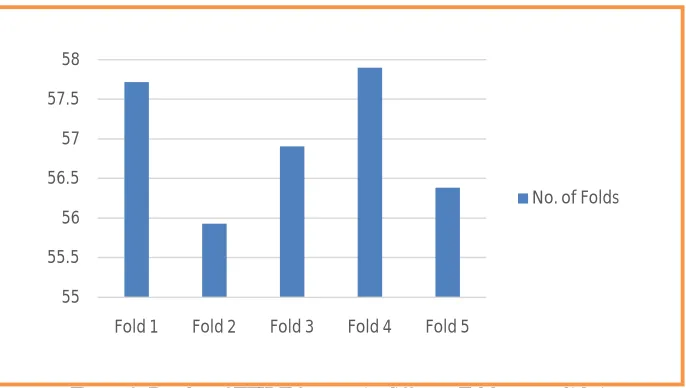
For calculating accuracy using 10 fold cross validation varying range from LDPt. It can be between 1, 0 and -1. In that using 90% training data and 10% testing data in using TFID features classified by Support Vector Machine Classification.
Table 1: Accuracy of TFIDF features in different Fold cross validation
Fold Accuracy
1 57.72
2 55.93
3 56.91
4 57.90
5 56.39
1 0
−1
Polarity of term= if Logarithmic Differential Polarity
The graphical representations showing
Figure 2: Barplot of TFIDF features in different Fold cross validation
IV. CONCLUSION
From the results of the experiments conducted it can be observed that accuracy of TFIDF features that 4 fold is greater as compare to remaining folds. TFIDF efficiently handles absence of a term in positively and / or negatively tagged documents, thus eliminating divide by zero error as well as term getting wrongly classified. Frequency and presence of a term in all the documents is an important aspect of Information Retrieval. Considers frequency and presence distribution of a term across positively and negatively tagged documents. We calculating Positivity term and Negativity term. These term to evaluate Logarithmic Differential Polarity. So these value getting between 1, 0 and -1. So getting accuracy for no. of folds 1, 2, 3, 4, 5. These accuracy is 57.72%, 55.93%, 56.91%, 57.90 and 56.39 In future we aim to experiment the effect of other distributional count associated with terms.
.
REFERENCES
[1] H. Chen, “Business and Market Intelligence 2.0”. In IEEE Intelligent Systems,vol. 25,issue no. 01, Page No. 68–71, 2010. [2] Kuat Yessenov, Sasa Misailovi ˇ c, “Sentiment Analysis of Movie Review Comments”. In Spring, Page No. 1-17, 2009.
[3] B. Pang and L. Lee, “Opinion mining and sentiment analysis,” Foundations and Trends in Information Retrieval, vol. 2, nos. 1–2, Page No.. 1–135, 2008. [4] J. Martineau and T. Finin, “Delta TFIDF: An Improved Feature Space for Sentiment Analysis,” In Proc. of 3rd Int’lAAAI Conf. on Weblogs and Social Media,
Page No.258-261, 2009.
[5] L. Lee and B. Pang, “Seeing Stars: Exploiting Class Relationships for Sentiment Categorization with Respect to Rating Scales,” In Proc. of Ann. Meeting Assoc. Computational Linguistics, Page No. 115-124, 2005.
[6] E. Cambria, R. Speer, C. Havasi, and Amir Hussain, “SenticNet: A Publicly Available Semantic Resource for Opinion Mining,” In Proceedings of AAAI Conf. on Commonsense Knowledge, Page No. 14-18, 2010.
[7] C. Lin, Y. He, and R. Everson, “Sentence subjectivity detection with weakly-supervised learning,” In Proc. of 5th Int’l Joint Conf. on Natural Language Processing,Page No. 1153–1161, 2011.
[8] E. Cambria, B. Schuller, Y. Xia, and C. Havasi, “New Avenues in Opinion Mining and Sentiment Analysis,” In IEEE Intelligent Systems, vol.28, no.2,Page No.. 15-21, 2013.
[9] G. Paltoglou and M. Thelwall, “A study of Information Retrieval weighting schemes for sentiment analysis,” In Proc. Of 48th Annual Meeting of the Association for Computational Linguistics, Page No. 1386-1395, 2010.
[10] B. Pang, L. Lee, and S. Vaithyanathan, ”Thumbs up? sentiment classification using machine learning techniques,” In Proc. of Conf. on Empirical Methods in Natural Language Processing, Page No. 79-86, 2002.
[11] O.F. Zaidan, J. Eisner, and C.D. Piatko, “Using Annotator Rationales to Improve Machine Learning for Text Categorization,” In Proc. of Conf. of North American Chapter of the Association for Computational Linguistics, Page No.260–267, 2007.
[12] Ghose and P. G. Ipeirotis, "Estimating the Helpfulness and Economic Impact of Product Reviews: Mining Text and Reviewer Characteristics," In Knowledge and Data Engineering, IEEE Transactions, vol.23, issue no.10, Page No. 1498-1512, 2011.
[13] Lin, Y. He, R. Everson, and S. Ruger, "Weakly Supervised Joint Sentiment-Topic Detection from Text," In Knowledge and Data Engineering, IEEE Transactions, vol.24,issue no.06, Page No. 1134-1145,2012.
55 55.5 56 56.5 57 57.5 58
Fold 1 Fold 2 Fold 3 Fold 4 Fold 5