Dynamic Analysis of Piled Block Foundation
Using SAP: 2000 VS. 18
Chandni Sheth
1, Dr. S.J. Shukla
2, Dr. A. K. Desai
3M. Tech Student, Department of Applied Mechanics, SVNIT, Surat, Gujarat, India1 Assistant Professor, Department of Applied Mechanics, SVNIT, Surat, Gujarat, India2 Associate Professor, Department of Applied Mechanics, SVNIT, Surat, Gujarat, India3
ABSTRACT:The design of a machine foundation is more complex than that of a foundation which supports only static
loads. In machine foundations, the designer must consider, in addition to the static loads, the dynamic forces caused by the working of the machine. These dynamic forces are, in turn, transmitted to the foundation supporting the machine. In the present work, pile is chosen as supporting system for block foundation. The foundation system was simulated in SAP: 2000 VS.18 software and dynamic response of foundation was analyzed. The results are compared and validated with the mode shapes and frequencies published in the book "Foundations for Industrial Machines" published by Dr. KG Bhatia.
KEYWORDS: Rotary machine, Piled block foundation, Soil structure interaction, Dynamic analysis, SAP: 2000 VS.
18.
I. INTRODUCTION
Introduction of piling in the machine foundation system will affect damping, mass and stiffness. In addition, stiffness can be proved as a quantifiable design variable. So that the designer can use one more accurate variable, stiffness. With the use of stiffness foundation becomes less massive. Reinforced concrete piling are quite competent for axial loads and inflexure to take lateral components and are most resistant to the many deleterious elements in the air-soil-water interactive zone.
Bharathi M., Dr. Saran Swami and Dr. Mukerjee Shyamal(2012)described the behavior of reciprocating
machines resting on piles. MATLAB programs were developed for different modes of vibration and the machine foundation system was analyzed for different soil, pile and machine parameters. Dr. Sevelia Jigar K., Patel Utkarsh
S., Mangukiya Siddharth H., Miyani Ankit L., Patel Hardik A. and Vora Smit V.(2015) studied
thedynamicbehaviour of a foundation structure for blower type machine subjected to forces due to operation of blowermachine. Chun-yu Song, Long-zhu Chen, and Rui-feng Wang has reviewed the conventional dynamic tests of composite foundation and the velocity or mechanical admittance method for a block on the single-piled composite foundation is then recommended in this paper. M.Z. Asik and C.V.G. Vallabhan developed a simplified semi-analytical method, to compute the response of a rigid strip and circular machine foundations.
Dr. Mohammed Y. Fattah and Dr. Mohammed J. Hamood concluded that as the pile cap thickness increases, the
II. A PROBLEM VALIDATION IN SAP 2000 V 18
The rotary machine, which is investigated, consists of driving rotor. It is laid on the RCC block foundation which is supported by nine reinforced concrete piles. Reinforced concrete with the M20.A finite element model of the structure was made in the software for the finite element analysis SAP 2000 V 18 . Weight of the rotary machine is 100.00 t. Machine operating speed is 50Hz.
III. INPUT DATA
Machine weight = 100 t
time history analysis input
period 0.06 number of steps per cycle
20
number of cycles
20
amplitude 1
Rigid Foundation Block
Length 4.0 m
Width 2.0 m
Height 3.75 m Poisson’s ratio μ 0.15
Specific mass density ρ
2500 kg/m3 = 2.5 t/m3
Modulus of elasticity
2 x 10⁷ kN/m2
Soil
Poisson’s ratio μ 0.33
Specific mass density ρ
1800 kg/ m3= 1.8
t/m3
Modulus of elasticity E
89218 kN/m2
Co-efficient of uniform compression Cu
4.48x10⁴ kN/m3
Soil spring stiffness
Translational : kx = kz = 17.97 x 10⁴ kN/m
ky = 35.94 x 10 4
kN/m
Rotational : kθ = 95.5 x 10⁴ kNm/rad (about X – axis)
kϕ = 23.9 x 10⁴ kNm/rad (about Z – axis)
Pile
Length 5 m
Number of pile 9
Diameter of pile 0.45 m
IV. MODELLING METHODOLOGY
The block and pile for the Rotary Machine, piled block foundation has been modeled in SAP 2000 VS 18 using solid Elements. Use of solid elements in SAP 2000 gives excellent results for the Free Vibration analysis/ Modal analysis. The entire machine load acts on the centre of gravity (C.G.) of component. The machine is connected to the top of the foundation at the bearing points using rigid links. The soil structure interaction is obtained by modeling soil as spring which is connected to the bottom of the block. The block is supported by 9 piles. Translational and rotational spring stiffness are given to the piles to model surrounding soil.
Figure 1 : Piled block foundation model using SAP 2000 v 18
V.RESULTS AND DISCUSSION
The results of displacements of different modes of referenced book are compared with the model developed in SAP2000 software. The percentage difference is quite law.
First Six Natural Frequencies in Hz Mode Number KG Bhatia Our research work in
SAP 2000 V 15
Percentage difference
1 3.62 3.96 8.58
2 5.62 4.66 17.08
3 9.44 7.88 16.52
4 10.89 10.23 6.06
5 15.39 15.9 3.20
VI. TIME HISTORY ANALYSIS
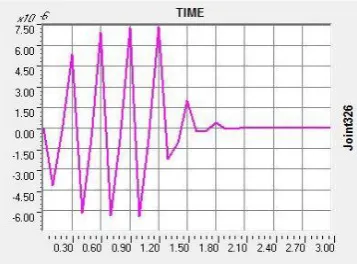
Time history analysis has been done at all the bearing locations and at the end of the pile tip. Maximum displacement is between 7 x 10⁻⁶ m to 9 x 10⁻⁶ m and minimum displacement is found to be in between -6 x 10⁻⁶ m to -4 x 10⁻⁶ m. Here in figure time history plot has been shown, in which time is plotted on X – axis and displacement is plotted on Y – axis.
Figure 4 : Time history analysis curve at end of the pile
VII. CONCLUSION
For block foundation resting on soil, piles and soil can be modeled by spring elements, the dynamic behavior can be represented accurately. It is recommended for block foundation to include the whole structure and replace the soil / piles by spring elements. The eigen value increases with each mode. From the results we can conclude that by inserting pile in block foundation, value of displacement can be minimized.
Figure 2: Mode Shape1 translational vibration along Z direction 3.96 Hz
REFERENCES
1) Bhatia, K. G., “Foundation for Industrial Machines", 1st ed. 2008, published by D- CAD Publishers, New Delhi, p.675, (2008a)
2) Bhatia, K. G., “Foundations for Industrial Machines and Earthquake Effects", ISET Journal of Earthquake Technology, Paper No. 495, Vol 45, No 1-2, pp. 13-29, 28th ISET Annual Lecture. Center for Applied Dynamics, D-CAD Technologies, New Delhi, (2008b)
3) Bowles, J. E., "Foundation Analysis and Design", Fifth Edition, Engineering Computer Software, Peoria, (1997). 4) Braja M. Das, “Principle of soil dynamics”PWS-KENT publishing company, Boston
5) Chowdhury Indrajit, Dasgupta P. Shambhu , Dynamics of Structure and foundation – A Unified Approach, Taylor & Francis Group, London, UK, 2009.
6) Chun-yu Song, Long-zhu Chen and Rui-feng Wang “Dynamic Response and Sensitivity Analysis of block on single-piled composite foundation” GSP 164 Innovative Applications of Geophysics in Civil Engineering, 2007
7) Dr. Mohammed Y. Fattah and Dr. Mohammed J. Hamood, “Behavior of machine foundations resting on piles.” (2012)
8) Dr. Sevelia J.K., Patel U. S., Mangukiya S. H., Miyani A. L., Patel H.A., Vora S. V., “Dynamic Analysis of Foundation Supporting Rotary Machine”, International Journal of Engineering Research and Applications ISSN: 2248-9622, Vol. 5, Issue 8, (Part - 2), pp.34-45, 2015. 9) M. Bharathi, Dr. Swami Saran and Dr. Shyamal Mukerjee “Analysis of reciprocating machine foundations resting on piles” ISET golden
jubilee symposium, Indian Society of Earthquake Technology, Department of Earthquake Engineering Building, IIT Roorkee, October 20-21, 2012
10) M. Gohnert, I. Luker and C. Morris, “Designing foundations with piles for vibrating machinery”,The Open Construction and Building Technology Journal, 2, 306-312,1874-8368/,2008
11) M. Z. Asik and C.V.G. Vallabhan, “A simplified model for the analysis of machine foundations on a non saturated, elastic and linear soil layer”, Computers and Structures ,79 2717-2726,2001
12) Novak, M., "Dynamics and Damping of Piles," Canadian Geotechnical Journal, Vol 11, No. 4, p.p. 574-598,1974 13) P. Srinivasula and C.V. Vaidyanathan “Handbook of machine foundation”, McGraw Hill
14) Piyush K. Bhandari, Ayan Sengupta, “Dynamic analysis of machine foundation”, International Journal of Innovative Research in Science, Engineering and Technology,Vol 3, Special Issue 4, April 2014
15) Prakash, S. and Puri, V.K. , "Foundation for Vibrating Machines", Special Issue, Journal of Structural Engineering, SERC, Mad ras, India,, April-May 2006.
16) Rajesh Prasad Shukla and Nihar Ranjan Patra, “An experimental study of vertically loaded pile groups”,5th Young Indian Geotechnical Engineers Conference 2015,Vadodara, India, , March 14-15, 2015,
17) Ramesh S., Kumar V. V., “Parametric Study on an Industrial Structure for Various Dynamic Loads”, IJRET: International Journal of Research in Engineering and Technology eISSN: 2319-1163 pISSN: 2321-7308 , Volume: 04 Issue: 02, pp- 134-143, 2015.
18) Ramesh S., Kumar V. Vinoth, “Parametric Study on an Industrial Structure for Various Dynamic Loads”, International Journal of Research in Engineering And Technology (IJRET), Feb-2015
19) S. K. Guha, “Vibration studies of block type machine foundations” first international conference on case histories in geotechnical engineering,1984
20) S. Santosh Kumar Prusty, “Dynamic response of pile foundations under coupled vibration”, B.tech,Final Year Project submitted to National Institute of Technology, Rourkela, May 2012.
21) Sheta, M. and Novak, M., 'Vertical Vibrations of Pile Groups," Journal of Geotechnical Engineering., ASCE, Vol 108, No. GT4, p.p. 570-590, April 1982
22) William E. saul and Thomas W. wolf,” Applications for new research for pile supported machine foundations” ,Annual Convention(1979), American Concrete Institute, Milwaukee, Wisconsin, U.S.A.,March 18 to 23, 1979.
23) Yati R. Tank, Akhilesh R. Tank, Hitesh K. Dhameliya “Dynamic Analysis of Single Cylinder Compressor Block Foundation using SAP: 2000 VS. 16” International Journal of Engineering Trends and Technology (IJETT) ,Volume 33 Number 7, March 2016