DOI: 10.1534/genetics.104.034769
Workshop Report
A Workshop Report on Wheat Genome Sequencing:
International Genome Research on Wheat Consortium
Bikram S. Gill,*
,1Rudi Appels,
†Anna-Maria Botha-Oberholster,
‡C. Robin Buell,
§Jeffrey L. Bennetzen,
¶Boulos Chalhoub,
&Forrest Chumley,** Jan Dvorˇa´k,
††Masaru Iwanaga,
‡‡Beat Keller,
§§Wanlong Li,* W. Richard McCombie,
¶¶Yasunari Ogihara,
&&Francis Quetier*** and Takuji Sasaki
†††*Plant Pathology Department, Kansas State University, Manhattan, Kansas 66506-5502,†Department of Agriculture, Murdoch University,
6983 Perth, Western Australia, Australia,‡Department of Genetics, Forestry and Agricultural Biotechnology Institute, University of Pretoria,
ZA-0002 Pretoria, South Africa,§The Institute for Genomic Research, Rockville, Maryland 20850,¶Department of Genetics,
University of Georgia, Athens, Georgia 30602,&Unite´ de Recherches en Ge´nomique Ve´ge´tale , Evry, 91157 Cedex, France, **Kansas Agricultural Experiment Station, Kansas State University, Manhattan, Kansas 66506,††Department of
Agronomy and Range Science, University of California, Davis, California 95616-8515,‡‡International Maize and
Wheat Improvement Center, Lisboa 27, 06600 Mexico, D.F., Mexico,§§Institute of Plant Biology,
University of Zu¨rich, CH-8008 Zu¨rich, Switzerland,¶¶Cold Spring Harbor Laboratory,
Cold Spring Harbor, New York 11724,&&Kihara Institute for Biological Sciences,
Yokohama City University, Yokohama 244-0813, Japan,***GENOSCOPE, Evry, 91057 Cedex, France and†††Genome Research Department,
National Institute of Agrobiological Sciences, 305-8602 Tsukuba, Ibaraki, Japan
ABSTRACT
Sponsored by the National Science Foundation and the U.S. Department of Agriculture, a wheat genome sequencing workshop was held November 10–11, 2003, in Washington, DC. It brought together 63 scientists of diverse research interests and institutions, including 45 from the United States and 18 from a dozen foreign countries (see list of participants at http://www.ksu.edu/igrow). The objectives of the workshop were to discuss the status of wheat genomics, obtain feedback from ongoing genome sequencing projects, and develop strategies for sequencing the wheat genome. The purpose of this report is to convey the information discussed at the workshop and provide the basis for an ongoing dialogue, bringing forth comments and suggestions from the genetics community.
WHEAT AS AN IMPORTANT CROP SPECIES by 2050, grain production must increase at an annual
rate of 2% on an area of land that will not increase Wheat was the first domesticated crop and is the
youn-much beyond the present level. Significant advances in gest polyploid species among the agricultural crops (see
the understanding of the wheat plant and grain biology Figures 1–3 for background information). Together
must be achieved to increase absolute yields and protect with rice and maize, wheat provides⬎60% of the
calo-the crop from an estimated average annual loss of 25% ries and proteins for our daily life. Wheat is best adapted
caused by biotic (pests) and abiotic stresses (heat, frost, to temperate regions, unlike rice and maize, which
pre-drought, and salinity). Genome sequencing is a widely fer tropical environments. Wheat occupies 17% of all
accepted mechanism for accelerating achievement of crop area (in 2002, 210 million hectaresvs.147 million
these objectives, because it leverages similar work from for rice and 139 million for maize). The trade value of
other crops and plants and enables more rapid genetic wheat exceeds that of any other cereal species, including
improvement. In addition to food security, wheat ge-rice and maize: $31 billion of world trade in 2001vs.$13
nome sequencing will lead to improved human health and $19 billion for rice and maize (FAOstat database:
and nutrition. http://apps.fao.org/default.jsp). To meet human needs
CEREAL GENOME STRUCTURE
1Corresponding author:Plant Pathology Department, Throckmorton
Rice, maize, and wheat, which coevolved from a
com-Hall, Kansas State University, Manhattan, KS 66506-5502.
E-mail: [email protected] mon ancestorⵑ55–75 million years ago (Kellogg2001;
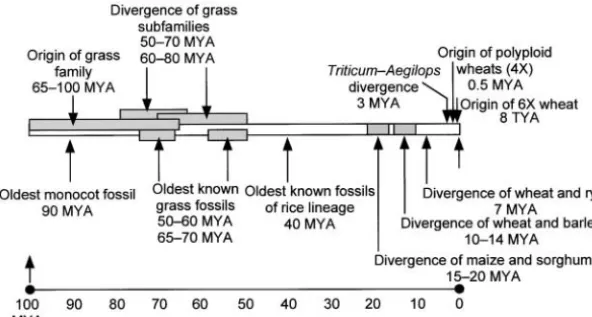
Figure1.—Grasses as a single genetic system and recent coevolutionary history of cereals and humans. Grasses originated 55–75 million years ago and now dominate 20% of the land area. The three major cereals (rice, maize, and wheat), which diverged from a common ancestor ⵑ40 million years ago, provide most of the food for humans. Humans and wheat share a remarkably parallel evolutionary history. About 3 million years ago, humans diverged from apes, and dip-loid A, B, and D progenitor species of wheat di-verged from a common ancestor. About 200,000 years ago, at nearly the same time that modern humans originated in Africa, two diploid grass species hybridized to form polyploid wheat in the Middle East. Humans domesticated wheat ⵑ15,000 years ago in the fertile crescent (modern-day Iraq and parts of Turkey, Syria, and Iran), marking the dawn of modern civilization. Comparative genetic and genomic studies during the last 10 years revealed extensive synteny among major cereals, and the concept of grasses as a single genetic system emerged. The genome sequence of rice (420 Mb) is nearly completed, and it will serve as the anchor genome to promote gene discovery in all cereals. However, recent data suggest that most domestication-driven, agronomic, and end-use traits, as well as those genes involved in landmark speciation events such as polyploidy, are crop and species specific. The emerging view is that DNA sequence information of all key species is essential for investigating grasses as a single genetic system. Maize (2500 Mb) genome sequencing is underway, and wheat (16,000 Mb) genome sequencing was discussed at the workshop. Figure courtesy of W. J. Raupp, based on discussions with P. F. Byrne, Colorado State University, Fort Collins, with additional data fromHuang
et al.(2002).
Figure 1), differ greatly in genome size. Among agricul- important genes from large cereal genomes based on microcolinearity. However, small translocations, dele-tural crops, common bread or hexaploid wheat (
Triti-cum aestivumL., 2n⫽6x⫽42, AABBDD) has the largest tions, inversions, and duplications often violate micro-colinearity and complicate this process (Tikhonov et
genome at 16,000 Mb,ⵑ8-fold larger than that of maize
and 40-fold larger than that of rice (Arumuganathan al., 1999;KellerandFeuillet2000;Dubcovskyet al.
2001; Li and Gill 2002; Sorrells et al. 2003). Most
and Earle 1991). Amplification of transposable
ele-ments (TEs), coupled with duplication of chromosome importantly, there is little colinearity for disease resis-tance genes due to their rapid evolution among grasses segments, was a major driving force for cereal genome
expansion, although polyploidization also contributed (Leister et al. 1998). Sequence comparisons between rice and the wheat genomic regions that harbor the to the large genome size of wheat. The rice genome at
430 Mb consists of at least 22% TEs (Ma et al. 2004). genesLr10,Pm3(Guyotet al.2004),Q, andTsn1(J. D.
Faris, J. P. Fellers, H. Lu, K. M. HaenandB. S. Gill,
The maize genome atⵑ2500 Mb consists of⬎50% TEs
(Meyerset al.2001,Whitelawet al.2003). About 90% unpublished results) detected extensive
microrearrange-ments or complete loss of microcolinearity. All this sug-of the wheat genome consists sug-of repeated sequences
and 70% of known TEs (Liet al.2004). Low-copy TEs gests that rice will often not be a good model for posi-tional cloning in wheat. However, sequencing the wheat and miniature inverted repeat TEs are most often
associ-ated with active genes, but high-copy TEs mainly insert genome will advance comparative studies of grass ge-nomes and lead to better understanding of the relation-in the relation-intergenic space (SanMiguelet al.1996, 2002).
Gene distribution along chromosomes is relatively ho- ship among grass lineages (Freeling2001).
Comparative analysis of orthologous sequences from mogeneous in the small genome of rice, but gene
clus-ters (gene-rich regions) are separated by long stretches two related species has been a powerful tool forde novo
prediction of genes and identification of noncoding of TEs (gene-poor or gene-free regions) in the wheat
genome, as demonstrated by deletion mapping (Gill functional elements on the basis of the assumption that sequences conserved among species that have diverged
et al.1996a,b;Fariset al.2000) and BAC-based physical
mapping (J. Dvorˇa´k, unpublished results). Within for many millions of years must have functional roles in their genomes. Comparison of human and mouse some gene-rich regions of the wheat genome, gene
den-sity is similar to that of smaller genomes (Feuilletand genome sequences increased the specificity of genome annotation in both species (Mouse Genome
Sequenc-Keller1999).
Comparative mapping of cereal genomes using a stan- ing Consortium 2002). Alignment of sequences or-thologous to a 1.8-Mb region of human chromosome dard set of probes showed extensive conservation in
gene content and order at a low-resolution genetic map 7q31, from several animal genomes, detected numerous functional elements such as transcription-factor-binding level. It seems a logical choice to use the small genome of
Figure2.—By 1915, botanists had described three classes of cultivated wheats; the one-seeded monococcum (2x), the two-seeded emmer (4x), and the dinkel (6x). The one-seeded wild relative of monococcum was reported in Greece and Anatolia between 1834 and 1884. The two-seeded wild relative of emmer was discovered by Aaronsohn in 1910 in Lebanon, Syria, Jordan, and Israel. Therefore, it was well accepted, as Candolle had suggested in 1886, that since wild wheats grow in the Euphrates basin, wheat cultivation must have originated there. Between 1918 and 1925, T. Sakamura and his student H. Kihara at Hokkaido University in Japan and K. Sax at Harvard University reported their classic studies on the genetic architecture of the three groups of wheats. They analyzed meiosis in wheat species and hybrids and were the first to establish the basic chromosome number of seven and document polyploidy in the wheat group. This was an exciting observation and established polyploidy as a major macrospeciation process and wheat as a polyploid genetic model. This method of delineating species evolutionary relationships on the basis of chromosome-pairing affinities in interspecific hybrids came to be called the genome-analyzer method. These hybrids of course could also be exploited in plant breeding for interspecific gene transfers as well as in an approach of shuttle genetics where, for example, genetic mapping can be done in diploid wheat and aneuploid mapping in polyploid wheat. Chromosome figures fromZhang(2002).
2003). Similarly, a significant portion of rice genes were the A, B, and D genomes, derived from a common ances-tor (Figures 2 and 3). Despite their close homology, ho-identified on the basis of their similarities with
Arabi-dopsis genes at the protein sequence level. Comparison meologs are normally prevented from pairing by thePh1
gene on the long arm of chromosome 5B. Thus, common of genomic sequences of 52 orthologous genes of rice
and maize indicated that most genes contain conserved wheat functions much like a diploid organism, although it is able to tolerate aneuploidy due to the buffering effect noncoding sequences (CNSs) and that upstream
regula-tory genes tend to be enriched in CNSs (Inada et al. of polyploidy. Sets of viable mono-, tri-, and tetrasomic cytogenetic stocks were developed for all chromosomes, 2003). From this point of view, sequencing the wheat
and nullisomics were developed for 11 chromosomes genome will facilitate annotation of all plant genomes,
(Sears1954). Since the loss of a pair of chromosomes
especially grass genomes.
can be compensated by two additional doses of a homeo-log, 42 compensating nulli-tetrasomics were developed
CURRENT UNDERSTANDING OF THE WHEAT (Sears 1966). The monosomic chromosomes tend to
GENOME AND ITS SEQUENCE
misdivide and this property was exploited to produce a Common wheat is an allohexaploid consisting of series of chromosome-arm aneuploids: monotelosomics, seven groups of chromosomes, each group containing ditelosomics, tritelosomics, and iso-chromosome lines
(SearsandSears1978). More recently, taking advantage
of the gametocidal chromosome introduced from the strated that 70% of the genes and 82% of the total recombination distance were contained within two
ma-Aegilops cylindricahost,EndoandGill(1996) developed
436 segmental deletion lines in Chinese Spring (CS). All jor gene-rich regions (1S0.8 and 1S0.5) that physically of these genetic stocks, which are in the CS background, encompass only 14% of the arm (Sandhuet al.2001). have been used to localize genes or markers to a specific This picture of uneven wheat gene distribution has been chromosome, chromosome arm, or subarm region and strongly supported by the recent assignment of nearly play a central role in wheat genetics and genomics. 6000 wheat expressed sequence tags (ESTs) to 159 dele-The 21 wheat chromosomes can be readily identified tion bins across the 21 chromosomes (Qiet al. 2004). by heterochromatic banding (Gillet al.1991; see Figure Associated with recombination, gene duplications also 3) orin situhybridization patterns using repetitive DNA show similar distribution patterns along the wheat chro-probes (Pedersen and Langridge 1997). A specific mosomes (Akhunovet al.2003).
chromosome or chromosome arm can be flow sorted Currently, ESTs (ⵑ500,000 to date) are the largest at high purity using the genetic stocks (Vra´na et al. sequence resource for wheat. ESTs are cDNA clones, 2000). These sorted chromosomes have been used for and as such they do not contain promoters, introns, construction of chromosome-specific BAC libraries and other functional elements. The gene coverage of
(Safar et al. 2004), together with other genetic and human ESTs is 75%; of mouse, 56% (Mouse Genome
molecular resources for wheat genome sequencing Sequencing Consortium2002); of Arabidopsis, 60% (summarized in Table 1). (Arabidopsis Genome Initiative 2000); of tomato, Genes and recombination events are not randomly 47% (Van der Hoevenet al. 2002); and of rice, 36% distributed along wheat chromosomes. They are clus- (Fenget al.2002). It is estimated that the gene coverage tered in the distal regions, while proximal regions are of the wheat EST collection isⵑ60%, close to that of largely gene poor or gene free (Werner et al. 1992; Arabidopsis (Li et al. 2004), indicating that ⵑ40% of
Gillet al.1993, 1996a,b;Kotaet al.1993;Delaneyet wheat genes are not represented in EST collections.
al.1995a,b; Mickelson-Young et al. 1995; Faris et al. In addition to the more than half million ESTs,ⵑ6 2000;Wenget al.2000;Qiet al.2003). A detailed study Mb of wheat genomic DNA has been sequenced, includ-of the short arm includ-of the group 1 chromosomes demon- ingⵑ3 Mb from a random shotgun genomic library and
ⵑ3 Mb from large-insert genomic clones. BAC clones selected as hybridizing with specific genes revealed that gene density varies greatly, ranging from 1 (Fariset al.
2003) to 16 genes/BAC (Brookset al.2002), and that genes tend to be clustered into gene islands (Wicker
et al.2001;Brookset al.2002;SanMiguelet al.2002).
Feuillet andKeller (1999) reported a gene density
TABLE 1
Genetic and molecular resources that can be applied to wheat genome sequencing analysis
Target Genetic maps Physical genome resources
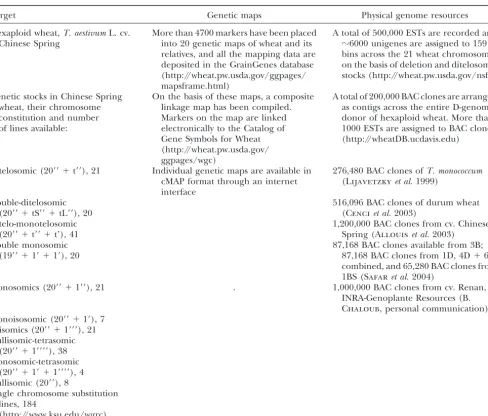
Hexaploid wheat,T. aestivumL. cv. More than 4700 markers have been placed A total of 500,000 ESTs are recorded and
Chinese Spring into 20 genetic maps of wheat and its ⵑ6000 unigenes are assigned to 159
relatives, and all the mapping data are bins across the 21 wheat chromosomes deposited in the GrainGenes database on the basis of deletion and ditelosomic (http://wheat.pw.usda.gov/ggpages/ stocks (http://wheat.pw.usda.gov/nsf) mapsframe.html)
Genetic stocks in Chinese Spring On the basis of these maps, a composite A total of 200,000 BAC clones are arranged
wheat, their chromosome linkage map has been compiled. as contigs across the entire D-genome
constitution and number Markers on the map are linked donor of hexaploid wheat. More than
of lines available: electronically to the Catalog of 1000 ESTs are assigned to BAC clones
Gene Symbols for Wheat (http://wheatDB.ucdavis.edu)
(http://wheat.pw.usda.gov/ ggpages/wgc)
Ditelosomic (20⬘⬘ ⫹t⬘⬘), 21 Individual genetic maps are available in 276,480 BAC clones ofT. monococcum
cMAP format through an internet (Lijavetzkyet al.1999) interface
Double-ditelosomic 516,096 BAC clones of durum wheat
(20⬘⬘ ⫹tS⬘⬘ ⫹tL⬘⬘), 20 (Cenciet al.2003)
Ditelo-monotelosomic 1,200,000 BAC clones from cv. Chinese
(20⬘⬘ ⫹t⬘⬘ ⫹t’), 41 Spring (Allouiset al.2003)
Double monosomic 87,168 BAC clones available from 3B;
(19⬘⬘ ⫹1⬘ ⫹1⬘), 20 87,168 BAC clones from 1D, 4D⫹6D
combined, and 65,280 BAC clones from 1BS (Safaret al.2004)
Monosomics (20⬘⬘ ⫹1⬘⬘), 21 . 1,000,000 BAC clones from cv. Renan,
INRA-Genoplante Resources (B.
Chaloub, personal communication) Monoisosomic (20⬘⬘ ⫹1⬘), 7
Trisomics (20⬘⬘ ⫹1⬘⬘⬘), 21 Nullisomic-tetrasomic
(20⬘⬘ ⫹1⬘⬘⬘⬘), 38 Monosomic-tetrasomic
(20⬘⬘ ⫹1⬘ ⫹1⬘⬘⬘⬘), 4 Nullisomic (20⬘⬘), 8
Single chromosome substitution lines, 184
(http://www.ksu.edu/wgrc)
The listed BAC libraries are public resources and free of IPR.
of 1 gene/4–5 kb within a small segment on chromosome (BamHI, EcoRI, XbaI, and XhoI) and a 4-bp restriction endonuclease (HaeIII). Subsequently, each of the four 1A. The 600-kb contig at theTsn1locus on chromosome
5B contained 13 genes at an average gene density of 1 recessed 3⬘ends generated by the four 6-bp restriction enzymes is labeled with a different fluorescent dye and gene/46 kb (J. D. Faris, J. P. Fellers, H. Lu, K. M. Haen
andB. S. Gill, unpublished results). However, 9 of these the fragments are sized using a capillary DNA sequencer
(Luoet al.2003a). At the same time, wheat RFLP mark-genes were located within a 90-kb segment, resulting in a
gene density of 1 gene/10 kb. In contrast,Faris et al. ers and ESTs have been placed onto the physical map to anchor the BAC contigs to genetic maps and deletion (2003) found only three known genes within a 300-kb
BAC contig spanning the Q locus on chromosome 5A, bins (Luoet al.2003b). yielding an estimate of 1 gene/100 kb. Large tracts of
repetitive elements with very few intervening low-copy
non-SELECTION OF A TARGET WHEAT GENOME
coding sequences separated the three genes.
FOR SEQUENCING
The physical map of the D-genome donor species
Aegi-lops tauschiiCoss. is under construction. Five BAC libraries Ancient or modern farmers have grown four wheat species: einkorn (monococcum), emmer (durum), ti-have been constructed and fingerprinted using a new,
used for food production, accounting for 4 and 96% present in only one of the three homeologous chromo-somes; the Phpairing-control genes mentioned above of the total wheat acreage, respectively. The diploid
relatives of bread wheat have smaller genomes than are located on chromosomes 5B and 3D; grain hardness geneHa is located only on 5D because the copies on that of hexaploid wheat (5500 Mbvs.16,000 Mb), and
sequencing one of them should require approximately 5A and 5B were eliminated after polyploidization ( Gau-tieret al.2000).
one-third of the time and expense of sequencing
hexa-ploid wheat. However, in addition to its great economic Comparative sequence analyses have demonstrated that plant genomes are more dynamic than animal ge-importance, there are several lines of evidence that led
many participants to favor sequencing common wheat. nomes. Studies on thebz(Fuand Dooner2002) and
z1C(SongandMessing2003) regions of maize revealed
The A, B, and D subgenomes of common wheat have
undergone dynamic evolution since they came together significant variation in local gene content and colinear-ity among inbreds. A similar situation was also found in to form hexaploid wheat (see Figures 1 and 2). Today,
they differ significantly from one another and from the Ae. tauschii(S.Brooksand J. P.Fellers,unpublished results) and T. monococcumL. (Scherreret al. 2002). genomes of cultivated diploid wheats. Sequencing
hexa-ploid wheat could yield the greatest store of important Even though diploid wheats and the subgenomes of hexaploid wheat can be expected to differ significantly new information about wheat and crop plant biology
and provide the greatest return on investment. from one another, it seems unlikely that an orthologous locus would have been deleted from all three homeolo-First, it is the wild wheat species T. urartu and not
einkorn wheat (the cultivated diploid) that is the A- gous chromosomes in hexaploid wheat. Thus, sequenc-ing the genome of common wheat would be the best way genome donor of polyploid wheat (Dvorˇa´k1998). The
A genomes in these two diploid wheat species have di- to harvest all the genes present in the diploid ancestors. ESTs and/or filtered genome sequences of diploid an-verged for a million years (Huanget al.2002). During
this period, the A genomes of diploid and polyploid cestors will be helpful in assigning the wheat BAC se-quences to a specific subgenome.
wheat accumulated many genetic differences. Both B- and D-genome donors exist only as wild species. It would be difficult to find a diploid species that truly
APPROACHES TO SEQUENCING LARGE GENOMES
reflects the related, but highly diverged, genome found
in hexaploid wheat. Therefore, although the physical Depending upon the amount of information required and resources available, a genome can be sequenced map of the diploid D genome will be extremely valuable,
hexaploid wheat should be the focus of a sequencing by three approaches or their combinations: clone by clone (CBC), whole genome shotgun (WGS), or selec-effort as all the characterized genes, mapping
popula-tions, and cytogenetic stocks exist in hexaploid wheat. tive gene sequencing. To date, most finished complex genomes, chromosomes, or subchromosome regions Second, polyploidy is a major force in plant evolution
and especially in agriculture as most crop plants are have been sequenced by a CBC approach (C. elegans
Sequencing Consortium1998;Arabidopsis Genome
also polyploid. At least 70% of angiosperms are thought
to have undergone one or more cycles of polyploidiza- Initiative 2000; International Human Genome
Mapping Consortium 2001;Feng et al.2002; Sasaki
tion (Stebbins1966;Masterson1994). Rapid genetic
and epigenetic changes and restructuring of the ge- et al. 2002; Wood et al. 2002; Rice Chromosome 10
Sequencing Consortium 2003; Sherer et al. 2003).
nomes occur in synthetic amphiploids where different
genomes are forced to share the same nucleus (Comai This strategy requires large insert libraries and fine clone-based physical maps for minimal tiling paths 2000;Wendel2000). Sequence elimination (Feldman
et al.1997;Liuet al.1998;Ozkanet al.2001), reactiva- (MTPs). Although the most costly approach, CBC pro-duces long, if not complete, pseudomolecules of a ge-tion of transposable elements (Kashkushet al. 2003),
and changes in methylation (Shakedet al. 2001) and nome or a chromosome and provides the most compre-hensive information about structure and function of a gene expression patterns (Heet al.2003) were observed
in wheat upon amphiploid formation. Actually, com- genome.
In contrast, WGS takes advantage of computing power mon wheat experienced two sequential polyploidization
events at different times (Figure 2). Sequencing the to produce draft sequences for a genome relatively quickly by sequencing and assembling small insert li-genome of common wheat will offer a unique
opportu-nity to elucidate mechanisms of polyploid speciation braries (Adamset al.2000;Venteret al.2001;Goffet al. 2002; Yu et al. 2002). The draft sequences can be and evolution.
Third, many agronomically important genes or their used to extract important information such as gene content (Venteret al.2001;Yuet al.2002) and composi-alleles are chromosome specific and are not triplicated
(see Figure 3). For example, known useful alleles of tional gradients of genes (Wong et al. 2002) and to develop markers (Goffet al.2002). The genome image pest resistance genes such as those against fungal
of repeated sequences in large genomes pose a major tration, preliminary results showed that MF could enrich wheat genes by 2- to 3-fold (Li et al. 2004) or even difficulty for WGS in computing capacity, sequence
as-sembly, and financial cost. WGS is very useful for small 5-fold (P. Rabinowicz, A. Bedell, M. A. Budiman, N. Lakey, A. O’Shaughnessy, V. Balija, L. Nascimento,
genomes (Adamset al.2000;Galaganet al.2003),
espe-cially for labs with limited genomics resources. A WGS W. R. McCombieandR. A. Martienssen, unpublished results). However, MF results in barley, a close relative variant is the whole chromosome shotgun, in which a
separated chromosome rather than the whole genome of wheat, show a higher level of enrichment, suggesting that the effectiveness of MF in wheat may be underesti-is used for library construction (Churcheret al.1997;
Bowmanet al.1999;Glockneret al.2002). For sequenc- mated (P.Rabinowicz,A. Bedell, M. A. Budiman, N.
Lakey, A. O’Shaughnessy, V. Balija, L. Nascimento,
ing the large genome of mouse, a mixed strategy was
adopted. Assembly of sevenfold WGS sequences gener- W. R. McCombieandR. A. Martienssen, unpublished results). CBCS/HC enriches for genes byⵑ10-fold (D. ated a draft genome sequence. CBC sequencing of BACs
created a hybrid WGS-BAC assembly while BACs were Lamoureuxand B. S.Gill,unpublished results). It was suggested that a combination BAC/CBC approach and used for finishing (Mouse Genome Sequencing
Con-sortium2002). gene filtration would greatly reduce the cost while
re-taining high coverage of genic regions. Comprehensive In recent years, two genome filtration strategies,
methylation filtration (MF) (Rabinowicz et al. 1999) genetic maps were considered pivotal for the assembly of BAC contigs.
andC0t-based cloning and sequencing (CBCS;
Peter-sonet al.2002) or highC0t(HC;Yuanet al.2003) were Considering the large genome size and the possibility
of international cooperation, a chromosome-based ap-proposed for selectively sequencing the gene space of
large genomes. MF is based on the characteristic of plant proach was suggested, in which a specific chromosome would be flow sorted (Vra´na et al. 2000; Safar et al.
genomes in which genes are largely hypomethylated but
repeated sequences are highly methylated. Methylated 2004) and used to construct a BAC library and a gene filtration library. One advantage of this approach lies DNA is cleaved when transferred into aMcr⫹Escherichia
colistrain and only hypomethylated DNA is recovered. in its potential for a division of labor. One country or center could concentrate on one chromosome or one CBCS/HC separates single- and low-copy sequences,
in-cluding most genes, from the repeated sequences on homeologous group.
There was general agreement in the meeting and in the basis of their differential renaturation
characteris-tics. Both MF and HC have been used for efficient char- follow-up communications within the group that wheat genome sequencing should be conducted in three acterization of the maize gene space (Palmeret al.2003;
Whitelawet al.2003) although their ability to discover phases: pilot, assessment, and scale up. The pilot phase
was recommended to be a 5-year wheat genome project
⬎90% of maize genes has not yet been proven.
Combin-ing CBCS with genome filtration can reduce the cost focused mainly on physical and genetic mapping along with sample sequencing of the wheat genome aimed greatly while retaining high coverage of genic regions.
Another alternative may be identification of gene-rich at better understanding wheat genome structure. This would involve generation of more refined physical maps regions on a detailed physical map and sequencing
large-insert clones from these regions. for wheat and anchoring of these to the genetic map. With respect to sequencing, two types of pilot sequenc-ing were recommended. First, more extensive samplsequenc-ing
WHEAT GENOME SEQUENCING: WHAT of the wheat genome would be conducted by
sequenc-APPROACHES ARE APPROPRIATE?
ing a large number of BACs (⬎100) that represent the gene-rich regions of the wheat genome and another In the workshop, various approaches to sequencing
the wheat genome were considered. These included ⬎100 that would provide a random sampling of the genome. This would provide a test of the gene-rich-selected BAC/CBCS, MF, HC, and/or a combination
approach. The discussion was focused on the relative region model for the structure of the wheat genome. The pilot phase of sequencing should also involve efficiency of each strategy in relation to cost and division
of labor among the international participants. deeper sequencing of enriched libraries (MF and high
C0t) to provide a more statistically significant sampling
The WGS approach was considered too difficult
mainly because of the large size and highly repetitive of the wheat genome. The pilot phase would also mea-sure the appropriateness of chromosome-arm enrich-nature of the wheat genome. Several participants
pro-posed a selected BAC approach, in which the gene- ment methods as they have great promise but as of yet have not been thoroughly sampled. Another vital containing BACs were isolated by hybridization with
ESTs and fingerprinted to construct MTPs and the gene- component of the pilot phase is development and valida-tion of wheat genome annotavalida-tion methods. The current rich MTPs were sequenced. It was argued that a global
physical map should be considered rather than only use of nonstandardized annotation methods prevents assessment of gene content across research groups. The the gene-rich regions for greater impact on map-based
available wheat sequence and annotation data. This will public domain and free of intellectual property rights.
then allow for a well-developed, scientifically supported,
and economically feasible approach to be proposed for 9. Organizing an international steering committee to coordinate and execute all aspects of the wheat ge-sequencing the entire wheat genome. Thus, the
scale-up phase will not be initiated until completion of the nome sequencing project.
assessment phase. This workshop was supported by grants from the National Science Foundation (DBI 0344938) and U.S. Department of Agriculture-Na-tional Research Initiative (2003-38836-01639) to B.S.G. This is Kansas Agricultural Experiment Station journal article no. 05-109-J. WORKSHOP CONCLUSIONS
There was a strong consensus among the workshop
participants that sequencing the wheat genome would LITERATURE CITED
deliver positive impacts across the spectrum of educa- Adams, M. D., S. E. Celniker, R. A. Holt, C. A. Evans, J. D. Gocayne tion, new research technologies, and application to the et al., 2000 The Genome sequence ofDrosophila melanogaster.
Science287:2185–2195.
agricultural industry and provide new insights into the
Akhunov, E. D., A. W. Goodyear, S. Geng, L. L. Qi, B. Echalier
functioning of a polyploid genome. Wheat genome se- et al., 2003 The organization and rate of evolution of wheat quencing could also be expected to stimulate national genomes are correlated with recombination rates along
chromo-some arms. Genome Res.13:753–763.
and international collaboration. An international wheat
Allouis, S., G. Moore, A. Bellee, R. Sharp, P. Faivre Rampantet
genome project could be established through the fol- al., 2003 Construction and characterizasation of a hexaploid lowing steps: wheat (Triticum aestivumL.) BAC library from the reference
germ-plasm “Chinese Spring.” Cereal Res. Commun.31:331–338. Arabidopsis Genome Initiative, 2000 Analysis of the genome
se-1. Constructing an accurate, sequence-ready, global
quence of the flowering plantArabidopsis thaliana.Nature408:
physical (BAC-contig) map anchored to the
high-796–815.
resolution genetic and deletion maps of the 21 chro- Arumuganathan, K., andE. D. Earle, 1991 Nuclear DNA content
of some important plant species. Plant Mol. Biol. Rep.9:208–218.
mosomes (see 4 below) of the hexaploid wheat
geno-Bowman, S., D. Lawson, D. Basham, D. Brown, T. Chillingworth
type Chinese Spring.
et al., 1999 The complete nucleotide sequence of chromosome
2. Exploring the use of flow-sorted chromosome- and 3 ofPlasmodium falciparum.Nature400:532–538.
Brooks, S. A., L. Huang, B. S. GillandJ. P. Fellers, 2002 Analysis
arm-specific libraries in the assembly of the global
of 106 kb of contiguous DNA sequence from the D genome of
physical map and in preparation for the sequencing
wheat reveals high gene density and a complex arrangement of
of the gene-containing regions of homeologous chro- genes related to disease resistance. Genome45:963–972.
C. elegansSequencing Consortium, 1998 Genome sequence of
mosome groups.
the nematodeC. elegans: a platform for investigating biology.
3. Identifying genomic sequence tags using
gene-Science282:2012–2018.
enrichment procedures such as hi-C0t or methyl fil- Cenci, A., N. Chantret, K. Xy, Y. Gu, O. D. Andersonet al., 2003 Construction and characterization of a half million clone
bacte-tration, ESTs, and full-length cDNAs of 2x, 4x, and
rial artificial chromosome (BAC) library of durum wheat. Theor.
6x wheat for an accurate estimation of the wheat
Appl. Genet.107:931–939.
unigene set. Churcher, C., S. Bowman, K. Badcock, A.Bankier, D. Brown
et al., 1997 The nucleotide sequence ofSaccharomyces cerevisiae
4. Leveraging rice sequence and wheat-rice gene
syn-chromosome IX. Nature387(6632 Suppl.): 84–87.
teny, comparative genetics, and wheat unigenes
to-Comai, L., 2000 Genetic and epigenetic interactions in allopolyploid
ward the development of high-resolution genetic and plants. Plant Mol. Biol.43:387–399.
Delaney, D. E., S. Nasuda, T. R. Endo, B. S. GillandS. H. Hulbert,
deletion maps of the 21 chromosomes of Chinese
1995a Cytogenetically based physical maps of the group 2
chro-Spring wheat.
mosomes of wheat. Theor. Appl. Genet.91:568–573.
5. Identifying a random set of 100 gene-containing Delaney, D. E., S. Nasuda, T. R. Endo, B. S. GillandS. H. Hulbert,
1995b Cytogenetically based physical maps of the group 3
chro-BACs from the physical map and another 100
ran-mosomes of wheat. Theor. Appl. Genet.91:780–782.
dom BACs for sample sequencing. This will provide
Dubcovsky, J., W. Ramakrishna, P. J. SanMiguel, C. S. Busso, L.
a test of the gene-rich model and allow refining the Yanet al., 2001 Comparative sequence analysis of colinear barley
and rice bacterial artificial chromosomes. Plant Physiol. 125:
technology for assembling sequences with a high
re-1342–1353.
petitive sequence content. Sample sequencing of
Dvorˇa´k, J., 1998 Genome analysis in theTriticum-Aegilopsalliance,
BACs from different ploidy wheats and genotypes pp. 8–11 inProceedings of the 9th International Wheat Genetics
Sympo-sium, Vol. 1, Saskatoon, Saskatchewan, Canada, edited by A. E.
should also be undertaken.
Slinkard.University Extension Press, University of
Saskatche-6. Integrating bioinformatics at every step for project
wan, Saskatoon, Saskatchewan.
management, data analysis, improved methods of Endo, T. R., andB. S. Gill, 1996 The deletion stocks of common
wheat. J. Hered.87:295–307.
sequence annotation, and dissemination of data.
Faris, J. D., K. M. HaenandB. S. Gill, 2000 Saturation mapping
7. Engaging all wheat stakeholders and educational
in-of a gene-rich recombinant hot spot region in wheat. Genetics
stitutions (K–12) globally, especially in developing 154:823–835.
Faris, J. D., J. P. Fellers, S. A. BrooksandB. S. Gill, 2003 A
countries, and locally in all aspects of the research,
bacterial artificial chromosome contig spanning the major
do-technology transfer, workforce training, and
promo-mestication locusQin wheat and identification of a candidate
tion of science. gene. Genetics164:311–321.
Feldman, M., B. Liu, G. Segal, S. Abbo, A. A. Levyet al., 1997 Rapid
elimination of low-copy DNA sequences in polyploid wheat: a Rapid reorganization of resistance gene homologues in cereal genomes. Proc. Natl. Acad. Sci. USA95:370–375.
possible mechanism for differentiation of homoeologous
chro-mosomes. Genetics147:1381–1387. Li, W., andB. S. Gill, 2002 The colinearity of theSh2/A1 ortholo-gous region in rice sorghum and maize is interrupted and accom-Feng, Q., Y. Zhang, P. Hao, S. Wang, G. Fuet al., 2002 Sequence
and analysis of rice chromosome 4. Nature420:316–320. panied by genome expansion in the Triticeae. Genetics 160:
1153–1162. Feuillet, C., andB. Keller, 1999 High gene density is conserved
at syntenic loci of small and large grass genomes. Proc. Natl. Li, W., P. Zhang, J. P. Fellers, B. FriebeandB. S. Gill, 2004 Se-quence composition, organization and evolution of the core Triti-Acad. Sci. USA96:8265–8270.
Feuillet, C., S. Travella, N. Stein, L. Albar, A. Nublatet al., 2003 ceae genome. Plant J. (in press).
Lijavetzky, D., G. Muzzi, T. Wicker, B. Keller, R. Winget al., Map-based isolation of the leaf rust disease resistance geneLr10
from the hexaploid wheat (Triticum aestivumL.) genome. Proc. 1999 Construction and characterization of a bacterial artificial chromosome (BAC) library for the A genome of wheat. Genome Natl. Acad. Sci. USA100:15253–15258.
Freeling, M., 2001 Grasses as a single genetic system. Reassessment. 42:1176–1182.
Liu, B., J. M. Vega, G. Segal, S. Abbo, M. Rodovaet al., 1998 Rapid Plant Physiol.125:1191–1197.
Fu, H., andH. Dooner, 2002 Intraspecific violation of genetic colin- genomic changes in newly synthesized amphiploids ofTriticum andAegilops. I. Changes in low-copy non-coding DNA sequences. earity and its implications in maize. Proc. Natl. Acad. Sci. USA
99:9573–9578. Genome41:272–277.
Luo, M. C., C. Thomas, F. M. You, J. Hsiao, S. Ouyanget al., 2003a Galagan, J. E., S. E. Calvo, K. A. Borkovich, E. U. Selker, N. D.
Read et al., 2003 The genome sequence of the filamentous High-throughput fingerprinting of bacterial artificial chromo-somes using the snapshot labeling kit and sizing of restriction fungusNeurospora crassa.Nature422:859–868.
Gautier, M., P. Cosson, A. Guirao, R. Alaryand P. Joudrier, fragments by capillary electrophoresis. Genomics82:378–389. Luo, M. C., C. Thomas, K. R. Deal, F. M. You, O. D. Andersonet 2000 Puroindoline genes are highly conserved in diploid
ances-tor wheats and related species but absent in tetraploidTriticum al., 2003b Construction of contigs ofAe. tauschiigenomic DNA fragments cloned in BAC and BiBAC vectors, pp. 293–296 in species. Plant Sci.153:81–91.
Gill, B. S., B. FriebeandT. R. Endo, 1991 Standard karyotype and Proceedings of the 10th International Wheat Genetics Sympo-sium, edited byN. E. Pogna, M. Romano´ , E. A. PognaandG. nomenclature system for description of chromosome bands and
structural aberrations in wheat (Triticum aestivum). Genome34: Galterio.Institute Sperimentale per la Cerealicoltura, Roma, Italy.
830–839.
Gill, K. S., B. S. GillandT. R. Endo, 1993 A chromosome region- Ma, J., K. M. DevosandJ. L. Bennetzen, 2004 Analyses of LTR-retrotransposon structures reveal recent and rapid genomic DNA specific mapping strategy reveals gene-rich telomeric ends in
wheat. Chromosoma102:374–381. loss in rice. Genome Res.14:860–869.
Margulies, E. H., M. Blanchette, D. Haussler, E. D. Greenand Gill, K. S., B. S. Gill, T. R. EndoandE. V. Boyko, 1996a
Identifica-tion and high-density mapping of gene-rich regions in chromo- NISC Comparative Sequencing Program, 2003 Identifica-tion and characterizaIdentifica-tion of multi-species conserved sequences. somes of group 5 of wheat. Genetics143:1001–1012.
Gill, K. S., B. S. Gill, T. R. EndoandT. Taylor, 1996b Identifica- Genome Res.13:2507–2518.
Masterson, J., 1994 Stomatal size in fossil plants: evidence for poly-tion and high-density mapping of gene-rich regions in
chromo-some group 1 of wheat. Genetics144:1883–1891. ploidy in a majority of angiosperms. Science264:421–423. Meyers, B. C., S. V. TingeyandM. Morgante, 2001 Abundance, Glockner, G., L. Eichinger, K. Szafranski, J. A. Pachebat, A. T.
Bankieret al., 2002 Sequence and analysis of chromosome 2 distribution, and transcriptional activity of repetitive elements in the maize genome. Genome Res.11:1660–1676.
ofDictyostelium discoideum.Nature418:79–85.
Goff, S. A., D. Ricke, T.-H. Lan, G. Presting, R. Wanget al., 2002 Mickelson-Young, L., T. R. EndoandB. S. Gill, 1995 A cytogenetic ladder-map of the wheat homoeologous group-4 chromosomes. A draft sequence of the rice genome (Oryza sativaL. ssp.japonica).
Science296:92–100. Theor. Appl. Genet.90:1007–1011.
Mouse Genome Sequencing Consortium, 2002 Initial sequencing Guyot, R., N. Yahiaoui, C. FeuilletandB. Keller, 2004 In silico
comparative analysis reveals a mosaic conservation of genes within and comparative analysis of the mouse genome. Nature 420:
520–562. a novel colinear region in wheat chromosome 1AS and rice
chro-mosome 5S. Funct. Integr. Genomics4:47–58. Ozkan, H., A. A. Levy and M. Feldman, 2001 Allopolyploidy-induced rapid genome evolution in the wheat (Aegilops-Triticum) He, P., B. R. Friebe, B. S. GillandJ. M. Zhou, 2003 Allopolyploidy
alters gene expression in the highly stable hexaploid wheat. Plant group. Plant Cell13:1735–1747.
Palmer, L. E., P. D. Rabinowicz, A. L. O’Shaughnessy, V. S. Balija, Mol. Biol.52:401–414.
Huang, L., S. A. Brooks, W. Li, J. P. Fellers, H. N. Tricket al., L. U. Nascimentoet al., 2003 Maize genome sequencing by methylation filtration. Science302:2115–2117.
2003 Map-based cloning of leaf rust resistance geneLr21from
the large and polyploidy genome of bread wheat. Genetics164: Pedersen, C., andP. Langridge, 1997 Identification of the entire chromosome complement of bread wheat by two-colour FISH. 655–664.
Huang, S., A.Sirikhachornkit, X.Su, J.Faris, B.Gill,et al.,2002 Genome40:589–593.
Peterson, D. G., S. R. Schulze, E. B. Sciara, S. A. Lee, J. E. Bowers Genes encoding plastid acetyl-CoA carboxylase and
3-phospho-glycerate kinase of theTriticum/Aegilopscomplex and the evolu- et al., 2002 Integration of Cot analysis, DNA cloning, and high-throughput sequencing facilitates genome characterization and tionary history of polyploid wheat. Proc. Natl. Acad. Sci. USA99:
8133–8138. gene discovery. Genome Res.12:795–807.
Qi, L., B. Echalier, B. Friebe andB. S. Gill, 2003 Molecular Inada, D., C. A. Bashir, C. Lee, B. C. Thomas, C. Koet al., 2003
Conserved noncoding sequences in the grasses. Genome Res.13: characterization of a set of wheat deletion stocks for use in chro-mosome bin mapping of ESTs. Funct. Integr. Genomics3:39–55. 2030–2041.
International Human Genome Mapping Consortium, 2001 A Qi, L., B.Echalier, S.Chao, G.Lazo, O. D.Andersonet al., 2004 A chromosome bin map of 16,000 expressed sequence tag loci physical map of the human genome. Nature409:934–941.
Kashkush, K., M. FeldmanandA. A. Levy, 2003 Transcriptional and distribution of genes among the three genomes of polyploid wheat. Genetics168:701–712.
activation of retrotransposons alters the expression of adjacent
genes in wheat. Nat. Genet.33:102–106. Rabinowicz, P. D., K. Schulz, N. Dedhia, C. Yordan, L. D. Parnell et al., 1999 Differential methylation of genes and retrotranspo-Keller, B., and C.Feuillet, 2000 Colinearity and gene density in
grass genomes. Trends Plant Sci.5:246–251. sons facilitates shotgun sequencing of maize genome. Nat. Genet.
23:305–308. Kellogg, E. A., 2001 Evolutionary history of the grasses. Plant
Phys-iol.125:1198–1205. Rice Chromosome 10 Sequencing Consortium, 2003 In-depth
view of structure, activity, and evolution of rice chromosome 10. Kota, R. S., K. S. Gill, B. S. GillandT. R. Endo, 1993 A
cytogeneti-cally based physical map of chromosome 1B in common wheat. Science300:1566–1569.
Safar, J., J. Bartos, J. Janda, A. Bellec, M. Kubalakovaet al., 2004 Genome36:548–554.
cloning of individual chromosome from bread wheat. Plant J. S. Tanksley, 2002 Deductions about the number, organization, and evolution of genes in the tomato genome based on analysis of
39:960–968.
Sandhu, D., J. A. Chanpoux, S. N. BondarevaandK. S. Gill, 2001 a large expressed sequence tag collection and selective genomic sequencing. Plant Cell14:1441–1456.
Identification and physical localization of useful genes and
mark-ers to a major gene-rich region on wheat group1Schromosomes. Venter, J. C., M D. Adams, E. W. Myers, P. W. Li, R. J. Muralet al., 2001 The sequence of the human genome. Science291:
Genetics157:1735–1747.
SanMiguel, P., A. Tikhonov, Y.-K. Jin, N. Motchoulskaia, D. Zak- 1304–1351.
Vra´na, J., M. Kubala´kova´, H. Simkova´, J. Cı´halı´kova´, M. A. Lysa´k harovaet al., 1996 Nested retrotransposon in the intergenic
regions of the maize genome. Science274:765–768. et al., 2000 Flow sorting of mitotic chromosomes in common wheat (Triticum aestivumL.). Genetics156:2033–2041. SanMiguel, P. J., W. Ramakrishna, J. L. Bennetzen, C. S. Busso
andJ. Dubcovsky, 2002 Transposable elements, genes and re- Wendel, J. F, 2000 Genome evolution in polyploids. Plant Mol. Biol.
42:225–249. combination in a 215-kb contig from wheat chromosome 5Am.
Funct. Integr. Genomics2:70–80. Weng, Y., N. A. TuleenandG. E. Hart, 2000 Extended physical maps and a consensus physical map of the homoeologous group-6 Sasaki, T., T. Matsumoto, K. Yamamoto, K. Sakata, T. Babaet al.,
2002 The genome sequence and structure of rice chromosome chromosomes of wheat (Triticum aestivumL. em Thell). Theor. Appl. Genet.100:519–527.
1. Nature420:312–316.
Scherer, S. W., J. Cheung, J. R. MacDonald, L. R. Osborne, K. Werner, J. E., T. R. EndoandB. S. Gill, 1992 Toward a cytogeneti-cally based physical map of the wheat genome. Proc. Natl. Acad. Nakabayashi et al., 2003 Human chromosome 7: DNA
se-quence and biology. Science300:767–772. Sci. USA89:11307–11311.
Whitelaw, C. A., W. B. Barbazuk, G. Pertea, A. P. Chan, F. Cheung Scherrer, B., B. KellerandC. Feuillet, 2002 Two haplotypes of
resistance gene analogs have been conserved during evolution et al., 2003 Enrichment of gene-coding sequences in maize by genome filtration. Science302:2118–2120.
at the leaf rust resistance locusLr10in wild and cultivated wheat.
Funct. Integr. Genomics2:40–50. Wicker, T., N. Stein, L. Albar, C. Feuillet, E. Schlagenhaufet al., 2001 Analysis of a contigous 211 kb sequence in diploid Sears, E. R., 1954 The aneuploids of common wheat. Mo. Agr. Exp.
Sta. Res. Bull.572:1–59. wheat (Triticum monococcumL.) reveals multiple mechanisms of genome evolution. Plant J.26:307–316.
Sears, E. R., 1966 Nullisomic-tetrasomic combinations in hexaploid
wheat, pp. 29–45 inChromosome Manipulation and Plant Genetics, Wong, G. K.-S., J. Wang, L. Tao, J. Tan, J. Zhanget al., 2002 Compo-sitional gradients in Gramineae genes. Genome Res.12:851–856. edited by R.Rileyand K. R.Lewis. Oliver & Boyd, Edinburgh.
Sears, E. R., andL. M. S. Sears, 1978 The telocentric chromosomes Wood, V., R. G. William, M.-A. Rajandream, M. Lyne, R. Lyneet al., 2002 The genome sequence of Schizosaccharomyces pombe. of common wheat, pp. 389–407 in Proceedings of the 5th
Interna-tional Wheat Genetics Symposium, edited by S.Ramanujam. In- Nature415:871–880.
Yahiaoui, N., P. Srichumpa, R. DudlerandB. Keller, 2004 Ge-dian Society of Genetics and Plant Breeding, New Delhi.
Shaked, H., K. Kashkush, H. Ozkan, M. FeldmanandA. A. Levy, nome analysis at different ploidy levels allows cloning of the powdery mildew resistance gene Pm3bfrom hexaploid wheat. 2001 Sequence elimination and cytosine methylation are rapid
and reproducible responses of the genome to wide hybridization Plant J.37:528–538.
Yan, L., A. Loukoianov, G. Tranquilli, M. Helguera, T. Fahima and allopolyploidy in wheat. Plant Cell13:1749–1759.
Song, R., andJ. Messing, 2003 Gene expression of a gene family et al., 2003 Positional cloning of the wheat vernalization gene Vrn1.Proc. Natl. Acad. Sci. USA100:6263–6268.
in maize based on noncollinear haplotypes Proc. Natl. Acad. Sci.
USA100:9055–9060. Yan, L., A. Loukoianov, A. Blechl, G. Tranquilli, W. Ramakrishna et al., 2004 The wheatvrn2gene is a flowering repressor down-Sorrells, M. E., M. L. Rota, C. E. Bermudez-Kandianis, R. A.
Greene, R. Kantetyet al., 2003 Comparative DNA sequence regulated by vernalization. Science303:1640–1644.
Yu, J., S. Hu, J. Wang, G. K.-S. Wong, S. Liet al., 2002 A draft analysis of wheat and rice genomes. Genome Res.13:1818–1827.
Stebbins, G. L., 1966 Chromosomal variation and evolution: poly- sequence of the rice genome (Oryza sativaL. ssp.indica). Science
296:79–92. ploidy and chromosome size and number shed light on
evolution-ary process in higher plants. Science152:1463–1469. Yuan, Y., P. J. SanMiguel andJ. L. Bennetzen, 2003 High-Cot sequence analysis of the maize genome. Plant J.34:249–55 (erra-Tikhonov, A. P., P. J. SanMiguel, Y. Nakajima, N. M. Gorenstein,
J. L. Bennetzenet al., 1999 Colinearity and its exceptions in tum: Plant J.36:430).
Zhang, P.,2002 Analysis of the wheat genome by BAC-FISH. Ph.D. orthologousadhregions of maize and sorghum. Proc. Natl. Acad.
Sci. USA96:7409–7414. Thesis, Department of Plant Pathology, Kansas State University, Manhattan, KS.