© 2015, IRJET.NET- All Rights Reserved
Page 2086
Project Management for Construction Projects: Improving Project
Performance
Ashish D. Joshi
1, Prof. Dr. S.D. Khandekar
21
Student, Construction & Management, RMD Sinhgad School of Engineering, Maharashtra, India
2
Associate Professor, Dept. of Civil Engineering ,Sinhgad Institute of Technology & Science Narhe, Maharashtra,
India
---***---Abstract-
in construction companies, constructionsare getting delayed and this has become the most common problem for all companies. In India most construction projects are also facing the same problem. The construction companies involve several objectives of agencies such as owner, Contractor, Consultant, Managers etc. is to be completed within given time limit, within fixed budget and good quality of work.
Construction projects are heavily affected by causes of delay, if anybody doesn’t knows which are the factors that causes delay then they cannot be succeeded
The aim of this research is to determine the delay factors with the help of which the agencies to improve performance of project.
In this research the project team members i.e. owner, contractor, consultant, Engineers etc are taken for questionnaire survey to obtain the delay factors.
Key Words:
delay factors, contractor, engineer,
consultant, owner
1. INTRODUCTION
In construction projects delay means more activities are pending to complete within specified time limit or mentioned in contract duration. For various team members like owner, contractor, engineers or consultants the type of definition is different for delay such as for owner delay means less income in maximum time, for consultant delay means lot of work schedule in less time limit etc. so because of high work load in less time cost can be affected and quality and safety of work may decrease, another point is material can waste because of improper planning. So all these factors are related to causes of delay so, we can find the causes of delay in construction industry to increase the performance of projects. For construction projects the working capital requirement is very high so, to owner needs planning that at which time and at which activity I have to spend this much of money to fulfill the requirement. This can be sorted out by proper planning and by identification of causes of delay.
2. OBJECTIVE OF STUDY
The main objectives of this study include the following.
I. To find out the causes of delay for residential construction projects.
II. To help project team members to reach their goal
3. LITERATURE REVIEW
A number of literatures are taken into account to find the goal of paper
Megha Desai and Rajiv Bhatt (2013) [1] this paper
identifies the causes of delays in residential construction projects of Indian construction industry. Total 59 causes were identified under 9 major groups. Total 50 respondents comprises of 20 developers, 17 contractors and 13 architects who participated in this field survey.
Ashwini Salunkhe and Rahul Patil (2014) [2] studied that to
improve performance of project the delay factors which affect the success of project& is to logically explore the delay factors of project and how these can be avoided or controlled. With the help of detailed literature review and interviews the construction delay factors were grouped into seven categories, which will give the parameters that could have direct effect on success of project.
Zarina Alias, E.M.A. Zawawi, Khalid Yusuf, Aris, NM (2014)
[3] studied that to identify the extent of the relationship
between CSFs and project performance. The research findings will be expected to assist the organization in evaluating the performance of project management. The conceptual framework was developed by identifying five (5) variables for project success namely Project Management Action, Project Procedures, Human Factors, External Issues and Project Related Factors.
Daniel F. Ofori (2013) [4] studied to identify and assess the
© 2015, IRJET.NET- All Rights Reserved
Page 2087
A.W.Shaikh, M.R. Muree and A.S. Soomro (2010) [5] studied
to identify the most critical factors that influence the causes of delay in construction projects.
4. RESEARCH METHODOLOGY
The methodology for this study taken from some literature search and conference study, books and international journals so, outcome of this is finding of causes of delays in construction projects.
These causes are finally placed in a questionnaire survey to identify the causes of delays.
As per the category of construction projects in the field it suits to questionnaire to Megha Desai and Rajiv Bhatt (2013) [1].
According to Megha Desai and Rajiv Bhatt (2013) [1] the questionnaire survey is established regarding to present study.
These causes were categorized in nine main groups as: Project related, Owner related, Contractor related, Consultant related, Design related, Material related, Equipment related, Labour related and External factors depending on their nature and mode of occurrence.
The second phase includes preparation of questionnaire based on Owners, Contractors, Consultants and Engineers to rank the critical delay factors according to RII method.
5. DATA COLLECTION
The data was collected from various construction firms around Pune city to classify the causes of delay and data taken from various literatures, books, conference proceedings, internet and international journals.
The architects, contractors, and developers of various firms of Pune were targeted for survey.
The list of delay factors are given in ANNEXTURE 1
5.1 DATA ANALYSIS
The data was collected from various construction firms around Pune city to classify the causes of delay and data taken from various literatures, books, conference proceedings, internet and international journals.
For the analysis 15 construction experts were targeted i.e. owner, Contractors, Consultants and Engineers, according to their review the data was analyzed by RII method.
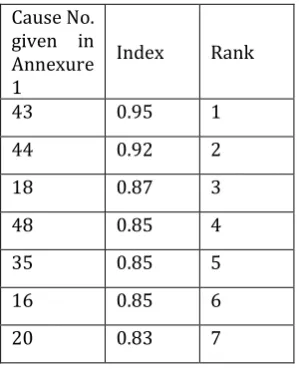
After analysis only causes of delays were selected which are above 0.8
A five point rating scale is prepared to give the rank to the causes of delay as follows,
1=very less, 2=less, 3= moderate, 4=strong, 5= very strong
Then this data was analyzed by RII method.
RII= ƩW÷A*N
W= sum of weight given by respondents, A=highest weight of scale i.e. 5 here, N= number of respondents
Cause No.
Table -1: Relative Importance index
6. CONCLUSIONS
This paper analyzed most critical delay factors by RII method to improve the performance of project to reduce the project time, over budgeting, reduce wastage of material with highest quality and safest manner.
If any constructions try to minimize these causes of delay then performance of project may increase.
These causes of delays are given below
1. Less number of labours against requirement 2. Skill of labour is very poor or less
3. Lack of project planning and scheduling by contractor
4. Delay due to receiving permissions from government authorities
5. Delay due to transporting material from supplier to site
6. Complete absence of good site management and supervision by contractor
7. Lacking of quality and quantity of work
REFERENCES
[1] Megha Desai and Rajiv Bhatt, “Critical Causes of Delay in Residential Construction Projects: Case study of Central Gujarat Region of India.”
© 2015, IRJET.NET- All Rights Reserved
Page 2088
[3] Zarina Alias, E.M.A. Zawawi, Khalid Yusuf, Aris, NM), “Determining Critical Success factors of Project Management Practice: A conceptual framework”, (2014).
[4] Danial F. Oferi,”Project Management Practices and Critical Success Factors-A Developing Country Perspective”.
[5] A.W.Shaikh, M.R. Muree and A.S. Soomro, “Identification of Critical Delay Factors in Construction”, (2010).
© 2015, IRJET.NET- All Rights Reserved
Page 2089
ANNEXURE 1
CLASSIFICATION OF CAUSES OF DELAY
Sr. No Causes of delay Group
1 Time period may less as compared to actual time period required
Project 2 Legal controversy between different parties
3 Ineffective delay punishments
4 Delay in progress due to shortage of cash flow from owner
Owner 5 Delay to hand over the site to the contractor by the owner
6 Change of work sequence or addition of work by owner during construction
7 Delay due to approving and revising the specifications
8 Delay to approve and revise site development decision
9 Delay due to lack of information or decision conveying from owner to other parties
10 Delay due to slow speed of process of decision making
11 No additional bonus facility to contractor for completing the work before schedule
12 Work on hold due to improper work methodology implemented
13 Delay in progress due to shortage of cash flow from contractor
Contractor 14 Rework due to improper methodology implemented by contractor
15 Disputes between contractor and other parties (Consultant and Contractor)
16 Complete absence of good site management and supervision by contractor
17 Delay due to lack of information or decision conveying from contractor to other parties
18 Lack of project planning and scheduling by contractor
19 Delay due to low efficiency of work by contractor
20 Lacking of quality and quantity of work
© 2015, IRJET.NET- All Rights Reserved
Page 2090
22 Delay due to checking of work or activities by consultant
Consultant 23 Delay due to approval for change in work by consultant
24 Rigidity of consultant
25 Lack of information exchange from consultant to other parties
26 Delay due to taking more time to revise the specification
27 Controversy between consultant and engineer
© 2015, IRJET.NET- All Rights Reserved
Page 2091
29 Errors and variations in design documents
Design 30 Delays in making design documents
31 Lack of details in drawings
32 Difficulty in project design
33 Not enough information collection and survey before design
34 Delay due to type of material and specification change during construction
Materials 35 Delay due to transporting material from supplier to site
36 Destruction of material when they needed urgently
37 Delay due to making of special building material
38 Delay due to arrival of procured materials
39 Equipment stopped working suddenly
Equipment 40 Lack of required equipments at site
41 Unskilled operator
42 Low output from equipment
43 Less number of labours against requirement
Labour 44 Skill of labour is very poor or less
45 Low efficiency of labours
46 controversy among labours
47 Effects of subsoil conditions
External 48 Delay due to receiving permissions from government authorities
49 Delay due to natural forces like rain etc.
50 Unavailability of basic needs to start the construction site (water, electricity, sanitary facility to man force, etc)
51 hazards during construction