© 2015, IRJET.NET- All Rights Reserved Page 1247
STUDIES ON UTILIZATION OF CHROMIUM IMPREGNATED BUFFING
DUST AS A MODIFIER IN BITUMEN
S.B.Kalaichelvi
1, Dr. K.Mohandoss
2, Dr. G.Sekaran
31 M. Phil Research Scholar, Dept. of Chemistry, Madras Christian College, Tamil Nadu, India 2 Professor, Dept. of chemistry, Madras Christian College, Tamil Nadu, India
3 Chief Scientist, Environmental Technology Division, CSIR-CLRI, Tamil Nadu, India
---***---
Abstract -
The leather industry generates hugeamount of chromium containing solid wastes. Conventional methods on disposal of these solid wastes are insufficient because of producing secondary pollutants. Hence, it is important to find an alternative method for the disposal of these chromium impregnated buffing dust (CIBD). In this present investigation the CIBD was pyrolysed at 400⁰C under inert atmosphere. Then, the residual ash from pyrolysis is stabilized using bitumen as a binder for the preparation of modified bitumen. Instrumental analyses such as thermogravimetric analysis, Scanning Electron Microscopy (SEM), and Energy Dispersive X-ray (EDX) analysis were carried out to confirm the binding of bitumen with residual ash. Further, the modified bitumen with aggregates was carried out for Toxicity Characterizationof Leachate Procedure test (TCLP) to evaluate the Leachability of the material.
Key Words: Chromium impregnated buffing Dust, pyrolysis, collagen fibers, modification, Bitumen
1. INTRODUCTION
Chrome tanning is the most common type of tanning process being practiced for the leather production around the world. Top handling quality; high hydro-thermal stability, user-specific properties and versatile applicability are features of chrome tanned leathers [1].In leather production process, 80% of raw materials are converted into solid wastes and only 20% of raw hides are transformed to leather [2,3]. A series of mechanical and chemical operations are involved in the transformation of raw hides into leather in tanning industry. Basic Chromium Sulphate is used in pickling operation to convert putrescible collagen fibers into non putrescible leather matrix. A micro fined solid particulate matter with chromium impregnation generated as tanned solid waste is obtained in the final stage called chromium impregnated buffing dust (CIBD). Apart from chromium, CIBD contains synthetic fat, oil, dye chemicals. About 2–6 kg of CIBD is generated as a
solid waste per ton of skin/hide processed. Since CIBD contains chromium, which is carcinogenic in nature and causes clinical problems like respiratory tract ailments, ulcers, perforated nasal septum, kidney malfunction and lung cancer in humans exposed to the environment containing buffing dust particulates. Hence, it is advised by pollution control board to collect the CIBD for safe disposal [4-6]. Today with the large increase in population and the strain being put on our world for saving our natural resources, it is becoming onerous on our part that the disposal of tannery wastes is a matter of industry’s responsibility to the society around it [7]. The available methods of disposal of CIBD were reported to be landfill, incineration and pyrolysis. Pyrolysis is widely applied for the waste disposal of organic wastes, such as agricultural wastes, scrap tyres, sewage sludge’s and plastic wastes. But, all the above mentioned methods have more disadvantages due to generation of secondary pollutants.
The pyrolysis process involves heating the carbonaceous material in an inert atmosphere. The resultant products of pyrolysis are gas, oil and carbonaceous residue. The gas can be re-used as fuel and the oil can be used as a raw material for chemicals. The carbonaceous residue can be burnt as fuel or safely disposed fixed on the carbonaceous matrix [8-13].
© 2015, IRJET.NET- All Rights Reserved Page 1248 Bitumen is an excellent binder and finds wide
applications from road construction to build up roofing membranes and other water proofing purposes. Binder may contribute to solving a waste disposable problem and improve quality of road pavements. Due to exponentially increase in truck traffic, commercial overloading and, variable climatic conditions, deterioration of road pavements results in a shorter period. Hence an innovation is required in conventional bitumen to modify it. Many research works on modification of bitumen are being carried out in bituminous pavement technology. Different materials like polymers and fibers are employed for modification. Presently, addition of fibers to bitumen plays a prominent role in modification [19]. The fibers are used in asphalt mixtures in order to increase the toughness and fracture resistance of the hot mix and to act as a stabilizer preventing the draining down of the asphalt binder [20].
Peltonen(1991) compared binding nature of cellulose fibers, glass fibers, mineral fibers, polyester fibers to bitumen [21]. Tapkin et al (2009) studied creep behavior of polypropylene fiber in bituminous mixtures [22]. Bartl et al (2005) evaluated the application of recycled fiber materials to improve bituminous properties [23].However only few investigations have been carried out on leather waste to modify the bitumen Krummenauer et al (2009) investigated the usability of leather saw dust in asphalt micro layer mixtures. Leather saw dust was used as such without pretreatment [20].
The present environmental policy is not recommending disposing of these CIBD by either incineration or landfill. These CIBD are being stored in the storage yard. Hence, it is important to find an alternative method for the safe disposal of CIBD.
In this present investigation CIBD was attempted and used as an additive material in the modified bitumen production. Chromium impregnated buffing dust (CIBD) was pyrolysed in an inert atmosphere to arrest oxidation from Cr3+ to Cr6+. Residual ash from pyrolysis was stabilized with bitumen. Thus Cr3+ in CIBD was disposed and bitumen was also modified. Physical properties of modified bitumen were studied. Thermogravimetric experiments were carried out in residual ash, modified bitumen and modified bitumen - fine aggregates specimens. Structural morphology of residual ash, modified bitumen, modified bitumen- fine aggregates specimens was also mapped. Chemical oxygen
demand (COD), total organic carbon (TOC), total chromium, hexavalent chromium was determined from leachate of Leachability test.
2. MATERIALS AND METHODS 2.1 Characterization of CIBD
CIBD was collected from a commercial tannery yard, Chennai, India. CIBD was characterized for moisture content, carbon, hydrogen, nitrogen and sulphur by following the standard methods as described in APHA.
2.2 Pyrolysis
About 1.5Kg of CIBD was loaded in a reacting vessel inside induction furnace. Alumel/chromel is heating element used in the thermocouple. The reactor was designed to operate under controlled reaction temperature and reaction time using a microprocessor. Condenser, gas pump, wet scrubber and dehydration unit were connected to the pyrolysis reactor. Pyrolysis was carried out under nitrogen atmosphere at temperature 400°Cso that no Cr3+ was oxidized to Cr6+. Emanating pyrolytic gases are scrubbed by wet scrubber and dehydrated by dehydration unit. Pyrolysis process is automatically cut off after temperature 400°C. After overnight cooling, residual ash was collected from reacting vessel.
2.3 Preparation of modified bitumen
© 2015, IRJET.NET- All Rights Reserved Page 1249
2.4 Properties of Modified Bitumen
The various properties of modified bitumen were characterized by following Indian standard procedure. The penetration was estimated by IS: 1203 – 1978, Specific gravity by pycnometer following IS: 1202 – 1978.The Softening point of modified bitumen was conducted by using Ring and Ball apparatus as per IS: 1205 – 1978, ductility of modified bitumen was measurement by following the procedure described in IS: 1208-1978.
2.5 Solidification of blocks
Modified bitumen containing bitumen and residual ash was mixed with fine aggregates in different proportions and heated to 170°C. Blocks of 5 Cm X 5 Cm X 5Cm dimensions were made using wooden cast and used for Leachability test.
2.6 Leachability test
Leachability of the metals from solidified specimens was determined by extraction procedure toxicity test (EPT). The EPT test helps in analyzing the hazardous nature of waste. This test is designed to determine semi-volatile organic compounds and heavy metals in tannery sludge. The samples were crushed, powdered and homogenized to pass through 9.5 mm screen. The powdered sample of 10 g was taken and placed in a beaker with 500 ml of deionized water whose pH was adjusted to 6 using 0.1N acetic acid. The contents were agitated in a mechanical shaker at 180 rpm and the liquid phase was separated from the solid phase by filtration through a 0.6–0.8 μm borosilicate glass fiber under pressure of 50 psi (340 KPa). The liquid phase was renewed for every 8 hours and it was analyzed for COD (chemical oxygen demand) and chromium upto 32 hours.
2.7 Instrumental Analyses
The elemental composition such as Carbon, Hydrogen, Nitrogen and Sulphur (CHNS) of CIBD, residual ash derived from pyrolysis process was determined using CHNS 1108 model Carlo– Erba analyzer.
Thermogravimetric analysis was carried out to determine the thermal stability of residual ash, modified bitumen and modified bitumen-aggregates specimens by using TGA Q50 V20.13 Build39 instrument. The surface morphology and chemical
characterization of residual ash, modified bitumen and modified bitumen-aggregates specimens were studied using Scanning Electron Microscopy coupled Energy Dispersive X-ray with high resolution. Hexavalent and total chromium in the ash was estimated spectrophotometrically at 540 nm. Residual Ash was subjected to alkaline digestion with phosphate buffer for the determination of hexavalent chromium and acid digestion followed by permanganate oxidation and reaction with 1,6-diphenyl carbazide in acidic medium for the estimation of total chromium.
3. RESULTS AND DISCUSSIONS
3.1 Characterization of CIBD
The composition of CIBD was Carbon 41.862%, Hydrogen4.948 %, Nitrogen 4.402% and Sulphur14.589%. The moisture content of CIBD is 9.35 %.
3.2 Pyrolysis
© 2015, IRJET.NET- All Rights Reserved Page 1250 Table-1: Properties of residual ash (ash derived from
pyrolysis)
3.3 Properties of Modified Bitumen
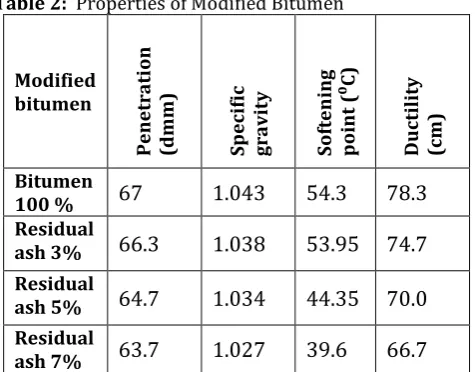
The data presented in table 3 shows that an increase in residual ash content in bitumen decreases the property of penetration value, specific gravity, softening point, ductility significantly.
3.3.1Penetration Test
The penetration is a measure of hardness or softness of bitumen binder. The added residual ash to bitumen binder exhibited a significant effect. The penetration values of bitumen modified with different percentage of residual ash were shown in Table 2. The penetration values were decreasing significantly for 60/70 bitumen mixed with residual ash of 3%, 5 %, 7%.It is observed that the penetration value decreases as the concentration of modifier increases. This revealed that high value of hardness and stiffness for modified bitumen. Hardness may due to higher percentage of carbon content which was obtained by pyrolysis. Further, the bitumen modified with residual ash of 3% seems to be more effective in the penetration values as compared to 5% and 7% of residual ash modifiers [24].
3.3.2 Specific gravity test
Table 2 presented that the specific gravity values decreased significantly by modifying the bitumen with 3%, 5% and 7% residual ash.
3.3.3 Softening point test
As shown in Table 3 the softening point decreased with increase in percentage of modifiers as the bitumen becomes increasingly viscous. The impact of
3% residual ash on softening point was much more than 5% and 7% residual ash. This indicates that only 3% residual ash has the resistance to the effect of heat and it will reduce its tendency to soften in hot weather. Thus, with its addition, the modified binder will be less susceptible to temperature changes [25].
3.3.4 Ductility test
It is a measure of tensile properties of bituminous material. The ductility test was conducted at 27: C for different percentages of residual ash content as illustrated in table 3. There was a dramatically decrease in ductility values. Addition of 3%, 5%, and 7% residual ash had constant effect on modified bitumen under elongation tensile force. These results could be explained by physical interactions of collagen fibres in the residual ash with carbon- carbon bond of bitumen.
Table 2: Properties of Modified Bitumen
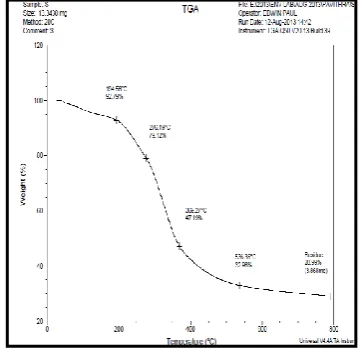
Modified heated in a platinum pan from 30 to 800:C at the rate of 20:C/min. Thermogram of residual ash (Fig.1) indicates nearly 9% weight loss at temperature 109.87 C in the first inflexion point. This was attributed to the loss of moisture. There is a slow weight loss of 7.02% up to334.94:C due to slow decomposition of polypeptide chain. The sample weight obtained at 334.94:C was 83.83%.This value marginally coincided with the pyrolysis yield at 400:C as discussed in Table 1. After 334.94:C ,on account of volatilization of formed intermediate compounds, there was a steady decrease in sample weight in thermogram till 800:C leaving 20.55% of thermally stable residue (Fig 1).
PARAMETERS VALUE
Carbon 50.604 %
Hydrogen 4 %
Nitrogen 12.165 %
Sulphur 21.116 %
Total Chromium 0.28 mg/g Hexavalent Chromium BDL Loss on Ignition 3.71 %
© 2015, IRJET.NET- All Rights Reserved Page 1251 Thermogram of modified bitumen (Fig 2) shows four
areas of weight loss. The first weight loss of nearly 7% at 194.50:C was due to elimination of moisture content and other three areas of weight loss are between 276.19:C and 536.36:C in modified bitumen sample. The weight loss between 276.19-369.27:C and 369.27- 536.36:C corresponded to 32% and 14% of total weight and was attributed to decomposition of organic compounds of residual ash and volatilization of low boiling point components of bitumen.
Thermogram of modified bitumen-fine aggregates Fig3 shows five stages of disintegration of the sample between 167.64:C and 633.91:C. The maximum weight loss of 35.65% was obtained in the region of temperature between 273.78-343.54:C. The samples were thermally stable upto 167.64:C (Fig 3).
3.5. Scanning Electron Microscopy (SEM) and Energy dispersive X-ray (EDX) analyses
The broken fibrous structures of pyrolysed sample are shown in Fig 4 (a) below. The plate like formation of pyrolysed sample distributed over bitumen can be viewed from Fig 4 (c, e) shows that pyrolysed residual ash sample blends well with bitumen and small aggregates particles are dispersed over it. EDX profiles Fig 4 (b, d and f) corresponding to the SEM images confirmed the presence of trivalent chromium at 5.5eV in the pyrolysed sample.
3.6 Leachability Test
The leachate solution of the specimen containing 3% of residual ash modified bitumen (which is effective in tests of properties of modified bitumen) was analyzed for COD, TOC, total chromium and hexavalent chromium. The observed COD and TOC values were 80 mg/l and 13 mg/l. From TCLP study, it was predicted that the total chromium and hexavalent chromium were at BDL (below detectable limit) for all test specimens.
Fig 1: Thermogram of residual ash
Fig 2: Thermogram of modified bitumen
Fig.3: Thermogram of modified bitumen-
© 2015, IRJET.NET- All Rights Reserved Page 1252
a
e
c
b
d
f
Fig.4: SEM and EDX spectrum of (a) & (b) residual ash (c)
& (d) modified bitumen (e) & (f) modified bitumen- fine aggregates
3.7 CONCLUSIONS
Chromium impregnated buffing dust generated from leather tanning industry was pyrolysed in an inert atmosphere. During pyrolysis residual ash containing trivalent chromium was not oxidized to hexavalent chromium and was confirmed by chromium at 5.5 eV from EDX analysis. The residual ash was stabilised with bitumen and stabilization was confirmed by instrumental techniques like Thermogravimetric analysis, Scanning electron microscopy and Toxicity Characterization of Leachate Procedure test.The physical properties of modified bitumen were studied. From the study, properties of specimen containing 3% residual ash modified bitumen were marginally correlate with 100% bitumen. The study shows green light that pyrolysed chromium impregnated buffing dust can be effectively utilized as a modifier in bitumen in limited percent.
ACKNOWLEDGMENTS
The Council of Scientific and Industrial Research (CSIR) is acknowledged for the financial assistance under SUSTRANS (ESC 0106) Network project. The authors are thankful to the Director, central leather research institute (CLRI) for providing the facility to carry out the work.
REFERENCES
[1] J. Ludvik, Chrome management in the tan yard, Regional Programme for Pollution Control in the Tanning Industry in South-East, US/RAS/92/120/11-51
[2] K.Kolomaznik, M.Adamek, I. Andeland M.Uhlirova (2008). Leather waste-potential threat to Human health and a new technology of its treatment, J. Hazard. Mater. 160: 514–520.
[3] V.J. Sunder, J. Raghava Rao, and C. Muralidharan (2002).Cleaner chrome tanning - emerging options, J. Clean Prod. 10: 69–74.
[4] S.Swarnalatha, T.Srinivasulu, M. Srimurali, and G. Sekaran (2008) .Safe disposal of toxic Chrome buffing dust generated from leather industries, J. Hazard. Mater.150:290–299.
[5] A.H.G. Love, chromium – biological and analytical considerations, in: D. Burrows (Ed.), Chromium metabolism and toxicity, CRC Press, Boca Raton, FL, 1983, p. 1.
[6] A. Leonard and R.R. Lawverys (1980). Carcinogenicity and mutagenicity of chromium, Mutat. Res. 76: 227–239.
[7] A.R.Y. Boushy and A. J. B. van der Poel, Poultry feed from waste chapman & Hall 1994, chapter 6 pp.165-186.
[8] A.Cassano, E. Drioli, R.Molinari, and C.Bertolutti (1997). Quality improvement of recycled Chromium in the tanning operation by membrane processes. Desalination, 108: 193–203.
[9] T.Imai and H.Okamura (1991). Studies on incineration of chrome leather waste, J. Am. Leather Chem.soc. 86 : 281– 294.
[10] D.Petruzelli, R.Passino, and G.Tiravant (1995). Ion exchange process for chromium removal and Recovery from tannery wastes, Ind. End. Chem. 34: 2612–2617.
© 2015, IRJET.NET- All Rights Reserved Page 1253 [12] M.Sivaparvathi, K.Suseela and SC. Nanda
(1986).Purification and properties of Pseudomona Aeruginosa protease causing hydrolysis of chrome shavings. Leather Sci.33:303–7.
[13] O.Yılmaz, I. CemKantarli, M.Yuksel, M.Saglam and J.Yanik (2007). Conversion of leather wastes to useful products, Resour. Conserv.Recy. 49 : 436– 448.
[14] M.A. Abreu, and S.M. Toffoli (2009). Characterization of a chromium-rich tannery waste and its potential use in ceramics Ceram.Int. 35: 2225–2234.
[15] T. Basegio, F.Berutti, A.Bernardes and C. Bergmann(2002).Environmental and technicalaspects of the utilization of tannery sludge as a raw material for clay products, J.Eur.Ceram.Soc. 22: 2251-2259.
[16] T.Basegio, C. Haas, A.Pokorny and A.M. Bernardes (2006). Production of materials with alumina and ashes from incineration of chromium tanned leather shavings: Environmental and technical aspects,J. Hazard. Mater. 21 : 1156–1164.
[17] Xu Na, Zhang Chuanbo, Qiang Xihuai and, Zhang Bin, Building Materials from Stabilization/Solidification of TannerySludge. China Leather 2009-13.
[18] S.M.Abtahi, M.Sheikhzadeh and S.M.Hejaz(2010). Fiber - reinforced asphaltconcrete – A Review Constr. Build. Mater. 24: 871–877.
[19] K R. Hansen, R B. Mcgennis, B.Prowel and A.Stonex, Current and future uses ofnon-TRB
bituminous components of bituminous paving mixtures. Transportation in the New Millennium.A2D02, Washington, USA, 2000.
[20] K. KrummenauerandJ. J. Oliveira Andrade (2009).Incorporation of chromium-tanned leather residue to asphalt micro-surface layer, Constr. Build.Mater. 23:574–581.
[21] P.V.Peltonen(1991). Characterization and testing of fiber-modified bitumen composites,J. mater.sci. 26: 5618-5622.
[22] S.Tapkın,U. Uşar,A. Tuncan and M. Tunca (2009).Repeated Creep Behavior of Polypropylene Fiber Reinforced Bituminous Mixtures, J. Transp. Eng. 135 : 240-249.
[23] A.Bartl, A. Hackl, B. Mihalyi, M. Wistubaand I. Marini (2005). Recycling of Fiber Materials 7th World
Congress of Chemical Engineering, Process. Saf. Environ. 83: 351–358.
[24] N.S. Mashaan, A.H. Ali, M.R. Karimand A. Mahrez (2011). Effect of crumb rubber concentration on the physical and rheological properties of rubberised bitumen binders, Int. J. Phys. Sci., 6: 684-690.
[25] I. Bamidele, O. Dahunsi, S. Awogboro, M. Akinpelu and S. Oladipupov (2013).Investigation of the properties of pure water sachet modified Bitumen, civ. Eng. Environ.Res. 3: 47-61
[26] C.Sethuraman, K. Srinivas and G. Sekaran(2014). Pyrolysis coupled pulse oxygen incineration for disposal of hazardous chromium impregnated fine particulate solid waste generated from Leather industry, J. Environ. Chem. Eng. 2: 516-524.
AUTHOR BIOGRAPHIES
S.B.KALAICHELVI is an M.Phil. research scholar of Madras Christian College, Chennai. Her areas of interest are waste disposal methods, waste water treatments and green synthesis.
DR. K. MOHANDOSS is retired professor of chemistry, Madras Christian College, Chennai and presently Principal of Mar Gregorios College of Arts and Science Chennai. His areas of interest are coordination Chemistry, analytical
chemistry, molecular spectroscopy, and bioinorganic chemistry.
Dr. G. SEKARAN is Chief Scientist,