R E S E A R C H
Open Access
Outer synchronization of a class of mixed
delayed complex networks based on pinning
control
Lin Shi
1, Guiling Chen
1*and Shouming Zhong
2*Correspondence:
1School of Mathematics, Southwest
Jiaotong University, Chengdu, P.R. China
Full list of author information is available at the end of the article
Abstract
In this paper, the problem on outer synchronization is investigated for a class of mixed delayed complex networks by using the pinning control strategy. Together with some Lyapunov–Krasovskii functional and effective mathematical techniques, several conditions are derived to guarantee a class of complex networks with mixed delays to be outer synchronization. By proposing a novel functional condition which has not been proposed so far, further improved synchronization criteria are proposed. Finally, two examples are given to illustrate the effectiveness of the results.
Keywords: Synchronization; Complex networks; LMI approach; Time-varying delays; Pinning control
1 Introduction
Complex networks [1,2] lie everywhere in our daily life, such as the Internet, world wide web, communication networks, social networks, genetic regulatory networks, power grid networks, and so on. In 1990, controlling chaos was proposed, and it was shown that one can convert a chaotic attractor to any one of a large number of possible attracting time-periodic motions via making only small time-dependent perturbations of an available sys-tem parameter [1]. Synchronization of complex networks has become an active field of research [3–10], because the synchronization mechanism can better explain many natural phenomena, including the synchronous information exchange in the Internet and world wide web, and the synchronous transfer of digital or analog signals in communication net-works. In 1998, focusing on the transition from a regular lattice to a random graph, Watts and Strogatz introduced an interesting model, i.e., the small-world network [4].
From the control strategy point of view, all kinds of control approaches have been pro-posed in the field of the synchronization of complex networks. These approaches can be divided into two classes in general. One is based on the continuous updating feedback signals, for instance time-delay feedback control [11], adaptive control [12,13], and non-linear feedback control [14]. The other kind is based on the discrete signals updated at in-stant times, such as sampled-data control [15] and impulsive control [16]. The traditional method to synchronize a complex network is to add a controller to each of the network nodes to tame the dynamics to approach a desired synchronization trajectory. However, a complex network is normally composed of a large number of high-dimensional nodes, and
it is expensive and infeasible to control all the neurons. Motivated by this practical con-sideration, the idea of controlling a small portion of nodes, named pinning control, was introduced in [17]. Pinning control, as a feasible strategy, could drive networks of coupled oscillators onto some desired trajectory. Generally speaking, we apply pinning control by adding a feedback control input on a fraction of networks nodes. Though we just exert the direct control on such pinned nodes, it can be propagated to the rest of the oscillators through the coupling among the nodes. Many pinning algorithms have been reported for the synchronization of dynamical networks (see [18–23]). [18] investigated the effects of control strength on nonlinearly coupled systems in the process of synchronization. Wu and Fu [21] studied the cluster mixed synchronization of complex networks with commu-nity structure and nonidentical nodes by using some linear pinning control schemes. It turned out that the pinning control method reduces the control cost to a certain extent by reducing the amount of controllers added to the nodes.
Up to now, all sorts of different synchronization phenomena, such as complete synchro-nization [24,25], generalized synchronization [26], phase synchronization [27], cluster synchronization [28], exponential synchronization [29] etc., have been reported in the lit-erature. Complete synchronization means that the coupled chaotic systems remain in step with each other in the course of time. In coupled systems with identical elements (i.e., each component having the same dynamics and parameter set), we can observe complete syn-chronization. Complete synchronization can be regarded as inner synsyn-chronization. Except the aforementioned inner synchronization behavior, there exists another synchronization phenomenon named outer synchronization, which occurs between two or more coupled networks [30]. In reality, many practical systems, such as the different species develop-ment in balance [31], the groups of Drosophila clock neurons [32], and the spread of dis-eases, such as SARS and bird flu, between two communities [33], can be used to illustrate the outer synchronization phenomenon between two networks. Due to its theoretical and practical importance, outer synchronization between two dynamical networks has drawn much attention in recent years [34–38]. In [34], the outer synchronization was studied between two delay-coupled complex dynamical networks with nonidentical topological structures and a noise perturbation. Zheng et al. [35] investigated the adaptive synchro-nization between two nonlinearly delay-coupled complex networks with the bidirectional actions and nonidentical topological structures. Outer synchronization between drive and response networks via adaptive impulsive pinning control was investigated in [36]. The problem of pinning outer synchronization was considered between two delayed complex networks with nonlinear coupling [37]. In [38], an aperiodically adaptive intermittent con-trol scheme combined with the pinning strategy was proposed for outer synchronization between two general complex delayed dynamical networks.
Motivated by the above discussions, in this paper, we study the outer synchronization of complex dynamical networks with mixed time delayed coupling. Combining the pinning control method and the linear matrix inequality technique, some sufficient conditions for synchronization of complex networks with time-varying delays are derived. By proposing a novel activation functional condition, further improved outer synchronization criteria are proposed. Finally, two examples are given to illustrate the effectiveness of the proposed methods.
dynamical networks with mixed delayed coupling by the pinning control method. Cor-responding synchronization criteria for guaranteeing synchronization are obtained. The theoretical results are verified numerically by several representative examples in Sect.4. Finally, this paper is concluded in Sect.5.
Notation Throughout this paper,Rn denotes then-dimensional Euclidean space and
Rn×n is the set of all n×n real matrices. For symmetric matrices X andY, the
no-tation X>Y (X≥Y) means that the matrixX–Y is positive definite (nonnegative).
X Y
YTZ
=X Y∗Zwith∗denoting the symmetric term in a symmetric matrix.
2 Preliminaries
Consider a complex dynamical network consisting ofNidentical nodes with linearly cou-pling network with mixed delays:
˙
xi(t) =Axi(t) +Bf
xi(t)
+Cfxi
t–τ(t)+D t
t–σ
fxi(s)
ds+
N
j=1
hijxj(t), (1)
where i = 1, 2, . . . ,N, xi(t) = (xi1(t), . . . ,xin(t))T ∈Rn is the state vector of node i, f : Rn →Rn is continuously differentiable, f(x
i(t)) = [f1(xi1(t)), . . . ,fn(xin(t))]T. Here A= diag{a1,a2, . . . ,an}< 0. The matricesB= (bij)n×nandC= (cij)n×nare weight and delayed
weight matrices, respectively. The matrixD= (dij)n×nis a distributed delayed weight
ma-trix.σis a distributed delay. The matrix=diag{γ1,γ2, . . . ,γn} ∈Rn×nis an inner coupling
matrix of complex networks and it is a positive definite matrix.H= (hij)N×N is an outer
coupling matrix representing the complex network topology defined as follows: If there is a connection between nodesiandj(j=i), thenhij= 0; otherwise,hij= 0 (j=i) and the
diagonal elements of matrixHare defined byhii= –
N j=1,j=ihij.
Assumption 1 Hereτ(t) denotes the interval time-varying delay satisfying
0≤τ0≤τ(t)≤τm, μ0≤ ˙τ(t)≤μm< +∞, and τ¯=τm–τ0. (2)
Assumption 2
li–≤fi(x) –fi(y) x–y ≤l
+
i, ∀x,y∈R,x=y,i= 1, 2, . . . ,n, (3)
wherel–
i,l+i,i= 1, 2, . . . ,n, are constants andL1=diag(l–1,l–2, . . . ,l–n),L2=diag(l1+,l+2, . . . ,l+n).
Remark1 The constantsl–
i andl+i in Assumption2are allowed to be positive, negative,
or zero. This assumption is weaker than Assumption 2 in [20], which is the special case of the function satisfying condition (3).
as
˙
yi(t) =Ayi(t) +Bf
yi(t)
+Cfyi
t–τ(t)
+D t
t–σ
fyi(s)
ds+
N
j=1
hijyj(t) +ui(t),
(4)
ui(t) =
⎧ ⎨ ⎩
–d(yi(t) –xi(t)), i= 1, 2, . . . ,l;
0, i=l+ 1, . . . ,N, (5)
whered=diag(d1,d2, . . . ,dn) > 0 is a positive definite feedback gain matrix, and 1≤l≤N.
Definition 2.1 The drive-response networks (1) and (4) are said to achieve outer syn-chronization if
lim
t→∞yi(t) –xi(t)= 0, i= 1, 2, . . . ,N.
We define outer synchronization errors between the drive network (1) and the response network (4) asei(t) =yi(t) –xi(t).
Then, the following error dynamical network can be obtained:
˙
ei(t) =Aei(t) +Bg
ei(t)
+Cgei
t–τ(t)
+D t
t–σ
gei(s)
ds+
N
j=1
hijej(t) –dei(t), (6)
wherei= 1, 2, . . . ,l,g(ei(t)) =f(yi(t)) –f(xi(t)),g(ei(t)) = [g1(ei1(t)), . . . ,gn(ein(t))]. According
to inequality (3), one can obtain
li–≤gi(x) x ≤l
+
i, gi(0) = 0, ∀x∈R,i= 1, 2, . . . ,n. (7)
Lemma 2.1 (Jensen’s inequality) For any constant matrix X ∈ n×n, X=XT > 0, two
scalars h2≥h1> 0such that the following integration is well defined,then
–(h2–h1) t–h1
t–h2
xT(s)Xx(s)ds≤–
t–h1
t–h2
x(s)ds T
X t–h1
t–h2
x(s)ds
.
Lemma 2.2 For any constant matrix Z∈ n×n,Z=ZT> 0,two scalarsτ
m≥τ0> 0such that the following integration is well defined,then
–
–τ0
–τm
t
t+θ
˙
xT(s)Zx˙(s)ds
≤2(1 –τ¯)
τm+τ0
xT(t)Zx(t) –2(1 –τ¯) τ2
m–τ02 t–τ0
t–τm
xT(s)ds Z
t–τ0
t–τm
x(s)ds.
Proof
˙
xT(s)Zx˙(s) x˙T(s)
˙
x(s) Z–1
Integration of the above inequality fromt+θ tot, where –τm≤θ≤–τ0, yields
According to Schur complements,
–
3 Main results
In this section, by using a Lyapunov–Krasovskii functional, new outer synchronization criteria for mixed delayed complex networks will be proposed.
and
E=
⎛ ⎜ ⎜ ⎜ ⎜ ⎜ ⎜ ⎜ ⎜ ⎜ ⎜ ⎜ ⎜ ⎜ ⎜ ⎜ ⎜ ⎜ ⎜ ⎜ ⎜ ⎜ ⎜ ⎜ ⎝
E11 0 0 0 E15 0 E17 0 0 0 E1,11 E1,12
∗ E22 0 0 E25 E26 0 0 0 0 0 0
∗ ∗ E33 0 0 0 0 E38 0 0 0 0
∗ ∗ ∗ E44 0 0 E47 0 0 0 0 0
∗ ∗ ∗ ∗ E55 0 E57 0 0 0 E5,11 E5,12
∗ ∗ ∗ ∗ ∗ E66 0 0 0 0 0 0
∗ ∗ ∗ ∗ ∗ ∗ E77 0 0 0 0 E7,12
∗ ∗ ∗ ∗ ∗ ∗ ∗ E88 0 0 0 0
∗ ∗ ∗ ∗ ∗ ∗ ∗ ∗ E99 0 0 0
∗ ∗ ∗ ∗ ∗ ∗ ∗ ∗ ∗ E10,10 0 E10,12
∗ ∗ ∗ ∗ ∗ ∗ ∗ ∗ ∗ ∗ E11,11 0
∗ ∗ ∗ ∗ ∗ ∗ ∗ ∗ ∗ ∗ ∗ E12,12
⎞ ⎟ ⎟ ⎟ ⎟ ⎟ ⎟ ⎟ ⎟ ⎟ ⎟ ⎟ ⎟ ⎟ ⎟ ⎟ ⎟ ⎟ ⎟ ⎟ ⎟ ⎟ ⎟ ⎟ ⎠
< 0, (9)
where
E11= 2P(A–d) +Q+ 2(L2 –L1)(A–d) +τ02X1+τ¯2X2
+2(1 –τ¯)
τm+τ0
Z– 2L1W1L2+W8,
E15=PB+ (– )(A–d) + (L2 –L1)B+L1W1+L2W1,
E17=PC+ (L2 –L1)C, E1,11=PD+ (L2 –L1)D, E1,12= (A–d)W5,
E22=R2– 2L1W2L2, E26=L2W2+L1W1,
E33= –Q–R1– 2L1W4L2, E38=L1W4+L2W4,
E44= (1 –μ0)R1– (1 –μm)R2– 2L1W3L2, E47=L1W3+L2W3,
E55= 2(– )B+σ2Y– 2W1+W7, E57= (– )C, E5,11= (– )D,
E5,12=BW5, E66= –2W2, E77= –2W3, E7,12= –CW5,
E88= –2W4, E99= –X1,
E10,10= –X2–2(1 –τ¯)
τ2
m–τ02
Z, E10,12=DW5,
E11,11= –σY, and E12,12=τ
2
m–τ02
2 Z– 2W5+W6.
Proof Construct a Lyapunov functional as follows:
V(et) =
7
i=1 Vi(et),
where
V1(et) = N
i=1
˙
By employing Lemma2.1, one can obtain
˙
According to Lemma2.2, one can obtain
˙
. . . , 8, such that the following inequalities hold:
– 2
Lyapunov–Krasovskii stability theorem, the controlled networks (1) and (4) can achieve the desired synchronization and the proof is completed.
Next, we derive an improved result for the dynamical networks (1) and (4).
Theorem 3.2 Under Assumptions1and2,for given matrices L1=diag(l1–,l–2, . . . ,l–n),L2= diag(l+
1,l+2, . . . ,l+n),and scalarsτm,τ0,the complex networks(1)and(4)can achieve outer synchronization if there exist symmetric positive definite matrices P,Q,R1,R2,X1,X2,Y,
Z,positive diagonal matrices wi=diag(k1i, . . . ,wni),i= 5, 6, 7, 8,Ki=diag(k1i, . . . ,kni),i=
hold:
F=
⎛ ⎜ ⎝
2(pk+l+kδk–l–kλk)H–w8kIN (λk–θk)γkH w5kγkH
∗ –w7
kIN 0
∗ ∗ –w6kIN
⎞ ⎟
⎠< 0, (20)
= (ij)n×n< 0, i,j= 1, . . . , 12, (21)
and
= (ij)n×n< 0, i,j= 1, . . . , 12, (22)
where
11= 2P(A–d) +Q+ 2(L2 –L1)(A–d) +τ02X1+τ¯2X2
+2(1 –τ¯)
τm+τ0
Z–L1K1(L1+L2) +W8,
15=PB+ (– )(A–d) + (L2 –L1)B+L1K1+ L1+L2
2 K1,
17=E17, 1,11=E1,11, 1,12=E1,12
22=R2–L1K2(L1+L2), 26= L1+L2
2 K2+L1K1,
33= –Q–R1–L1K4(L1+L2), 38=L1K4+ L1+L2
2 K4,
44= (1 –μ0)R1– (1 –μm)R2–L1K3(L1+L2), 47=L1K3+ L1+L2
2 K3,
55= 2(– )B+σ2Y– 2K1+W7, 57=E57, 5,11=E57,
5,12=E5,12, 66= –2K2, 77= –2K3, 7,12= –CW5,
88= –2K4, 99= –X1,
10,10= –X2–
2(1 –τ¯)
τ2
m–τ02
Z, 10,12=DW5,
11,11= –σY, 12,12= τ2
m–τ02
2 Z– 2W5+W6,
11= 2P(A–d) +Q+ 2(L2 –L1)(A–d) +τ02X1+τ¯2X2
+2(1 –τ¯)
τm+τ0
Z– (L1+L2)K5L2+W8,
15=PB+ (– )(A–d) + (L2 –L1)B+ L1+L2
2 K5+L2K5,
17=E17, 1,11=E1,11, 1,12=E1,12
22=R2– (L1+L2)K6L2, 26=L2K6+ L1+L2
2 K5,
33= –Q–R1– (L1+L2)K7L2, 38= L1+L2
2 K7+L2K7,
44= (1 –μ0)R1– (1 –μm)R2– (L1+L2)K6L2, 47= L1+L2
55= 2(– )B+σ2Y– 2K4+W7, 57=E57, 5,11=E57,
Here, we consider inequality (17) to two cases.
Case1:
This condition is equivalent to
Based on the theory of Lyapunov–Krasovskii stability, (20) and (21), the controlled net-works (1) can achieve synchronization whenli–≤gi(x)
x ≤
l–i+li+
Case2:
This condition is equivalent to
Based on the theory of Lyapunov–Krasovskii stability, (20) and (22), the controlled net-works (1) can achieve synchronization whenl–i+l+i
i, respectively,
more information on cross terms among the statesgi(ei(t–τ0)),gi(ei(t–τ(t))),gi(ei(t–τm)),
ei(t–τ0),ei(t–τ(t)), andei(t–τm) will be utilized, which may lead to less conservative
stability criteria.
Remark3 In [39], they only investigated the pinning synchronization in neural networks with discrete time-varying delay. In this paper, we consider a complex network with dis-crete and distributed delays. For the coupling matrixH, we needhij= 0, but in [14] they
4 Illustrative example
In this section, a numerical example is given to demonstrate the effectiveness of the pro-posed methods.
Example1 Consider a two-dimensional network with both discrete and distributed de-lays:
˙
xi(t) =Axi(t) +Bf
xi(t)
+Cfxi
t–τ(t)+D t
t–σ
fxi(s)
ds, (29)
where xi(t) = (xi1(t),xi2(t))T is the state vector of the networks, f(xi(t)) = (tanh(xi1(t)),
tanh(xi2(t)))Tis the activation functions vector,τ(t) =|sin(t)|. Taking
A=
–1.5 0
0 –2
, B=
–2.5 –0.3
6 5
,
C=
–3 2 0.3 –8
, D=
–0.5 –1 –3.6 –0.5
,
the dynamical behavior of (29) with the initial condition x1(0) = [0.2, 0.5]T, x2(0) =
[–0.6, 0.1]T, Fig.1displays the chaotic attractor.
In this simulation, we consider the two-dimensional error system
˙
ei(t) =Aei(t)+Bg
ei(t)
+Cgei
t–τ(t)+D t
t–σ
gei(s)
ds+
20
j=1
hijej(t)–dei(t), (30)
where ei(t) = (ei1(t),ei2(t))T is the state vector of the ith neural network. Here i =
Here, we just choose the control gainsdito be 2. If it is selected as too high value, it is easy
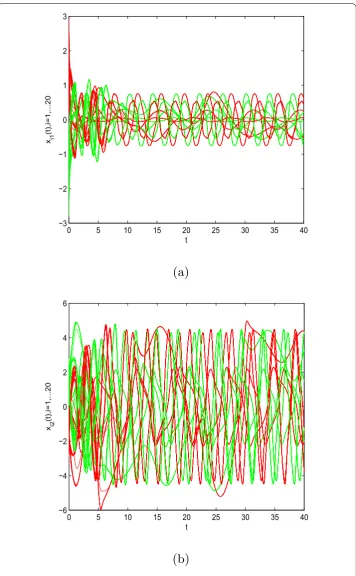
to synchronize the systems. Figure2shows the drive systemxi(t) state orbits which are
unstable.
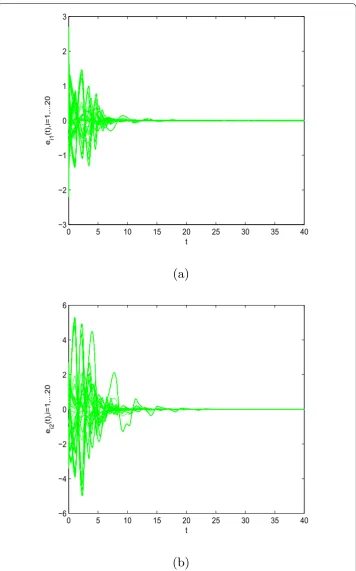
The evolution of the synchronization errorsei(t) (i= 1, 2, . . . , 20) is depicted in Fig.3. It
shows that the error system can be outer synchronization under pinning controller. Then by resorting to LMI in Matlab Toolbox, Theorem3.1can guarantee the outer syn-chronization of the dynamical networks, and we can derive the feasible solution to LMIs in (8) and (9) as follows: –0.2486 – 0.6525
From these simulations, one can conclude that using the proposed method in this paper, outer synchronization of systems (1) and (4) can be achieved.
5 Conclusion
In Theorem3.1, by choosing a new Lyapunov functional, some new synchronization con-dition for complex networks with mixed time-varying delays has been proposed. Based on the results of Theorem3.1, by constructing new inequalities of activation functions, further improved stability criteria are proposed in Theorem3.2. Finally, a numerical ex-ample has been given to illustrate the effectiveness of the proposed methods. It should be mentioned that the given method can be further studied and can be extended to fractional-order systems and discrete complex systems.
Acknowledgements
The authors thank the anonymous referee for careful reading and some helpful comments.
Funding
The work is supported by the Fundamental Research Funds for the Central Universities (Grant No. 2682017CX068 and 2682017CX059), and the National Natural Science Foundation of China (Grant No. 11701475).
Competing interests
The authors declare that they have no competing interests.
Authors’ contributions
All authors conceived of the study, participated in its design and coordination, drafted the manuscript, participated in the sequence alignment, and read and approved the final manuscript.
Author details
1School of Mathematics, Southwest Jiaotong University, Chengdu, P.R. China.2School of Mathematical Sciences,
University of Electronic Science and Technology of China, Chengdu, P.R. China.
Publisher’s Note
Springer Nature remains neutral with regard to jurisdictional claims in published maps and institutional affiliations.
Received: 28 January 2018 Accepted: 3 August 2018
References
1. Ott, E., Grebogi, C., Yorke, J.A.: Controlling chaos. Phys. Rev. Lett.11, 1196–1199 (1990)
2. Hu, G., Qu, Z.: Controlling spatiotemporal chaos in coupled map lattice systems. Phys. Lett. A72, 68–73 (1994) 3. Watts, D.J., Strogatz, S.H.: Collective dynamics of ‘small-world’ networks. Nature393, 440–442 (1998)
4. Newman, M.E.J., Watts, D.J.: Renormalization group analysis of the small-world network model. Phys. Lett. A263, 341–346 (1999)
5. Ji, D.H., Jeong, S.C., Park, J.H., Lee, S.M., Won, S.C.: Adaptive lag synchronization for uncertain complex dynamical network with delayed coupling. Appl. Math. Comput.218, 4872–4880 (2012)
6. Shen, H., Park, J.H., Wu, Z., Zhang, Z.: Finite-timeH1synchronization for complex networks with semi-Markov jump topology. Commun. Nonlinear Sci. Numer. Simul.24, 40–51 (2015)
7. Ji, D.H., Lee, D.W., Koo, J.H., Won, S.C., Lee, S.M., Park, J.H.: Synchronization of neutral complex dynamical networks with coupling time-varying delays. Nonlinear Dyn.65, 349–358 (2011)
8. Gu, X.-M., Huang, T.-Z., Ji, C.-C., Carpentieri, B., Alikhanov, A.A.: Fast iterative method with a second order implicit difference scheme for time-space fractional convection–diffusion equation. J. Sci. Comput.72, 957–985 (2017) 9. Chen, G., Li, D., Shi, L., van Gaans, O., Lunel, S.V.: Stability results for stochastic delayed recurrent neural networks with
discrete and distributed delays. J. Differ. Equ.264, 3864–3898 (2018)
10. Lu, R., Yu, W., Lü, J., Xue, A.: Synchronization on complex networks of networks. IEEE Trans. Neural Netw. Learn. Syst.
25, 2110–2118 (2014)
11. Shi, K., Liu, X., Zhu, H., Zhong, S., Zeng, Y., Yin, C.: Novel delay-dependent master–slave synchronization criteria of chaotic Lur’e systems with time-varying-delay feedback control. Appl. Math. Comput.282, 137–154 (2016) 12. Lu, J., Cao, J., Ho, D.W.C.: Adaptive stabilization and synchronization for chaotic Lur’e systems with time-varying delay.
IEEE Trans. Circuits Syst. I, Regul. Pap.55, 1347–1356 (2008)
13. Shi, L., Zhu, H., Zhong, S., Shi, K., Cheng, J.: Cluster synchronization of linearly coupled complex networks via linear and adaptive feedback pinning controls. Nonlinear Dyn.88, 859–870 (2017)
14. Shi, L., Zhu, H., Zhong, S., Zeng, Y., Cheng, J.: Synchronization for time-varying complex networks based on control. J. Comput. Appl. Math.301, 178–187 (2016)
16. Yang, X., Cao, J., Qiu, J.:pth moment exponential stochastic synchronization of coupled memristor-based neural networks with mixed delays via delayed impulsive control. Neural Netw.65, 80–91 (2015)
17. Wang, X., Chen, G.: Pinning control of scale-free dynamical networks. Physica A310, 521–531 (2002)
18. Zhou, X., Feng, H., Chen, S.: The effect of control strength on the synchronization in pinning control questions. Neural Netw.61, 2014–2018 (2011)
19. Turci, L., Macau, E.: Performance of pinning-controlled synchronization. Phys. Rev. A84, 011120 (2011) 20. DeLellis, P., di Bernardo, M., Porfiri, M.: Pinning control of complex networks via edge snapping. Chaos21, 033119
(2011)
21. Wu, Z., Fu, X.: Cluster mixed synchronization via pinning control and adaptive coupling strength in community networks with nonidentical nodes. Commun. Nonlinear Sci. Numer. Simul.17, 1628–1636 (2012)
22. Wu, Z., Xu, X., Chen, G., Fu, X.: Adaptive synchronization and pinning control of colored networks. Chaos22, 043137 (2012)
23. Cai, S., Hao, J., He, Q., Liu, Z.: Exponential synchronization of complex delayed dynamical networks via pinning periodically intermittent control. Phys. Lett. A375, 1965–1971 (2011)
24. Xiao, Y., Xu, W., Li, X., Tang, S.: Adaptive complete synchronization of chaotic dynamical network with unknown and mismatched parameters. Chaos17, 033118 (2007)
25. Zhang, C., Li, W., Wang, K.: Graph-theoretic approach to stability of multi-group models with dispersal. Discrete Contin. Dyn. Syst., Ser. B20, 259–280 (2015)
26. Zheng, Z., Hu, G.: Generalized synchronization versus phase synchronization. Phys. Rev. E62, 7882–7885 (2000) 27. Rosenblum, M., Pikovsky, A., Kurths, J.: Phase synchronization of chaotic oscillators. Phys. Rev. Lett.76, 1804–1807
(1996)
28. Shi, L., Zhu, H., Zhong, S., Shi, K., Cheng, J.: Cluster synchronization of linearly coupled complex networks via linear and adaptive feedback pinning controls. Nonlinear Dyn.88, 859–870 (2017)
29. Zhang, C., Li, W., Wang, K.: Graph theory-based approach for stability analysis of stochastic coupled systems with Lévy noise on networks. IEEE Trans. Neural Netw. Learn. Syst.26, 1698–1709 (2014)
30. Li, C., Sun, W., Kurths, J.: Synchronization between two coupled complex networks. Phys. Rev. A76, 046204 (2007) 31. Tang, H., Chen, L., Lu, J., Tse, C.K.: Adaptive synchronization between two complex networks with nonidentical
topological structures. Physica A387, 5623–5630 (2008)
32. Wang, J., Zhang, J., Yuan, Z., Chen, A., Zhou, T.: Neurotransmitter-mediated collective rhythms in grouped drosophila circadian clocks. J. Biol. Rhythms23, 472–482 (2008)
33. Vogel, G.: SARS and bird flu veteran to take WHO helm. Science314, 1067 (2006)
34. Wang, G., Cao, J., Lu, J.: Outer synchronization between two nonidentical networks with circumstance noise. Physica A389, 1480–1488 (2010)
35. Zheng, S., Wang, S., Dong, G., Bi, Q.: Adaptive synchronization of two nonlinearly coupled complex dynamical networks with delayed coupling. Commun. Nonlinear Sci. Numer. Simul.17, 284–291 (2012)
36. Wu, Z., Chen, G., Fu, X.: Outer synchronization of drive-response dynamical networks via adaptive impulsive pinning control. J. Franklin Inst.352, 4297–4308 (2015)
37. Ma, X., Wang, J.: Pinning outer synchronization between two delayed complex networks with nonlinear coupling via adaptive periodically intermittent control. Neurocomputing199, 197–203 (2016)
38. Lei, X., Cai, S., Jiang, S., Liu, Z.: Adaptive outer synchronization between two complex delayed dynamical networks via aperiodically intermittent pinning control. Neurocomputing222, 26–35 (2017)