R E S E A R C H
Open Access
An optimized Crank–Nicolson finite
difference extrapolating model for the
fractional-order parabolic-type sine-Gordon
equation
Yanjie Zhou
1and Zhendong Luo
2**Correspondence:[email protected]
2School of Mathematics and
Physics, North China Electric Power University, Beijing, China Full list of author information is available at the end of the article
Abstract
In this paper, by means of a proper orthogonal decomposition (POD) we mainly reduce the order of the classical Crank–Nicolson finite difference (CCNFD) model for the fractional-order parabolic-type sine-Gordon equations (FOPTSGEs). Toward this end, we will first review the CCNFD model for FOPTSGEs and the theoretical results (such as existence, stabilization, and convergence) of the CCNFD solutions. Then we establish an optimized Crank–Nicolson finite difference extrapolating (OCNFDE) model, including very few unknowns but holding the fully second-order accuracy for FOPTSGEs via POD. Next, by a matrix analysis we will discuss the existence,
stabilization, and convergence of the OCNFDE solutions. Finally, we will use a numerical example to validate the validity of theoretical conclusions. Moreover, we show that the OCNFDE model is very valid for settling FOPTSGEs.
MSC: 34K28; 35R11; 65M12
Keywords: Proper orthogonal decomposition; Classical Crank–Nicolson finite difference model; Fractional-order parabolic-type sine-Gordon equation; Optimized Crank–Nicolson finite difference extrapolating model; Existence, stabilization, and convergence
1 Introduction
Though there are lots studies for fractional-order differential equations in recent years (see, e.g., [1–4]), there are few reports about the reduced-order study for the fractional-order differential equations except for Ref. [4]. In this paper, by means of proper orthogo-nal decomposition (POD) we mainly reduce the order of the classical Crank–Nicolson fi-nite difference (CCNFD) model for the fractional-order parabolic-type sine-Gordon equa-tions (FOPTSGEs) as follows.
∂ϑ(t,x)
∂t =K
∂νϑ(t,x) ∂|x|ν +sin
ϑ(t,x), (t,x)∈(0,T)×(0,L), (1)
ϑ(t, 0) =ϑ(t,L) =g(t), t∈(0,T), (2)
ϑ(0,x) =ϕ(x), x∈(0,L), (3)
where K is the known coefficient of dispersion, 1 <ν≤2,T is the total time, Lis the positive real number, g(t) is a known boundary value function, ϕ(x) is a known initial function, and∂νϑ(t,x)/∂|x|νis the fractional-order derivative, defined by
∂νϑ(t,x) ∂|x|ν =S(ν)
∂2 ∂x2
x
0
(x–y)1–νϑ(t,y) dy+ L
x
(y–x)1–νϑ(t,y) dy
, (4)
whereS(ν) = –[2cos(νπ
2)Γ(2 –ν)]–1andΓ(·) is the Gamma distribution function. For
sim-plicity we further suppose thatg(t) = 0 in the following discussion.
The FOPTSGEs (1)–(3), which are substantially parabolic-type fraction-order par-tial differenpar-tial equations (PDEs) with the nonlinear term sin(ϑ), just as the standard fractional-order PDEs in [5–7], also hold very important physical meanings, such as phe-nomena in fluid dynamics in porous media, groundwater dynamics, and seepage hy-draulics groundwater hyhy-draulics (see, e.g., [2,3,5,6]). Nevertheless, the FOPTSGEs (1)– (3) usually have no analytic solution, so that we have to rely on numerical methods (see, e.g., [6,7]). Recently, a CCNFD model of the FOPTSGEs (1)–(3) has been established in [8], but it contains a lot of unknowns (i.e., degrees of freedom). Therefore, because of the accumulation of the round-off error in the numerical computations, there would appear floating point overflow after a number of computing steps, so that we cannot obtain per-fect conclusions. Thus, ensuring that the CCNFD solutions hold the desired accuracy, how to reduce the unknowns of the CCNFD model so as to alleviate the calculated load and the accumulation of the round-off errors in the numerical computations is an urgent problem, which is the main mission in this paper.
POD is regarded as a valid method to reduce the order of numerical models (see [9– 12]). It substantially seeks an orthonormal basis from the given data. POD may immensely lessen the unknowns in the numerical formats and has been widely applied in many fields including pattern and signal recognition (see [13]), statistics (see [14]), and hydrodynamics (see [15]). Recently, it has been resoundingly used to the order reduction of the Galerkin, finite element, FD, finite volume element, reduced basis, and meshless methods for PDEs (see, e.g., [16–30]). Nevertheless, the existing most reduced-order models (see, e.g., [9– 30]) they are formed with the POD basis produced from the classical numerical solutions at all nodes of time, before repetitively calculating the optimized solutions at the same nodes of time, which are actually some repetitive computations. To eliminate the tauto-logical computations, some optimized FD extrapolating models based on POD have been proposed (see, e.g., [31–34]).
Nevertheless, as far as we know, there has not been any research on the optimized Crank–Nicolson finite difference extrapolating (OCNFDE) scheme of FOPTSGEs con-structed by POD. Therefore, in this paper, by POD we build the OCNFDE model only including few unknowns for FOPTSGEs. Specially, we merely choose the CCNFD solu-tions at the first several nodes of time to form the snapshots, and then use them to produce a set of POD basis, finally use the POD basis to establish the OCNFDE model for finding the OCNFDE solutions at total nodes of time. This is the same thing as utilizing the ex-isting information (on the quite short time interval [0,T0],T0T) to forecast the future
physical law (on the time interval [T0,T]). Moreover, we will adopt the error estimates to
The remaining contents of this paper are arranged as follows. In Sect.2, we first recall the CCNFD model for the FOPTSGEs (1)–(3) and extract the snapshots from the first few CCNFD solutions. In Sect.3, we produce a set of POD basis with the snapshots and set up the OCNFDE model. Then, in Sect.4, by the matrix analysis, we analyze the exis-tence, stabilization, and convergence for the OCNFDE solutions and offer the flowchart of settling the OCNFDE model. Next, in Sect.5, we use two numerical examples to verify that the conclusions of numerical calculations are accorded with the theory ones. It is also shown that the OCNFDE model is very valid for settling the FOPTSGEs (1)–(3), since it can vastly lessen the number of unknowns, alleviate the calculated load, and save the CPU consumption time and the memory space in the numerical computations. Section6finally summarizes the dominating conclusions.
2 The CCNFD model for FOPTSGEs
In this section, we review the CCNFD model for the FOPTSGEs (1)–(3), which has been posed in [8].
LetMandNrepresent two positive integers, leth=L/Mdenote the spatial step, and let
τ =T/Ndenote the time step. The CCNFD model with the fully second-order accuracy
for the FOPTSGEs (1)–(3) is denoted as follows:
Put
Therefore, the CCNFD model (5)–(6) can be presented in the following matrix format:
¯
Furthermore, the vector-format CCNFD model (7)–(8) can be reduced as follows:
Vn=Vn–1+1
Apparently, there is a unique set of the solution vector {Vn}N
n=1 for the vector-format
CCNFD model (9). The following stabilization and convergence of the set of the solution
{Vn}N
n=1has been proved in [35, Theorem 2].
Theorem 2 AsI+E∞≤1,the set of solution{Vn}N
n=1for the CCNFD model(9)is sta-ble and convergent.Furthermore,the error estimates between the set of solution{Vn}N
n=1 for the CCNFD model(9)andV˜(tn) = [ϑ(tn,x1),ϑ(tn,x2), . . . ,ϑ(tn,xM–1)]T(n= 1, 2, . . . ,N) produced from the analytic solution of the FOPTSGEs(1)–(3)are denoted by
(lN) in the set of solution {Vn}Nn=1 for the CCNFD model (9) as a group of snap-shots.
3 The OCNFDE model for FOPTSGEs
3.1 Production and results of POD basis
To the snapshotsV1,V2, . . . ,Vl (lN) obtained in Sect.2, letBϑ = (V1,V2, . . . ,Vl) (ap-parentlyBϑ∈R(M–1)×l), letλ
j> 0 (j= 1, 2, . . . ,r=:rank(Bϑ)) be the positive eigenvalues of
BϑBTϑ arranged nonincreasingly, and letVϑ= (φ1,φ2, . . . ,φr)∈R(M–1)×rbe the orthonor-mal eigenvectors ofBϑBTϑ associated with the positive eigenvalues. Thus, a set of POD
basisΨ =: (φ1,φ2, . . . ,φd) (d≤r) is obtained from the initialdeigenvectors inVϑ and
holds the following result (see, e.g., [20,21,36]):
Bϑ–Ψ ΨTBϑ2,2=λd+1, (12)
whereBϑ2,2=supx∈RM–1Bϑx2/x2, andx2is thel2norm for the vectorx∈RM–1.
Furthermore, we have
Vn–Ψ ΨTVn
2=Bϑ–Ψ Ψ
TBϑεn
2
≤Bϑ–Ψ ΨTBϑ2,2εn2
≤λd+1, n= 1, 2, . . . ,l, (13)
whereεn(n= 1, 2, . . . ,l) represent a set of unit orthogonal vectors withnth component being 1. Thus,Ψ = (φ1,φ2, . . . ,φd) forms a set of POD basis.
Remark4 Because the orderlof the matrixAT
ϑAϑis far smaller than the orderM– 1 of the
matrixAϑATϑ, that is, the number of the snapshotslis far smaller than that of the spatial internal nodesM– 1, whereas both positive eigenvaluesλi (i= 1, 2, . . . ,r) are the same, we may first find the eigenvectorsψiand the eigenvaluesλi(i= 1, 2, . . . ,r) ofATϑAϑ, and
then compute the eigenvectorsϕiofAϑATϑ via the formulaϕi=Aϑψi/
√
λi(i= 1, 2, . . . ,r),
so that the POD basis can be obtained expediently.
3.2 The OCNFDE model of the FOPTSGEs
From Sect.3.1we have obtained the firstlOCNFDE solutionsVnd=Ψ ΨTVn=:Ψ βnd(n= 1, 2, . . . ,l≤N), whereVnd= (un
d,1,und,2, . . . ,und,M–2,und,M–1)Tandβ
n
d= (β1n,β2n, . . . ,βdn)T. At the moment, replacing Vnin (9) with Vn
d=Ψ β n
d (n=l+ 1,l+ 2, . . . ,N), we can obtain the following OCNFDE model:
⎧ ⎪ ⎪ ⎪ ⎪ ⎪ ⎨ ⎪ ⎪ ⎪ ⎪ ⎪ ⎩
Ψ βnd=Ψ ΨTVn, n= 1, 2, . . . ,l;
Ψ βnd=Ψ βnd–1+12E(2Ψ βdn–1+EΨ βdn–1+τG(Ψ βnd–1))
+τ 2[G(Ψ β
n–1
d ) +G(Ψ βdn–1+EΨ βdn–1+τG(Ψ βnd–1))], l+ 1≤n≤N,
Vnd=Ψ βnd, n= 1, 2, . . . ,N,
whereVn(n= 1, 2, . . . ,l) are the given CCNFD solution vectors for the CCNFD model (9). The OCNFDE model (14) is reduced to the following model:
⎧ ⎪ ⎪ ⎪ ⎪ ⎪ ⎨ ⎪ ⎪ ⎪ ⎪ ⎪ ⎩
βnd=ΨTϑVn, 1≤n≤l;
βnd=βnd–1+21ΨTE[2Ψ βdn–1+EΨ βdn–1+τG(Ψ βnd–1)]
+τ 2Ψ
T[G(Ψ βn–1
d ) +G(Ψ βdn–1+EΨ βdn–1+τG(Ψ βnd–1))], l+ 1≤n≤N,
Vnd=Ψ βnd, 1≤n≤N.
(15)
Remark5 Since the CCNFD model (9) includes (M– 1) unknowns at each node of time, but the OCNFDE model (15) at the same node of time has onlydunknowns (dM– 1), the OCNFDE model (15) is far superior to the CCNFD model (9).
4 The existence, stabilization, and convergence for the OCNFDE solutions and the flowchart for settling the OCNFDE model
4.1 The existence, stabilization, and convergence for the OCNFDE solutions
Apparently, there is a unique set of the solution vector{Vnd}Nn=1for the OCNFDE model (15). Further, the stabilization and convergence for the OCNFDE solutions have the fol-lowing result.
Theorem 6 Under the same conditions of Theorem2,the series of solutions{Vnd}N n=1of the OCNFDE model(15)is stable and convergent and has the following error estimates:
Vn–Vnd∞≤ρ(n)λd+1, n= 1, 2, . . . ,N, (16)
the above Vi (i = 1, 2, . . . ,N) represents the CCNFD solution vectors of the CCNFD model (9), ρ(n) = 1 (1 ≤n≤ l), and ρ(n) = (1 + 2τ +τ2)n–l (l+ 1 ≤n ≤N).
Fur-thermore, we have the error estimates between the analytic solution vectors V˜(tn) = [u(tn,x1),u(tn,x2), . . . ,u(tn,xM–1)]T(n= 1, 2, . . . ,N)of the FOPTSGEs(1)–(3)and the OC-NFDE solutionsVndof the OCNFDE model(15)as follows:
V˜n–Vnd∞≤Cτ2+h2+ρ(n)λd+1
, n= 1, 2, . . . ,N, (17)
where C is a generic positive constant.
Proof (1)The stabilization and convergence of the OCNFDE solutions ByVn
d=Ψ β n
d(n= 1, 2, . . . ,N) we can restore the OCNFDE model (14) as follows:
Vnd=Ψ ΨTVn, 1≤n≤l; (18)
Vnd=Vnd–1+1 2E
2Vnd–1+EVdn–1+τGVnd–1
+τ 2
GVnd–1+GVnd–1+EVdn–1+τGVnd–1, l+ 1≤n≤N. (19)
As the CCNFD solutions Vn (n= 1, 2, . . . ,l) are given and stable, the stabilization ofVn d (n= 1, 2, . . . ,l) can obtained byVn
AsI+E∞≤1, we obtain
Using the differential mean value theorem, we have
GV(ti)
–GVi∞≤V(ti) –Vi∞, (21)
GVi∞≤Vi∞. (22)
Hence, by (20)–(22) from (9) we have
Vnd∞≤Vnd–1+1
which shows that the OCNFDE solutions{Vn
d}Nn=l+1are stable and convergent according to
the Lax stabilization theorem (see [10]). Therefore, the solutions{Vn
d}Nn=1for the OCNFDE
(2)The error estimates(11)of the CCNFD solutions{Vnd}Nn=1
Asn= 1, 2, . . . ,l, by the properties of norm and (13) we straight-away obtain the error estimations:
Vn–Vnd∞≤Vn–Vnd 2=V
n–Ψ ΨTVn
2≤
λd+1, 1≤n≤l. (25)
Leten=Vn–Vnd. By subtracting (19) from (9) we get
en=en–1+
1 2E
2en–1+Een–1+τG
Vn–1–τGVnd–1
+τ 2
GVn–1+GVn–1+EVn–1+τGVn–1
–GVnd–1–GVdn–1+EVnd–1+τGVnd–1
=τ 2
GVn–1+EVn–1+τGVn–1
–GVnd–1+EVdn–1+τGVnd–1+
I+E+1 2E
2
en–1
+τ 2(I+E)
GVn–1–GVdn–1, l+ 1≤n≤N. (26)
Thus, by (20)–(22), from (26), we have
en∞≤I+E+1
2E
2
∞
en–1∞+τ
2E∞en–1∞ +τ
2
en–1∞+I+E∞en–1∞+τen–1∞
≤(1 +βτ)en–1∞
≤1 + 2τ+τ2en–1∞, n=l+ 1,l+ 2, . . . ,N. (27)
Thus, by iterating (27), and using (25), we have
en∞≤1 + 2τ+τ2n–lel∞
≤1 + 2τ+τ2n–lλd+1, n=l+ 1,l+ 2, . . . ,N. (28)
Combining (25) with (28) yields (16), and combining Theorem2with (16) yields (17). This
finishes the proof of Theorem6.
Remark7 The error terms√λd+1andρ(n) = (1 + 2τ+τ2)n–l(l+ 1≤n≤N) in Theorem6
to zero. Thus, if we selectd that satisfies (1 + 2τ +τ2)N–l√λ
d+1≤min{τ2,h2}, then we
can ensure that the OCNFDE solutions reach the optimal convergence order, i.e., when we selectdthat satisfies (1 + 2τ+τ2)N–l√λ
d+1≤min{τ2,h2}, the OCNFDE solutions have
second-order accuracy.
4.2 Flowchart of settling the OCNFDE model
The flowchart for settling the ROESTCFE model of the FOPTSGEs (1)–(3) consists of the following six steps.
Step 1Extract the snapshotsVi (i= 1, 2, . . . ,l, usuallyl= 20) from the firstlCCNFD solutions of the CCNFD model:
Vn=Vn–1+1 2E
2Vn–1+EVn–1+τGVn–1
+τ 2
GVn–1+GVn–1+EVn–1+τGVn–1, n= 1, 2, . . . ,l,
satisfying the following initial value conditions:
V0=ϑ10,ϑ20, . . . ,ϑM0–2,ϑM0–1T, ϑi0=ϕ(0,ih),i= 1, 2, . . . ,M– 1.
Step 2Form the snapshot matrixAϑ= [V1,V2, . . . ,Vl].
Step 3Compute the eigenvaluesλ1≥λ2≥ · · · ≥λr> 0 and the corresponding eigenvec-torsψj(j= 1, 2, . . . ,r=:dim{V1,V2, . . . ,Vl}) of the matrixAT
ϑAϑ.
Step 4 For the given time stepτ and spatial stephand the desired error boundδ= O(τ2,h2), choose the numberdof the POD basis that satisfiesλd+1≤δ2.
Step 5Formulate the POD basisΨ = [ϕ1,ϕ2, . . . ,ϕd] byϕi=Aϑψi/√λi(i= 1, 2, . . . ,d) and obtain the OCNFDE solutions by settling the OCNFDE model:
⎧ ⎪ ⎪ ⎪ ⎪ ⎪ ⎨ ⎪ ⎪ ⎪ ⎪ ⎪ ⎩
βnd=ΨTϑVn, 1≤n≤l;
βnd=βnd–1+21ΨTE(2Ψ βdn–1+EΨ βdn–1+τG(Ψ βnd–1))
+τ 2Ψ
T[G(Ψ βn–1
d ) +G(Ψ βdn–1+EΨ βdn–1+τG(Ψ βnd–1))], l+ 1≤n≤N,
Vnd=Ψ βnd, 1≤n≤N,
which only containsdunknowns.
Step 6On condition that (1 + 2τ+τ2)n–l√λd+1=O(τ2,h2) (n=l+ 1,l+ 2, . . . ,N), then
end; else, letVi=Vnd–l–i(i= 1, 2, . . . ,l), then return to Step 2.
5 Two numerical examples
In this following, we offer two numerical examples to explain that the advantage of the OCNFDE model (15) of the FOPTSGEs (1)–(3).
5.1 The comparison between the OCNFDE and CCNFD solutions
In the FOPTSGEs (1)–(3), we chooseT= 2000 (i.e., 0≤t≤2000),L= 16,000 (i.e., 0≤x≤ 16,000),τ=h= 0.01,K= 1,ν= 1.5, the boundary valueg(t) = 0.22, and the initial function
u(0,x) =ϕ(x) = ⎧ ⎨ ⎩
0.22 +sin(πx/2000), x∈[6000, 8000],
Under this case, it is not easy to seek the analytical solution of the FOPTSGEs (1)–(3), so that we have to rely on the numerical solutions.
We first find the firstl= 20 solution vectorsVn(n= 1, 2, . . . , 20) by the CCNFD model (9) and form the snapshot matrixBϑ= [V1,V2, . . . ,V20]. Then by Steps 3 and 5 in Sect.4.2
we find the eigenvaluesλ1≥λ2≥ · · · ≥λ20≥0 and the corresponding eigenvectors ϕj (j= 1, 2, . . . , 20). By estimating we gain that√λ7≤3.5×10⁻⁴. Thus, we choose the POD
basisΨ = [ϕ1,ϕ2, . . . ,ϕ6] and compute the OCNFDE solutionsϑdin (n= 1, 2, . . . , 200,000 andi= 1, 2, . . . , 1,600,000, i.e., 0 <t≤2000 and 0≤x≤16,000) via the OCNFDE model (15), and depict them graphically in Fig.1. To compare with the OCNFDE solutions, we also find the CCNFD solutionsϑin(n= 1, 2, . . . , 200,000 andi= 1, 2, . . . , 1,600,000, i.e., 0 < t≤2000 and 0≤x≤16,000) via the CCNFD model (9), and depict them graphically in Fig.2. Although Fig.2and Fig.1are almost the same, by carefully comparing we find that the conclusions of the OCNFDE solutions in Fig.1are better than those of the CCNFD solutions in Fig.2.
Figure 1The ROENBE solutions when 0≤t≤2000 and 0≤x≤16,000
Figure 3The error photo between the CCNFD solutions and the OCNFDE solutions on 0≤t≤2000
Table 1 Comparisons of errors and CPU time of the CCNFD and OCNFDE solutions
Real time CCNFD scheme OCNFDE scheme
Error ˜V(tn) –Vn2 CPU time Error ˜V(tn) –Vnd2 CPU time
n= 100,000 0.00046 381 s 0.00048 3.0 s
n= 150,000 0.00058 571 s 0.00063 4.5 s
n= 200,000 0.00076 762 s 0.00082 6.0 s
Figure3shows the error photo between the CCNFD solutions and the OCNFDE solu-tions on 0≤t≤2000, which accords with the theoretical conclusion of (16) in Theorem6, since both the theoretical and the numerical errors areO(10–4) asτ=h= 0.01.
As the CCNFD model at each node of time includes 1,600,000 unknowns, but the OC-NFDE model at the same node of time only contains six unknowns, the OCOC-NFDE model can immensely alleviate the accumulation of the round-off error in the numerical compu-tation and enhance the accuracy of the OCNFDE numerical solutions. From the records for settling the CCNFD model and the OCNFDE model in the same Laptop (iPone Mac book: Int Core i5 Processor, 16 GB RAM) we find that the CPU consumption time for set-tling the CCNFD model on 0≤t≤2000 is 762 min, whereas the CPU consumption time for settling the OCNFDE model is less than 6 min, that is, the CPU consumption time for settling the CCNFD model is 126 times more than that for settling the OCNFDE model. More comparisons of errors and CPU time of the CCNFD and OCNFDE solutions are listed in Table1, where ˜V(tn) –Vn2and ˜V(tn) –Vnd2are approximately estimated by
Vn+1–Vn2andVnd+1–Vnd2, respectively.
Table1further shows that the numerical computing conclusions accord with the theo-retical ones. This implies that the OCNFDE model is effective for settling the FOPTSGEs (1)–(3) and that the OCNFDE model is far superior to the CCNFD model.
5.2 The comparison between the OCNFDE method and OCNFDE/DEI method
When we solve the OCNFDE model (15), we need to compute the following nonlinear terms:
GPODβdn–1=:ΨTGΨ βnd–1,
for solving the OCNFDE model (15), we adopt a discrete-empirical-interpolation (EDI) method for the nonlinear termsG(Ψ βnd–1), i.e., the nonlinear termsG(Ψ βnd–1) are approx-imated with the EDI termsGEDIas follows:
GPODβdn–1GEDIβdn–1=:ΨTGˆPTGˆ–1PTGΨ βnd–1,
where Gˆ ∈R(M–1)×d contains the firstd POD bases produced by the snapshots G(Vn) (n= 1, 2, . . . ,L) associated with the largestdeigenvalues,P= [eρ1,eρ2, . . . ,eρd]∈R(M–1)×d consists of the rows ofGcorresponding to the DEIM indicesρ1,ρ2, . . . ,ρdthat are obtained by the greedy algorithm (see [29,39]).
In the second example, we chooseT = 2.5 (i.e., 0≤t≤2.5),L= 2.7 (i.e., 0≤x≤2.5),
τ =h= 0.01,K= 1,ν= 1.5, the boundary valueg(t) =x(2.5 –x)sin(0.8πx)exp(–t), and the initial functionu(0,x) =ϕ(x) =x(2.5 –x)sin(0.8πx).
Similarly, we first find the firstl= 20 solution vectorsVn(n= 1, 2, . . . , 20) by the CCNFD model (9) and form the snapshot matrixBϑ= [V1,V2, . . . ,V20]. Then by Steps 3 and 5 in Sect.4.2we find the eigenvaluesλ1≥λ2≥ · · · ≥λ20≥0 and the corresponding
eigenvec-torsϕj(j= 1, 2, . . . , 20). By estimating we achieve that√λ6≤2.4×10⁻⁴, which implies that
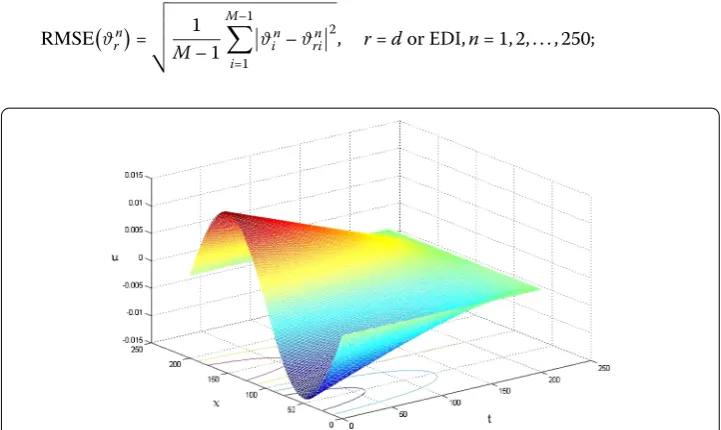
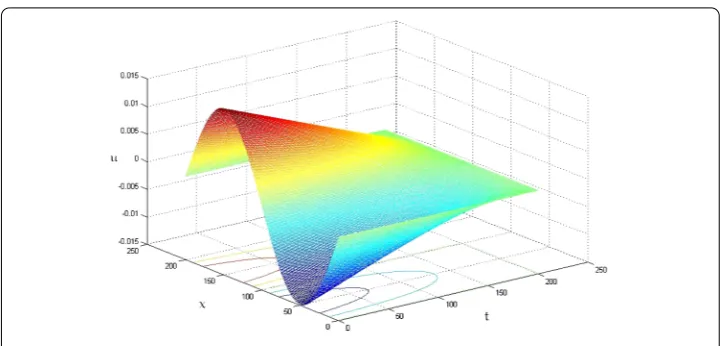
we only need to choose the POD basisΨ = [ϕ1,ϕ2, . . . ,ϕ5] and compute the OCNFDE and OCNFDE/EDI solutionsϑdin andϑEDIn i(n= 1, 2, . . . , 250 andi= 1, 2, . . . , 250, i.e., 0 <t≤2.5 and 0≤x≤2.5) via the OCNFDE model (15) and the OCNFDE/EDI model (whoseG
in (15) is replaced withGEDI), and depict them graphically in Figs.4and5, respectively. Figures4and5are almost the same.
To quantify the efficiency of the OCNFDE and OCNFDE/DEI methods, we compare the CPU time between the OCNFDE and OCNFDE/DEI methods, the root mean square errors (RMSE) between the CCNFD and OCNFDE solutions and between the CCNFD and OCNFDE/EDI solutions, and the correlation coefficients (CC) between the OCNFDE and OCNFDE/EDI solutions. RMSE and CC are, respectively, obtained by means of the following formulas:
RMSEϑrn= 1
M– 1 M–1
i=1
ϑin–ϑrin2, r=dor EDI,n= 1, 2, . . . , 250;
Figure 5The OCNFDE/DEI solutions when 0≤t≤2.5 and 0≤x≤2.5
Table 2 Comparisons of CC, RMSE, and CPU time of the OCNFDE and OCNFDE/EDI solutions
n CC(n)×10–4 OCNFDE scheme OCNFDE/EDI scheme
RMSE CPU time RMSE CPU time
n= 150 1.6214 0.00032 2.88 seconds 0.00046 1.68 seconds
n= 200 1.6279 0.00042 3.84 seconds 0.00063 2.24 seconds
n= 250 1.6472 0.00068 4.80 seconds 0.00087 2.80 seconds
CC(n) =
250
i=1(ϑdin–ϑ¯din)(ϑEDIn i–ϑ¯EDIn i) 250
i=1(ϑdin–ϑ¯din)2 250
i=1(ϑEDIin –ϑ¯EDIn i)2
, n= 1, 2, . . . , 250,
whereϑ¯rjn(r=dor EDI) are the expected values ofϑrjn, respectively. Table2shows that the CPU time between the OCNFDE and OCNFDE/DEI methods, RMSEs between the CCNFD and OCNFDE solutions and between the CCNFD and OCNFDE/EDI solutions, and CCs between the OCNFDE and OCNFDE/EDI solutions att= 1.5, 2.0, and 2.5, re-spectively.
Table2shows that the CPU time of the OCNFDE/EDI model is less than that of the OCNFDE one due to adopting EDI method, but it is reasonable that RMSEs of the OC-NFDE/EDI model is slightly larger than those of the OCNFDE model thanks to the non-linear termsGbeing approximated with EDI. It shows that the OCNFDE/EDI methd is better than the OCNFDE method.
6 Conclusions
so-lutions are proved by using the matrix analysis, so that the theoretical analysis and the numerical computations become more concise and convenient. In addition, as the OC-NFDE model for the FOPTSGEs (1)–(3) is first established, it is an improvement of other existing reduced-order models mentioned in Sect.1.
Although we only have studied the order reduction of the CCNFD model for the FOPTS-GEs (1)–(3), because the CCNFD model can solve FOPTSFOPTS-GEs in a two- and three-dimensional unbounded domain (see, e.g., [3]), the OCNFDE model can easily and ef-fectively be applied to reduce the order for the FOPTSGEs (1)–(3) in two- and three-dimensional domains.
Acknowledgements
The authors are thankful to the editors and staff of AIDE for their hard work in the publication of the paper.
Funding
This research was supported by the National Key Research and Development Project of China Grant 2017YFC1500301, the National Science Foundation of China grants 11671106 and 41704047, and the cultivation fund of the National Natural and Social Science Foundations in BTBU Grant LKJJ2016-22.
Availability of data and materials
The authors declare that all data and material in the paper are available and veritable.
Competing interests
The authors declare that they have no competing interests.
Authors’ contributions
Both authors contributed equally and significantly in writing this article. Both authors wrote, read and approved the final manuscript.
Author details
1School of Science, Beijing Technology and Business University, Beijing, China.2School of Mathematics and Physics,
North China Electric Power University, Beijing, China.
Publisher’s Note
Springer Nature remains neutral with regard to jurisdictional claims in published maps and institutional affiliations.
Received: 28 August 2018 Accepted: 19 December 2018
References
1. Dehghan, M., Manafian, J., Saadatmandi, A.: Solving nonlinear fractional partial differential equations using the homotopy analysis method. Numer. Methods Partial Differ. Equ.26(2), 448–479 (2010)
2. Kilbas, A.A., Srivastava, H.M., Trujillo, J.J.: Theory and Applications of Fractional Differential Equations. Elsevier, Amsterdam (2006)
3. Liu, F., Zhuang, P., Liu, Q.X.: Numerical Methods of Fractional Partial Differential Equations and Their Applications. Science Press, Beijing (2015) (in Chinese)
4. Cao, Y.H., Luo, Z.D.: A reduced-order extrapolating Crank–Nicolson finite difference scheme for the Riesz space fractional order equations with a nonlinear source function and delay. J. Nonlinear Sci. Appl.11, 672–682 (2018) 5. Elsaid, A., Hammad, D.: A reliable treatment of homotopy perturbation method for the sine-Gordon equation of
arbitrary (fractional) order. J. Fract. Calc. Appl.2(1), 1–8 (2012)
6. Yousef, A.M., Rida, S.Z., Ibrahim, H.R.: Approximate solution of fractional-order nonlinear sine-Gordon equation. Elixir Appl. Math.82, 32549–32553 (2015)
7. Macías-Díaz, J.E.: Numerical study of the process of nonlinear supratransmission in Riesz space-fractional sine-Gordon equations. Commun. Nonlinear Sci. Numer. Simul.46(1), 89–102 (2017)
8. Zhou, Y.J., Luo, Z.D.: A Crank–Nicolson finite difference scheme for the Riesz space fractional order parabolic type sine-Gordon equation. Adv. Differ. Equ.2018, 137, 1–7 (2018)
9. Sirovich, L.: Turbulence and the dynamics of coherent structures: parts I–III. Q. Appl. Math.45(3), 561–590 (1987) 10. Holmes, P., Lumley, J.L., Berkooz, G.: Turbulence, Coherent Structures, Dynamical Systems and Symmetry. Cambridge
University Press, Cambridge (1996)
11. Cazemier, W., Verstappen, R.W.C.P., Veldman, A.E.P.: Proper orthogonal decomposition and low-dimensional models for driven cavity flows. Phys. Fluids10(7), 1685–1699 (1998)
12. Ly, H.V., Tran, H.T.: Proper orthogonal decomposition for flow calculations and optimal control in a horizontal CVD reactor. Q. Appl. Math.60(4), 631–656 (1989)
13. Fukunaga, K.: Introduction to Statistical Recognition. Academic Press, New York (1990) 14. Jolliffe, I.T.: Principal Component Analysis. Springer, Berlin (2002)
15. Selten, F.M.: Baroclinic empirical orthogonal functions as basis functions in an atmospheric model. J. Atmos. Sci.
16. Kunisch, K., Volkwein, S.: Galerkin proper orthogonal decomposition methods for parabolic problems. Numer. Math.
90(1), 117–148 (2001)
17. Kunisch, K., Volkwein, S.: Galerkin proper orthogonal decomposition methods for a general equation in fluid dynamics. SIAM J. Numer. Anal.40(2), 492–515 (2002)
18. Luo, Z.D., Chen, J., Navon, I.M., Yang, X.Z.: Mixed finite element formulation and error estimates based on proper orthogonal decomposition for the non-stationary Navier–Stokes equations. SIAM J. Numer. Anal.47(1), 1–19 (2008) 19. Luo, Z.D., Li, H., Zhou, Y.J., Xie, Z.H.: A reduced finite element formulation based on POD method for two-dimensional
solute transport problems. J. Math. Anal. Appl.385(1), 371–383 (2012)
20. Luo, Z.D., Yang, X.Z., Zhou, Y.J.: A reduced finite difference scheme based on singular value decomposition and proper orthogonal decomposition for Burgers equation. J. Comput. Appl. Math.229(1), 97–107 (2009)
21. Sun, P., Luo, Z.D., Zhou, Y.J.: Some reduced finite difference schemes based on a proper orthogonal decomposition technique for parabolic equations. Appl. Numer. Math.60(1–2), 154–164 (2010)
22. Luo, Z.D., Xie, Z.H., Shang, Y.Q., Chen, J.: A reduced finite volume element formulation and numerical simulations based on POD for parabolic problems. J. Comput. Appl. Math.235(8), 2098–2111 (2011)
23. Luo, Z.D., Li, H., Zhou, Y.J., Huang, X.M.: A reduced FVE formulation based on POD method and error analysis for two-dimensional viscoelastic problem. J. Math. Anal. Appl.385(1), 310–321 (2012)
24. Benner, P., Cohen, A., Ohlberger, M., Willcox, A.K.: Model Reduction and Approximation: Theory and Algorithm. Computational Science & Engineering. SIAM, Philadelphia (2017)
25. Hesthaven, J.S., Rozza, G., Stamm, B.: Certified Reduced Basis Methods for Parametrized Partial Differential Equations. Springer, Berlin (2016)
26. Quarteroni, A., Manzoni, A., Negri, F.: Reduced Basis Methods for Partial Differential Equations. Springer, Berlin (2016) 27. Dehghan, M., Abbaszadeh, M.: An upwind local radial basis functions-differential quadrature (RBF-DQ) method with proper orthogonal decomposition (POD) approach for solving compressible Euler equation. Eng. Anal. Bound. Elem.
92, 244–256 (2018)
28. Dehghan, M., Abbaszadeh, M.: A reduced proper orthogonal decomposition (POD) element free Galerkin (POD-EFG) method to simulate two-dimensional solute transport problems and error estimate. Appl. Numer. Math.126, 92–112 (2018)
29. Dehghan, M., Abbaszadeh, M.: A combination of proper orthogonal decomposition-discrete empirical interpolation method (POD-DEIM) and meshless local RBF-DQ approach for prevention of groundwater contamination. Comput. Math. Appl.75(4), 1390–1412 (2018)
30. Dehghan, M., Abbaszadeh, M.: The use of proper orthogonal decomposition (POD) meshless RBF-FD technique to simulate the shallow water equations. J. Comput. Phys.351, 478–510 (2017)
31. Luo, Z.D., Li, H., Sun, P., Gao, J.Q.: A reduced-order finite difference extrapolation algorithm based on POD technique for the non-stationary Navier–Stokes equations. Appl. Math. Model.37(7), 5464–5473 (2013)
32. Luo, Z.D., Gao, J.Q.: A POD-based reduced-order finite difference time-domain extrapolating scheme for the 2D Maxwell equations in a lossy medium. J. Math. Anal. Appl.444, 433–451 (2016)
33. Xia, H., Luo, Z.D.: An optimized finite difference iterative scheme based on POD technique for the 2D viscoelastic wave equation. Appl. Math. Mech.38(12), 1721–1732 (2017)
34. Xia, H., Luo, Z.D.: A POD-based optimized finite difference CN extrapolated implicit scheme for the 2D viscoelastic wave equation. Math. Methods Appl. Sci.40(15), 6880–6890 (2017)
35. Liu, S., Fu, Z.T., Liu, S.: Exact solutions to sine-Gordon-type equations. Phys. Lett. A351, 59–63 (2006)
36. Luo, Z.D., Chen, G.: Proper Orthogonal Decomposition Methods for Partial Differential Equations. Mathematics in Science and Engineering. Elsevier, Amsterdam (2018). https://www.elsevier.com/books/proper-orthogonal-decomposition-methods-for-partial-differential-equations/luo/978-0-12-816798-4
37. Chung, T.: Computational Fluid Dynamics. Cambridge University Press, Cambridge (2002)
38. Zhang, W.S.: Finite Difference Methods for Partial Differential Equations in Science Computation. Higher Education Press, Beijing (2006)
39. Chaturantabut, S., Sorensen, D.C.: Nonlinear model reduction via discrete empirical interpolation. SIAM J. Sci. Comput.