R E S E A R C H
Open Access
Global attractivity of an
integro-differential model of competition
Baoguo Chen
**Correspondence:
[email protected] Research Center for Science Technology and Society, Fuzhou University of International Studies and Trade, Fuzhou, Fujian 350202, P.R. China
Abstract
An integro-differential model of competition is studied in this paper. We show that the system always admits a unique globally attractive positive equilibrium. Our result complements and supplements the main result in the literature.
MSC: competition model; integro-differential equation; delay; global attractivity
Keywords: 34C05; 92D25; 34D20; 34D40
1 Introduction
During the last decades, many scholars investigated the dynamic behaviors of the cooper-ative system, or mutualism model, see [–] and the references cited therein. Specially, in a series of their studies, Chen and his coauthors ([–, ]) argued that a suitable cooper-ative model should consider the saturating effect of the relationship between the species, and they gave a thorough investigation on the dynamic behaviors of the cooperative sys-tem with Holling II type functional response.
Stimulated by the works of [–], in [], Yang et al. studied the dynamic behaviors of the following autonomous discrete cooperative system:
x(k+ ) =x(k)exp
r
K+αx(k) +x(k)
–x(k)
,
x(k+ ) =x(k)exp
r
K+αx(k) +x(k)
–x(k)
,
wherexi(k) (i= , ) is the population density of theith species at k-generation. They showed that if
(H) ri,Ki,αi(i= , ) are all positive constants andαi>Ki(i= , );
and
(H) riαi≤(i= , )
hold, then the above system admits a unique positive equilibrium (x∗,x∗), which is globally asymptotically stable.
Recently, Chen [] argued that it is interesting to investigate the dynamic behaviors of the above system under the assumptionKi>αi. He showed that ifriKi≤,i= , , the system could also admit a unique globally attractive positive equilibrium.
In [], Chen further proposed the following discrete competition model: low by positive constants, andKi>αi,i= , . Sufficient conditions are obtained for the permanence of the above system.
The success of [, ] motivated us to consider the continuous case. Xie et al. [] have already investigated the stability property of the following two species mutualism model:
dN(t) method, Xie et al. [] showed that the system admits a unique globally attractive positive equilibrium. For more background of system (.), one could refer to [, , ] and the references cited therein.
As far as system (.) is concerned, one interesting issue is proposed: What would hap-pen ifαi<Ki,i= , ? Is it possible that the system admits dynamic behaviors similar to those of the caseαi>Ki,i= , ?
Similarly, the second equation in system (.) can be rewritten as follows:
dN(t)
From the point of view of biology, in the sequel, we shall consider (.)-(.) together with the initial conditions
Ni(s) =φi(s), s∈(–∞, ],i= , , (.)
whereφi∈BC+and
BC+=φ∈C(–∞, ], [, +∞):φ() > andφis bounded, i= , .
One could easily prove thatNi(t) > for alli= , in a maximal interval of the existence of solution.
The aim of this paper is to give an affirmative answer to the above issue. More precisely, we will prove the following result.
Theorem . Under the assumptionαi<Ki,i= , ,system(.)with the initial conditions (.)admits a unique positive equilibrium(N∗,N∗),which is globally attractive,that is,for any positive solution(N(t),N(t))of system(.)with the initial conditions(.),one has
lim
t→+∞Ni(t) =N ∗
i, i= , .
2 Proof of the main result
Now let us state several lemmas which will be useful in proving the main result.
Lemma . System(.)admits a unique positive equilibrium(N∗,N∗).
Proof The positive equilibrium of system (.) satisfies the following equation:
K+αN +N
–N= ,
K+αN +N
–N= ,
(.)
which is equivalent to
AN+AN+A= ,
BN+BN+B= ,
(.)
where
A= +α, A=K–K–αα+ , A= –αK–K;
B= +α, B=K–K–αα+ , B= –K–αK.
Noting thatA> ,A< ,B> ,B< , it immediately follows that system (.) admits a unique positive solution (N∗,N∗), where
N∗=–A+
A– AA A
, N∗=–B+
√
B– BB B
.
Lemma .([]) Let x:R→R be a bounded nonnegative continuous function,and let k: [, +∞)→(, +∞)be a continuous kernel such that ∞k(s)ds= .Then
lim inf
t→+∞ x(t)≤lim inft→+∞
t –∞
k(t–s)x(s)ds
≤lim sup t→+∞
t
–∞k(t–s)x(s)ds≤
lim sup t→+∞
x(t).
Lemma .([]) If a> ,b> andx˙≥x(b–ax),when t≥and x() > ,we have
lim inf t→+∞ x(t)≥
b a.
If a> ,b> andx˙≤x(b–ax),when t≥and x() > ,we have
lim sup t→+∞
x(t)≤b
a.
Now we are in a position to prove the main result of this paper.
Proof of Theorem. Let (N(t),N(t)) be any positive solution of system (.) with initial conditions (.). From (.) it follows that
dN(t)
dt ≤rN(t)
K–N(t)
. (.)
Thus, as a direct corollary of Lemma ., according to (.), one has
lim sup t→+∞
N(t)≤K, (.)
and so, from Lemma . we have
lim sup t→+∞
t –∞
J(t–s)N(s)ds≤K. (.)
Hence, forε> small enough, it follows from (.) and (.) that there existsT> such that for allt≥T,
N(t) <K+ε def
=M() ,
∞
J(s)N(t–s)ds=
t –∞
J(t–s)N(s)ds<K+ε def
= M().
(.)
Similarly, for aboveε> , it follows from (.) that
lim sup
t→+∞ N(t)≤K,
lim sup t→+∞
t –∞
and so, there existsT>Tsuch that for allt≥T,
Thus, as a direct corollary of Lemma ., according to (.), one has
lim inf
Hence, for ε> small enough, without loss of generality, we may assume that ε <
Similarly, for aboveε> , it follows from (.) that
Note that the functiong(x) = +xx (x≥) is a strictly increasing function, hence (.)
Therefore, by Lemma ., we have
lim sup
Therefore, by Lemma ., we have
lim inf
Thus, from Lemma . we have
That is, there existsT>Tsuch that for allt≥T,
Similarly, it follows from (.) and (.) that
(.) and (.), we have
M()i <Mi(), m()i >m()i , i= , .
Let us assume now that our claim is true forn, that is,
Mi(n)<M(in–), mi(n)>m(in–), i= , .
Thus, the unique interior equilibriumE∗(N∗,N∗) is globally attractive. This completes the
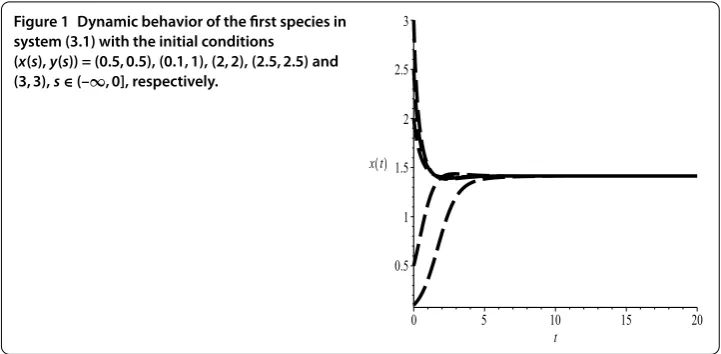
Figure 1 Dynamic behavior of the first species in system (3.1) with the initial conditions
(x(s),y(s)) = (0.5, 0.5), (0.1, 1), (2, 2), (2.5, 2.5) and (3, 3),s∈(–∞, 0], respectively.
3 Numerical simulations
In this section we will give several examples to show the feasibility of Theorem .. Firstly, let us consider the weakly integral kernel case.
Example .
dx(t)
dt =x(t)
+ ∞e–sy(t–s)ds + ∞e–sy(t–s)ds–x(t)
,
dy(t)
dt =y(t)
+ ∞e–sx(t–s)ds
+ ∞e–sx(t–s)ds–y(t)
.
(.)
Corresponding to system (.), one has
r=r=α=α= , K=K= .
By a simple computation, system (.) admits a unique positive equilibrium (√,√). It follows from Theorem . that (√,√) is globally attractive. Figures and also support this assertion.
Example .
dx(t)
dt =x(t)
+ ∞e–sy(t–s)ds + ∞e–sy(t–s)ds –x(t)
,
dy(t)
dt =y(t)
+ ∞e–sx(t–s)ds + ∞e–sx(t–s)ds –y(t)
.
(.)
Corresponding to system (.), one has
r=r=α=α= , K=K= .
By a simple computation, system (.) admits a unique positive equilibrium (√,√). It follows from Theorem . that (√,√) is globally attractive. Figures and also support this assertion.
Figure 2 Dynamic behavior of the second species in system (3.1) with the initial conditions (x(s),y(s)) = (0.5, 0.5), (0.1, 1), (2, 2), (2.5, 2.5) and (3, 3),s∈(–∞, 0], respectively.
Figure 3 Dynamic behavior of the first species in system (3.2) with the initial conditions (x(s),y(s)) = (0.5, 0.5), (0.1, 1), (2, 2), (2.5, 2.5) and (3, 3),s∈(–∞, 0], respectively.
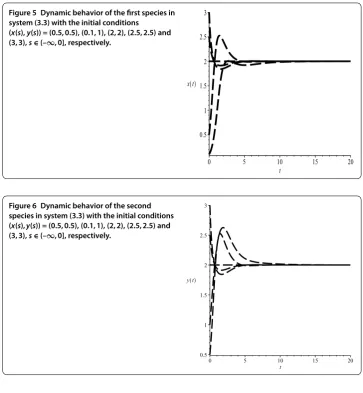
Figure 5 Dynamic behavior of the first species in system (3.3) with the initial conditions
(x(s),y(s)) = (0.5, 0.5), (0.1, 1), (2, 2), (2.5, 2.5) and (3, 3),s∈(–∞, 0], respectively.
Figure 6 Dynamic behavior of the second species in system (3.3) with the initial conditions (x(s),y(s)) = (0.5, 0.5), (0.1, 1), (2, 2), (2.5, 2.5) and (3, 3),s∈(–∞, 0], respectively.
Example .
dx(t)
dt =x(t)
+ ∞se–sy(t–s)ds + ∞e–sy(t–s)ds –x(t)
,
dy(t)
dt =y(t)
+ ∞se–sx(t–s)ds
+ ∞e–sx(t–s)ds –y(t)
.
(.)
Corresponding to system (.), one has
r=r=α=α= , K=K= .
By a simple computation, system (.) admits a unique positive equilibrium (, ). It fol-lows from Theorem . that (, ) is globally attractive. Figures and also support this assertion.
4 Discussion
the system admits a unique globally attractive positive equilibrium. In this paper, we focus our attention on the caseαi<Ki,i= , . We first show that this case represents a popula-tion system of competipopula-tion type. Then, by applying the iterative technique, we also show that the system admits a unique globally attractive positive equilibrium.
It is well known that the competitive exclusion principle is the most important rule for a population system. It says that two species competing for the same resource cannot coex-ist at constant population values. However, as we can see from Theorem ., for all of the parameters which satisfyKi>αi,i= , , two species could coexist in a stable state. Also, numeric simulations (Figures -) support this assertion. Why did this phenomenon hap-pen? Maybe the reason relies on the term
(K–α) ∞J(s)N(t–s)ds + ∞J(s)N(t–s)ds
and (K–α)
∞
J(s)N(t–s)ds + ∞J(s)N(t–s)ds
,
sinceK>K–α,K>K–αand
∞
J(s)N(t–s)ds + ∞J(s)N(t–s)ds
< ,
∞
J(s)N(t–s)ds + ∞J(s)N(t–s)ds
< .
One could see that the influence of interspecific competition is less than the influence of intrinsic competition, and this leads to stable coexistence of the two species.
Competing interests
The author declares that there is no conflict of interests.
Acknowledgements
The author is grateful to anonymous referees for their excellent suggestions, which greatly improved the presentation of the paper. This work is supported by the National Social Science Foundation of China (16BKS132), the Humanities and Social Science Research Project of Ministry of Education Fund (15YJA710002) and the Natural Science Foundation of Fujian Province (2015J01283).
Received: 6 August 2016 Accepted: 4 January 2017
References
1. Chen, FD, You, MS: Permanence for an integrodifferential model of mutualism. Appl. Math. Comput.186(1), 30-34 (2007)
2. Chen, FD, Liao, XY, Huang, ZK: The dynamic behavior ofN-species cooperation system with continuous time delays and feedback controls. Appl. Math. Comput.181, 803-815 (2006)
3. Chen, FD: Permanence of a discreteN-species cooperation system with time delays and feedback controls. Appl. Math. Comput.186, 23-29 (2007)
4. Chen, FD: Permanence for the discrete mutualism model with time delays. Math. Comput. Model.47, 431-435 (2008) 5. Chen, FD, Yang, JH, Chen, LJ, Xie, XD: On a mutualism model with feedback controls. Appl. Math. Comput.214,
581-587 (2009)
6. Chen, FD, Xie, XD: Study on the Dynamic Behaviors of Cooperation Population Modeling. Science Press, Beijing (2014)
7. Chen, FD, Li, Z, Huang, YJ: Note on the permanence of a competitive system with infinite delay and feedback controls. Nonlinear Anal., Real World Appl.8(2), 680-687 (2007)
8. Chen, LJ, Chen, LJ, Li, Z: Permanence of a delayed discrete mutualism model with feedback controls. Math. Comput. Model.50, 1083-1089 (2009)
9. Chen, LJ, Xie, XD: Permanence of ann-species cooperation system with continuous time delays and feedback controls. Nonlinear Anal., Real World Appl.12, 34-38 (2001)
10. Chen, LJ, Xie, XD: Feedback control variables have no influence on the permanence of a discreteN-species cooperation system. Discrete Dyn. Nat. Soc.2009, Article ID 306425 (2009)
11. Chen, YF, Han, RY, Yang, LY, et al.: Global asymptotical stability of an obligate Lotka-Volterra mutualism model. Ann. Differ. Equ.30(3), 267-271 (2014)
12. Chen, YP: Permanence and global stability of a discrete cooperation system. Ann. Differ. Equ.24(2), 127-132 (2008) 13. Xie, XD, Chen, FD, Xue, YL: Note on the stability property of a cooperative system incorporating harvesting. Discrete
Dyn. Nat. Soc.2014, Article ID 327823 (2014)
14. Xie, XD, Chen, FD, Yang, K, Xue, YL: Global attractivity of an integro-differential model of mutualism. Abstr. Appl. Anal.
15. Xie, XD, Miao, ZS, Xue, YL: Positive periodic solution of a discrete Lotka-Volterra commensal symbiosis model. Commun. Math. Biol. Neurosci.2015, Article ID 2 (2015)
16. Xue, YL, Xie, XD, Chen, FD, Han, RY: Almost periodic solution of a discrete commensalism system. Discrete Dyn. Nat. Soc.2015, Article ID 295483 (2015)
17. Han, RY, Chen, FD: Global stability of a commensal symbiosis model with feedback controls. Commun. Math. Biol. Neurosci.2015, Article ID 15 (2015)
18. Hale, JK: Theory of Functional Differential Equations. Springer, Heidelberg (1977)
19. He, WL: Permanence and global attractivity ofN-species cooperation system with discrete time delays and feedback controls. Ann. Differ. Equ.23(1), 3-10 (2007)
20. Liu, W, Stevic, S: Global attractivity of a family of nonautonomous max-type difference equations. Appl. Math. Comput.218(11), 6297-6303 (2012)
21. Liu, W, Yang, X, Iricanin, BD: On somek-dimensional cyclic systems of difference equations. Abstr. Appl. Anal.2010, 528648 (2010)
22. Diblík, J, Khusainov, DY, Grytsay, IV, et al.: Stability of nonlinear autonomous quadratic discrete systems in the critical case. Discrete Dyn. Nat. Soc.43(1), 179-186 (2010)
23. Li, XP, Yang, WS: Permanence of a discrete model of mutualism with infinite deviating arguments. Discrete Dyn. Nat. Soc.2010, Article ID 931798 (2010)
24. Liu, ZJ, Wu, JH, Tan, RH, et al.: Modeling and analysis of a periodic delayed two-species model of facultative mutualism. Appl. Math. Comput.217, 893-903 (2010)
25. Liu, ZJ, Tan, RH, Chen, YP, et al.: On the stable periodic solutions of a delayed two-species model of facultative mutualism. Appl. Math. Comput.196, 105-117 (2008)
26. Miao, ZS, Xie, XD, Pu, LQ: Dynamic behaviors of a periodic Lotka-Volterra commensal symbiosis model with impulsive. Commun. Math. Biol. Neurosci.2015, Article ID 3 (2015)
27. Montes De Oca, F, Vivas, M: Extinction in two dimensional Lotka-Volterra system with infinite delay. Nonlinear Anal., Real World Appl.7(5), 1042-1047 (2006)
28. Yang, K, Xie, XD, Chen, FD: Global stability of a discrete mutualism model. Abstr. Appl. Anal.2014, Article ID 709124 (2014)
29. Yang, K, Miao, ZS, Chen, FD, Xie, XD: Influence of single feedback control variable on an autonomous Holling-II type cooperative system. J. Math. Anal. Appl.435(1), 874-888 (2016)
30. Yang, WS, Li, XP: Permanence of a discrete nonlinearN-species cooperation system with time delays and feedback controls. Appl. Math. Comput.218(7), 3581-3586 (2011)
31. Yang, LY, Xie, XD, Chen, FD: Dynamic behaviors of a discrete periodic predator-prey-mutualist system. Discrete Dyn. Nat. Soc.2015, Article ID 247269 (2015)
32. Li, Z: Permanence for the discrete mutualism model with delays. J. Math. Study43(1), 51-54 (2010)
33. Li, Y, Zhang, T: Permanence of a discreten-species cooperation system with time-varying delays and feedback controls. Math. Comput. Model.53(5-6), 1320-1330 (2011)
34. Zhang, H, Li, Y, Jing, B, et al.: Global stability of almost periodic solution of multispecies mutualism system with time delays and impulsive effects. Appl. Math. Comput.232(1), 1138-1150 (2014)
35. Chen, BG: Permanence for the discrete competition model with infinite deviating arguments. Discrete Dyn. Nat. Soc.
2016, Article ID 1686973 (2016)