EFFICIENCY IN CONSTRUCTION PROCESS
TAHRINA TAIB
EFFICIENCY IN CONSTRUCTION PROCESS
TAHRINA TAIB
A project report submitted in partial fulfillment of the requirements for the award of the degree of Master of Science (Construction Management)
Faculty of Civil Engineering Universiti Teknologi Malaysia
iv
ABSTRACT
v
ABSTRAK
vi
TABLE OF CONTENTS
CHAPTER TITLE PAGE
DECLARATION
DEDICATION
ACKNOWLEDGEMENTS
ABSTRACT
ABSTRAK
TABLE OF CONTENTS
LIST OF TABLES
LIST OF FIGURES
LIST OF APPENDICES
i ii iii iv v vi xi xii xiii
1 INTRODUCTION
vii
CHAPTER TITLE PAGE
2 LIMITATIONS AND PROBLEMS OF TRADITIONAL
CONSTRUCTION PROCESS 2.1 2.2 2.3 2.4 Introduction
Traditional construction process Efficiency in construction process Inefficiencies in Construction Process 2.4.1 Poor Time Management 2.4.2 Construction waste
2.4.3 Communication breakdown
2.4.4 Lack of project control and monitor 2.4.5 Uncertainty handling approaches
7 8 9 10 10 12 20 21 24
3 METHODOLOGY IN ACHIEVING THE EFFICIENT
CONSTRUCTION PROCESS
3.1 3.2
Introduction
Construction process improvement
3.2.1 Adapting Project Management Perspective to Construction Management
3.2.2 Using Theory and Philosophy from Other Industry
3.2.2.1 Lean Construction
3.2.2.2 Supply Chain Management 3.2.2.3 Materials Management
viii
CHAPTER TITLE PAGE
3.2.2.4 Kaizen Philosophy 3.2.2.5 Kanban Philosophy 3.2.2.6 JIT (Just in Time) Method
3.2.3.1 Buildability/Constructability Concept 3.2.3.2 Controlling Work Flow
3.2.3 Technological Advancement Perspective
36 38 44 45 47 48
4 RESEARCH METHODOLOGY
4.1 4.2 4.3 4.4 4.5 4.6 Introduction
Identification of research topic and scope of study Data Collection
4.3.1 Interview with expert panels 4.3.2 Survey Questionnaire
4.3.3 Respond to questionnaire survey 4.3.4 Frequency analysis
4.3.5 Average Index Analysis (A.I) Research findings
Make conclusion
Conclusion and recommendation
50 50 52 52 53 56 57 57 60 60 60
5 DATA COLLECTION AND ANALYSIS
5.1 5.2 5.3 5.4
Introduction
Interview With Expert Panels Questionnaires Survey Demographic of Respondents 5.4.1 Respondents’ Position
ix
CHAPTER TITLE PAGE
5.5 5.6 5.7 5.8
5.4.2 Respondent’s Working Experience Major Causes to Project Delay
Problems and Limitation in Traditional Work Process Strategies used to improve construction process
Element of Improvement in Enhancing Construction Improvement 73 73 74 77 78
6 DISCUSSION OF THE RESULTS
6.1 6.2 6.3 6.4 6.5 6.6 Introduction
Rationale needs to improve efficiency of construction process
Urgent need to improve the current performance Strategies to improve construction process Definition of efficiency concept
Element of improvement
80 80 85 85 88 89
7 CONCLUSION AND RECOMMENDATIONS
7.1 7.2
7.3
Introduction
Achievement of this study 7.2.1 Objective No. 1 7.2.2 Objective No. 2 7.2.3 Objective No. 3 Limitation of studies 7.3.1 Time limitation 7.3.2 Cost limitation
7.3.3 Area of coverage limitation
x
CHAPTER TITLE PAGE
7.4 Recommendations
7.4.1 Recommendations based on findings
7.4.2 Recommendations for further research studies
94 94 95
LIST OF REFERENCES
APPENDIX A
APPENDIX B
xi
LIST OF TABLES
TABLE NO. TITLE PAGE
2.1 2.2 2.3 2.4 5.1 5.2 5.3 5.4 5.5 5.6 5.7 5.8 5.9
Waste generated from construction
Pre-construction people involved in materials management Construction site people involved in materials management Off-site people involved in construction materials management
Content Analysis of current construction process Questionnaires delivered
Respondents Position
Respondent Working Experience
Results of most causes due to project delay
Results of problems and limitations in construction process Results of needs to improve construction process
Results of practical and widely used strategies to improve construction process
xii
LIST OF FIGURES
FIGURE NO. TITLE PAGE
1.1 2.1 3.1 3.2 3.3
The flow chart of the research methodology
Construction waste percentage by volume and weight Target of improvement
Basic Ingredients in Project Management
Generic configuration of a supply chain in manufacturing
xiii
LIST OF APPENDIXES
APPENDIX TITLE PAGE
A B
Interview Question Survey Questionnaire
CHAPTER 1
INTRODUCTION
1.1 Introduction
2
Traditional construction method generally adopted by past experience or project. Furthermore there is no standard measurement in enhancing traditional construction process such as monitoring and controlling method for construction progress. Contractor used their past experience in predicting the project time. In reality, they faced a lot of problem in engaging the project and project time will be behind the schedule. It is very important to improve the efficiencies of construction process. Generally by enhancing the efficiencies in construction process, project time will be reduced, improved construction quality, eliminated waste and saved cost.
1.2 Problem statement
3
1.3 Research aim and objectives
The main aim of this study is to determine strategies to improve construction process.
Below are the objectives of this study:
• To review the rationale and the need to improve the efficiency of the current
construction process
• To evaluate the methodology used currently by the industry to improve the
construction process
• To propose strategies to improve construction process.
1.4 Scope and limitation
4
1.5 Brief Research Methodology
This project conducted through several phases that included literature review, data collection, data analysis, findings, and recommendations. Literature review is to compile and determine the idea, theory and common practices in achieving the efficient construction process. Two methods were used in collecting data. They are through interviews and questionnaire survey.
The panels interviewed are those directly in-charge in construction projects either in private or government sector. They include personnel from private and public agencies such as JKR, consultant firms and contractors. Then, the results from the interviews were used as a guide to develop the questionnaire survey form. Apart from that the findings from the literature review has been used as well to develop the questionnaire.
A questionnaire is a series of questions submitted to a number of people to obtain data for a survey or report. This is a valuable method of collecting a wide range of information from a large number of individuals, often referred to as respondents. Good questionnaire construction is critical to the success of a survey. Inappropriate questions, incorrect ordering of questions, incorrect scaling, or bad questionnaire format can make the survey valueless.
5
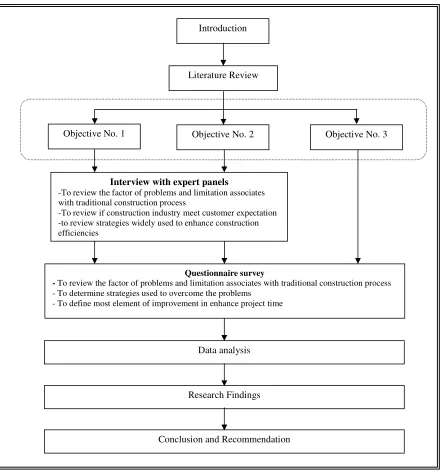
Basically objectives of this study were achieved as the flow shown below:-
Figure 1.1: The flow chart of the brief research methodology.
Introduction
Objective No. 3 Objective No. 2
Objective No. 1
Literature Review
Interview with expert panels
-To review the factor of problems and limitation associates with traditional construction process
-To review if construction industry meet customer expectation -to review strategies widely used to enhance construction efficiencies
Questionnaire survey
- To review the factor of problems and limitation associates with traditional construction process - To determine strategies used to overcome the problems
- To define most element of improvement in enhance project time
Data analysis
Research Findings
6
1.6 Study Outlined
The study is presented in seven (7) main chapters.
Chapter One introduces the report outlining aims and objectives and general overview of the paper. This chapter is very crucial because it provides the overall information about the research besides the subsequent process is derived from the research problem.
Chapter Two described the problems faced in current construction process and its limitations.
Chapter Three discussed on the improvement of construction process by using collaborative teamwork concept, integrating design and construction and using tool and philosophy from other industry.
Chapter Four discusses on the type of study methodology and its procedures. The process of data collection and analysis is also explained in this chapter.
Chapter Five presented data collected in this study. They are analyzed and presented in appropriate table.
Chapter Six is on the discussion of results or research findings.
96
LIST OF REFERENCES
Abdelhamid T. (2007). Lean Construction Principles. PhD Thesis. Graduate class offering at Michigan State University
AlA Houston (1994). Construction Materials Management Guidelines for Economy And Ecology In Design And Construction, Houston, Texas
Akinci B., Fischer M., Levitt R. and Carlson R. (2002). Formalization and automation of time-space conflict analysis, Journal of Computing in Civil Engineering, Vol. 16, No. 2, 124-134.
Arditi D., Sikangwan P. and Tokdemir O.B. (2002). Scheduling system for high rise building construction, Construction Management and Economics, Vol. 20, No. 3, 353-364.
97
Baldwin, A.N.; Thorpe, A. and Carter, C. (1996). The construction alliance and electronic information exchange: a symbolic relationship, CIB-65, Strathclyde University, Glasgow.
Ballard G. (2000). The last planner system of production control, PhD Thesis, University of Birmingham, UK.
Ballard G., Castern M. and Howell G. (1996). PARC: a case study, Proceedings of the Fourth Annual Conference of the International Group for Lean Construction, Birmingham, UK.
C.F Gray and E.W Larson (1999). “Project Management The Managerial Process”, Mc Graw Hill, USA
Chan, D.W.M. and Kumaraswamy, M.M. (1996) An evaluation of construction time performance in the building industry. Building and Environment, 31(6), 569–78.
Chan, D.W.M. and Kumaraswamy, M.M. (1999a) Forecasting construction duration for public housing projects: a Hong Kong perspective. Building and Environment, 34(5), 633–46.
Chan, D.W.M. and Kumarawamy, M.M. (1999b) Modelling and predicting construction duration in Hong Kong public housing. Construction Management and Economics, 17(3), 351–62.
98
Choo H.J., Tommelein I.D., Ballard G. and Zabelle T. R. (1999). WorkPlan: constraint-based database for work package scheduling, Journal of Construction Engineering and Management. 125, No. 3, 151-160. , Vol 125, No. 3, 151-160.
Dawood N., Sriprasert E. and Mallasi Z. (2002a). 4D visualisation development: real life case studies, Proceedings of CIB w78 Conference 2002, Aarhus, Denmark, 53-59.
Goldratt E.M. (1997). Critical chain, The North River Press, Great Barrington, MA.
Hadikusumo B.H.W. and Rowlinson S. (2002). Integration of virtually real construction model and design-for-safety process database, Automation in Construction, Vol. 11, No. 5, 501-510.
Harris F. and McCaffer R. (1989). Modern construction management, Collins, London.
Halpin D.W. and Riggs L.S. (1992). Planning and analysis of construction operations, John Wiley and Sons, NC.
99
Herroelen W. and Leus R. (2001). On the merits and pitfalls of critical chain scheduling, Journal of Operations Management. 19, 559-577. , Vol 19, 559-577.
Horman M., Kenley R. and Jennings V. (1997). A lean approach to construction: a historical case study, Proceedings of the Fifth Annual Conference of the International Group for Lean Construction, Gold Coast, Australia.
Iris Communications, Inc. (1995). Green Building Sources: Construction Site Waste Management, Bend
Jaafari A. (1984). Criticism of CPM for project planning analysis, Journal of Construction Engineering and Management. 110, No. 2, 222-233. , Vol 110, No. 2, 222-233.
Jaafari A. (1996). Time and priority allocation scheduling technique for projects, International Journal of Project Management, Vol. 14, No. 5, 289-299.
J.E. Diekmann and K.B. Thrush, Project Control in Design Engineering, A Report to the Construction Industry Institute, The University of Texas at Austin, Texas, May 1986
J. M. Dowdall CB (2005), Modernising Construction Procurement in Nortern Ireland, Nothern Ireleand Audit Office
100
Kartam N.A., Levitt R.E. and Wilkins D.E. (1991). Extending artificial intelligence techniques for hierarchical planning, Journal of Computing in Civil engineering, Vol. 5, No. 4, 464-477.
Kähkönen K. and Leinonen J. (2001). Visual product chronology, Presentation given to the Workshop on Virtual Construction, Organised by ENCORD, 26-27 November 2001, Essen, Germany.
Koo B. and Fischer M. (2000). Feasibility study of 4D CAD in commercial construction, Journal of Construction Engineering and Management, Vol. 126, No. 4, 251-260.
Koskela, L. and Howell, G., (2002). “The Underlying Theory of Project Management is Obsolete.” Proceedings of the PMI Research Conference, 2002, Pg. 293-302
L. C. Stuckenbruck, "Project Management Framework," Project Management Journal, Vol. 17, No. 3, August 1986, pp. 25-30.
Lichtig, W. (2005). "Ten Key Decisions to A Successful Construction Project." American Bar Association, Forum on the Construction Industry, September 29-30, 2005, Toronto, Canada
101
Martinez J.C. (1996). STROBOSCOPE: state and resource based simulation of construction processes, PhD Thesis, University of Michigan, Ann Arbor, MI.
McKinney K. and Fischer M. (1998). Generating, evaluating and visualizing construction schedule with CAD tools, Automation in Construction, Vol. 7, No. 6, 433-447.
Mawdesley M., Askew W. and O’Reilly M. (1997). Planning and controlling construction projects: the best laid plansson Wesley Longman, Essex. , Addi
M.P Spinner, (1997). “Project Management Principles and Practices”, New Jersey, USA
M.R.A Kadir, W.P. Lee, M.S. Jaafar, S.M. Sapuan, A.A.A. Ali (2005). Factors affecting construction labour productivity for Malaysian residential projects
Preece, C.N.; Moodley, K. & Smith, A.M. (1998). Corporate communications in construction: public relations strategies for successful business and projects, p. 119, Blackwell Publishing, Oxford
Pultar M. (1990). Progress-based construction scheduling, Journal of Construction Engineering and Management. 116, No. 4, 670-688. , Vol 116, No. 4, 670-688.
102
R.Vrijhoef and L. Koskela, (1999). “Roles Of Supply Chain Management In Construction, 26-28 July 1999, University of California, Berkeley, CA, USA
Skitmore, R.M. and Ng, S.T. (2003) Forecast models for actual construction time and cost. Building and Environment, 8(8), 1075–83.
Sriprasert E. and Dawood N. (2001). Potential of integrated digital technologies for construction work-face instruction, Proceedings of AVRII and CONVR 2001, Chalmers, Gothenburg, Sweden, 136-145
Steyn H. (2000). An investigation into the fundamentals of critical chain project scheduling, International Journal of Project Management, Vol. 19, 363-369
Thomas, U.R., Smith, G.R. and Cummings, D.J. (1995) Have I reached substantial completion? Journal of Construction Engineering and Management, 121(1), 121–9.